Evaluating Written Texts by
Analyzing Claims
“Extraordinary claims require
extraordinary evidence’
~Carl Sagan
Objectives
• To explain critical reading as looking for ways
of thinking;
• To identify claim of fact, policy, and value
explicitly or implicitly made in a written text;
and
• To write a 1000-word critique of a selected
text on the basis of its claim, context and
properties as a written material.
Critical Reading Techniques
1. Keeping a reading journal
is meant as a personal expression or one’s
thoughts on experiences, inspirations,
accomplishments failures, and the many
discoveries in everyday life.
Critical Reading Techniques
2. Annotating the text
is simply making notes on your copy of the
reading. This includes highlighting or underlining
important passages and writing notes,
comments, questions, and reactions on the
margins.
A Reader’s Guide to Annotation
2.1 Use a pen, pencil, post-it notes or a highlighter.
(Although use it sparingly!)
*Summarize important ideas in your own words
*Add examples from real life, other books, TV,
movies, and so forth
*Define words that are new to you.
*Mark passages that you find confusing with a???
*Write questions that you might have
Critical Reading Techniques
4. Summarizing the text
similar to outlining, in that you need to get
the gist. It consists of getting the main points of
the essay, and important supporting details.
Critical Reading Techniques
4. Summarizing the text
similar to outlining, in that you need to get
the gist. It consists of getting the main points of
the essay, and important supporting details.
Critical Reading Techniques
5. Questioning the text
Involves asking specific questions on points that
you are skeptical about.
Ask yourself
• What type of audience is addressed?
• What are the writer’s assumptions?
• What are the writer’s intentions?
• How well does the writer accomplish these?
• How convincing is the evidence presented?
• How reliable are the sources? Are they based on
personal experience, scientific data, or outside
authorities?
• Did the writer address opposing views on the issue?
• Is the writer persuasive in his/her perspective?
Essential Questions
• What are the benefits of becoming a critical
reader?
• How does critical reading improve my writing?
• How can I effectively distinguish among claims
of fact, policy, and value?
• Why do we need sufficient, relevant evidence,
and sound reasoning to support a claim?
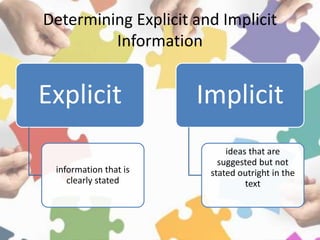
Determining Explicit and Implicit
Information
Explicit
information that is
clearly stated
Implicit
ideas that are
suggested but not
stated outright in the
text
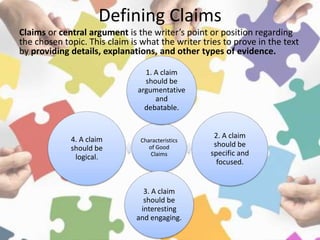
Defining Claims
Claims or central argument is the writer’s point or position regarding
the chosen topic. This claim is what the writer tries to prove in the text
by providing details, explanations, and other types of evidence.
Characteristics
of Good
Claims
1. A claim
should be
argumentative
and
debatable.
2. A claim
should be
specific and
focused.
3. A claim
should be
interesting
and engaging.
4. A claim
should be
logical.
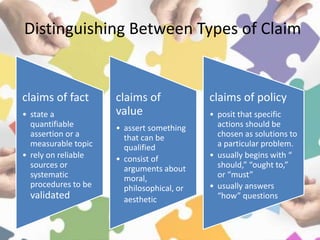
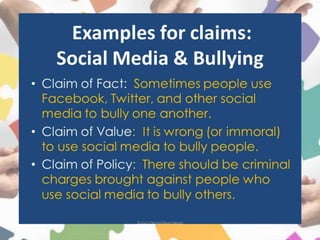
Distinguishing Between Types of Claim
claims of fact
• state a
quantifiable
assertion or a
measurable topic
• rely on reliable
sources or
systematic
procedures to be
validated
claims of
value
• assert something
that can be
qualified
• consist of
arguments about
moral,
philosophical, or
aesthetic
claims of policy
• posit that specific
actions should be
chosen as solutions to
a particular problem.
• usually begins with “
should,” “ought to,”
or “must”
• usually answers
“how” questions
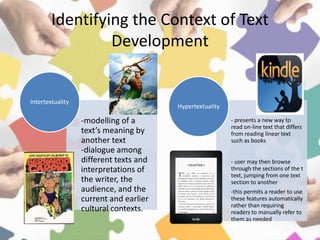
Identifying the Context of Text
Development
-modelling of a
text’s meaning by
another text
-dialogue among
different texts and
interpretations of
the writer, the
audience, and the
current and earlier
cultural contexts.
Intertextuality
- presents a new way to
read on-line text that differs
from reading linear text
such as books
- user may then browse
through the sections of the t
text, jumping from one text
section to another
-this permits a reader to use
these features automatically
rather than requiring
readers to manually refer to
them as needed
Hypertextuality
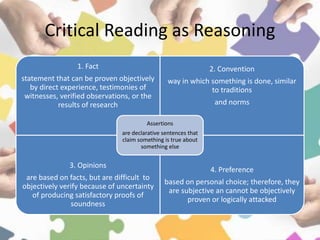
Critical Reading as Reasoning
1. Fact
statement that can be proven objectively
by direct experience, testimonies of
witnesses, verified observations, or the
results of research
2. Convention
way in which something is done, similar
to traditions
and norms
3. Opinions
are based on facts, but are difficult to
objectively verify because of uncertainty
of producing satisfactory proofs of
soundness
4. Preference
based on personal choice; therefore, they
are subjective an cannot be objectively
proven or logically attacked
Assertions
are declarative sentences that
claim something is true about
something else
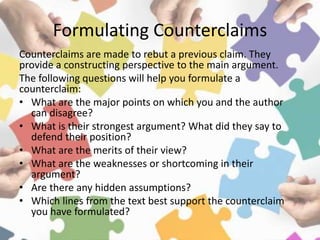
Formulating Counterclaims
Counterclaims are made to rebut a previous claim. They
provide a constructing perspective to the main argument.
The following questions will help you formulate a
counterclaim:
• What are the major points on which you and the author
can disagree?
• What is their strongest argument? What did they say to
defend their position?
• What are the merits of their view?
• What are the weaknesses or shortcoming in their
argument?
• Are there any hidden assumptions?
• Which lines from the text best support the counterclaim
you have formulated?
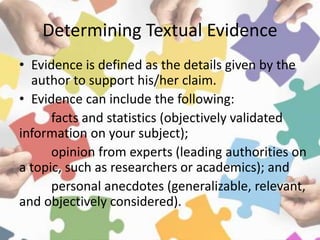
Determining Textual Evidence
• Evidence is defined as the details given by the
author to support his/her claim.
• Evidence can include the following:
facts and statistics (objectively validated
information on your subject);
opinion from experts (leading authorities on
a topic, such as researchers or academics); and
personal anecdotes (generalizable, relevant,
and objectively considered).
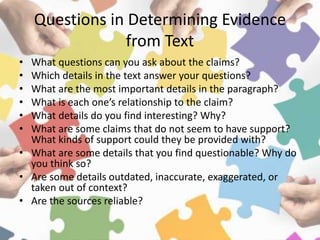
Questions in Determining Evidence
from Text
• What questions can you ask about the claims?
• Which details in the text answer your questions?
• What are the most important details in the paragraph?
• What is each one’s relationship to the claim?
• What details do you find interesting? Why?
• What are some claims that do not seem to have support?
What kinds of support could they be provided with?
• What are some details that you find questionable? Why do
you think so?
• Are some details outdated, inaccurate, exaggerated, or
taken out of context?
• Are the sources reliable?
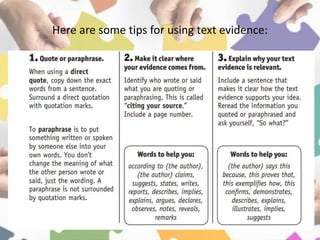
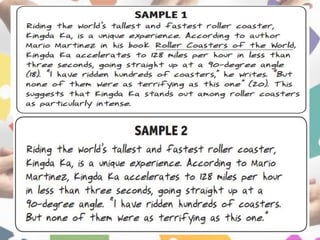
Here are some tips for using text evidence:
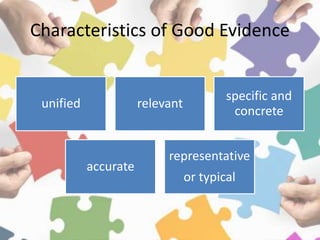
Characteristics of Good Evidence
unified relevant
specific and
concrete
accurate
representative
or typical
Paraphrasing
A paraphrase is…
• Your own rendition of essential information
and ideas expressed by someone else,
presented in a new form.
• one legitimate way (when accompanied by
accurate documentation) to borrow from a
source.
• a more detailed restatement than a summary,
which focuses concisely on a single main idea.
Why paraphrasing is a valuable skill?
• It is better than quoting information from an
undistinguished passage
• It helps you control the temptation to quote
too much
• The mental process required for successful
paraphrasing helps you to grasp the full
meaning of the original.
Steps to Effective Paraphrasing
1. Reread the original passage until you understand its full
meaning.
2. Set the original aside, and write your paraphrase on a note
card.
3. Jot down a few words below your paraphrase to remind you
later how you envision using this material. At the top of the
note card, write a key word or phrase to indicate the subject
of your paraphrase.
4. Check your rendition with the original to make sure that
your version accurately expresses all the essential
information in a new form.
5. Use quotation marks to identify any unique term or
phraseology you have borrowed exactly from the source.
6. Record the source (including the page) on your note card so
that you can credit it easily if you decide to incorporate the
material into your paper.
Reminders
• Paraphrases and summaries do not use quotation
marks and require the author’s last name and year of
publication. Page number is not required for
paraphrases and summaries.
• When citing a source, you always have two choices: 1)
Write the author’s name as part of your sentence in
the text. 2) Write the author’s name in the
parentheses. Use only last name in all APA in-text
citations and do not include the title of books or
articles in the body of your paper. The date must go
directly after the author’s name.
1-2 authors in text
• Emery’s (2004) case study of a boy with
autism found art therapy to be a useful tool to
help him relate to others.
• Abrams and Kane (2007) report the drop-out
rate is double that of other schools.
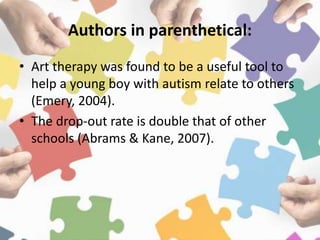
Authors in parenthetical:
• Art therapy was found to be a useful tool to
help a young boy with autism relate to others
(Emery, 2004).
• The drop-out rate is double that of other
schools (Abrams & Kane, 2007).
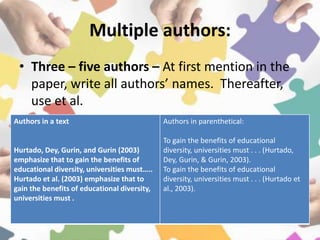
Multiple authors:
• Three – five authors – At first mention in the
paper, write all authors’ names. Thereafter,
use et al.
Authors in a text
Hurtado, Dey, Gurin, and Gurin (2003)
emphasize that to gain the benefits of
educational diversity, universities must…..
Hurtado et al. (2003) emphasize that to
gain the benefits of educational diversity,
universities must .
Authors in parenthetical:
To gain the benefits of educational
diversity, universities must . . . (Hurtado,
Dey, Gurin, & Gurin, 2003).
To gain the benefits of educational
diversity, universities must . . . (Hurtado et
al., 2003).
Multiple Authors
• Six or more authors: Use only the first author’s name
followed by et al.
(Kosslyn et al., 1996)
• Multiple references in the same parentheses: Put in
alphabetical order by author’s last name and separate
with semi-colon.
• (Bruffee, 1993; Goodsell, Maher, & Tinto, 1992;
Pascarella & Terenzini, 1991; Pike, 1993)
• Source with no author: Use abbreviated version of
title. (“Study Finds,” 2007)
• …the book College Bound Seniors (2008) describes…
Read more:
http://libguides.lmu.edu/c.php?g=324079&p=2174127
Some examples to compare
The original passage A legitimate paraphrase
Students frequently overuse
direct quotation in taking
notes, and as a result they
overuse quotations in the final
[research] paper. Probably only
about 10% of your final
manuscript should appear as
directly quoted matter.
Therefore, you should strive to
limit the amount of exact
transcribing of source materials
while taking notes. Lester,
James D. Writing Research
Papers. 2nd ed. (1976): 46-47.
In research papers students
often quote excessively, failing
to keep quoted material down
to a desirable level. Since the
problem usually originates
during note taking, it is
essential to minimize the
material recorded verbatim
(Lester 46-47).
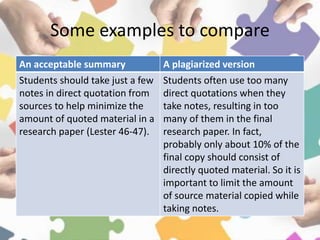
Some examples to compare
An acceptable summary A plagiarized version
Students should take just a few
notes in direct quotation from
sources to help minimize the
amount of quoted material in a
research paper (Lester 46-47).
Students often use too many
direct quotations when they
take notes, resulting in too
many of them in the final
research paper. In fact,
probably only about 10% of the
final copy should consist of
directly quoted material. So it is
important to limit the amount
of source material copied while
taking notes.
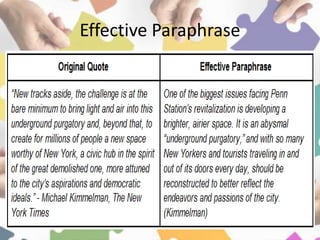
Effective Paraphrase
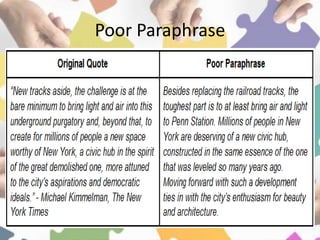
Poor Paraphrase
Sources
• https://owl.english.purdue.edu/owl/resource/
619/1/
• http://www.easybib.com/guides/students/res
earch-guide/paraphrasing-patchwriting-direct-
quotes/c-an-example-of-a-poor-paraphrase/

L2-Evaluating-Written-Texts-by-Analyzing-Claims.pptx

  • 1.
    Evaluating Written Textsby Analyzing Claims “Extraordinary claims require extraordinary evidence’ ~Carl Sagan
  • 2.
    Objectives • To explaincritical reading as looking for ways of thinking; • To identify claim of fact, policy, and value explicitly or implicitly made in a written text; and • To write a 1000-word critique of a selected text on the basis of its claim, context and properties as a written material.
  • 3.
    Critical Reading Techniques 1.Keeping a reading journal is meant as a personal expression or one’s thoughts on experiences, inspirations, accomplishments failures, and the many discoveries in everyday life.
  • 4.
    Critical Reading Techniques 2.Annotating the text is simply making notes on your copy of the reading. This includes highlighting or underlining important passages and writing notes, comments, questions, and reactions on the margins.
  • 5.
    A Reader’s Guideto Annotation 2.1 Use a pen, pencil, post-it notes or a highlighter. (Although use it sparingly!) *Summarize important ideas in your own words *Add examples from real life, other books, TV, movies, and so forth *Define words that are new to you. *Mark passages that you find confusing with a??? *Write questions that you might have
  • 6.
    Critical Reading Techniques 4.Summarizing the text similar to outlining, in that you need to get the gist. It consists of getting the main points of the essay, and important supporting details.
  • 7.
    Critical Reading Techniques 4.Summarizing the text similar to outlining, in that you need to get the gist. It consists of getting the main points of the essay, and important supporting details.
  • 8.
    Critical Reading Techniques 5.Questioning the text Involves asking specific questions on points that you are skeptical about.
  • 9.
    Ask yourself • Whattype of audience is addressed? • What are the writer’s assumptions? • What are the writer’s intentions? • How well does the writer accomplish these? • How convincing is the evidence presented? • How reliable are the sources? Are they based on personal experience, scientific data, or outside authorities? • Did the writer address opposing views on the issue? • Is the writer persuasive in his/her perspective?
  • 10.
    Essential Questions • Whatare the benefits of becoming a critical reader? • How does critical reading improve my writing? • How can I effectively distinguish among claims of fact, policy, and value? • Why do we need sufficient, relevant evidence, and sound reasoning to support a claim?
  • 11.
    Determining Explicit andImplicit Information Explicit information that is clearly stated Implicit ideas that are suggested but not stated outright in the text
  • 12.
    Defining Claims Claims orcentral argument is the writer’s point or position regarding the chosen topic. This claim is what the writer tries to prove in the text by providing details, explanations, and other types of evidence. Characteristics of Good Claims 1. A claim should be argumentative and debatable. 2. A claim should be specific and focused. 3. A claim should be interesting and engaging. 4. A claim should be logical.
  • 13.
    Distinguishing Between Typesof Claim claims of fact • state a quantifiable assertion or a measurable topic • rely on reliable sources or systematic procedures to be validated claims of value • assert something that can be qualified • consist of arguments about moral, philosophical, or aesthetic claims of policy • posit that specific actions should be chosen as solutions to a particular problem. • usually begins with “ should,” “ought to,” or “must” • usually answers “how” questions
  • 15.
    Identifying the Contextof Text Development -modelling of a text’s meaning by another text -dialogue among different texts and interpretations of the writer, the audience, and the current and earlier cultural contexts. Intertextuality - presents a new way to read on-line text that differs from reading linear text such as books - user may then browse through the sections of the t text, jumping from one text section to another -this permits a reader to use these features automatically rather than requiring readers to manually refer to them as needed Hypertextuality
  • 17.
    Critical Reading asReasoning 1. Fact statement that can be proven objectively by direct experience, testimonies of witnesses, verified observations, or the results of research 2. Convention way in which something is done, similar to traditions and norms 3. Opinions are based on facts, but are difficult to objectively verify because of uncertainty of producing satisfactory proofs of soundness 4. Preference based on personal choice; therefore, they are subjective an cannot be objectively proven or logically attacked Assertions are declarative sentences that claim something is true about something else
  • 18.
    Formulating Counterclaims Counterclaims aremade to rebut a previous claim. They provide a constructing perspective to the main argument. The following questions will help you formulate a counterclaim: • What are the major points on which you and the author can disagree? • What is their strongest argument? What did they say to defend their position? • What are the merits of their view? • What are the weaknesses or shortcoming in their argument? • Are there any hidden assumptions? • Which lines from the text best support the counterclaim you have formulated?
  • 20.
    Determining Textual Evidence •Evidence is defined as the details given by the author to support his/her claim. • Evidence can include the following: facts and statistics (objectively validated information on your subject); opinion from experts (leading authorities on a topic, such as researchers or academics); and personal anecdotes (generalizable, relevant, and objectively considered).
  • 21.
    Questions in DeterminingEvidence from Text • What questions can you ask about the claims? • Which details in the text answer your questions? • What are the most important details in the paragraph? • What is each one’s relationship to the claim? • What details do you find interesting? Why? • What are some claims that do not seem to have support? What kinds of support could they be provided with? • What are some details that you find questionable? Why do you think so? • Are some details outdated, inaccurate, exaggerated, or taken out of context? • Are the sources reliable?
  • 22.
    Here are sometips for using text evidence:
  • 24.
    Characteristics of GoodEvidence unified relevant specific and concrete accurate representative or typical
  • 25.
    Paraphrasing A paraphrase is… •Your own rendition of essential information and ideas expressed by someone else, presented in a new form. • one legitimate way (when accompanied by accurate documentation) to borrow from a source. • a more detailed restatement than a summary, which focuses concisely on a single main idea.
  • 26.
    Why paraphrasing isa valuable skill? • It is better than quoting information from an undistinguished passage • It helps you control the temptation to quote too much • The mental process required for successful paraphrasing helps you to grasp the full meaning of the original.
  • 27.
    Steps to EffectiveParaphrasing 1. Reread the original passage until you understand its full meaning. 2. Set the original aside, and write your paraphrase on a note card. 3. Jot down a few words below your paraphrase to remind you later how you envision using this material. At the top of the note card, write a key word or phrase to indicate the subject of your paraphrase. 4. Check your rendition with the original to make sure that your version accurately expresses all the essential information in a new form. 5. Use quotation marks to identify any unique term or phraseology you have borrowed exactly from the source. 6. Record the source (including the page) on your note card so that you can credit it easily if you decide to incorporate the material into your paper.
  • 28.
    Reminders • Paraphrases andsummaries do not use quotation marks and require the author’s last name and year of publication. Page number is not required for paraphrases and summaries. • When citing a source, you always have two choices: 1) Write the author’s name as part of your sentence in the text. 2) Write the author’s name in the parentheses. Use only last name in all APA in-text citations and do not include the title of books or articles in the body of your paper. The date must go directly after the author’s name.
  • 29.
    1-2 authors intext • Emery’s (2004) case study of a boy with autism found art therapy to be a useful tool to help him relate to others. • Abrams and Kane (2007) report the drop-out rate is double that of other schools.
  • 30.
    Authors in parenthetical: •Art therapy was found to be a useful tool to help a young boy with autism relate to others (Emery, 2004). • The drop-out rate is double that of other schools (Abrams & Kane, 2007).
  • 31.
    Multiple authors: • Three– five authors – At first mention in the paper, write all authors’ names. Thereafter, use et al. Authors in a text Hurtado, Dey, Gurin, and Gurin (2003) emphasize that to gain the benefits of educational diversity, universities must….. Hurtado et al. (2003) emphasize that to gain the benefits of educational diversity, universities must . Authors in parenthetical: To gain the benefits of educational diversity, universities must . . . (Hurtado, Dey, Gurin, & Gurin, 2003). To gain the benefits of educational diversity, universities must . . . (Hurtado et al., 2003).
  • 32.
    Multiple Authors • Sixor more authors: Use only the first author’s name followed by et al. (Kosslyn et al., 1996) • Multiple references in the same parentheses: Put in alphabetical order by author’s last name and separate with semi-colon. • (Bruffee, 1993; Goodsell, Maher, & Tinto, 1992; Pascarella & Terenzini, 1991; Pike, 1993) • Source with no author: Use abbreviated version of title. (“Study Finds,” 2007) • …the book College Bound Seniors (2008) describes… Read more: http://libguides.lmu.edu/c.php?g=324079&p=2174127
  • 33.
    Some examples tocompare The original passage A legitimate paraphrase Students frequently overuse direct quotation in taking notes, and as a result they overuse quotations in the final [research] paper. Probably only about 10% of your final manuscript should appear as directly quoted matter. Therefore, you should strive to limit the amount of exact transcribing of source materials while taking notes. Lester, James D. Writing Research Papers. 2nd ed. (1976): 46-47. In research papers students often quote excessively, failing to keep quoted material down to a desirable level. Since the problem usually originates during note taking, it is essential to minimize the material recorded verbatim (Lester 46-47).
  • 34.
    Some examples tocompare An acceptable summary A plagiarized version Students should take just a few notes in direct quotation from sources to help minimize the amount of quoted material in a research paper (Lester 46-47). Students often use too many direct quotations when they take notes, resulting in too many of them in the final research paper. In fact, probably only about 10% of the final copy should consist of directly quoted material. So it is important to limit the amount of source material copied while taking notes.
  • 35.
  • 36.
  • 37.