LEARNING FROM
OTHERS AND
REVIEWING THE
LITERATURE
GROUP 4
JHUNEL REFUGIA
ERICKA DULAY
MARY ANN DULAY.
MARK GIL GARCIA
JHUN MARK CHAN
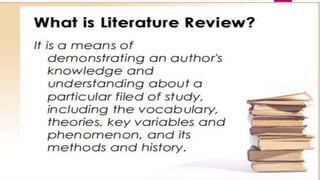
What is Review of Related Literature
(RRL)?
 RRL is an important component of research
regardless of the type of research. Be it qualitative
or quantitative research, you spend time and effort
in reviewing related literature. Reviewing related
literature is one major activity in research that
makes you examine or study again concepts or
ideas related to your research that people managed
to publish in books, journals, or other reading
materials in the past.
A review of related literature is the process of collecting, selecting, and reading
books, journals, reports, abstracts, and other reference materials. The
following information may be collected:
1. Background information about the problem and related concepts.
2. Theories that explains the existence of the problem and the possible
connection between certain factors and the problem.
3. Data that confirms the existence and seriousness of the problem.
4. General and specific findings of studies related to the problem.
5. Recommendations for further study given in related studies.
Purpose of RRL
 To find out the connection of your research to the current conditions
or situations of the world.
 To know more about theories or concepts underlying your research
and to learn the with respect to your own research study.
 To discover the relation of your research with previous research
studies.
 To obtain information on the accuracy or relevance to your research
studies.
 To familiarize yourself with technical terms related to your research.
The two styles or Approaches of RRL or
Review of Related Literature
 Traditional Review of Literature
 Systematic Review of Literature
Traditional Review of Literature
 To do an review of literature in a traditional way is to summarize
present forms of knowledge on a specific subject. Your aim here
is to give an expanded or new understanding of an existing
work. Being necessarily descriptive, interpretative, evaluative
and methodically unclear and uncertain, a traditional review is
prone to your subjectivity. This kind of review does not require
you to describe your method of reviewing literature but expects
you to state your intentions in conducting the review and to
name the sources of information.
Traditional review is of different types
are as follows:
 Conceptual review – analysis of concepts or ideas to give meaning to some
national or world issues
 Critical review – focuses on theories or hypothesis and examine meanings and
results of their application to situations
 State-of-Art – makes the researcher deal with the latest research studies on the
subject
 Expert review – encourages a well-known expert to do the RRL because of the
influence of a certain ideology, paradigm, or belief on him/her
 Scoping review– prepares a situation for a future research work in the form of
project making about community development, government policies, and health
Systematic Review of Literature
 indicate by its name, systematic, which means methodical, is a style of RRL
that involves sequential acts of a review of related literature. Unlike the
traditional review that has no particular method, systematic review requires
you to go through the following RRL steps (Ridley 2012):
• Have a clear understanding of the research questions. Serving as the compass
to direct your research activities, the research questions tell you want to collect
and where to obtain those data you want to collect.
• Plan your manner of obtaining the data. Imagining how you will get to where
the data are, you will come to think also of what keywords to use for easy
searching and how to accord courtesy and respect to people or institutions from
where the data will come such as planning how to communicate your request to
 Do the literature search. Using keywords, you look for the needed
information from all source of knowledge: internet, books, journals
periodicals, government publications, general references, and the like.
 Using a certain standard, determine which data, studies, or sources of
knowledge are valuable or not to warrant the reasonableness of your
decision to take some data and junk the rest.
 Determine the methodological soundness of the research studies. Use a
checklist or a certain set of criteria in assessing the ways researchers
conduct their studies to arrive at a certain conclusion.
 Summarize what you have gathered from various sources of data. To
concisely present a synthesis of your report, use a graph such as table and
Steps in Conducting a Systematic Review
 Clarifying the research questions
 Planning the research based on your understanding of
the research questions
 Searching for literature
 Listing criteria for considering the values of written
works
 Evaluating the quality of previous research studies
 Summarizing the various forms of knowledge collected
Meta-analysis in Quantitative Research
 Meta-analysis is a kind of review of related literature in which you re-examine and combine
the total results of two or more statistical studies for coming out with a grand total to
indicate stronger effects of the research outcome. Putting the results together and making
them appear as one result work to strengthen whatever impact the independent variable has
on the dependent variable.
 Meta-analysis helps in guaranteeing the precision of the measuring method used in a
quantitative research. However, this merging of statistical results is not applicable to all
quantitative research studies. You resort to meta-analysis only if the statistics that you
intend to combine come from studies having several similarities like they are comparable in
terms of research questions, research design, treatment, measuring technique, and
measurable outcome. Similar in many ways, these studies that are apt for combination
purposes are called homogeneous studies. Conversely, with a number of differences from
other studies, they are called heterogeneous studies and exempted from this type of
systematic review of related literature called meta-analysis.
Foreign Literature
Foreign literature studies concerns the
comprehensive research of literature in the
language of the country it was written in that
includes the study of the regional and
historical circumstances in which it was
written.
Local Literature
 Local literature is an informative booklet or other means of
information that informs people about the local environment.
THE PROCESS OF REVIEW OF
RELATED LITERATURE
 Curious about a person or a thing, you want to know more about the ins
and outs of this object of your interest. In your quest of becoming
knowledgeable about the “apple of your eyes”, you are inclined to find
all ways and means to get a full view, knowledge, or understanding of
the center of your attention. And if there is one activity of yours that
really pushes you to continue searching knowledge up to a certain
period of time about the focus of your attention, it is research. From the
start up to the end of your research, you are prone to searching answers
to the many things you are curious about.
Stage 1: Search for the Literature
 This is the stage of review of related literature where you devote much of
your time in looking for sources of knowledge, data, or information to answer
your research questions or to support your assumptions about your
research topic. Three basic types of literature sources:
 General references that will direct you to the location of other sources
 Primary sources that report or describe other people’s experiences or
worldviews.
 Secondary sources of knowledge give the most number of materials such as
the internet, books, peer-reviewed articles in journals, published literary
reviews of a field, grey literature or unpublished and non-peer reviewed
materials like theses, dissertations, conference proceedings, leaflets and
Here are the pointers you have to remember in searching for the best
sources of information or data:
1. Choose previous research findings that are closely related your
research
2. Give more weight to studies done by people possessing expertise or
authority in the field of knowledge to which the research studies
belong.
3. Consider sources of knowledge that refer more to primary data than to
secondary data.
4. Prefer getting information from peer-reviewed materials than from
Stage 2: Reading the Source Material
 Reading, understanding, or making the materials meaningful to you is what
will preoccupy you on the second stage of reading RRL. You can only
benefit much from your reading activities if you confront reading materials
with the help of your HOTS. In understanding the sources of knowledge
with your HOTS, you need to think interpretatively through these ways of
inferential thinking: predicting, generalizing, concluding, and assuming. On
top of these should be your ability to criticize or evaluate, apply, and create
things about what you have read. Hence, reading or making sense of the
source materials does not only make you list down ideas from the
materials, but also permits you to modify, construct, or reconstruct ideas
based on a certain principle, theory, pattern, method, or theme underlying
your research.
Stage 3: Writing the Review
 A simple presentation of the findings or argumentations of the writers on a
particular topic with no incorporation of your own inferential, analytical, and
comparative- contrastive thinking about other people’s ideas indicates poor
literature review writing. This mere description, transfer, or listing of writer’s ideas
that is devoid of or not reflective of your thinking is called dump or stringing
method. Good literature writing shuns presenting ideas in serial abstracts, which
means every paragraph merely consists of one article. This is a source–by-source
literature writing that fails to link, compare, and contrast series of articles based
on a theory or a theme around which research questions revolve. (Remlen 2011).,
Another good approach to writing an excellent review is adopting good opening sentences of
articles that should chronologically appear in the paper. Opening an article with a bibliographical
list that begins with the author’s name like the following example is not good
Aquino (2015) said…
Duterte (2018) said…
Examples of better article openings manifesting critical thinking through analysis, comparison and
contrast of ideas and findings are as follows:
One early work by (Castro, 2017) proves that…
Another study on the topic by (Torres, 2017) maintains that…
 Transitional devices – also, additionally, again, similarity, a similar opinion,
however, conversely, on the other hand, nevertheless, a contrasting opinion, a
different approach, etc.
 Active verbs – analyze, argues, assess, assert, assume, claim, compare,
contrast, conclude, criticize, debate, defend, define, demonstrate, discuss,
distinguish, differentiate, evaluate, examine, emphasize, expand, explain, exhibit,
identify, illustrate, imply, indicate, judge, justify, narrate, outline, persuade,
propose, question, relate to, report, review, suggest, summarize.
STANDARD STYLES IN RELATED
LITERATURE CITATIONS OR
REFERENCES
 In reviewing related literature, you come to read varieties of reading materials
containing knowledge related to your research. It is a fact that these ideas,
including the language structures to express these ideas belong to other people.
They are not yours. One cardinal principle in research is acknowledging or
recognizing the owners of any form of knowledge you intend to include in your
research paper. Doing this practice signals not just honesty and courtesy to
learned people whose ideas lend information to your paper, but also indicates
your appreciation for their contribution to the field. (Hammersely 2013)
 The following are the three terms used to express your appreciation for or
recognition of people’s ownership of borrowed ideas (Sharp 2012)
1. Acknowledgment – the beginning portion of the work that identifies individuals
who have contributed something for the production of the paper
2. References or Bibliography – a complete list of all reading materials, including
books, journals, periodicals, etc. from where the borrowed ideas came from
3. Citation or In-text Citation – references within the main body of the text,
specifically in review of related literature
Purposes of Citation
1. To give importance and respect to other people for what they know about field
2. To give authority, validity, and credibility to other people’s claims, conclusions, and
arguments
3. To prove your broad and extensive reading of authentic and relevant materials
about your topic
4. To help readers find or contact the sources of ideas easily
5. To permit readers to check the accuracy of your work
6. To save yourself from plagiarism
Style of Citation
 Integral citation
Examples of integral Citation:
APA
One study by Manalo (2015) reveals…
The latest work by (Lee, 2015) asserts…
According to Abad etc al. (2015) context is…
MLA
One study by (Manalo 70)
The latest work by (Lee 123)
According to (Abad et al.: 54)
 Non-integral Citation
In contrast to integral citation that reflects the author’s personal inclinations to a certain extent, this
second citation style downplays any strength of the writer’s personal characteristics. The stress is
given to the piece of information rather than to the owner of the ideas.
Examples of Non-integral Citation:
A. The Code of Ethics for Intercultural Competence give four ways by which people from different
cultural background can harmoniously related themselves with one another. (De la Cruz, 2015)
B. Knowledge is one component of not only systemic Functional Grammar but Intercultural
Competence as well. It is the driving force beyond any successful collaborative competence. (Smith
2015)
C. The other components of intercultural Competence which are also present in SFG are: context (
Harold , 2015), appropriateness (Villar, Marcos, Atienza, 2016; Santos, and Daez, 2016), and
emotions (Flores, 2016)
Patterns of Citation
1. Summary. The citation in this case is a shortened version of the original text that is expressed in your own
language. Making the text short, you have to pick out only the most important ideas or aspects of the text.
2. Paraphrase. His is the antithesis of the first one because, here, instead of shortening the form of the text, you
explain what the text means to you using your own words. In doing so, it is possible that your explanations may
decrease or exceed the number of words of the original text.
3. Short Direct Quotation. Only a part of the author’s sentence, the whole sentence, or several sentences, not
exceeding 40 words, is what you can quote or repeat in writing through this citation pattern. Since this makes you
copy exact words of the writer, it is necessary that you give the number of the page where the readers can find the
copied words
Example:
Contexts is influenced by these four factors: “language, culture, institutions, and ideologies.”(Aranda, 2015, p.8)
4. Long Direct Quotation or Block Quotation, or Extract. Named I many ways,
this citation pattern makes you copy the author’s exact words numbering from 40 up
to 100 words. Under APA, the limits is eight lines. Placed at the center of the page
with no indentation, the copied lines look like they compose a stanza of a poem.
 There are two basic methods of referencing, pointing to, or identifying the exact
author referred to by your paper. These are the APA (American Psychological
Association and the MLA (Modern Language Association). Each of these two
methods has its own in-text citation style. The following shows the difference
between them as regards citation format.
APA –(Ramos, 2015) or Ramos (2016)
(Manalo, 2015) or Manalo (2016)
MLA –(Bautista 183), Flores et.al. 150-158)
(Acosta, Hizon, Lopez 235-240)
(Velarde 4: 389-403)- for periodicals
5. Tense of verbs for reporting
Active verbs are effective words to use in reporting authors’ ideas. Present their ideas
in any of these: present, simple past, or present perfect tense. The APA system,
however, prefers the use of present perfect tense.
Examples:
Present tense- Marcos explains…
Past tense- Marcos explained…
Present perfect tense- Marcos has explained…
Plagiarism
 Plagiarism is an act of quoting or copying the exact words of the writer and
passing the quoted words off as your own words. The leading act of plagiarism is
using the words of the original text in expressing your understanding of the
reading materials. The right way to avoid plagiarism is to express the borrowed
ideas in your own words. (Ransome 2013)
Practical Research two lesson four grade 12

Practical Research two lesson four grade 12

  • 1.
    LEARNING FROM OTHERS AND REVIEWINGTHE LITERATURE GROUP 4 JHUNEL REFUGIA ERICKA DULAY MARY ANN DULAY. MARK GIL GARCIA JHUN MARK CHAN
  • 2.
    What is Reviewof Related Literature (RRL)?  RRL is an important component of research regardless of the type of research. Be it qualitative or quantitative research, you spend time and effort in reviewing related literature. Reviewing related literature is one major activity in research that makes you examine or study again concepts or ideas related to your research that people managed to publish in books, journals, or other reading materials in the past.
  • 3.
    A review ofrelated literature is the process of collecting, selecting, and reading books, journals, reports, abstracts, and other reference materials. The following information may be collected: 1. Background information about the problem and related concepts. 2. Theories that explains the existence of the problem and the possible connection between certain factors and the problem. 3. Data that confirms the existence and seriousness of the problem. 4. General and specific findings of studies related to the problem. 5. Recommendations for further study given in related studies.
  • 4.
    Purpose of RRL To find out the connection of your research to the current conditions or situations of the world.  To know more about theories or concepts underlying your research and to learn the with respect to your own research study.  To discover the relation of your research with previous research studies.  To obtain information on the accuracy or relevance to your research studies.  To familiarize yourself with technical terms related to your research.
  • 9.
    The two stylesor Approaches of RRL or Review of Related Literature  Traditional Review of Literature  Systematic Review of Literature
  • 10.
    Traditional Review ofLiterature  To do an review of literature in a traditional way is to summarize present forms of knowledge on a specific subject. Your aim here is to give an expanded or new understanding of an existing work. Being necessarily descriptive, interpretative, evaluative and methodically unclear and uncertain, a traditional review is prone to your subjectivity. This kind of review does not require you to describe your method of reviewing literature but expects you to state your intentions in conducting the review and to name the sources of information.
  • 11.
    Traditional review isof different types are as follows:  Conceptual review – analysis of concepts or ideas to give meaning to some national or world issues  Critical review – focuses on theories or hypothesis and examine meanings and results of their application to situations  State-of-Art – makes the researcher deal with the latest research studies on the subject  Expert review – encourages a well-known expert to do the RRL because of the influence of a certain ideology, paradigm, or belief on him/her  Scoping review– prepares a situation for a future research work in the form of project making about community development, government policies, and health
  • 12.
    Systematic Review ofLiterature  indicate by its name, systematic, which means methodical, is a style of RRL that involves sequential acts of a review of related literature. Unlike the traditional review that has no particular method, systematic review requires you to go through the following RRL steps (Ridley 2012): • Have a clear understanding of the research questions. Serving as the compass to direct your research activities, the research questions tell you want to collect and where to obtain those data you want to collect. • Plan your manner of obtaining the data. Imagining how you will get to where the data are, you will come to think also of what keywords to use for easy searching and how to accord courtesy and respect to people or institutions from where the data will come such as planning how to communicate your request to
  • 13.
     Do theliterature search. Using keywords, you look for the needed information from all source of knowledge: internet, books, journals periodicals, government publications, general references, and the like.  Using a certain standard, determine which data, studies, or sources of knowledge are valuable or not to warrant the reasonableness of your decision to take some data and junk the rest.  Determine the methodological soundness of the research studies. Use a checklist or a certain set of criteria in assessing the ways researchers conduct their studies to arrive at a certain conclusion.  Summarize what you have gathered from various sources of data. To concisely present a synthesis of your report, use a graph such as table and
  • 14.
    Steps in Conductinga Systematic Review  Clarifying the research questions  Planning the research based on your understanding of the research questions  Searching for literature  Listing criteria for considering the values of written works  Evaluating the quality of previous research studies  Summarizing the various forms of knowledge collected
  • 27.
    Meta-analysis in QuantitativeResearch  Meta-analysis is a kind of review of related literature in which you re-examine and combine the total results of two or more statistical studies for coming out with a grand total to indicate stronger effects of the research outcome. Putting the results together and making them appear as one result work to strengthen whatever impact the independent variable has on the dependent variable.  Meta-analysis helps in guaranteeing the precision of the measuring method used in a quantitative research. However, this merging of statistical results is not applicable to all quantitative research studies. You resort to meta-analysis only if the statistics that you intend to combine come from studies having several similarities like they are comparable in terms of research questions, research design, treatment, measuring technique, and measurable outcome. Similar in many ways, these studies that are apt for combination purposes are called homogeneous studies. Conversely, with a number of differences from other studies, they are called heterogeneous studies and exempted from this type of systematic review of related literature called meta-analysis.
  • 28.
    Foreign Literature Foreign literaturestudies concerns the comprehensive research of literature in the language of the country it was written in that includes the study of the regional and historical circumstances in which it was written.
  • 29.
    Local Literature  Localliterature is an informative booklet or other means of information that informs people about the local environment.
  • 30.
    THE PROCESS OFREVIEW OF RELATED LITERATURE  Curious about a person or a thing, you want to know more about the ins and outs of this object of your interest. In your quest of becoming knowledgeable about the “apple of your eyes”, you are inclined to find all ways and means to get a full view, knowledge, or understanding of the center of your attention. And if there is one activity of yours that really pushes you to continue searching knowledge up to a certain period of time about the focus of your attention, it is research. From the start up to the end of your research, you are prone to searching answers to the many things you are curious about.
  • 31.
    Stage 1: Searchfor the Literature  This is the stage of review of related literature where you devote much of your time in looking for sources of knowledge, data, or information to answer your research questions or to support your assumptions about your research topic. Three basic types of literature sources:  General references that will direct you to the location of other sources  Primary sources that report or describe other people’s experiences or worldviews.  Secondary sources of knowledge give the most number of materials such as the internet, books, peer-reviewed articles in journals, published literary reviews of a field, grey literature or unpublished and non-peer reviewed materials like theses, dissertations, conference proceedings, leaflets and
  • 32.
    Here are thepointers you have to remember in searching for the best sources of information or data: 1. Choose previous research findings that are closely related your research 2. Give more weight to studies done by people possessing expertise or authority in the field of knowledge to which the research studies belong. 3. Consider sources of knowledge that refer more to primary data than to secondary data. 4. Prefer getting information from peer-reviewed materials than from
  • 33.
    Stage 2: Readingthe Source Material  Reading, understanding, or making the materials meaningful to you is what will preoccupy you on the second stage of reading RRL. You can only benefit much from your reading activities if you confront reading materials with the help of your HOTS. In understanding the sources of knowledge with your HOTS, you need to think interpretatively through these ways of inferential thinking: predicting, generalizing, concluding, and assuming. On top of these should be your ability to criticize or evaluate, apply, and create things about what you have read. Hence, reading or making sense of the source materials does not only make you list down ideas from the materials, but also permits you to modify, construct, or reconstruct ideas based on a certain principle, theory, pattern, method, or theme underlying your research.
  • 34.
    Stage 3: Writingthe Review  A simple presentation of the findings or argumentations of the writers on a particular topic with no incorporation of your own inferential, analytical, and comparative- contrastive thinking about other people’s ideas indicates poor literature review writing. This mere description, transfer, or listing of writer’s ideas that is devoid of or not reflective of your thinking is called dump or stringing method. Good literature writing shuns presenting ideas in serial abstracts, which means every paragraph merely consists of one article. This is a source–by-source literature writing that fails to link, compare, and contrast series of articles based on a theory or a theme around which research questions revolve. (Remlen 2011).,
  • 35.
    Another good approachto writing an excellent review is adopting good opening sentences of articles that should chronologically appear in the paper. Opening an article with a bibliographical list that begins with the author’s name like the following example is not good Aquino (2015) said… Duterte (2018) said… Examples of better article openings manifesting critical thinking through analysis, comparison and contrast of ideas and findings are as follows: One early work by (Castro, 2017) proves that… Another study on the topic by (Torres, 2017) maintains that…
  • 36.
     Transitional devices– also, additionally, again, similarity, a similar opinion, however, conversely, on the other hand, nevertheless, a contrasting opinion, a different approach, etc.  Active verbs – analyze, argues, assess, assert, assume, claim, compare, contrast, conclude, criticize, debate, defend, define, demonstrate, discuss, distinguish, differentiate, evaluate, examine, emphasize, expand, explain, exhibit, identify, illustrate, imply, indicate, judge, justify, narrate, outline, persuade, propose, question, relate to, report, review, suggest, summarize.
  • 37.
    STANDARD STYLES INRELATED LITERATURE CITATIONS OR REFERENCES  In reviewing related literature, you come to read varieties of reading materials containing knowledge related to your research. It is a fact that these ideas, including the language structures to express these ideas belong to other people. They are not yours. One cardinal principle in research is acknowledging or recognizing the owners of any form of knowledge you intend to include in your research paper. Doing this practice signals not just honesty and courtesy to learned people whose ideas lend information to your paper, but also indicates your appreciation for their contribution to the field. (Hammersely 2013)
  • 38.
     The followingare the three terms used to express your appreciation for or recognition of people’s ownership of borrowed ideas (Sharp 2012) 1. Acknowledgment – the beginning portion of the work that identifies individuals who have contributed something for the production of the paper 2. References or Bibliography – a complete list of all reading materials, including books, journals, periodicals, etc. from where the borrowed ideas came from 3. Citation or In-text Citation – references within the main body of the text, specifically in review of related literature
  • 39.
    Purposes of Citation 1.To give importance and respect to other people for what they know about field 2. To give authority, validity, and credibility to other people’s claims, conclusions, and arguments 3. To prove your broad and extensive reading of authentic and relevant materials about your topic 4. To help readers find or contact the sources of ideas easily 5. To permit readers to check the accuracy of your work 6. To save yourself from plagiarism
  • 40.
    Style of Citation Integral citation Examples of integral Citation: APA One study by Manalo (2015) reveals… The latest work by (Lee, 2015) asserts… According to Abad etc al. (2015) context is… MLA One study by (Manalo 70) The latest work by (Lee 123) According to (Abad et al.: 54)
  • 41.
     Non-integral Citation Incontrast to integral citation that reflects the author’s personal inclinations to a certain extent, this second citation style downplays any strength of the writer’s personal characteristics. The stress is given to the piece of information rather than to the owner of the ideas. Examples of Non-integral Citation: A. The Code of Ethics for Intercultural Competence give four ways by which people from different cultural background can harmoniously related themselves with one another. (De la Cruz, 2015) B. Knowledge is one component of not only systemic Functional Grammar but Intercultural Competence as well. It is the driving force beyond any successful collaborative competence. (Smith 2015) C. The other components of intercultural Competence which are also present in SFG are: context ( Harold , 2015), appropriateness (Villar, Marcos, Atienza, 2016; Santos, and Daez, 2016), and emotions (Flores, 2016)
  • 42.
    Patterns of Citation 1.Summary. The citation in this case is a shortened version of the original text that is expressed in your own language. Making the text short, you have to pick out only the most important ideas or aspects of the text. 2. Paraphrase. His is the antithesis of the first one because, here, instead of shortening the form of the text, you explain what the text means to you using your own words. In doing so, it is possible that your explanations may decrease or exceed the number of words of the original text. 3. Short Direct Quotation. Only a part of the author’s sentence, the whole sentence, or several sentences, not exceeding 40 words, is what you can quote or repeat in writing through this citation pattern. Since this makes you copy exact words of the writer, it is necessary that you give the number of the page where the readers can find the copied words Example: Contexts is influenced by these four factors: “language, culture, institutions, and ideologies.”(Aranda, 2015, p.8)
  • 43.
    4. Long DirectQuotation or Block Quotation, or Extract. Named I many ways, this citation pattern makes you copy the author’s exact words numbering from 40 up to 100 words. Under APA, the limits is eight lines. Placed at the center of the page with no indentation, the copied lines look like they compose a stanza of a poem.
  • 44.
     There aretwo basic methods of referencing, pointing to, or identifying the exact author referred to by your paper. These are the APA (American Psychological Association and the MLA (Modern Language Association). Each of these two methods has its own in-text citation style. The following shows the difference between them as regards citation format. APA –(Ramos, 2015) or Ramos (2016) (Manalo, 2015) or Manalo (2016) MLA –(Bautista 183), Flores et.al. 150-158) (Acosta, Hizon, Lopez 235-240) (Velarde 4: 389-403)- for periodicals
  • 45.
    5. Tense ofverbs for reporting Active verbs are effective words to use in reporting authors’ ideas. Present their ideas in any of these: present, simple past, or present perfect tense. The APA system, however, prefers the use of present perfect tense. Examples: Present tense- Marcos explains… Past tense- Marcos explained… Present perfect tense- Marcos has explained…
  • 46.
    Plagiarism  Plagiarism isan act of quoting or copying the exact words of the writer and passing the quoted words off as your own words. The leading act of plagiarism is using the words of the original text in expressing your understanding of the reading materials. The right way to avoid plagiarism is to express the borrowed ideas in your own words. (Ransome 2013)