



@kaimrc_edu


       1
How to write a health survey?

      Mona Al-Dabbagh, MD, MHSc
  Consultant Pediatric Infectious Diseases
       King AbdulAziz Medical City
      National Guard Health Affairs
Objectives
• To present a general outline to health surveys
• To demonstrate a systematic guide to writing
  questionnaires and survey questions.
What is a survey?


• ‘A purposeful and systematic collection
  of data from population by means of
  asking questions’
Types of Health surveys
• Aim:                    Sampling
   – Descriptive             – Random population
   – Analytical              – Non-random population

• Topic:                  • Nature of information
   – Health status           – Subjective
   – Health determinant      – Factual
   – Health services
                          • Data collection
• Study design:              – Self-administered
   – Cross-over              – Interview
   – Longitudinal            – Mixed mode
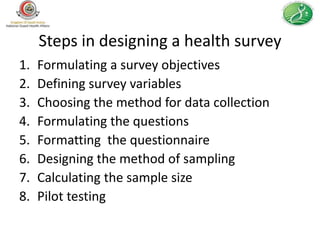
Steps in designing a health survey
1.   Formulating a survey objectives
2.   Defining survey variables
3.   Choosing the method for data collection
4.   Formulating the questions
5.   Formatting the questionnaire
6.   Designing the method of sampling
7.   Calculating the sample size
8.   Pilot testing
Formulating survey questions
Question type
• Concept measured
   – Facts, opinions/attitude, feeling, knowledge, others.
• Measurement level
   – Nominal, ordinal, interval, ratio
• Response format
   – Open-ended, closed-ended, other
• Complexity
   – Single questions, checklist, multi-item scale, other
• Sensitivity/ threat level
Factual questions
• How old are you?
   ___________ years

• What is your gender?
    Male
    Female

• How many children do you have?
   1
   2
   3
   4
    More than 4 (specify)
Factual questions
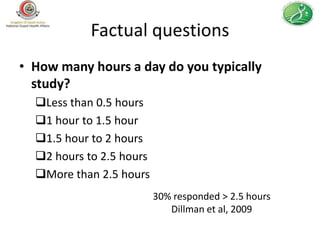
• How many hours a day do you typically
  study?
  Less than 0.5 hours
  1 hour to 1.5 hour
  1.5 hour to 2 hours
  2 hours to 2.5 hours
  More than 2.5 hours
                          30% responded > 2.5 hours
                             Dillman et al, 2009
Factual questions
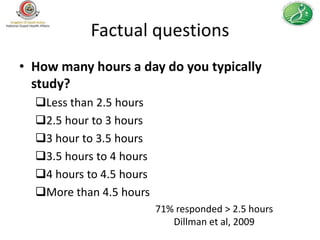
• How many hours a day do you typically
  study?
  Less than 2.5 hours
  2.5 hour to 3 hours
  3 hour to 3.5 hours
  3.5 hours to 4 hours
  4 hours to 4.5 hours
  More than 4.5 hours
                          71% responded > 2.5 hours
                             Dillman et al, 2009
Opinions
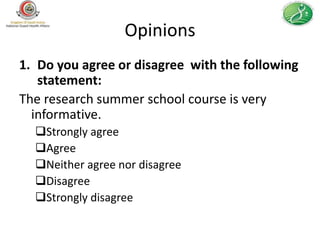
1. Do you agree or disagree with the following
   statement:
The research summer school course is very
  informative.
  Strongly agree
  Agree
  Neither agree nor disagree
  Disagree
  Strongly disagree
Opinions
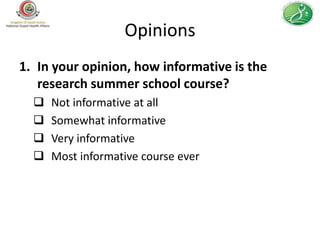
1. In your opinion, how informative is the
   research summer school course?
     Not informative at all
     Somewhat informative
     Very informative
     Most informative course ever
Opinions
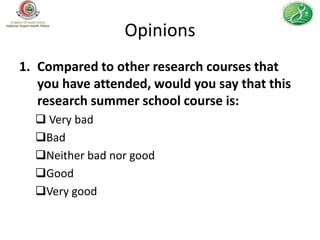
1. Compared to other research courses that
   you have attended, would you say that this
   research summer school course is:
   Very bad
  Bad
  Neither bad nor good
  Good
  Very good
Knowledge
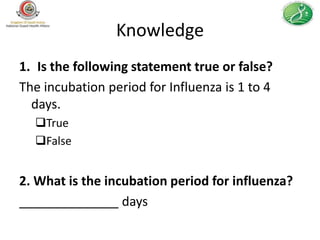
1. Is the following statement true or false?
The incubation period for Influenza is 1 to 4
  days.
  True
  False


2. What is the incubation period for influenza?
______________ days
Response format
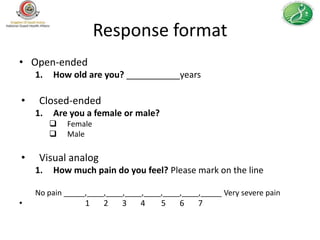
• Open-ended
    1.   How old are you? ___________years

•    Closed-ended
    1.   Are you a female or male?
            Female
            Male

•    Visual analog
    1.   How much pain do you feel? Please mark on the line

    No pain _____,____,____,____,____,____,____,_____ Very severe pain
•                1     2   3    4    5    6    7
Level measurement
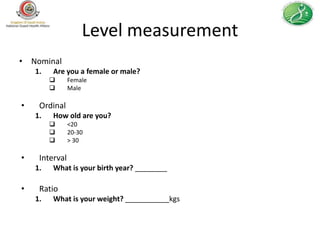
• Nominal
    1.   Are you a female or male?
               Female
               Male

•    Ordinal
    1.   How old are you?
               <20
               20-30
               > 30

•    Interval
    1.   What is your birth year? ________

•    Ratio
    1.   What is your weight? ___________kgs
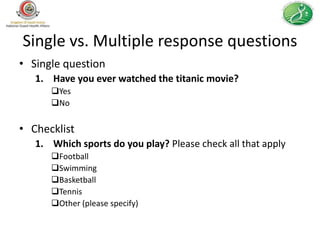
Single vs. Multiple response questions
• Single question
   1. Have you ever watched the titanic movie?
      Yes
      No


• Checklist
   1. Which sports do you play? Please check all that apply
      Football
      Swimming
      Basketball
      Tennis
      Other (please specify)
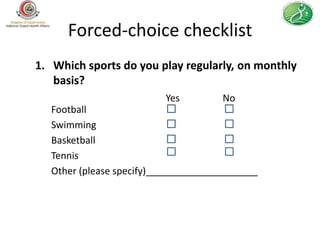
Forced-choice checklist
1. Which sports do you play regularly, on monthly
   basis?
                         Yes         No
  Football
  Swimming
  Basketball
  Tennis
  Other (please specify)_____________________
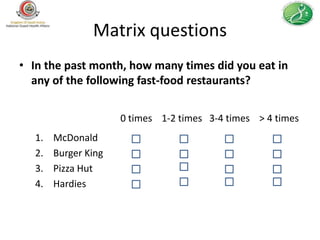
Matrix questions
• In the past month, how many times did you eat in
  any of the following fast-food restaurants?


                     0 times 1-2 times 3-4 times > 4 times
  1.   McDonald
  2.   Burger King
  3.   Pizza Hut
  4.   Hardies
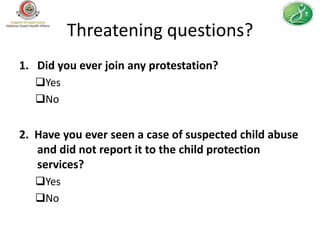
Threatening questions?
1. Did you ever join any protestation?
   Yes
   No


2. Have you ever seen a case of suspected child abuse
   and did not report it to the child protection
   services?
   Yes
   No
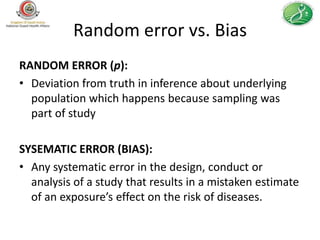
Random error vs. Bias
RANDOM ERROR (p):
• Deviation from truth in inference about underlying
  population which happens because sampling was
  part of study

SYSEMATIC ERROR (BIAS):
• Any systematic error in the design, conduct or
  analysis of a study that results in a mistaken estimate
  of an exposure’s effect on the risk of diseases.
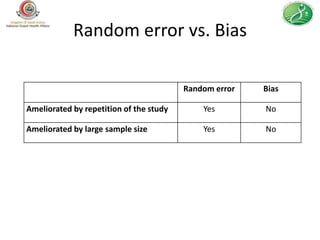
Random error vs. Bias

                                         Random error   Bias

Ameliorated by repetition of the study       Yes        No

Ameliorated by large sample size             Yes        No
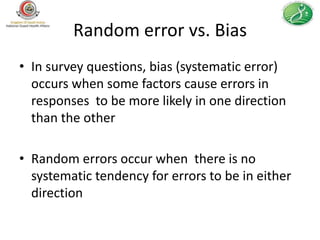
Random error vs. Bias
• In survey questions, bias (systematic error)
  occurs when some factors cause errors in
  responses to be more likely in one direction
  than the other

• Random errors occur when there is no
  systematic tendency for errors to be in either
  direction
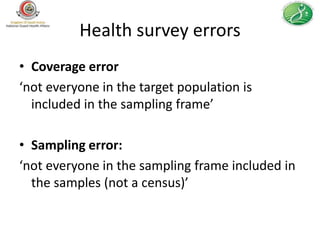
Health survey errors
• Coverage error
‘not everyone in the target population is
  included in the sampling frame’

• Sampling error:
‘not everyone in the sampling frame included in
  the samples (not a census)’
Cont. Health survey errors
• Non-response error
‘not everyone included in the sample actually
  participated’

• Measurement error
‘not all responses are perfectly valid’
Issues to consider in questionnaires
• Questionnaire length
• Question order
     o First question
     o Logic order, grouping
     o Demographic questions
     o Attitude questions (general specific)
     o Factual questions (context specific general ‘recall’)

• Instructions
     o minimal, easy to remember
     o Place specific instructions when needed, make distinct from
       the questions
Issues to consider in questionnaires
• Questionnaire layout (self-administered)
       o   Cover page
       o   Number of pages
       o   Paper size
       o   Question grouping
       o   Matrices
       o   Double questions


• Visual elements (self-administered)
       o   Font
       o   Color/ shading
       o   contrast
       o   Spacing
       o   Response space
       o   Page breaks
       o   consistency
Ethical issues in surveys
• Ethics application
  – Who is doing the study, funding, conflict of
    interest, prior reviews
  – Summary of the project
  – Details of data collection procedures
  – Risk and benefits to participants
  – Informed consent procedure
  – Confidentiality and data safety procedures
Cont. Ethical issues in surveys
• Informed consent/ cover letter
  –   Investigators/ institution
  –   Purpose of the study
  –   Tasks
  –   Duration
  –   Confidentiality
  –   Right to withdraw
  –   Risk and benefits
  –   Remuneration
  –   Contact
  –   Feedback
Questions?
Do’s and don’ts
•   Make it short
•   Name your survey
•   Start with a cover page for introduction
•   Simple wording and easy grammar
•   Assure common understanding
•   Start with an interesting question
•   Avoid leading questions
•   Avoid double negatives
•   Balance rating scale
•   Avoid too long list of choices
Do’s and don’ts
•   Avoid difficult concepts
•   Avoid difficult recall questions
•   Use closed ended questions
•   Use logic order for questions
•   Use square boxes with X placed in front, rather than
    numerical labels for response questions
•   Avoid double questions
•   Avoid complex matrices.
•   Use booklet format (not staples at the upper corner)
•   Pre-test your survey
Thank you
RSS 2012 How to Write a Health Survey

RSS 2012 How to Write a Health Survey

  • 1.
  • 2.
    How to writea health survey? Mona Al-Dabbagh, MD, MHSc Consultant Pediatric Infectious Diseases King AbdulAziz Medical City National Guard Health Affairs
  • 3.
    Objectives • To presenta general outline to health surveys • To demonstrate a systematic guide to writing questionnaires and survey questions.
  • 4.
    What is asurvey? • ‘A purposeful and systematic collection of data from population by means of asking questions’
  • 5.
    Types of Healthsurveys • Aim: Sampling – Descriptive – Random population – Analytical – Non-random population • Topic: • Nature of information – Health status – Subjective – Health determinant – Factual – Health services • Data collection • Study design: – Self-administered – Cross-over – Interview – Longitudinal – Mixed mode
  • 6.
    Steps in designinga health survey 1. Formulating a survey objectives 2. Defining survey variables 3. Choosing the method for data collection 4. Formulating the questions 5. Formatting the questionnaire 6. Designing the method of sampling 7. Calculating the sample size 8. Pilot testing
  • 7.
  • 8.
    Question type • Conceptmeasured – Facts, opinions/attitude, feeling, knowledge, others. • Measurement level – Nominal, ordinal, interval, ratio • Response format – Open-ended, closed-ended, other • Complexity – Single questions, checklist, multi-item scale, other • Sensitivity/ threat level
  • 9.
    Factual questions • Howold are you? ___________ years • What is your gender?  Male  Female • How many children do you have? 1 2 3 4  More than 4 (specify)
  • 10.
    Factual questions • Howmany hours a day do you typically study? Less than 0.5 hours 1 hour to 1.5 hour 1.5 hour to 2 hours 2 hours to 2.5 hours More than 2.5 hours 30% responded > 2.5 hours Dillman et al, 2009
  • 11.
    Factual questions • Howmany hours a day do you typically study? Less than 2.5 hours 2.5 hour to 3 hours 3 hour to 3.5 hours 3.5 hours to 4 hours 4 hours to 4.5 hours More than 4.5 hours 71% responded > 2.5 hours Dillman et al, 2009
  • 12.
    Opinions 1. Do youagree or disagree with the following statement: The research summer school course is very informative. Strongly agree Agree Neither agree nor disagree Disagree Strongly disagree
  • 13.
    Opinions 1. In youropinion, how informative is the research summer school course?  Not informative at all  Somewhat informative  Very informative  Most informative course ever
  • 14.
    Opinions 1. Compared toother research courses that you have attended, would you say that this research summer school course is:  Very bad Bad Neither bad nor good Good Very good
  • 15.
    Knowledge 1. Is thefollowing statement true or false? The incubation period for Influenza is 1 to 4 days. True False 2. What is the incubation period for influenza? ______________ days
  • 16.
    Response format • Open-ended 1. How old are you? ___________years • Closed-ended 1. Are you a female or male?  Female  Male • Visual analog 1. How much pain do you feel? Please mark on the line No pain _____,____,____,____,____,____,____,_____ Very severe pain • 1 2 3 4 5 6 7
  • 17.
    Level measurement • Nominal 1. Are you a female or male?  Female  Male • Ordinal 1. How old are you?  <20  20-30  > 30 • Interval 1. What is your birth year? ________ • Ratio 1. What is your weight? ___________kgs
  • 18.
    Single vs. Multipleresponse questions • Single question 1. Have you ever watched the titanic movie? Yes No • Checklist 1. Which sports do you play? Please check all that apply Football Swimming Basketball Tennis Other (please specify)
  • 19.
    Forced-choice checklist 1. Whichsports do you play regularly, on monthly basis? Yes No Football Swimming Basketball Tennis Other (please specify)_____________________
  • 20.
    Matrix questions • Inthe past month, how many times did you eat in any of the following fast-food restaurants? 0 times 1-2 times 3-4 times > 4 times 1. McDonald 2. Burger King 3. Pizza Hut 4. Hardies
  • 21.
    Threatening questions? 1. Didyou ever join any protestation? Yes No 2. Have you ever seen a case of suspected child abuse and did not report it to the child protection services? Yes No
  • 22.
    Random error vs.Bias RANDOM ERROR (p): • Deviation from truth in inference about underlying population which happens because sampling was part of study SYSEMATIC ERROR (BIAS): • Any systematic error in the design, conduct or analysis of a study that results in a mistaken estimate of an exposure’s effect on the risk of diseases.
  • 23.
    Random error vs.Bias Random error Bias Ameliorated by repetition of the study Yes No Ameliorated by large sample size Yes No
  • 24.
    Random error vs.Bias • In survey questions, bias (systematic error) occurs when some factors cause errors in responses to be more likely in one direction than the other • Random errors occur when there is no systematic tendency for errors to be in either direction
  • 25.
    Health survey errors •Coverage error ‘not everyone in the target population is included in the sampling frame’ • Sampling error: ‘not everyone in the sampling frame included in the samples (not a census)’
  • 26.
    Cont. Health surveyerrors • Non-response error ‘not everyone included in the sample actually participated’ • Measurement error ‘not all responses are perfectly valid’
  • 27.
    Issues to considerin questionnaires • Questionnaire length • Question order o First question o Logic order, grouping o Demographic questions o Attitude questions (general specific) o Factual questions (context specific general ‘recall’) • Instructions o minimal, easy to remember o Place specific instructions when needed, make distinct from the questions
  • 28.
    Issues to considerin questionnaires • Questionnaire layout (self-administered) o Cover page o Number of pages o Paper size o Question grouping o Matrices o Double questions • Visual elements (self-administered) o Font o Color/ shading o contrast o Spacing o Response space o Page breaks o consistency
  • 29.
    Ethical issues insurveys • Ethics application – Who is doing the study, funding, conflict of interest, prior reviews – Summary of the project – Details of data collection procedures – Risk and benefits to participants – Informed consent procedure – Confidentiality and data safety procedures
  • 30.
    Cont. Ethical issuesin surveys • Informed consent/ cover letter – Investigators/ institution – Purpose of the study – Tasks – Duration – Confidentiality – Right to withdraw – Risk and benefits – Remuneration – Contact – Feedback
  • 31.
  • 32.
    Do’s and don’ts • Make it short • Name your survey • Start with a cover page for introduction • Simple wording and easy grammar • Assure common understanding • Start with an interesting question • Avoid leading questions • Avoid double negatives • Balance rating scale • Avoid too long list of choices
  • 33.
    Do’s and don’ts • Avoid difficult concepts • Avoid difficult recall questions • Use closed ended questions • Use logic order for questions • Use square boxes with X placed in front, rather than numerical labels for response questions • Avoid double questions • Avoid complex matrices. • Use booklet format (not staples at the upper corner) • Pre-test your survey
  • 34.

Editor's Notes

  • #6 Data collection:1-Interview:Personal interviewTelephone interview2- self-administeredPaperComputer based3- mixed-mode survey
  • #26 RANDOM ERROR (p):Deviation from truth in inference about underlying population which happens because sampling was part of studySYSEMATIC ERROR (BIAS):Any systematic error in the design, conduct or analysis of a study that results in a mistaken estimate of an exposure’s effect on the risk of diseases.