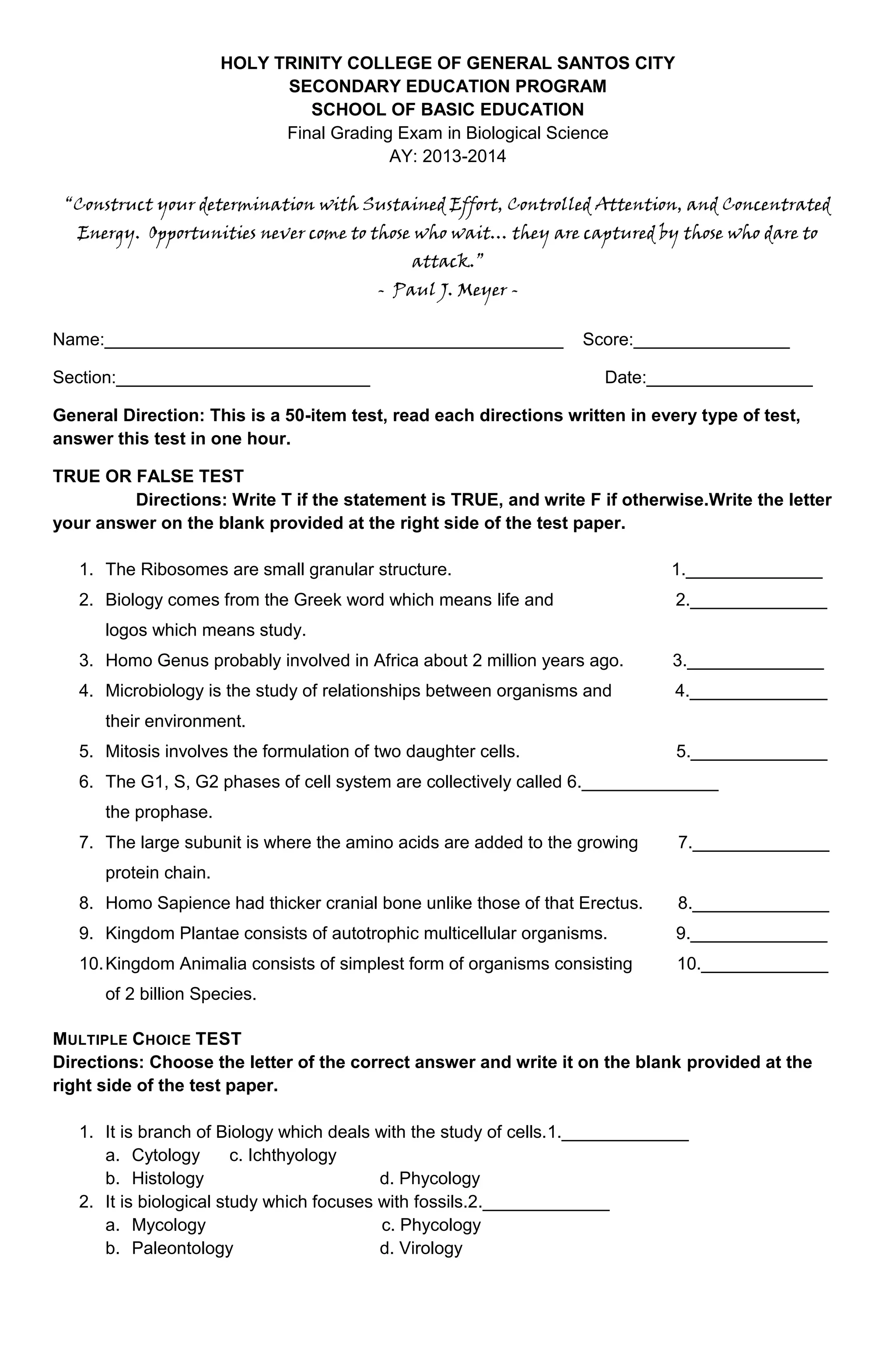
HOLY TRINITY COLLEGE OF GENERAL SANTOS CITY
SECONDARY EDUCATION PROGRAM
SCHOOL OF BASIC EDUCATION
Final Grading Exam in Biological Science
AY: 2013-2014
“Construct your determination with Sustained Effort, Controlled Attention, and Concentrated
Energy. Opportunities never come to those who wait… they are captured by those who dare to
attack.”

- Paul J. Meyer Name:_______________________________________________
Section:__________________________

Score:________________
Date:_________________

General Direction: This is a 50-item test, read each directions written in every type of test,
answer this test in one hour.
TRUE OR FALSE TEST
Directions: Write T if the statement is TRUE, and write F if otherwise.Write the letter
your answer on the blank provided at the right side of the test paper.
1. The Ribosomes are small granular structure.

1.______________

2. Biology comes from the Greek word which means life and

2.______________

logos which means study.
3. Homo Genus probably involved in Africa about 2 million years ago.

3.______________

4. Microbiology is the study of relationships between organisms and

4.______________

their environment.
5. Mitosis involves the formulation of two daughter cells.

5.______________

6. The G1, S, G2 phases of cell system are collectively called 6.______________
the prophase.
7. The large subunit is where the amino acids are added to the growing

7.______________

protein chain.
8. Homo Sapience had thicker cranial bone unlike those of that Erectus.

8.______________

9. Kingdom Plantae consists of autotrophic multicellular organisms.

9.______________

10. Kingdom Animalia consists of simplest form of organisms consisting

10._____________

of 2 billion Species.
MULTIPLE CHOICE TEST
Directions: Choose the letter of the correct answer and write it on the blank provided at the
right side of the test paper.
1. It is branch of Biology which deals with the study of cells.1._____________
a. Cytology
c. Ichthyology
b. Histology
d. Phycology
2. It is biological study which focuses with fossils.2._____________
a. Mycology
c. Phycology
b. Paleontology
d. Virology
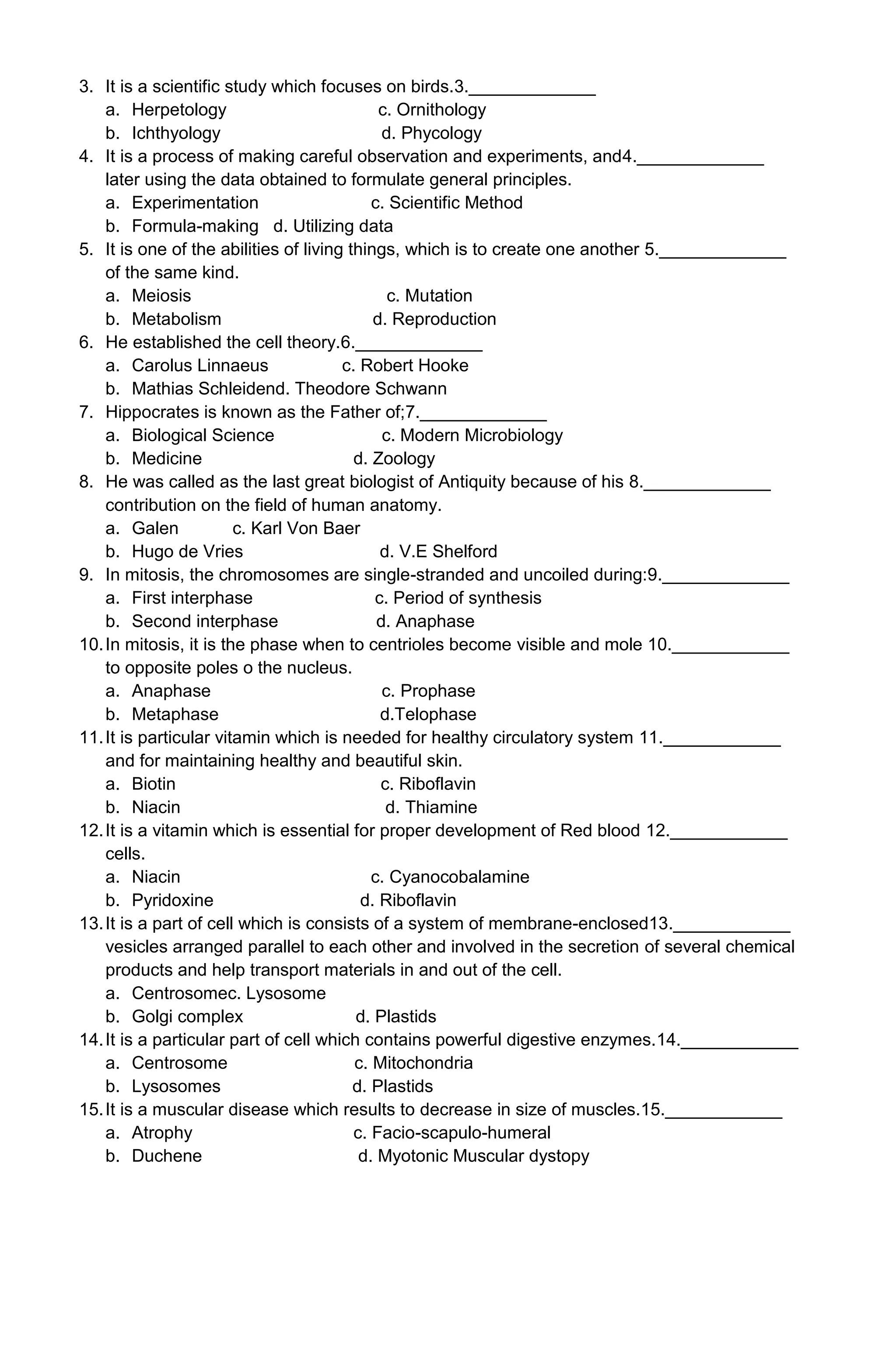
3. It is a scientific study which focuses on birds.3._____________
a. Herpetology
c. Ornithology
b. Ichthyology
d. Phycology
4. It is a process of making careful observation and experiments, and4._____________
later using the data obtained to formulate general principles.
a. Experimentation
c. Scientific Method
b. Formula-making d. Utilizing data
5. It is one of the abilities of living things, which is to create one another 5._____________
of the same kind.
a. Meiosis
c. Mutation
b. Metabolism
d. Reproduction
6. He established the cell theory.6._____________
a. Carolus Linnaeus
c. Robert Hooke
b. Mathias Schleidend. Theodore Schwann
7. Hippocrates is known as the Father of;7._____________
a. Biological Science
c. Modern Microbiology
b. Medicine
d. Zoology
8. He was called as the last great biologist of Antiquity because of his 8._____________
contribution on the field of human anatomy.
a. Galen
c. Karl Von Baer
b. Hugo de Vries
d. V.E Shelford
9. In mitosis, the chromosomes are single-stranded and uncoiled during:9._____________
a. First interphase
c. Period of synthesis
b. Second interphase
d. Anaphase
10. In mitosis, it is the phase when to centrioles become visible and mole 10.____________
to opposite poles o the nucleus.
a. Anaphase
c. Prophase
b. Metaphase
d.Telophase
11. It is particular vitamin which is needed for healthy circulatory system 11.____________
and for maintaining healthy and beautiful skin.
a. Biotin
c. Riboflavin
b. Niacin
d. Thiamine
12. It is a vitamin which is essential for proper development of Red blood 12.____________
cells.
a. Niacin
c. Cyanocobalamine
b. Pyridoxine
d. Riboflavin
13. It is a part of cell which is consists of a system of membrane-enclosed13.____________
vesicles arranged parallel to each other and involved in the secretion of several chemical
products and help transport materials in and out of the cell.
a. Centrosomec. Lysosome
b. Golgi complex
d. Plastids
14. It is a particular part of cell which contains powerful digestive enzymes.14.____________
a. Centrosome
c. Mitochondria
b. Lysosomes
d. Plastids
15. It is a muscular disease which results to decrease in size of muscles.15.____________
a. Atrophy
c. Facio-scapulo-humeral
b. Duchene
d. Myotonic Muscular dystopy
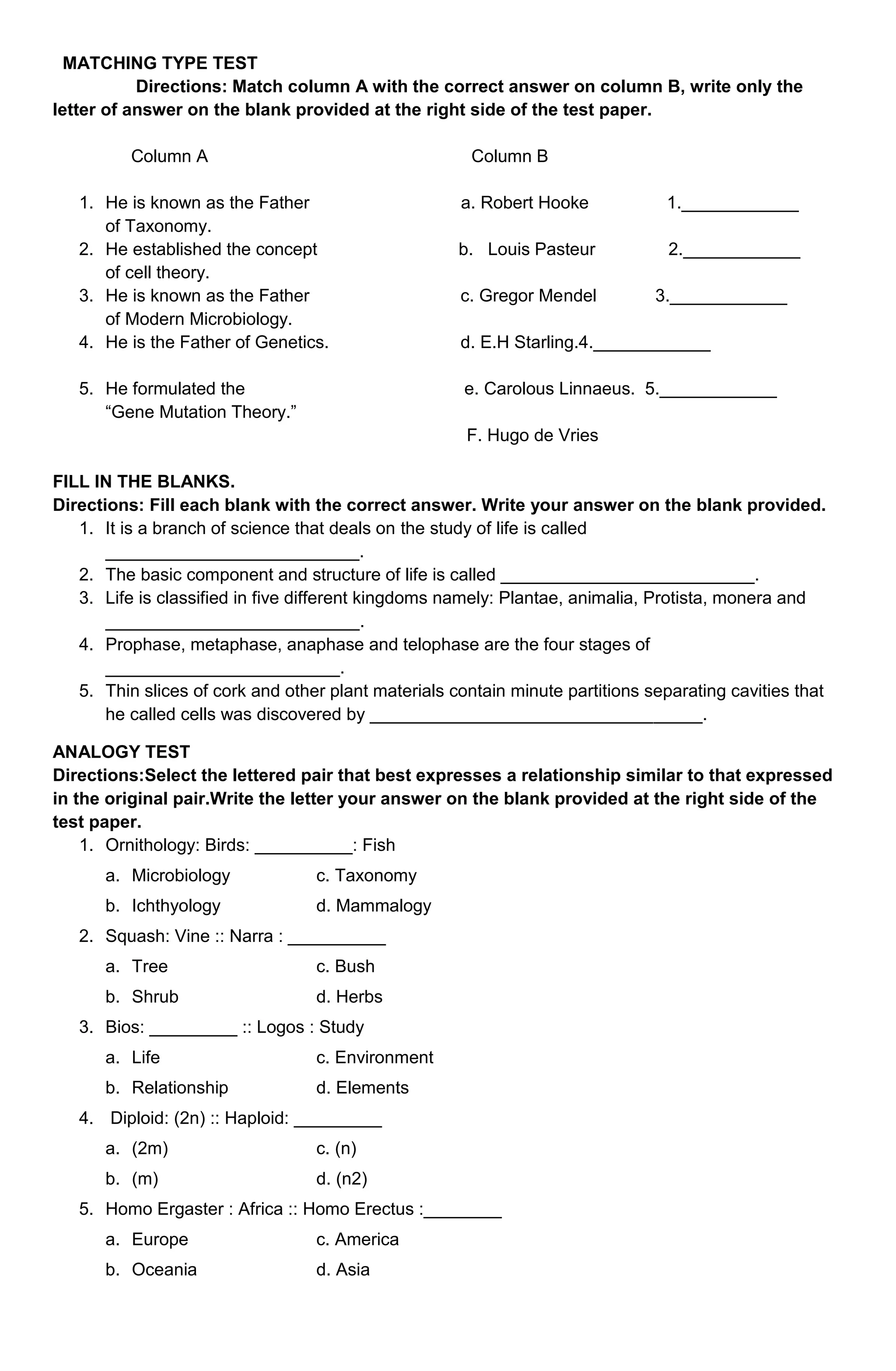
MATCHING TYPE TEST
Directions: Match column A with the correct answer on column B, write only the
letter of answer on the blank provided at the right side of the test paper.
Column A

Column B

1. He is known as the Father
of Taxonomy.
2. He established the concept
of cell theory.
3. He is known as the Father
of Modern Microbiology.
4. He is the Father of Genetics.
5. He formulated the
“Gene Mutation Theory.”

a. Robert Hooke

1.____________

b. Louis Pasteur

2.____________

c. Gregor Mendel

3.____________

d. E.H Starling.4.____________
e. Carolous Linnaeus. 5.____________
F. Hugo de Vries

FILL IN THE BLANKS.
Directions: Fill each blank with the correct answer. Write your answer on the blank provided.
1. It is a branch of science that deals on the study of life is called
__________________________.
2. The basic component and structure of life is called __________________________.
3. Life is classified in five different kingdoms namely: Plantae, animalia, Protista, monera and
__________________________.
4. Prophase, metaphase, anaphase and telophase are the four stages of
________________________.
5. Thin slices of cork and other plant materials contain minute partitions separating cavities that
he called cells was discovered by __________________________________.
ANALOGY TEST
Directions:Select the lettered pair that best expresses a relationship similar to that expressed
in the original pair.Write the letter your answer on the blank provided at the right side of the
test paper.
1. Ornithology: Birds: __________: Fish
a. Microbiology

c. Taxonomy

b. Ichthyology

d. Mammalogy

2. Squash: Vine :: Narra : __________
a. Tree

c. Bush

b. Shrub

d. Herbs

3. Bios: _________ :: Logos : Study
a. Life

c. Environment

b. Relationship

d. Elements

4. Diploid: (2n) :: Haploid: _________
a. (2m)

c. (n)

b. (m)

d. (n2)

5. Homo Ergaster : Africa :: Homo Erectus :________
a. Europe

c. America

b. Oceania

d. Asia
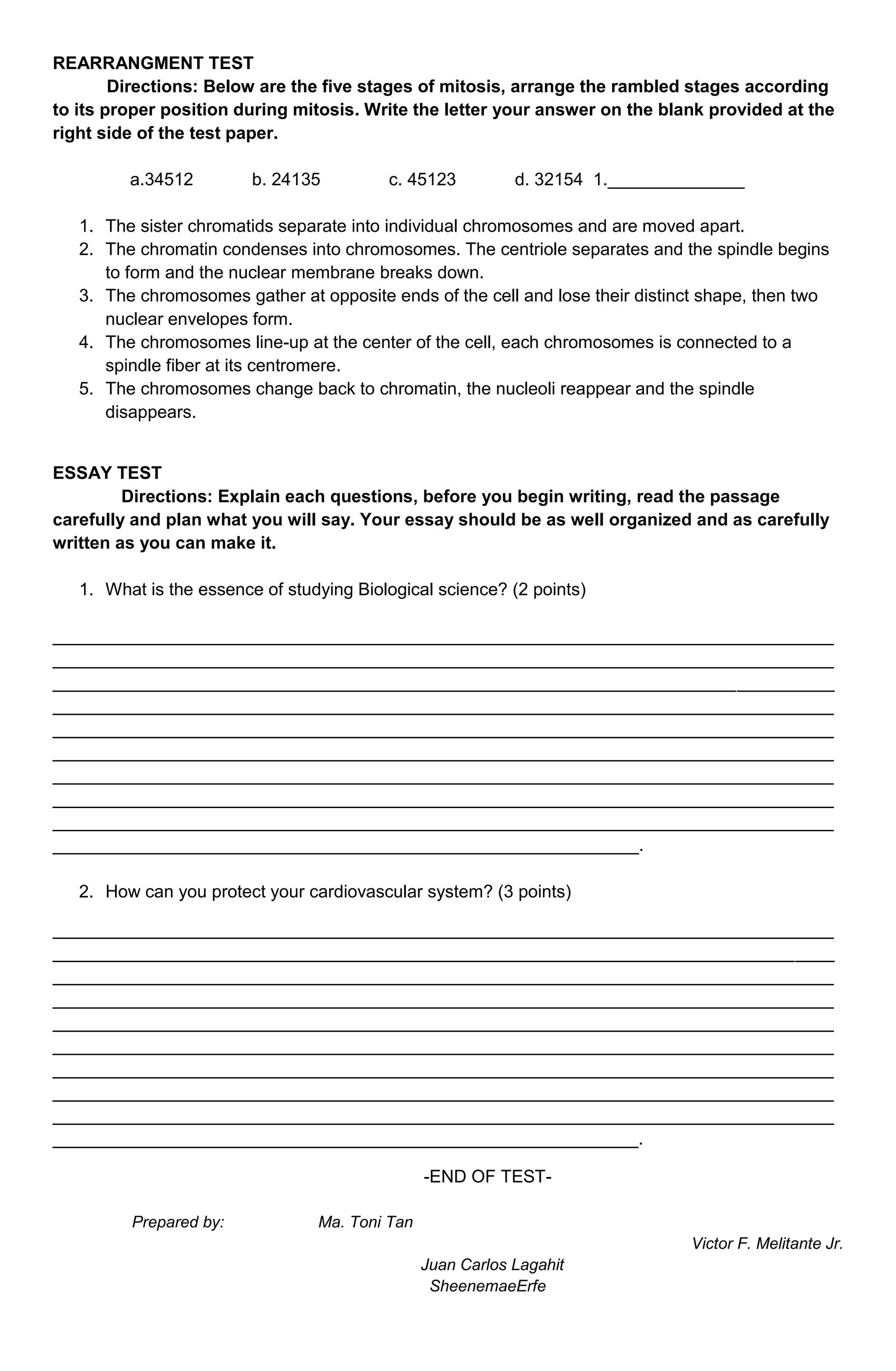
REARRANGMENT TEST
Directions: Below are the five stages of mitosis, arrange the rambled stages according
to its proper position during mitosis. Write the letter your answer on the blank provided at the
right side of the test paper.
a.34512

b. 24135

c. 45123

d. 32154 1.______________

1. The sister chromatids separate into individual chromosomes and are moved apart.
2. The chromatin condenses into chromosomes. The centriole separates and the spindle begins
to form and the nuclear membrane breaks down.
3. The chromosomes gather at opposite ends of the cell and lose their distinct shape, then two
nuclear envelopes form.
4. The chromosomes line-up at the center of the cell, each chromosomes is connected to a
spindle fiber at its centromere.
5. The chromosomes change back to chromatin, the nucleoli reappear and the spindle
disappears.

ESSAY TEST
Directions: Explain each questions, before you begin writing, read the passage
carefully and plan what you will say. Your essay should be as well organized and as carefully
written as you can make it.
1. What is the essence of studying Biological science? (2 points)
________________________________________________________________________________
________________________________________________________________________________
________________________________________________________________________________
________________________________________________________________________________
________________________________________________________________________________
________________________________________________________________________________
________________________________________________________________________________
________________________________________________________________________________
________________________________________________________________________________
____________________________________________________________.
2. How can you protect your cardiovascular system? (3 points)
________________________________________________________________________________
________________________________________________________________________________
________________________________________________________________________________
________________________________________________________________________________
________________________________________________________________________________
________________________________________________________________________________
________________________________________________________________________________
________________________________________________________________________________
________________________________________________________________________________
____________________________________________________________.
-END OF TESTPrepared by:

Ma. Toni Tan
Victor F. Melitante Jr.
Juan Carlos Lagahit
SheenemaeErfe

sample test questionnaire in Biological Science

  • 1.
    HOLY TRINITY COLLEGEOF GENERAL SANTOS CITY SECONDARY EDUCATION PROGRAM SCHOOL OF BASIC EDUCATION Final Grading Exam in Biological Science AY: 2013-2014 “Construct your determination with Sustained Effort, Controlled Attention, and Concentrated Energy. Opportunities never come to those who wait… they are captured by those who dare to attack.” - Paul J. Meyer Name:_______________________________________________ Section:__________________________ Score:________________ Date:_________________ General Direction: This is a 50-item test, read each directions written in every type of test, answer this test in one hour. TRUE OR FALSE TEST Directions: Write T if the statement is TRUE, and write F if otherwise.Write the letter your answer on the blank provided at the right side of the test paper. 1. The Ribosomes are small granular structure. 1.______________ 2. Biology comes from the Greek word which means life and 2.______________ logos which means study. 3. Homo Genus probably involved in Africa about 2 million years ago. 3.______________ 4. Microbiology is the study of relationships between organisms and 4.______________ their environment. 5. Mitosis involves the formulation of two daughter cells. 5.______________ 6. The G1, S, G2 phases of cell system are collectively called 6.______________ the prophase. 7. The large subunit is where the amino acids are added to the growing 7.______________ protein chain. 8. Homo Sapience had thicker cranial bone unlike those of that Erectus. 8.______________ 9. Kingdom Plantae consists of autotrophic multicellular organisms. 9.______________ 10. Kingdom Animalia consists of simplest form of organisms consisting 10._____________ of 2 billion Species. MULTIPLE CHOICE TEST Directions: Choose the letter of the correct answer and write it on the blank provided at the right side of the test paper. 1. It is branch of Biology which deals with the study of cells.1._____________ a. Cytology c. Ichthyology b. Histology d. Phycology 2. It is biological study which focuses with fossils.2._____________ a. Mycology c. Phycology b. Paleontology d. Virology
  • 2.
    3. It isa scientific study which focuses on birds.3._____________ a. Herpetology c. Ornithology b. Ichthyology d. Phycology 4. It is a process of making careful observation and experiments, and4._____________ later using the data obtained to formulate general principles. a. Experimentation c. Scientific Method b. Formula-making d. Utilizing data 5. It is one of the abilities of living things, which is to create one another 5._____________ of the same kind. a. Meiosis c. Mutation b. Metabolism d. Reproduction 6. He established the cell theory.6._____________ a. Carolus Linnaeus c. Robert Hooke b. Mathias Schleidend. Theodore Schwann 7. Hippocrates is known as the Father of;7._____________ a. Biological Science c. Modern Microbiology b. Medicine d. Zoology 8. He was called as the last great biologist of Antiquity because of his 8._____________ contribution on the field of human anatomy. a. Galen c. Karl Von Baer b. Hugo de Vries d. V.E Shelford 9. In mitosis, the chromosomes are single-stranded and uncoiled during:9._____________ a. First interphase c. Period of synthesis b. Second interphase d. Anaphase 10. In mitosis, it is the phase when to centrioles become visible and mole 10.____________ to opposite poles o the nucleus. a. Anaphase c. Prophase b. Metaphase d.Telophase 11. It is particular vitamin which is needed for healthy circulatory system 11.____________ and for maintaining healthy and beautiful skin. a. Biotin c. Riboflavin b. Niacin d. Thiamine 12. It is a vitamin which is essential for proper development of Red blood 12.____________ cells. a. Niacin c. Cyanocobalamine b. Pyridoxine d. Riboflavin 13. It is a part of cell which is consists of a system of membrane-enclosed13.____________ vesicles arranged parallel to each other and involved in the secretion of several chemical products and help transport materials in and out of the cell. a. Centrosomec. Lysosome b. Golgi complex d. Plastids 14. It is a particular part of cell which contains powerful digestive enzymes.14.____________ a. Centrosome c. Mitochondria b. Lysosomes d. Plastids 15. It is a muscular disease which results to decrease in size of muscles.15.____________ a. Atrophy c. Facio-scapulo-humeral b. Duchene d. Myotonic Muscular dystopy
  • 3.
    MATCHING TYPE TEST Directions:Match column A with the correct answer on column B, write only the letter of answer on the blank provided at the right side of the test paper. Column A Column B 1. He is known as the Father of Taxonomy. 2. He established the concept of cell theory. 3. He is known as the Father of Modern Microbiology. 4. He is the Father of Genetics. 5. He formulated the “Gene Mutation Theory.” a. Robert Hooke 1.____________ b. Louis Pasteur 2.____________ c. Gregor Mendel 3.____________ d. E.H Starling.4.____________ e. Carolous Linnaeus. 5.____________ F. Hugo de Vries FILL IN THE BLANKS. Directions: Fill each blank with the correct answer. Write your answer on the blank provided. 1. It is a branch of science that deals on the study of life is called __________________________. 2. The basic component and structure of life is called __________________________. 3. Life is classified in five different kingdoms namely: Plantae, animalia, Protista, monera and __________________________. 4. Prophase, metaphase, anaphase and telophase are the four stages of ________________________. 5. Thin slices of cork and other plant materials contain minute partitions separating cavities that he called cells was discovered by __________________________________. ANALOGY TEST Directions:Select the lettered pair that best expresses a relationship similar to that expressed in the original pair.Write the letter your answer on the blank provided at the right side of the test paper. 1. Ornithology: Birds: __________: Fish a. Microbiology c. Taxonomy b. Ichthyology d. Mammalogy 2. Squash: Vine :: Narra : __________ a. Tree c. Bush b. Shrub d. Herbs 3. Bios: _________ :: Logos : Study a. Life c. Environment b. Relationship d. Elements 4. Diploid: (2n) :: Haploid: _________ a. (2m) c. (n) b. (m) d. (n2) 5. Homo Ergaster : Africa :: Homo Erectus :________ a. Europe c. America b. Oceania d. Asia
  • 4.
    REARRANGMENT TEST Directions: Beloware the five stages of mitosis, arrange the rambled stages according to its proper position during mitosis. Write the letter your answer on the blank provided at the right side of the test paper. a.34512 b. 24135 c. 45123 d. 32154 1.______________ 1. The sister chromatids separate into individual chromosomes and are moved apart. 2. The chromatin condenses into chromosomes. The centriole separates and the spindle begins to form and the nuclear membrane breaks down. 3. The chromosomes gather at opposite ends of the cell and lose their distinct shape, then two nuclear envelopes form. 4. The chromosomes line-up at the center of the cell, each chromosomes is connected to a spindle fiber at its centromere. 5. The chromosomes change back to chromatin, the nucleoli reappear and the spindle disappears. ESSAY TEST Directions: Explain each questions, before you begin writing, read the passage carefully and plan what you will say. Your essay should be as well organized and as carefully written as you can make it. 1. What is the essence of studying Biological science? (2 points) ________________________________________________________________________________ ________________________________________________________________________________ ________________________________________________________________________________ ________________________________________________________________________________ ________________________________________________________________________________ ________________________________________________________________________________ ________________________________________________________________________________ ________________________________________________________________________________ ________________________________________________________________________________ ____________________________________________________________. 2. How can you protect your cardiovascular system? (3 points) ________________________________________________________________________________ ________________________________________________________________________________ ________________________________________________________________________________ ________________________________________________________________________________ ________________________________________________________________________________ ________________________________________________________________________________ ________________________________________________________________________________ ________________________________________________________________________________ ________________________________________________________________________________ ____________________________________________________________. -END OF TESTPrepared by: Ma. Toni Tan Victor F. Melitante Jr. Juan Carlos Lagahit SheenemaeErfe