DEPARTEMENT OF FAMILY MEDICINE
AKTH KANO
POST- PARTUM IUD INSERTION
DR OGECHUKWU MBANU
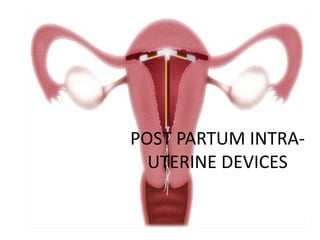
POST PARTUM INTRA-
UTERINE DEVICES
OUTLINE
• Introduction /definition
• IUDs ,uses , classification ,mechanisms of action and
advantages
• classification of PPIUDs
• Why PPIUD
• Non pregnant versus immediate post partum uteru and
cervix
• An overview of the process of PPIUD
• Contraindications /misconceptions
• IUDs and STIs
• Reasons for non use of IUDs
• Warning symptoms
• Conclusion
• References
introduction
As of 2013 250 million pregnancies occurred
globally
Majority in less developed nations with high
fertility rate, hence, need for fertility regulation
33.3% unintended;
As of 2013 Unmet need for family planning in
Nigeria is currently 16% among married women
IUD is the most commonly used reversible
method of contraception worldwide with about
127 million current users
 Postpartum insertion of IUD is safe, effective
and convenient for women
Unmet Need for Modern Contraception
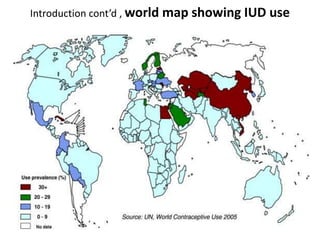
Introduction cont’d , world map showing IUD use
DEFINITIONS
• Post-partum : This is the period beginning
immediately after the birth of a child and extending
for about four to six weeks
• IUD OR IUCD: Is a small usually T – shaped plastic
device that is wrapped in copper or contains
hormones , inserted into the uterine cavity mostly
for the purpose of contraception
• Post – partum IUD(PPIUD) :The insertion of an IUD
into the uterine cavity during post- partum period
• Trans – caesarean: Procedure done within the
period of the cs
Definitions cont’d ;Stages of postpartum period
4 stages :
• The post - placental period—within the first 10
minutes after expulsion of the placenta
• The immediate postpartum period—includes
the first 48 hours postpartum
• The early postpartum period—extends until
the first week postpartum
• The remote postpartum period—which
includes the period of time required for the
complete involution of the uterus and has
traditionally extended through the fourth
week postpartum
Intrauterine Contraception Devices:
• Most commonly used reversible method of
Contraception worldwide
• effective > 97%
• The newer devices have failure rate of < 0.5%
Clinical uses
• Long-term contraception
• Emergency contraceptive (1:1000 )
• Menorrhagia
• Endometriosis
• Chronic pelvic pain
• Dysmenorrhea
• Endometrial hyperplasia
• Contraindication to COC such as in ischemic heart
disease , focal migraine, liver disease,and breast CA
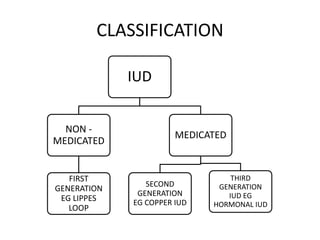
CLASSIFICATION
IUD
MEDICATED
THIRD
GENERATION
IUD EG
HORMONAL IUD
SECOND
GENERATION
EG COPPER IUD
NON -
MEDICATED
FIRST
GENERATION
EG LIPPES
LOOP
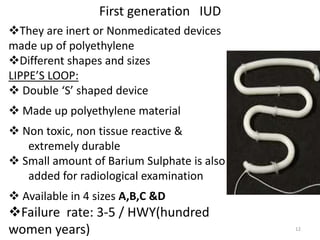
First generation IUD
They are inert or Nonmedicated devices
made up of polyethylene
Different shapes and sizes
LIPPE’S LOOP:
 Double ‘S’ shaped device
 Made up polyethylene material
 Non toxic, non tissue reactive &
extremely durable
 Small amount of Barium Sulphate is also
added for radiological examination
 Available in 4 sizes A,B,C &D
Failure rate: 3-5 / HWY(hundred
women years) 12
Second generation Iud
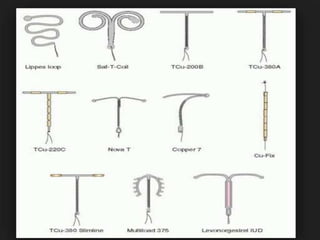
Wrapped with copper.
EARLIER DEVICES
Copper – 7(Gravigard)
Copper - T 200
1st year failure rate of 0.1- 2.2%
NEWER DEVICES
Variants of T device
 T copper 220C
 T copper 380A( paragard )
Nova T
Multi load devices
 ML-Cu250
 ML-Cu375 (u- shaped)
13
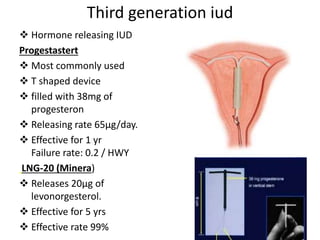
Third generation iud
 Hormone releasing IUD
Progestastert
 Most commonly used
 T shaped device
 filled with 38mg of
progesteron
 Releasing rate 65µg/day.
 Effective for 1 yr
Failure rate: 0.2 / HWY
LNG-20 (Minera)
 Releases 20µg of
levonorgesterol.
 Effective for 5 yrs
 Effective rate 99%
Other types IUD
• Silver IUD (silverlily): a silver copper combination
• Gold containing IUD such as Goldring medusa,
Eurogine gold T IUD, Gold lily :these contain gold
and copper
• Frameless IUD such as Gynefix which consists of
hollow copper tubes on a polypropylene thread. It
is anchored about 1 cm into the myometrium at
the fundus.
Mechanism of Action:
- All IUCD cause a foreign body reaction in the
endometrium with increased prostaglandin
production and Leucocyte infiltration thus
inhibiting sperm transport.
- Alteration of uterine and tubal fluid which
impaired the viability of the gametes.
- The progesterone IUCD (LNG.IUD) cause
endometrial suppression and thinning, also
changes in the cervical mucus and utero- tubal
fluid which impair sperm migration.
General advantages of IUD
• Long acting and reversible
• No excessive weight gain
• Very effective – at least 99%.
• Can be easily removed
• Does not affect breastfeeding.
• Does not interfere with sexual intercourse
• No-one else needs to know you are using it.
• No evidence of an increased risk of cancer..
• Copper IUDs can also be used for emergency
contraception
• Hormone IUDs release a very small dose of hormone
thus side effects are minimal
• Mirena reduces period bleeding and pain so most
women will have light bleeding or no periods at all.
Classification of PPIUD
Based on Postpartum IUD timing
• Post - placental: Inserted within 10 minutes the
placenta is expelled in a vaginal delivery
• Immediate postpartum: Insertion within 48
hours of delivery , before the client leaves the
hospital.
• Trans - ceasarean: Insertion following a cesarean
delivery, before the uterine incision is sutured.
• Post - abortion: The IUD is inserted following an
abortion.
• Note: An interval IUD inserted at any time
between pregnancies after 4 weeks post-partum
or completely unrelated to pregnancy
Why postpartum IUD ?
• It is readily accessible for women who deliver at
health care facilities
• Postpartum amenorrhea and Return to fertility
• Breastfeeding status: has no effect on amount
or quality of breast milk
• Postpartum abstinence and return to having sex
• Limited mobility and access to services in
postpartum period
• Decision- making: influence of other parties like
mother in laws
Why postpartum IUD cont’d
• inertia in seeking postpartum services
• Does not require any daily action on the part
of the user
• Preventing lost opportunities
• . Cost-effectiveness
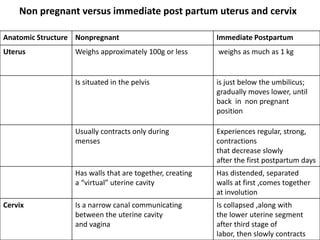
Non pregnant versus immediate post partum uterus and cervix
Anatomic Structure Nonpregnant Immediate Postpartum
Uterus Weighs approximately 100g or less weighs as much as 1 kg
Is situated in the pelvis is just below the umbilicus;
gradually moves lower, until
back in non pregnant
position
Usually contracts only during
menses
Experiences regular, strong,
contractions
that decrease slowly
after the first postpartum days
Has walls that are together, creating
a “virtual” uterine cavity
Has distended, separated
walls at first ,comes together
at involution
Cervix Is a narrow canal communicating
between the uterine cavity
and vagina
Is collapsed ,along with
the lower uterine segment
after third stage of
labor, then slowly contracts
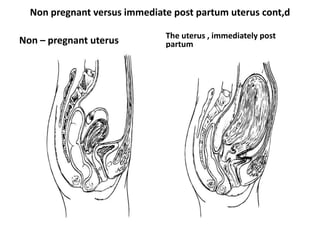
Non pregnant versus immediate post partum uterus cont,d
Non – pregnant uterus The uterus , immediately post
partum
Immediate postpartum versus non pregnant uterus
and cervix
The anatomical changes in immediate
postpartum uterus and cervix
• Makes it possible to safely insert IUD
immediately after delivery
• This Insertion can be immediate, pre
discharge ,or at caesarean section
• This will reduce the un-met need of our
women for contraception
An overview of the process of PPIUD
Key Components of Care Related to PPIUD
Service Delivery
Rights of Clients
 Information
Access to services
Informed choice
Safe services
Privacy and confidentiality
Dignity, comfort, and expression of opinion
Continuity of care
An overview of the process of PPIUD cont’d
Key Components of IUD service cont’d
Needs of Providers
Facilitative supervision and management
 Information update
 training, and development
 Supplies, equipment, and infrastructure
Process cont’d PPIUD counseling
This should be integrated into the antenatal
programme
• Encourage healthy spacing of pregnancies
• Discuss the different types of family planning
and encourage to consider PPIUD
• Encouraged to discuss and choose a family
planning method with husband before she is
at risk of getting pregnant
• The right family planning method must suit
the patients brestfeeding need and other
family needs
Counseling for those who have accepted PPIUD
• She can have it inserted within 48 hours of
delivery before leaving the facility, or she can
have it inserted four weeks after delivery.
• Postpartum IUD does not affect breast milk
and breast feeding.
• Post-placental , immediate , Trans - caesarean
and interval IUD insertion are safe procedures.
• The expulsion rate is higher for IUDs inserted
within 48 hours of delivery . The client needs
to be on the lookout for an expulsion
COUNSELING CONT’D
• In the case of expulsion she can usually
have another IUD inserted after four
weeks
• she will need another method of
contraception in the mean time
• possibility of “missing strings”
• The importance of a follow-up visit
• Be sure to discuss any possible difficulties
related to her returning for a follow-up
visit
An overview of the process of PPIUD cont’d
• NOTE
• 1. Prior to inserting the postpartum IUD: Confirm
that the client has made an informed, voluntary
decision ,consent form signed.
• 2. Before and during postpartum insertion of the
IUD: Put the client at ease by talking with her
• 3. After the insertion:
• A client card with the name of the IUD and the
date of insertion should be given to her
• Written post-insertion instructions should be
given too
• Assure her that IUD does not affect breast milk
or breastfeeding
• Give appointment for follow up
Client Assessment for Postpartum IUD Use
• Components of a Client Assessment
• 1. Taking and assessing the client’s medical
history, including
• a. General medical, obstetric, and gynecologic
history
• b. STI risk assessment
• 2. Performing a physical examination
• 3.There is no laboratory test required for
postpartum IUD insertions
• 4. Providers should check in the antenatal and
obstetric record for any laboratory test done
at that moment as a good practice
Technique
• Immediate postpartum IUD can be
inserted using a kellys or ringed forceps
• Post-placental IUD can be done with
kellys forceps or by manual insertion
• For trans-caesarean IUD ,as the uterus is
open, the IUD can be placed with the
fingers or with any grasping instrument
in the uterine fundus
General contraindications to IUDs
•Post partum puerperal sepsis
•Suspected gynecological malignancy
(Cervical cancer, Endometrial cancer)
•Current STDs
•Current PID
•Anatomical abnormalities of the uterus or cervix
•Allergy to copper
•History of abnormal uterine bleeding
•Wilsons disease in the case of copper T 380A
•Endometritis
•Pregnancy
•History of ectopic pregnancies
Complications of IUD(PPIUD)
• infection (about 1%) this can lead to PID
• perforation of the womb (about 1 in
• 1,000).
• pregnancy can occur with an IUD in place but this is
rare.
• ectopic pregnancy ;Higher rate with progestasert
• copper IUD may cause more bleeding and cramping
during periods.
• copper IUD can very rarely cause an allergic reaction
• Hormone IUDs may initially cause irregular, light
bleeding for more days than usual.
• Expulsion (about 5%)
• Spontaneous abortion
• Increase risk of preterm labour (if left in place)
missconceptions
.There is no evidence that IUDs cause
 acne,
headaches,
 breast Tenderness
 nausea,
 mood changes,
 loss of libido or
 weight gain
The IUD and sexually transmitted infections
• According to WHO 2004 medical eligibility
criteria, the following women with STIs and
with HIV-related conditions generally can
start using IUD:
• Women who have had pelvic inflammatory
disease (PID) in the past, as long as they have
no known current risk factors for STIs. (If they
have had a subsequent pregnancy, they can
use the IUD—)
• Women who have HIV but who do not have
AIDS.
• Women who have AIDS and who are doing
clinically well on antiretroviral therapy
Reasons for nonuse of IUD can be grouped into
a few broad categories
Opposition to family planning
Lack of knowledge
Access and cost
Health concerns and side effects of methods
Misconceptions about pregnancy risk
Warning symptoms
• Cannot feel string
• Missed period
• Unusual vaginal fluid or odour
• Severe abdominal pain, cramps ,or bleeding
• Bleeding occuring with sex
• Unexplained fever ,chills
• Severe pain during sex
Conclusion
• In Nigeria risk of pregnancy increases
over time during post partum period .
• Over half (54%) of all non- first births in
Nigeria are spaced at less than the
recommended 24 month interval
• This puts women and their infants at
increased risk of poor maternal and
perinatal outcomes
• Greater awareness and use of PPIUD can
help reduce this risk
THANK YOU
FOR
LISTENING
REFERENCE
• Nelson A. Intrauterine contraceptives vol.6. Philadelphia .Lippincott
Williams and Wilkins ; 2004 .Gynaecology and obstetrics
• WHO and gutmacher institute; facts on induced abortion worldwide
.2007
• THE POSTPARTUM INTRAUTERINE DEVICE participant handbook . A
training course for service providers 2008 USAID , the ACQUIRE project
• The postpartum intrauterine device(PPIUD) services- A reference
manual for providers 2010 ,USAID , access
• Family planning needs during the 1st two years post partum in nigeria-
2013 – USAID, CHIP.
• Iud – A quick review , Kamlesh Giri
• Intrauterine contraceptive devices ppt presentation by Lavina
Balavutham
• Intrauterine devices knowledge , attitude and use among women
seeking termination of pregnancy in Gauteng South Africa
• A giude to developing family planning messages for women in the first
year post partum

Post partum iud insertion

  • 1.
    DEPARTEMENT OF FAMILYMEDICINE AKTH KANO POST- PARTUM IUD INSERTION DR OGECHUKWU MBANU
  • 2.
  • 3.
    OUTLINE • Introduction /definition •IUDs ,uses , classification ,mechanisms of action and advantages • classification of PPIUDs • Why PPIUD • Non pregnant versus immediate post partum uteru and cervix • An overview of the process of PPIUD • Contraindications /misconceptions • IUDs and STIs • Reasons for non use of IUDs • Warning symptoms • Conclusion • References
  • 4.
    introduction As of 2013250 million pregnancies occurred globally Majority in less developed nations with high fertility rate, hence, need for fertility regulation 33.3% unintended; As of 2013 Unmet need for family planning in Nigeria is currently 16% among married women IUD is the most commonly used reversible method of contraception worldwide with about 127 million current users  Postpartum insertion of IUD is safe, effective and convenient for women
  • 5.
    Unmet Need forModern Contraception
  • 6.
    Introduction cont’d ,world map showing IUD use
  • 7.
    DEFINITIONS • Post-partum :This is the period beginning immediately after the birth of a child and extending for about four to six weeks • IUD OR IUCD: Is a small usually T – shaped plastic device that is wrapped in copper or contains hormones , inserted into the uterine cavity mostly for the purpose of contraception • Post – partum IUD(PPIUD) :The insertion of an IUD into the uterine cavity during post- partum period • Trans – caesarean: Procedure done within the period of the cs
  • 8.
    Definitions cont’d ;Stagesof postpartum period 4 stages : • The post - placental period—within the first 10 minutes after expulsion of the placenta • The immediate postpartum period—includes the first 48 hours postpartum • The early postpartum period—extends until the first week postpartum • The remote postpartum period—which includes the period of time required for the complete involution of the uterus and has traditionally extended through the fourth week postpartum
  • 9.
    Intrauterine Contraception Devices: •Most commonly used reversible method of Contraception worldwide • effective > 97% • The newer devices have failure rate of < 0.5%
  • 10.
    Clinical uses • Long-termcontraception • Emergency contraceptive (1:1000 ) • Menorrhagia • Endometriosis • Chronic pelvic pain • Dysmenorrhea • Endometrial hyperplasia • Contraindication to COC such as in ischemic heart disease , focal migraine, liver disease,and breast CA
  • 11.
    CLASSIFICATION IUD MEDICATED THIRD GENERATION IUD EG HORMONAL IUD SECOND GENERATION EGCOPPER IUD NON - MEDICATED FIRST GENERATION EG LIPPES LOOP
  • 12.
    First generation IUD Theyare inert or Nonmedicated devices made up of polyethylene Different shapes and sizes LIPPE’S LOOP:  Double ‘S’ shaped device  Made up polyethylene material  Non toxic, non tissue reactive & extremely durable  Small amount of Barium Sulphate is also added for radiological examination  Available in 4 sizes A,B,C &D Failure rate: 3-5 / HWY(hundred women years) 12
  • 13.
    Second generation Iud Wrappedwith copper. EARLIER DEVICES Copper – 7(Gravigard) Copper - T 200 1st year failure rate of 0.1- 2.2% NEWER DEVICES Variants of T device  T copper 220C  T copper 380A( paragard ) Nova T Multi load devices  ML-Cu250  ML-Cu375 (u- shaped) 13
  • 14.
    Third generation iud Hormone releasing IUD Progestastert  Most commonly used  T shaped device  filled with 38mg of progesteron  Releasing rate 65µg/day.  Effective for 1 yr Failure rate: 0.2 / HWY LNG-20 (Minera)  Releases 20µg of levonorgesterol.  Effective for 5 yrs  Effective rate 99%
  • 15.
    Other types IUD •Silver IUD (silverlily): a silver copper combination • Gold containing IUD such as Goldring medusa, Eurogine gold T IUD, Gold lily :these contain gold and copper • Frameless IUD such as Gynefix which consists of hollow copper tubes on a polypropylene thread. It is anchored about 1 cm into the myometrium at the fundus.
  • 17.
    Mechanism of Action: -All IUCD cause a foreign body reaction in the endometrium with increased prostaglandin production and Leucocyte infiltration thus inhibiting sperm transport. - Alteration of uterine and tubal fluid which impaired the viability of the gametes. - The progesterone IUCD (LNG.IUD) cause endometrial suppression and thinning, also changes in the cervical mucus and utero- tubal fluid which impair sperm migration.
  • 18.
    General advantages ofIUD • Long acting and reversible • No excessive weight gain • Very effective – at least 99%. • Can be easily removed • Does not affect breastfeeding. • Does not interfere with sexual intercourse • No-one else needs to know you are using it. • No evidence of an increased risk of cancer.. • Copper IUDs can also be used for emergency contraception • Hormone IUDs release a very small dose of hormone thus side effects are minimal • Mirena reduces period bleeding and pain so most women will have light bleeding or no periods at all.
  • 19.
    Classification of PPIUD Basedon Postpartum IUD timing • Post - placental: Inserted within 10 minutes the placenta is expelled in a vaginal delivery • Immediate postpartum: Insertion within 48 hours of delivery , before the client leaves the hospital. • Trans - ceasarean: Insertion following a cesarean delivery, before the uterine incision is sutured. • Post - abortion: The IUD is inserted following an abortion. • Note: An interval IUD inserted at any time between pregnancies after 4 weeks post-partum or completely unrelated to pregnancy
  • 20.
    Why postpartum IUD? • It is readily accessible for women who deliver at health care facilities • Postpartum amenorrhea and Return to fertility • Breastfeeding status: has no effect on amount or quality of breast milk • Postpartum abstinence and return to having sex • Limited mobility and access to services in postpartum period • Decision- making: influence of other parties like mother in laws
  • 21.
    Why postpartum IUDcont’d • inertia in seeking postpartum services • Does not require any daily action on the part of the user • Preventing lost opportunities • . Cost-effectiveness
  • 22.
    Non pregnant versusimmediate post partum uterus and cervix Anatomic Structure Nonpregnant Immediate Postpartum Uterus Weighs approximately 100g or less weighs as much as 1 kg Is situated in the pelvis is just below the umbilicus; gradually moves lower, until back in non pregnant position Usually contracts only during menses Experiences regular, strong, contractions that decrease slowly after the first postpartum days Has walls that are together, creating a “virtual” uterine cavity Has distended, separated walls at first ,comes together at involution Cervix Is a narrow canal communicating between the uterine cavity and vagina Is collapsed ,along with the lower uterine segment after third stage of labor, then slowly contracts
  • 23.
    Non pregnant versusimmediate post partum uterus cont,d Non – pregnant uterus The uterus , immediately post partum
  • 24.
    Immediate postpartum versusnon pregnant uterus and cervix The anatomical changes in immediate postpartum uterus and cervix • Makes it possible to safely insert IUD immediately after delivery • This Insertion can be immediate, pre discharge ,or at caesarean section • This will reduce the un-met need of our women for contraception
  • 25.
    An overview ofthe process of PPIUD Key Components of Care Related to PPIUD Service Delivery Rights of Clients  Information Access to services Informed choice Safe services Privacy and confidentiality Dignity, comfort, and expression of opinion Continuity of care
  • 26.
    An overview ofthe process of PPIUD cont’d Key Components of IUD service cont’d Needs of Providers Facilitative supervision and management  Information update  training, and development  Supplies, equipment, and infrastructure
  • 27.
    Process cont’d PPIUDcounseling This should be integrated into the antenatal programme • Encourage healthy spacing of pregnancies • Discuss the different types of family planning and encourage to consider PPIUD • Encouraged to discuss and choose a family planning method with husband before she is at risk of getting pregnant • The right family planning method must suit the patients brestfeeding need and other family needs
  • 28.
    Counseling for thosewho have accepted PPIUD • She can have it inserted within 48 hours of delivery before leaving the facility, or she can have it inserted four weeks after delivery. • Postpartum IUD does not affect breast milk and breast feeding. • Post-placental , immediate , Trans - caesarean and interval IUD insertion are safe procedures. • The expulsion rate is higher for IUDs inserted within 48 hours of delivery . The client needs to be on the lookout for an expulsion
  • 29.
    COUNSELING CONT’D • Inthe case of expulsion she can usually have another IUD inserted after four weeks • she will need another method of contraception in the mean time • possibility of “missing strings” • The importance of a follow-up visit • Be sure to discuss any possible difficulties related to her returning for a follow-up visit
  • 30.
    An overview ofthe process of PPIUD cont’d • NOTE • 1. Prior to inserting the postpartum IUD: Confirm that the client has made an informed, voluntary decision ,consent form signed. • 2. Before and during postpartum insertion of the IUD: Put the client at ease by talking with her • 3. After the insertion: • A client card with the name of the IUD and the date of insertion should be given to her • Written post-insertion instructions should be given too • Assure her that IUD does not affect breast milk or breastfeeding • Give appointment for follow up
  • 31.
    Client Assessment forPostpartum IUD Use • Components of a Client Assessment • 1. Taking and assessing the client’s medical history, including • a. General medical, obstetric, and gynecologic history • b. STI risk assessment • 2. Performing a physical examination • 3.There is no laboratory test required for postpartum IUD insertions • 4. Providers should check in the antenatal and obstetric record for any laboratory test done at that moment as a good practice
  • 32.
    Technique • Immediate postpartumIUD can be inserted using a kellys or ringed forceps • Post-placental IUD can be done with kellys forceps or by manual insertion • For trans-caesarean IUD ,as the uterus is open, the IUD can be placed with the fingers or with any grasping instrument in the uterine fundus
  • 33.
    General contraindications toIUDs •Post partum puerperal sepsis •Suspected gynecological malignancy (Cervical cancer, Endometrial cancer) •Current STDs •Current PID •Anatomical abnormalities of the uterus or cervix •Allergy to copper •History of abnormal uterine bleeding •Wilsons disease in the case of copper T 380A •Endometritis •Pregnancy •History of ectopic pregnancies
  • 34.
    Complications of IUD(PPIUD) •infection (about 1%) this can lead to PID • perforation of the womb (about 1 in • 1,000). • pregnancy can occur with an IUD in place but this is rare. • ectopic pregnancy ;Higher rate with progestasert • copper IUD may cause more bleeding and cramping during periods. • copper IUD can very rarely cause an allergic reaction • Hormone IUDs may initially cause irregular, light bleeding for more days than usual. • Expulsion (about 5%) • Spontaneous abortion • Increase risk of preterm labour (if left in place)
  • 35.
    missconceptions .There is noevidence that IUDs cause  acne, headaches,  breast Tenderness  nausea,  mood changes,  loss of libido or  weight gain
  • 36.
    The IUD andsexually transmitted infections • According to WHO 2004 medical eligibility criteria, the following women with STIs and with HIV-related conditions generally can start using IUD: • Women who have had pelvic inflammatory disease (PID) in the past, as long as they have no known current risk factors for STIs. (If they have had a subsequent pregnancy, they can use the IUD—) • Women who have HIV but who do not have AIDS. • Women who have AIDS and who are doing clinically well on antiretroviral therapy
  • 37.
    Reasons for nonuseof IUD can be grouped into a few broad categories Opposition to family planning Lack of knowledge Access and cost Health concerns and side effects of methods Misconceptions about pregnancy risk
  • 38.
    Warning symptoms • Cannotfeel string • Missed period • Unusual vaginal fluid or odour • Severe abdominal pain, cramps ,or bleeding • Bleeding occuring with sex • Unexplained fever ,chills • Severe pain during sex
  • 39.
    Conclusion • In Nigeriarisk of pregnancy increases over time during post partum period . • Over half (54%) of all non- first births in Nigeria are spaced at less than the recommended 24 month interval • This puts women and their infants at increased risk of poor maternal and perinatal outcomes • Greater awareness and use of PPIUD can help reduce this risk
  • 40.
  • 41.
    REFERENCE • Nelson A.Intrauterine contraceptives vol.6. Philadelphia .Lippincott Williams and Wilkins ; 2004 .Gynaecology and obstetrics • WHO and gutmacher institute; facts on induced abortion worldwide .2007 • THE POSTPARTUM INTRAUTERINE DEVICE participant handbook . A training course for service providers 2008 USAID , the ACQUIRE project • The postpartum intrauterine device(PPIUD) services- A reference manual for providers 2010 ,USAID , access • Family planning needs during the 1st two years post partum in nigeria- 2013 – USAID, CHIP. • Iud – A quick review , Kamlesh Giri • Intrauterine contraceptive devices ppt presentation by Lavina Balavutham • Intrauterine devices knowledge , attitude and use among women seeking termination of pregnancy in Gauteng South Africa • A giude to developing family planning messages for women in the first year post partum