Questionnaire


By Rama Krishna Kompella
OBJECTIVES
To understand:
•   Objectives of questionnaires
•   Advantages and disadvantages
•   Design of questionnaires
•   Type of questions used
•   Common problems and pitfalls
WHAT IS A QUESTIONNAIRE?

• An instrument (form) to
  – collect answers to questions
  – collect factual data
     • gathers information or measures
• A series of written questions/items in a
  fixed, rational order
WHY USING A QUESTIONNAIRE?
A well designed questionnaire:
• Gives accurate and relevant information to
  your research question
• Minimizes potential sources of bias
• Will more likely be completed

⇒As simple and focused as possible
ADVANTAGES OF QUESTIONNAIRES

• Can reach a large number of people
  relatively easily and economically
• Provide quantifiable answers
• Relatively easy to analyse
DISADVANTAGES OF QUESTIONNAIRES

 • Provides only limited insight into problem
    – Limited response allowed by questions
    – Maybe not the right questions are asked
 • Varying response
    – Misunderstanding/misinterpretation
 • Need to get it right first time
    – Hard to chase after missing data
TYPES OF QUESTIONNAIRE
  • Face to face
  • Telephone
Interviewer
      -administrated


• By mail
• E-mail/Internet
Self-administrated
SELF-ADMINISTERED QUESTIONNAIRE
 • Advantages:
   –   Cheap and easy to administer
   –   Preserves confidentiality
   –   Completed at respondent's convenience
   –   No influence by interviewer
SELF-ADMINISTERED QUESTIONNAIRE
 • Disadvantages:
   –   Low response rate
   –   Questions can be misunderstood
   –   No control by interviewer
   –   Time and resouces loss
INTERVIEW-ADMINISTERED
         QUESTIONNAIRE
• Advantages:
  – Participation by illiterate people
  – Clarification of ambiguity
  – Quick answers
INTERVIEW-ADMINISTERED
         QUESTIONNAIRE
• Disadvantages:
  – Interviewer bias
  – Needs more resources
  – Only short questionnaires possible
     • Especially on telephone
  – Difficult for sensitive issues
Basic Survey Process

Steps:
  1.   Deciding on a mechanism
   Drawing a sample
   Designing the questionnaire


   Fielding a survey and collecting the data
   Analysis
   Reporting
STAGES IN DESIGNING A
         QUESTIONNAIRE (1)
Planning the study:
• Decide on goals
   – Identify risk factors for getting bitten by dogs
• Know the subject
   – Literature, experts on dog bites
• Formulate a hypothesis
   – Postmen more likely to get bitten by dogs than the normal
     population
• Define information needed to test hypothesis
   – Occupation, owning dog, outdoor activities, attitude
     towards dogs
STAGES IN DESIGNING A
           QUESTIONNAIRE (2)
Determine study population:
• Know the respondents
  –   Occupation
  –   Special sensitivities
  –   Education
  –   Ethnic
  –   Language
⇒Questionnaire needs to be adapted to your
 population, not the opposite!
STAGES IN DESIGNING A
        QUESTIONNAIRE (3)
Design questions:
  – Content of the questions
  – Format of the questions
  – Presentation and layout
  – Coding schedule (if appropriate)
• Pilot and refine questionnaire
WHAT MAKES A WELL DESIGNED
     QUESTIONNAIRE?
• Good appearance
  → easy on the eye
• Short and simple
• Relevant and logical
⇒ High response rate
⇒ Easy data summarisation and analysis
QUESTION ORDER
• Decide on order of items/questions
  – Easy       → difficult
  – General    → particular
  – Factual    → abstract


• Where to place sensitive questions?
Be aware of ordering effects!
QUESTION ORDER
• Questions should be ordered so as to seem
  logical to the respondent
• First questions should be relevant and easy
• Questions are effectively ordered from most
  salient to least salient
• Demographic questions should not be covered
  at the beginning
• Potentially objectionable questions are placed
  near the end
QUESTION ORDER
• Group questions by topic/ response options
• Starting questions
   –   Simple
   –   With closed format
   –   Relevant to main subject
   –   Non-offending
   –   Neither demographic nor personal questions
• Don’t put most important item last
QUESTIONNAIRE INTRODUCTION
• Survey/interview introduction
   –   Who you are/ what is your thesis topic
   –   Why you are investigating
   –   Where you obtained the respondent’s name
   –   How and where you can be contacted
   –   Guarantee of confidentiality
   –   Length of interview (be honest)
⇒ Usefulness of study should be clear
  to all respondents
CONTENT OF QUESTIONS
• Clear focus on research question
  – Avoid sidetracking
  – Avoid unnecessary information
• Demographic information
• Contact information (if non-anonymised)
DO:

• Use simple wording
• Be brief
• Be specific
DO NOT:
• Be vague
• Be condescending or talk down to
  respondent
• Use biased wording
• Use abbreviations or scientific jargon
• Use objectionable questions
• Be redundant
FORMAT OF QUESTIONS
• Adjust to responding audience
  – Professionals vs. public
• Keep sentences simple and short
• Define key words
• Remember option “don’t know”
FORMAT OF QUESTIONS
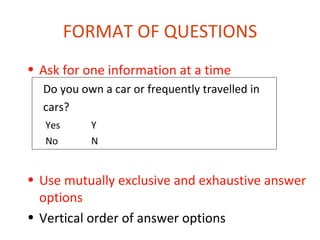
• Ask for one information at a time
  Do you own a car or frequently travelled in
  cars?
   Yes     Y
   No      N


• Use mutually exclusive and exhaustive answer
  options
• Vertical order of answer options
BE ACCURATE
Do you often travel in cars?
Yes      Y
No       N
vs.
How often did you travel in cars during the
past 3 months?
Once
Twice
Three times or more
Not at all            o
Don´t know            o
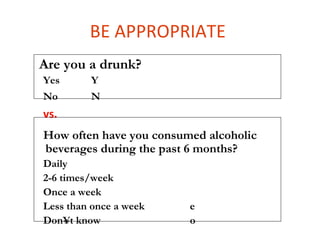
BE APPROPRIATE
Are you a drunk?
Yes      Y
No       N
vs.
How often have you consumed alcoholic
beverages during the past 6 months?
Daily
2-6 times/week
Once a week
Less than once a week    e
Don´t know               o
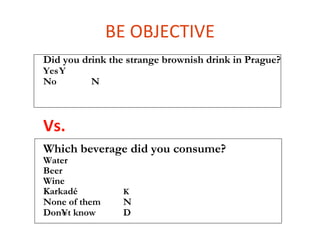
BE OBJECTIVE
Did you drink the strange brownish drink in Prague?
YesY
No        N


Vs.
Which beverage did you consume?
Water
Beer
Wine
Karkadé          K
None of them     N
Don´t know       D
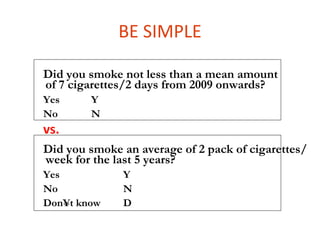
BE SIMPLE

Did you smoke not less than a mean amount
of 7 cigarettes/2 days from 2009 onwards?
Yes     Y
No      N
vs.
Did you smoke an average of 2 pack of cigarettes/
week for the last 5 years?
Yes           Y
No            N
Don´t know    D
BIAS
Bias = systematic differences in the
     measurement of a response
INFORMATION BIAS
• Recall bias
  – Cases more likely to remember than controls
• Observer bias
  – Different interviewer – different interpretations
  – Different interpretation of similar questions
  – Reduce by structured questionnaire
NON-RESPONSE BIAS
• Those who respond are different from
  those who do not
  – Telephone interviews: more females, elderly
• Reduce
  – Ensure high response rate
  – Random choice of interview partners
  – Correct during analysis (eg age, sex)
FORMAT OF QUESTIONS
Two main question formats
• Closed format → forced choice
   Yes                       Always
   No                        Sometimes
   Don’t know                Never
• Open format → free text

   What is your most distressing symptom? Please
   describe:
   ________________________________________________
   ________________________________________________
OPEN OR CLOSED?
Closed
• Advantages:
  –   Simple and quick
  –   Reduces discrimination against less literate
  –   Easy to code, record, analyze
  –   Easy to compare
  –   Easy to report results
CLOSED QUESTIONS
• Disadvantages:
  – Restricted number of possible answers
  – Loss of information
• Possible compromise:
  – Insert field “others”
OPEN QUESTIONS
• Advantages:
  – Not directive
  – Allows exploration of issues
    to generate hypothesis
     • qualitative research, focus groups, trawling
       questionnaires
  – Used even if no comprehensive range of
    alternative choices
  – Good for exploring knowledge and attitudes
  – Detailed and unexpected answers possible
OPEN QUESTIONS
• Disadvantages:
  –   Interviewer bias
  –   Time-consuming
  –   Coding problems
  –   Difficult to analyze!
  –   Difficult to compare groups
CLOSED QUESTIONS
1. Straightforward response
  What is your age in years?            ___ years
  How long have you owned a dog?        ___ years
  What is your sex (gender)?
        Male
        Female
  Did you stay in Hotel X on 23/7/05?
        Yes
        No
        Don’t know
CLOSED QUESTIONS
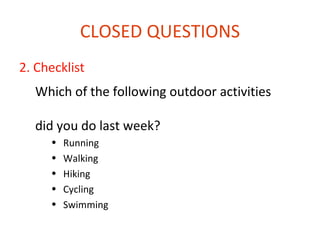
2. Checklist
  Which of the following outdoor activities

  did you do last week?
     •   Running
     •   Walking
     •   Hiking
     •   Cycling
     •   Swimming
CLOSED QUESTIONS
3. Rating scale
Did you do use sunscreen during the following
outdoor activities during the past six months?
             Always Sometimes Seldomly Never
   Running
   Walking
   Cycling
CLOSED QUESTIONS
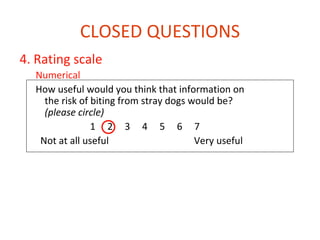
4. Rating scale
  Numerical
  How useful would you think that information on
    the risk of biting from stray dogs would be?
    (please circle)
                1 2 3 4 5 6 7
   Not at all useful                    Very useful

  Analogue
    How much is your pain severe (put the tick on the line)

             0                             10
CLOSED QUESTIONS

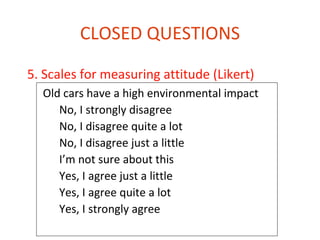
5. Scales for measuring attitude (Likert)
  Old cars have a high environmental impact
     No, I strongly disagree
     No, I disagree quite a lot
     No, I disagree just a little
     I’m not sure about this
     Yes, I agree just a little
     Yes, I agree quite a lot
     Yes, I strongly agree
PROBLEMS AND PITFALLS
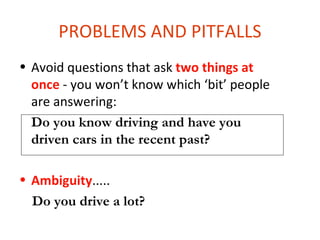
• Avoid questions that ask two things at
  once - you won’t know which ‘bit’ people
  are answering:
  Do you know driving and have you
  driven cars in the recent past?

• Ambiguity.....
  Do you drive a lot?
PROBLEMS AND PITFALLS
• Avoid jargon/abbreviations/slang
   What do you feel about 4Ps of Apple?
   Did you ever feel post-purchase dissonance?


• Avoid not mutually exclusive options
   What age are you?
      16-20

      20-25

      25-30

      35-40
PROBLEMS AND PITFALLS
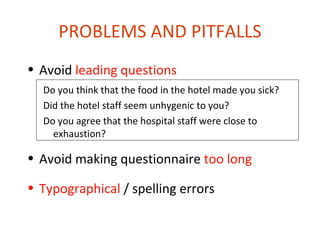
• Avoid leading questions
  Do you think that the food in the hotel made you sick?
  Did the hotel staff seem unhygenic to you?
  Do you agree that the hospital staff were close to
    exhaustion?

• Avoid making questionnaire too long

• Typographical / spelling errors
PILOTING AND EVALUATION
• Pilot with a similar group of people to
  your intended subjects
• Highlights problems before starting
  – Effects of alternative wording
  – Overall impression on respondents and
    interviewers
  – Final polishing after several amendments
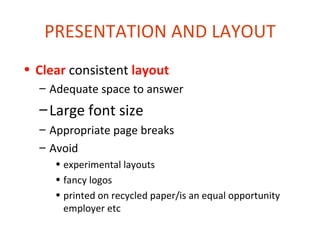
PRESENTATION AND LAYOUT
• Clear consistent layout
  – Adequate space to answer
  – Large font size
  – Appropriate page breaks
  – Avoid
     • experimental layouts
     • fancy logos
     • printed on recycled paper/is an equal opportunity
       employer etc
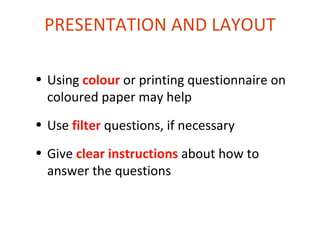
PRESENTATION AND LAYOUT

• Using colour or printing questionnaire on
  coloured paper may help
• Use filter questions, if necessary
• Give clear instructions about how to
  answer the questions
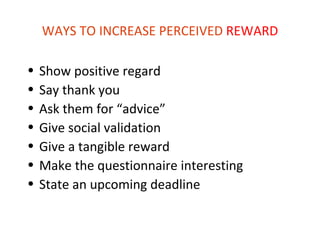
WAYS TO INCREASE PERCEIVED REWARD

•   Show positive regard
•   Say thank you
•   Ask them for “advice”
•   Give social validation
•   Give a tangible reward
•   Make the questionnaire interesting
•   State an upcoming deadline
WAYS TO DECREASE PERCEIVED
            COST

• Avoid subordinating language
• Do not embarrass the respondent
• Do not inconvenience the respondent
• Make questions appear short and easy
• Avoid asking personal information (if it
  must be asked, use ‘soft’ wording and
  inform about confidentiality)
• Keep subsequent requests similar
CREATE A NAVIGATIONAL PATH
• Instructions should be placed right where they
  are needed
• Matrices are confusing: it is best to order
  questions from top to bottom, and left to right
• Use larger font to attract attention
• Use color shading to attract attention or show
  groupings
• Use spacing and similarities to show groupings
WAYS TO ESTABLISH TRUST


• Provide a token of appreciation
• Provide a sense of legitimate authority
• Make completing the questionnaire seem
  important
• Remind respondent of previous
  relationship with sponsor (if applicable)
SUMMARY
A well designed questionnaire:
• Will give appropriate data which allow to
  answer your research question
• Will minimise potential sources of bias, thus
  increasing the validity of the questionnaire
• Will much more likely be completed
FINALLY, KEEP YOUR
QUESTIONNAIRE SHORT AND
  THE QUESTIONS SIMPLE,
FOCUSED AND APPROPRIATE
Q & As

T6 questionnaire

  • 1.
  • 2.
    OBJECTIVES To understand: • Objectives of questionnaires • Advantages and disadvantages • Design of questionnaires • Type of questions used • Common problems and pitfalls
  • 3.
    WHAT IS AQUESTIONNAIRE? • An instrument (form) to – collect answers to questions – collect factual data • gathers information or measures • A series of written questions/items in a fixed, rational order
  • 4.
    WHY USING AQUESTIONNAIRE? A well designed questionnaire: • Gives accurate and relevant information to your research question • Minimizes potential sources of bias • Will more likely be completed ⇒As simple and focused as possible
  • 5.
    ADVANTAGES OF QUESTIONNAIRES •Can reach a large number of people relatively easily and economically • Provide quantifiable answers • Relatively easy to analyse
  • 6.
    DISADVANTAGES OF QUESTIONNAIRES • Provides only limited insight into problem – Limited response allowed by questions – Maybe not the right questions are asked • Varying response – Misunderstanding/misinterpretation • Need to get it right first time – Hard to chase after missing data
  • 7.
    TYPES OF QUESTIONNAIRE • Face to face • Telephone Interviewer -administrated • By mail • E-mail/Internet Self-administrated
  • 8.
    SELF-ADMINISTERED QUESTIONNAIRE •Advantages: – Cheap and easy to administer – Preserves confidentiality – Completed at respondent's convenience – No influence by interviewer
  • 9.
    SELF-ADMINISTERED QUESTIONNAIRE •Disadvantages: – Low response rate – Questions can be misunderstood – No control by interviewer – Time and resouces loss
  • 10.
    INTERVIEW-ADMINISTERED QUESTIONNAIRE • Advantages: – Participation by illiterate people – Clarification of ambiguity – Quick answers
  • 11.
    INTERVIEW-ADMINISTERED QUESTIONNAIRE • Disadvantages: – Interviewer bias – Needs more resources – Only short questionnaires possible • Especially on telephone – Difficult for sensitive issues
  • 13.
    Basic Survey Process Steps: 1. Deciding on a mechanism  Drawing a sample  Designing the questionnaire  Fielding a survey and collecting the data  Analysis  Reporting
  • 14.
    STAGES IN DESIGNINGA QUESTIONNAIRE (1) Planning the study: • Decide on goals – Identify risk factors for getting bitten by dogs • Know the subject – Literature, experts on dog bites • Formulate a hypothesis – Postmen more likely to get bitten by dogs than the normal population • Define information needed to test hypothesis – Occupation, owning dog, outdoor activities, attitude towards dogs
  • 15.
    STAGES IN DESIGNINGA QUESTIONNAIRE (2) Determine study population: • Know the respondents – Occupation – Special sensitivities – Education – Ethnic – Language ⇒Questionnaire needs to be adapted to your population, not the opposite!
  • 16.
    STAGES IN DESIGNINGA QUESTIONNAIRE (3) Design questions: – Content of the questions – Format of the questions – Presentation and layout – Coding schedule (if appropriate) • Pilot and refine questionnaire
  • 17.
    WHAT MAKES AWELL DESIGNED QUESTIONNAIRE? • Good appearance → easy on the eye • Short and simple • Relevant and logical ⇒ High response rate ⇒ Easy data summarisation and analysis
  • 18.
    QUESTION ORDER • Decideon order of items/questions – Easy → difficult – General → particular – Factual → abstract • Where to place sensitive questions? Be aware of ordering effects!
  • 19.
    QUESTION ORDER • Questionsshould be ordered so as to seem logical to the respondent • First questions should be relevant and easy • Questions are effectively ordered from most salient to least salient • Demographic questions should not be covered at the beginning • Potentially objectionable questions are placed near the end
  • 20.
    QUESTION ORDER • Groupquestions by topic/ response options • Starting questions – Simple – With closed format – Relevant to main subject – Non-offending – Neither demographic nor personal questions • Don’t put most important item last
  • 21.
    QUESTIONNAIRE INTRODUCTION • Survey/interviewintroduction – Who you are/ what is your thesis topic – Why you are investigating – Where you obtained the respondent’s name – How and where you can be contacted – Guarantee of confidentiality – Length of interview (be honest) ⇒ Usefulness of study should be clear to all respondents
  • 22.
    CONTENT OF QUESTIONS •Clear focus on research question – Avoid sidetracking – Avoid unnecessary information • Demographic information • Contact information (if non-anonymised)
  • 23.
    DO: • Use simplewording • Be brief • Be specific
  • 24.
    DO NOT: • Bevague • Be condescending or talk down to respondent • Use biased wording • Use abbreviations or scientific jargon • Use objectionable questions • Be redundant
  • 25.
    FORMAT OF QUESTIONS •Adjust to responding audience – Professionals vs. public • Keep sentences simple and short • Define key words • Remember option “don’t know”
  • 26.
    FORMAT OF QUESTIONS •Ask for one information at a time Do you own a car or frequently travelled in cars? Yes Y No N • Use mutually exclusive and exhaustive answer options • Vertical order of answer options
  • 27.
    BE ACCURATE Do youoften travel in cars? Yes Y No N vs. How often did you travel in cars during the past 3 months? Once Twice Three times or more Not at all o Don´t know o
  • 28.
    BE APPROPRIATE Are youa drunk? Yes Y No N vs. How often have you consumed alcoholic beverages during the past 6 months? Daily 2-6 times/week Once a week Less than once a week e Don´t know o
  • 29.
    BE OBJECTIVE Did youdrink the strange brownish drink in Prague? YesY No N Vs. Which beverage did you consume? Water Beer Wine Karkadé K None of them N Don´t know D
  • 30.
    BE SIMPLE Did yousmoke not less than a mean amount of 7 cigarettes/2 days from 2009 onwards? Yes Y No N vs. Did you smoke an average of 2 pack of cigarettes/ week for the last 5 years? Yes Y No N Don´t know D
  • 31.
    BIAS Bias = systematicdifferences in the measurement of a response
  • 32.
    INFORMATION BIAS • Recallbias – Cases more likely to remember than controls • Observer bias – Different interviewer – different interpretations – Different interpretation of similar questions – Reduce by structured questionnaire
  • 33.
    NON-RESPONSE BIAS • Thosewho respond are different from those who do not – Telephone interviews: more females, elderly • Reduce – Ensure high response rate – Random choice of interview partners – Correct during analysis (eg age, sex)
  • 34.
    FORMAT OF QUESTIONS Twomain question formats • Closed format → forced choice Yes Always No Sometimes Don’t know Never • Open format → free text What is your most distressing symptom? Please describe: ________________________________________________ ________________________________________________
  • 35.
    OPEN OR CLOSED? Closed •Advantages: – Simple and quick – Reduces discrimination against less literate – Easy to code, record, analyze – Easy to compare – Easy to report results
  • 36.
    CLOSED QUESTIONS • Disadvantages: – Restricted number of possible answers – Loss of information • Possible compromise: – Insert field “others”
  • 37.
    OPEN QUESTIONS • Advantages: – Not directive – Allows exploration of issues to generate hypothesis • qualitative research, focus groups, trawling questionnaires – Used even if no comprehensive range of alternative choices – Good for exploring knowledge and attitudes – Detailed and unexpected answers possible
  • 38.
    OPEN QUESTIONS • Disadvantages: – Interviewer bias – Time-consuming – Coding problems – Difficult to analyze! – Difficult to compare groups
  • 39.
    CLOSED QUESTIONS 1. Straightforwardresponse What is your age in years? ___ years How long have you owned a dog? ___ years What is your sex (gender)? Male Female Did you stay in Hotel X on 23/7/05? Yes No Don’t know
  • 40.
    CLOSED QUESTIONS 2. Checklist Which of the following outdoor activities did you do last week? • Running • Walking • Hiking • Cycling • Swimming
  • 41.
    CLOSED QUESTIONS 3. Ratingscale Did you do use sunscreen during the following outdoor activities during the past six months? Always Sometimes Seldomly Never Running Walking Cycling
  • 42.
    CLOSED QUESTIONS 4. Ratingscale Numerical How useful would you think that information on the risk of biting from stray dogs would be? (please circle) 1 2 3 4 5 6 7 Not at all useful Very useful Analogue How much is your pain severe (put the tick on the line) 0 10
  • 43.
    CLOSED QUESTIONS 5. Scalesfor measuring attitude (Likert) Old cars have a high environmental impact No, I strongly disagree No, I disagree quite a lot No, I disagree just a little I’m not sure about this Yes, I agree just a little Yes, I agree quite a lot Yes, I strongly agree
  • 44.
    PROBLEMS AND PITFALLS •Avoid questions that ask two things at once - you won’t know which ‘bit’ people are answering: Do you know driving and have you driven cars in the recent past? • Ambiguity..... Do you drive a lot?
  • 45.
    PROBLEMS AND PITFALLS •Avoid jargon/abbreviations/slang What do you feel about 4Ps of Apple? Did you ever feel post-purchase dissonance? • Avoid not mutually exclusive options What age are you? 16-20 20-25 25-30 35-40
  • 46.
    PROBLEMS AND PITFALLS •Avoid leading questions Do you think that the food in the hotel made you sick? Did the hotel staff seem unhygenic to you? Do you agree that the hospital staff were close to exhaustion? • Avoid making questionnaire too long • Typographical / spelling errors
  • 47.
    PILOTING AND EVALUATION •Pilot with a similar group of people to your intended subjects • Highlights problems before starting – Effects of alternative wording – Overall impression on respondents and interviewers – Final polishing after several amendments
  • 48.
    PRESENTATION AND LAYOUT •Clear consistent layout – Adequate space to answer – Large font size – Appropriate page breaks – Avoid • experimental layouts • fancy logos • printed on recycled paper/is an equal opportunity employer etc
  • 49.
    PRESENTATION AND LAYOUT •Using colour or printing questionnaire on coloured paper may help • Use filter questions, if necessary • Give clear instructions about how to answer the questions
  • 50.
    WAYS TO INCREASEPERCEIVED REWARD • Show positive regard • Say thank you • Ask them for “advice” • Give social validation • Give a tangible reward • Make the questionnaire interesting • State an upcoming deadline
  • 51.
    WAYS TO DECREASEPERCEIVED COST • Avoid subordinating language • Do not embarrass the respondent • Do not inconvenience the respondent • Make questions appear short and easy • Avoid asking personal information (if it must be asked, use ‘soft’ wording and inform about confidentiality) • Keep subsequent requests similar
  • 52.
    CREATE A NAVIGATIONALPATH • Instructions should be placed right where they are needed • Matrices are confusing: it is best to order questions from top to bottom, and left to right • Use larger font to attract attention • Use color shading to attract attention or show groupings • Use spacing and similarities to show groupings
  • 53.
    WAYS TO ESTABLISHTRUST • Provide a token of appreciation • Provide a sense of legitimate authority • Make completing the questionnaire seem important • Remind respondent of previous relationship with sponsor (if applicable)
  • 54.
    SUMMARY A well designedquestionnaire: • Will give appropriate data which allow to answer your research question • Will minimise potential sources of bias, thus increasing the validity of the questionnaire • Will much more likely be completed
  • 55.
    FINALLY, KEEP YOUR QUESTIONNAIRESHORT AND THE QUESTIONS SIMPLE, FOCUSED AND APPROPRIATE
  • 57.

Editor's Notes

  • #38 Vorteile: Nicht direktiv : Befragte werden nicht in eine Richtung gedrängt Zur Hypothesen-Generierung : wenn mehrere Menschen ähnliche (unerwartete) Antworten haben, allgemeine Tendenz? Abfrage von Wissen oder Einstellungen Detaillierte, auch unerwartete Antworten möglich Erforscht, wie Menschen über ein Problem sprechen: sprachlich Nachteile: Antwort Interviewer-abhängig: Interviewer schreibt nicht alles genau so hin sondern interpretiert auch hinein Zeit- und arbeitsintensiv: Lange Antworten, Redefluss, aber auch Auswertung Kodierprobleme Schwierig zu analysieren: welche Einteilungen wählen? Vergleiche zwischen Gruppen problematisch