




@kaimrc_edu


         1
Basim S. Alsaywid
 Pediatric Urologist
The Research Process
Research Planning

   Identify knowledge gap to select and to justify the
    research problem.

   Transform the problem into clear researchable aims
    and research question (formulate the research
    question).

   Search for existing information.

   Focus the research question

   Design the study.
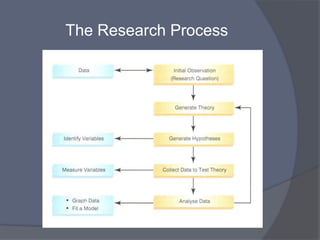
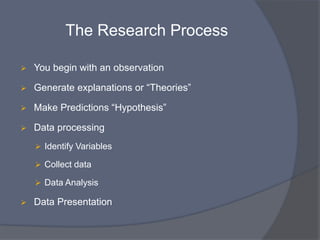
The Research Process

   You begin with an observation

   Generate explanations or “Theories”

   Make Predictions “Hypothesis”

   Data processing
     Identify Variables

     Collect data

     Data Analysis

   Data Presentation
Sources of Research Questions

•   Health development and promotion depends on
    researchers asking the „right‟ questions and identifying
    solvable problems.

•   Sources:
    • Expertise of researchers (professional background):

      •   Theoretical knowledge

      •   Practical experience

    • Culmination of intensive preliminary observations

    • Reading in the library

    • Discussion
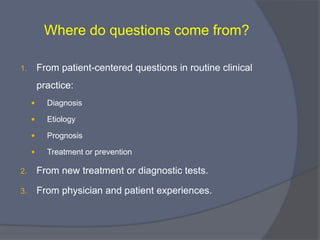
Where do questions come from?

1.       From patient-centered questions in routine clinical
         practice:
          Diagnosis

          Etiology

          Prognosis

          Treatment or prevention

2.       From new treatment or diagnostic tests.

3.       From physician and patient experiences.
Defining a good question

•   Importance

•   Interest
    • Motivation

    • Innovation

    • Ethical considerations

•   Answerability
    • Type III error: Asking the wrong question

    • Type IV error: Asking a question not worth answering
Formulate an answerable question

1.       What is the question?
          Variance questions: Focuses on difference and correlation
           (Quantitative, Clinical)

          Process questions: Focuses on how and why things happen
           (Qualitative)

2.       What is the problem, intervention, comparator, and
         outcome?

3.       What is the best feasible study type?
What is the question?

TASK

   Think of some of the clinical questions you have asked
    recently.

   Write one of these questions down in your own
    words…
Example

“What is the role of antibiotics in people who get recurrent
                      skin infections”
Example

   “What is the role of antibiotics in people who get
    recurrent skin infections”

   What is wrong with the way we expressed our
    question?
     Too board, not specific.

     Not clear what information is needed.

     Unanswerable.
•   To formulate an answerable question we first need to
    think . . . . . . .


    • What do we really want to know?

    • What type of question are we asking?

       •   Does our question concern background or foreground information?
Background questions

•   Questions concerning basic biological processes.

•   e.g. What is . . . . .? How does . . . . .?

•   Best information source: regularly updated electronic
    textbooks
Foreground questions

•   Generated in the clinical setting

•   Specific and relevant to clinical decision making

•   Observational? Frequency? Diagnosis? Aetiology?
    Prognosis? Or Intervention?
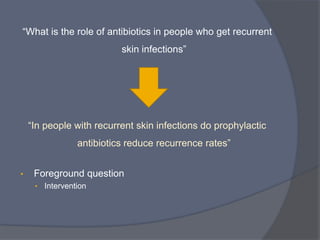
“What is the role of antibiotics in people who get recurrent
                          skin infections”


    “In people with recurrent skin infections do prophylactic
                antibiotics reduce recurrence rates”


•    Foreground question
     • Intervention
What is the problem, intervention, comparator,
               and outcome?

•   Problem/Population:
    • Who are the relevant patients/population group and what is the

      problem.

•   Intervention or exposures and comparator:
    • What are the treatment / exposure being considered?

    • What is the comparator?

•   Outcome:
    • What are the person-relevant consequences of the exposure

      that we are interested in.
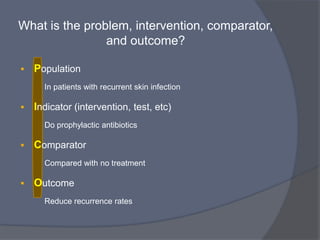
What is the problem, intervention, comparator,
                and outcome?

   Population
      In patients with recurrent skin infection

   Indicator (intervention, test, etc)
      Do prophylactic antibiotics

   Comparator
      Compared with no treatment

   Outcome
      Reduce recurrence rates
The Finer criteria for a good research question
                                                                accredited to students


1.       Feasible
          Adequate number of patients, adequate expertise and resources.
          Affordable in time and money.
          Manageable in scope.
2. Interesting to the investigator
3. Novel
          Provides new findings
          Extends previous findings
          Confirms previous findings
4. Ethical
5. Relevant
          To scientific knowledge
          To clinical and health policy
          To future research directions
What is the best feasible study type?
Types of Study
1.       Observational studies
          Researcher has an observational role

          Researcher does not intervene, leaves nature takes its course

          Researcher role is to record what happens or what happened in
           the past.

          “Bread-and-Butter”


2.       Experimental studies (Interventional Studies)
          Researcher actively attempts to change something to alter the
           disease course.
Observational Studies

1.       Descriptive studies:
             Describes the occurrence of disease and exposure.

             Most commonly used

             Look for patterns of disease, to measure the occurrence of
              disease, to identify risk factors for disease

             Concerned with the „person, place, and time‟

             Questions  “Who? What? Where? and When? (Not Why?)

             Includes:
          ○      Case Reports

          ○      Case Series
Observational Studies

1.       Analytical studies:
             Incorporate analysis of association between exposure and disease.

             Involve planned comparisons between people with and without
              disease, between people with or without exposures thought to cause
              disease.

             Try to answer question “Why”
             Includes:

          ○      Cohort Studies (follow-up Studies).

          ○      Case-Control Studies.

          ○      Cross-sectional Studies.

          ○      Ecological Studies.
Cross-sectional Studies

•   Sample of the subjects in a population are investigated for
    outcome and/or exposure.

•   Used as a first step in more complex design

•   Simple description of disease prevalence (blood
    pressure, height, DM)

•   Known as: Prevalence Studies
Cross-sectional Studies

     Advantages                 Disadvantages
1. May study several       1.   Does not establish

   outcomes and exposure        sequence of events.

2. Short Duration          2.   Survivor bias

3. Good first step         3.   Not feasible for rare

4. Yield prevalence and
                                conditions

   relative association    4.   Does not yield incidence.

5. Inexpensive
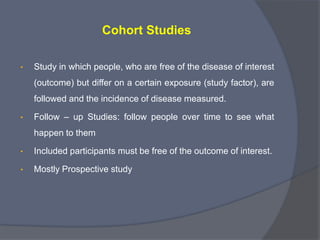
Cohort Studies

•   Study in which people, who are free of the disease of interest
    (outcome) but differ on a certain exposure (study factor), are
    followed and the incidence of disease measured.

•   Follow – up Studies: follow people over time to see what
    happen to them

•   Included participants must be free of the outcome of interest.

•   Mostly Prospective study
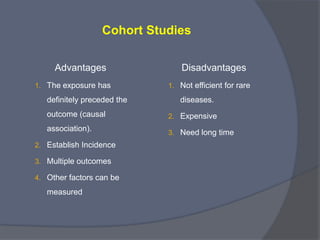
Cohort Studies

     Advantages                  Disadvantages
1. The exposure has          1. Not efficient for rare
   definitely preceded the      diseases.
   outcome (causal           2. Expensive
   association).             3. Need long time
2. Establish Incidence

3. Multiple outcomes

4. Other factors can be

   measured
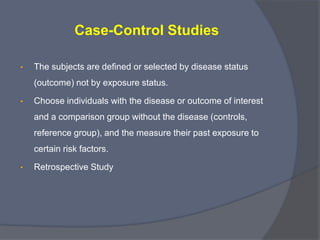
Case-Control Studies

•   The subjects are defined or selected by disease status
    (outcome) not by exposure status.

•   Choose individuals with the disease or outcome of interest
    and a comparison group without the disease
    (controls, reference group), and the measure their past
    exposure to certain risk factors.

•   Retrospective Study
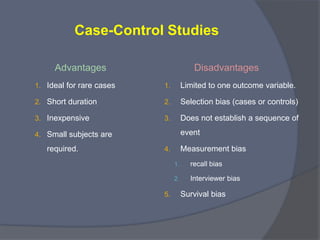
Case-Control Studies

     Advantages                        Disadvantages
1. Ideal for rare cases   1.        Limited to one outcome variable.

2. Short duration         2.        Selection bias (cases or controls)

3. Inexpensive            3.        Does not establish a sequence of

4. Small subjects are               event

   required.              4.        Measurement bias
                               1.     recall bias

                               2.     Interviewer bias

                          5.        Survival bias
Intervention studies or experiments

•   A study in which the investigator intentionally alters one or
    more factors under controlled conditions in order to study the
    effect of doing so.

•   Includes:
    • Randomized Controlled (clinical) trials (RCTs)

    • Preventive Trials

    • Community Trials

RSS 2012 Developing Research Idea and Question

  • 1.
  • 2.
    Basim S. Alsaywid Pediatric Urologist
  • 3.
  • 4.
    Research Planning  Identify knowledge gap to select and to justify the research problem.  Transform the problem into clear researchable aims and research question (formulate the research question).  Search for existing information.  Focus the research question  Design the study.
  • 5.
    The Research Process  You begin with an observation  Generate explanations or “Theories”  Make Predictions “Hypothesis”  Data processing  Identify Variables  Collect data  Data Analysis  Data Presentation
  • 6.
    Sources of ResearchQuestions • Health development and promotion depends on researchers asking the „right‟ questions and identifying solvable problems. • Sources: • Expertise of researchers (professional background): • Theoretical knowledge • Practical experience • Culmination of intensive preliminary observations • Reading in the library • Discussion
  • 7.
    Where do questionscome from? 1. From patient-centered questions in routine clinical practice:  Diagnosis  Etiology  Prognosis  Treatment or prevention 2. From new treatment or diagnostic tests. 3. From physician and patient experiences.
  • 8.
    Defining a goodquestion • Importance • Interest • Motivation • Innovation • Ethical considerations • Answerability • Type III error: Asking the wrong question • Type IV error: Asking a question not worth answering
  • 9.
    Formulate an answerablequestion 1. What is the question?  Variance questions: Focuses on difference and correlation (Quantitative, Clinical)  Process questions: Focuses on how and why things happen (Qualitative) 2. What is the problem, intervention, comparator, and outcome? 3. What is the best feasible study type?
  • 10.
    What is thequestion? TASK  Think of some of the clinical questions you have asked recently.  Write one of these questions down in your own words…
  • 11.
    Example “What is therole of antibiotics in people who get recurrent skin infections”
  • 12.
    Example  “What is the role of antibiotics in people who get recurrent skin infections”  What is wrong with the way we expressed our question?  Too board, not specific.  Not clear what information is needed.  Unanswerable.
  • 13.
    To formulate an answerable question we first need to think . . . . . . . • What do we really want to know? • What type of question are we asking? • Does our question concern background or foreground information?
  • 14.
    Background questions • Questions concerning basic biological processes. • e.g. What is . . . . .? How does . . . . .? • Best information source: regularly updated electronic textbooks
  • 15.
    Foreground questions • Generated in the clinical setting • Specific and relevant to clinical decision making • Observational? Frequency? Diagnosis? Aetiology? Prognosis? Or Intervention?
  • 16.
    “What is therole of antibiotics in people who get recurrent skin infections” “In people with recurrent skin infections do prophylactic antibiotics reduce recurrence rates” • Foreground question • Intervention
  • 17.
    What is theproblem, intervention, comparator, and outcome? • Problem/Population: • Who are the relevant patients/population group and what is the problem. • Intervention or exposures and comparator: • What are the treatment / exposure being considered? • What is the comparator? • Outcome: • What are the person-relevant consequences of the exposure that we are interested in.
  • 18.
    What is theproblem, intervention, comparator, and outcome?  Population In patients with recurrent skin infection  Indicator (intervention, test, etc) Do prophylactic antibiotics  Comparator Compared with no treatment  Outcome Reduce recurrence rates
  • 19.
    The Finer criteriafor a good research question accredited to students 1. Feasible  Adequate number of patients, adequate expertise and resources.  Affordable in time and money.  Manageable in scope. 2. Interesting to the investigator 3. Novel  Provides new findings  Extends previous findings  Confirms previous findings 4. Ethical 5. Relevant  To scientific knowledge  To clinical and health policy  To future research directions
  • 20.
    What is thebest feasible study type?
  • 21.
    Types of Study 1. Observational studies  Researcher has an observational role  Researcher does not intervene, leaves nature takes its course  Researcher role is to record what happens or what happened in the past.  “Bread-and-Butter” 2. Experimental studies (Interventional Studies)  Researcher actively attempts to change something to alter the disease course.
  • 22.
    Observational Studies 1. Descriptive studies:  Describes the occurrence of disease and exposure.  Most commonly used  Look for patterns of disease, to measure the occurrence of disease, to identify risk factors for disease  Concerned with the „person, place, and time‟  Questions  “Who? What? Where? and When? (Not Why?)  Includes: ○ Case Reports ○ Case Series
  • 23.
    Observational Studies 1. Analytical studies:  Incorporate analysis of association between exposure and disease.  Involve planned comparisons between people with and without disease, between people with or without exposures thought to cause disease.  Try to answer question “Why”  Includes: ○ Cohort Studies (follow-up Studies). ○ Case-Control Studies. ○ Cross-sectional Studies. ○ Ecological Studies.
  • 24.
    Cross-sectional Studies • Sample of the subjects in a population are investigated for outcome and/or exposure. • Used as a first step in more complex design • Simple description of disease prevalence (blood pressure, height, DM) • Known as: Prevalence Studies
  • 25.
    Cross-sectional Studies Advantages Disadvantages 1. May study several 1. Does not establish outcomes and exposure sequence of events. 2. Short Duration 2. Survivor bias 3. Good first step 3. Not feasible for rare 4. Yield prevalence and conditions relative association 4. Does not yield incidence. 5. Inexpensive
  • 26.
    Cohort Studies • Study in which people, who are free of the disease of interest (outcome) but differ on a certain exposure (study factor), are followed and the incidence of disease measured. • Follow – up Studies: follow people over time to see what happen to them • Included participants must be free of the outcome of interest. • Mostly Prospective study
  • 27.
    Cohort Studies Advantages Disadvantages 1. The exposure has 1. Not efficient for rare definitely preceded the diseases. outcome (causal 2. Expensive association). 3. Need long time 2. Establish Incidence 3. Multiple outcomes 4. Other factors can be measured
  • 28.
    Case-Control Studies • The subjects are defined or selected by disease status (outcome) not by exposure status. • Choose individuals with the disease or outcome of interest and a comparison group without the disease (controls, reference group), and the measure their past exposure to certain risk factors. • Retrospective Study
  • 29.
    Case-Control Studies Advantages Disadvantages 1. Ideal for rare cases 1. Limited to one outcome variable. 2. Short duration 2. Selection bias (cases or controls) 3. Inexpensive 3. Does not establish a sequence of 4. Small subjects are event required. 4. Measurement bias 1. recall bias 2. Interviewer bias 5. Survival bias
  • 30.
    Intervention studies orexperiments • A study in which the investigator intentionally alters one or more factors under controlled conditions in order to study the effect of doing so. • Includes: • Randomized Controlled (clinical) trials (RCTs) • Preventive Trials • Community Trials