REFERENCE 
WRITING
Referencing is a standardised way of acknowledging 
the sources of information and ideas that we 
have used in our assignments and which allows the 
sources to be identified. 
Obligation 
Avoid plagiarism 
To verify quotations 
To enable readers to follow up 
Understand what we have written and the cited 
author’s work.
CITATION-using another persons work in our work and 
acknowledging them 
SECONDARY REFERENCING- when an author refers to 
another authors work and the primary source is not 
available 
BIBLIOGRAPHY-there may be many articles which we 
have referred but not cited, these can be listed at 
the end of our assignment in a bibliography. These 
articles should be listed in alphabetical order
1. When we copy word or a paragraph from a journal 
article/book 
2. When we copy word or a paragraph from a web site 
3. When we write in our own words or ideas from a 
journal article/book 
4. When we write in our own words or ideas from a 
web site 
If you do not make reference to someone else’s 
ideas/work you may be accused of passing it off as 
your own (plagiarism).
Plagiarism –What is it & How to 
avoid it 
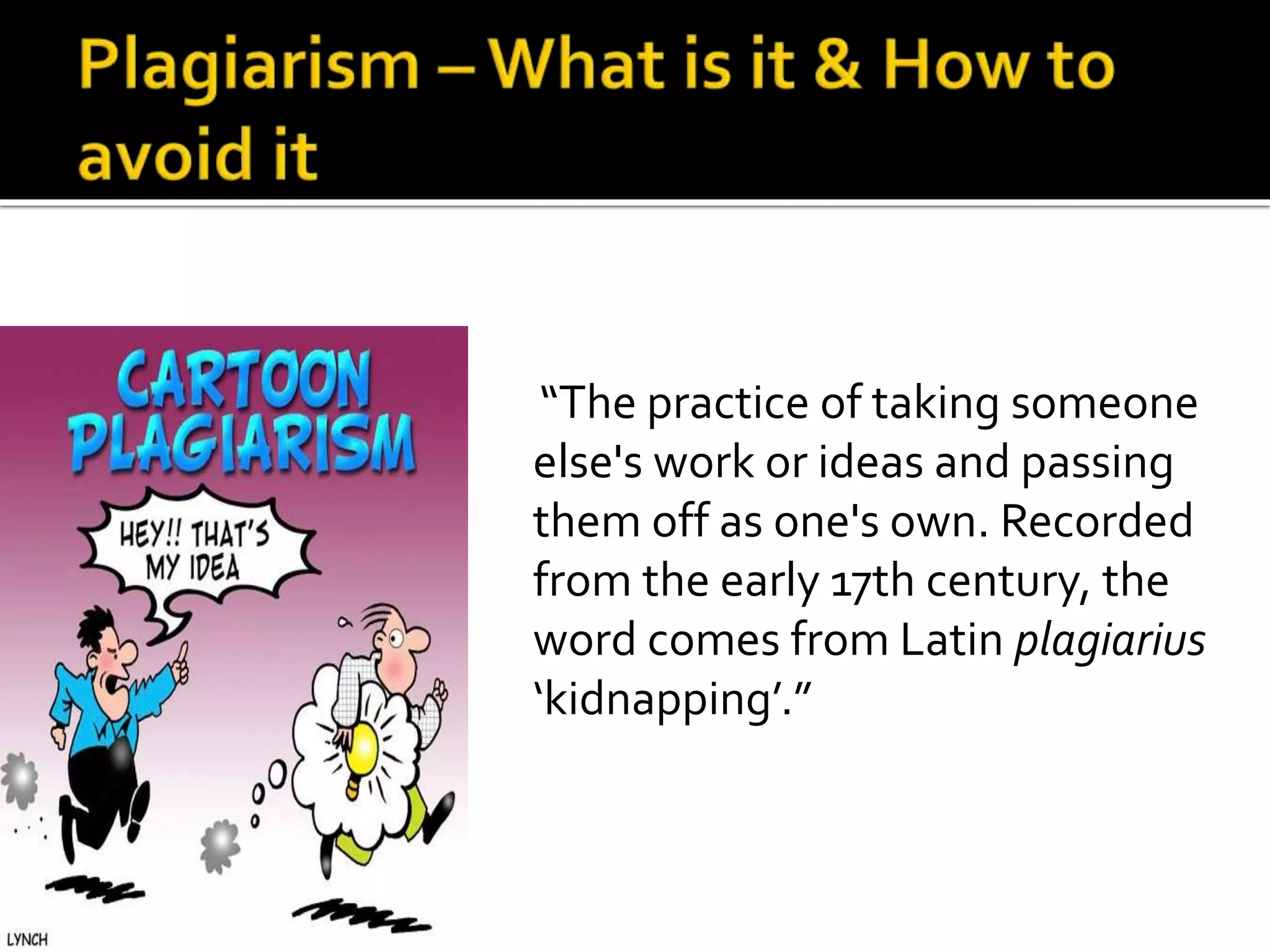
“The practice of taking someone 
else's work or ideas and passing 
them off as one's own. Recorded 
from the early 17th century, the 
word comes from Latin plagiarius 
‘kidnapping’.”
Vancouver system 
Harvard system 
APA system- American Psychological Association 
(APA) style 
Combined Alphabet-Number system
Numbered referencing style 
commonly used in medicine and science 
• When we cite someone’s work in our essay, we use a 
number to refer the reference 
• Our reference list at the end of our document, will 
provide full details of the reference and correspond in 
sequence to the numbers in the text using 
consecutive numbers
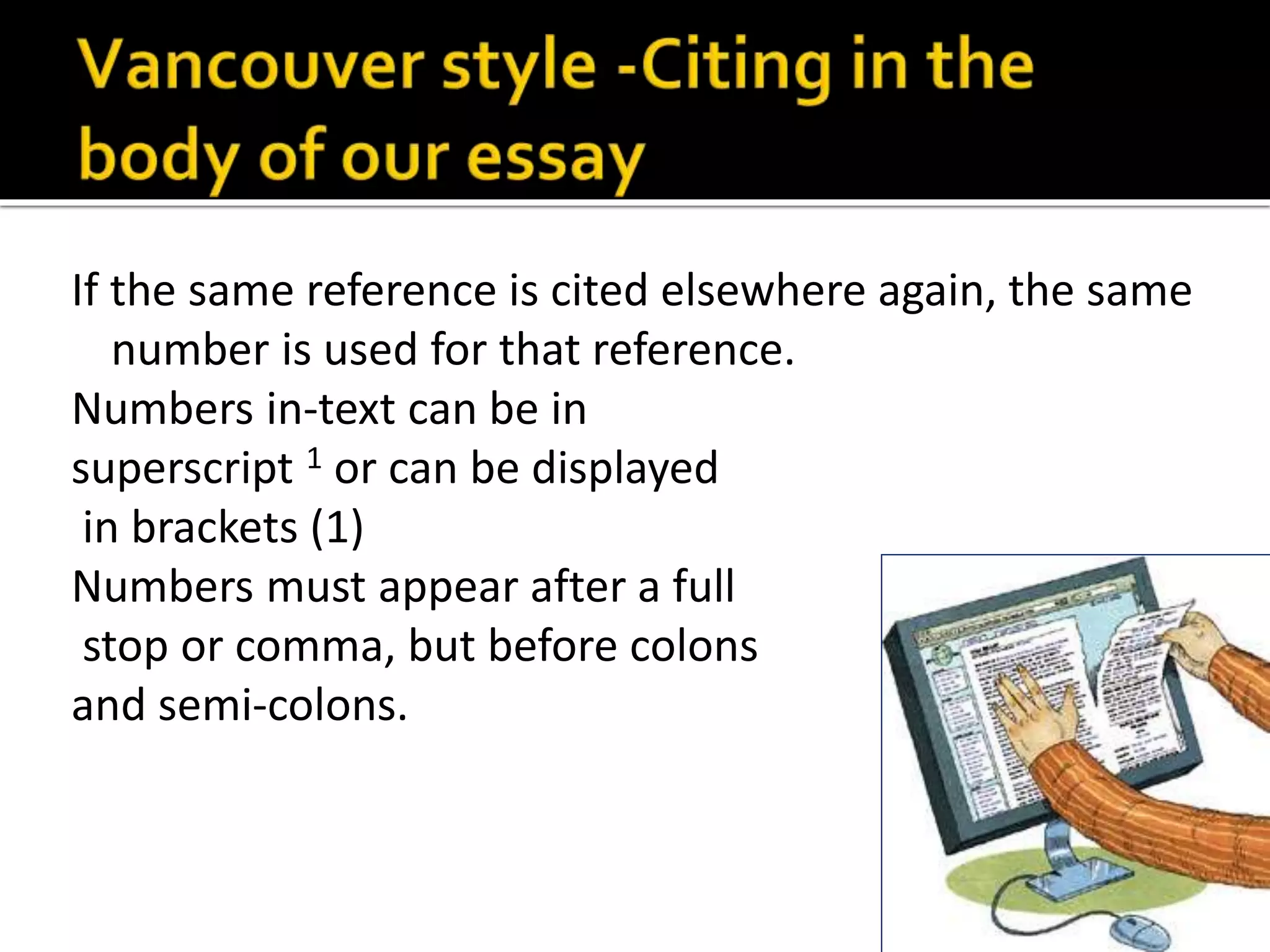
If the same reference is cited elsewhere again, the same 
number is used for that reference. 
Numbers in-text can be in 
superscript 1 or can be displayed 
in brackets (1) 
Numbers must appear after a full 
stop or comma, but before colons 
and semi-colons.
• When citing more than one reference, join 
consecutive references with a hyphen (1-5) 
• When citing multiple references that are non-inclusive, 
separate the references with commas. (2,5, 
8, 10)
Name of authors (six et al- if more than six authors) 
Title of article 
Title of journal (abbreviated) 
Year (month/day not necessary) of publication 
Volume number (and issue/part) 
Page number (no use of unnecessary digits)
2. Jain A, Jain S, Rawat S. Emerging fungal infections 
among children: A review on its clinical 
manifestations, diagnosis, and prevention. J Pharm 
Bio allied Sci. 2010;2:314–20 
Abbreviate title according to the style used in 
Medline. A list of abbreviations can be found at: 
http://www.ncbi.nlm.nih.gov/entrez/query.fcgi?db=jou 
rnals 
No punctuation marks are used in the abbreviated 
journal name – just spaces.
Title of article 
Rosenthal Ann K. Osteoarthritis: The need for therapeutic interventions. Current 
rheumatology reviews. 2012;11(3):24-27 
Date of publication 
Author of 
article 
Title of 
journal 
Volume & issue 
number 
Page 
numbers 
How to cite 
a journal 
article
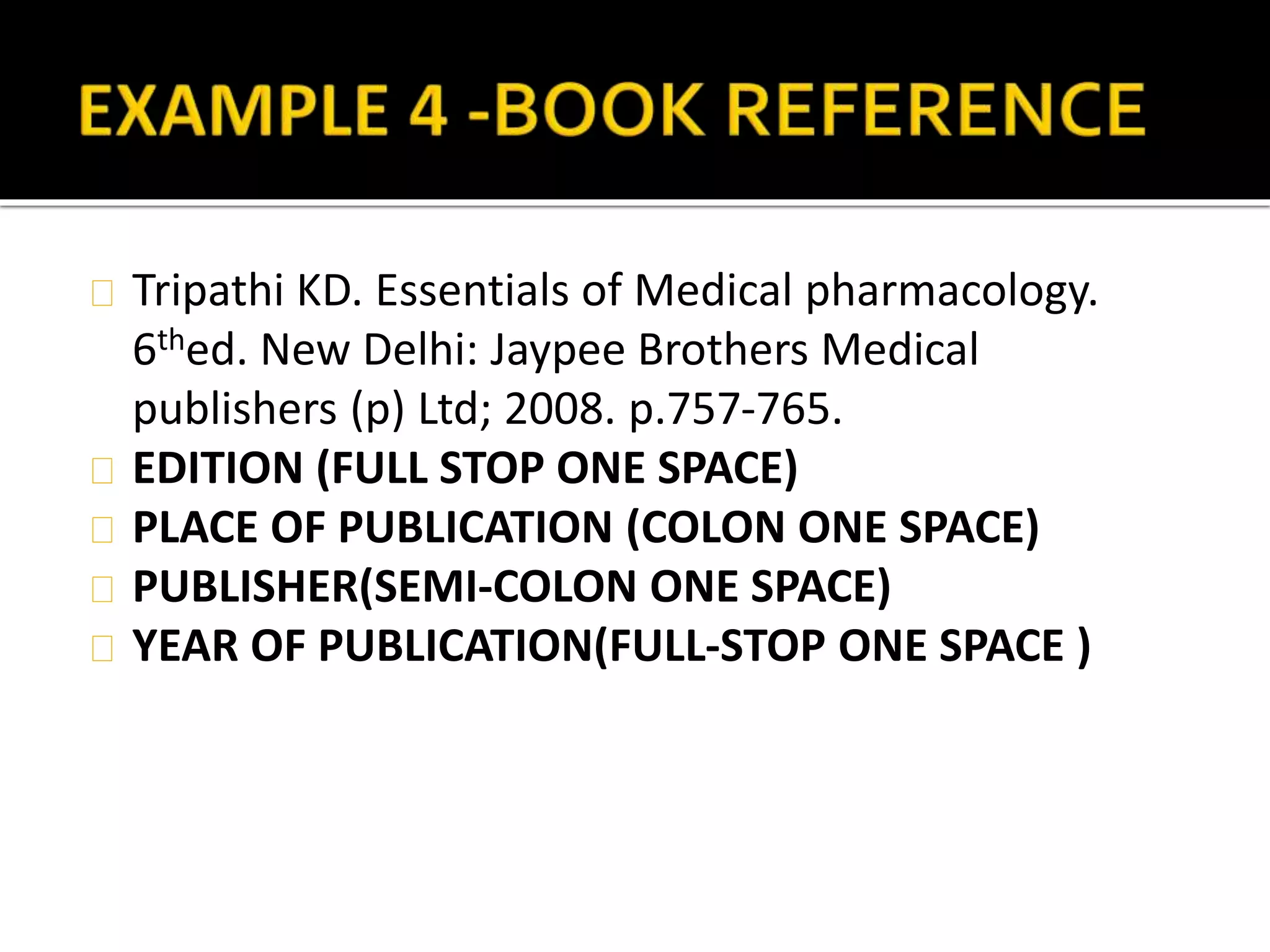
Tripathi KD. Essentials of Medical pharmacology. 
6thed. New Delhi: Jaypee Brothers Medical 
publishers (p) Ltd; 2008. p.757-765. 
EDITION (FULL STOP ONE SPACE) 
PLACE OF PUBLICATION (COLON ONE SPACE) 
PUBLISHER(SEMI-COLON ONE SPACE) 
YEAR OF PUBLICATION(FULL-STOP ONE SPACE )
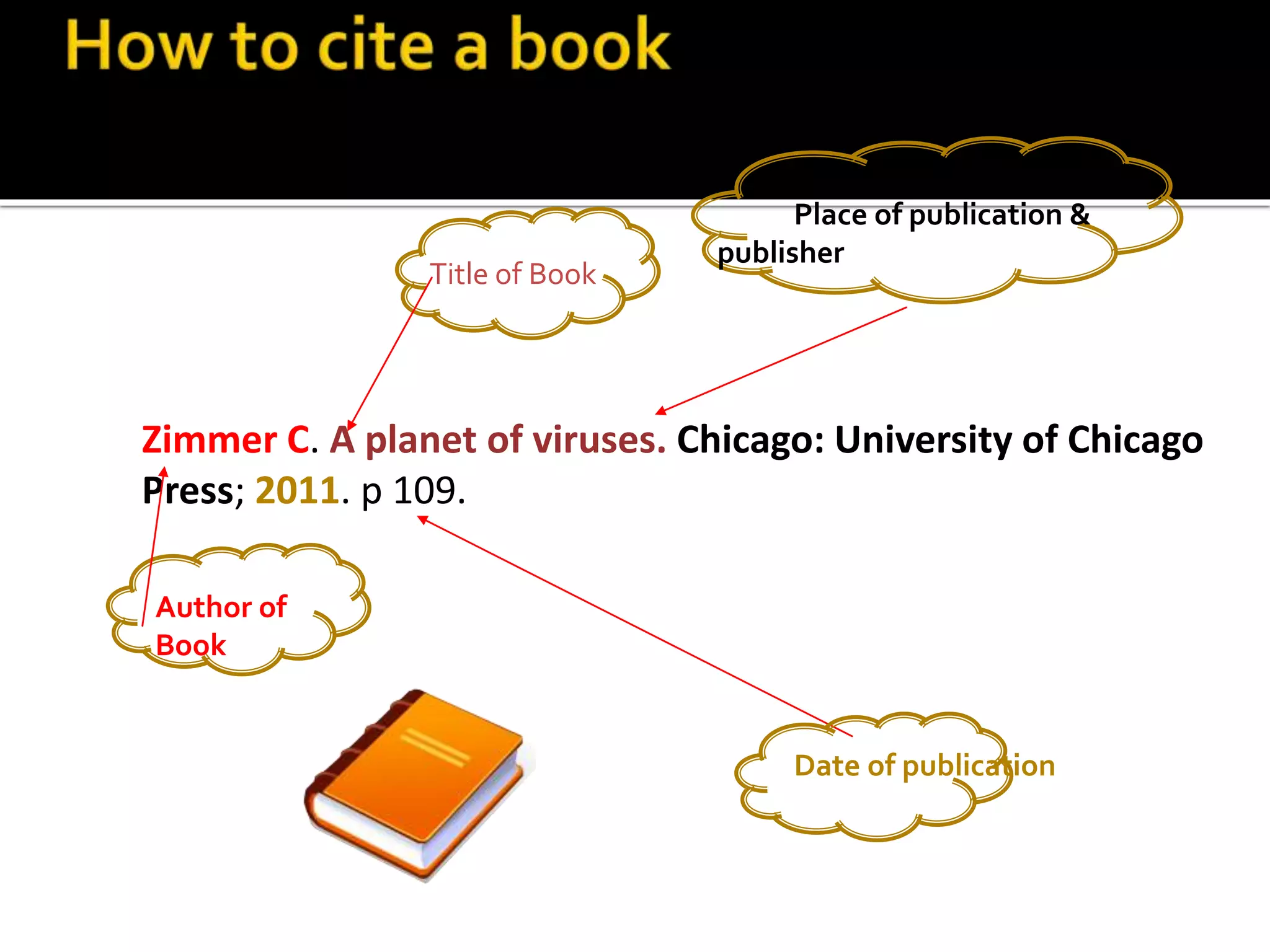
How to identify a book 
Place of publication & 
publisher 
Zimmer C. A planet of viruses. Chicago: University of Chicago 
Press; 2011. p 109. 
Author of 
Book 
Title of Book 
Date of publication
Required: City, Abbreviated State, and Publisher 
If multiple cities, name of first city listed only 
Place COMMA between city & state 
Separate state & publisher with colon ( : ); 
place semicolon after name of publisher. 
Add year published + PERIOD. 
e.g. Boston, Mass:Ebony;2001. 
Add page numbers to report only one article in a book 
(These rules for punctuation vary widely) 
e.g., Boston, Mass:Ebony;2001. p. 345-378.
CHAPTER OR PART OF A BOOK TO WHICH A 
NUMBER OF AUTHORS HAVE CONTRIBUTED 
Hay RJ, Ashbee HR. Mycology. In: Rook’s textbook of 
dermatology. Burns T, Breathnach S, Cox N, Griffiths 
C editors.8thed. Edinburgh: Wiley Blackwell;2010;Vol 
2 p.36.1-36.93
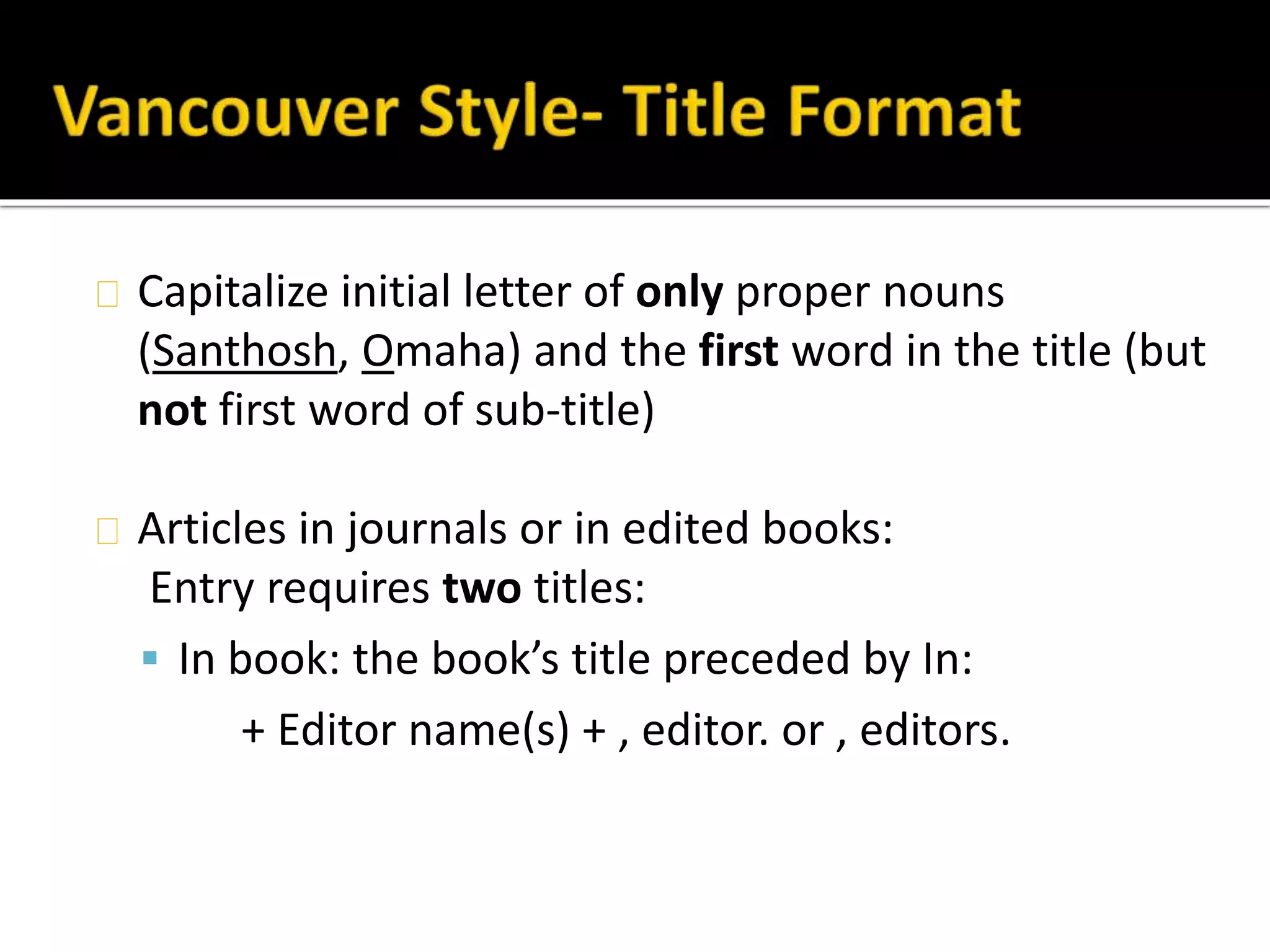
Capitalize initial letter of only proper nouns 
(Santhosh, Omaha) and the first word in the title (but 
not first word of sub-title) 
Articles in journals or in edited books: 
Entry requires two titles: 
 In book: the book’s title preceded by In: 
+ Editor name(s) + , editor. or , editors.
Wadsworth P. Microinjection of mitotic cells. In: Rieder CL, editor. Mitosis and meiosis. San Diego: 
Academic Press; 1999. p 219-31. 
How to identify a 
Chapter in a book 
Author of Chapter 
Title of 
Chapter Editor of Book 
Title of book 
Place of publication & 
publisher 
Date of publication 
Page numbers of 
Chapter 
IN
SPONSORED BY INSTITUTION, CORPORATION 
OR OTHER ORGANISATION 
1. World Health Organization. Laboratory manual for 
diagnosis of fungal opportunistic infections in 
HIV/AIDS patients. Geneva: World Health 
Organization;2009. p.4-10 .
Indicate type of source in square brackets after title 
(But this practice varies widely according to 
journal/instructor)e.g., [monograph on the 
Internet] or [serial online] 
Internet sources require a final sentence beginning 
Ex: Available from: 
http://nursingworld.org/member2.htm 
Place period only after an ending slash (/) 
Rules to cite Internet sources vary widely in practice
Indexing friendly 
Librarian friendly 
Editor/Reviewer friendly 
It reflects a librarian’s world view. 
An author or writing is just a number 
A journal, its vol are other items helpful for 
categorising. 
To help indexing for NLM 
Detecting plagiarism 
Helpful for editor/reviewer
vancouver style of referencing

vancouver style of referencing

  • 1.
  • 2.
    Referencing is astandardised way of acknowledging the sources of information and ideas that we have used in our assignments and which allows the sources to be identified. Obligation Avoid plagiarism To verify quotations To enable readers to follow up Understand what we have written and the cited author’s work.
  • 3.
    CITATION-using another personswork in our work and acknowledging them SECONDARY REFERENCING- when an author refers to another authors work and the primary source is not available BIBLIOGRAPHY-there may be many articles which we have referred but not cited, these can be listed at the end of our assignment in a bibliography. These articles should be listed in alphabetical order
  • 4.
    1. When wecopy word or a paragraph from a journal article/book 2. When we copy word or a paragraph from a web site 3. When we write in our own words or ideas from a journal article/book 4. When we write in our own words or ideas from a web site If you do not make reference to someone else’s ideas/work you may be accused of passing it off as your own (plagiarism).
  • 5.
    Plagiarism –What isit & How to avoid it “The practice of taking someone else's work or ideas and passing them off as one's own. Recorded from the early 17th century, the word comes from Latin plagiarius ‘kidnapping’.”
  • 6.
    Vancouver system Harvardsystem APA system- American Psychological Association (APA) style Combined Alphabet-Number system
  • 7.
    Numbered referencing style commonly used in medicine and science • When we cite someone’s work in our essay, we use a number to refer the reference • Our reference list at the end of our document, will provide full details of the reference and correspond in sequence to the numbers in the text using consecutive numbers
  • 8.
    If the samereference is cited elsewhere again, the same number is used for that reference. Numbers in-text can be in superscript 1 or can be displayed in brackets (1) Numbers must appear after a full stop or comma, but before colons and semi-colons.
  • 9.
    • When citingmore than one reference, join consecutive references with a hyphen (1-5) • When citing multiple references that are non-inclusive, separate the references with commas. (2,5, 8, 10)
  • 10.
    Name of authors(six et al- if more than six authors) Title of article Title of journal (abbreviated) Year (month/day not necessary) of publication Volume number (and issue/part) Page number (no use of unnecessary digits)
  • 11.
    2. Jain A,Jain S, Rawat S. Emerging fungal infections among children: A review on its clinical manifestations, diagnosis, and prevention. J Pharm Bio allied Sci. 2010;2:314–20 Abbreviate title according to the style used in Medline. A list of abbreviations can be found at: http://www.ncbi.nlm.nih.gov/entrez/query.fcgi?db=jou rnals No punctuation marks are used in the abbreviated journal name – just spaces.
  • 12.
    Title of article Rosenthal Ann K. Osteoarthritis: The need for therapeutic interventions. Current rheumatology reviews. 2012;11(3):24-27 Date of publication Author of article Title of journal Volume & issue number Page numbers How to cite a journal article
  • 13.
    Tripathi KD. Essentialsof Medical pharmacology. 6thed. New Delhi: Jaypee Brothers Medical publishers (p) Ltd; 2008. p.757-765. EDITION (FULL STOP ONE SPACE) PLACE OF PUBLICATION (COLON ONE SPACE) PUBLISHER(SEMI-COLON ONE SPACE) YEAR OF PUBLICATION(FULL-STOP ONE SPACE )
  • 14.
    How to identifya book Place of publication & publisher Zimmer C. A planet of viruses. Chicago: University of Chicago Press; 2011. p 109. Author of Book Title of Book Date of publication
  • 15.
    Required: City, AbbreviatedState, and Publisher If multiple cities, name of first city listed only Place COMMA between city & state Separate state & publisher with colon ( : ); place semicolon after name of publisher. Add year published + PERIOD. e.g. Boston, Mass:Ebony;2001. Add page numbers to report only one article in a book (These rules for punctuation vary widely) e.g., Boston, Mass:Ebony;2001. p. 345-378.
  • 16.
    CHAPTER OR PARTOF A BOOK TO WHICH A NUMBER OF AUTHORS HAVE CONTRIBUTED Hay RJ, Ashbee HR. Mycology. In: Rook’s textbook of dermatology. Burns T, Breathnach S, Cox N, Griffiths C editors.8thed. Edinburgh: Wiley Blackwell;2010;Vol 2 p.36.1-36.93
  • 17.
    Capitalize initial letterof only proper nouns (Santhosh, Omaha) and the first word in the title (but not first word of sub-title) Articles in journals or in edited books: Entry requires two titles:  In book: the book’s title preceded by In: + Editor name(s) + , editor. or , editors.
  • 18.
    Wadsworth P. Microinjectionof mitotic cells. In: Rieder CL, editor. Mitosis and meiosis. San Diego: Academic Press; 1999. p 219-31. How to identify a Chapter in a book Author of Chapter Title of Chapter Editor of Book Title of book Place of publication & publisher Date of publication Page numbers of Chapter IN
  • 19.
    SPONSORED BY INSTITUTION,CORPORATION OR OTHER ORGANISATION 1. World Health Organization. Laboratory manual for diagnosis of fungal opportunistic infections in HIV/AIDS patients. Geneva: World Health Organization;2009. p.4-10 .
  • 20.
    Indicate type ofsource in square brackets after title (But this practice varies widely according to journal/instructor)e.g., [monograph on the Internet] or [serial online] Internet sources require a final sentence beginning Ex: Available from: http://nursingworld.org/member2.htm Place period only after an ending slash (/) Rules to cite Internet sources vary widely in practice
  • 21.
    Indexing friendly Librarianfriendly Editor/Reviewer friendly It reflects a librarian’s world view. An author or writing is just a number A journal, its vol are other items helpful for categorising. To help indexing for NLM Detecting plagiarism Helpful for editor/reviewer