RANDOMISATION IN
CLINICAL TRIALS
Sekhar babu. B
3rd year post graduate
Dept. of pharmacology
OVERVIEW
• Introduction
• What is Randomisation
• Need of Randomisation
• Criteria of Randomisation
• Methods of Randomisation
• Bias and types
INTRODUCTION
• Clinical trials are research studies that test how well new medical
approaches work in people
• Randomisation is a process by which allocation of subjects to
treatment groups is done by chance, without the stability to predict
who is in what group
RANDOMISATION
• A method based on chance alone by which study participants are
assigned to treatment group
• Randomisation minimises the differences among groups by equally
distributing with particular characteristics among all trial arms. The
researchers donot know which treatment is better
NEED OF RANDOMISATION
• Primary: To prevent bias in allocating subjects to treatment groups
• Secondary: To achieve comparability between the groups
CRITERIA FOR RANDOMISATION
• Unpredictability:
Each participant has the same chance of receiving any of the interventions
Allocation is carried out using a chance mechanism so that neither the
participant nor the investigator will know in advance which will be assigned
• Balance:
Treatment groups are of a similar size, groups are alike in all important
aspects and only differ in the intervention each group receives
• Simplicity:
Easy for investigator to implement
SIMPLE RANDOMISATION
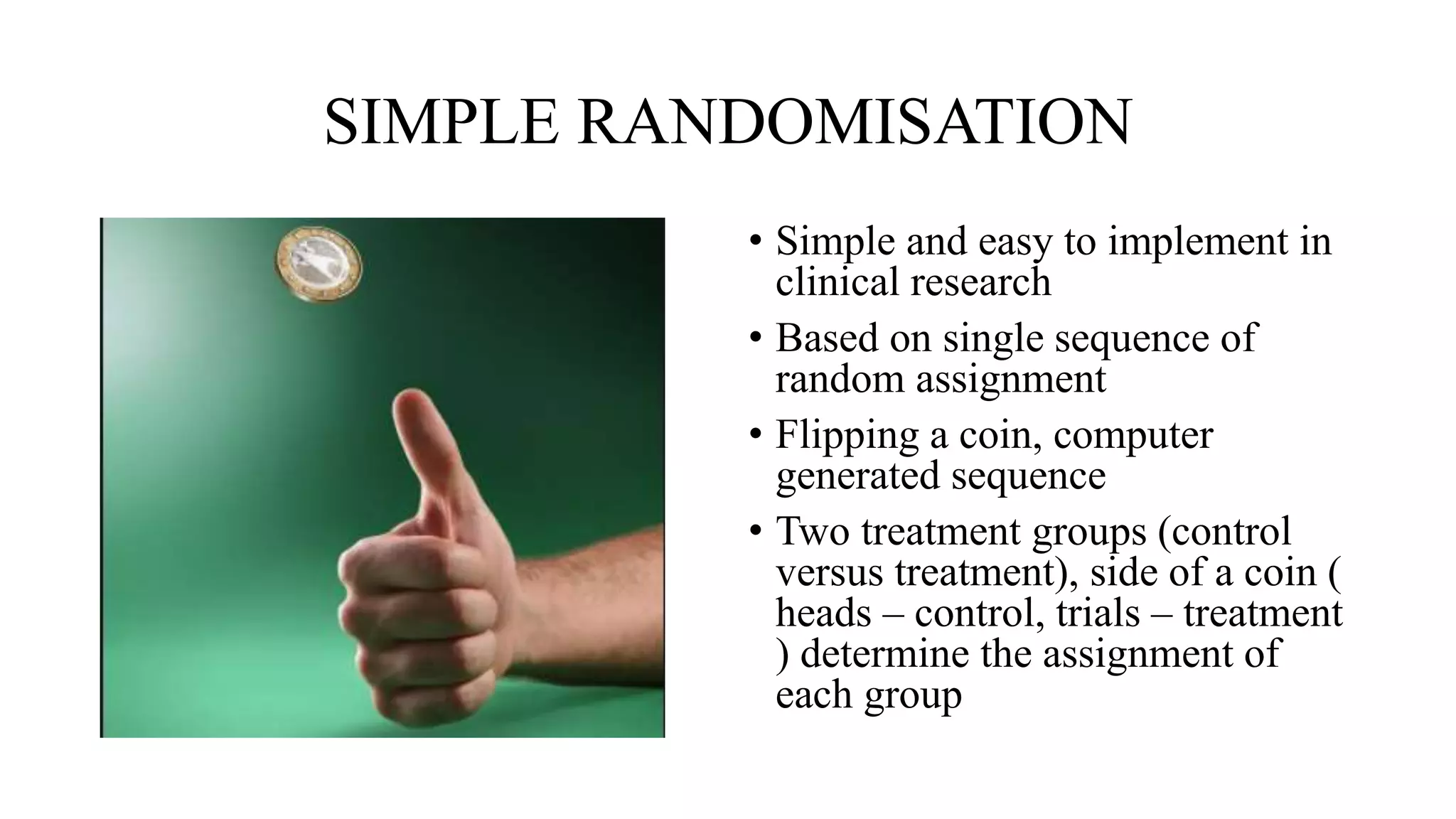
• Simple and easy to implement in
clinical research
• Based on single sequence of
random assignment
• Flipping a coin, computer
generated sequence
• Two treatment groups (control
versus treatment), side of a coin (
heads – control, trials – treatment
) determine the assignment of
each group
Systemic randomisation
• Used when complete list of population from which sample is to be drawn is
available
• When population is large, discrete, scattered and homogenous
• Choose a sample by taking kth patients
• K is sample interval, k= total population/desirable sample size
• One random number is selected, less than or equal to K
• Every kth patient after this random number is taken as sample
• Advantages:
1. Simple and easy to implement
2. Time and labour is relatively small
3. If population is large, homogenous this method give accurate result
• Disadvantage:
Complete list of population with numbering is available
RANDOM ALLOCATION
• Procedure in which identified sample participants are randomly
assigned to a treatment and each participant has same probability of
being assigned to any particular treatment
• If the design is based on N participants and n1 are to be assigned to
Treatment 1 then all the possible samples of size n1 have the same
probability of being assigned to Treatment 1
BLOCK RANDOMISATION
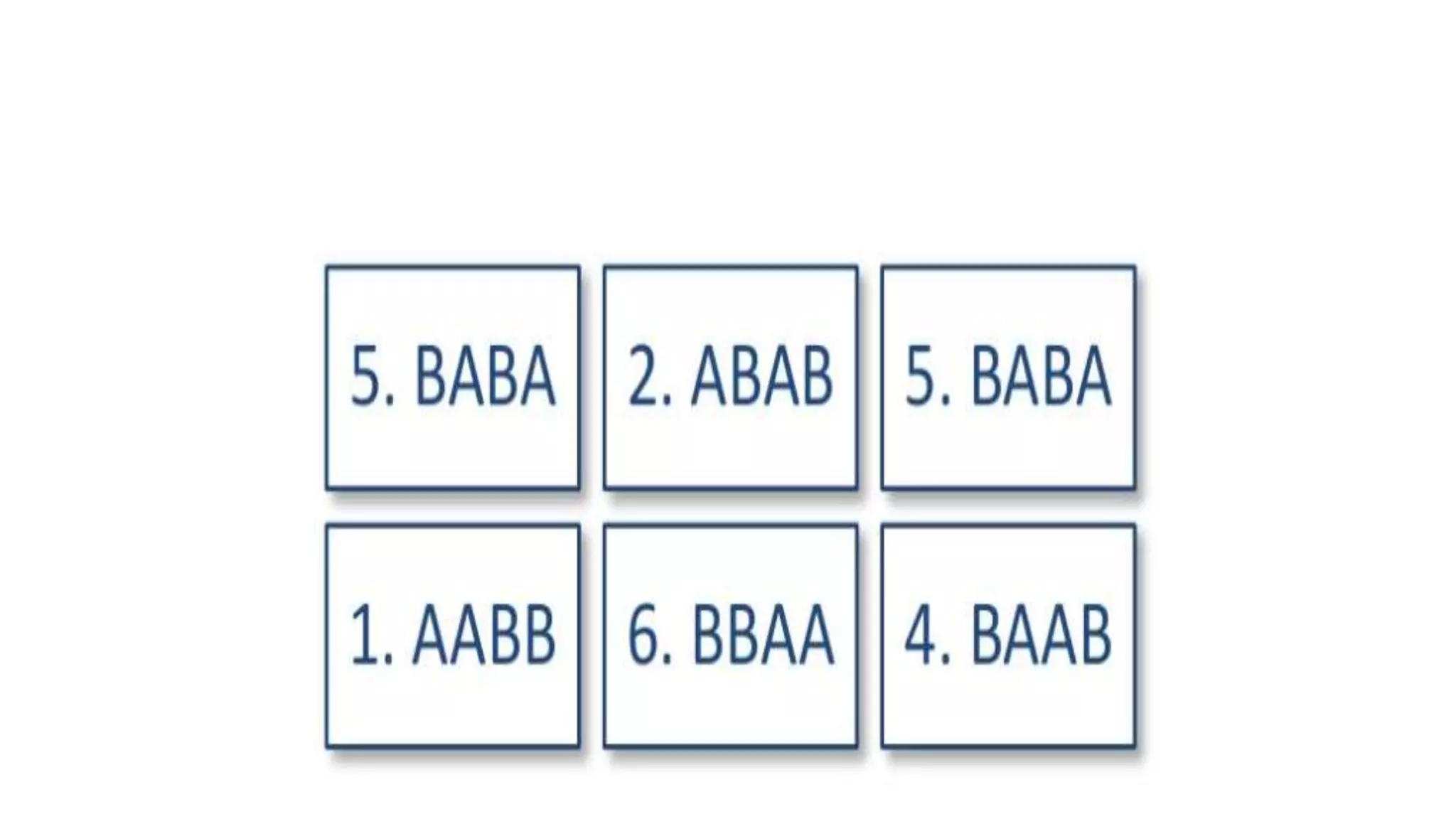
• Commonly used in the two treatment situation where sample sizes
for the two treatments are to be equal or approximately equal
• The process involves recruiting participants in short blocks and
ensuring that half of the participants within each block are allocated
to treatment A and other half to treatment B
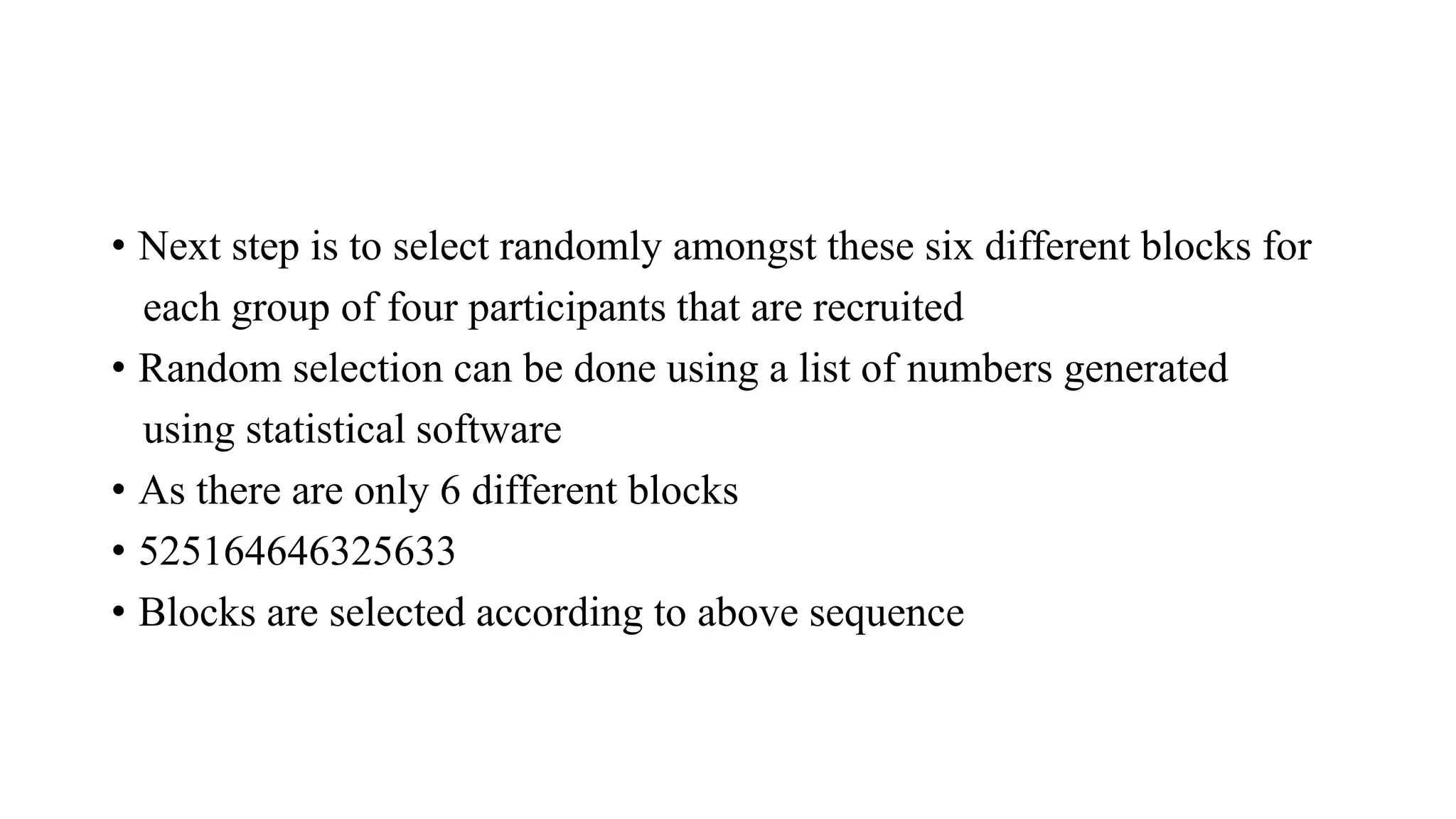
• Next step is to select randomly amongst these six different blocks for
each group of four participants that are recruited
• Random selection can be done using a list of numbers generated
using statistical software
• As there are only 6 different blocks
• 525164646325633
• Blocks are selected according to above sequence
STRATIFICATION
• A stratification factor is a categorical covariate which divides the
patient population according to levels
• Sex: 2 levels – male/female
• Age : <40, 40-59, >59
• Recruitment centers
• Any other known prognostic factor
Stratification and randomisation
MULTISTAGE RANDOMISATION
• Procedure carried out at several stages using random sampling
technique
• In cases of large country survey
Example :
• Random number of districts are selected from each states followed by
random number of taluka, village, unit, respectively
• For hookworm survey 10% in the village of a taluka are chosen for
stool examination
• Advantages:
1. Flexibility in sampling
2. Can use division and subdivision of district to decrease labour
MULTIPHASE RANDOMISATION
Part of sample is taken from the whole sample and part from subsample
Example
physical examination and Mantoux test done in all cases
X-ray done in Mantoux positive cases or with clinical sign
sputum examination done in X-ray positive cases
Number in subsample become smaller and smaller
Less cost, less laborious.
MINIMISATION
• Process of adaptive stratified sampling
• Aim is to minimise the imbalance between the number of patients in
each treatment group over number of variables
• Randomisation method allocates subjects to the treatment groups with
maintaining balance in terms of prognostic factors
• Effective in sample size and with multiple prognostic variables
INAPPROPRIATE RANDOMISATION
METHODS
• Assigning patients alternately to treatment group
• Assigning first half of the population to one group
• Assignments by methods based on patient characteristics based on
date of birth, order of entry into the clinic, day of clinical attendance is
not reliably random
BIAS
• Occur if the results observed reflect other factors in addition to effect
of the treatment
• Conscious and subconscious level
• Occur at conduct of trial, data analysis and interpretation of data
PATIENT BIAS
• Patients knowledge that he is receiving a new treatment may
substantially affect the patients subjective assessment
• There is a subject and disease interaction
CARE PROVIDER BIAS
• Care providers knowledge of which treatment a patient is receiving
may affect the way the provider
Deals with the patient
Treats the patient
• These differences may give the patient, information about the
treatment the patient is receiving, affect the outcome of the study
ASSESSOR BIAS
• The assessors knowledge of which treatment the patient is receiving
may affect the way the assessors assess the outcome
• Would directly affect the validity of the conclusions of the study
• If the assessment is done while the patient is still receiving treatment,
this may provide the patient with information about the treatment
being received
LABORATORY BIAS
• Knowledge of which treatment the patient received may affect the way
in which the test is run or interpreted, or be retested
ANALYSIS AND INTERPRETATION BIAS
• Knowledge of the treatment group may effect the results of the
analysis of the data by
• Seeking an explanation of an anomalous finding when one is found
contrary to the study hypothesis
• Accepting a positive finding without fully exploring the data
• Knowledge of the treatment group may affect the decision made by
external monitors of a study by
• Terminating a study for adverse events because they were expecting it
• Terminating a study for superior of treatment because they were
expecting it
REFERENCES
• An overview of randomisation techniques: an unbiased assessment of
outcome in clinical research J Hum Reprod Sci. 2011 Jan- April; 4(1):
8-11
• Designing a research project: Randomised controlled trials and their
principles- J M Kendall
• Risk and evidence of bias in randomised controlled trials- Alex Eble
and Peter boone 2012
• Randomisation in clinical trials, Dr Urmila- pune
• Concept of randomisation and blinding in clinical trials – Suraj P
Anand
Thank u

Randomisation

  • 1.
    RANDOMISATION IN CLINICAL TRIALS Sekharbabu. B 3rd year post graduate Dept. of pharmacology
  • 2.
    OVERVIEW • Introduction • Whatis Randomisation • Need of Randomisation • Criteria of Randomisation • Methods of Randomisation • Bias and types
  • 3.
    INTRODUCTION • Clinical trialsare research studies that test how well new medical approaches work in people • Randomisation is a process by which allocation of subjects to treatment groups is done by chance, without the stability to predict who is in what group
  • 5.
    RANDOMISATION • A methodbased on chance alone by which study participants are assigned to treatment group • Randomisation minimises the differences among groups by equally distributing with particular characteristics among all trial arms. The researchers donot know which treatment is better
  • 7.
    NEED OF RANDOMISATION •Primary: To prevent bias in allocating subjects to treatment groups • Secondary: To achieve comparability between the groups
  • 8.
    CRITERIA FOR RANDOMISATION •Unpredictability: Each participant has the same chance of receiving any of the interventions Allocation is carried out using a chance mechanism so that neither the participant nor the investigator will know in advance which will be assigned • Balance: Treatment groups are of a similar size, groups are alike in all important aspects and only differ in the intervention each group receives
  • 9.
    • Simplicity: Easy forinvestigator to implement
  • 10.
    SIMPLE RANDOMISATION • Simpleand easy to implement in clinical research • Based on single sequence of random assignment • Flipping a coin, computer generated sequence • Two treatment groups (control versus treatment), side of a coin ( heads – control, trials – treatment ) determine the assignment of each group
  • 11.
    Systemic randomisation • Usedwhen complete list of population from which sample is to be drawn is available • When population is large, discrete, scattered and homogenous • Choose a sample by taking kth patients • K is sample interval, k= total population/desirable sample size • One random number is selected, less than or equal to K • Every kth patient after this random number is taken as sample
  • 12.
    • Advantages: 1. Simpleand easy to implement 2. Time and labour is relatively small 3. If population is large, homogenous this method give accurate result • Disadvantage: Complete list of population with numbering is available
  • 13.
    RANDOM ALLOCATION • Procedurein which identified sample participants are randomly assigned to a treatment and each participant has same probability of being assigned to any particular treatment • If the design is based on N participants and n1 are to be assigned to Treatment 1 then all the possible samples of size n1 have the same probability of being assigned to Treatment 1
  • 14.
    BLOCK RANDOMISATION • Commonlyused in the two treatment situation where sample sizes for the two treatments are to be equal or approximately equal • The process involves recruiting participants in short blocks and ensuring that half of the participants within each block are allocated to treatment A and other half to treatment B
  • 16.
    • Next stepis to select randomly amongst these six different blocks for each group of four participants that are recruited • Random selection can be done using a list of numbers generated using statistical software • As there are only 6 different blocks • 525164646325633 • Blocks are selected according to above sequence
  • 18.
    STRATIFICATION • A stratificationfactor is a categorical covariate which divides the patient population according to levels • Sex: 2 levels – male/female • Age : <40, 40-59, >59 • Recruitment centers • Any other known prognostic factor
  • 19.
  • 20.
    MULTISTAGE RANDOMISATION • Procedurecarried out at several stages using random sampling technique • In cases of large country survey Example : • Random number of districts are selected from each states followed by random number of taluka, village, unit, respectively • For hookworm survey 10% in the village of a taluka are chosen for stool examination
  • 21.
    • Advantages: 1. Flexibilityin sampling 2. Can use division and subdivision of district to decrease labour
  • 22.
    MULTIPHASE RANDOMISATION Part ofsample is taken from the whole sample and part from subsample Example physical examination and Mantoux test done in all cases X-ray done in Mantoux positive cases or with clinical sign sputum examination done in X-ray positive cases Number in subsample become smaller and smaller Less cost, less laborious.
  • 23.
    MINIMISATION • Process ofadaptive stratified sampling • Aim is to minimise the imbalance between the number of patients in each treatment group over number of variables • Randomisation method allocates subjects to the treatment groups with maintaining balance in terms of prognostic factors • Effective in sample size and with multiple prognostic variables
  • 24.
    INAPPROPRIATE RANDOMISATION METHODS • Assigningpatients alternately to treatment group • Assigning first half of the population to one group • Assignments by methods based on patient characteristics based on date of birth, order of entry into the clinic, day of clinical attendance is not reliably random
  • 25.
    BIAS • Occur ifthe results observed reflect other factors in addition to effect of the treatment • Conscious and subconscious level • Occur at conduct of trial, data analysis and interpretation of data
  • 26.
    PATIENT BIAS • Patientsknowledge that he is receiving a new treatment may substantially affect the patients subjective assessment • There is a subject and disease interaction
  • 27.
    CARE PROVIDER BIAS •Care providers knowledge of which treatment a patient is receiving may affect the way the provider Deals with the patient Treats the patient • These differences may give the patient, information about the treatment the patient is receiving, affect the outcome of the study
  • 28.
    ASSESSOR BIAS • Theassessors knowledge of which treatment the patient is receiving may affect the way the assessors assess the outcome • Would directly affect the validity of the conclusions of the study • If the assessment is done while the patient is still receiving treatment, this may provide the patient with information about the treatment being received
  • 29.
    LABORATORY BIAS • Knowledgeof which treatment the patient received may affect the way in which the test is run or interpreted, or be retested
  • 30.
    ANALYSIS AND INTERPRETATIONBIAS • Knowledge of the treatment group may effect the results of the analysis of the data by • Seeking an explanation of an anomalous finding when one is found contrary to the study hypothesis • Accepting a positive finding without fully exploring the data
  • 31.
    • Knowledge ofthe treatment group may affect the decision made by external monitors of a study by • Terminating a study for adverse events because they were expecting it • Terminating a study for superior of treatment because they were expecting it
  • 32.
    REFERENCES • An overviewof randomisation techniques: an unbiased assessment of outcome in clinical research J Hum Reprod Sci. 2011 Jan- April; 4(1): 8-11 • Designing a research project: Randomised controlled trials and their principles- J M Kendall • Risk and evidence of bias in randomised controlled trials- Alex Eble and Peter boone 2012 • Randomisation in clinical trials, Dr Urmila- pune • Concept of randomisation and blinding in clinical trials – Suraj P Anand
  • 33.