APA Citation Style             (6 th   Ed.)
         Dr. Arlene S. Opina
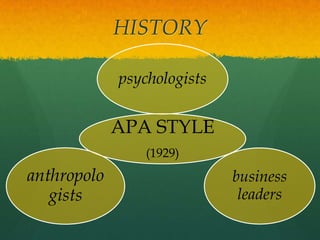
HISTORY

             psychologists


             APA STYLE
                 (1929)
anthropolo                   business
   gists                      leaders
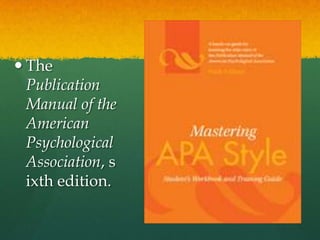
 The
  Publication
  Manual of the
  American
  Psychological
  Association, s
  ixth edition.
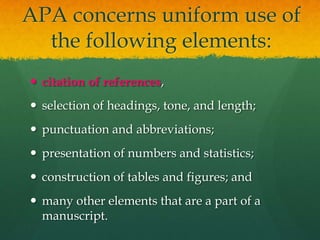
APA concerns uniform use of
  the following elements:
 citation of references,
 selection of headings, tone, and length;
 punctuation and abbreviations;
 presentation of numbers and statistics;
 construction of tables and figures; and
 many other elements that are a part of a
  manuscript.
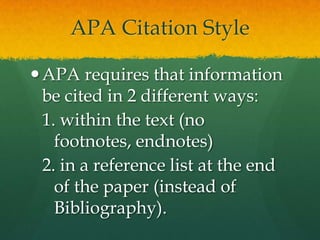
APA Citation Style

 APA requires that information
  be cited in 2 different ways:
  1. within the text (no footnotes,
    endnotes)
  2. in a reference list at the end
    of the paper (instead of
    Bibliography).
Reference Citations in
          Text

 In APA style, in-text citations
  are placed within sentences
  and paragraphs so that it is
  clear what information is being
  quoted or paraphrased and
  whose information is being
  cited.
Reference Citations in
          Text
 APA uses the author-date
 method of citation.
 The last name of the author
  and the date of publication are
  inserted in the text in the
  appropriate place.
Example

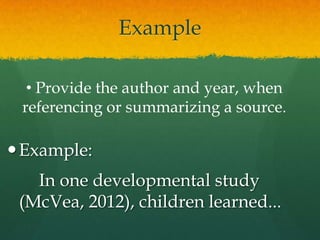
  • Provide the author and year, when
 referencing or summarizing a source.

 Example:
   In one developmental study
 (McVea, 2012), children learned...
Reference Citations in
             Text
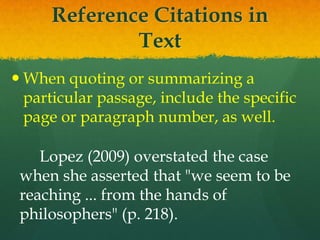
 When quoting or summarizing a
  particular passage, include the specific
  page or paragraph number, as well.

    Lopez (2009) overstated the case
 when she asserted that "we seem to be
 reaching ... from the hands of
 philosophers" (p. 218).
No page number

If page numbers are not included in
  electronic sources (such as Web-
  based journals), provide the
  paragraph number preceded by the
  abbreviation "para." or the heading
  and following paragraph.
(Mönnich & Spiering, 2008, para. 9)
Reference Citations in
           Text
 When quoting in your paper, if a direct
  quote is less than 40
  words, incorporate it into your text
  and use quotation marks. If a direct
  quote is more than 40 words, make
  the quotation a free-standing
  indented block of text and DO NOT
  use quotation marks.
Works by a single
         author
 In one experimental study (Lopez,
  2012), students learned... OR

 In the study by Lopez (2012),
  critical thinking… OR
 In 2012, Lopez’ study of critical
  thinking…
Works by two authors
When a work has two authors, always cite both
 names every time the reference occurs in the
 text. In parenthetical material join the names
  with an ampersand (&).

  as has been shown (Jambalos & Albano, 2008)
In the narrative text, join the names with the word
  "and.”
  as Jambalos and Albano (2008) demonstrated
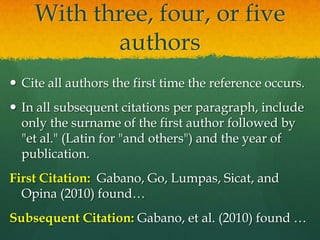
With three, four, or five
           authors
 Cite all authors the first time the reference occurs.
 In all subsequent citations per paragraph, include
  only the surname of the first author followed by
  "et al." (Latin for "and others") and the year of
  publication.
First Citation: Gabano, Go, Lumpas, Sicat, and
  Opina (2010) found…
Subsequent Citation: Gabano et al. (2010) found …
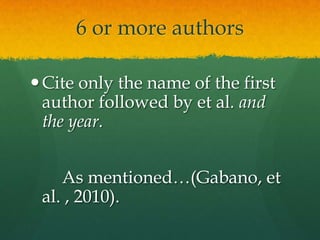
6 or more authors

 Cite only the name of the first
  author followed by et al. and
  the year.


    As mentioned…(Gabano et
 al. , 2010).
Works by associations, corporations,
       government agencies, etc.


  The names of groups that serve as
   authors (corporate authors) are usually
   written out each time they appear in a
   text reference.


  As found in the study…(National
Institute of Mental Health [NIMH], 2009).
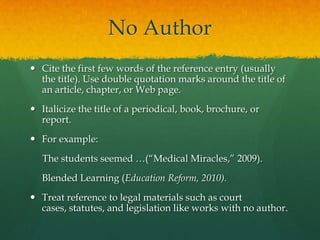
No Author
 Cite the first few words of the reference entry (usually
  the title). Use double quotation marks around the title of
  an article, chapter, or Web page.
 Italicize the title of a periodical, book, brochure, or
  report.
 For example:
   The students seemed …(“Medical Miracles,” 2009).
  Blended Learning (Education Reform, 2010).
 Treat reference to legal materials such as court cases,
  statutes, and legislation like works with no author.
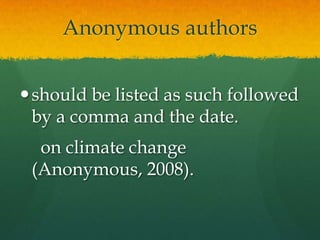
Anonymous authors


 should be listed as such followed
  by a comma and the date.
  on climate change
 (Anonymous, 2008).
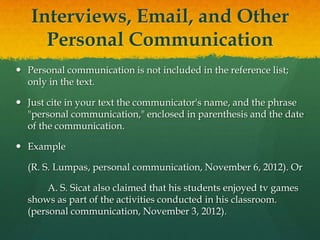
Interviews, Email, and Other
     Personal Communication
 Personal communication is not included in the reference list;
  only in the text.

 Just cite in your text the communicator's name, and the phrase
  "personal communication," enclosed in parenthesis and the date
  of the communication.

 Example

  (R. S. Lumpas, personal communication, November 6, 2012). Or

       A. S. Sicat also claimed that his students enjoyed tv games
  shows as part of the activities conducted in his classroom.
  (personal communication, November 3, 2012).
Citations in
Reference List
Reference List

 References cited in the text of a
  research paper must appear in
  a Reference List . This list
  provides the information
  necessary to identify and
  retrieve each source.
Digital object identifier
             (DOI)
 DOI - a unique alphanumeric string
  assigned to identify content and provide a
  persistent link to its location on the
  internet.
 The DOI is typically located on the first
  page of the electronic journal article near
  the copyright notice. When a DOI is used
  in your citation, no other retrieval
  information is needed.
No DOI
 If no DOI has been assigned to the
  content, provide the home page URL of the
  journal or of the book or report publisher.
 Do not insert a hyphen if you need to break a
  URL across lines;
 do not add a period after a URL, to prevent the
  impression that the period is part of the URL.
 In general, it is not necessary to include retrieval
  dates unless the source material has changed
  over time.
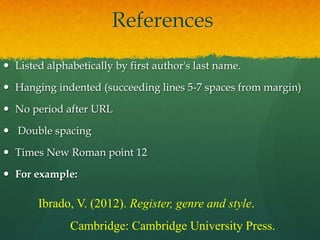
References
 Listed alphabetically by first author's last name.

 Hanging indented (succeeding lines 5-7 spaces from margin)

 No period after URL

 Double spacing

 Times New Roman point 12

 For example:

       Ibrado, V. (2012). Register, genre and style.
              Cambridge: Cambridge University Press.
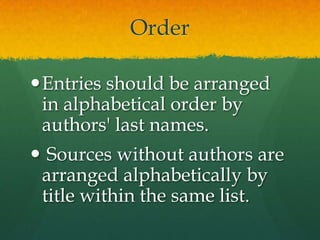
Order

Entries should be arranged
 in alphabetical order by
 authors' last names.
 Sources without authors are
 arranged alphabetically by
 title within the same list.
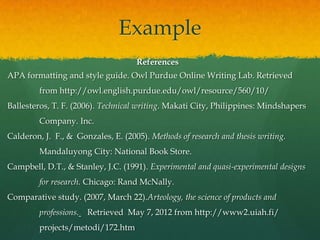
Example
                                    References
APA formatting and style guide. Owl Purdue Online Writing Lab. Retrieved
         from http://owl.english.purdue.edu/owl/resource/560/10/
Ballesteros, T. F. (2006). Technical writing. Makati City, Philippines: Mindshapers
         Company. Inc.
Calderon, J. F., & Gonzales, E. (2005). Methods of research and thesis writing.
         Mandaluyong City: National Book Store.
Campbell, D.T., & Stanley, J.C. (1991). Experimental and quasi-experimental designs
         for research. Chicago: Rand McNally.
Comparative study. (2007, March 22).Arteology, the science of products and
         professions.   Retrieved May 7, 2012 from http://www2.uiah.fi/
         projects/metodi/172.htm
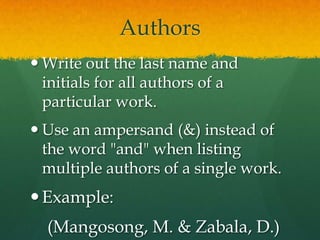
Authors
 Write out the last name and
  initials for all authors of a
  particular work.
 Use an ampersand (&) instead of
  the word "and" when listing
  multiple authors of a single work.
 Example:
  (Mangosong, M. & Zabala, D.)
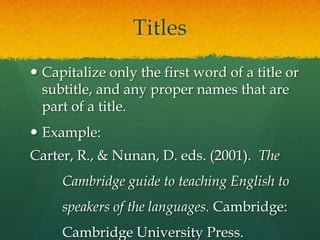
Titles
 Capitalize only the first word of a title or
  subtitle, and any proper names that are
  part of a title.
 Example:
Carter, R., & Nunan, D. eds. (2001). The
     Cambridge guide to teaching English to
     speakers of the languages. Cambridge:
     Cambridge University Press.
Pagination

 Use the abbreviation p. or pp. to
  designate page numbers of articles from
  periodicals. The abbreviation p. or pp.
 is used only in magazines and
 newspapers, but not in journals.
 These abbreviations are also used to
  designate pages in encyclopedia articles
  and chapters from edited books.
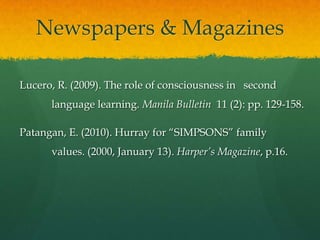
Newspapers & Magazines

Lucero, R. (2009). The role of consciousness in second
      language learning. Manila Bulletin 11 (2): pp. 129-158.

Patangan, E. (2010). Hurray for “SIMPSONS” family
      values. (2000, January 13). Harper’s Magazine, p.16.
Indentation

 The first line of the entry is flushed
         with the left margin, and all
         subsequent lines are
         indented (5 to 7 spaces) to
         form a "hanging indent
         format“.
Underlining vs. Italics

 It is appropriate to use italics instead of
  underlining for titles of books and
  journals.
 Example
White, R., & Arndt, V. (2000). Process
       writing. New York: Longman.
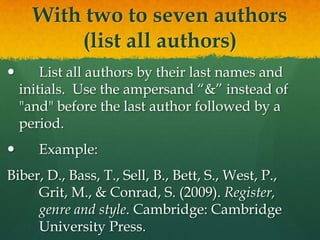
With two to seven authors
          (list all authors)
       List all authors by their last names and
    initials. Use the ampersand “&” instead of
    "and" before the last author followed by a
    period.
      Example:
Biber, D., Bass, T., Sell, B., Bett, S., West, P.,
     Grit, M., & Conrad, S. (2009). Register,
     genre and style. Cambridge: Cambridge
     University Press.
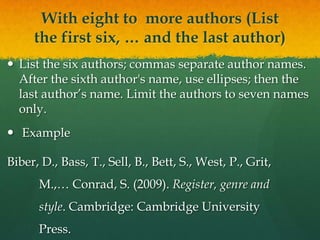
With eight to more authors (List
     the first six, … and the last author)
 List the six authors; commas separate author names.
  After the sixth author's name, use ellipses; then the
  last author’s name. Limit the authors to seven names
  only.
 Example

Biber, D., Bass, T., Sell, B., Bett, S., West, P., Grit,
      M.,… Conrad, S. (2009). Register, genre and
      style. Cambridge: Cambridge University
      Press.
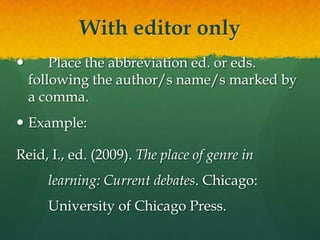
With editor only
       Place the abbreviation ed. or eds.
    following the author/s name/s marked by
    a comma.
 Example:

Reid, I., ed. (2009). The place of genre in
      learning: Current debates. Chicago:
      University of Chicago Press.
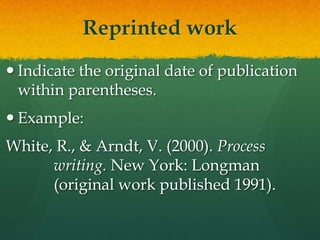
Reprinted work
 Indicate the original date of publication
  within parentheses.
 Example:
White, R., & Arndt, V. (2000). Process
      writing. New York: Longman
      (original work published 1991).
Articles in journals, magazines,
        and newspapers.

 References to must include the
 following elements: author(s), date of
 publication, article title, journal
 title, volume number, issue number
 (if applicable), and page numbers.
JOURNALS, MAGAZINES, NEWSP
    APERS accessed online

Gatcho, R. (2008). Students’ typology: The
     effects of regret in escalation of
     commitment. Organizational Behavior and
     Human Decision Processes, 105(2), 221-
     232. doi:10.1016/j.obhdp.2007.08.002
Article from an
      Internet-only journal

Hirtle, P. B. (2008, July-August). Copyright
    renewal, copyright restoration, and
    the difficulty of determining
    copyright status. D-Lib Magazine,
    14(7/8). doi:10.1045/july2008-hirtle .
Journal article from a
   subscription database (no DOI)

Lapuz, A. (2008, July 21). Information
      worth billions. Fortune, 158(2), 73-79.
      Retrieved from Business Source
      Complete, EBSCO. Retrieved from
      http://search.ebscohost.com
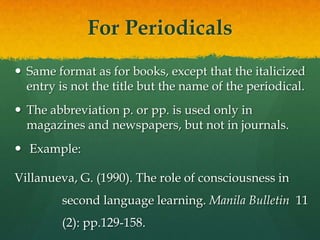
For Periodicals
 Same format as for books, except that the italicized
  entry is not the title but the name of the periodical.
 The abbreviation p. or pp. is used only in
  magazines and newspapers, but not in journals.
 Example:

Villanueva, G. (1990). The role of consciousness in
         second language learning. Manila Bulletin 11
         (2): pp.129-158.
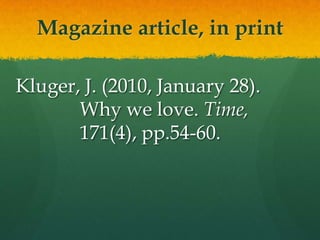
Magazine article, in print

Kluger, J. (2010, January 28).
       Why we love. Time,
       171(4), pp.54-60.
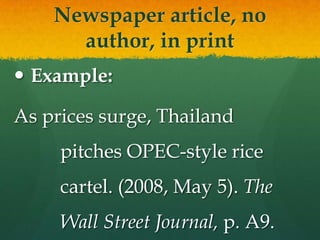
Newspaper article, no
      author, in print
 Example:

As prices surge, Thailand
     pitches OPEC-style rice
     cartel. (2008, May 5). The
     Wall Street Journal, p. A9.
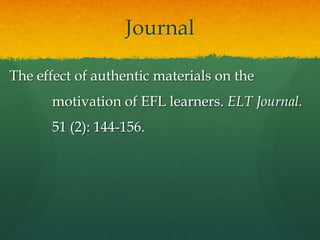
Journal

The effect of authentic materials on the
      motivation of EFL learners. ELT Journal.
      51 (2): 144-156.
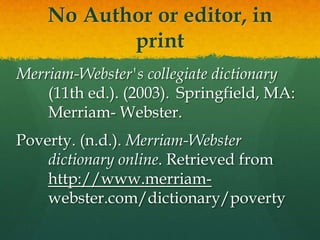
No Author or editor, in
           print
Merriam-Webster's collegiate dictionary
    (11th ed.). (2003). Springfield, MA:
    Merriam- Webster.
Poverty. (n.d.). Merriam-Webster
    dictionary online. Retrieved from
    http://www.merriam-
    webster.com/dictionary/poverty
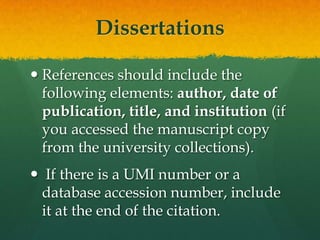
Dissertations

 References should include the
  following elements: author, date of
  publication, title, and institution (if
  you accessed the manuscript copy
  from the university collections).
 If there is a UMI number or a
 database accession number, include
 it at the end of the citation.
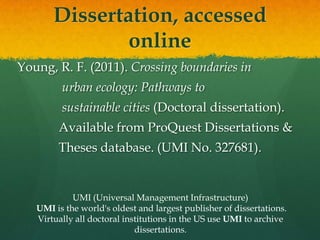
Dissertation, accessed
               online
Young, R. F. (2011). Crossing boundaries in
         urban ecology: Pathways to
         sustainable cities (Doctoral dissertation).
        Available from ProQuest Dissertations &
        Theses database. (UMI No. 327681).


            UMI (Universal Management Infrastructure)
   UMI is the world's oldest and largest publisher of dissertations.
   Virtually all doctoral institutions in the US use UMI to archive
                             dissertations.
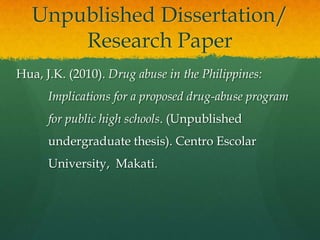
Unpublished Dissertation/
       Research Paper
Hua, J.K. (2010). Drug abuse in the Philippines:
      Implications for a proposed drug-abuse program
      for public high schools. (Unpublished
      undergraduate thesis). Centro Escolar
      University, Makati.
Encyclopedias or dictionaries
   and entries in an encyclopedia
 References must include the
  following elements: author(s) or
  editor(s), date of
  publication, title, place of
  publication, and the name of the
  publisher.
 For sources accessed online, include
  the retrieval date as the entry may be
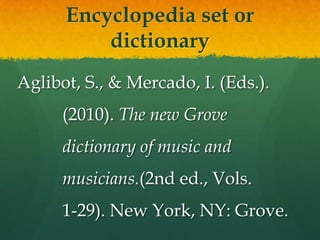
Encyclopedia set or
          dictionary
Aglibot, S., & Mercado, I. (Eds.).
      (2010). The new Grove
      dictionary of music and
      musicians.(2nd ed., Vols.
      1-29). New York, NY: Grove.
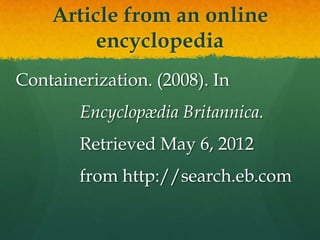
Article from an online
         encyclopedia
Containerization. (2008). In
        Encyclopædia Britannica.
        Retrieved May 6, 2012
        from http://search.eb.com
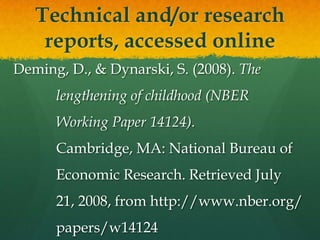
Technical and/or research
    reports, accessed online
Deming, D., & Dynarski, S. (2008). The
      lengthening of childhood (NBER
      Working Paper 14124).
      Cambridge, MA: National Bureau of
      Economic Research. Retrieved July
      21, 2008, from http://www.nber.org/
      papers/w14124
Audio-visual media

 References must include the following
  elements: name and function of the
  primary contributors
  (e.g., producer, director), date, title, th
  e medium in brackets, location or
  place of production, and name of the
  distributor. If the medium is indicated
  as part of the retrieval ID, brackets are
  not needed.
Videocassette/DVD

Achbar, M. (Director/Producer), Abbott, J.
      (Director), Bakan, J. (Writer), &
 Simpson,        B. (Producer) (2004). The
 corporation          [DVD]. Canada: Big
 Picture Media                   Corporation.
Audio
Hanh, T. (Speaker). (2008).
      Mindful living: a collection of
      teachings on love,
       mindfulness, and meditation
       [Cassette Recording].
       Boulder, CO: Sounds True
       Audio.
Motion picture

Gilbert, B. (Producer), & Higgins, C.
     (Screenwriter/Director). (2008).
     Nine to five [Motion Picture].
     United States: Twentieth
     Century Fox.
Television broadcast

Anderson, R., & Morgan, C.
     (Producers). (2010, June 20).
      60 Minutes [Television
      broadcast]. Washington, DC:
      CBS News.
Music recording


Jackson, M. (2009). Beat it.
    Thriller [CD]. New York,
    NY: Sony Music.
Blog entry

Arrington, M. (2008, August 5).
    The viral video guy gets $1
    million in funding. Message
    posted to http://www.tech
     crunch.com
Professional Website

National Renewable Energy
   Laboratory. (2008).
   Biofuels. Retrieved May 6, 2008,
   from http://www.nrel.
   gov/learning/re_biofuels.
   html
By Dr. Arlene S. Opina

        Contributor
  Victoria Grace C. Ibrado

APA citation format

  • 1.
    APA Citation Style (6 th Ed.) Dr. Arlene S. Opina
  • 2.
    HISTORY psychologists APA STYLE (1929) anthropolo business gists leaders
  • 3.
     The Publication Manual of the American Psychological Association, s ixth edition.
  • 4.
    APA concerns uniformuse of the following elements:  citation of references,  selection of headings, tone, and length;  punctuation and abbreviations;  presentation of numbers and statistics;  construction of tables and figures; and  many other elements that are a part of a manuscript.
  • 5.
    APA Citation Style APA requires that information be cited in 2 different ways: 1. within the text (no footnotes, endnotes) 2. in a reference list at the end of the paper (instead of Bibliography).
  • 6.
    Reference Citations in Text  In APA style, in-text citations are placed within sentences and paragraphs so that it is clear what information is being quoted or paraphrased and whose information is being cited.
  • 7.
    Reference Citations in Text  APA uses the author-date method of citation.  The last name of the author and the date of publication are inserted in the text in the appropriate place.
  • 8.
    Example •Provide the author and year, when referencing or summarizing a source.  Example: In one developmental study (McVea, 2012), children learned...
  • 9.
    Reference Citations in Text  When quoting or summarizing a particular passage, include the specific page or paragraph number, as well. Lopez (2009) overstated the case when she asserted that "we seem to be reaching ... from the hands of philosophers" (p. 218).
  • 10.
    No page number Ifpage numbers are not included in electronic sources (such as Web- based journals), provide the paragraph number preceded by the abbreviation "para." or the heading and following paragraph. (Mönnich & Spiering, 2008, para. 9)
  • 11.
    Reference Citations in Text  When quoting in your paper, if a direct quote is less than 40 words, incorporate it into your text and use quotation marks. If a direct quote is more than 40 words, make the quotation a free-standing indented block of text and DO NOT use quotation marks.
  • 12.
    Works by asingle author  In one experimental study (Lopez, 2012), students learned... OR  In the study by Lopez (2012), critical thinking… OR  In 2012, Lopez’ study of critical thinking…
  • 13.
    Works by twoauthors When a work has two authors, always cite both names every time the reference occurs in the text. In parenthetical material join the names with an ampersand (&). as has been shown (Jambalos & Albano, 2008) In the narrative text, join the names with the word "and.” as Jambalos and Albano (2008) demonstrated
  • 14.
    With three, four,or five authors  Cite all authors the first time the reference occurs.  In all subsequent citations per paragraph, include only the surname of the first author followed by "et al." (Latin for "and others") and the year of publication. First Citation: Gabano, Go, Lumpas, Sicat, and Opina (2010) found… Subsequent Citation: Gabano et al. (2010) found …
  • 15.
    6 or moreauthors  Cite only the name of the first author followed by et al. and the year. As mentioned…(Gabano et al. , 2010).
  • 16.
    Works by associations,corporations, government agencies, etc. The names of groups that serve as authors (corporate authors) are usually written out each time they appear in a text reference. As found in the study…(National Institute of Mental Health [NIMH], 2009).
  • 17.
    No Author  Citethe first few words of the reference entry (usually the title). Use double quotation marks around the title of an article, chapter, or Web page.  Italicize the title of a periodical, book, brochure, or report.  For example: The students seemed …(“Medical Miracles,” 2009). Blended Learning (Education Reform, 2010).  Treat reference to legal materials such as court cases, statutes, and legislation like works with no author.
  • 18.
    Anonymous authors  shouldbe listed as such followed by a comma and the date. on climate change (Anonymous, 2008).
  • 19.
    Interviews, Email, andOther Personal Communication  Personal communication is not included in the reference list; only in the text.  Just cite in your text the communicator's name, and the phrase "personal communication," enclosed in parenthesis and the date of the communication.  Example (R. S. Lumpas, personal communication, November 6, 2012). Or A. S. Sicat also claimed that his students enjoyed tv games shows as part of the activities conducted in his classroom. (personal communication, November 3, 2012).
  • 20.
  • 21.
    Reference List  Referencescited in the text of a research paper must appear in a Reference List . This list provides the information necessary to identify and retrieve each source.
  • 22.
    Digital object identifier (DOI)  DOI - a unique alphanumeric string assigned to identify content and provide a persistent link to its location on the internet.  The DOI is typically located on the first page of the electronic journal article near the copyright notice. When a DOI is used in your citation, no other retrieval information is needed.
  • 23.
    No DOI  Ifno DOI has been assigned to the content, provide the home page URL of the journal or of the book or report publisher.  Do not insert a hyphen if you need to break a URL across lines;  do not add a period after a URL, to prevent the impression that the period is part of the URL.  In general, it is not necessary to include retrieval dates unless the source material has changed over time.
  • 24.
    References  Listed alphabeticallyby first author's last name.  Hanging indented (succeeding lines 5-7 spaces from margin)  No period after URL  Double spacing  Times New Roman point 12  For example: Ibrado, V. (2012). Register, genre and style. Cambridge: Cambridge University Press.
  • 25.
    Order Entries should bearranged in alphabetical order by authors' last names.  Sources without authors are arranged alphabetically by title within the same list.
  • 26.
    Example References APA formatting and style guide. Owl Purdue Online Writing Lab. Retrieved from http://owl.english.purdue.edu/owl/resource/560/10/ Ballesteros, T. F. (2006). Technical writing. Makati City, Philippines: Mindshapers Company. Inc. Calderon, J. F., & Gonzales, E. (2005). Methods of research and thesis writing. Mandaluyong City: National Book Store. Campbell, D.T., & Stanley, J.C. (1991). Experimental and quasi-experimental designs for research. Chicago: Rand McNally. Comparative study. (2007, March 22).Arteology, the science of products and professions. Retrieved May 7, 2012 from http://www2.uiah.fi/ projects/metodi/172.htm
  • 27.
    Authors  Write outthe last name and initials for all authors of a particular work.  Use an ampersand (&) instead of the word "and" when listing multiple authors of a single work.  Example: (Mangosong, M. & Zabala, D.)
  • 28.
    Titles  Capitalize onlythe first word of a title or subtitle, and any proper names that are part of a title.  Example: Carter, R., & Nunan, D. eds. (2001). The Cambridge guide to teaching English to speakers of the languages. Cambridge: Cambridge University Press.
  • 29.
    Pagination  Use theabbreviation p. or pp. to designate page numbers of articles from periodicals. The abbreviation p. or pp. is used only in magazines and newspapers, but not in journals.  These abbreviations are also used to designate pages in encyclopedia articles and chapters from edited books.
  • 30.
    Newspapers & Magazines Lucero,R. (2009). The role of consciousness in second language learning. Manila Bulletin 11 (2): pp. 129-158. Patangan, E. (2010). Hurray for “SIMPSONS” family values. (2000, January 13). Harper’s Magazine, p.16.
  • 31.
    Indentation  The firstline of the entry is flushed with the left margin, and all subsequent lines are indented (5 to 7 spaces) to form a "hanging indent format“.
  • 32.
    Underlining vs. Italics It is appropriate to use italics instead of underlining for titles of books and journals.  Example White, R., & Arndt, V. (2000). Process writing. New York: Longman.
  • 33.
    With two toseven authors (list all authors)  List all authors by their last names and initials. Use the ampersand “&” instead of "and" before the last author followed by a period.  Example: Biber, D., Bass, T., Sell, B., Bett, S., West, P., Grit, M., & Conrad, S. (2009). Register, genre and style. Cambridge: Cambridge University Press.
  • 34.
    With eight tomore authors (List the first six, … and the last author)  List the six authors; commas separate author names. After the sixth author's name, use ellipses; then the last author’s name. Limit the authors to seven names only.  Example Biber, D., Bass, T., Sell, B., Bett, S., West, P., Grit, M.,… Conrad, S. (2009). Register, genre and style. Cambridge: Cambridge University Press.
  • 35.
    With editor only  Place the abbreviation ed. or eds. following the author/s name/s marked by a comma.  Example: Reid, I., ed. (2009). The place of genre in learning: Current debates. Chicago: University of Chicago Press.
  • 36.
    Reprinted work  Indicatethe original date of publication within parentheses.  Example: White, R., & Arndt, V. (2000). Process writing. New York: Longman (original work published 1991).
  • 37.
    Articles in journals,magazines, and newspapers. References to must include the following elements: author(s), date of publication, article title, journal title, volume number, issue number (if applicable), and page numbers.
  • 38.
    JOURNALS, MAGAZINES, NEWSP APERS accessed online Gatcho, R. (2008). Students’ typology: The effects of regret in escalation of commitment. Organizational Behavior and Human Decision Processes, 105(2), 221- 232. doi:10.1016/j.obhdp.2007.08.002
  • 39.
    Article from an Internet-only journal Hirtle, P. B. (2008, July-August). Copyright renewal, copyright restoration, and the difficulty of determining copyright status. D-Lib Magazine, 14(7/8). doi:10.1045/july2008-hirtle .
  • 40.
    Journal article froma subscription database (no DOI) Lapuz, A. (2008, July 21). Information worth billions. Fortune, 158(2), 73-79. Retrieved from Business Source Complete, EBSCO. Retrieved from http://search.ebscohost.com
  • 41.
    For Periodicals  Sameformat as for books, except that the italicized entry is not the title but the name of the periodical.  The abbreviation p. or pp. is used only in magazines and newspapers, but not in journals.  Example: Villanueva, G. (1990). The role of consciousness in second language learning. Manila Bulletin 11 (2): pp.129-158.
  • 42.
    Magazine article, inprint Kluger, J. (2010, January 28). Why we love. Time, 171(4), pp.54-60.
  • 43.
    Newspaper article, no author, in print  Example: As prices surge, Thailand pitches OPEC-style rice cartel. (2008, May 5). The Wall Street Journal, p. A9.
  • 44.
    Journal The effect ofauthentic materials on the motivation of EFL learners. ELT Journal. 51 (2): 144-156.
  • 45.
    No Author oreditor, in print Merriam-Webster's collegiate dictionary (11th ed.). (2003). Springfield, MA: Merriam- Webster. Poverty. (n.d.). Merriam-Webster dictionary online. Retrieved from http://www.merriam- webster.com/dictionary/poverty
  • 46.
    Dissertations  References shouldinclude the following elements: author, date of publication, title, and institution (if you accessed the manuscript copy from the university collections).  If there is a UMI number or a database accession number, include it at the end of the citation.
  • 47.
    Dissertation, accessed online Young, R. F. (2011). Crossing boundaries in urban ecology: Pathways to sustainable cities (Doctoral dissertation). Available from ProQuest Dissertations & Theses database. (UMI No. 327681). UMI (Universal Management Infrastructure) UMI is the world's oldest and largest publisher of dissertations. Virtually all doctoral institutions in the US use UMI to archive dissertations.
  • 48.
    Unpublished Dissertation/ Research Paper Hua, J.K. (2010). Drug abuse in the Philippines: Implications for a proposed drug-abuse program for public high schools. (Unpublished undergraduate thesis). Centro Escolar University, Makati.
  • 49.
    Encyclopedias or dictionaries and entries in an encyclopedia  References must include the following elements: author(s) or editor(s), date of publication, title, place of publication, and the name of the publisher.  For sources accessed online, include the retrieval date as the entry may be
  • 50.
    Encyclopedia set or dictionary Aglibot, S., & Mercado, I. (Eds.). (2010). The new Grove dictionary of music and musicians.(2nd ed., Vols. 1-29). New York, NY: Grove.
  • 51.
    Article from anonline encyclopedia Containerization. (2008). In Encyclopædia Britannica. Retrieved May 6, 2012 from http://search.eb.com
  • 52.
    Technical and/or research reports, accessed online Deming, D., & Dynarski, S. (2008). The lengthening of childhood (NBER Working Paper 14124). Cambridge, MA: National Bureau of Economic Research. Retrieved July 21, 2008, from http://www.nber.org/ papers/w14124
  • 53.
    Audio-visual media  Referencesmust include the following elements: name and function of the primary contributors (e.g., producer, director), date, title, th e medium in brackets, location or place of production, and name of the distributor. If the medium is indicated as part of the retrieval ID, brackets are not needed.
  • 54.
    Videocassette/DVD Achbar, M. (Director/Producer),Abbott, J. (Director), Bakan, J. (Writer), & Simpson, B. (Producer) (2004). The corporation [DVD]. Canada: Big Picture Media Corporation.
  • 55.
    Audio Hanh, T. (Speaker).(2008). Mindful living: a collection of teachings on love, mindfulness, and meditation [Cassette Recording]. Boulder, CO: Sounds True Audio.
  • 56.
    Motion picture Gilbert, B.(Producer), & Higgins, C. (Screenwriter/Director). (2008). Nine to five [Motion Picture]. United States: Twentieth Century Fox.
  • 57.
    Television broadcast Anderson, R.,& Morgan, C. (Producers). (2010, June 20). 60 Minutes [Television broadcast]. Washington, DC: CBS News.
  • 58.
    Music recording Jackson, M.(2009). Beat it. Thriller [CD]. New York, NY: Sony Music.
  • 59.
    Blog entry Arrington, M.(2008, August 5). The viral video guy gets $1 million in funding. Message posted to http://www.tech crunch.com
  • 60.
    Professional Website National RenewableEnergy Laboratory. (2008). Biofuels. Retrieved May 6, 2008, from http://www.nrel. gov/learning/re_biofuels. html
  • 61.
    By Dr. ArleneS. Opina Contributor Victoria Grace C. Ibrado