Citing and Referencing
academic sources
Community Medicine Department
By the end of this practical session, the
student will be able to:
1. Apply Vancouver style for referencing
a book, journal article and Webpage.
2. Apply Vancouver style for referencing
tables and a figures.
3. Recognize how to avoid plagiarism.
Introduction
Referencing
•A standardized way of acknowledging the sources
of information and ideas that we have used in our
assignments and which allows the sources to be
identified
Why reference?
• To avoid plagiarism
• To verify quotations (confirm references)
• To enable readers to follow up what you have written
and more fully understand the cited author’s work.
What is the Vancouver Referencing Technique?
A uniform set of requirements for bibliographic
references.
a “Numbered" style
follows rules established by the International Committee
of Medical Journal Editors
also known as: Uniform Requirements for Manuscripts
Submitted to Biomedical Journals.
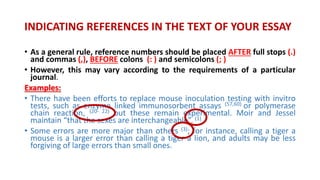
• As a general rule, reference numbers should be placed AFTER full stops (.)
and commas (,), BEFORE colons (: ) and semicolons (; )
• However, this may vary according to the requirements of a particular
journal.
Examples:
• There have been efforts to replace mouse inoculation testing with invitro
tests, such as enzyme linked immunosorbent assays (57,60) or polymerase
chain reaction, (20- 22) but these remain experimental. Moir and Jessel
maintain “that the sexes are interchangeable”. (1)
• Some errors are more major than others (3); for instance, calling a tiger a
mouse is a larger error than calling a tiger a lion, and adults may be less
forgiving of large errors than small ones.
INDICATING REFERENCES IN THE TEXT OF YOUR ESSAY
Learning Objectives
Apply Vancouver style for referencing a book,
journal article and Webpage.
Apply Vancouver style for referencing tables and a
figures.
Recognize how to avoid plagiarism.
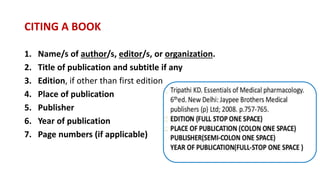
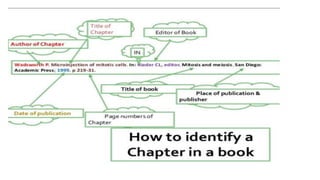
1. Name/s of author/s, editor/s, or organization.
2. Title of publication and subtitle if any
3. Edition, if other than first edition
4. Place of publication
5. Publisher
6. Year of publication
7. Page numbers (if applicable)
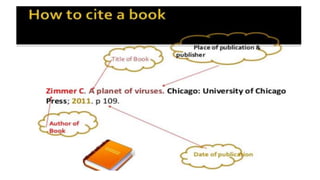
CITING A BOOK
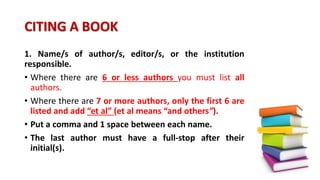
CITING A BOOK
1. Name/s of author/s, editor/s, or the institution
responsible.
• Where there are 6 or less authors you must list all
authors.
• Where there are 7 or more authors, only the first 6 are
listed and add “et al” (et al means “and others”).
• Put a comma and 1 space between each name.
• The last author must have a full-stop after their
initial(s).
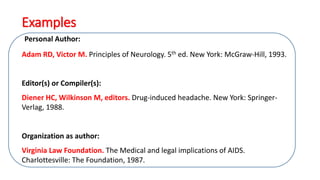
Personal Author:
Adam RD, Victor M. Principles of Neurology. 5th ed. New York: McGraw-Hill, 1993.
Editor(s) or Compiler(s):
Diener HC, Wilkinson M, editors. Drug-induced headache. New York: Springer-
Verlag, 1988.
Organization as author:
Virginia Law Foundation. The Medical and legal implications of AIDS.
Charlottesville: The Foundation, 1987.
Examples
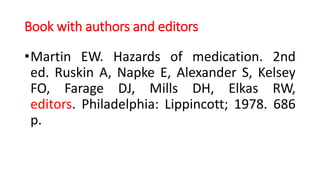
Book with authors and editors
•Martin EW. Hazards of medication. 2nd
ed. Ruskin A, Napke E, Alexander S, Kelsey
FO, Farage DJ, Mills DH, Elkas RW,
editors. Philadelphia: Lippincott; 1978. 686
p.
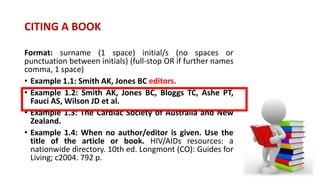
CITING A BOOK
Format: surname (1 space) initial/s (no spaces or
punctuation between initials) (full-stop OR if further names
comma, 1 space)
• Example 1.1: Smith AK, Jones BC editors.
• Example 1.2: Smith AK, Jones BC, Bloggs TC, Ashe PT,
Fauci AS, Wilson JD et al.
• Example 1.3: The Cardiac Society of Australia and New
Zealand.
• Example 1.4: When no author/editor is given. Use the
title of the article or book. HIV/AIDs resources: a
nationwide directory. 10th ed. Longmont (CO): Guides for
Living; c2004. 792 p.
2. Title of publication and subtitle if any
CITING A BOOK
Format: 1: title (full-stop, 1 space)
• Example 2.1: Harrison's principles of internal medicine.
• Example 2.2: Physical pharmacy: physical chemical principles in the
pharmaceutical sciences.
• Example 2.3: Pharmacy in Australia: the national experience
CITING A BOOK
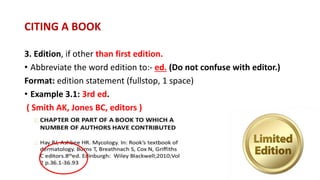
3. Edition, if other than first edition.
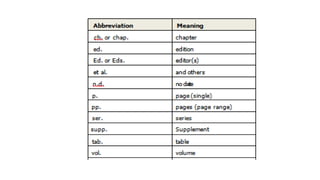
• Abbreviate the word edition to:- ed. (Do not confuse with editor.)
Format: edition statement (fullstop, 1 space)
• Example 3.1: 3rd ed.
( Smith AK, Jones BC, editors )
CITING A BOOK
Format: place of publication (colon, 1 space)
• Example 4.1: Hartford (CN):
• Example 4.2: Texas (NSW):
• Example 4.3: Kyoto (Japan):
CITING A BOOK
5. Publisher
• The publisher’s name should be spelt out in full.
Format: publisher (semi-colon, 1 space)
• Example 5.1: Australian Government Publishing Service;
• Example 5.2: Raven Press;
• Example 5.3: Williams & Wilkins;
CITING A BOOK
6. Year of publication.
• Format: year (full-stop, add 1 space if page numbers follow)
• Example 6.1: 1999.
• Example 6.2: 2000. p. 12-5.
CITING A BOOK
7. Page numbers (if applicable).
• Abbreviate the word page to “p.”.
• NOTE: do not repeat digits unnecessarily – abbreviate.
Format: p (full-stop, 1 space) page numbers (full-stop).
• Example 7.1: p. 122-9.
• Example 7.2: p. 1129-57.
• Example 7.3:p.333,338,340-5. (not on continuous pages)
CITING A BOOK
State true(T ) or false (F) in front of these statements
1. The name of the book is written in italics and
underlined
2. We usually write ALL the authors in the reference
regarding their number
3. The publisher’s name should be spelt out in full.
4. In writing the page number in a BOOK , we abbreviate
the word page to “p”.
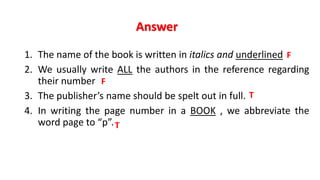
Answer
1. The name of the book is written in italics and underlined
2. We usually write ALL the authors in the reference regarding
their number
3. The publisher’s name should be spelt out in full.
4. In writing the page number in a BOOK , we abbreviate the
word page to “p”.
T
F
F
T
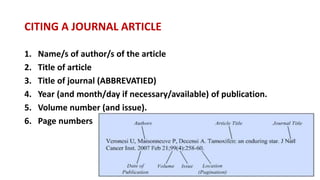
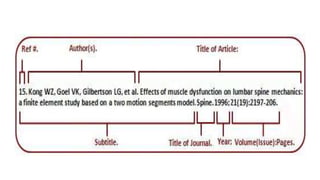
CITING A JOURNAL ARTICLE
1. Name/s of author/s of the article
2. Title of article
3. Title of journal (ABBREVATIED)
4. Year (and month/day if necessary/available) of publication.
5. Volume number (and issue).
6. Page numbers
CITING A JOURNAL ARTICLE
1. Name/s of author/s of the article.
• See step 1 of "Citing a book" for full details.
2. Title of article.
• See step 2 of "Citing a book" for full details.
• Example 2.1: Validation of an immunoassay for measurement of
plasma total homocysteine.
CITING A JOURNAL ARTICLE
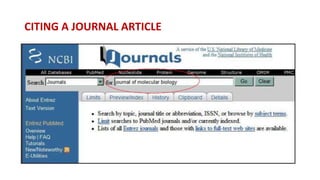
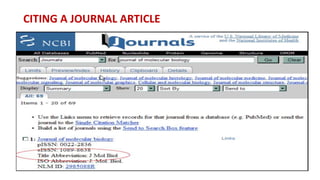
3. Title of journal (ABBREVATIED).
• Abbreviate title according to the style used in Medline. A list of
abbreviations can be found at:
• http://www.ncbi.nlm.nih.gov/entrez/query.fcgi?db=journals
• Note: NO PUNCTATIONS MARKS are used in the abbreviated journal
name – just spaces.
Format: journal title abbreviation (1 space)
• Example 3.1: J Acad Nutr Diet
• Example 3.2: J Nutr Environ Med
CITING A JOURNAL ARTICLE
4. Year (and month/day if necessary/available) of publication.
• Abbreviate the month to the first 3 letters.
Format: year (1 space) month (1 space) day (semi-colon, no space) OR
year (semi-colon, no space)
• Example 4.1: 1996 Jun 1;12(5):127-33.
CITING A JOURNAL ARTICLE
5. Volume number (and issue/part -).
• *If the journal has continuous page numbering through volume’s
issues, the month/day and issue information may be omitted.
Format: volume number (no space) issue number in brackets (colon, no
space) OR volume number (colon, no space)
• Example 5.1: 1996;12(5):127-33. or 1996;12:127-33
CITING A JOURNAL ARTICLE
6. Page numbers
• NOTE: do not repeat digits unnecessarily
Format: page numbers (full-stop)
• Example 6.1: 531-5
CITING A JOURNAL ARTICLE
CITING A WEBSITE
• (If the author is not documented, the title becomes the first
element of the reference.)
• Author. Title. [Online]. Publication Year [cited year/ month
(abbreviated) day]; pages. Available from: URL:URL address
underlined
• URL: Uniform Resource Locator
Author. Title. [Online]. Publication Year [cited year month (abbreviated) day];
. Available from: URL:URL address underlined
Examples:
• National Organization for Rare Diseases [Online]. 1999 Aug 16 [cited 1999 Aug
21]; Available from: URL:http://www.rarediseases.org/
• Royal College of General Practitioners. The primary health care team. [Online].
1998 [cited 1999 Aug 22]. Available from:
URL:http://ww.rcgp.org.uk/informat/publicat/rcf0021.htm
• Zand J. The natural pharmacy: herbal medicine for depression [Online].
[1999?] [cited 2001 Aug 23]. Available from:
URL:http://www.healthy.net/asp/templates/Article.asp?PageType=Article&Id=
920
CITING A WEBSITE
• Strang J, Smith, M and Spurrell S. The Community Drug Team”, British
Journal of Addiction.1992;87:169-78.
• [Journal article]
• Tripp, M. In: Judson, H (ed.) Heroin Addiction in Britain, pp 46-93,
Harcourt Brace Jovanovich: New York.2003.
• [Chapter in edited book]
• [Book]
Fine, M & Kurdek, LA 1993, “Reflections on determining authorship
credit and authorship order on faculty-student collaborations”.
American Psychologist, Vol. 48, pp.1141-1147. Retrieved June 7, 1999,
from http://www.apa.org/journals/amp/kurdek.html.
• [Electronic journal]
Mention the source of the following references ?
Choose ONE correct answer:
In Vancouver style, which of the following statements is CORRECT
when citing a book or Journal?
A. If there are 6 or less authors you must list the first two ONLY
B. If there are 6 or less authors you must list all authors.
C. If there are 7 or more authors, only the first 6 are listed and add “et
al”.
D. If there are 7 or more authors, only the first 2 are listed and add “et
al”.
E. Both b and c are correct
E
Q & A
When citing a book in Vancouver style , abbreviate the word
…………….to:- ed.
A. Edition
B. Editors
C. Editorial
D. a and b
A
Q & A
In Vancouver style , while citing a …………………., abbreviate the title
according to the style used in Medline and NO PUNCTATIONS MARKS
are used
A. Book
B. Webpage
C. Conference proceeding
D. Journal article
D
Q & A
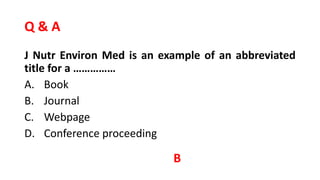
J Nutr Environ Med is an example of an abbreviated
title for a ……………
A. Book
B. Journal
C. Webpage
D. Conference proceeding
B
Q & A
Royal College of General Practitioners. The primary health
care team. [Online]. 1998 [cited 1999 Aug 22]. Available
from:
URL:http://ww.rcgp.org.uk/informat/publicat/rcf0021.htm
This is an example of citing a ………………………………
A. Book
B. Journal
C. Webpage
D. Conference proceeding
C
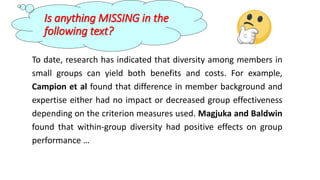
Is anything MISSING in the
following text?
To date, research has indicated that diversity among members in
small groups can yield both benefits and costs. For example,
Campion et al found that difference in member background and
expertise either had no impact or decreased group effectiveness
depending on the criterion measures used. Magjuka and Baldwin
found that within-group diversity had positive effects on group
performance …
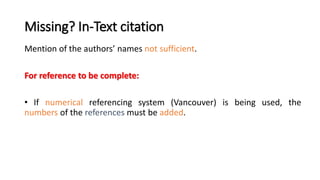
Missing? In-Text citation
Mention of the authors’ names not sufficient.
For reference to be complete:
• If numerical referencing system (Vancouver) is being used, the
numbers of the references must be added.
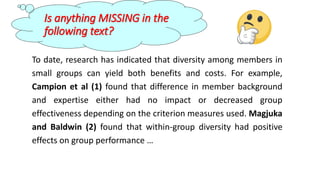
Is anything MISSING in the
following text?
To date, research has indicated that diversity among members in
small groups can yield both benefits and costs. For example,
Campion et al (1) found that difference in member background
and expertise either had no impact or decreased group
effectiveness depending on the criterion measures used. Magjuka
and Baldwin (2) found that within-group diversity had positive
effects on group performance …
Learning Objectives
Apply Vancouver style for referencing a book,
journal article and Webpage.
Apply Vancouver style for referencing tables and a
figures.
Recognize how to avoid plagiarism.
ADDITIONAL NOTES ON THE VANCOUVER STYLE:
TABLES
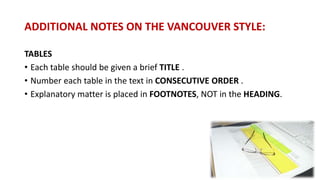
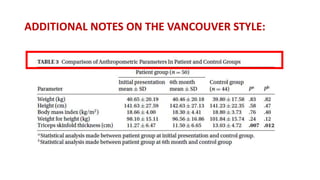
• Each table should be given a brief TITLE .
• Number each table in the text in CONSECUTIVE ORDER .
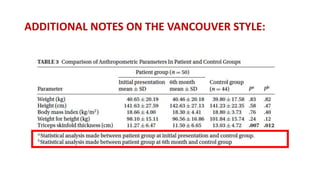
• Explanatory matter is placed in FOOTNOTES, NOT in the HEADING.
ADDITIONAL NOTES ON THE VANCOUVER STYLE:
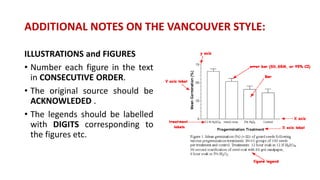
ILLUSTRATIONS and FIGURES
• Number each figure in the text
in CONSECUTIVE ORDER.
• The original source should be
ACKNOWLEDED .
• The legends should be labelled
with DIGITS corresponding to
the figures etc.
ADDITIONAL NOTES ON THE VANCOUVER STYLE:
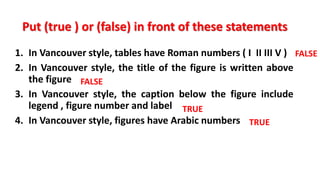
Put (true ) or (false) in front of these statements
1. In Vancouver style, tables have Roman numbers ( I II III V )
2. In Vancouver style, the title of the figure is written above
the figure
3. In Vancouver style, the caption below the figure include
legend , figure number and label
4. In Vancouver style, figures have Arabic numbers
TRUE
FALSE
FALSE
TRUE
Learning Objectives
Apply Vancouver style for referencing a book,
journal article and Webpage.
Apply Vancouver style for referencing tables and a
figures.
Recognize how to avoid plagiarism.
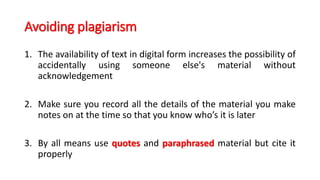
Avoiding plagiarism
1. The availability of text in digital form increases the possibility of
accidentally using someone else's material without
acknowledgement
2. Make sure you record all the details of the material you make
notes on at the time so that you know who’s it is later
3. By all means use quotes and paraphrased material but cite it
properly
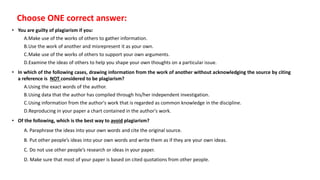
• You are guilty of plagiarism if you:
A.Make use of the works of others to gather information.
B.Use the work of another and misrepresent it as your own.
C.Make use of the works of others to support your own arguments.
D.Examine the ideas of others to help you shape your own thoughts on a particular issue.
• In which of the following cases, drawing information from the work of another without acknowledging the source by citing
a reference is NOT considered to be plagiarism?
A.Using the exact words of the author.
B.Using data that the author has compiled through his/her independent investigation.
C.Using information from the author's work that is regarded as common knowledge in the discipline.
D.Reproducing in your paper a chart contained in the author's work.
• Of the following, which is the best way to avoid plagiarism?
A. Paraphrase the ideas into your own words and cite the original source.
B. Put other people’s ideas into your own words and write them as if they are your own ideas.
C. Do not use other people’s research or ideas in your paper.
D. Make sure that most of your paper is based on cited quotations from other people.
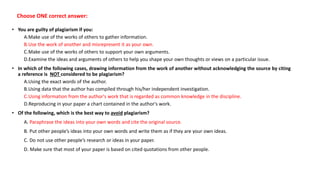
Choose ONE correct answer:
• You are guilty of plagiarism if you:
A.Make use of the works of others to gather information.
B.Use the work of another and misrepresent it as your own.
C.Make use of the works of others to support your own arguments.
D.Examine the ideas and arguments of others to help you shape your own thoughts or views on a particular issue.
• In which of the following cases, drawing information from the work of another without acknowledging the source by citing
a reference is NOT considered to be plagiarism?
A.Using the exact words of the author.
B.Using data that the author has compiled through his/her independent investigation.
C.Using information from the author's work that is regarded as common knowledge in the discipline.
D.Reproducing in your paper a chart contained in the author's work.
• Of the following, which is the best way to avoid plagiarism?
A. Paraphrase the ideas into your own words and cite the original source.
B. Put other people’s ideas into your own words and write them as if they are your own ideas.
C. Do not use other people’s research or ideas in your paper.
D. Make sure that most of your paper is based on cited quotations from other people.
Choose ONE correct answer:
Further information
• http://www.tcd.ie/Library/support/referencing.php
• http://www.learnhigher.ac.uk
• http://www.coventry.ac.uk/caw
• http://www.cite.auckland.ac.nz
`

practicaciting lsession citation and referencing .pptx

  • 1.
    Citing and Referencing academicsources Community Medicine Department
  • 2.
    By the endof this practical session, the student will be able to: 1. Apply Vancouver style for referencing a book, journal article and Webpage. 2. Apply Vancouver style for referencing tables and a figures. 3. Recognize how to avoid plagiarism.
  • 3.
  • 4.
    Referencing •A standardized wayof acknowledging the sources of information and ideas that we have used in our assignments and which allows the sources to be identified Why reference? • To avoid plagiarism • To verify quotations (confirm references) • To enable readers to follow up what you have written and more fully understand the cited author’s work.
  • 7.
    What is theVancouver Referencing Technique? A uniform set of requirements for bibliographic references. a “Numbered" style follows rules established by the International Committee of Medical Journal Editors also known as: Uniform Requirements for Manuscripts Submitted to Biomedical Journals.
  • 8.
    • As ageneral rule, reference numbers should be placed AFTER full stops (.) and commas (,), BEFORE colons (: ) and semicolons (; ) • However, this may vary according to the requirements of a particular journal. Examples: • There have been efforts to replace mouse inoculation testing with invitro tests, such as enzyme linked immunosorbent assays (57,60) or polymerase chain reaction, (20- 22) but these remain experimental. Moir and Jessel maintain “that the sexes are interchangeable”. (1) • Some errors are more major than others (3); for instance, calling a tiger a mouse is a larger error than calling a tiger a lion, and adults may be less forgiving of large errors than small ones. INDICATING REFERENCES IN THE TEXT OF YOUR ESSAY
  • 9.
    Learning Objectives Apply Vancouverstyle for referencing a book, journal article and Webpage. Apply Vancouver style for referencing tables and a figures. Recognize how to avoid plagiarism.
  • 10.
    1. Name/s ofauthor/s, editor/s, or organization. 2. Title of publication and subtitle if any 3. Edition, if other than first edition 4. Place of publication 5. Publisher 6. Year of publication 7. Page numbers (if applicable) CITING A BOOK
  • 12.
    CITING A BOOK 1.Name/s of author/s, editor/s, or the institution responsible. • Where there are 6 or less authors you must list all authors. • Where there are 7 or more authors, only the first 6 are listed and add “et al” (et al means “and others”). • Put a comma and 1 space between each name. • The last author must have a full-stop after their initial(s).
  • 13.
    Personal Author: Adam RD,Victor M. Principles of Neurology. 5th ed. New York: McGraw-Hill, 1993. Editor(s) or Compiler(s): Diener HC, Wilkinson M, editors. Drug-induced headache. New York: Springer- Verlag, 1988. Organization as author: Virginia Law Foundation. The Medical and legal implications of AIDS. Charlottesville: The Foundation, 1987. Examples
  • 14.
    Book with authorsand editors •Martin EW. Hazards of medication. 2nd ed. Ruskin A, Napke E, Alexander S, Kelsey FO, Farage DJ, Mills DH, Elkas RW, editors. Philadelphia: Lippincott; 1978. 686 p.
  • 15.
    CITING A BOOK Format:surname (1 space) initial/s (no spaces or punctuation between initials) (full-stop OR if further names comma, 1 space) • Example 1.1: Smith AK, Jones BC editors. • Example 1.2: Smith AK, Jones BC, Bloggs TC, Ashe PT, Fauci AS, Wilson JD et al. • Example 1.3: The Cardiac Society of Australia and New Zealand. • Example 1.4: When no author/editor is given. Use the title of the article or book. HIV/AIDs resources: a nationwide directory. 10th ed. Longmont (CO): Guides for Living; c2004. 792 p.
  • 17.
    2. Title ofpublication and subtitle if any CITING A BOOK
  • 18.
    Format: 1: title(full-stop, 1 space) • Example 2.1: Harrison's principles of internal medicine. • Example 2.2: Physical pharmacy: physical chemical principles in the pharmaceutical sciences. • Example 2.3: Pharmacy in Australia: the national experience CITING A BOOK
  • 19.
    3. Edition, ifother than first edition. • Abbreviate the word edition to:- ed. (Do not confuse with editor.) Format: edition statement (fullstop, 1 space) • Example 3.1: 3rd ed. ( Smith AK, Jones BC, editors ) CITING A BOOK
  • 20.
    Format: place ofpublication (colon, 1 space) • Example 4.1: Hartford (CN): • Example 4.2: Texas (NSW): • Example 4.3: Kyoto (Japan): CITING A BOOK
  • 21.
    5. Publisher • Thepublisher’s name should be spelt out in full. Format: publisher (semi-colon, 1 space) • Example 5.1: Australian Government Publishing Service; • Example 5.2: Raven Press; • Example 5.3: Williams & Wilkins; CITING A BOOK
  • 22.
    6. Year ofpublication. • Format: year (full-stop, add 1 space if page numbers follow) • Example 6.1: 1999. • Example 6.2: 2000. p. 12-5. CITING A BOOK
  • 23.
    7. Page numbers(if applicable). • Abbreviate the word page to “p.”. • NOTE: do not repeat digits unnecessarily – abbreviate. Format: p (full-stop, 1 space) page numbers (full-stop). • Example 7.1: p. 122-9. • Example 7.2: p. 1129-57. • Example 7.3:p.333,338,340-5. (not on continuous pages) CITING A BOOK
  • 25.
    State true(T )or false (F) in front of these statements 1. The name of the book is written in italics and underlined 2. We usually write ALL the authors in the reference regarding their number 3. The publisher’s name should be spelt out in full. 4. In writing the page number in a BOOK , we abbreviate the word page to “p”.
  • 26.
    Answer 1. The nameof the book is written in italics and underlined 2. We usually write ALL the authors in the reference regarding their number 3. The publisher’s name should be spelt out in full. 4. In writing the page number in a BOOK , we abbreviate the word page to “p”. T F F T
  • 27.
    CITING A JOURNALARTICLE 1. Name/s of author/s of the article 2. Title of article 3. Title of journal (ABBREVATIED) 4. Year (and month/day if necessary/available) of publication. 5. Volume number (and issue). 6. Page numbers
  • 28.
    CITING A JOURNALARTICLE 1. Name/s of author/s of the article. • See step 1 of "Citing a book" for full details.
  • 29.
    2. Title ofarticle. • See step 2 of "Citing a book" for full details. • Example 2.1: Validation of an immunoassay for measurement of plasma total homocysteine. CITING A JOURNAL ARTICLE
  • 30.
    3. Title ofjournal (ABBREVATIED). • Abbreviate title according to the style used in Medline. A list of abbreviations can be found at: • http://www.ncbi.nlm.nih.gov/entrez/query.fcgi?db=journals • Note: NO PUNCTATIONS MARKS are used in the abbreviated journal name – just spaces. Format: journal title abbreviation (1 space) • Example 3.1: J Acad Nutr Diet • Example 3.2: J Nutr Environ Med CITING A JOURNAL ARTICLE
  • 31.
  • 32.
  • 33.
    4. Year (andmonth/day if necessary/available) of publication. • Abbreviate the month to the first 3 letters. Format: year (1 space) month (1 space) day (semi-colon, no space) OR year (semi-colon, no space) • Example 4.1: 1996 Jun 1;12(5):127-33. CITING A JOURNAL ARTICLE
  • 34.
    5. Volume number(and issue/part -). • *If the journal has continuous page numbering through volume’s issues, the month/day and issue information may be omitted. Format: volume number (no space) issue number in brackets (colon, no space) OR volume number (colon, no space) • Example 5.1: 1996;12(5):127-33. or 1996;12:127-33 CITING A JOURNAL ARTICLE
  • 35.
    6. Page numbers •NOTE: do not repeat digits unnecessarily Format: page numbers (full-stop) • Example 6.1: 531-5 CITING A JOURNAL ARTICLE
  • 37.
    CITING A WEBSITE •(If the author is not documented, the title becomes the first element of the reference.) • Author. Title. [Online]. Publication Year [cited year/ month (abbreviated) day]; pages. Available from: URL:URL address underlined • URL: Uniform Resource Locator
  • 38.
    Author. Title. [Online].Publication Year [cited year month (abbreviated) day]; . Available from: URL:URL address underlined Examples: • National Organization for Rare Diseases [Online]. 1999 Aug 16 [cited 1999 Aug 21]; Available from: URL:http://www.rarediseases.org/ • Royal College of General Practitioners. The primary health care team. [Online]. 1998 [cited 1999 Aug 22]. Available from: URL:http://ww.rcgp.org.uk/informat/publicat/rcf0021.htm • Zand J. The natural pharmacy: herbal medicine for depression [Online]. [1999?] [cited 2001 Aug 23]. Available from: URL:http://www.healthy.net/asp/templates/Article.asp?PageType=Article&Id= 920 CITING A WEBSITE
  • 39.
    • Strang J,Smith, M and Spurrell S. The Community Drug Team”, British Journal of Addiction.1992;87:169-78. • [Journal article] • Tripp, M. In: Judson, H (ed.) Heroin Addiction in Britain, pp 46-93, Harcourt Brace Jovanovich: New York.2003. • [Chapter in edited book] • [Book] Fine, M & Kurdek, LA 1993, “Reflections on determining authorship credit and authorship order on faculty-student collaborations”. American Psychologist, Vol. 48, pp.1141-1147. Retrieved June 7, 1999, from http://www.apa.org/journals/amp/kurdek.html. • [Electronic journal] Mention the source of the following references ?
  • 40.
    Choose ONE correctanswer: In Vancouver style, which of the following statements is CORRECT when citing a book or Journal? A. If there are 6 or less authors you must list the first two ONLY B. If there are 6 or less authors you must list all authors. C. If there are 7 or more authors, only the first 6 are listed and add “et al”. D. If there are 7 or more authors, only the first 2 are listed and add “et al”. E. Both b and c are correct E
  • 41.
    Q & A Whenciting a book in Vancouver style , abbreviate the word …………….to:- ed. A. Edition B. Editors C. Editorial D. a and b A
  • 42.
    Q & A InVancouver style , while citing a …………………., abbreviate the title according to the style used in Medline and NO PUNCTATIONS MARKS are used A. Book B. Webpage C. Conference proceeding D. Journal article D
  • 43.
    Q & A JNutr Environ Med is an example of an abbreviated title for a …………… A. Book B. Journal C. Webpage D. Conference proceeding B
  • 44.
    Q & A RoyalCollege of General Practitioners. The primary health care team. [Online]. 1998 [cited 1999 Aug 22]. Available from: URL:http://ww.rcgp.org.uk/informat/publicat/rcf0021.htm This is an example of citing a ……………………………… A. Book B. Journal C. Webpage D. Conference proceeding C
  • 45.
    Is anything MISSINGin the following text? To date, research has indicated that diversity among members in small groups can yield both benefits and costs. For example, Campion et al found that difference in member background and expertise either had no impact or decreased group effectiveness depending on the criterion measures used. Magjuka and Baldwin found that within-group diversity had positive effects on group performance …
  • 46.
    Missing? In-Text citation Mentionof the authors’ names not sufficient. For reference to be complete: • If numerical referencing system (Vancouver) is being used, the numbers of the references must be added.
  • 47.
    Is anything MISSINGin the following text? To date, research has indicated that diversity among members in small groups can yield both benefits and costs. For example, Campion et al (1) found that difference in member background and expertise either had no impact or decreased group effectiveness depending on the criterion measures used. Magjuka and Baldwin (2) found that within-group diversity had positive effects on group performance …
  • 48.
    Learning Objectives Apply Vancouverstyle for referencing a book, journal article and Webpage. Apply Vancouver style for referencing tables and a figures. Recognize how to avoid plagiarism.
  • 49.
    ADDITIONAL NOTES ONTHE VANCOUVER STYLE: TABLES • Each table should be given a brief TITLE . • Number each table in the text in CONSECUTIVE ORDER . • Explanatory matter is placed in FOOTNOTES, NOT in the HEADING.
  • 50.
    ADDITIONAL NOTES ONTHE VANCOUVER STYLE:
  • 51.
    ADDITIONAL NOTES ONTHE VANCOUVER STYLE:
  • 52.
    ILLUSTRATIONS and FIGURES •Number each figure in the text in CONSECUTIVE ORDER. • The original source should be ACKNOWLEDED . • The legends should be labelled with DIGITS corresponding to the figures etc. ADDITIONAL NOTES ON THE VANCOUVER STYLE:
  • 53.
    ADDITIONAL NOTES ONTHE VANCOUVER STYLE:
  • 54.
    Put (true )or (false) in front of these statements 1. In Vancouver style, tables have Roman numbers ( I II III V ) 2. In Vancouver style, the title of the figure is written above the figure 3. In Vancouver style, the caption below the figure include legend , figure number and label 4. In Vancouver style, figures have Arabic numbers TRUE FALSE FALSE TRUE
  • 55.
    Learning Objectives Apply Vancouverstyle for referencing a book, journal article and Webpage. Apply Vancouver style for referencing tables and a figures. Recognize how to avoid plagiarism.
  • 56.
    Avoiding plagiarism 1. Theavailability of text in digital form increases the possibility of accidentally using someone else's material without acknowledgement 2. Make sure you record all the details of the material you make notes on at the time so that you know who’s it is later 3. By all means use quotes and paraphrased material but cite it properly
  • 57.
    • You areguilty of plagiarism if you: A.Make use of the works of others to gather information. B.Use the work of another and misrepresent it as your own. C.Make use of the works of others to support your own arguments. D.Examine the ideas of others to help you shape your own thoughts on a particular issue. • In which of the following cases, drawing information from the work of another without acknowledging the source by citing a reference is NOT considered to be plagiarism? A.Using the exact words of the author. B.Using data that the author has compiled through his/her independent investigation. C.Using information from the author's work that is regarded as common knowledge in the discipline. D.Reproducing in your paper a chart contained in the author's work. • Of the following, which is the best way to avoid plagiarism? A. Paraphrase the ideas into your own words and cite the original source. B. Put other people’s ideas into your own words and write them as if they are your own ideas. C. Do not use other people’s research or ideas in your paper. D. Make sure that most of your paper is based on cited quotations from other people. Choose ONE correct answer:
  • 58.
    • You areguilty of plagiarism if you: A.Make use of the works of others to gather information. B.Use the work of another and misrepresent it as your own. C.Make use of the works of others to support your own arguments. D.Examine the ideas and arguments of others to help you shape your own thoughts or views on a particular issue. • In which of the following cases, drawing information from the work of another without acknowledging the source by citing a reference is NOT considered to be plagiarism? A.Using the exact words of the author. B.Using data that the author has compiled through his/her independent investigation. C.Using information from the author's work that is regarded as common knowledge in the discipline. D.Reproducing in your paper a chart contained in the author's work. • Of the following, which is the best way to avoid plagiarism? A. Paraphrase the ideas into your own words and cite the original source. B. Put other people’s ideas into your own words and write them as if they are your own ideas. C. Do not use other people’s research or ideas in your paper. D. Make sure that most of your paper is based on cited quotations from other people. Choose ONE correct answer:
  • 60.
    Further information • http://www.tcd.ie/Library/support/referencing.php •http://www.learnhigher.ac.uk • http://www.coventry.ac.uk/caw • http://www.cite.auckland.ac.nz
  • 61.