

















Journal Club Presentation
Overview, Setting up rules and roles
Usama Ragab Youssif (MSc.)
Assistant lecturer of Medicine
January 23, 2017 Monday
• A physician who does not use books and
journals, who does not need a library, who
does not read one or two of the best
weeklies and monthlies, soon sinks to the
level of the cross-counter prescriber, and not
alone in practice, but in those mercenary
feelings and habits that characterize a trade.
William Osler
Agenda
• Definition.
• History.
• Aim and Goals of Journal club.
• Journal club presentation.
• Setup rules.
• Setup roles.
Definition
• A journal club is a group of individuals who
meet regularly to critically evaluate recent
articles in the academic literature, generally
of some branch of science or philosophy.
Journal clubs are usually organized around a
defined subject in basic or applied research.
Simply….
• Journal clubs can be used in the education
of graduate or professional students.
History
• The earliest references to a journal club was found in a
book of memoirs and letters by the late Sir James Paget, a
British surgeon, who describes a group at St.
Bartholomew's Hospital in London in the mid-19th century
as "a kind of club ... a small room over a baker's shop near
the Hospital-gate where we could sit and read
the journals."
Esisi, Martina. "Journal clubs." BMJ Careers. 13 Oct. 2007. Web. 09 Jan. 2010. <http://careers.bmj.com/careers/advice/view-article.html?id=2631#ref2
History (cont.)
• Sir William Osler established
the first formalized journal club
at McGill University in Montreal
in 1875. The original purpose
of Osler's journal club was "for
the purchase and distribution
of periodicals to which he could
not afford to subscribe."
Crit Care (2004). 8: 401–2.
History (cont.)
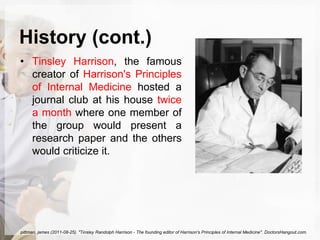
• Tinsley Harrison, the famous
creator of Harrison's Principles
of Internal Medicine hosted a
journal club at his house twice
a month where one member of
the group would present a
research paper and the others
would criticize it.
pittman, james (2011-08-25). "Tinsley Randolph Harrison - The founding editor of Harrison's Principles of Internal Medicine". DoctorsHangout.com.
History (cont.)
• Till 1980’s it was to provide its
member with up-to date medical
literature but quite recently it has
become a forum for teaching and
learning critical appraisal techniques
and a method to promote evidence-
based medical practice.
• We are drowning in information but starved
for knowledge
John Naisbitt
Topics should preferably of evidence
based Medicine (EBM)
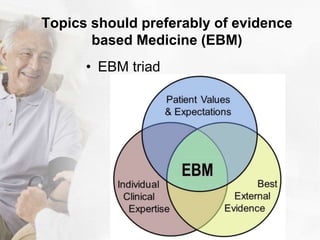
• EBM triad
Why??
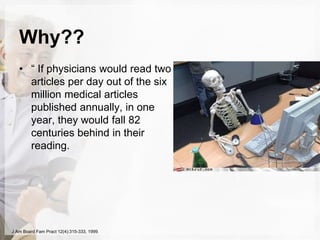
• “ If physicians would read two
articles per day out of the six
million medical articles
published annually, in one
year, they would fall 82
centuries behind in their
reading.
J Am Board Fam Pract 12(4):315-333, 1999.
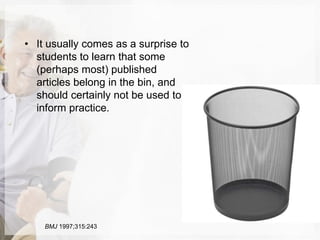
• It usually comes as a surprise to
students to learn that some
(perhaps most) published
articles belong in the bin, and
should certainly not be used to
inform practice.
BMJ 1997;315:243
Aim and Goal of Journal Club
• Providing participation with an update of medical literature.
• Reading and critiquing research.
1- Research process
• To improve the knowledge of Research Methodology &
Biostatistics
• To develop abilities to critically analyze the research
article
• Help people to learn and improve their critical appraisal
skills
2- Learning
• To provide improvement for clinical practice by increasing
exposure to the latest research findings
• Provide continuing medical education
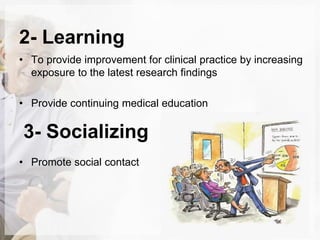
3- Socializing
• Promote social contact
Presentation of Journal club
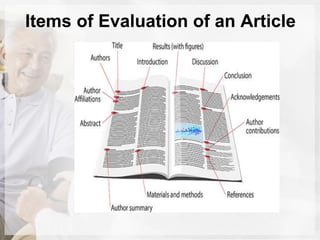
Items of Evaluation of an Article
Title
 Authors and funding source
 Brief Intro about journal selected
 Abstract & Key words
 Introduction
 Material and Methods
 Results
 Discussion
 Conclusion
 Take home message from article presented
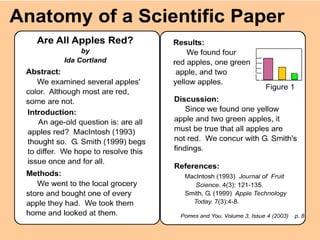
Items of Evaluation of an Article
• “There is an art of reading, as well as an art
of thinking, and an art of writing.”
Clarence Day
• Simple and concise
• Variables to be specific
• May also reflect study design
Title
Authors and funding source
• Who are the authors? Do you know any of their previous
work?
• The Institution/ Organization to which they belong and e-
mail to be mentioned.
• Who paid for the study? This gives you a head start on
knowing what sort of biases to look for.
Authors and funding source
Brief Intro about journal selected
• Organ of which institution
• Impact factor : if any
• Peer reviewed or not
• Indexed or not
• National/International
Brief Intro about journal selected
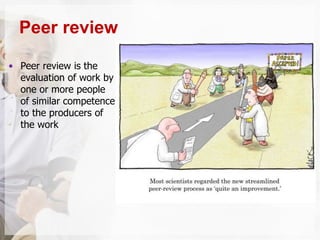
• Peer review is the
evaluation of work by
one or more people
of similar competence
to the producers of
the work
Peer review
• Indexing of journal is measure the sign of its quality
compares to non-indexed journal though the article may be
high quality paper.
• Indexing also increases the impact factor of the journal.
• Indexing increases publications and also many more authors
would be publishing than ever before.
Indexed or not
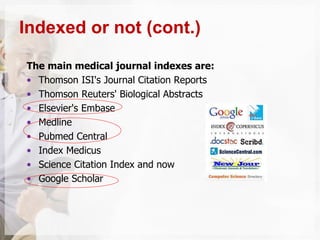
The main medical journal indexes are:
• Thomson ISI's Journal Citation Reports
• Thomson Reuters' Biological Abstracts
• Elsevier's Embase
• Medline
• Pubmed Central
• Index Medicus
• Science Citation Index and now
• Google Scholar
Indexed or not (cont.)
• The impact factor (IF) or Journal impact factor (JIF) of an academic
journal is a measure reflecting the yearly average number
of citations to recent articles published in that journal.
• It is frequently used as a proxy for the relative importance of a
journal within its field
• In any given year, the impact factor of a journal is the number of
citations received in that year by articles published in that journal
during the two preceding years, divided by the total number of
articles published in that journal during the two preceding years
Impact factor
Journal Citation Reports: Impact Factor". Retrieved 2016-09-12.
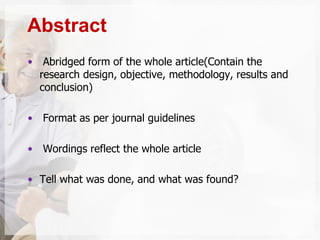
Abstract
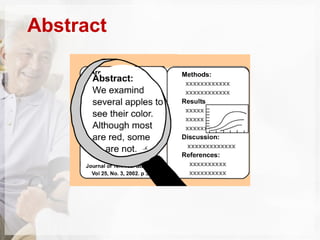
• Abridged form of the whole article(Contain the
research design, objective, methodology, results and
conclusion)
• Format as per journal guidelines
• Wordings reflect the whole article
• Tell what was done, and what was found?
Abstract
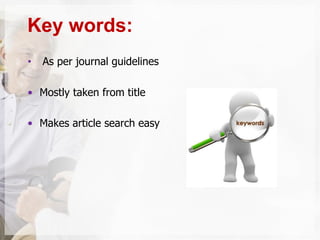
• As per journal guidelines
• Mostly taken from title
• Makes article search easy
Key words:
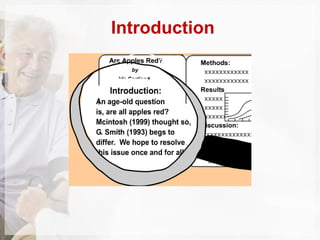
Introduction
Background information of the article
I. Research question & objective/ purpose of study clearly
stated ?
II. Hypothesis clearly stated ?
• What is the context and motivation for doing the study?
(Need of the study) – justified or not
• Brief literature review of disease and drug
• Prevalence of disease
• Objective of the study
Introduction
• Study design
• Inclusion and exclusion criteria
• Sample size (and methods of calculations)
• Statistical analysis
• Primary and secondary end points
Material and Methods
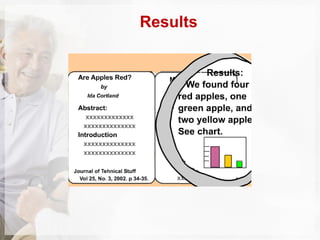
Results
• Demography data.
• Raw data you may need for your own research.
• Generally summarized in tables/graphs: easy viewing
• Consider both the statistical significance and the effect
size.
Results
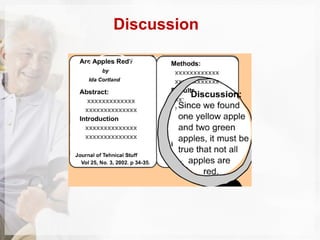
Discussion
• Summarize important results
• Reasons for conclusion
• To correlate the present findings with the related previous
studies
Discussion
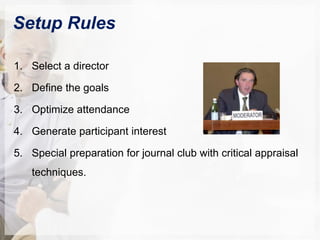
Setup Rules
1. Select a director
2. Define the goals
3. Optimize attendance
4. Generate participant interest
5. Special preparation for journal club with critical appraisal
techniques.
Setup rules (cont.)
• Articles are selected by director and presenter
• Approval 2 weeks before.
• A specific participant is assigned the task of presenting the
article (once monthly).
• Participant should present the content, evaluation report
with his/her own opinion and defend with proper reasoning.
Select an article
• Consider articles on
topics of interest to you
that will generate
conversation.
• Variety is a good thing
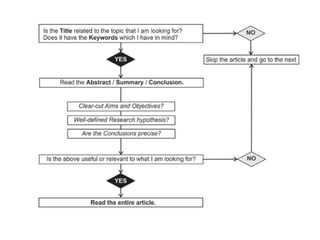
Presentation of Journal club
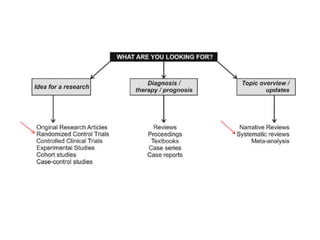
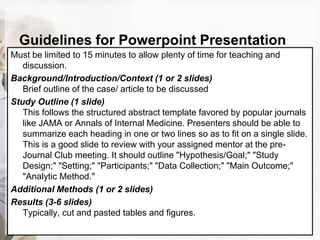
Guidelines for Powerpoint Presentation
Must be limited to 15 minutes to allow plenty of time for teaching and
discussion.
Background/Introduction/Context (1 or 2 slides)
Brief outline of the case/ article to be discussed
Study Outline (1 slide)
This follows the structured abstract template favored by popular journals
like JAMA or Annals of Internal Medicine. Presenters should be able to
summarize each heading in one or two lines so as to fit on a single slide.
This is a good slide to review with your assigned mentor at the pre-
Journal Club meeting. It should outline "Hypothesis/Goal;" "Study
Design;" "Setting;" "Participants;" "Data Collection;" "Main Outcome;"
"Analytic Method."
Additional Methods (1 or 2 slides)
Results (3-6 slides)
Typically, cut and pasted tables and figures.
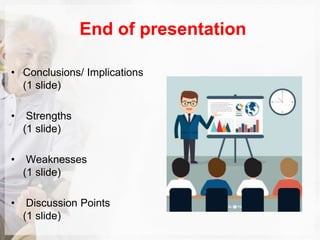
End of presentation
• Conclusions/ Implications
(1 slide)
• Strengths
(1 slide)
• Weaknesses
(1 slide)
• Discussion Points
(1 slide)
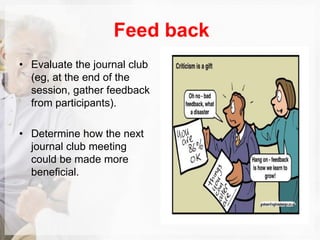
Feed back
• Evaluate the journal club
(eg, at the end of the
session, gather feedback
from participants).
• Determine how the next
journal club meeting
could be made more
beneficial.
Setup roles
Your turn
RESPONSIBLE PERSONS
• Mentors: Prof. ******************
• Coordinator: Acute medicine chairman (or whoever)
• Members : IM and allied specialties staff and medical
residents.
ROLES
Mentor / Coordinator Role
Helps members identify appropriate article that fits pre-specified
design of the month.
Meet with residents/physicians 1-2 weeks then 1-2 days before
Journal Club to discuss paper and prepare.
Lead a 30-40 min. discussion of the paper and related topics in
critical appraisal following the residents' presentation at Journal Club
Resident’s / Members Role
Residents or specialist physicians select a recent article(s)/
interesting case and clear it with assigned Journal Club mentor.
They read the article and arrange a meeting with the mentor at
least once in a fortnight before Journal Club to discuss strengths
and weaknesses, identify teaching points, and outline approach to
presentation.
They email a link to the article to all residents the day before
Journal Club.
Finally, they give a 10-15 minute PowerPoint presentation of the
article to begin the Journal Club discussion
Journal club presentation, Dr Usama Ragab

Journal club presentation, Dr Usama Ragab

  • 1.
    Journal Club Presentation Overview,Setting up rules and roles Usama Ragab Youssif (MSc.) Assistant lecturer of Medicine January 23, 2017 Monday
  • 2.
    • A physicianwho does not use books and journals, who does not need a library, who does not read one or two of the best weeklies and monthlies, soon sinks to the level of the cross-counter prescriber, and not alone in practice, but in those mercenary feelings and habits that characterize a trade. William Osler
  • 3.
    Agenda • Definition. • History. •Aim and Goals of Journal club. • Journal club presentation. • Setup rules. • Setup roles.
  • 4.
    Definition • A journalclub is a group of individuals who meet regularly to critically evaluate recent articles in the academic literature, generally of some branch of science or philosophy. Journal clubs are usually organized around a defined subject in basic or applied research.
  • 5.
    Simply…. • Journal clubscan be used in the education of graduate or professional students.
  • 6.
    History • The earliestreferences to a journal club was found in a book of memoirs and letters by the late Sir James Paget, a British surgeon, who describes a group at St. Bartholomew's Hospital in London in the mid-19th century as "a kind of club ... a small room over a baker's shop near the Hospital-gate where we could sit and read the journals." Esisi, Martina. "Journal clubs." BMJ Careers. 13 Oct. 2007. Web. 09 Jan. 2010. <http://careers.bmj.com/careers/advice/view-article.html?id=2631#ref2
  • 7.
    History (cont.) • SirWilliam Osler established the first formalized journal club at McGill University in Montreal in 1875. The original purpose of Osler's journal club was "for the purchase and distribution of periodicals to which he could not afford to subscribe." Crit Care (2004). 8: 401–2.
  • 8.
    History (cont.) • TinsleyHarrison, the famous creator of Harrison's Principles of Internal Medicine hosted a journal club at his house twice a month where one member of the group would present a research paper and the others would criticize it. pittman, james (2011-08-25). "Tinsley Randolph Harrison - The founding editor of Harrison's Principles of Internal Medicine". DoctorsHangout.com.
  • 9.
    History (cont.) • Till1980’s it was to provide its member with up-to date medical literature but quite recently it has become a forum for teaching and learning critical appraisal techniques and a method to promote evidence- based medical practice.
  • 10.
    • We aredrowning in information but starved for knowledge John Naisbitt
  • 11.
    Topics should preferablyof evidence based Medicine (EBM) • EBM triad
  • 13.
    Why?? • “ Ifphysicians would read two articles per day out of the six million medical articles published annually, in one year, they would fall 82 centuries behind in their reading. J Am Board Fam Pract 12(4):315-333, 1999.
  • 14.
    • It usuallycomes as a surprise to students to learn that some (perhaps most) published articles belong in the bin, and should certainly not be used to inform practice. BMJ 1997;315:243
  • 15.
    Aim and Goalof Journal Club • Providing participation with an update of medical literature. • Reading and critiquing research.
  • 16.
    1- Research process •To improve the knowledge of Research Methodology & Biostatistics • To develop abilities to critically analyze the research article • Help people to learn and improve their critical appraisal skills
  • 17.
    2- Learning • Toprovide improvement for clinical practice by increasing exposure to the latest research findings • Provide continuing medical education 3- Socializing • Promote social contact
  • 18.
  • 19.
    Items of Evaluationof an Article Title  Authors and funding source  Brief Intro about journal selected  Abstract & Key words  Introduction  Material and Methods  Results  Discussion  Conclusion  Take home message from article presented
  • 20.
    Items of Evaluationof an Article
  • 23.
    • “There isan art of reading, as well as an art of thinking, and an art of writing.” Clarence Day
  • 24.
    • Simple andconcise • Variables to be specific • May also reflect study design Title
  • 25.
  • 26.
    • Who arethe authors? Do you know any of their previous work? • The Institution/ Organization to which they belong and e- mail to be mentioned. • Who paid for the study? This gives you a head start on knowing what sort of biases to look for. Authors and funding source
  • 27.
    Brief Intro aboutjournal selected
  • 28.
    • Organ ofwhich institution • Impact factor : if any • Peer reviewed or not • Indexed or not • National/International Brief Intro about journal selected
  • 29.
    • Peer reviewis the evaluation of work by one or more people of similar competence to the producers of the work Peer review
  • 30.
    • Indexing ofjournal is measure the sign of its quality compares to non-indexed journal though the article may be high quality paper. • Indexing also increases the impact factor of the journal. • Indexing increases publications and also many more authors would be publishing than ever before. Indexed or not
  • 31.
    The main medicaljournal indexes are: • Thomson ISI's Journal Citation Reports • Thomson Reuters' Biological Abstracts • Elsevier's Embase • Medline • Pubmed Central • Index Medicus • Science Citation Index and now • Google Scholar Indexed or not (cont.)
  • 32.
    • The impactfactor (IF) or Journal impact factor (JIF) of an academic journal is a measure reflecting the yearly average number of citations to recent articles published in that journal. • It is frequently used as a proxy for the relative importance of a journal within its field • In any given year, the impact factor of a journal is the number of citations received in that year by articles published in that journal during the two preceding years, divided by the total number of articles published in that journal during the two preceding years Impact factor Journal Citation Reports: Impact Factor". Retrieved 2016-09-12.
  • 33.
  • 34.
    • Abridged formof the whole article(Contain the research design, objective, methodology, results and conclusion) • Format as per journal guidelines • Wordings reflect the whole article • Tell what was done, and what was found? Abstract
  • 35.
    • As perjournal guidelines • Mostly taken from title • Makes article search easy Key words:
  • 36.
  • 37.
    Background information ofthe article I. Research question & objective/ purpose of study clearly stated ? II. Hypothesis clearly stated ? • What is the context and motivation for doing the study? (Need of the study) – justified or not • Brief literature review of disease and drug • Prevalence of disease • Objective of the study Introduction
  • 38.
    • Study design •Inclusion and exclusion criteria • Sample size (and methods of calculations) • Statistical analysis • Primary and secondary end points Material and Methods
  • 39.
  • 40.
    • Demography data. •Raw data you may need for your own research. • Generally summarized in tables/graphs: easy viewing • Consider both the statistical significance and the effect size. Results
  • 41.
  • 42.
    • Summarize importantresults • Reasons for conclusion • To correlate the present findings with the related previous studies Discussion
  • 44.
    Setup Rules 1. Selecta director 2. Define the goals 3. Optimize attendance 4. Generate participant interest 5. Special preparation for journal club with critical appraisal techniques.
  • 45.
    Setup rules (cont.) •Articles are selected by director and presenter • Approval 2 weeks before. • A specific participant is assigned the task of presenting the article (once monthly). • Participant should present the content, evaluation report with his/her own opinion and defend with proper reasoning.
  • 46.
    Select an article •Consider articles on topics of interest to you that will generate conversation. • Variety is a good thing
  • 49.
  • 50.
    Guidelines for PowerpointPresentation Must be limited to 15 minutes to allow plenty of time for teaching and discussion. Background/Introduction/Context (1 or 2 slides) Brief outline of the case/ article to be discussed Study Outline (1 slide) This follows the structured abstract template favored by popular journals like JAMA or Annals of Internal Medicine. Presenters should be able to summarize each heading in one or two lines so as to fit on a single slide. This is a good slide to review with your assigned mentor at the pre- Journal Club meeting. It should outline "Hypothesis/Goal;" "Study Design;" "Setting;" "Participants;" "Data Collection;" "Main Outcome;" "Analytic Method." Additional Methods (1 or 2 slides) Results (3-6 slides) Typically, cut and pasted tables and figures.
  • 51.
    End of presentation •Conclusions/ Implications (1 slide) • Strengths (1 slide) • Weaknesses (1 slide) • Discussion Points (1 slide)
  • 52.
    Feed back • Evaluatethe journal club (eg, at the end of the session, gather feedback from participants). • Determine how the next journal club meeting could be made more beneficial.
  • 53.
  • 54.
    RESPONSIBLE PERSONS • Mentors:Prof. ****************** • Coordinator: Acute medicine chairman (or whoever) • Members : IM and allied specialties staff and medical residents.
  • 55.
    ROLES Mentor / CoordinatorRole Helps members identify appropriate article that fits pre-specified design of the month. Meet with residents/physicians 1-2 weeks then 1-2 days before Journal Club to discuss paper and prepare. Lead a 30-40 min. discussion of the paper and related topics in critical appraisal following the residents' presentation at Journal Club Resident’s / Members Role Residents or specialist physicians select a recent article(s)/ interesting case and clear it with assigned Journal Club mentor. They read the article and arrange a meeting with the mentor at least once in a fortnight before Journal Club to discuss strengths and weaknesses, identify teaching points, and outline approach to presentation. They email a link to the article to all residents the day before Journal Club. Finally, they give a 10-15 minute PowerPoint presentation of the article to begin the Journal Club discussion

Editor's Notes

  • #3 Thus, why we need it? 1- To know what is going around us. 2- It help us to change our practice towards better.
  • #4 My agenda for today, to talk about the definition of Journal club, historical prespectives, what is the aim of journal club presentation, how to present an efficient journal club To setup rules To assign roles
  • #8 Sir William Osler, 1st Baronet, FRS, FRCP (July 12, 1849 – December 29, 1919) was a Canadian physician and one of the four founding professors of Johns Hopkins Hospital. Osler created the first residency program for specialty training of physicians, and he was the first to bring medical students out of the lecture hall for bedside clinical training. He has frequently been described as the "Father of Modern Medicine".
  • #11 John Naisbitt (born January 15, 1929 in Salt Lake City, Utah) is an American author and public speaker in the area of futures studies.
  • #15 You must learn how to read papers, and discuss them very fast
  • #22 You tend to read the title; easy You tend to read the abstract You tend to read the intro; it is in your speciality, you probably understand it. You tend to ignore methods; because you don’t know methodology. You tend to pick important things in the results Then jump to conclusion.
  • #24 Clarence Shepard Day, Jr. (November 18, 1874 – December 28, 1935) was an American author and cartoonist, best known for his 1935 work Life With Father.
  • #35 Question? What specific results are mentioned? Are they relevant?
  • #38 Question? Do you understand background information? Do you need to look up reference for more info?
  • #39 Your paper is only as good as the method you use to get the results
  • #42 1- Clinical response (Subjective parameters) 2- Scales/Scores/Indices (Semi objective parameters) 3- Laboratory/Imaging tests (Objective parameters) Question? For figures, do axes make sense? Units used? Does the curve make sense?
  • #44 Question? Do you agree with the logic of conclusion? Are these results are useful to you? Could data be reproducible? What are the possible strength/limitations and biases or flaws of the study?