Concepts of Router and Routing


                                 1
Router


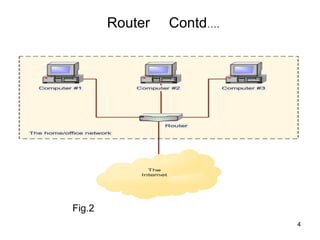
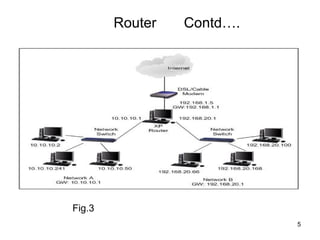
• A device that connects two or more computer networks
  together is called as a Router


• It allows two or more different computer networks to

  send data to each other


                                                         2
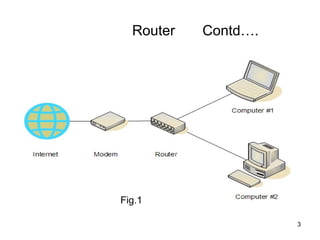
Router   Contd….


Fig.1

                     3
Router   Contd….


Fig.2
                           4
Router   Contd….


Fig.3
                           5
Router        Contd….


• A router is a computer whose software and hardware

  are designed to perform the tasks of routing and

  forwarding information (sending the information

  to the destination).


                                                       6
Router           Contd….


Routers generally contain
    • A specialized operating system

    • RAM

    • NVRAM

    • Flash memory and

    • one or more processors


                                         7
Router         Contd….


• Routers operate in two different planes

• Control Plane: The router learns the outgoing interface
  that is most appropriate for forwarding specific packets to
  specific destinations

• Forwarding Plane: The router is responsible for the actual
  process of sending a packet received on a logical interface
  to an outbound logical interface

                                                            8
Control Plane Activities
• Routers periodically disseminate topology information to all
  the other routers with the help of control packets (e.g.
  :HELLO, TC packets)
• Topology information contains the information about the one
  hop and two hop neighbors to each of the router, link cost
  etc
• Link cost can be defined in several terms: a time estimate, a
  distance estimate, congestion estimate, bandwidth estimate
  etc. for the communication link between router and its one
  hop neighbor
• After learning the topology information, every router
  computes shortest route from itself to every other router in
  the Internet
• The computed shortest routes are stored in a route cache in
  the form of routing table
• Routing table gives the nest hop router to which packet has
  to be forwarded to send it in the shortest path for each
  destination IP address ( network part of IP address)        9
Forward Plane Activities

• The Packet which arrive at Router’s interface is first
  buffered (stored)
• The Router examines the packet’s header and the picks
  the destination IP address to where the packet has to
  reach
• It looks into the routing table to know the next hop router
  to which the packet has to be forwarded in order to send it
  in the shortest path
• Then Router forwards the packet to the corresponding
  next Router address via one of its ports
• The same process is carried out at each Router along the
  shortest path till the destination router is reached


                                                          10
Types of Routers

Various types of routers
   • Edge Router
   • Border Router
   • Core router
   • Enterprise Router
   • Access Router
   • Distribution Router


                                 11
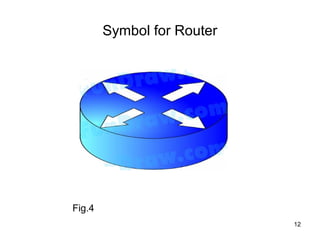
Symbol for Router


Fig.4
                            12
13
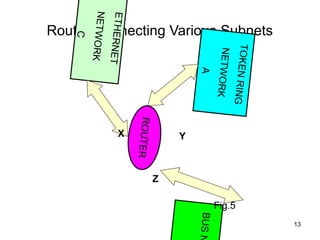
 Router Connecting Various Subnets


                                     TOKEN RI
                                              NG
                                                                Fig.5
                                      NETWORK
                                         A                              BUS N
                                                     Y


                                                            Z
                                                   ROUTER
ETHERNE

                                                    X
        T
NETWORK
                 C
Router Concepts

• Router must have three interfaces and three Network
  Interface Cards (NICs) to interact with the networks A, B and
  C at the junctions X and Y and Z as shown in figure 5


• In Internet, there are number of networks that communicate
  with each other. Therefore, there would be as many routers
  as networks


                                                          14
Routing

• Routing is the process of selecting paths in a network to

  send data or physical traffic


• Routing is performed for many kinds of networks,

  including the telephone network , the Internet, and

  transport networks


                                                          15
Router          Contd….


• Routing directs forwarding, the passing of logically

  addressed packets from their source towards their

  ultimate destination through intermediary nodes


• Nodes are hardware devices called routers, bridges,

  gateways, firewalls, or switches

                                                         16
Router         Contd….

• Ordinary computers with multiple network cards can also
  forward packets and perform routing, though they are not
  specialized hardware and may suffer from limited
  performance
• The routing process usually directs forwarding on the
  basis of routing tables which maintain a record of the
  routes to various network destinations
• Thus constructing routing tables, which are held in the
  routers' memory, becomes very important for efficient
  routing

                                                            17
Router         Contd….

• Therefore, Routing is the process of sending the data in
  the form of packets called datagrams from the source to
  the destination computers through many networks
• Routing algorithms take the decisions about routing
  process and factors affecting them are as follows
• Least cost routing
• Distributed routing
• Packet life time
                                                             18
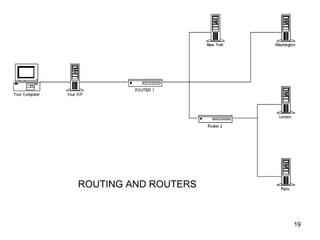
ROUTING AND ROUTERS


                      19
Summary

In this class, you have learnt about

   • Router and routing concepts


                                       20
Quiz

1. A Router is connected to five networks.
  Then number of NICs required by the
  router is

       a)   2
       b)   3
       c)   5
       d)   7


                                             21
Frequently Asked Questions

1.   Differentiate between Router and Routing?


2.   List the various types of routers


3.   Write short notes on routing


                                                 22

Router&routing

  • 1.
    Concepts of Routerand Routing 1
  • 2.
    Router • A devicethat connects two or more computer networks together is called as a Router • It allows two or more different computer networks to send data to each other 2
  • 3.
    Router Contd…. Fig.1 3
  • 4.
    Router Contd…. Fig.2 4
  • 5.
    Router Contd…. Fig.3 5
  • 6.
    Router Contd…. • A router is a computer whose software and hardware are designed to perform the tasks of routing and forwarding information (sending the information to the destination). 6
  • 7.
    Router Contd…. Routers generally contain • A specialized operating system • RAM • NVRAM • Flash memory and • one or more processors 7
  • 8.
    Router Contd…. • Routers operate in two different planes • Control Plane: The router learns the outgoing interface that is most appropriate for forwarding specific packets to specific destinations • Forwarding Plane: The router is responsible for the actual process of sending a packet received on a logical interface to an outbound logical interface 8
  • 9.
    Control Plane Activities •Routers periodically disseminate topology information to all the other routers with the help of control packets (e.g. :HELLO, TC packets) • Topology information contains the information about the one hop and two hop neighbors to each of the router, link cost etc • Link cost can be defined in several terms: a time estimate, a distance estimate, congestion estimate, bandwidth estimate etc. for the communication link between router and its one hop neighbor • After learning the topology information, every router computes shortest route from itself to every other router in the Internet • The computed shortest routes are stored in a route cache in the form of routing table • Routing table gives the nest hop router to which packet has to be forwarded to send it in the shortest path for each destination IP address ( network part of IP address) 9
  • 10.
    Forward Plane Activities •The Packet which arrive at Router’s interface is first buffered (stored) • The Router examines the packet’s header and the picks the destination IP address to where the packet has to reach • It looks into the routing table to know the next hop router to which the packet has to be forwarded in order to send it in the shortest path • Then Router forwards the packet to the corresponding next Router address via one of its ports • The same process is carried out at each Router along the shortest path till the destination router is reached 10
  • 11.
    Types of Routers Varioustypes of routers • Edge Router • Border Router • Core router • Enterprise Router • Access Router • Distribution Router 11
  • 12.
  • 13.
    13 Router ConnectingVarious Subnets TOKEN RI NG Fig.5 NETWORK A BUS N Y Z ROUTER ETHERNE X T NETWORK C
  • 14.
    Router Concepts • Routermust have three interfaces and three Network Interface Cards (NICs) to interact with the networks A, B and C at the junctions X and Y and Z as shown in figure 5 • In Internet, there are number of networks that communicate with each other. Therefore, there would be as many routers as networks 14
  • 15.
    Routing • Routing isthe process of selecting paths in a network to send data or physical traffic • Routing is performed for many kinds of networks, including the telephone network , the Internet, and transport networks 15
  • 16.
    Router Contd…. • Routing directs forwarding, the passing of logically addressed packets from their source towards their ultimate destination through intermediary nodes • Nodes are hardware devices called routers, bridges, gateways, firewalls, or switches 16
  • 17.
    Router Contd…. • Ordinary computers with multiple network cards can also forward packets and perform routing, though they are not specialized hardware and may suffer from limited performance • The routing process usually directs forwarding on the basis of routing tables which maintain a record of the routes to various network destinations • Thus constructing routing tables, which are held in the routers' memory, becomes very important for efficient routing 17
  • 18.
    Router Contd…. • Therefore, Routing is the process of sending the data in the form of packets called datagrams from the source to the destination computers through many networks • Routing algorithms take the decisions about routing process and factors affecting them are as follows • Least cost routing • Distributed routing • Packet life time 18
  • 19.
  • 20.
    Summary In this class,you have learnt about • Router and routing concepts 20
  • 21.
    Quiz 1. A Routeris connected to five networks. Then number of NICs required by the router is a) 2 b) 3 c) 5 d) 7 21
  • 22.
    Frequently Asked Questions 1. Differentiate between Router and Routing? 2. List the various types of routers 3. Write short notes on routing 22