BS-Computer Science IV
Routing
Data Networks & Communication
Presented By:
•4661
•4677
•4678
•4673
•4679
Submitted to:
Mam Sana.
Routing
• Definition:
Routing is the process of selecting best paths in a network. In the past, the term routing
was also used to mean forwarding network traffic among networks.
Routing is performed for many kinds of networks.
• Telephone network (circuit switching).
• Electronic data networks (such as the Internet).
• Transportation networks.
• Router:
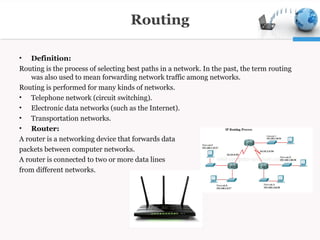
A router is a networking device that forwards data
packets between computer networks.
A router is connected to two or more data lines
from different networks.
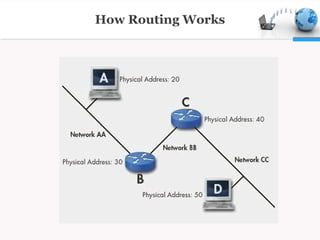
How Routing Works
Routing
• IP Address:
An Internet Protocol address (IP address) is a numerical label assigned to each
device (e.g., computer, printer) participating in a computer network that
uses
the Internet Protocol for communication.
An IP address serves two principal functions:
 Host or network interface identification.
 Location addressing.
Its role has been characterized as follows:
 A name indicates what we seek.
 An address indicates where it is.
 A route indicates how to get there.
The format of an IP address is a 32-bit numeric address written as four numbers
separated by periods. Each number can be zero to 255.
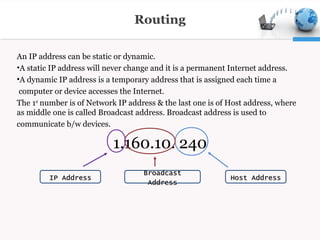
For example, 1.160.10.240 could be an IP address.
Routing
An IP address can be static or dynamic.
•A static IP address will never change and it is a permanent Internet address.
•A dynamic IP address is a temporary address that is assigned each time a
computer or device accesses the Internet.
The 1st
number is of Network IP address & the last one is of Host address, where
as middle one is called Broadcast address. Broadcast address is used to
communicate b/w devices.
1.160.10. 240
Host AddressHost Address
BroadcastBroadcast
AddressAddress
IP AddressIP Address
Routing
Routing Protocols:
RIP (Routing Information Protocol) is a widely-used protocol for
managing router information within a self-contained network such as a corporate
local area network (LAN) or an interconnected group of such LANs.
EIGRP (Enhanced Interior Gateway Routing Protocol) is a network
protocol that lets routers exchange information more efficiently than with earlier
network protocols.
OSPF (Open Shortest Path First) router protocol is used to find the best
path for packets as they pass through a set of connected networks. OSPF is one of
several Interior Gateway Protocols that replaces the Routing Information
Protocol (RIP), an older routing protocol that is installed in many of today's
corporate networks.
BGP (Border Gateway Protocol) is a protocol for exchanging routing
information between gateway hosts (each with its own router) in a network of
autonomous systems.
Routing
• Routing & Bridging:
In networking many of us are confused with bridging and routing. Both are the
transmitting technique. Difference is that Bridging takes place at 2nd
layer of ISO
(Data-link layer) while Routing takes place at 3rd
layer of ISO (Network Layer).
• Routing Algorithms:
The routing algorithm is the part of the network layer software responsible for deciding
which output line an incoming packet should be transmitted on, i.e. what should be
the next
intermediate node for the packet.
• Routing protocols:
Routing protocols use metrics to evaluate what path will be the best for a packet to travel.
A metric is a standard of measurement; such as path bandwidth, reliability, delay, current
load on that path etc.
That is used by routing algorithms to determine the optimal path to a destination.
Routing
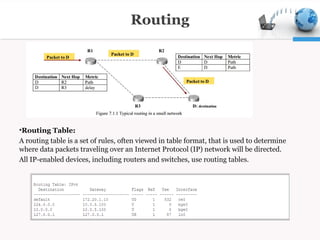
•Routing Table:
A routing table is a set of rules, often viewed in table format, that is used to determine
where data packets traveling over an Internet Protocol (IP) network will be directed.
All IP-enabled devices, including routers and switches, use routing tables.
Routing
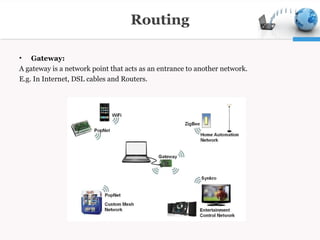
• Gateway:
A gateway is a network point that acts as an entrance to another network.
E.g. In Internet, DSL cables and Routers.
Types of Routing
• Static Routing:
A system that works on static routing doesn’t rely on routing protocols for routing. You must
maintains the known system routes manually.
• Dynamic Routing:
A system that works on dynamic routing rely on routing protocols to maintain its routing
tables.
• Routing delay:
It refers to the length of time required to move a packet from source to destination through
the internet.
• Bandwidth:
The amount of data that can be transmitted in a fixed amount of time. For digital devices,
the bandwidth is usually expressed in bits per second(bps) or bytes per second. For
analog devices, the bandwidth is expressed in cycles per second, or Hertz (Hz).
Routing
Difference B/w Hub, Switch & Router.
•Switches are used to create Networks while Routers are used to Connect
Networks.
•Hubs perform Half Duplex while Switches and Routers performs Full Duplex.
•Hubs works at 1st
layer (Physical), Switches at 2nd
(Data Link) & Routers at 3rd
layer.
•In a connection, where hub is utilized, when a segment(data) is send, it appears
at every node in the network.
•Switches are known as Intelligent Hubs. At the First startup of a network It also
send frame to every port and Store their MAC address in its Hardware Table. So
next time If any one Send something, it will be sent to the correct port.
•Routers send the packets exactly to the destination. Therefore it is considered an
Intelligent device then Hub & Switch.
•Routers use IP Address for Routing a Packet.
Routing

Routing

  • 2.
    BS-Computer Science IV Routing DataNetworks & Communication Presented By: •4661 •4677 •4678 •4673 •4679 Submitted to: Mam Sana.
  • 3.
    Routing • Definition: Routing isthe process of selecting best paths in a network. In the past, the term routing was also used to mean forwarding network traffic among networks. Routing is performed for many kinds of networks. • Telephone network (circuit switching). • Electronic data networks (such as the Internet). • Transportation networks. • Router: A router is a networking device that forwards data packets between computer networks. A router is connected to two or more data lines from different networks.
  • 4.
  • 5.
    Routing • IP Address: AnInternet Protocol address (IP address) is a numerical label assigned to each device (e.g., computer, printer) participating in a computer network that uses the Internet Protocol for communication. An IP address serves two principal functions:  Host or network interface identification.  Location addressing. Its role has been characterized as follows:  A name indicates what we seek.  An address indicates where it is.  A route indicates how to get there. The format of an IP address is a 32-bit numeric address written as four numbers separated by periods. Each number can be zero to 255. For example, 1.160.10.240 could be an IP address.
  • 6.
    Routing An IP addresscan be static or dynamic. •A static IP address will never change and it is a permanent Internet address. •A dynamic IP address is a temporary address that is assigned each time a computer or device accesses the Internet. The 1st number is of Network IP address & the last one is of Host address, where as middle one is called Broadcast address. Broadcast address is used to communicate b/w devices. 1.160.10. 240 Host AddressHost Address BroadcastBroadcast AddressAddress IP AddressIP Address
  • 7.
    Routing Routing Protocols: RIP (RoutingInformation Protocol) is a widely-used protocol for managing router information within a self-contained network such as a corporate local area network (LAN) or an interconnected group of such LANs. EIGRP (Enhanced Interior Gateway Routing Protocol) is a network protocol that lets routers exchange information more efficiently than with earlier network protocols. OSPF (Open Shortest Path First) router protocol is used to find the best path for packets as they pass through a set of connected networks. OSPF is one of several Interior Gateway Protocols that replaces the Routing Information Protocol (RIP), an older routing protocol that is installed in many of today's corporate networks. BGP (Border Gateway Protocol) is a protocol for exchanging routing information between gateway hosts (each with its own router) in a network of autonomous systems.
  • 8.
    Routing • Routing &Bridging: In networking many of us are confused with bridging and routing. Both are the transmitting technique. Difference is that Bridging takes place at 2nd layer of ISO (Data-link layer) while Routing takes place at 3rd layer of ISO (Network Layer). • Routing Algorithms: The routing algorithm is the part of the network layer software responsible for deciding which output line an incoming packet should be transmitted on, i.e. what should be the next intermediate node for the packet. • Routing protocols: Routing protocols use metrics to evaluate what path will be the best for a packet to travel. A metric is a standard of measurement; such as path bandwidth, reliability, delay, current load on that path etc. That is used by routing algorithms to determine the optimal path to a destination.
  • 9.
    Routing •Routing Table: A routingtable is a set of rules, often viewed in table format, that is used to determine where data packets traveling over an Internet Protocol (IP) network will be directed. All IP-enabled devices, including routers and switches, use routing tables.
  • 10.
    Routing • Gateway: A gatewayis a network point that acts as an entrance to another network. E.g. In Internet, DSL cables and Routers.
  • 11.
    Types of Routing •Static Routing: A system that works on static routing doesn’t rely on routing protocols for routing. You must maintains the known system routes manually. • Dynamic Routing: A system that works on dynamic routing rely on routing protocols to maintain its routing tables. • Routing delay: It refers to the length of time required to move a packet from source to destination through the internet. • Bandwidth: The amount of data that can be transmitted in a fixed amount of time. For digital devices, the bandwidth is usually expressed in bits per second(bps) or bytes per second. For analog devices, the bandwidth is expressed in cycles per second, or Hertz (Hz).
  • 12.
    Routing Difference B/w Hub,Switch & Router. •Switches are used to create Networks while Routers are used to Connect Networks. •Hubs perform Half Duplex while Switches and Routers performs Full Duplex. •Hubs works at 1st layer (Physical), Switches at 2nd (Data Link) & Routers at 3rd layer. •In a connection, where hub is utilized, when a segment(data) is send, it appears at every node in the network. •Switches are known as Intelligent Hubs. At the First startup of a network It also send frame to every port and Store their MAC address in its Hardware Table. So next time If any one Send something, it will be sent to the correct port. •Routers send the packets exactly to the destination. Therefore it is considered an Intelligent device then Hub & Switch. •Routers use IP Address for Routing a Packet.