MRI OF SHOULDER JOINT 
Dr Krishna Kiran MD.DNB.FRCR 
Radiologist 
Calicut 
This presentation is intended for medical and 
allied professionals.
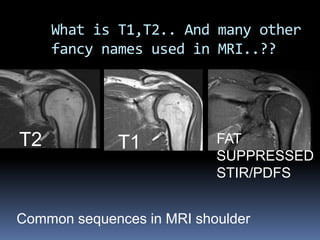
What is T1,T2.. And many other 
fancy names used in MRI..?? 
T2 T1 FAT 
SUPPRESSED 
STIR/PDFS 
Common sequences in MRI shoulder
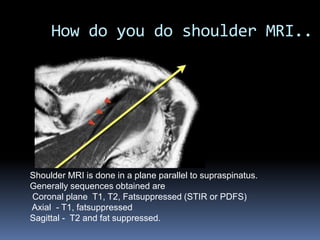
How do you do shoulder MRI.. 
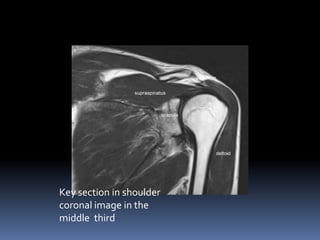
Shoulder MRI is done in a plane parallel to supraspinatus. 
Generally sequences obtained are 
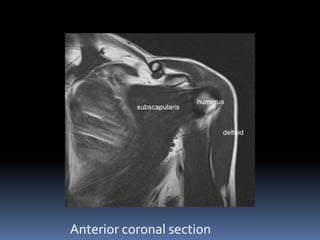
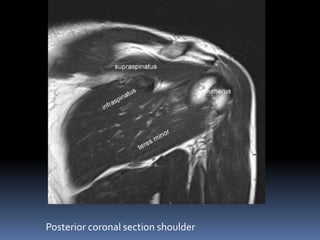
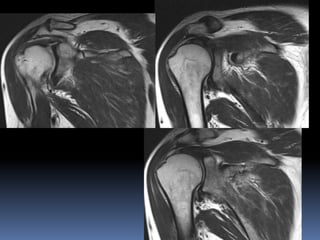
Coronal plane T1, T2, Fatsuppressed (STIR or PDFS) 
Axial - T1, fatsuppressed 
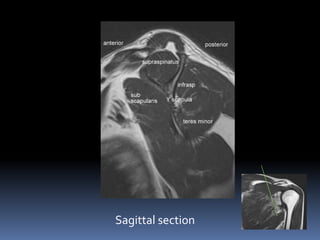
Sagittal - T2 and fat suppressed.
Key section in shoulder 
coronal image in the 
middle third
Anterior coronal section
Posterior coronal section shoulder
Sagittal section
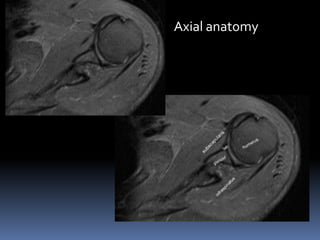
Axial anatomy
After review of 
anatomy , Let us 
proceed to our 
case.
CASE 1 
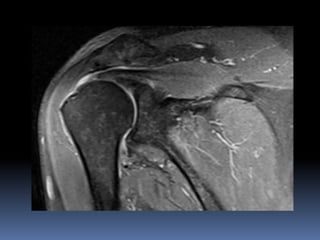
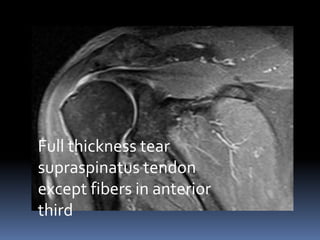
?ROTATOR CUFF TEAR
Full thickness tear 
supraspinatus tendon 
except fibers in anterior 
third
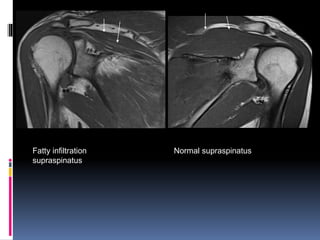
 Complete tears of supraspinatus tendon are 
accompanied by muscle atrophy and fatty 
infiltration. 
 These are important negative prognostic 
factors for tendon repair and shoulder 
arthroplasty. 
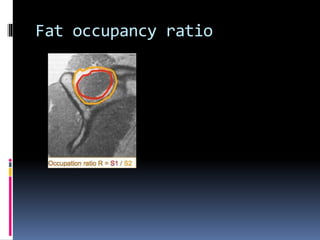
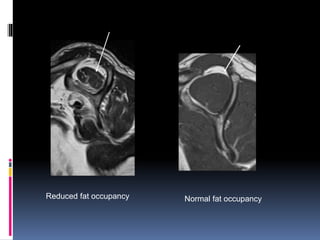
 Muscle thickness using Fat occupancy ratio 
and fatty infiltration of muscle can be 
assessed on MRI.
Fat occupancy ratio
Reduced fat occupancy Normal fat occupancy
Fatty infiltration 
supraspinatus 
Normal supraspinatus
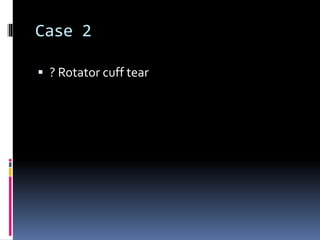
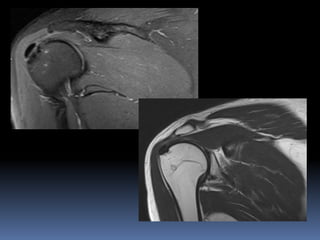
Case 2 
 ? Rotator cuff tear
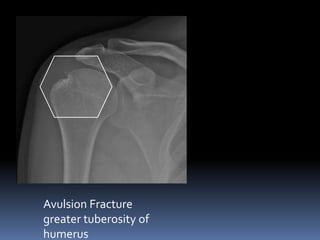
Avulsion Fracture 
greater tuberosity of 
humerus
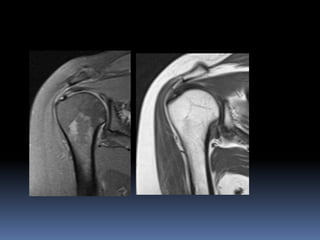
Case 3 
 ?RCT
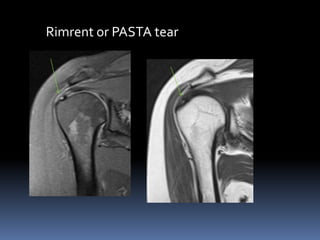
Rimrent or PASTA tear
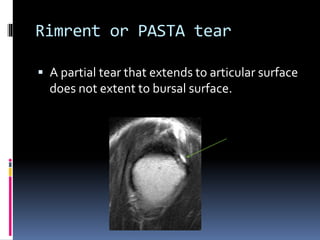
Rimrent or PASTA tear 
 A partial tear that extends to articular surface 
does not extent to bursal surface.
Case 4 
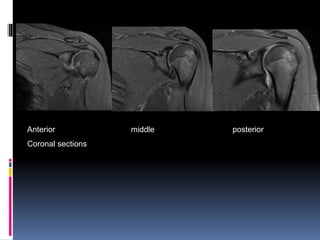
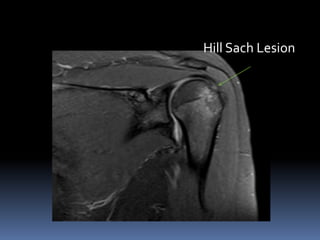
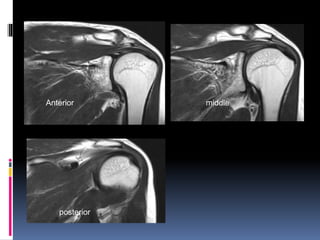
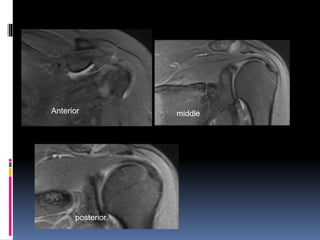
 Recurrent Dislocation shoulder
Anterior middle posterior 
Coronal sections
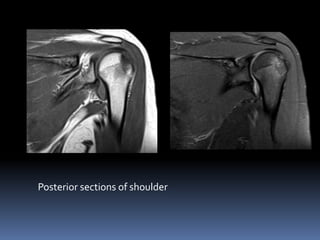
Posterior sections of shoulder
Hill Sach Lesion
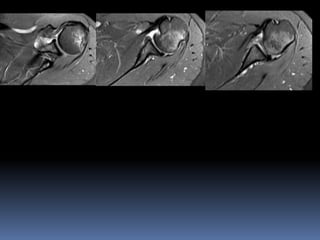
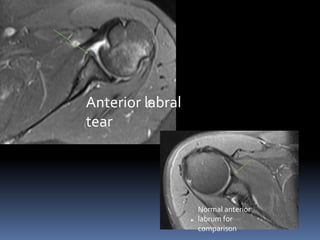
Anterior labral 
tear 
Normal anterior 
labrum for 
comparison
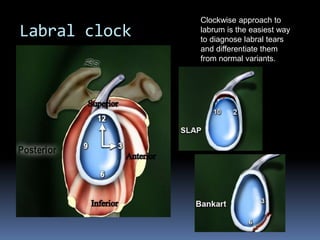
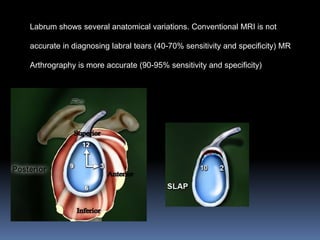
Labral clock 
Clockwise approach to 
labrum is the easiest way 
to diagnose labral tears 
and differentiate them 
from normal variants.
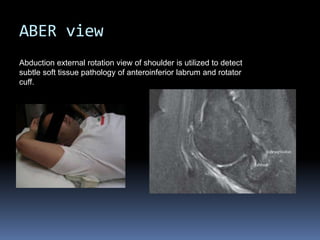
ABER view 
Abduction external rotation view of shoulder is utilized to detect 
subtle soft tissue pathology of anteroinferior labrum and rotator 
cuff.
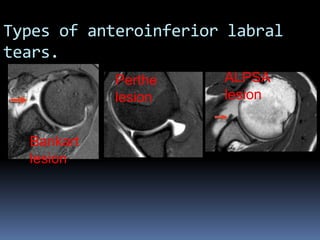
Types of anteroinferior labral 
tears. 
Bankart 
lesion 
Perthe 
lesion 
ALPSA 
lesion
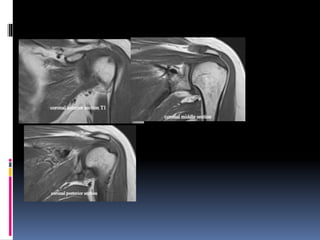
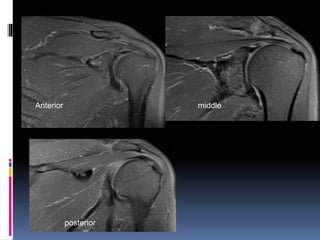
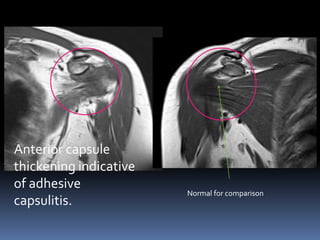
Case 5 
 Shoulder pain and limitation of movement.
Anterior middle 
posterior
Anterior capsule 
thickening indicative 
of adhesive 
capsulitis. 
Normal for comparison
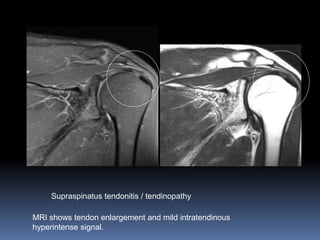
Case 6 
Shoulder pain on overhead hand 
movement
Anterior middle 
posterior
Anterior middle 
posterior
Supraspinatus tendonitis / tendinopathy 
MRI shows tendon enlargement and mild intratendinous 
hyperintense signal.
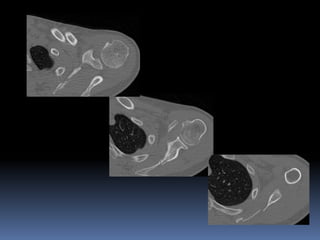
Case 7 
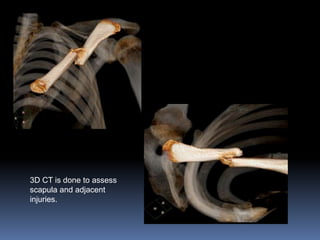
 Suspected scapula fracture
3D CT is done to assess 
scapula and adjacent 
injuries.
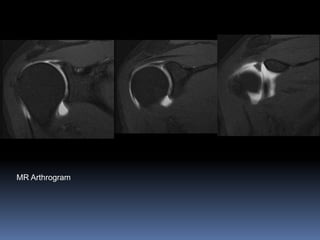
Case 8 
 An athlete complains of pain on throwing and 
overhead movement of arm.
MR Arthrogram
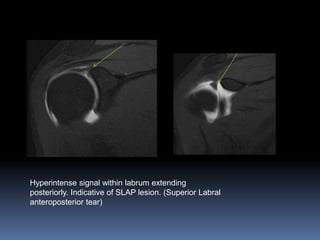
Hyperintense signal within labrum extending 
posteriorly. Indicative of SLAP lesion. (Superior Labral 
anteroposterior tear)
Labrum shows several anatomical variations. Conventional MRI is not 
accurate in diagnosing labral tears (40-70% sensitivity and specificity) MR 
Arthrography is more accurate (90-95% sensitivity and specificity)
History of Trauma 
CASE 1O
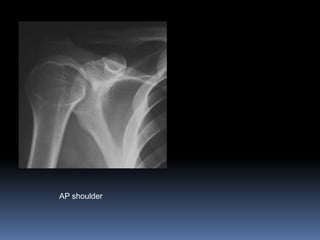
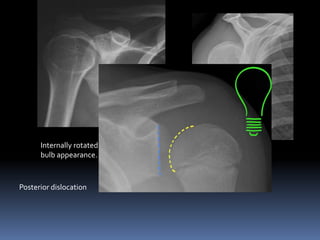
AP shoulder
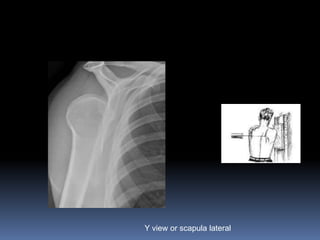
Y view or scapula lateral
Internally rotated humerus giving light 
bulb appearance. Y view showing 
Posterior dislocation 
posterior 
dislocation.
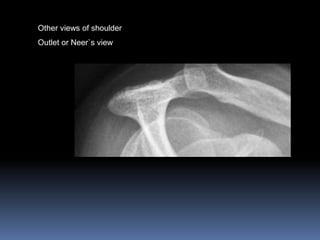
Other views of shoulder 
Outlet or Neer`s view
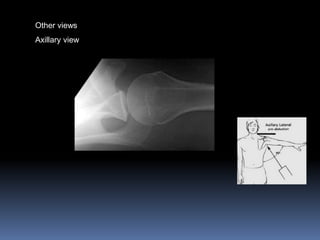
Other views 
Axillary view
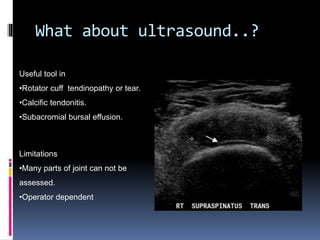
What about ultrasound..? 
Useful tool in 
•Rotator cuff tendinopathy or tear. 
•Calcific tendonitis. 
•Subacromial bursal effusion. 
Limitations 
•Many parts of joint can not be 
assessed. 
•Operator dependent
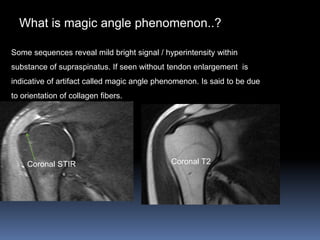
What is magic angle phenomenon..? 
Some sequences reveal mild bright signal / hyperintensity within 
substance of supraspinatus. If seen without tendon enlargement is 
indicative of artifact called magic angle phenomenon. Is said to be due 
to orientation of collagen fibers. 
Coronal STIR Coronal T2
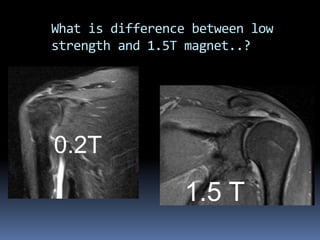
What is difference between low 
strength and 1.5T magnet..? 
0.2T 
1.5 T
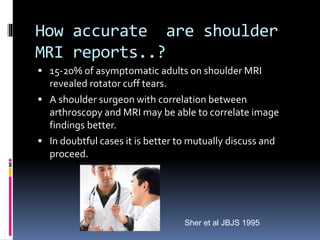
How accurate are shoulder 
MRI reports..? 
 15-20% of asymptomatic adults on shoulder MRI 
revealed rotator cuff tears. 
 A shoulder surgeon with correlation between 
arthroscopy and MRI may be able to correlate image 
findings better. 
 In doubtful cases it is better to mutually discuss and 
proceed. 
Sher et al JBJS 1995
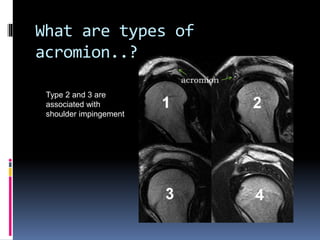
What are types of 
acromion..? 
Type 2 and 3 are 
associated with 
shoulder impingement
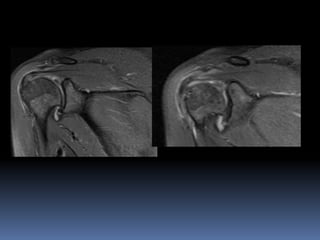
QUIZ 
 Shoulder , arm pain after suddenly lifting 
heavy weight
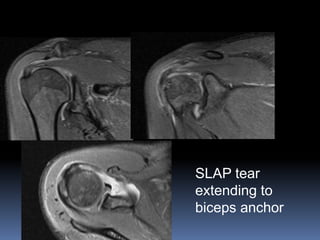
SLAP tear 
extending to 
biceps anchor
Take home points.. 
 Shoulder is a complex joint , imaging also 
tends to be complex and prone for errors. 
 When in doubt discuss and proceed. 
 Signal within tendon may not be significant , 
remember magic angle ..!!

MRI OF SHOULDER INJURY