PRESENTER: DR. SUSHIL
PAUDEL
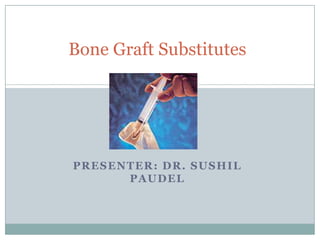
Bone Graft Substitutes
Definition
Bone substitutes are natural, synthetic or composite
materials used to fill bone defects and promote bone
healing
Purpose
To provide:
Linkage
Splintage
and
Promote osteogenesis
Linkage
 Fill bony defects/cavities
 Replace crushed bone
 Arthrodesis
Splintage
 Non unions
 Arthrodesis
Why do we need them???
 2.2 million graft procedures done yearly
 9 out of 10 involve use of Auto/Allografts
 Estimated cost about $2.5 billion per year
Properties of an ideal bone graft
 Osteoconductive matrix
 Osteogenic cells
 Osteoinductive proteins
Osteoconductive matrix
Acts as a scaffold which supports osteoblasts and
progenitor cells
Provides integrated porous structure through which new
cells can migrate and new vessels can form
Osteogenic cells
Includes osteoblasts and osteoblastic precursors
Capable of forming new bone in proper environment
Osteoinductive proteins
Stimulate and support mitogenesis of undifferentiated cells
into osteoblastic cells
Bone graft substitutes have one or more of these three
properties
Autografts
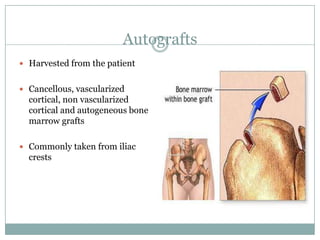
 Harvested from the patient
 Cancellous, vascularized
cortical, non vascularized
cortical and autogeneous bone
marrow grafts
 Commonly taken from iliac
crests
Advantages
 No immune reaction
 All three properties present
Disadvantages
 Requires additional surgery
 Limited quantity
 Non availability for further surgery
 Increased morbidity
 Infection
 Chronic pain
 Cosmetic
Allografts
 Alternative to autografts
 Taken from donors or cadavers
Advantages
 Eliminates donor site morbidity
 Tackles issue of limited supply
Disadvantages
 Immune reaction
 Risk of infection
 Disease transmission
 Reduced osteoinductivity and osteogenecity
 Ethical issues
FUELLED THE QUEST
FOR NEW
ALTERNATIVES
BONE GRAFT
Disadvantages of allo/autografts
Classification
 Laurencin et al, proposed a classification system of material
based groups
 Includes:
Allograft based
Factor based
Cell based
Ceramic based
Polymer based
Allograft based
 Includes allograft bone used alone or in combination with
other material
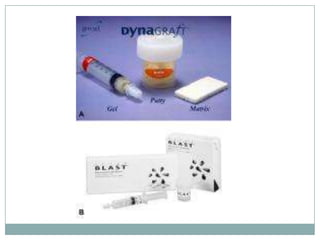
 Available as Demineralized bone matrix, and other forms as
an autograft, Eg- corticocancellous grafts etc.
Dimineralized bone matrix
 Has osteoconductive and osteoinductive properties
 Does not provide structural support
 Very good for filling bone defects and cavities
 Biological activity - proteins and growth factors present in
the extracellular matrix
 Prepared by a standard process- Urist et al, modified by
Reddi and huggins
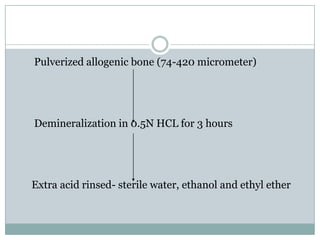
Pulverized allogenic bone (74-420 micrometer)
Demineralization in 0.5N HCL for 3 hours
Extra acid rinsed- sterile water, ethanol and ethyl ether
Uses
 Excellent for contained stable defects Eg- cysts and cavities
 Have been used for non unions and acute bone defects *
 Also been used to enhance arthrodesis Eg- spine etc.**
• *tiedmann et al, Orthopedics 1995:18 1153-8
• **Urist MR et al, Clin. Orthop. 1981;154:97-113
 DBM is available in various forms as
Freeze dried powder
Crushed granules, chips
Paste
Gels
mixture of DBM with autologous bone marrow has also been used as
injection*
* Connolly JF, Clin. Orthop. 1995;313:8-18
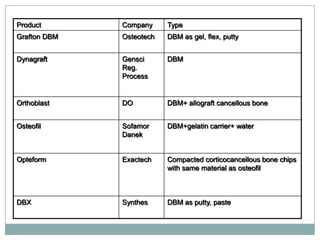
Product Company Type
Grafton DBM Osteotech DBM as gel, flex, putty
Dynagraft Gensci
Reg.
Process
DBM
Orthoblast DO DBM+ allograft cancellous bone
Osteofil Sofamor
Danek
DBM+gelatin carrier+ water
Opteform Exactech Compacted corticocancellous bone chips
with same material as osteofil
DBX Synthes DBM as putty, paste
Disadvantages
 Infection
 Disease transmission
 Variable potency- multiple donors, manufacture processes
 No RCT has been done comparing its efficacy
Factor based
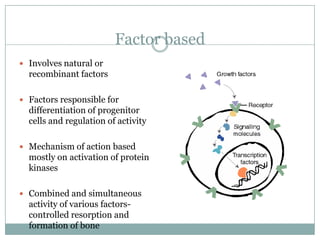
 Involves natural or
recombinant factors
 Factors responsible for
differentiation of progenitor
cells and regulation of activity
 Mechanism of action based
mostly on activation of protein
kinases
 Combined and simultaneous
activity of various factors-
controlled resorption and
formation of bone
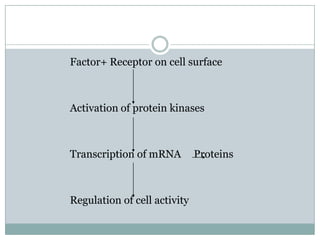
Factor+ Receptor on cell surface
Activation of protein kinases
Transcription of mRNA Proteins
Regulation of cell activity
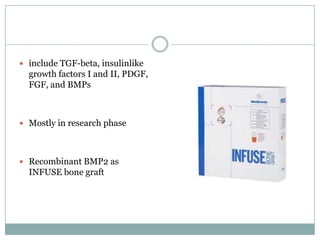
 include TGF-beta, insulinlike
growth factors I and II, PDGF,
FGF, and BMPs
 Mostly in research phase
 Recombinant BMP2 as
INFUSE bone graft
Brief history of rhBMP2
 1965- Urist et al, isolated a group of proteins they called
BMPs
 2002- FDA approved rhBMP2 for use in lumbar spine
fusion with LT-CAGER device
 2004-FDA approved use of rhBMP2 in open tibial fractures
rhBMP2/ACS+allograft V/S autogeneous
bone graft in diaphyseal tibial fractures
 Study by Jones AL et al
 30 patients with diaphyseal tibial fractures with cortical bone loss
 Mean length of defect-4 cm
 Divided in 2 groups
 Short musculoskeletal function assessment administered before and after surgery
 10 in autograft group, 13 in rhBMP2 group showed healing
 Significantly less blood loss in rhBMP2 group
 Comparative improvement in SMFA in both groups
 Jones AL et al J Bone Joint Surgery AM 2006 Jul;88(2):1431-41
Contraindications to rhBMP2
 Hypersensitivity to rhBMP2 or bovine collagen type I
 In vicinity of resected tumor
 Patients with active malignancy or patients undergoing treatment
 Skeletally immature patient
 Pregnant women
 Patients with active infection at operative site
Cell based
 Based on in vitro differentiation of mesenchymal stem cells to
osteoblastic lineage
 Various additives- dexamethasone, ascorbic acid, b-glycerophosphate
 Addition of factors- TGF-beta, BMP2, BMP4, BMP7
 They have been used alongwith ceramics
 Proposed to be used in bone repair prosthetic setting
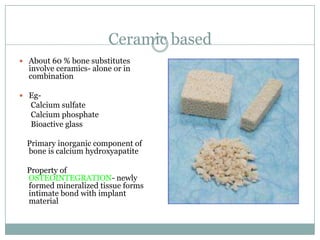
Ceramic based
 About 60 % bone substitutes
involve ceramics- alone or in
combination
 Eg-
Calcium sulfate
Calcium phosphate
Bioactive glass
Primary inorganic component of
bone is calcium hydroxyapatite
Property of
OSTEOINTEGRATION- newly
formed mineralized tissue forms
intimate bond with implant
material
Ideal ceramic
 Chemical structure to promote bone healing
 Replaced by native bone
 Mechanically strong to provide stability
Calcium phosphate biomaterials
 Mainly used as osteoconductive matrix
 Polycrystalline structure
 Crystals of highly oxidised material fused by sintering
 Brittle substance with poor tensile strength
 Used for filling contained bone defects and areas of bone loss
 Placed in rigidly stabilized bone or intact bone- to avoid shear stress on biomaterial
 Tightly pack in adjacent host bone to maximize ingrowth
Available as porous/non porous blocks or porous granules
Tri calcium phosphate
 It is a porous ceramic
 Converts partly to hydroxyapatite in the body
 More porous and faster rate of resorption than
hydroxyapatite mechanically weaker in
compression
 Unpredictable Biodegradation profile not popular
 May be used for filling bone defects- trauma, benign
tumors, cysts
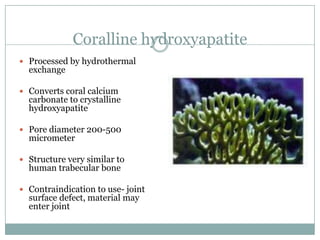
Coralline hydroxyapatite
 Processed by hydrothermal
exchange
 Converts coral calcium
carbonate to crystalline
hydroxyapatite
 Pore diameter 200-500
micrometer
 Structure very similar to
human trabecular bone
 Contraindication to use- joint
surface defect, material may
enter joint
 Study show equivalent result with coralline hydroxyapatite
and autologous bone graft-tibial plateau fractures*
 Results less predictable on management of metaphyseal
fractures
* Bucholz RW clin orthop. 1989;240:53-62
Calcium collagen graft material
 Osteoconductive composite of
 hydroxyapatite
 calcium phosphate
 type I and III collagen
 autologous bone marrow
 Does not provide structural support
 Effective bone substitute/ bone graft expander
 Good for use in acute long bone cortical fractures
 No scientific evidence of benefit in management of non-
unions
 Not recommended for use in metaphyseal bone defects due
to articular fractures as provides no structural support
Calcium sulfate graft material
 Alphahemihydrate crystalline structure
 May be used as a bone void filler
 Completely resorbs as new bone remodels to fill defect
 Potential uses- filling defects including segmental defects,
exapanding grafts as in spinal fusion
 May be used to fill bone graft harvest sites
 Very limited information available regarding use in humans
 No published control studies available
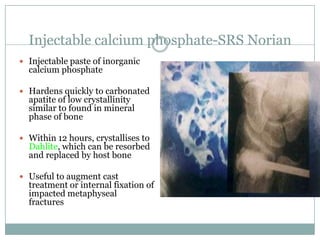
Injectable calcium phosphate-SRS Norian
 Injectable paste of inorganic
calcium phosphate
 Hardens quickly to carbonated
apatite of low crystallinity
similar to found in mineral
phase of bone
 Within 12 hours, crystallises to
Dahlite, which can be resorbed
and replaced by host bone
 Useful to augment cast
treatment or internal fixation of
impacted metaphyseal
fractures
 Studies have been done in cases of impacted extra articular
distal end radius fractures with good results
 Jupiter et al. J Orthop Trauma 1997;11:110-6
 Kopylov et al. J Hand Surg [Br]. 1996;21:768-71
 Kopylov et al. Acta Orthop Scand 1999;70;1-5
Norian SRS in radial osteotomies
 study by Logano calderon et al
 Retrospective analysis of 6 elderly patients with corrective radial
osteotomies
 Fixed with angular stable implants+ Norian SRS
 All osteotomies healed
 Post op DASH-28 points, Modified Mayo score-68
Logan calderon et al J Hand Surg[Am] 2007 sep;32(7):976-83
Norian SRS in knee replacement
 Study by Mangotti A et al
 Used Norian SRS as substitute of bone graft for tibial bone
defects in TKR
 3 unicompartmental TKR, 2 revision TKR, 1 hinged knee
prosthesis
 No poor results, improved knee scores, no evidence of post
op deformity
 Mangotti A et al Arch Orthop Trauma Surg.2006 Nov:126(9):594-8
 Other uses:
 hip
 spine
 calcaneal
 other metaphyseal fractures
At risk of implant failure or redisplacment due to load
Bio active glass
 Variation of glass beads
 Composed of silica, calcium oxide, disodium oxide and
peroxide
 They bind to collagen, growth factors and fibrin to form a
matrix
 Provides compressive strength but not structural support
Polymer based group
 Can be divided into natural/synthetic
 Further divided into biodegradable/non biodegradable
 Eg:
 Healoss(DePuy)- natural polymer based group
polymer-ceramic composite
collagen coated with hydroxapatite
used in spinal fusions
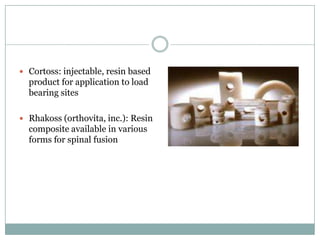
 Cortoss: injectable, resin based
product for application to load
bearing sites
 Rhakoss (orthovita, inc.): Resin
composite available in various
forms for spinal fusion
Composite grafts
 Rationale most of the graft substitutes are only
osteoconductive
Cinolti G et al J Bone Joint Surg Br. 2004 Jan;86(1):135-42
“Osteoconductive material alone do not give effective fusion
as autologous graft”
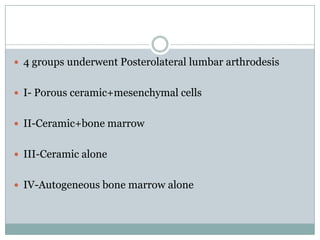
 4 groups underwent Posterolateral lumbar arthrodesis
 I- Porous ceramic+mesenchymal cells
 II-Ceramic+bone marrow
 III-Ceramic alone
 IV-Autogeneous bone marrow alone
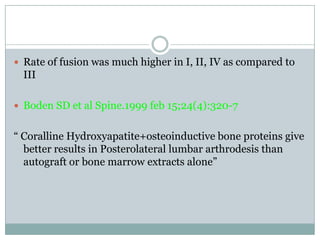
 Rate of fusion was much higher in I, II, IV as compared to
III
 Boden SD et al Spine.1999 feb 15;24(4):320-7
“ Coralline Hydroxyapatite+osteoinductive bone proteins give
better results in Posterolateral lumbar arthrodesis than
autograft or bone marrow extracts alone”
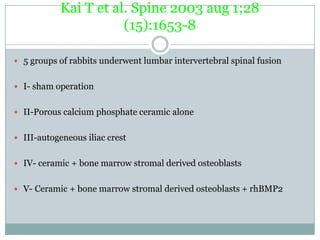
Kai T et al. Spine 2003 aug 1;28
(15):1653-8
 5 groups of rabbits underwent lumbar intervertebral spinal fusion
 I- sham operation
 II-Porous calcium phosphate ceramic alone
 III-autogeneous iliac crest
 IV- ceramic + bone marrow stromal derived osteoblasts
 V- Ceramic + bone marrow stromal derived osteoblasts + rhBMP2
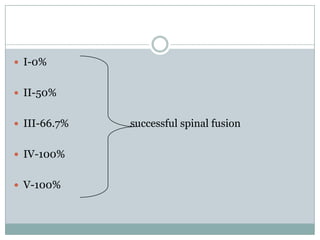
 I-0%
 II-50%
 III-66.7% successful spinal fusion
 IV-100%
 V-100%
 Size of fusion mass and stiffness of fusion segments-
greatest in group V
 Conclusions:
 rhBMP2 addition may reinforce biomechanical stiffness for spinal
fusion segments
 Porous calcium ceramics should not be used alone
Choice of graft
 What is the expectation? Structure/bone forming function
 Availability of graft?
 Recipient bed?
 Cost?
Remember!!! Stable fixation is required for use of most
grafts
New concept
 Concept of tissue engineering
Application of biologic, chemical and engineering
principles
repair, restoration and regeneration of tissues
using biomaterials, cells and factors
Bone graft substitutes

Bone graft substitutes

  • 1.
  • 2.
    Definition Bone substitutes arenatural, synthetic or composite materials used to fill bone defects and promote bone healing
  • 3.
  • 4.
    Linkage  Fill bonydefects/cavities  Replace crushed bone  Arthrodesis
  • 5.
  • 6.
    Why do weneed them???  2.2 million graft procedures done yearly  9 out of 10 involve use of Auto/Allografts  Estimated cost about $2.5 billion per year
  • 7.
    Properties of anideal bone graft  Osteoconductive matrix  Osteogenic cells  Osteoinductive proteins
  • 8.
    Osteoconductive matrix Acts asa scaffold which supports osteoblasts and progenitor cells Provides integrated porous structure through which new cells can migrate and new vessels can form
  • 9.
    Osteogenic cells Includes osteoblastsand osteoblastic precursors Capable of forming new bone in proper environment
  • 10.
    Osteoinductive proteins Stimulate andsupport mitogenesis of undifferentiated cells into osteoblastic cells Bone graft substitutes have one or more of these three properties
  • 11.
    Autografts  Harvested fromthe patient  Cancellous, vascularized cortical, non vascularized cortical and autogeneous bone marrow grafts  Commonly taken from iliac crests
  • 12.
    Advantages  No immunereaction  All three properties present
  • 13.
    Disadvantages  Requires additionalsurgery  Limited quantity  Non availability for further surgery  Increased morbidity  Infection  Chronic pain  Cosmetic
  • 14.
    Allografts  Alternative toautografts  Taken from donors or cadavers
  • 15.
    Advantages  Eliminates donorsite morbidity  Tackles issue of limited supply
  • 16.
    Disadvantages  Immune reaction Risk of infection  Disease transmission  Reduced osteoinductivity and osteogenecity  Ethical issues
  • 17.
    FUELLED THE QUEST FORNEW ALTERNATIVES BONE GRAFT Disadvantages of allo/autografts
  • 18.
    Classification  Laurencin etal, proposed a classification system of material based groups  Includes: Allograft based Factor based Cell based Ceramic based Polymer based
  • 19.
    Allograft based  Includesallograft bone used alone or in combination with other material  Available as Demineralized bone matrix, and other forms as an autograft, Eg- corticocancellous grafts etc.
  • 20.
    Dimineralized bone matrix Has osteoconductive and osteoinductive properties  Does not provide structural support  Very good for filling bone defects and cavities  Biological activity - proteins and growth factors present in the extracellular matrix  Prepared by a standard process- Urist et al, modified by Reddi and huggins
  • 21.
    Pulverized allogenic bone(74-420 micrometer) Demineralization in 0.5N HCL for 3 hours Extra acid rinsed- sterile water, ethanol and ethyl ether
  • 22.
    Uses  Excellent forcontained stable defects Eg- cysts and cavities  Have been used for non unions and acute bone defects *  Also been used to enhance arthrodesis Eg- spine etc.** • *tiedmann et al, Orthopedics 1995:18 1153-8 • **Urist MR et al, Clin. Orthop. 1981;154:97-113
  • 23.
     DBM isavailable in various forms as Freeze dried powder Crushed granules, chips Paste Gels mixture of DBM with autologous bone marrow has also been used as injection* * Connolly JF, Clin. Orthop. 1995;313:8-18
  • 24.
    Product Company Type GraftonDBM Osteotech DBM as gel, flex, putty Dynagraft Gensci Reg. Process DBM Orthoblast DO DBM+ allograft cancellous bone Osteofil Sofamor Danek DBM+gelatin carrier+ water Opteform Exactech Compacted corticocancellous bone chips with same material as osteofil DBX Synthes DBM as putty, paste
  • 26.
    Disadvantages  Infection  Diseasetransmission  Variable potency- multiple donors, manufacture processes  No RCT has been done comparing its efficacy
  • 27.
    Factor based  Involvesnatural or recombinant factors  Factors responsible for differentiation of progenitor cells and regulation of activity  Mechanism of action based mostly on activation of protein kinases  Combined and simultaneous activity of various factors- controlled resorption and formation of bone
  • 28.
    Factor+ Receptor oncell surface Activation of protein kinases Transcription of mRNA Proteins Regulation of cell activity
  • 29.
     include TGF-beta,insulinlike growth factors I and II, PDGF, FGF, and BMPs  Mostly in research phase  Recombinant BMP2 as INFUSE bone graft
  • 30.
    Brief history ofrhBMP2  1965- Urist et al, isolated a group of proteins they called BMPs  2002- FDA approved rhBMP2 for use in lumbar spine fusion with LT-CAGER device  2004-FDA approved use of rhBMP2 in open tibial fractures
  • 31.
    rhBMP2/ACS+allograft V/S autogeneous bonegraft in diaphyseal tibial fractures  Study by Jones AL et al  30 patients with diaphyseal tibial fractures with cortical bone loss  Mean length of defect-4 cm  Divided in 2 groups  Short musculoskeletal function assessment administered before and after surgery  10 in autograft group, 13 in rhBMP2 group showed healing  Significantly less blood loss in rhBMP2 group  Comparative improvement in SMFA in both groups  Jones AL et al J Bone Joint Surgery AM 2006 Jul;88(2):1431-41
  • 32.
    Contraindications to rhBMP2 Hypersensitivity to rhBMP2 or bovine collagen type I  In vicinity of resected tumor  Patients with active malignancy or patients undergoing treatment  Skeletally immature patient  Pregnant women  Patients with active infection at operative site
  • 33.
    Cell based  Basedon in vitro differentiation of mesenchymal stem cells to osteoblastic lineage  Various additives- dexamethasone, ascorbic acid, b-glycerophosphate  Addition of factors- TGF-beta, BMP2, BMP4, BMP7  They have been used alongwith ceramics  Proposed to be used in bone repair prosthetic setting
  • 34.
    Ceramic based  About60 % bone substitutes involve ceramics- alone or in combination  Eg- Calcium sulfate Calcium phosphate Bioactive glass Primary inorganic component of bone is calcium hydroxyapatite Property of OSTEOINTEGRATION- newly formed mineralized tissue forms intimate bond with implant material
  • 35.
    Ideal ceramic  Chemicalstructure to promote bone healing  Replaced by native bone  Mechanically strong to provide stability
  • 36.
    Calcium phosphate biomaterials Mainly used as osteoconductive matrix  Polycrystalline structure  Crystals of highly oxidised material fused by sintering  Brittle substance with poor tensile strength  Used for filling contained bone defects and areas of bone loss  Placed in rigidly stabilized bone or intact bone- to avoid shear stress on biomaterial  Tightly pack in adjacent host bone to maximize ingrowth Available as porous/non porous blocks or porous granules
  • 37.
    Tri calcium phosphate It is a porous ceramic  Converts partly to hydroxyapatite in the body  More porous and faster rate of resorption than hydroxyapatite mechanically weaker in compression  Unpredictable Biodegradation profile not popular  May be used for filling bone defects- trauma, benign tumors, cysts
  • 38.
    Coralline hydroxyapatite  Processedby hydrothermal exchange  Converts coral calcium carbonate to crystalline hydroxyapatite  Pore diameter 200-500 micrometer  Structure very similar to human trabecular bone  Contraindication to use- joint surface defect, material may enter joint
  • 39.
     Study showequivalent result with coralline hydroxyapatite and autologous bone graft-tibial plateau fractures*  Results less predictable on management of metaphyseal fractures * Bucholz RW clin orthop. 1989;240:53-62
  • 40.
    Calcium collagen graftmaterial  Osteoconductive composite of  hydroxyapatite  calcium phosphate  type I and III collagen  autologous bone marrow  Does not provide structural support  Effective bone substitute/ bone graft expander  Good for use in acute long bone cortical fractures
  • 41.
     No scientificevidence of benefit in management of non- unions  Not recommended for use in metaphyseal bone defects due to articular fractures as provides no structural support
  • 42.
    Calcium sulfate graftmaterial  Alphahemihydrate crystalline structure  May be used as a bone void filler  Completely resorbs as new bone remodels to fill defect  Potential uses- filling defects including segmental defects, exapanding grafts as in spinal fusion  May be used to fill bone graft harvest sites
  • 43.
     Very limitedinformation available regarding use in humans  No published control studies available
  • 44.
    Injectable calcium phosphate-SRSNorian  Injectable paste of inorganic calcium phosphate  Hardens quickly to carbonated apatite of low crystallinity similar to found in mineral phase of bone  Within 12 hours, crystallises to Dahlite, which can be resorbed and replaced by host bone  Useful to augment cast treatment or internal fixation of impacted metaphyseal fractures
  • 45.
     Studies havebeen done in cases of impacted extra articular distal end radius fractures with good results  Jupiter et al. J Orthop Trauma 1997;11:110-6  Kopylov et al. J Hand Surg [Br]. 1996;21:768-71  Kopylov et al. Acta Orthop Scand 1999;70;1-5
  • 46.
    Norian SRS inradial osteotomies  study by Logano calderon et al  Retrospective analysis of 6 elderly patients with corrective radial osteotomies  Fixed with angular stable implants+ Norian SRS  All osteotomies healed  Post op DASH-28 points, Modified Mayo score-68 Logan calderon et al J Hand Surg[Am] 2007 sep;32(7):976-83
  • 47.
    Norian SRS inknee replacement  Study by Mangotti A et al  Used Norian SRS as substitute of bone graft for tibial bone defects in TKR  3 unicompartmental TKR, 2 revision TKR, 1 hinged knee prosthesis  No poor results, improved knee scores, no evidence of post op deformity  Mangotti A et al Arch Orthop Trauma Surg.2006 Nov:126(9):594-8
  • 48.
     Other uses: hip  spine  calcaneal  other metaphyseal fractures At risk of implant failure or redisplacment due to load
  • 49.
    Bio active glass Variation of glass beads  Composed of silica, calcium oxide, disodium oxide and peroxide  They bind to collagen, growth factors and fibrin to form a matrix  Provides compressive strength but not structural support
  • 50.
    Polymer based group Can be divided into natural/synthetic  Further divided into biodegradable/non biodegradable  Eg:  Healoss(DePuy)- natural polymer based group polymer-ceramic composite collagen coated with hydroxapatite used in spinal fusions
  • 51.
     Cortoss: injectable,resin based product for application to load bearing sites  Rhakoss (orthovita, inc.): Resin composite available in various forms for spinal fusion
  • 52.
    Composite grafts  Rationalemost of the graft substitutes are only osteoconductive Cinolti G et al J Bone Joint Surg Br. 2004 Jan;86(1):135-42 “Osteoconductive material alone do not give effective fusion as autologous graft”
  • 53.
     4 groupsunderwent Posterolateral lumbar arthrodesis  I- Porous ceramic+mesenchymal cells  II-Ceramic+bone marrow  III-Ceramic alone  IV-Autogeneous bone marrow alone
  • 54.
     Rate offusion was much higher in I, II, IV as compared to III  Boden SD et al Spine.1999 feb 15;24(4):320-7 “ Coralline Hydroxyapatite+osteoinductive bone proteins give better results in Posterolateral lumbar arthrodesis than autograft or bone marrow extracts alone”
  • 55.
    Kai T etal. Spine 2003 aug 1;28 (15):1653-8  5 groups of rabbits underwent lumbar intervertebral spinal fusion  I- sham operation  II-Porous calcium phosphate ceramic alone  III-autogeneous iliac crest  IV- ceramic + bone marrow stromal derived osteoblasts  V- Ceramic + bone marrow stromal derived osteoblasts + rhBMP2
  • 56.
     I-0%  II-50% III-66.7% successful spinal fusion  IV-100%  V-100%
  • 57.
     Size offusion mass and stiffness of fusion segments- greatest in group V  Conclusions:  rhBMP2 addition may reinforce biomechanical stiffness for spinal fusion segments  Porous calcium ceramics should not be used alone
  • 58.
    Choice of graft What is the expectation? Structure/bone forming function  Availability of graft?  Recipient bed?  Cost? Remember!!! Stable fixation is required for use of most grafts
  • 59.
    New concept  Conceptof tissue engineering Application of biologic, chemical and engineering principles repair, restoration and regeneration of tissues using biomaterials, cells and factors