SHOULDER JOINT
INSTABILITY
DR. PRASANTH
• Most mobile joint in the body
• Synovial joint….. Ball and socket joint
• Articular surfaces- head of the humerus + glenoid cavity
both covered by hyaline cartilage.
• Size of head of humerus is 3-4 times larger than the glenoid cavity.
[ glenoid labrum (lip) covers excess part of the head ]- fibrocartilaginous rim
Labrum Increases humeral contact to 75%
• Adv- increased shoulder ROM
• Disadv – stability of the joint decreases.
Capsule
• Loose and redundant at most positions
• At extremes – tightens , provides stability.
• Caspsule of shoulder joint attached- medially to glenoid labrum
- laterally to anatomical neck
and extended little further down medially to shaft humerus for a short
distance.
• Has two layers – 1. synovial layer (inner)
2. fibrous layer (outer)
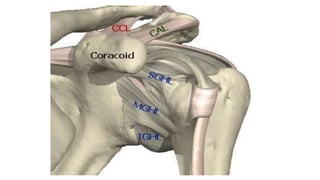
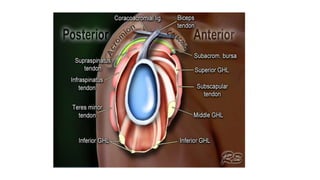
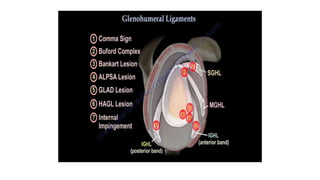
Glenohumeral ligaments.
• Superior GHL - runs from anterosuperior labrum to the humerus
function- resists anterior translation of adducted arm
• Middle GHL – runs from anterosuperior glenoid arising just inferior to S.GHL
to anterior aspect of the anatomical neck
function- resists anterior and posterior translation in the mid range of
arm abduction at 45° and external rotation
• Inferior GHL – runs from inferior ⅔ of glenoid cavity to lateral humerus
anterior band function – primary stabilizer that limits antero-inferior
translation of arm in 90° abduction and external rotation
 anterior band forms weak line that predispose to bankart lesion.
posterior band function – resists posterior translation in adduction and
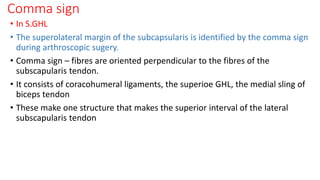
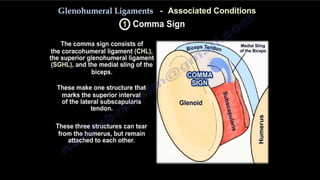
Comma sign
• In S.GHL
• The superolateral margin of the subcapsularis is identified by the comma sign
during arthroscopic sugery.
• Comma sign – fibres are oriented perpendicular to the fibres of the
subscapularis tendon.
• It consists of coracohumeral ligaments, the superioe GHL, the medial sling of
biceps tendon
• These make one structure that makes the superior interval of the lateral
subscapularis tendon
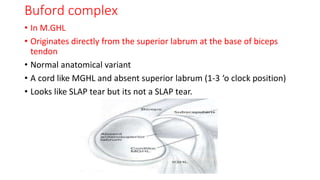
Buford complex
• In M.GHL
• Originates directly from the superior labrum at the base of biceps
tendon
• Normal anatomical variant
• A cord like MGHL and absent superior labrum (1-3 ‘o clock position)
• Looks like SLAP tear but its not a SLAP tear.
LESIONS OF
GLENO HUMERAL
LIGAMENTS
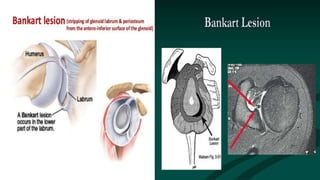
Bankart lesion
• In I.GHL (ANTERIOR BAND)
• Mc lesion of anterior shoulder instability following anterior shoulder
dislocation.
• It involves avulsion of anterior inferior labrum
• Typically located at 3-6’ o clock position (IGHL , ANTERIOR BAND LOCATES),
where the humeral head dislocates.
• Lesion can be bony / fibrous.
ALPSA LESION
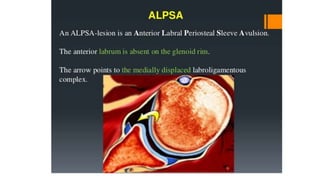
• Labral ligament complex is displaced medially and shifted inferiorly.
• A – Anterior
• L – labral
• P – periosteal
• S – sleeve
• A – avulsion
• The labrum is displaced by the I.GHL
and the labrum is rolled up like a sleeve
with an intact anterior scapular periosteum.
GLAD LESION
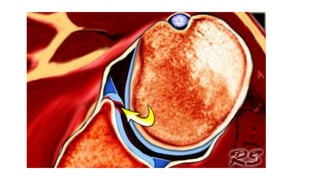
• Tear of anteroinferior labrum ( non displaced) with avulsion of adjacent
glenoid cartilage , no capsular stripping.
• G – glenoid
• L – labral
• A – avulsion
• D – defect
• The lesion results from impaction of
humeral head against the glenoid.
This is caused by abduction and external rotation injury.
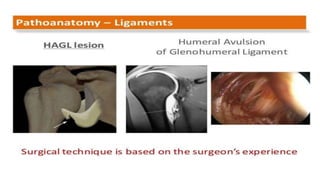
HAGL LESION
• The position of the I.GHL , which is the most important and strongest
ligament , limits anterior / inferior subluxation of the humeral head.
• Humeral avulsion of glenohumeral ligament may occur due to shoulder
dislocation.
• The inferior GHL avulses from the inferior humeral neck
• Usually occurs due to the anterior shoulder dislocation
(hyperabduction + external rotation)
• Looks like the capsule and ligament avulsed from the inferior humeral
neck and ripped off.
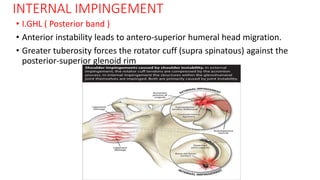
INTERNAL IMPINGEMENT
• I.GHL ( Posterior band )
• Anterior instability leads to antero-superior humeral head migration.
• Greater tuberosity forces the rotator cuff (supra spinatous) against the
posterior-superior glenoid rim
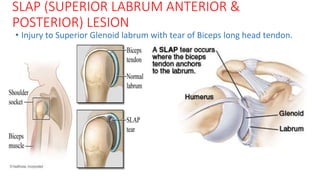
SLAP (SUPERIOR LABRUM ANTERIOR &
POSTERIOR) LESION
• Injury to Superior Glenoid labrum with tear of Biceps long head tendon.
SLAC (SUPERIOR LABRUM ANTERIOR CUFF)
LESION
• Injury to superior labrum with anterior supraspinatous exhibits a
partial / complete tear resulting from instability.
MATSEN’S SIMPLIFIED
CLASSIFICATION SYSTEM
1 - TUBS (Traumatic Unidirectional Bankart Surgery )
1 - AMBRII (Atraumatic, Multidirectional, Bilateral, Rehabilitation,
Inferior capsular shift, and Internal closure)
•Micro traumatic or developmental lesions fall between the extremes of
macro traumatic and atraumatic lesions and can overlap these extreme
lesions .
FEDS (FREQUENCY, ETIOLOGY, DIRECTION,
SEVERITY) CLASSIFICATION.
• FREQUENCY – Solitary ( 1 episode)
- frequent ( 2-5 episodes )
- recurrent ( >5 episodes)
• Etiology - Traumatic
- Atraumatic
• Direction – Anterior
- Inferior
- Posterior
• Severity – Subluxation ( reduced without help)
- Dislocation (help needed to reduce)
• Due to excessive glenohumeral (GH) translation and instability to
maintain the functional relationship with applied physiological loads
• Amount of translation can range from
– dislocation (spont relocation doesnot occur)
- subluxation (spont relocation usually occurs)
- apprehension (fear that the shoulder will subluxate/
dislocate but may not necessarily so)
- laxity ( physiologic motion of GH joint that allows a normal
ROM )
•
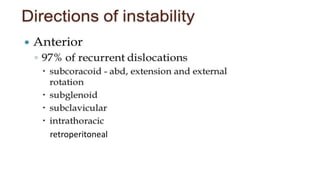
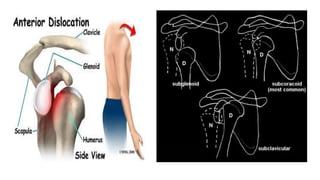
retroperitoneal
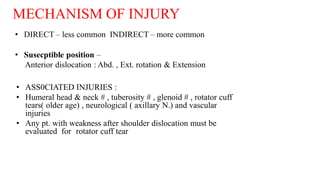
MECHANISM OF INJURY
• ASS0CIATED INJURIES :
• Humeral head & neck # , tuberosity # , glenoid # , rotator cuff
tears( older age) , neurological ( axillary N.) and vascular
injuries
• Any pt. with weakness after shoulder dislocation must be
evaluated for rotator cuff tear
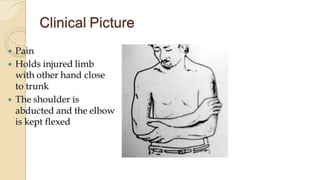
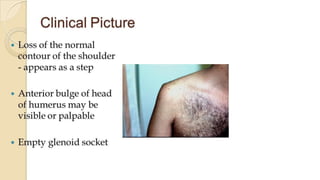
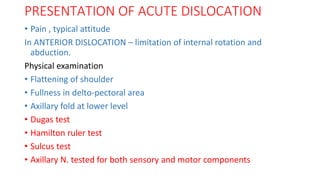
PRESENTATION OF ACUTE DISLOCATION
• Pain , typical attitude
In ANTERIOR DISLOCATION – limitation of internal rotation and
abduction.
Physical examination
• Flattening of shoulder
• Fullness in delto-pectoral area
• Axillary fold at lower level
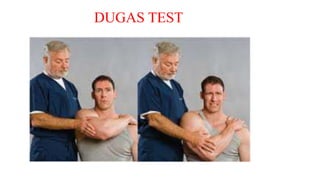
• Dugas test
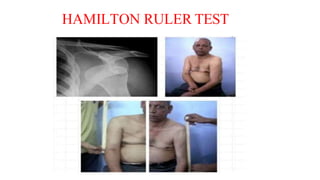
• Hamilton ruler test
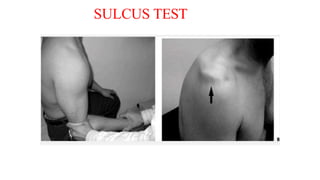
• Sulcus test
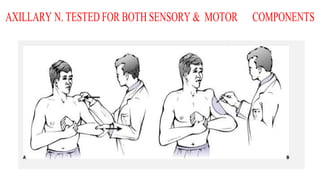
• Axillary N. tested for both sensory and motor components
DUGAS TEST
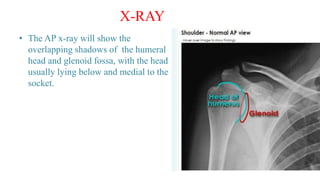
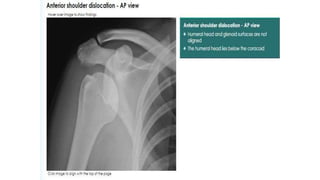
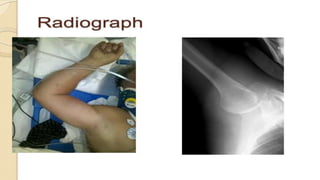
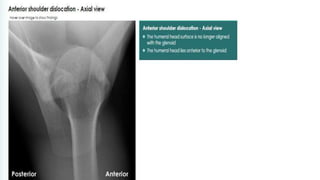
• The AP x-ray will show the
overlapping shadows of the humeral
head and glenoid fossa, with the head
usually lying below and medial to the
socket.
X-RAY
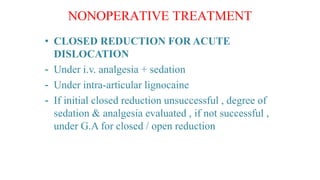
• CLOSED REDUCTION FOR ACUTE
DISLOCATION
- Under i.v. analgesia + sedation
- Under intra-articular lignocaine
- If initial closed reduction unsuccessful , degree of
sedation & analgesia evaluated , if not successful ,
under G.A for closed / open reduction
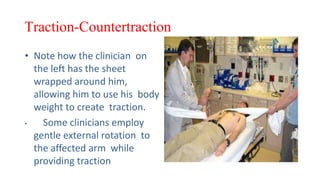
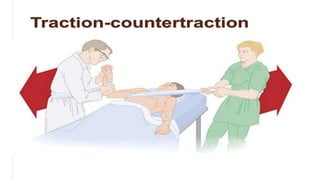
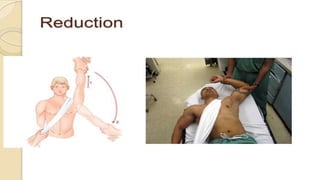
Traction-Countertraction
• Note how the clinician on
the left has the sheet
wrapped around him,
allowing him to use his body
weight to create traction.
• Some clinicians employ
gentle external rotation to
the affected arm while
providing traction
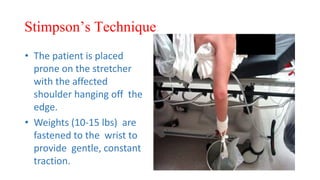
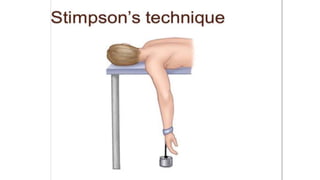
Stimpson’s Technique
• The patient is placed
prone on the stretcher
with the affected
shoulder hanging off the
edge.
• Weights (10-15 lbs) are
fastened to the wrist to
provide gentle, constant
traction.
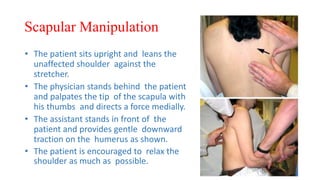
Scapular Manipulation
• The patient sits upright and leans the
unaffected shoulder against the
stretcher.
• The physician stands behind the patient
and palpates the tip of the scapula with
his thumbs and directs a force medially.
• The assistant stands in front of the
patient and provides gentle downward
traction on the humerus as shown.
• The patient is encouraged to relax the
shoulder as much as possible.
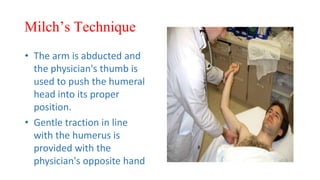
Milch’s Technique
• The arm is abducted and
the physician's thumb is
used to push the humeral
head into its proper
position.
• Gentle traction in line
with the humerus is
provided with the
physician's opposite hand
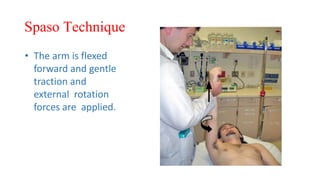
Spaso Technique
• The arm is flexed
forward and gentle
traction and
external rotation
forces are applied.
• The arm is rested in a sling for about three weeks in those
under 30 years of age (who are most prone to recurrence)
and for only a week in those over 30 (who are most prone to
stiffness).
• Then movements are begun, but combined abduction and
lateral rotation must be avoided for at least 3 weeks.
• Throughout this period, elbow and finger movements are
practised every day.
OPERATIVE TREATMENT
• SURGICAL STABILISATION FOR ANT .
INSTABILITY
In – Failed appropriate nonoperative treatment
- Recurrent dislocation at young age
- Irreducible dislocation
- Open dislocation
- Unstable joint reduction
- 1st dislocation in young pt with high demand activity
• SURGICAL OPTIONS
- Arthroscopic surgery
- Open tech. with soft tissue repair
- Open tech. with bony augmentation
OPEN PROCEDURES
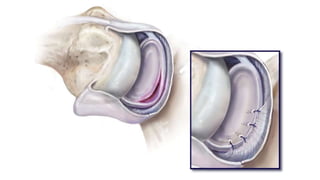
BANKART OPERATION WITH CAPSULAR SHIFT
- MC performed surgery
- Ant. Labral defect identified , mobilized & reattached to
original anatomic site with suture anchor .
- Capsular reconstruction also recommended
- Subscapularis tendon is split at junction of upper 2/3rd &
lower 2/3rd
BANKART OPERATION alone 67% recurrence rate.
• Remplissage (French-”to fill in”) procedure done for Hill sachs lesion
which involves >30% of articular surface.
• Infraspinatous tendon inserted into Hill sachs lesion.
• [Bankart surgery + Remplissage]- 10% recurrence rate.
• complications
• Excessive tightening of ant. Capsule and subscapularis can restrict ext. rotations
and functions and may cause degenerative joint disease known as
capsulorrhaphy arthropathy.
BRISTOW HELFET OPERATION
- Suturing of coracoid process with the conjoint tendon to the ant.
Portion of scapular neck through a transversely sectioned
subscapularis Muscle.
- The transferred short head of biceps & corachobrachialis –
strong buttress across the anterior & inferior aspects of joint
- Tendon also holds the lower half of subscapularis Muscle. Thus
prevents slipping over the humeral head when abducted.
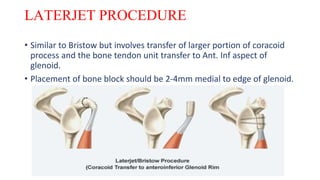
LATERJET PROCEDURE
• Similar to Bristow but involves transfer of larger portion of coracoid
process and the bone tendon unit transfer to Ant. Inf aspect of
glenoid.
• Placement of bone block should be 2-4mm medial to edge of glenoid.
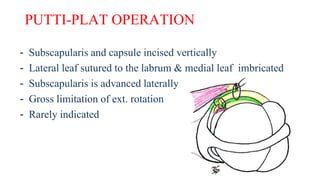
PUTTI-PLAT OPERATION
- Subscapularis and capsule incised vertically
- Lateral leaf sutured to the labrum & medial leaf imbricated
- Subscapularis is advanced laterally
- Gross limitation of ext. rotation
- Rarely indicated
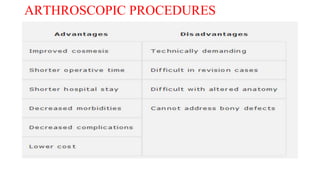
ARTHROSCOPIC PROCEDURES
HEMIARTHROPLASTY
• Indications
– Chronic dislocation > 6 months old
– Severe humeral head arthritis
– Collapse of humeral head during reduction
– Reverse Hill-Sachs defect > 50% of articular surface
TOTAL SHOULDER
ARTHROPLASTY
• Indications
– Significant glenoid arthritis in addition to one of the
hemiarthroplasty indications
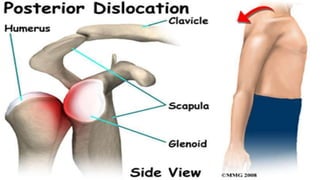
POSTERIOR DISLOCATION OF THE SHOULDER
• Posterior dislocation is rare, accounting for less than 2% of
all dislocations around the shoulder.
CLINICAL FEATURES
• The diagnosis is frequently missed – partly because reliance is
placed on a single AP x-ray (which may look almost normal) and
partly because those attending to the patient fail to think of it.
• There are, in fact, several well-marked clinical features.
• The arm is held in Internal Rotation and is locked in that position.
• The front of the shoulder looks flat with a prominent coracoid, but
swelling may obscure this deformity; seen from above, however, the
XRAY
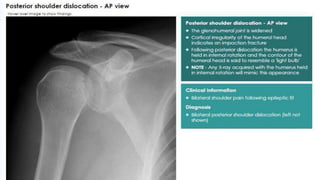
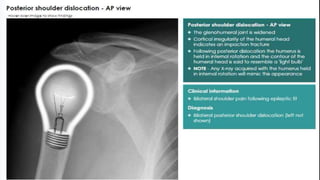
• In the AP film the humeral head, because it is medially
rotated, looks abnormal in shape (like an electric light bulb)
and it stands away somewhat from the glenoid fossa (the
‘empty glenoid’ sign).
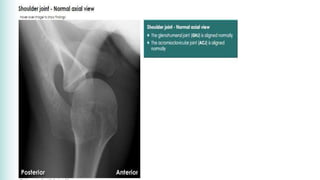
• An Axillary view is essential; it shows posterior subluxation
or dislocation and sometimes a deep indentation on the
anterior aspect of the humeral head.
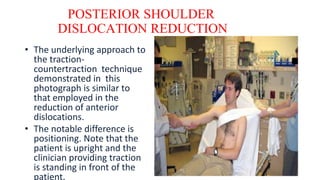
POSTERIOR SHOULDER
DISLOCATION REDUCTION
• The underlying approach to
the traction-
countertraction technique
demonstrated in this
photograph is similar to
that employed in the
reduction of anterior
dislocations.
• The notable difference is
positioning. Note that the
patient is upright and the
clinician providing traction
is standing in front of the
patient.
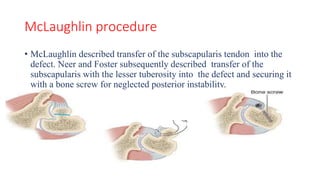
McLaughlin procedure
• McLaughlin described transfer of the subscapularis tendon into the
defect. Neer and Foster subsequently described transfer of the
subscapularis with the lesser tuberosity into the defect and securing it
with a bone screw for neglected posterior instability.
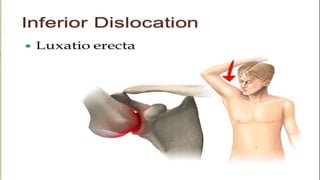
INFERIOR DISLOCATION OF THE SHOULDER
(LUXATIO ERECTA)
• Inferior dislocation is rare but it demands early recognition because
the consequences are potentially very serious.
• Dislocation occurs with the arm in nearly full abduction/elevation.
• The humeral head is levered out of its socket and pokes into the
axilla; the arm remains fixed in abduction.
• Always examine for neurovascular damage
MECHANISM OF INJURY AND
PATHOLOGY
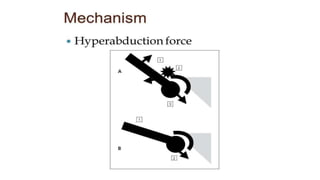
• The injury is caused by a severe hyper-abduction force.
• With the humerus as the lever and the acromion as the fulcrum,
the humeral head is lifted across the inferior rim of the glenoid
socket; it remains in the subglenoid position, with the humeral
shaft pointing upwards.
• Soft-tissue injury may be severe and includes avulsion of the
capsule and surrounding tendons, rupture of muscles, fractures
of the glenoid or proximal humerus and damage to the brachial
plexus and axillary artery.
RECURRENT SHOULDER DISLOCATION
Factors that influence the probability of recurrent
dislocations are –
• Age,
• Return to contact or collision sports,
• Hyper laxity, and
• The presence of a significant bony defect in the glenoid or
humeral head
The duration of immobilization also does not seem to affect
stability
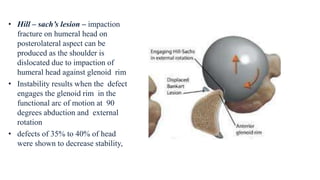
• Hill – sach’s lesion – impaction
fracture on humeral head on
posterolateral aspect can be
produced as the shoulder is
dislocated due to impaction of
humeral head against glenoid rim
• Instability results when the defect
engages the glenoid rim in the
functional arc of motion at 90
degrees abduction and external
rotation
• defects of 35% to 40% of head
were shown to decrease stability,
• Capsular laxity - Excessive laxity can be caused by a congenital
collagen deficiency, shown by hyper laxity of other joints, or by plastic
deformation of the capsuloligamentous complex from a single macro
traumatic event or repetitive micro traumatic events.
• Patient with recurrent subluxation describes a sudden catch, followed by
sudden inability to move the arm with a “Numb” feeling( Transient stretch
of Axillary nerve during a hard throw) so called “Dead arm syndrome”
Hyperlaxity has been implicated as a cause of failure in surgical
correction of chronic shoulder instability
An arthroscopic study of anterior shoulder dislocations found that 38% of
the acute injuries were intrasubstance ligamentous failures, and 62%
were disruptions of the capsuloligamentous insertion into the glenoid
neck
The “circle concept” of structural damage to the capsular structures was
suggested by cadaver studies that showed that humeral dislocation does not
occur unless the posterior capsular structures are disrupted in addition to
the anterior capsular structures. Posterior capsulolabral changes associated
with recurrent anterior instability often are identified by arthroscopy.
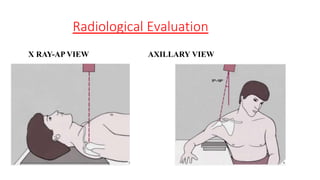
Radiological Evaluation
X RAY-AP VIEW AXILLARY VIEW
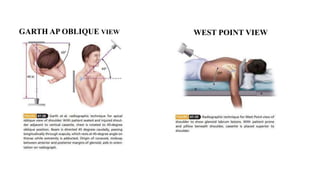
GARTH AP OBLIQUE VIEW WEST POINT VIEW
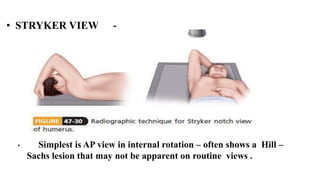
• STRYKER VIEW -
• Simplest is AP view in internal rotation – often shows a Hill –
Sachs lesion that may not be apparent on routine views .
• Standard double-contrast arthrography – helpful if excessive capsular
capacity with an enlarged axillary pouch is noted .
• CT with 3D reconstruction – effectively shows bony lesions such as Hill-
Sachs lesions , glenoid rim #s , glenoid version , some soft tissue
abnormalities .
• Double-contrast CT arthrography – especially useful in patients without
clear cut clinical signs of subluxation or dislocation , also showing soft tissue
and labral defects .
• Gadolinium-enhanced MRI – best minimally invasive view of capsular or
labral damage , detecting humeral avulsion of gleno humeral ligament
(HAGL) lesions , which require repair .
• Examination using anesthetic and arthroscopy – support the
clinical diagnosis or sometimes show unsuspected planes of
instability , especially in multidirectional instability patterns .
• The most significant findings of instability are demonstrable at
40 degrees and 80 degrees of external rotation .
MULTIDIRECTIONAL SHOULDER
INSTABILITY
Also referred to as AMBRI-
•TREATMENT- Non operative and operative
NON OPERATIVE
• Dynamic stabilization physical therapy
– Indications
• First line of treatment
• Vast majority of patients
– Technique
• 3-6 month regimen needed
• Strengthening of dynamic stabilizers (rotator cuff and periscapular
musculature)
• Closed kinetic chain exercises are used early in the rehabilitation process
to safely stimulate co-contraction of the scapular and rotator cuff muscles
OPERATIVE
• CAPSULAR SHIFT / STABILIZATION PROCEDURE
(OPEN OR ARTHROSCOPIC)
– Indications
• Failure of extensive nonoperative management
• Pain and instability that interferes with ADLs of sports activities
– Contraindications
• Voluntary dislocators
• CAPSULAR RECONSTRUCTION (ALLOGRAFT)
– Rare, described in refractory cases and patients with collagen
disorders
Thank you
7/9/19

Shoulder joint instability

  • 1.
  • 2.
    • Most mobilejoint in the body • Synovial joint….. Ball and socket joint • Articular surfaces- head of the humerus + glenoid cavity both covered by hyaline cartilage. • Size of head of humerus is 3-4 times larger than the glenoid cavity. [ glenoid labrum (lip) covers excess part of the head ]- fibrocartilaginous rim Labrum Increases humeral contact to 75% • Adv- increased shoulder ROM • Disadv – stability of the joint decreases.
  • 3.
    Capsule • Loose andredundant at most positions • At extremes – tightens , provides stability. • Caspsule of shoulder joint attached- medially to glenoid labrum - laterally to anatomical neck and extended little further down medially to shaft humerus for a short distance. • Has two layers – 1. synovial layer (inner) 2. fibrous layer (outer)
  • 4.
    Glenohumeral ligaments. • SuperiorGHL - runs from anterosuperior labrum to the humerus function- resists anterior translation of adducted arm • Middle GHL – runs from anterosuperior glenoid arising just inferior to S.GHL to anterior aspect of the anatomical neck function- resists anterior and posterior translation in the mid range of arm abduction at 45° and external rotation • Inferior GHL – runs from inferior ⅔ of glenoid cavity to lateral humerus anterior band function – primary stabilizer that limits antero-inferior translation of arm in 90° abduction and external rotation  anterior band forms weak line that predispose to bankart lesion. posterior band function – resists posterior translation in adduction and
  • 8.
    Comma sign • InS.GHL • The superolateral margin of the subcapsularis is identified by the comma sign during arthroscopic sugery. • Comma sign – fibres are oriented perpendicular to the fibres of the subscapularis tendon. • It consists of coracohumeral ligaments, the superioe GHL, the medial sling of biceps tendon • These make one structure that makes the superior interval of the lateral subscapularis tendon
  • 10.
    Buford complex • InM.GHL • Originates directly from the superior labrum at the base of biceps tendon • Normal anatomical variant • A cord like MGHL and absent superior labrum (1-3 ‘o clock position) • Looks like SLAP tear but its not a SLAP tear.
  • 11.
  • 13.
    Bankart lesion • InI.GHL (ANTERIOR BAND) • Mc lesion of anterior shoulder instability following anterior shoulder dislocation. • It involves avulsion of anterior inferior labrum • Typically located at 3-6’ o clock position (IGHL , ANTERIOR BAND LOCATES), where the humeral head dislocates. • Lesion can be bony / fibrous.
  • 15.
    ALPSA LESION • Labralligament complex is displaced medially and shifted inferiorly. • A – Anterior • L – labral • P – periosteal • S – sleeve • A – avulsion • The labrum is displaced by the I.GHL and the labrum is rolled up like a sleeve with an intact anterior scapular periosteum.
  • 17.
    GLAD LESION • Tearof anteroinferior labrum ( non displaced) with avulsion of adjacent glenoid cartilage , no capsular stripping. • G – glenoid • L – labral • A – avulsion • D – defect • The lesion results from impaction of humeral head against the glenoid. This is caused by abduction and external rotation injury.
  • 19.
    HAGL LESION • Theposition of the I.GHL , which is the most important and strongest ligament , limits anterior / inferior subluxation of the humeral head. • Humeral avulsion of glenohumeral ligament may occur due to shoulder dislocation. • The inferior GHL avulses from the inferior humeral neck • Usually occurs due to the anterior shoulder dislocation (hyperabduction + external rotation) • Looks like the capsule and ligament avulsed from the inferior humeral neck and ripped off.
  • 21.
    INTERNAL IMPINGEMENT • I.GHL( Posterior band ) • Anterior instability leads to antero-superior humeral head migration. • Greater tuberosity forces the rotator cuff (supra spinatous) against the posterior-superior glenoid rim
  • 22.
    SLAP (SUPERIOR LABRUMANTERIOR & POSTERIOR) LESION • Injury to Superior Glenoid labrum with tear of Biceps long head tendon.
  • 23.
    SLAC (SUPERIOR LABRUMANTERIOR CUFF) LESION • Injury to superior labrum with anterior supraspinatous exhibits a partial / complete tear resulting from instability.
  • 24.
    MATSEN’S SIMPLIFIED CLASSIFICATION SYSTEM 1- TUBS (Traumatic Unidirectional Bankart Surgery ) 1 - AMBRII (Atraumatic, Multidirectional, Bilateral, Rehabilitation, Inferior capsular shift, and Internal closure) •Micro traumatic or developmental lesions fall between the extremes of macro traumatic and atraumatic lesions and can overlap these extreme lesions .
  • 25.
    FEDS (FREQUENCY, ETIOLOGY,DIRECTION, SEVERITY) CLASSIFICATION. • FREQUENCY – Solitary ( 1 episode) - frequent ( 2-5 episodes ) - recurrent ( >5 episodes) • Etiology - Traumatic - Atraumatic • Direction – Anterior - Inferior - Posterior • Severity – Subluxation ( reduced without help) - Dislocation (help needed to reduce)
  • 26.
    • Due toexcessive glenohumeral (GH) translation and instability to maintain the functional relationship with applied physiological loads • Amount of translation can range from – dislocation (spont relocation doesnot occur) - subluxation (spont relocation usually occurs) - apprehension (fear that the shoulder will subluxate/ dislocate but may not necessarily so) - laxity ( physiologic motion of GH joint that allows a normal ROM )
  • 28.
  • 30.
    MECHANISM OF INJURY •ASS0CIATED INJURIES : • Humeral head & neck # , tuberosity # , glenoid # , rotator cuff tears( older age) , neurological ( axillary N.) and vascular injuries • Any pt. with weakness after shoulder dislocation must be evaluated for rotator cuff tear
  • 33.
    PRESENTATION OF ACUTEDISLOCATION • Pain , typical attitude In ANTERIOR DISLOCATION – limitation of internal rotation and abduction. Physical examination • Flattening of shoulder • Fullness in delto-pectoral area • Axillary fold at lower level • Dugas test • Hamilton ruler test • Sulcus test • Axillary N. tested for both sensory and motor components
  • 34.
  • 38.
    • The APx-ray will show the overlapping shadows of the humeral head and glenoid fossa, with the head usually lying below and medial to the socket. X-RAY
  • 44.
    • CLOSED REDUCTIONFOR ACUTE DISLOCATION - Under i.v. analgesia + sedation - Under intra-articular lignocaine - If initial closed reduction unsuccessful , degree of sedation & analgesia evaluated , if not successful , under G.A for closed / open reduction
  • 45.
    Traction-Countertraction • Note howthe clinician on the left has the sheet wrapped around him, allowing him to use his body weight to create traction. • Some clinicians employ gentle external rotation to the affected arm while providing traction
  • 48.
    Stimpson’s Technique • Thepatient is placed prone on the stretcher with the affected shoulder hanging off the edge. • Weights (10-15 lbs) are fastened to the wrist to provide gentle, constant traction.
  • 51.
    Scapular Manipulation • Thepatient sits upright and leans the unaffected shoulder against the stretcher. • The physician stands behind the patient and palpates the tip of the scapula with his thumbs and directs a force medially. • The assistant stands in front of the patient and provides gentle downward traction on the humerus as shown. • The patient is encouraged to relax the shoulder as much as possible.
  • 52.
    Milch’s Technique • Thearm is abducted and the physician's thumb is used to push the humeral head into its proper position. • Gentle traction in line with the humerus is provided with the physician's opposite hand
  • 53.
    Spaso Technique • Thearm is flexed forward and gentle traction and external rotation forces are applied.
  • 54.
    • The armis rested in a sling for about three weeks in those under 30 years of age (who are most prone to recurrence) and for only a week in those over 30 (who are most prone to stiffness). • Then movements are begun, but combined abduction and lateral rotation must be avoided for at least 3 weeks. • Throughout this period, elbow and finger movements are practised every day.
  • 55.
    OPERATIVE TREATMENT • SURGICALSTABILISATION FOR ANT . INSTABILITY In – Failed appropriate nonoperative treatment - Recurrent dislocation at young age - Irreducible dislocation - Open dislocation - Unstable joint reduction - 1st dislocation in young pt with high demand activity • SURGICAL OPTIONS - Arthroscopic surgery - Open tech. with soft tissue repair - Open tech. with bony augmentation
  • 56.
    OPEN PROCEDURES BANKART OPERATIONWITH CAPSULAR SHIFT - MC performed surgery - Ant. Labral defect identified , mobilized & reattached to original anatomic site with suture anchor . - Capsular reconstruction also recommended - Subscapularis tendon is split at junction of upper 2/3rd & lower 2/3rd
  • 57.
    BANKART OPERATION alone67% recurrence rate. • Remplissage (French-”to fill in”) procedure done for Hill sachs lesion which involves >30% of articular surface. • Infraspinatous tendon inserted into Hill sachs lesion. • [Bankart surgery + Remplissage]- 10% recurrence rate. • complications • Excessive tightening of ant. Capsule and subscapularis can restrict ext. rotations and functions and may cause degenerative joint disease known as capsulorrhaphy arthropathy.
  • 59.
    BRISTOW HELFET OPERATION -Suturing of coracoid process with the conjoint tendon to the ant. Portion of scapular neck through a transversely sectioned subscapularis Muscle. - The transferred short head of biceps & corachobrachialis – strong buttress across the anterior & inferior aspects of joint - Tendon also holds the lower half of subscapularis Muscle. Thus prevents slipping over the humeral head when abducted.
  • 60.
    LATERJET PROCEDURE • Similarto Bristow but involves transfer of larger portion of coracoid process and the bone tendon unit transfer to Ant. Inf aspect of glenoid. • Placement of bone block should be 2-4mm medial to edge of glenoid.
  • 61.
    PUTTI-PLAT OPERATION - Subscapularisand capsule incised vertically - Lateral leaf sutured to the labrum & medial leaf imbricated - Subscapularis is advanced laterally - Gross limitation of ext. rotation - Rarely indicated
  • 62.
  • 63.
    HEMIARTHROPLASTY • Indications – Chronicdislocation > 6 months old – Severe humeral head arthritis – Collapse of humeral head during reduction – Reverse Hill-Sachs defect > 50% of articular surface TOTAL SHOULDER ARTHROPLASTY • Indications – Significant glenoid arthritis in addition to one of the hemiarthroplasty indications
  • 64.
    POSTERIOR DISLOCATION OFTHE SHOULDER • Posterior dislocation is rare, accounting for less than 2% of all dislocations around the shoulder.
  • 66.
    CLINICAL FEATURES • Thediagnosis is frequently missed – partly because reliance is placed on a single AP x-ray (which may look almost normal) and partly because those attending to the patient fail to think of it. • There are, in fact, several well-marked clinical features. • The arm is held in Internal Rotation and is locked in that position. • The front of the shoulder looks flat with a prominent coracoid, but swelling may obscure this deformity; seen from above, however, the
  • 68.
    XRAY • In theAP film the humeral head, because it is medially rotated, looks abnormal in shape (like an electric light bulb) and it stands away somewhat from the glenoid fossa (the ‘empty glenoid’ sign). • An Axillary view is essential; it shows posterior subluxation or dislocation and sometimes a deep indentation on the anterior aspect of the humeral head.
  • 71.
    POSTERIOR SHOULDER DISLOCATION REDUCTION •The underlying approach to the traction- countertraction technique demonstrated in this photograph is similar to that employed in the reduction of anterior dislocations. • The notable difference is positioning. Note that the patient is upright and the clinician providing traction is standing in front of the patient.
  • 72.
    McLaughlin procedure • McLaughlindescribed transfer of the subscapularis tendon into the defect. Neer and Foster subsequently described transfer of the subscapularis with the lesser tuberosity into the defect and securing it with a bone screw for neglected posterior instability.
  • 73.
    INFERIOR DISLOCATION OFTHE SHOULDER (LUXATIO ERECTA) • Inferior dislocation is rare but it demands early recognition because the consequences are potentially very serious. • Dislocation occurs with the arm in nearly full abduction/elevation. • The humeral head is levered out of its socket and pokes into the axilla; the arm remains fixed in abduction. • Always examine for neurovascular damage
  • 75.
    MECHANISM OF INJURYAND PATHOLOGY • The injury is caused by a severe hyper-abduction force. • With the humerus as the lever and the acromion as the fulcrum, the humeral head is lifted across the inferior rim of the glenoid socket; it remains in the subglenoid position, with the humeral shaft pointing upwards. • Soft-tissue injury may be severe and includes avulsion of the capsule and surrounding tendons, rupture of muscles, fractures of the glenoid or proximal humerus and damage to the brachial plexus and axillary artery.
  • 79.
    RECURRENT SHOULDER DISLOCATION Factorsthat influence the probability of recurrent dislocations are – • Age, • Return to contact or collision sports, • Hyper laxity, and • The presence of a significant bony defect in the glenoid or humeral head The duration of immobilization also does not seem to affect stability
  • 80.
    • Hill –sach’s lesion – impaction fracture on humeral head on posterolateral aspect can be produced as the shoulder is dislocated due to impaction of humeral head against glenoid rim • Instability results when the defect engages the glenoid rim in the functional arc of motion at 90 degrees abduction and external rotation • defects of 35% to 40% of head were shown to decrease stability,
  • 81.
    • Capsular laxity- Excessive laxity can be caused by a congenital collagen deficiency, shown by hyper laxity of other joints, or by plastic deformation of the capsuloligamentous complex from a single macro traumatic event or repetitive micro traumatic events. • Patient with recurrent subluxation describes a sudden catch, followed by sudden inability to move the arm with a “Numb” feeling( Transient stretch of Axillary nerve during a hard throw) so called “Dead arm syndrome” Hyperlaxity has been implicated as a cause of failure in surgical correction of chronic shoulder instability
  • 82.
    An arthroscopic studyof anterior shoulder dislocations found that 38% of the acute injuries were intrasubstance ligamentous failures, and 62% were disruptions of the capsuloligamentous insertion into the glenoid neck The “circle concept” of structural damage to the capsular structures was suggested by cadaver studies that showed that humeral dislocation does not occur unless the posterior capsular structures are disrupted in addition to the anterior capsular structures. Posterior capsulolabral changes associated with recurrent anterior instability often are identified by arthroscopy.
  • 83.
  • 84.
    GARTH AP OBLIQUEVIEW WEST POINT VIEW
  • 85.
    • STRYKER VIEW- • Simplest is AP view in internal rotation – often shows a Hill – Sachs lesion that may not be apparent on routine views .
  • 86.
    • Standard double-contrastarthrography – helpful if excessive capsular capacity with an enlarged axillary pouch is noted . • CT with 3D reconstruction – effectively shows bony lesions such as Hill- Sachs lesions , glenoid rim #s , glenoid version , some soft tissue abnormalities . • Double-contrast CT arthrography – especially useful in patients without clear cut clinical signs of subluxation or dislocation , also showing soft tissue and labral defects . • Gadolinium-enhanced MRI – best minimally invasive view of capsular or labral damage , detecting humeral avulsion of gleno humeral ligament (HAGL) lesions , which require repair .
  • 87.
    • Examination usinganesthetic and arthroscopy – support the clinical diagnosis or sometimes show unsuspected planes of instability , especially in multidirectional instability patterns . • The most significant findings of instability are demonstrable at 40 degrees and 80 degrees of external rotation .
  • 88.
    MULTIDIRECTIONAL SHOULDER INSTABILITY Also referredto as AMBRI- •TREATMENT- Non operative and operative
  • 89.
    NON OPERATIVE • Dynamicstabilization physical therapy – Indications • First line of treatment • Vast majority of patients – Technique • 3-6 month regimen needed • Strengthening of dynamic stabilizers (rotator cuff and periscapular musculature) • Closed kinetic chain exercises are used early in the rehabilitation process to safely stimulate co-contraction of the scapular and rotator cuff muscles
  • 90.
    OPERATIVE • CAPSULAR SHIFT/ STABILIZATION PROCEDURE (OPEN OR ARTHROSCOPIC) – Indications • Failure of extensive nonoperative management • Pain and instability that interferes with ADLs of sports activities – Contraindications • Voluntary dislocators • CAPSULAR RECONSTRUCTION (ALLOGRAFT) – Rare, described in refractory cases and patients with collagen disorders
  • 91.