Dr. Mohammad Amiri , OD
Department of Optometry ,Faculty of
Rehabilitation
Shahid Beheshti Medical Sceince University
Vision Care of Menicon
Keratoconus
And specialty contact lens fitting of irregular
corneas
Keratoconus
• Is a progressive disorder in which the cornea has irregular
  shape
• Onset: around puberty
• Autosomal dominant
• Usually bilateral; but assymetrical
• Systemic association: e.g. Down syndrome; Turner syndrome;
  Marfan syndrome
• Ocular association: e.g. retinitis pigmentosa; vernal
  keratoconjunctivitis;
• According to
  morphology can be
  classified into
• Nipple cones: small size
  5mm; steep curvature;
  the apex of the cone is
  central or infero-nasally
• Oval cones: 5-6mm size;
  ellipsoid (oval) &
  displaced
  inferotemporally
• Globus cones: the
  largest >6mm
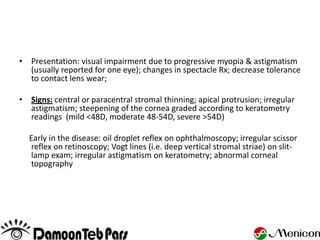
• Presentation: visual impairment due to progressive myopia & astigmatism
  (usually reported for one eye); changes in spectacle Rx; decrease tolerance
  to contact lens wear;

• Signs: central or paracentral stromal thinning; apical protrusion; irregular
  astigmatism; steepening of the cornea graded according to keratometry
  readings (mild <48D, moderate 48-54D, severe >54D)

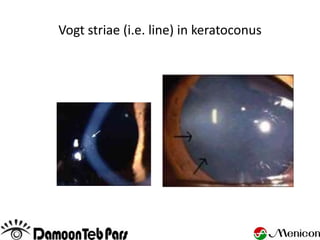
  Early in the disease: oil droplet reflex on ophthalmoscopy; irregular scissor
  reflex on retinoscopy; Vogt lines (i.e. deep vertical stromal striae) on slit-
  lamp exam; irregular astigmatism on keratometry; abnormal corneal
  topography
Vogt striae (i.e. line) in keratoconus
Munson sign in keratoconus
Late in the disease:
  Munson sign (i.e.
  bulging of the lower lid
  on downgaze); visual
  acuity worsens;
  watering; oedema;
  stromal scarring after
  beaks healing;
Keratoconus
• What have the years taught us?
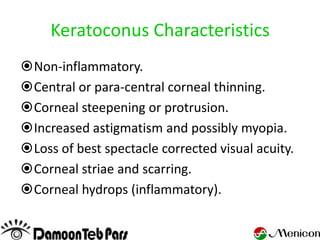
Keratoconus Characteristics
Non-inflammatory.
Central or para-central corneal thinning.
Corneal steepening or protrusion.
Increased astigmatism and possibly myopia.
Loss of best spectacle corrected visual acuity.
Corneal striae and scarring.
Corneal hydrops (inflammatory).
Keratoconus

• Non-Inflammatory Ectasia
   •   Stromal Thinning
   •   Disruption of Bowman’s
       Membrane

• Corneal Ectasia
   •   Myopia
   •   Irregular Astigmatism

• Optical Correction
   •   Spectacles– early
   •   Contact Lenses– later
Keratoconus

• Demographics
  •   Estimates vary from 50 to 170
      per 100,000


• Obscure Etiology
  •   Heredity
  •   Allergies, Eye Rubbing
Why Does the Cornea Bulge in
             Keratoconus?
• Corneal tissue is
  abnormal
   •   Too elastic?
   •   Abnormal cross-linking of
       collagen?

• Loss of structural
  integrity of Bowman’s
  Layer?

• Keratocyte apoptosis
   •   Trauma (eye rubbing)

• Corneal tissue bulges
  because it is too thin?
Pathology of Keratoconus

 Loss of Bowman’s Layer.

 Stromal Thinning.

 Apoptosis.

 Increased Enzyme Activity.

 Enlarged Prominent Corneal Nerves.
Causes of Keratoconus

• Heredity vs. Mechanical

• Cellular

• Tissue

• Genetic
Cellular Changes
• Keratoconus cells are hypersensative.
• Increased enzyme activity, lack of enzyme
  inhibitors.
• Matrix substrate instability in response to
  environmental stress factors.
• mtDNA damage and exaggerated oxidative
  response causing cellular damage.
Tissue Changes

 Loss of Bowman’s layer.

 Lamellar slippage.

 Lack “anchoring” lamellar fibrils.

 Apoptosis of the stroma causing anterior

  thinning.
Heredity vs. Mechanical
• Does eye rubbing cause Keratoconus?
• 2 out of 250 doctors feel that rubbing is a
  cause.
• KC patients do rub their eyes more often than
  those without KC.
• What is it that makes KC patients rub their
  eyes?
Genetics
• Autosomal dominant w/variable penetrance.
• SOD1, an antioxidant enzyme, is abnormal in
  some KC corneas.
• No single gene responsible.
• 10 different chromosomes have been
  associated with KC.
• Most likely multiple genes involved.
Additional Information
Male to Female Ratio = 3:1
Approximately 20% result in PKP.
90% are diagnosed by optometrists.
Mean age of diagnosis is 22.88 years.
Visual outcome with RGP is better than PKP.
More prevalent in certain ethnic groups (4x
 higher in Asians from Indian sub-continent
 regions than White Europeans).
Progression and Prognosis
Age is a big factor.
The younger the diagnosis, the poorer the
 prognosis.
Less likely to progress to the point of a
 transplant if diagnosed in the 30’s.
20% of Keratoconus patients result in corneal
 transplants.
35 to 45% of all transplants are due to
 Keratoconus.
Possible Aggravating Factors

• UV exposure.

• Allergies.

• Vigorous eye rubbing.

• Poorly fitting contact lenses.

• Inflammation.
Types of Keratoconus
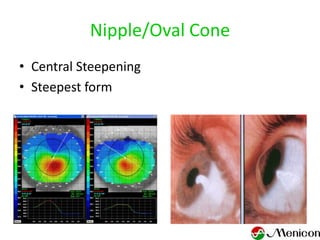
• Nipple/Oval cone - central or mildly para-
  central localized thinning and steepening.
• Keratoglobus - Large generalized thinning and
  steepening.
• PMD (pellucid marginal degeneration) –
  peripheral thinning and steepening.
• Keratoconus Fruste – Less progressive and less
  manipulative.
Nipple/Oval Cone
• Central Steepening
• Steepest form
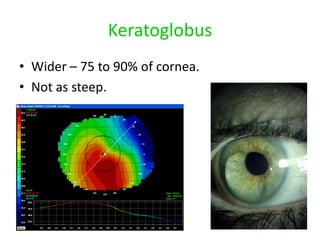
Keratoglobus
• Wider – 75 to 90% of cornea.
• Not as steep.
Pellucid Marginal Degeneration
• Peripheral Thinning
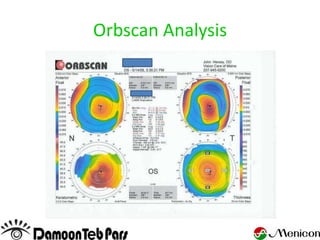
Orbscan Analysis
How to Treat Keratoconus
 Spectacles
 Contacts
     Soft Standard
     Soft Custom
     RGP Standard
     RGP Custom
     Hybrid
 Surgery
   Intacs
   Penetrating Keratoplasty
 Riboflavin/UV treatment
When to Intervene?
• Best Spectacle/Soft CL Acuity 20/30 or better?
  – Good tolerance of acuity.
  – Corneal health is not compromised.
  – “If it aint broke, don’t fix it.”
• Best Spectacle/Soft CL Acuity worse than
  20/30?
  – Specialized contact lenses.
  – My opinion, use RGP lenses.
Which RGP Design?
• Early Keratoconus
  – Standard RGP
  – KC RGP
• Mid-stage Keratoconus
  – KC RGP
  – Custom KC RGP
• Advanced Keratoconus
  – Custom KC RGP
  – Intra-limbal or Scleral RGP
My “GO TO” Lens – Rose K
• Developed by Dr. Paul Rose.
• Designed to fit the irregular cornea.
• “Very forgiving lens”
• Multiple designs to fit all shapes of corneas
  and corneal conditions.
• Blanchard is very good to work with and has
  staff to assist with very difficult cases.
Nipple/Oval Cone Fitting
•   Most common form of KC.
•   Early stages - simple RGP or KC RGP
•   Later stages – KC RGP usually small and steep.
•   The steeper the cone, the smaller the lens
    diameter.
Rose K2
• Rose K vs. Rose K2
• 72% of patients notice an increase in acuity
  with aspheric, aberration control.
• Lens to be centered on the cone.
• Reduce excessive movement (1 to 2mm).
Fitting the Rose K2
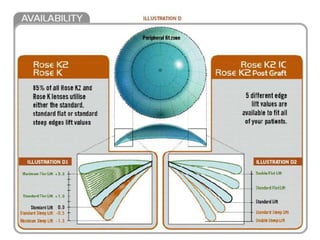
• Too high – tighten edge lift
  reduce OAD
  steepen base curve

• Too low – increase edge lift
  increase OAD
  flatten base curve
Fitting the Rose K2
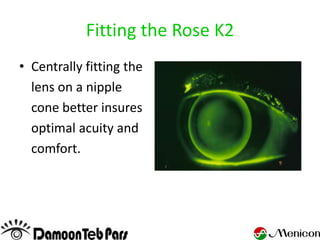
• Centrally fitting the
  lens on a nipple
  cone better insures
  optimal acuity and
  comfort.
Rose K2IC
•   IC stands for irregular cornea
•   Larger diameter
•   Larger optic zone
•   Aspheric for aberration control
•   Reverse geometry design
• PMD

• Keratoglobus

• LASIK induced ectasia

• Corneal transplants
Corneal Dystrophies

Traumatic Corneas with Scars

Post RK

Irregular Astigmatism or Corneal Warpage
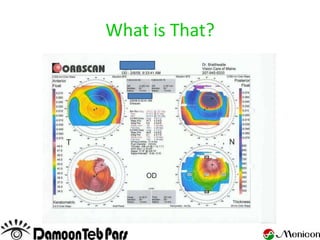
What is That?
Asymmetric Corneal Technology
• ACT.
ACT – Continued…
Fitting with ACT
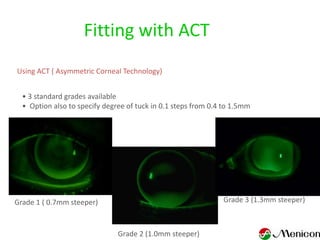
Using ACT ( Asymmetric Corneal Technology)


  • 3 standard grades available
  • Option also to specify degree of tuck in 0.1 steps from 0.4 to 1.5mm


Grade 1 ( 0.7mm steeper)                                       Grade 3 (1.3mm steeper)


                               Grade 2 (1.0mm steeper)
Fitting with ACT

ACT - Improved comfort , lens stability and vision

          NO ACT                    WITH ACT
Toric Peripheral Curves
Fitting Pearls
 Tendency to tighten after initial fitting.
 Light central touch will increase acuity.
 Avoid central staining.
 Movement is necessary but slight movement is
  usually sufficient.
 Pay attention to tear flow beneath lens.
 The steeper the lens, the smaller OAD and less
  movement.
 Don’t change too many parameters at once.
Penetrating Keratoplasty
                   When to refer?

 Acuity is 20/50 or worse.
 Patient intolerance to visual decrease.
 Scars within the visual axis.
 Multiple episodes of Hydrops.
 Contact lens intolerance.
 Unable to get adequate/healthy CL fit.
 Consider OD to OD referral.
 Give reasonable expectations.
Post PKP Management
• How soon can you fit with lens?
• Why are the curvatures so strange?
• Do you have to wait for all sutures to be
  removed?
• Corrective options.
  – Spectacles
  – RGP contact lenses.
  – LASIK
Rose K2 Post Graft
PKP Topography
Rose K2 Post Graft
 Much more difficult to fit than KC.
 Patients are less tolerable to CL.
 Eyes are more dry.
 Ill-fitting contact lenses can lead to graft
  rejection.
 Lens design is crucial to success.
K2PG Fitting Pearls
•   Don’t be intimidated!
•   Watch tear flow!
•   Also good lens for ectasia patients.
•   Stay with your fitting basics
    – Fit base curves.
    – Adjust diameter.
    – Adjust peripheral curves.
    – Use ACT or Toric PC if needed.
Post Graft – Too Steep
Post Graft – Too Flat
Post Graft – Good Fit
Watch Vasculature
The Difficult Ones

• Nothing is comfortable.

• Acuity isn’t improving..

• Eyes are too dry. (Sjogren’s Syndrome)

• Cornea is too irregular for any lens to fit
  properly or in a healthy manner.
What Do You Do?

Rosek2 part1

  • 3.
    Dr. Mohammad Amiri, OD Department of Optometry ,Faculty of Rehabilitation Shahid Beheshti Medical Sceince University Vision Care of Menicon Keratoconus And specialty contact lens fitting of irregular corneas
  • 4.
    Keratoconus • Is aprogressive disorder in which the cornea has irregular shape • Onset: around puberty • Autosomal dominant • Usually bilateral; but assymetrical • Systemic association: e.g. Down syndrome; Turner syndrome; Marfan syndrome • Ocular association: e.g. retinitis pigmentosa; vernal keratoconjunctivitis;
  • 5.
    • According to morphology can be classified into • Nipple cones: small size 5mm; steep curvature; the apex of the cone is central or infero-nasally
  • 6.
    • Oval cones:5-6mm size; ellipsoid (oval) & displaced inferotemporally
  • 7.
    • Globus cones:the largest >6mm
  • 8.
    • Presentation: visualimpairment due to progressive myopia & astigmatism (usually reported for one eye); changes in spectacle Rx; decrease tolerance to contact lens wear; • Signs: central or paracentral stromal thinning; apical protrusion; irregular astigmatism; steepening of the cornea graded according to keratometry readings (mild <48D, moderate 48-54D, severe >54D) Early in the disease: oil droplet reflex on ophthalmoscopy; irregular scissor reflex on retinoscopy; Vogt lines (i.e. deep vertical stromal striae) on slit- lamp exam; irregular astigmatism on keratometry; abnormal corneal topography
  • 9.
    Vogt striae (i.e.line) in keratoconus
  • 10.
    Munson sign inkeratoconus Late in the disease: Munson sign (i.e. bulging of the lower lid on downgaze); visual acuity worsens; watering; oedema; stromal scarring after beaks healing;
  • 11.
    Keratoconus • What havethe years taught us?
  • 12.
    Keratoconus Characteristics Non-inflammatory. Central orpara-central corneal thinning. Corneal steepening or protrusion. Increased astigmatism and possibly myopia. Loss of best spectacle corrected visual acuity. Corneal striae and scarring. Corneal hydrops (inflammatory).
  • 13.
    Keratoconus • Non-Inflammatory Ectasia • Stromal Thinning • Disruption of Bowman’s Membrane • Corneal Ectasia • Myopia • Irregular Astigmatism • Optical Correction • Spectacles– early • Contact Lenses– later
  • 14.
    Keratoconus • Demographics • Estimates vary from 50 to 170 per 100,000 • Obscure Etiology • Heredity • Allergies, Eye Rubbing
  • 15.
    Why Does theCornea Bulge in Keratoconus? • Corneal tissue is abnormal • Too elastic? • Abnormal cross-linking of collagen? • Loss of structural integrity of Bowman’s Layer? • Keratocyte apoptosis • Trauma (eye rubbing) • Corneal tissue bulges because it is too thin?
  • 16.
    Pathology of Keratoconus Loss of Bowman’s Layer.  Stromal Thinning.  Apoptosis.  Increased Enzyme Activity.  Enlarged Prominent Corneal Nerves.
  • 17.
    Causes of Keratoconus •Heredity vs. Mechanical • Cellular • Tissue • Genetic
  • 18.
    Cellular Changes • Keratoconuscells are hypersensative. • Increased enzyme activity, lack of enzyme inhibitors. • Matrix substrate instability in response to environmental stress factors. • mtDNA damage and exaggerated oxidative response causing cellular damage.
  • 19.
    Tissue Changes  Lossof Bowman’s layer.  Lamellar slippage.  Lack “anchoring” lamellar fibrils.  Apoptosis of the stroma causing anterior thinning.
  • 20.
    Heredity vs. Mechanical •Does eye rubbing cause Keratoconus? • 2 out of 250 doctors feel that rubbing is a cause. • KC patients do rub their eyes more often than those without KC. • What is it that makes KC patients rub their eyes?
  • 21.
    Genetics • Autosomal dominantw/variable penetrance. • SOD1, an antioxidant enzyme, is abnormal in some KC corneas. • No single gene responsible. • 10 different chromosomes have been associated with KC. • Most likely multiple genes involved.
  • 22.
    Additional Information Male toFemale Ratio = 3:1 Approximately 20% result in PKP. 90% are diagnosed by optometrists. Mean age of diagnosis is 22.88 years. Visual outcome with RGP is better than PKP. More prevalent in certain ethnic groups (4x higher in Asians from Indian sub-continent regions than White Europeans).
  • 23.
    Progression and Prognosis Ageis a big factor. The younger the diagnosis, the poorer the prognosis. Less likely to progress to the point of a transplant if diagnosed in the 30’s. 20% of Keratoconus patients result in corneal transplants. 35 to 45% of all transplants are due to Keratoconus.
  • 24.
    Possible Aggravating Factors •UV exposure. • Allergies. • Vigorous eye rubbing. • Poorly fitting contact lenses. • Inflammation.
  • 25.
    Types of Keratoconus •Nipple/Oval cone - central or mildly para- central localized thinning and steepening. • Keratoglobus - Large generalized thinning and steepening. • PMD (pellucid marginal degeneration) – peripheral thinning and steepening. • Keratoconus Fruste – Less progressive and less manipulative.
  • 26.
    Nipple/Oval Cone • CentralSteepening • Steepest form
  • 27.
    Keratoglobus • Wider –75 to 90% of cornea. • Not as steep.
  • 28.
  • 29.
  • 33.
    How to TreatKeratoconus  Spectacles  Contacts  Soft Standard  Soft Custom  RGP Standard  RGP Custom  Hybrid  Surgery  Intacs  Penetrating Keratoplasty  Riboflavin/UV treatment
  • 34.
    When to Intervene? •Best Spectacle/Soft CL Acuity 20/30 or better? – Good tolerance of acuity. – Corneal health is not compromised. – “If it aint broke, don’t fix it.” • Best Spectacle/Soft CL Acuity worse than 20/30? – Specialized contact lenses. – My opinion, use RGP lenses.
  • 35.
    Which RGP Design? •Early Keratoconus – Standard RGP – KC RGP • Mid-stage Keratoconus – KC RGP – Custom KC RGP • Advanced Keratoconus – Custom KC RGP – Intra-limbal or Scleral RGP
  • 36.
    My “GO TO”Lens – Rose K • Developed by Dr. Paul Rose. • Designed to fit the irregular cornea. • “Very forgiving lens” • Multiple designs to fit all shapes of corneas and corneal conditions. • Blanchard is very good to work with and has staff to assist with very difficult cases.
  • 37.
    Nipple/Oval Cone Fitting • Most common form of KC. • Early stages - simple RGP or KC RGP • Later stages – KC RGP usually small and steep. • The steeper the cone, the smaller the lens diameter.
  • 38.
    Rose K2 • RoseK vs. Rose K2 • 72% of patients notice an increase in acuity with aspheric, aberration control. • Lens to be centered on the cone. • Reduce excessive movement (1 to 2mm).
  • 39.
    Fitting the RoseK2 • Too high – tighten edge lift reduce OAD steepen base curve • Too low – increase edge lift increase OAD flatten base curve
  • 40.
    Fitting the RoseK2 • Centrally fitting the lens on a nipple cone better insures optimal acuity and comfort.
  • 41.
    Rose K2IC • IC stands for irregular cornea • Larger diameter • Larger optic zone • Aspheric for aberration control • Reverse geometry design
  • 42.
    • PMD • Keratoglobus •LASIK induced ectasia • Corneal transplants
  • 43.
    Corneal Dystrophies Traumatic Corneaswith Scars Post RK Irregular Astigmatism or Corneal Warpage
  • 44.
  • 46.
  • 47.
  • 48.
    Fitting with ACT UsingACT ( Asymmetric Corneal Technology) • 3 standard grades available • Option also to specify degree of tuck in 0.1 steps from 0.4 to 1.5mm Grade 1 ( 0.7mm steeper) Grade 3 (1.3mm steeper) Grade 2 (1.0mm steeper)
  • 49.
    Fitting with ACT ACT- Improved comfort , lens stability and vision NO ACT WITH ACT
  • 50.
  • 51.
    Fitting Pearls  Tendencyto tighten after initial fitting.  Light central touch will increase acuity.  Avoid central staining.  Movement is necessary but slight movement is usually sufficient.  Pay attention to tear flow beneath lens.  The steeper the lens, the smaller OAD and less movement.  Don’t change too many parameters at once.
  • 52.
    Penetrating Keratoplasty When to refer?  Acuity is 20/50 or worse.  Patient intolerance to visual decrease.  Scars within the visual axis.  Multiple episodes of Hydrops.  Contact lens intolerance.  Unable to get adequate/healthy CL fit.  Consider OD to OD referral.  Give reasonable expectations.
  • 53.
    Post PKP Management •How soon can you fit with lens? • Why are the curvatures so strange? • Do you have to wait for all sutures to be removed? • Corrective options. – Spectacles – RGP contact lenses. – LASIK
  • 54.
  • 55.
  • 56.
    Rose K2 PostGraft  Much more difficult to fit than KC.  Patients are less tolerable to CL.  Eyes are more dry.  Ill-fitting contact lenses can lead to graft rejection.  Lens design is crucial to success.
  • 57.
    K2PG Fitting Pearls • Don’t be intimidated! • Watch tear flow! • Also good lens for ectasia patients. • Stay with your fitting basics – Fit base curves. – Adjust diameter. – Adjust peripheral curves. – Use ACT or Toric PC if needed.
  • 58.
    Post Graft –Too Steep
  • 59.
  • 60.
  • 61.
  • 62.
    The Difficult Ones •Nothing is comfortable. • Acuity isn’t improving.. • Eyes are too dry. (Sjogren’s Syndrome) • Cornea is too irregular for any lens to fit properly or in a healthy manner.
  • 63.

Editor's Notes

  • #4 Thank Elliott and Lee.Introduction
  • #12 Lawrence Gallomp
  • #17 1- Epithelial cells seem to be in direct contact with stroma.2- In central and/or inferior cones, stroma can be less than ½ that of normal stroma. Epithelium 2-3 cell layers thick.3- Programmed cell death. Greater apoptosis in the anterior stroma. Repetative injury to epithelium stimulating greater apoptosis.4- Decreased presence of enzyme inhibitors.
  • #18 2 doctors out of 250 still felt that KC was caused by eye rubbing. KC patients may indeed rub their eyes more than most, but maybe there is something about KC that makes them feel like they
  • #29 Difficult for transplantation.
  • #40 Generally works for all types of RGP’s and corneas.
  • #41 It is recommended that you fit the central base curve first and then make and adjustments to the diameter and edge.