JAHANGIRABAD INSTITUTE OF TECHNOLOGY
DEPARTMENT OF COMPUTER SCIENCE
ANKUR SRIVASTAVA
ASSISTANT PROFESSOR
JETGI BARABANKI
ROM
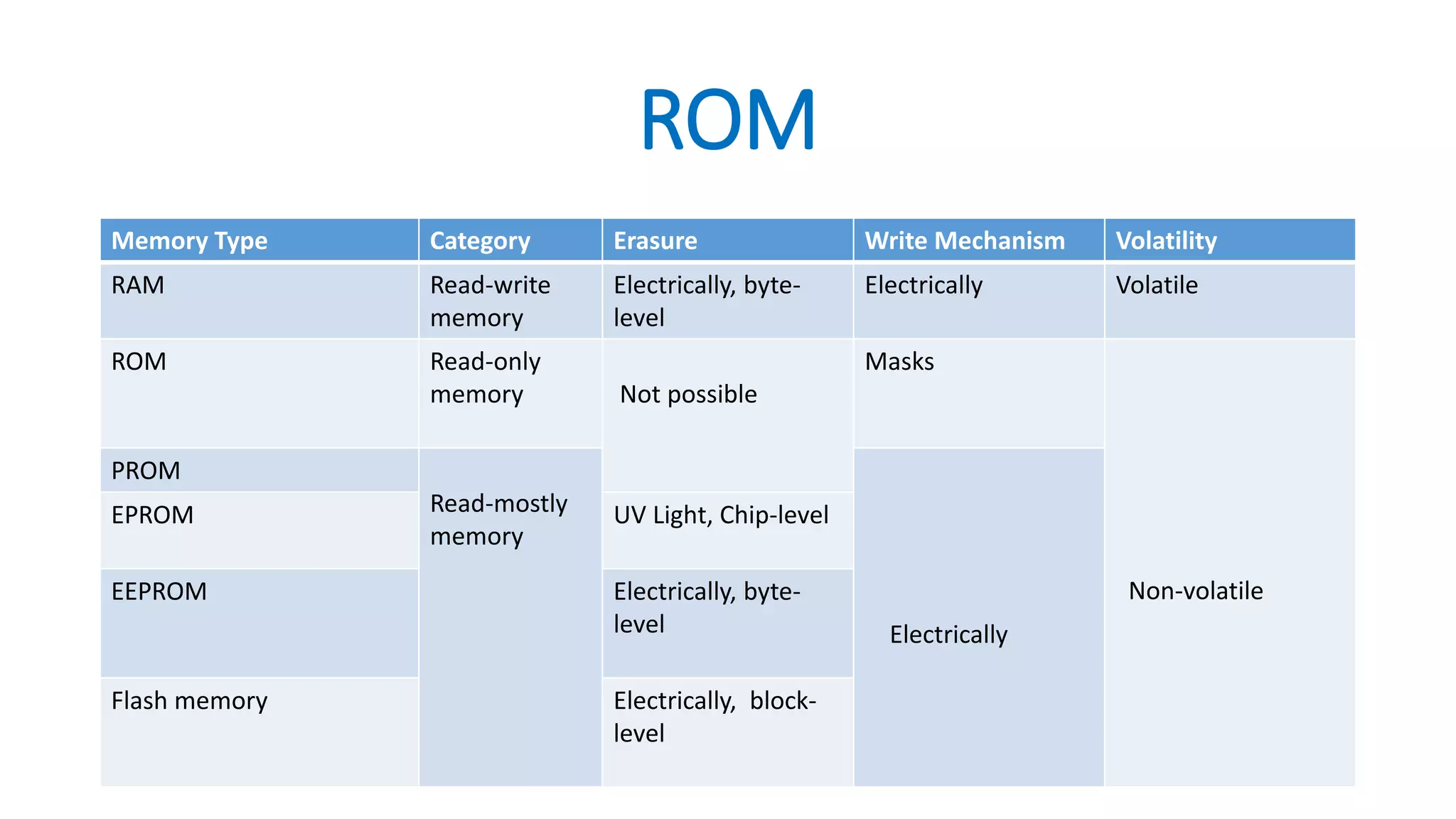
Memory Type Category Erasure Write Mechanism Volatility
RAM Read-write
memory
Electrically, byte-
level
Electrically Volatile
ROM Read-only
memory Not possible
Masks
Non-volatile
PROM
Read-mostly
memory
Electrically
EPROM UV Light, Chip-level
EEPROM Electrically, byte-
level
Flash memory Electrically, block-
level
ROM(READ ONLY MEMORY)
• It contains a permanent pattern of data that cannot be changed.
• It is nonvolatile: no power source is required to maintain the bit
values.
• While it is possible to read to read a ROM, it is not possible to write
new data into it.
• A ROM is created like any other integrated chip.
Problems
• The data insertion step includes a relatively large fixed cost, whether
one or thousands of copies of a particular ROM are fabricated.
• There is no room for error. If one bit is wrong, the whole batch of
ROMs must be thrown out.
Contd…
• When only a small number of ROMs with a particular memory
content is needed, a less expensive alternative is the PROM.
• The PROM is nonvolatile and may be written into only once.
• The writing process is performed electrically and may be performed
by a supplier at a time later than the original chip fabrication.
• PROMs provide flexibility and convenience.
• The ROM remains attractive for high volume production runs.
READ-MOSTLY MEMORY(RMM)
• It is useful for applications in which read operations are far more
frequent than write operations.
• There are 3 forms of RMM
• EPROM
• EEPROM
• FLASH MEMORY.
EPROM
• The optically EPROM is read and written electrically, as with PROM.
• BEFORE A WRITE OPERATION, ALL THE STORAGE CELLS MUST BE
ERASED TO THE SAME INITIAL STATE BY EXPOSURE OF THE PACKAGED
CHIP TO UV radiation.
• Erasure is performed by shining an intense UV Light through a
window that is designed into the memory chip.
• Each erasure can take as much as 20 minutes to perform.
• EPROM can be altered multiple times.
• EPROM is more expensive than PROM.
EEPROM
• This is EMM that can be written into at any time without erasing prior
contents; only the byte or bytes addressed are updated.
• Write operation takes longer than read operation, on the order of
several hundred microseconds per byte.
• The EEPROM combines the advantage of nonvolatility with the
flexibility of being updatable in place, using ordinary bus control,
address, and data lines.
• EEPROM is more expensive than EPROM and also is less dense,
supporting fewer bits per chip.
Flash Memory
• It is intermediate between EPROM & EEPROM in both cost and
functionality.
• Like EEPROM, flash memory uses an electrical erasing technology.
• An entire flash memory v=can be erased in one or a few seconds,
which is much faster than EPROM.
• It is possible to erase just blocks of memory rather than en entire
chip.
• FM gets its name because the microchip is organized so that a section
of memory cells are erased in a single action or “flash”.
• FM does not provide byte level erasure.
• FM uses only one transistor per bit, achieves high density.
THANK YOU

Rom.ppt

  • 1.
    JAHANGIRABAD INSTITUTE OFTECHNOLOGY DEPARTMENT OF COMPUTER SCIENCE ANKUR SRIVASTAVA ASSISTANT PROFESSOR JETGI BARABANKI
  • 2.
    ROM Memory Type CategoryErasure Write Mechanism Volatility RAM Read-write memory Electrically, byte- level Electrically Volatile ROM Read-only memory Not possible Masks Non-volatile PROM Read-mostly memory Electrically EPROM UV Light, Chip-level EEPROM Electrically, byte- level Flash memory Electrically, block- level
  • 3.
    ROM(READ ONLY MEMORY) •It contains a permanent pattern of data that cannot be changed. • It is nonvolatile: no power source is required to maintain the bit values. • While it is possible to read to read a ROM, it is not possible to write new data into it. • A ROM is created like any other integrated chip.
  • 4.
    Problems • The datainsertion step includes a relatively large fixed cost, whether one or thousands of copies of a particular ROM are fabricated. • There is no room for error. If one bit is wrong, the whole batch of ROMs must be thrown out.
  • 5.
    Contd… • When onlya small number of ROMs with a particular memory content is needed, a less expensive alternative is the PROM. • The PROM is nonvolatile and may be written into only once. • The writing process is performed electrically and may be performed by a supplier at a time later than the original chip fabrication. • PROMs provide flexibility and convenience. • The ROM remains attractive for high volume production runs.
  • 6.
    READ-MOSTLY MEMORY(RMM) • Itis useful for applications in which read operations are far more frequent than write operations. • There are 3 forms of RMM • EPROM • EEPROM • FLASH MEMORY.
  • 7.
    EPROM • The opticallyEPROM is read and written electrically, as with PROM. • BEFORE A WRITE OPERATION, ALL THE STORAGE CELLS MUST BE ERASED TO THE SAME INITIAL STATE BY EXPOSURE OF THE PACKAGED CHIP TO UV radiation. • Erasure is performed by shining an intense UV Light through a window that is designed into the memory chip. • Each erasure can take as much as 20 minutes to perform. • EPROM can be altered multiple times. • EPROM is more expensive than PROM.
  • 8.
    EEPROM • This isEMM that can be written into at any time without erasing prior contents; only the byte or bytes addressed are updated. • Write operation takes longer than read operation, on the order of several hundred microseconds per byte. • The EEPROM combines the advantage of nonvolatility with the flexibility of being updatable in place, using ordinary bus control, address, and data lines. • EEPROM is more expensive than EPROM and also is less dense, supporting fewer bits per chip.
  • 9.
    Flash Memory • Itis intermediate between EPROM & EEPROM in both cost and functionality. • Like EEPROM, flash memory uses an electrical erasing technology. • An entire flash memory v=can be erased in one or a few seconds, which is much faster than EPROM. • It is possible to erase just blocks of memory rather than en entire chip. • FM gets its name because the microchip is organized so that a section of memory cells are erased in a single action or “flash”. • FM does not provide byte level erasure. • FM uses only one transistor per bit, achieves high density.
  • 10.