MAHE KARIM
CSE,DIU
www.about.me/mahekarim
WHAT IS MEMORY ?
• A memory chip is a small computer device used to store
information, data or a program that is run on a computer or
other electronic device
• There are several different types of memory chips, although
some are more commonly used than others.
TYPES OF MEMORY
• Normally Two (02) Types of Memory
RAM – Random Access Memory / Volatile Memory & Writeable
ROM – Read Only Memory / Non-Volatile Memory & Read Only
VOLTAILE AND WRITEABLE MEMORY
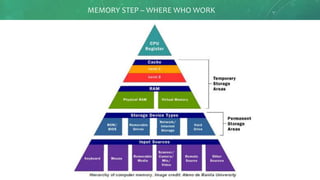
MEMORY STEP – WHERE WHO WORK
CACHE MEMORY
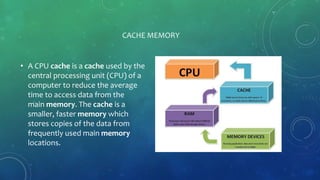
• A CPU cache is a cache used by the
central processing unit (CPU) of a
computer to reduce the average
time to access data from the
main memory. The cache is a
smaller, faster memory which
stores copies of the data from
frequently used main memory
locations.
EPROM
• EPROM : Erasable Programmable Read-
Only Memory.
• Reprogramming requires up to 20
minutes of high-intensity UV light
exposure.
Flash EEPROM : Electrically Erasable
Programmable ROM.
• Also called EAROM (Electrically
Alterable ROM) and NOVRAM (NOn-
Volatile RAM).
• Writing is much slower than a
normal RAM.
•
• Used to store setup information,
e.g. video card, on computer
systems.
• Can be used to replace EPROM for
BIOS memory.
DRAM
• DRAM:
• SRAMs are limited in size (up to about 128K X 8).
• DRAMs are available in much larger sizes, e.g., 64M X 1.
•
• DRAMs MUST be refreshed (rewritten) every 2 to 4 ms
• Since they store their value on an integrated capacitor that loses charge over time.
•
• This refresh is performed by a special circuit in the DRAM which refreshes the entire memory
using 256 reads.
• Refresh also occurs on a normal read, write or during a special refresh cycle.
• More on this later.
•
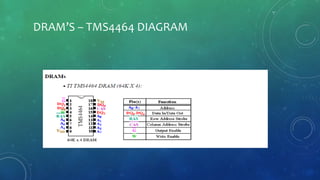
• The large storage capacity of DRAMs make it impractical to add the required number of address pins.
• Instead, the address pins are multiplexed .
DRAM’S – TMS4464 DIAGRAM
THANK YOU

Introduction to Types of Memory Chips

  • 1.
  • 2.
    WHAT IS MEMORY? • A memory chip is a small computer device used to store information, data or a program that is run on a computer or other electronic device • There are several different types of memory chips, although some are more commonly used than others.
  • 3.
    TYPES OF MEMORY •Normally Two (02) Types of Memory RAM – Random Access Memory / Volatile Memory & Writeable ROM – Read Only Memory / Non-Volatile Memory & Read Only
  • 4.
  • 5.
    MEMORY STEP –WHERE WHO WORK
  • 6.
    CACHE MEMORY • ACPU cache is a cache used by the central processing unit (CPU) of a computer to reduce the average time to access data from the main memory. The cache is a smaller, faster memory which stores copies of the data from frequently used main memory locations.
  • 7.
    EPROM • EPROM :Erasable Programmable Read- Only Memory. • Reprogramming requires up to 20 minutes of high-intensity UV light exposure. Flash EEPROM : Electrically Erasable Programmable ROM. • Also called EAROM (Electrically Alterable ROM) and NOVRAM (NOn- Volatile RAM). • Writing is much slower than a normal RAM. • • Used to store setup information, e.g. video card, on computer systems. • Can be used to replace EPROM for BIOS memory.
  • 8.
    DRAM • DRAM: • SRAMsare limited in size (up to about 128K X 8). • DRAMs are available in much larger sizes, e.g., 64M X 1. • • DRAMs MUST be refreshed (rewritten) every 2 to 4 ms • Since they store their value on an integrated capacitor that loses charge over time. • • This refresh is performed by a special circuit in the DRAM which refreshes the entire memory using 256 reads. • Refresh also occurs on a normal read, write or during a special refresh cycle. • More on this later. • • The large storage capacity of DRAMs make it impractical to add the required number of address pins. • Instead, the address pins are multiplexed .
  • 9.
  • 10.