Buildings across Time, 4th Edition
Chapter Five: The Roman World
Introduction
Roman buildings, developed from Greek and Etruscan precedent, are found
over the wide geographic range of the Roman empire. Distinctive public
building types, including amphitheaters, baths, theaters, stadia, basilicas, and
temples, were created to serve a complex urban culture. Houses ranged from
multi-story apartments to elegant palaces and rural villas.
Roman engineering was exceptional. Public works, from water supply to
sewers, roads and bridges, supported cities across the empire. Roman builders
exploited the arch, vault, and dome to create dramatic interior spaces, and they
used concrete (known in Ancient Rome as pozzolana) as an economical,
durable, and versatile construction material.
Etruscan Architecture
Marzabotta
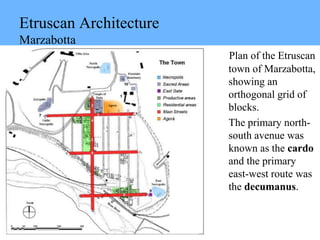
Plan of the Etruscan
town of Marzabotta,
showing an
orthogonal grid of
blocks.
The primary north-
south avenue was
known as the cardo
and the primary
east-west route was
the decumanus.
Etruscan Architecture
Etruscan Temple
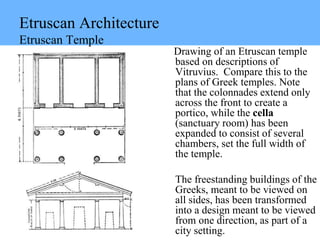
Drawing of an Etruscan temple
based on descriptions of
Vitruvius. Compare this to the
plans of Greek temples. Note
that the colonnades extend only
across the front to create a
portico, while the cella
(sanctuary room) has been
expanded to consist of several
chambers, set the full width of
the temple.
The freestanding buildings of the
Greeks, meant to be viewed on
all sides, has been transformed
into a design meant to be viewed
from one direction, as part of a
city setting.
Etruscan Architecture
Perugia Gate
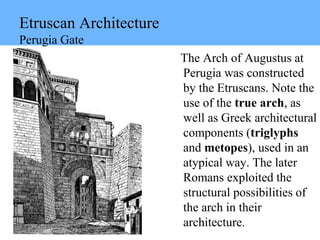
The Arch of Augustus at
Perugia was constructed
by the Etruscans. Note the
use of the true arch, as
well as Greek architectural
components (triglyphs
and metopes), used in an
atypical way. The later
Romans exploited the
structural possibilities of
the arch in their
architecture.
Etruscan Architecture
Perugia Gate
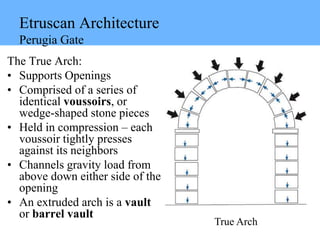
The True Arch:
• Supports Openings
• Comprised of a series of
identical voussoirs, or
wedge-shaped stone pieces
• Held in compression – each
voussoir tightly presses
against its neighbors
• Channels gravity load from
above down either side of the
opening
• An extruded arch is a vault
or barrel vault
True Arch
Roman Construction
Arch and Vault
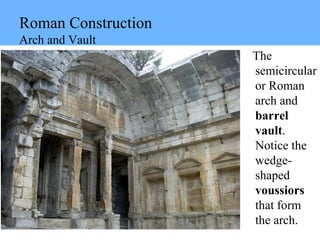
The
semicircular
or Roman
arch and
barrel
vault.
Notice the
wedge-
shaped
voussiors
that form
the arch.
Roman Construction
Arch and Vault
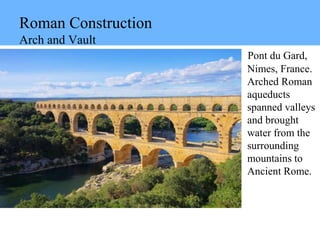
Pont du Gard,
Nimes, France.
Arched Roman
aqueducts
spanned valleys
and brought
water from the
surrounding
mountains to
Ancient Rome.
Roman Construction
Arch and Vault
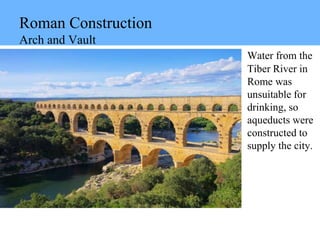
Water from the
Tiber River in
Rome was
unsuitable for
drinking, so
aqueducts were
constructed to
supply the city.
©2014 McGraw-Hill Higher Education. All rights reserved.
Roman Construction
Concrete construction
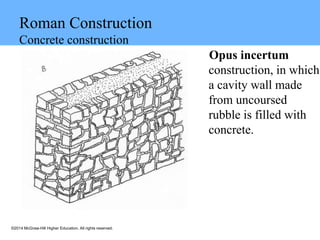
Opus incertum
construction, in which
a cavity wall made
from uncoursed
rubble is filled with
concrete.
©2014 McGraw-Hill Higher Education. All rights reserved.
Roman Construction
Concrete construction
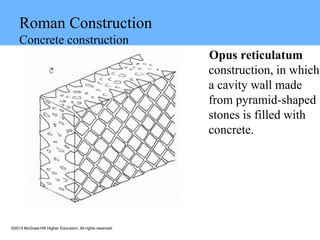
Opus reticulatum
construction, in which
a cavity wall made
from pyramid-shaped
stones is filled with
concrete.
©2014 McGraw-Hill Higher Education. All rights reserved.
Roman Construction
Concrete construction
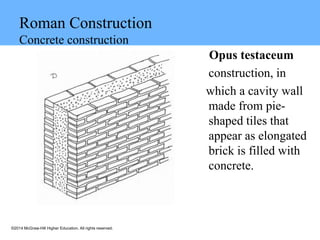
Opus testaceum
construction, in
which a cavity wall
made from pie-
shaped tiles that
appear as elongated
brick is filled with
concrete.
Roman City Planning
Pompeii
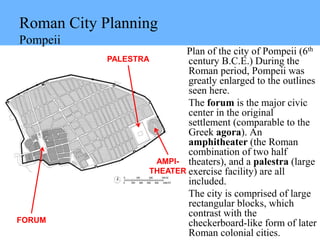
Plan of the city of Pompeii (6th
century B.C.E.) During the
Roman period, Pompeii was
greatly enlarged to the outlines
seen here.
The forum is the major civic
center in the original
settlement (comparable to the
Greek agora). An
amphitheater (the Roman
combination of two half
theaters), and a palestra (large
exercise facility) are all
included.
The city is comprised of large
rectangular blocks, which
contrast with the
checkerboard-like form of later
Roman colonial cities.
FORUM
AMPI-
THEATER
PALESTRA
Roman City Planning
Pompeii
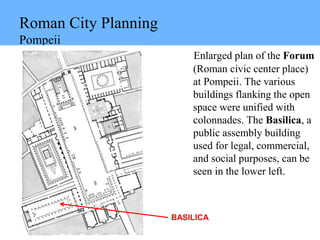
Enlarged plan of the Forum
(Roman civic center place)
at Pompeii. The various
buildings flanking the open
space were unified with
colonnades. The Basilica, a
public assembly building
used for legal, commercial,
and social purposes, can be
seen in the lower left.
BASILICA
©2014 McGraw-Hill Higher Education. All rights reserved.
Roman City Planning
Pompeii
https://www.youtube.com/watch?v=IDCVcuVR5w8
Roman City Planning
Timgad
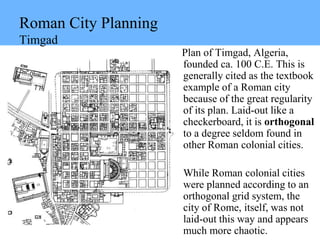
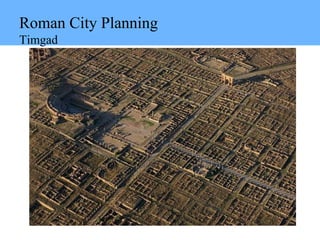
Plan of Timgad, Algeria,
founded ca. 100 C.E. This is
generally cited as the textbook
example of a Roman city
because of the great regularity
of its plan. Laid-out like a
checkerboard, it is orthogonal
to a degree seldom found in
other Roman colonial cities.
While Roman colonial cities
were planned according to an
orthogonal grid system, the
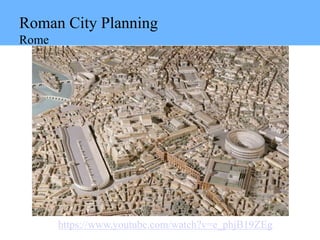
city of Rome, itself, was not
laid-out this way and appears
much more chaotic.
Roman City Planning
Timgad
Roman City Planning
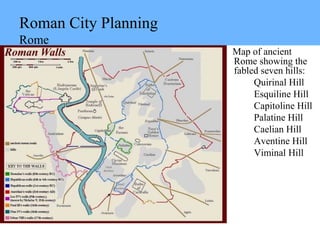
Rome
Map of ancient
Rome showing the
fabled seven hills:
Quirinal Hill
Esquiline Hill
Capitoline Hill
Palatine Hill
Caelian Hill
Aventine Hill
Viminal Hill
Roman City Planning
Rome
https://www.youtube.com/watch?v=e_phjB19ZEg
Roman City Planning
Forum of Trajan
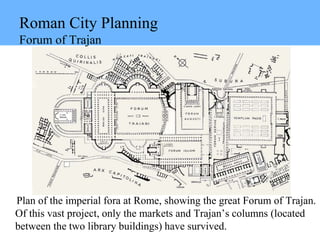
Plan of the imperial fora at Rome, showing the great Forum of Trajan.
Of this vast project, only the markets and Trajan’s columns (located
between the two library buildings) have survived.
https://www.youtube.com/watch?v=z83guai4S68&feature=youtu.be
Roman City Planning
Forum of Trajan
©2014 McGraw-Hill Higher Education. All rights reserved.
Roman City Planning
Forum of Trajan
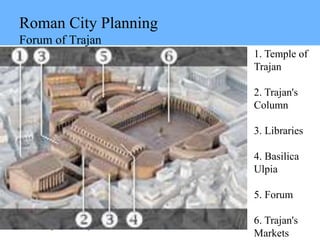
1. Temple of
Trajan
2. Trajan's
Column
3. Libraries
4. Basilica
Ulpia
5. Forum
6. Trajan's
Markets
Roman City Planning
Trajan’s Market
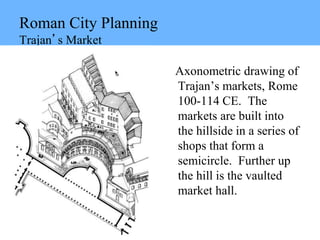
Axonometric drawing of
Trajan’s markets, Rome
100-114 CE. The
markets are built into
the hillside in a series of
shops that form a
semicircle. Further up
the hill is the vaulted
market hall.
©2014 McGraw-Hill Higher Education. All rights reserved.
Roman City Planning
Trajan’s Column
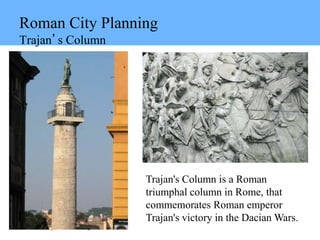
Trajan's Column is a Roman
triumphal column in Rome, that
commemorates Roman emperor
Trajan's victory in the Dacian Wars.
Roman Temples
Pantheon
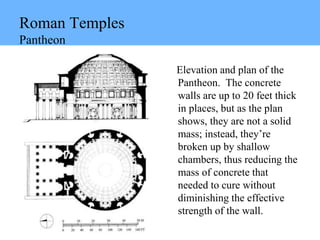
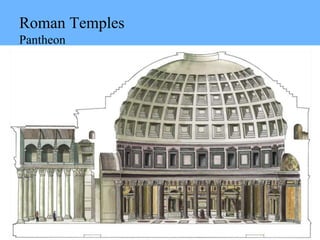
Elevation and plan of the
Pantheon. The concrete
walls are up to 20 feet thick
in places, but as the plan
shows, they are not a solid
mass; instead, they’re
broken up by shallow
chambers, thus reducing the
mass of concrete that
needed to cure without
diminishing the effective
strength of the wall.
Roman Temples
Pantheon
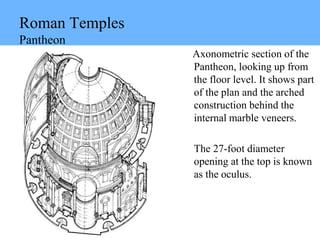
Axonometric section of the
Pantheon, looking up from
the floor level. It shows part
of the plan and the arched
construction behind the
internal marble veneers.
The 27-foot diameter
opening at the top is known
as the oculus.
Roman Temples
Pantheon
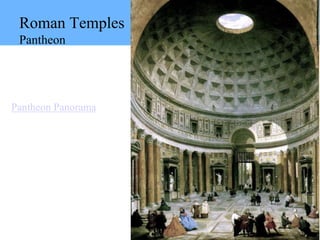
Pantheon Panorama
©2014 McGraw-Hill Higher Education. All rights reserved.
Roman Temples
Pantheon
Roman Temples
Pantheon
https://www.youtube.com/watch?v=KaY8zqYfQI0
Public Buildings
Basilica Nova
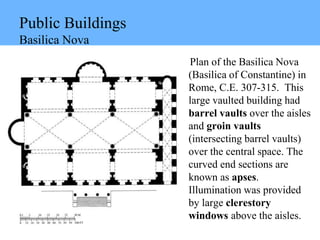
Plan of the Basilica Nova
(Basilica of Constantine) in
Rome, C.E. 307-315. This
large vaulted building had
barrel vaults over the aisles
and groin vaults
(intersecting barrel vaults)
over the central space. The
curved end sections are
known as apses.
Illumination was provided
by large clerestory
windows above the aisles.
Public Buildings
Basilica Nova
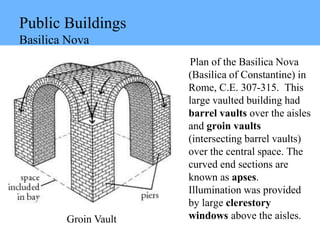
Plan of the Basilica Nova
(Basilica of Constantine) in
Rome, C.E. 307-315. This
large vaulted building had
barrel vaults over the aisles
and groin vaults
(intersecting barrel vaults)
over the central space. The
curved end sections are
known as apses.
Illumination was provided
by large clerestory
windows above the aisles.Groin Vault
Public Buildings
Basilica Nova
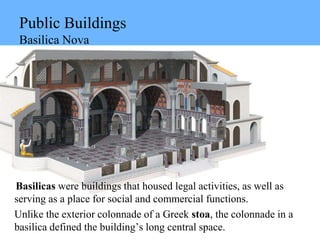
Basilicas were buildings that housed legal activities, as well as
serving as a place for social and commercial functions.
Unlike the exterior colonnade of a Greek stoa, the colonnade in a
basilica defined the building’s long central space.
Public Buildings
Caracalla
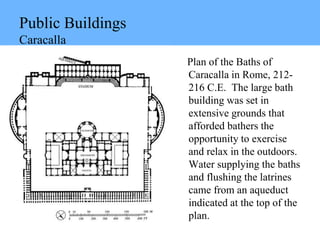
Plan of the Baths of
Caracalla in Rome, 212-
216 C.E. The large bath
building was set in
extensive grounds that
afforded bathers the
opportunity to exercise
and relax in the outdoors.
Water supplying the baths
and flushing the latrines
came from an aqueduct
indicated at the top of the
plan.
Public Buildings
Caracalla
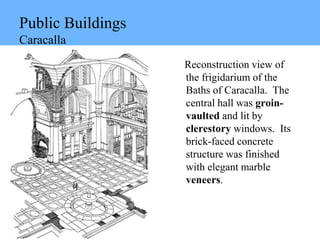
Reconstruction view of
the frigidarium of the
Baths of Caracalla. The
central hall was groin-
vaulted and lit by
clerestory windows. Its
brick-faced concrete
structure was finished
with elegant marble
veneers.
Public Buildings
Diocletian
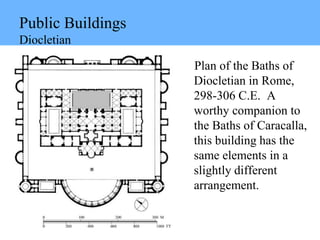
Plan of the Baths of
Diocletian in Rome,
298-306 C.E. A
worthy companion to
the Baths of Caracalla,
this building has the
same elements in a
slightly different
arrangement.
©2014 McGraw-Hill Higher Education. All rights reserved.
Public Buildings
Diocletian
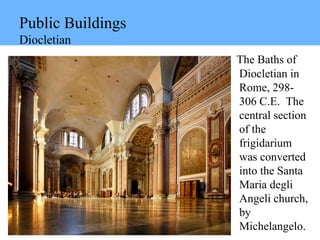
The Baths of
Diocletian in
Rome, 298-
306 C.E. The
central section
of the
frigidarium
was converted
into the Santa
Maria degli
Angeli church,
by
Michelangelo.
Public Buildings
Forum Baths
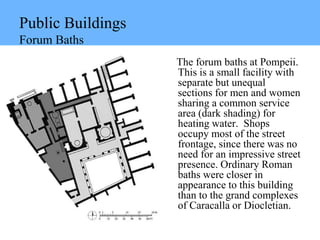
The forum baths at Pompeii.
This is a small facility with
separate but unequal
sections for men and women
sharing a common service
area (dark shading) for
heating water. Shops
occupy most of the street
frontage, since there was no
need for an impressive street
presence. Ordinary Roman
baths were closer in
appearance to this building
than to the grand complexes
of Caracalla or Diocletian.
Public Buildings
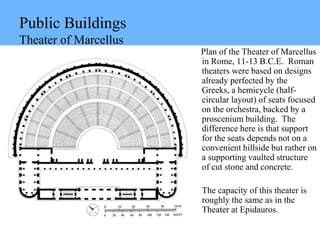
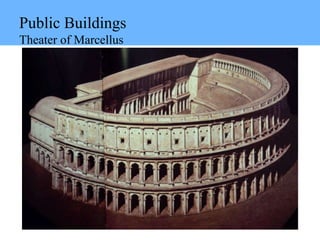
Theater of Marcellus
Plan of the Theater of Marcellus
in Rome, 11-13 B.C.E. Roman
theaters were based on designs
already perfected by the
Greeks, a hemicycle (half-
circular layout) of seats focused
on the orchestra, backed by a
proscenium building. The
difference here is that support
for the seats depends not on a
convenient hillside but rather on
a supporting vaulted structure
of cut stone and concrete.
The capacity of this theater is
roughly the same as in the
Theater at Epidauros.
Public Buildings
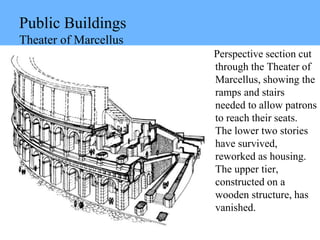
Theater of Marcellus
Perspective section cut
through the Theater of
Marcellus, showing the
ramps and stairs
needed to allow patrons
to reach their seats.
The lower two stories
have survived,
reworked as housing.
The upper tier,
constructed on a
wooden structure, has
vanished.
Public Buildings
Theater of Marcellus
Public Buildings
Pompeii Amphitheater
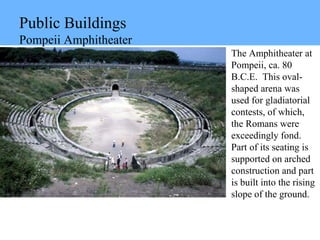
The Amphitheater at
Pompeii, ca. 80
B.C.E. This oval-
shaped arena was
used for gladiatorial
contests, of which,
the Romans were
exceedingly fond.
Part of its seating is
supported on arched
construction and part
is built into the rising
slope of the ground.
Public Buildings
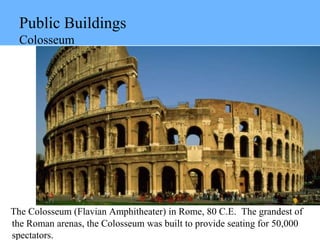
Colosseum
The Colosseum (Flavian Amphitheater) in Rome, 80 C.E. The grandest of
the Roman arenas, the Colosseum was built to provide seating for 50,000
spectators.
Public Buildings
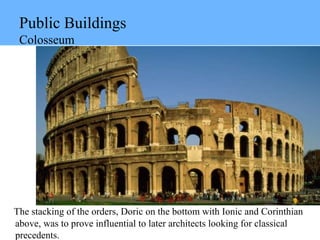
Colosseum
The stacking of the orders, Doric on the bottom with Ionic and Corinthian
above, was to prove influential to later architects looking for classical
precedents.
Public Buildings
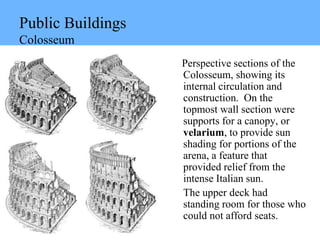
Colosseum
Perspective sections of the
Colosseum, showing its
internal circulation and
construction. On the
topmost wall section were
supports for a canopy, or
velarium, to provide sun
shading for portions of the
arena, a feature that
provided relief from the
intense Italian sun.
The upper deck had
standing room for those who
could not afford seats.
Public Buildings
Colosseum
https://www.youtube.com/watch?v=OOylD1KC6kc
Roman Residences
House of the Surgeon
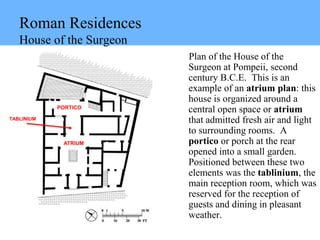
Plan of the House of the
Surgeon at Pompeii, second
century B.C.E. This is an
example of an atrium plan: this
house is organized around a
central open space or atrium
that admitted fresh air and light
to surrounding rooms. A
portico or porch at the rear
opened into a small garden.
Positioned between these two
elements was the tablinium, the
main reception room, which was
reserved for the reception of
guests and dining in pleasant
weather.
ATRIUM
TABLINIUM
PORTICO
Roman Residences
House of Pansa
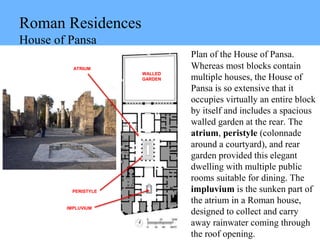
Plan of the House of Pansa.
Whereas most blocks contain
multiple houses, the House of
Pansa is so extensive that it
occupies virtually an entire block
by itself and includes a spacious
walled garden at the rear. The
atrium, peristyle (colonnade
around a courtyard), and rear
garden provided this elegant
dwelling with multiple public
rooms suitable for dining. The
impluvium is the sunken part of
the atrium in a Roman house,
designed to collect and carry
away rainwater coming through
the roof opening.
IMPLUVIUM
PERISTYLE
ATRIUM
WALLED
GARDEN
Roman Residences
Hadrian’s Villa
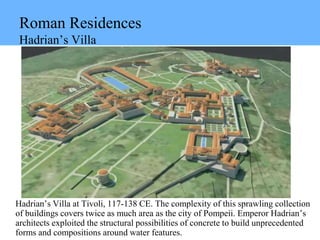
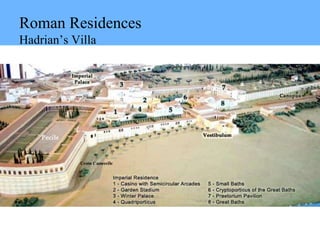
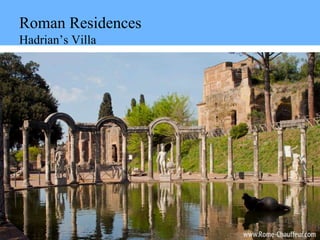
Hadrian’s Villa at Tivoli, 117-138 CE. The complexity of this sprawling collection
of buildings covers twice as much area as the city of Pompeii. Emperor Hadrian’s
architects exploited the structural possibilities of concrete to build unprecedented
forms and compositions around water features.
Roman Residences
Hadrian’s Villa
Roman Residences
Hadrian’s Villa
Roman Residences
Hadrian’s Villa
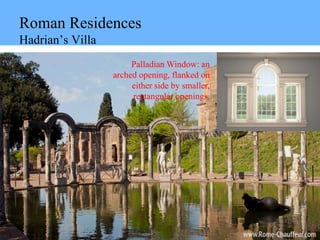
Palladian Window: an
arched opening, flanked on
either side by smaller,
rectangular openings.
Roman Residences
Hadrian’s Villa
https://www.youtube.com/watch?v=Nu_6X04EGHk

Chapter Five: The Roman World

  • 1.
    Buildings across Time,4th Edition Chapter Five: The Roman World Introduction Roman buildings, developed from Greek and Etruscan precedent, are found over the wide geographic range of the Roman empire. Distinctive public building types, including amphitheaters, baths, theaters, stadia, basilicas, and temples, were created to serve a complex urban culture. Houses ranged from multi-story apartments to elegant palaces and rural villas. Roman engineering was exceptional. Public works, from water supply to sewers, roads and bridges, supported cities across the empire. Roman builders exploited the arch, vault, and dome to create dramatic interior spaces, and they used concrete (known in Ancient Rome as pozzolana) as an economical, durable, and versatile construction material.
  • 2.
    Etruscan Architecture Marzabotta Plan ofthe Etruscan town of Marzabotta, showing an orthogonal grid of blocks. The primary north- south avenue was known as the cardo and the primary east-west route was the decumanus.
  • 3.
    Etruscan Architecture Etruscan Temple Drawingof an Etruscan temple based on descriptions of Vitruvius. Compare this to the plans of Greek temples. Note that the colonnades extend only across the front to create a portico, while the cella (sanctuary room) has been expanded to consist of several chambers, set the full width of the temple. The freestanding buildings of the Greeks, meant to be viewed on all sides, has been transformed into a design meant to be viewed from one direction, as part of a city setting.
  • 4.
    Etruscan Architecture Perugia Gate TheArch of Augustus at Perugia was constructed by the Etruscans. Note the use of the true arch, as well as Greek architectural components (triglyphs and metopes), used in an atypical way. The later Romans exploited the structural possibilities of the arch in their architecture.
  • 5.
    Etruscan Architecture Perugia Gate TheTrue Arch: • Supports Openings • Comprised of a series of identical voussoirs, or wedge-shaped stone pieces • Held in compression – each voussoir tightly presses against its neighbors • Channels gravity load from above down either side of the opening • An extruded arch is a vault or barrel vault True Arch
  • 6.
    Roman Construction Arch andVault The semicircular or Roman arch and barrel vault. Notice the wedge- shaped voussiors that form the arch.
  • 7.
    Roman Construction Arch andVault Pont du Gard, Nimes, France. Arched Roman aqueducts spanned valleys and brought water from the surrounding mountains to Ancient Rome.
  • 8.
    Roman Construction Arch andVault Water from the Tiber River in Rome was unsuitable for drinking, so aqueducts were constructed to supply the city.
  • 9.
    ©2014 McGraw-Hill HigherEducation. All rights reserved. Roman Construction Concrete construction Opus incertum construction, in which a cavity wall made from uncoursed rubble is filled with concrete.
  • 10.
    ©2014 McGraw-Hill HigherEducation. All rights reserved. Roman Construction Concrete construction Opus reticulatum construction, in which a cavity wall made from pyramid-shaped stones is filled with concrete.
  • 11.
    ©2014 McGraw-Hill HigherEducation. All rights reserved. Roman Construction Concrete construction Opus testaceum construction, in which a cavity wall made from pie- shaped tiles that appear as elongated brick is filled with concrete.
  • 12.
    Roman City Planning Pompeii Planof the city of Pompeii (6th century B.C.E.) During the Roman period, Pompeii was greatly enlarged to the outlines seen here. The forum is the major civic center in the original settlement (comparable to the Greek agora). An amphitheater (the Roman combination of two half theaters), and a palestra (large exercise facility) are all included. The city is comprised of large rectangular blocks, which contrast with the checkerboard-like form of later Roman colonial cities. FORUM AMPI- THEATER PALESTRA
  • 13.
    Roman City Planning Pompeii Enlargedplan of the Forum (Roman civic center place) at Pompeii. The various buildings flanking the open space were unified with colonnades. The Basilica, a public assembly building used for legal, commercial, and social purposes, can be seen in the lower left. BASILICA
  • 14.
    ©2014 McGraw-Hill HigherEducation. All rights reserved. Roman City Planning Pompeii https://www.youtube.com/watch?v=IDCVcuVR5w8
  • 15.
    Roman City Planning Timgad Planof Timgad, Algeria, founded ca. 100 C.E. This is generally cited as the textbook example of a Roman city because of the great regularity of its plan. Laid-out like a checkerboard, it is orthogonal to a degree seldom found in other Roman colonial cities. While Roman colonial cities were planned according to an orthogonal grid system, the city of Rome, itself, was not laid-out this way and appears much more chaotic.
  • 16.
  • 17.
    Roman City Planning Rome Mapof ancient Rome showing the fabled seven hills: Quirinal Hill Esquiline Hill Capitoline Hill Palatine Hill Caelian Hill Aventine Hill Viminal Hill
  • 18.
  • 19.
    Roman City Planning Forumof Trajan Plan of the imperial fora at Rome, showing the great Forum of Trajan. Of this vast project, only the markets and Trajan’s columns (located between the two library buildings) have survived.
  • 20.
  • 21.
    ©2014 McGraw-Hill HigherEducation. All rights reserved. Roman City Planning Forum of Trajan 1. Temple of Trajan 2. Trajan's Column 3. Libraries 4. Basilica Ulpia 5. Forum 6. Trajan's Markets
  • 22.
    Roman City Planning Trajan’sMarket Axonometric drawing of Trajan’s markets, Rome 100-114 CE. The markets are built into the hillside in a series of shops that form a semicircle. Further up the hill is the vaulted market hall.
  • 23.
    ©2014 McGraw-Hill HigherEducation. All rights reserved. Roman City Planning Trajan’s Column Trajan's Column is a Roman triumphal column in Rome, that commemorates Roman emperor Trajan's victory in the Dacian Wars.
  • 24.
    Roman Temples Pantheon Elevation andplan of the Pantheon. The concrete walls are up to 20 feet thick in places, but as the plan shows, they are not a solid mass; instead, they’re broken up by shallow chambers, thus reducing the mass of concrete that needed to cure without diminishing the effective strength of the wall.
  • 25.
    Roman Temples Pantheon Axonometric sectionof the Pantheon, looking up from the floor level. It shows part of the plan and the arched construction behind the internal marble veneers. The 27-foot diameter opening at the top is known as the oculus.
  • 26.
  • 27.
    ©2014 McGraw-Hill HigherEducation. All rights reserved. Roman Temples Pantheon
  • 28.
  • 29.
    Public Buildings Basilica Nova Planof the Basilica Nova (Basilica of Constantine) in Rome, C.E. 307-315. This large vaulted building had barrel vaults over the aisles and groin vaults (intersecting barrel vaults) over the central space. The curved end sections are known as apses. Illumination was provided by large clerestory windows above the aisles.
  • 30.
    Public Buildings Basilica Nova Planof the Basilica Nova (Basilica of Constantine) in Rome, C.E. 307-315. This large vaulted building had barrel vaults over the aisles and groin vaults (intersecting barrel vaults) over the central space. The curved end sections are known as apses. Illumination was provided by large clerestory windows above the aisles.Groin Vault
  • 31.
    Public Buildings Basilica Nova Basilicaswere buildings that housed legal activities, as well as serving as a place for social and commercial functions. Unlike the exterior colonnade of a Greek stoa, the colonnade in a basilica defined the building’s long central space.
  • 32.
    Public Buildings Caracalla Plan ofthe Baths of Caracalla in Rome, 212- 216 C.E. The large bath building was set in extensive grounds that afforded bathers the opportunity to exercise and relax in the outdoors. Water supplying the baths and flushing the latrines came from an aqueduct indicated at the top of the plan.
  • 33.
    Public Buildings Caracalla Reconstruction viewof the frigidarium of the Baths of Caracalla. The central hall was groin- vaulted and lit by clerestory windows. Its brick-faced concrete structure was finished with elegant marble veneers.
  • 34.
    Public Buildings Diocletian Plan ofthe Baths of Diocletian in Rome, 298-306 C.E. A worthy companion to the Baths of Caracalla, this building has the same elements in a slightly different arrangement.
  • 35.
    ©2014 McGraw-Hill HigherEducation. All rights reserved. Public Buildings Diocletian The Baths of Diocletian in Rome, 298- 306 C.E. The central section of the frigidarium was converted into the Santa Maria degli Angeli church, by Michelangelo.
  • 36.
    Public Buildings Forum Baths Theforum baths at Pompeii. This is a small facility with separate but unequal sections for men and women sharing a common service area (dark shading) for heating water. Shops occupy most of the street frontage, since there was no need for an impressive street presence. Ordinary Roman baths were closer in appearance to this building than to the grand complexes of Caracalla or Diocletian.
  • 37.
    Public Buildings Theater ofMarcellus Plan of the Theater of Marcellus in Rome, 11-13 B.C.E. Roman theaters were based on designs already perfected by the Greeks, a hemicycle (half- circular layout) of seats focused on the orchestra, backed by a proscenium building. The difference here is that support for the seats depends not on a convenient hillside but rather on a supporting vaulted structure of cut stone and concrete. The capacity of this theater is roughly the same as in the Theater at Epidauros.
  • 38.
    Public Buildings Theater ofMarcellus Perspective section cut through the Theater of Marcellus, showing the ramps and stairs needed to allow patrons to reach their seats. The lower two stories have survived, reworked as housing. The upper tier, constructed on a wooden structure, has vanished.
  • 39.
  • 40.
    Public Buildings Pompeii Amphitheater TheAmphitheater at Pompeii, ca. 80 B.C.E. This oval- shaped arena was used for gladiatorial contests, of which, the Romans were exceedingly fond. Part of its seating is supported on arched construction and part is built into the rising slope of the ground.
  • 41.
    Public Buildings Colosseum The Colosseum(Flavian Amphitheater) in Rome, 80 C.E. The grandest of the Roman arenas, the Colosseum was built to provide seating for 50,000 spectators.
  • 42.
    Public Buildings Colosseum The stackingof the orders, Doric on the bottom with Ionic and Corinthian above, was to prove influential to later architects looking for classical precedents.
  • 43.
    Public Buildings Colosseum Perspective sectionsof the Colosseum, showing its internal circulation and construction. On the topmost wall section were supports for a canopy, or velarium, to provide sun shading for portions of the arena, a feature that provided relief from the intense Italian sun. The upper deck had standing room for those who could not afford seats.
  • 44.
  • 45.
    Roman Residences House ofthe Surgeon Plan of the House of the Surgeon at Pompeii, second century B.C.E. This is an example of an atrium plan: this house is organized around a central open space or atrium that admitted fresh air and light to surrounding rooms. A portico or porch at the rear opened into a small garden. Positioned between these two elements was the tablinium, the main reception room, which was reserved for the reception of guests and dining in pleasant weather. ATRIUM TABLINIUM PORTICO
  • 46.
    Roman Residences House ofPansa Plan of the House of Pansa. Whereas most blocks contain multiple houses, the House of Pansa is so extensive that it occupies virtually an entire block by itself and includes a spacious walled garden at the rear. The atrium, peristyle (colonnade around a courtyard), and rear garden provided this elegant dwelling with multiple public rooms suitable for dining. The impluvium is the sunken part of the atrium in a Roman house, designed to collect and carry away rainwater coming through the roof opening. IMPLUVIUM PERISTYLE ATRIUM WALLED GARDEN
  • 47.
    Roman Residences Hadrian’s Villa Hadrian’sVilla at Tivoli, 117-138 CE. The complexity of this sprawling collection of buildings covers twice as much area as the city of Pompeii. Emperor Hadrian’s architects exploited the structural possibilities of concrete to build unprecedented forms and compositions around water features.
  • 48.
  • 49.
  • 50.
    Roman Residences Hadrian’s Villa PalladianWindow: an arched opening, flanked on either side by smaller, rectangular openings.
  • 51.