GREEK ARCHITECTURE
PRESENTED BY:
SMIT J. PANCHAL
RONAK JAIN
TUSHAR KACHADIYA
SARYU A. PATEL
GREEK ARCHITECTURE
GEOGRAPHICAL CONDITION
GEOLOGICAL CONDITION
CLIMATIC CONDITION
RELIGIOUS CONDITION
SOCIAL CONDITION
HISTORICAL CONDITION
GEOGRAPHICAL CONDITION:
The ‘Aegean’ culture was started on ‘Crete’ an
island in the Mediterranean sea in about 3000
B.C. by the migration of the people from Asia
minor. after the fall of ‘Aegean’ its culture was
extended to Greece and its island centuries
later.
It had a link by trade and commerce with Asia
minor, Cyprus, Palestine, Syria, Egypt and as far
as Italy and Sicily.
Geography had a great influence on the Greek
culture. the country is a mountainous and
separated by the hills and dales.
Moreover the area is surrounded on all three
sides by sea with innumerable islands. the coast
line is indented with many natural harbours. sea
was the main source of communication.
naturally the Greeks became bold, adventurous
sea-men. they mainly depended for their
expansion of kingdom on colonization.
GREEK ARCHITECTURE
GEOGRAPHICAL CONDITION
GEOLOGICAL CONDITION
CLIMATIC CONDITION
RELIGIOUS CONDITION
SOCIAL CONDITION
HISTORICAL CONDITION
GEOLOGICAL CONDITION:
Greece and its islands had plenty of building
materials. But amongst them, the building stone
of great importance was unrivalled marble
which was plenty near Athens. On account of its
beauty and fine texture it was possible for them
to achieve refine treatment and delicacy of
outlines in their carvings which are the main
characteristics of GREEK ARCHITECTURE.
The Greeks attached so much liking to this
marble that they even covered stone and sun-
dried bricks with marble ‘stucco’ – a powdered
marble dust to receive colour decoration.
This marble stucco had been used in many
Greek – temples and palaces and have been
highly polished that they reflect like a mirror,
which is another important feature of GREEK
ARCHITECTURE.
GREEK ARCHITECTURE
GEOGRAPHICAL CONDITION
GEOLOGICAL CONDITION
CLIMATIC CONDITION
RELIGIOUS CONDITION
SOCIAL CONDITION
HISTORICAL CONDITION
CLIMATIC CONDITION:
The climate is moderate, neither too cold nor
too hot. This favoured the Greeks an outdoor
life. They therefore constructed building suited
to their out-door life such as administrative
building, theatres, agora-an open air market,
etc.
The hot sun and sudden, unexpected showers of
rains were the reasons for the construction of
portico and colonnades which have become
characteristic features of their style.
GREEK ARCHITECTURE
GEOGRAPHICAL CONDITION
GEOLOGICAL CONDITION
CLIMATIC CONDITION
RELIGIOUS CONDITION
SOCIAL CONDITION
HISTORICAL CONDITION
RELIGIOUS CONDITION:
The religion of ‘Aegean’ was based on natural
worship and had many divinities in the form of
human, scared bulls, but ‘ rhea’ the goddess of
fertility or mother goddess was supreme.
Priestesses rather than priests, carried out on
sacrificial alter, in open air courtyard or in small
shrines. Hence no temples were built.
But after the fall of Aegean, the Greeks began to
worship their deities in the temples. The Greek
temples were surrounded by open colonnades
in full view of common people. This is in strong
contrast to the Egyptian temples which were
royal monuments and hidden from public gaze
and enclosed within high massive girdle walls.
GREEK ARCHITECTURE
GEOGRAPHICAL CONDITION
GEOLOGICAL CONDITION
CLIMATIC CONDITION
RELIGIOUS CONDITION
SOCIAL CONDITION
HISTORICAL CONDITION
SOCIAL CONDITION:
Civilization spread mainly during ‘Bronze Age’ in the
island of ‘Crete’ consisting of about hundred cities.
Trade and commerce, science and astronomy greatly
developed. The Greeks were democratic and women
played important role in social life. The idea was based
on individual freedom. However common customs,
religions, ideas and great epics united them like the
Indians. Greeks’ national games and festivals
encouraged literature, music and drama. Hence Greeks
constructed stadiums, palaestra (wrestling school),
theatres (for dance, drama), hippo-drome (for horse
and chariot race), basilica (assembly hall) and agora
(open air market) etc. Greek did not believe in life after
death, hence there was little concern for tombs.
There were also Pythagoras, the great Mathematician,
Socrates, Plato, and Aristotle the great Philosopher,
Scientist and Teacher of ‘Alexander the Great’.
Greek’s love for beauty and variety gave rise to two
versions of columns and entablature, the Doric of
Western and Ionic of Eastern Greeks and the latter
developed a third, the Corinthian. The three are known
as ‘Orders of Architecture’ column consists of base,
shaft, capital and entablature is made of architrave,
frieze and cornice.
GREEK ARCHITECTURE
GEOGRAPHICAL CONDITION
GEOLOGICAL CONDITION
CLIMATIC CONDITION
RELIGIOUS CONDITION
SOCIAL CONDITION
HISTORICAL CONDITION
HISTORICAL CONDITION:
‘Hellenic’ Greece was born with a humble start and
made very rapid development with new civilization.
And by 600 B.C. the Greeks founded most of their
colonies. Most of the temples and world famous
buildings were built during this period on the high
ground at acropolis (upper city) in Athens.
After Sparta’s arbitrary rule, next came philip (359-335
B.C.), the able king of Macedonia, under whose rule,
the Athenian prosperity was at its highest peak. His
son ‘Alexander the Great’ (336-323 B.C.) rose to a high
position. In 334 B.C. within a span of six years he
conquered the Egyptian and Persian empire. He
founded in Egypt the famous city ‘Alexandria’ which
became the main centre of Greek culture. He also
conquered some part of northern India in 326 B.C.
which helped the Greek art and culture to spread in
Asian countries. On his return journey he died at
Babylon in 323 B.C. at the early age of 32.
Greece finally fell to Romans in 146 B.C. Cleopetra, the
last queen of Egypt, eventually married Mark Antony in
37 B.C. hoping to extend her empire. However after
the defeat, she committed suicide in 30 B.C. when
Egypt was captured by Octavian, the future Roman
Emperor Augustus.
GREEK ARCHITECTURE
HELLENIC PERIOD (650 – 323 B.C.)
HELLENISTIC PERIOD (323 – 30 B.C.)
CHARACTERISTIC FEATURES
OPTICAL ILLUSIONS
CHARACTERISTIC FEATURES:
The term Hellenic is used to describe the early
Greek’s Civilization.
Greek Architecture is essentially a columnar and
trabeated style and is considered to have evolved
from wooden hut of upright posts and supporting
beam and sloping rafters. The architectural style
was simple in appearance and self – evident in
design.
Spans were limited because of trabeated style
where the architraves were composed of single
blocks of stones or marbles. They often used
internal columns in temple hall. Arches, Domes,
Vaults were not used by the Greeks. This is in
strong contrast to the Roman Vault, Domes which
were used to cover the vast spans. Greeks used
timber in the beginning but soon they started using
the marble, the most beautiful building stone. The
same timber forms were imitated with great artistic
skill, in refined treatment and delicacy of out–lines
in their carvings. On account of this, Greek
architecture has been rightly called as “CARPENTRY
IN MARBLE”
GREEK ARCHITECTURE
HELLENIC PERIOD (650 – 323 B.C.)
HELLENISTIC PERIOD (323 – 30 B.C.)
CHARACTERISTIC FEATURES
OPTICAL ILLUSIONS
CHARACTERISTICS FEATURES:
The exteriors of the buildings were designed
with colonnades i.e. a series of columns. The
doorways were square and rectangular.
Windows were rarely used. Sloping roofs were
covered with terra cotta or marble tiles mask.
In 600 B.C. the use of marble became limited
and was used only for finer works and
sculptures. The walls were constructed with
rubble and ashlar. But no mortar was used. They
minimised the joints by using large sized stoned.
Stone walls were beautified with marble stucco.
GREEK ARCHITECTURE
HELLENIC PERIOD (650 – 323 B.C.)
HELLENISTIC PERIOD (323 – 30 B.C.)
CHARACTERISTIC FEATURES
OPTICAL ILLUSIONS
OPTICAL ILLUSIONS:
The important refinement adopted in Greek
style was to correct the optical illusion. The long
horizontal feature such as entablature which if
built straight would have appeared to sag in the
middle. This has been corrected by forming the
façade with slight convex outlines in the centre.
Also the vertical columns if built straight would
have appeared curved inward. Hence to correct
this defect, the sides of the columns were
curved in a convex manner i.e. were made to
bulge in the centre slightly, known as ‘Entasis’.
Also the letters of inscriptions were made larger
in upper lines than in lower, so that they might
appear to be of the same size when seen from
ground level.
The admirable refinement, delicate adjustment,
testify the remarkable sense of form and
proportion exhibited in all the Greek Buildings.
GREEK ARCHITECTURE OPTICAL ILLUSIONS:
A. Correction of apparent proportions from an
inscription on the face of the antae of a
temple at Priene.
B. Colour Effect on Proportions
1. X- The metopes & naos wall being black the
columns appear sturdier and the architrave,
triglyphs & cornice have importance.
2. Y- With reversed colouring, the columns
appear thinner & higher & the entrablature
loses its importance.
C. The Parthenon – Inclination of columns &
entablature.
(H) Parallel straight lines having convex curves
on either side appear wider apart in the center.
(J) Parallel straight lines having concave curves
on either side appear closer together in the
center.
GREEK ARCHITECTURE OPTICAL ILLUSIONS:
D. Entasis: Vertical features were also inclined
inwards towards the top to correct the
appearance of falling outwards. This is called
Entasis. The shafts of the Parthenon have a
slight convexity of silhouette – as well as the
usual upward taper – the deviation amounting
to 11/16“ in a height of 31 ft.
E. Angle columns of temples were not only set
closer to the adjacent columns, but were also
stouter, as it was found that they appeared
thinner against the open sky than those seen
against the solid background of the ‘naos’ wall.
F. The long horizontal lines of features as
stylobates, architraves and cornices, which if
straight in reality would have appeared to sag or
drop in the middle of their length, were formed
with slightly convex outlines (In Parthenon, it
has a upward curvature of 3/8”)
GREEK ARCHITECTURE
HELLENIC PERIOD (650 – 323 B.C.)
HELLENISTIC PERIOD (323 – 30 B.C.)
ORDERS
ORDERS
The three kind of architectural vocabularies
called Orders of architecture namely, DORIC,
IONIC AND CORINTHIAN were standardised and
were largely employed in temples and places to
attain the greatest effect with regard to beauty.
The Greek Orders were necessary features of
construction and essence of Greek Architecture.
An order in classic architecture consists of
upright column or support and the horizontal
entablature or part supported. The column
consists of base, the bottom part, shaft, the
middle part, while entablature consists of
architrave, the lower part, frieze, the middle
part and cornice the upper most part.
GREEK ARCHITECTURE
HELLENIC PERIOD (650 – 323 B.C.)
HELLENISTIC PERIOD (323 – 30 B.C.)
ORDERS
ORDERS
The Greek classic order is distinguished from
other I the sense that the different forms are
brought to a definite set of rules.
But these may not be necessarily taken as the
principles on which they were first designed.
These are the outcome of the study of the
scholars of later times to fit the old examples.
Greek buildings with all its beauty and
grandeur existed even before the
Orders were formed. Hence the Orders
we study are based on the
measurements of the existed Classic
Orders.
GREEK ARCHITECTURE
HELLENIC PERIOD (650 – 323 B.C.)
HELLENISTIC PERIOD (323 – 30 B.C.)
ORDERS – DORIC
The column height is six to seven times its lower
diameter ‘D’. The column has no base but stands
directly on a platform of three steps called
Crepidoma. The bottom part is called Plinth
(Stereobate) the middle, dado or die and the top
one, the sylobate, each part being ¼ ‘D’ in
height.
The word Doric comes from Dorians the people
of ancient Greece. The Oreder is taken from the
famous Temple of Parthenon at Athens. It was
constructed in B.C. 438 on the high grounds of
Acropolis.
GREEK ARCHITECTURE
HELLENIC PERIOD (650 – 323 B.C.)
HELLENISTIC PERIOD (323 – 30 B.C.)
ORDERS – DORIC
ORDERS – DORIC
The shaft is circular and gradually tapersto 2/3D
to 3/4D at top. The shaft in its length is divided
into 20 flutes. i.e. elliptical channels or grooves,
separated by sharp projections or ‘Arrises’. The
‘Inter columniation’ or centre to centre distance
between two adjacent columns measured at the
lower diameter of their shafts is 2D.
The distinctive capital consists of ‘Abacus’ and
‘Echinus’. The abacus which is square block
forms the upper member of the capital. The
‘echinus’ has a varying outline, Below the
echinus, there are horizontal filtets three to five
in numbers called ‘Annulets’ which break the
vertical lines of the arrises and flutes of shaft.
GREEK ARCHITECTURE
HELLENIC PERIOD (650 – 323 B.C.)
HELLENISTIC PERIOD (323 – 30 B.C.)
ORDERS – DORIC
ORDERS – DORIC
ENTABLATURE – The entablature which is two diameter
high, consists of three parts, namely ‘ Architrave’, ‘Frieze’
and ‘Cornice’.
ARCHITRAVE – it is lintel proper which is plain and ¾ ‘D’ in
height. It has a flat moulding at top called the ‘Taenia’ and
below it is a ‘regula’ a short band with six ‘ guattae’ i.e.
small cone like blocks occurring under each triglyph. The
Architrave projects slightly beyond the face of the column.
FRIEZE – the frieze which is ¾ ‘D’ high contains ‘Triglyph’
and ‘Metope’. The width of Triglyph is ussually one
module. The Triglyph are placed immediately over the
columns and at centres of the bays. The Triglyphs are so
arranged that the spaces between them are nearly
‘squares’. These squares are called ‘Metopes’, they
generally contain sculptures of hunting, fighting etc.
CORNICE – it is the crowning part. It is semi – diameter
high. It has at the top curved shaped slab called
‘Cymatium’ or a guttr-moulding resting on a birds beak and
below this, is corona orvertical face. The cornice projects
beyond the frieze by one module. On the top of cornice,
decorated bocks called ‘Antefixae’ are placed at regular
distance to hide the joints of the roof tiles.
GREEK ARCHITECTURE
HELLENIC PERIOD (650 – 323 B.C.)
HELLENISTIC PERIOD (323 – 30 B.C.)
ORDERS – DORIC
ORDERS – DORIC
EVOLUTION OF DORIC ORDER
GREEK ARCHITECTURE
HELLENIC PERIOD (650 – 323 B.C.)
HELLENISTIC PERIOD (323 – 30 B.C.)
ORDERS – DORIC
ORDERS – DORIC
GREEK ARCHITECTURE
HELLENIC PERIOD (650 – 323 B.C.)
HELLENISTIC PERIOD (323 – 30 B.C.)
ORDERS – IONIC
The column has a base. The column height
including base, shaft, and capital is usually nine
times the lower diameter. The moulded base
which is semi-diameter in height consists of
upper and lower ‘Torus’ separated by ‘Scotia’
and fillets. The circular shaft has 24 flutes
separated by fillets and not by arrises as in Doric
order. The shaft dimensions to 5/6 the diameter
at its top. The inter-columniation is 4D
This Order is named after the Ionians of ancient
Greece. The Ionic Order is specially remarkable
for its volute or scroll capital or decorative motif
derived from lotus or nautilus shell or ram’s
horns
GREEK ARCHITECTURE
HELLENIC PERIOD (650 – 323 B.C.)
HELLENISTIC PERIOD (323 – 30 B.C.)
ORDERS – IONIC
ORDERS – IONIC
ENTABLATURE – The Ionic entablature varies in
height but is usually about two diameter high.
It consists of the following:
ARCHITRAVE – It is –r dimeter high. It consists of
triple fasciae i.e. three beams projecting one
above the other.
FRIEZE – It is either plan or ornamented by a
continuous band of sculptures. It is ̂diameter
high.
CORNICE – It has a similar treatment like Doric
Order. It is semi-diameter high. There is usually
no antifixae on the flanks but aymatium is
elaborately enriched by lotus and papyrus
ornament.
The Greek Ionic Order is more ornate than the
Doric. It has grace, elegance and refinement of
outlines.
GREEK ARCHITECTURE
ORDERS – IONIC VOULTE
GREEK ARCHITECTURE
HELLENIC PERIOD (650 – 323 B.C.)
HELLENISTIC PERIOD (323 – 30 B.C.)
ORDERS – CORINTHIAN
ORDERS – CORINTHIAN
The Corinthian Order has distinctive capital which is
much deeper than Ionic being about 1-1/3 diameter
high. Its origin is uncertain but it might have been
evolved from the Egyptian ‘Bell’ shaped capital
The column including base, shaft and capital is about
ten times its lower diameter in height.
The base is semi-diameter high like the Ionian Order
with its upper and lower torus separated by Scotia and
fillets. The lower Torus is W times the diameter of the
shaft. The shaft is circular and tapered to 5/6 the
diameter at top. It has 24 flutes separated by fillets,
which are nearly one-fourth of the width of the flutes.
The intercolumniation is 3 D.
Usual type of capital has a deep inverted bell shape,
the lower part of which contains two rows of eight
acanthus leaves resting on lotus or water leaves from
which spring small volutes supporting the corners of
the moulded abacus and the central foliated
ornaments.
This Order is more lighter and The Greek Corinthian
Order was chiefly used as a decorative feature and
was little used by the Greeks.
GREEK ARCHITECTURE
HELLENIC PERIOD (650 – 323 B.C.)
HELLENISTIC PERIOD (323 – 30 B.C.)
ORDERS – CORINTHIAN
ORDERS – CORINTHIAN
ENTABLATURE – The Corinthian entablature
which is usually 2 j diameter high bears a
closeresemblance to the Ionic Order. It consists
of the following:
ARCHITRAVE – It is –r dimeter high and is
divided in three fasciae i.e. three slabs raised
one above the other with slight projections.
FRIEZE – It is also –j diameter high and
ornamented by a continuous band of
sculptures.
CORNICE – It is lighter than other types. It is also
-% diameter high and contains dentils below the
corona. At top ‘Antefixa’ ornament is provided.
The Order is more lighter and The Greek
Corinthian Order chiefly used as a decorative
feature and was little used by the Greeks.
GREEK ARCHITECTURE
HELLENIC PERIOD (650 – 323 B.C.)
HELLENISTIC PERIOD (323 – 30 B.C.)
ORDERS – CORINTHIAN CAPITAL
ORDERS – EVOLUTION OF THE
CORINTHIAN CAPITAL
GREEK ARCHITECTURE
HELLENIC PERIOD (650 – 323 B.C.)
HELLENISTIC PERIOD (323 – 30 B.C.)
ORDERS
ORDERS – COMPARISION
GREEK ARCHITECTURE
HELLENIC PERIOD (650 – 323 B.C.)
HELLENISTIC PERIOD (323 – 30 B.C.)
ACROPOLIS
ACROPOLIS
The Acropolis at Athens is the supreme example
of a Greek sanctuary. It was originally a Late
Bronze Age citadel, with massive fortifications
similar to those at Tiryns and Mycenae, and
with a western entrance gate flanked by a
projecting bastion like the Lion gate at Mycenae.
The usual buildings in
the Acropolis at
Athens were Temples
constructions.
GREEK ARCHITECTURE ACROPOLIS
GREEK ARCHITECTURE
HELLENIC PERIOD (650 – 323 B.C.)
HELLENISTIC PERIOD (323 – 30 B.C.)
ACROPOLIS
TEMPLES
The temples were main types of buildings in
the Hellenic period. They were to worship the
deities to whom the temple was dedicated.
The Greek temples are oriented to face east so
that the statue of the deity would be lit by the
glory of the rising sun
The temple is usually surrounded by open
colonnades which is character of the Greek
architecture. The entrance doors on the east
front were tall, about the height of naos so as to
allow plenty of light to lit the statue in the naos
treasury chambers in front and rear known as
pronaos and epinaos.
Windows were rare which gave to the thought
that a few temples might have been partly open
to sky. The front consists of closely spaced
columns supporting a triangular shaped
pediment. The tympanum in the pediment is
usually filled with sculptures. The timber roofs
were most common, covered with terra-cotta or
marble tiles overlapping one above the other.
GREEK ARCHITECTURE
HELLENIC PERIOD (650 – 323 B.C.)
HELLENISTIC PERIOD (323 – 30 B.C.)
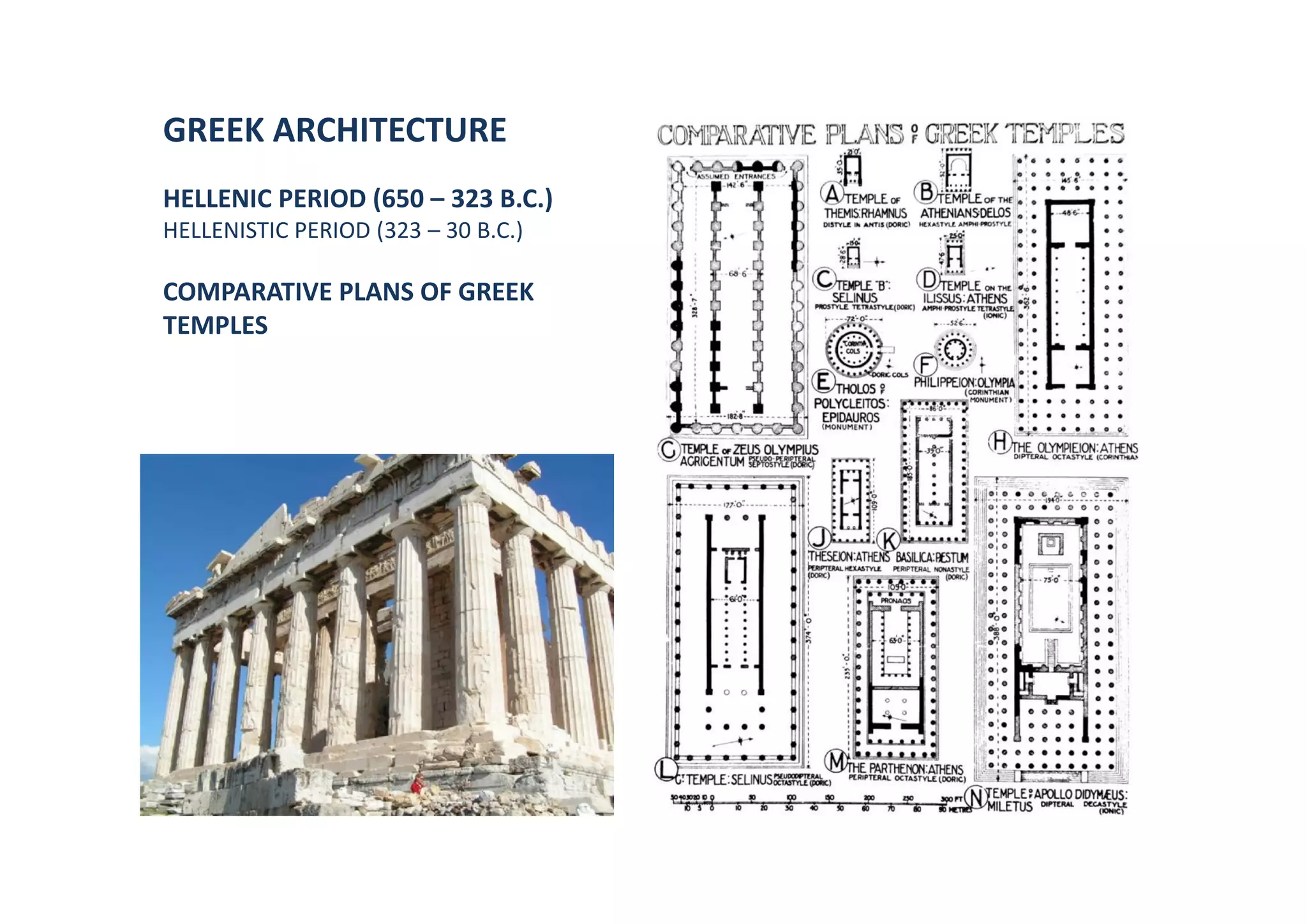
COMPARATIVE PLANS OF GREEK
TEMPLES
GREEK ARCHITECTURE
HELLENIC PERIOD (650 – 323 B.C.)
HELLENISTIC PERIOD (323 – 30 B.C.)
PARTHENON AT ATHENS
447 – 432 B.C.
The temple is built entirely in pentelic marble
on the high ground of Acropolis, south of
Temple of Athena (old) and dedicated to Athena
Parthenon the virgin Athena.
It was constructed by the architects Ictinus and
Callicrates under the supervision of master
sculptor Pheidias.
GREEK ARCHITECTURE
HELLENIC PERIOD (650 – 323 B.C.)
HELLENISTIC PERIOD (323 – 30 B.C.)
PARTHENON AT ATHENS
447 – 432 B.C.
The temple is built on rectangular plan 71 m
long and 32 m wide. It stands on crepidoma, a
platform of three steps with tread 70 cm, and
rise 50 cm and curves up in the middle of all
four sides. These being difficult to climb,
smaller steps are also provided at the centre of
east and west ends.
GREEK ARCHITECTURE
HELLENIC PERIOD (650 – 323 B.C.)
HELLENISTIC PERIOD (323 – 30 B.C.)
PARTHENON AT ATHENS 447 – 432 B.C.
ELEVATIONS
SECTIONS
The temple is constructed
facing east so that the
first rays of the rising sun
should fall and illuminate
the statue of Athena,
which is placed in ‘naos’
measuring 30 m long, 19
m wide with three rows
of columns, ten on each
side and five on western
side in two tiers.
GREEK ARCHITECTURE
HELLENIC PERIOD (650 – 323 B.C.)
HELLENISTIC PERIOD (323 – 30 B.C.)
PARTHENON AT ATHENS
447 – 432 B.C.
The statue of Athena in gold and
ivory with eyes of precious stones
was the finest sculptural
achievement of master artist
Pheidias. The statue measured 13
M with its pedestal.
GREEK ARCHITECTURE
HELLENIC PERIOD (650 – 323 B.C.)
HELLENISTIC PERIOD (323 – 30 B.C.)
PARTHENON AT ATHENS
447 – 432 B.C.
There are seventeen columns on either side
measuring the corner columns twice, the
intermediate columns are about L88 m whereas
the corner columns are 1.90 m in diameter at
base.
The corner columns were not only made stouter
but also set closer to the adjacent columns.
Otherwise they would have appeared thinner
and lonely against the open sky than those seen
against the solid background of the naos wall.
All columns are 10.4 m high and of Doric Order.
The fluting of the columns represent the highest
degree of artistry, the shafts have the slight
convexity or entasis.
The temple is designed in octa-style i.e. eight
columns in front and back, which lean inward.
THANK YOU

Greek architecture

  • 1.
    GREEK ARCHITECTURE PRESENTED BY: SMITJ. PANCHAL RONAK JAIN TUSHAR KACHADIYA SARYU A. PATEL
  • 2.
    GREEK ARCHITECTURE GEOGRAPHICAL CONDITION GEOLOGICALCONDITION CLIMATIC CONDITION RELIGIOUS CONDITION SOCIAL CONDITION HISTORICAL CONDITION GEOGRAPHICAL CONDITION: The ‘Aegean’ culture was started on ‘Crete’ an island in the Mediterranean sea in about 3000 B.C. by the migration of the people from Asia minor. after the fall of ‘Aegean’ its culture was extended to Greece and its island centuries later. It had a link by trade and commerce with Asia minor, Cyprus, Palestine, Syria, Egypt and as far as Italy and Sicily. Geography had a great influence on the Greek culture. the country is a mountainous and separated by the hills and dales. Moreover the area is surrounded on all three sides by sea with innumerable islands. the coast line is indented with many natural harbours. sea was the main source of communication. naturally the Greeks became bold, adventurous sea-men. they mainly depended for their expansion of kingdom on colonization.
  • 3.
    GREEK ARCHITECTURE GEOGRAPHICAL CONDITION GEOLOGICALCONDITION CLIMATIC CONDITION RELIGIOUS CONDITION SOCIAL CONDITION HISTORICAL CONDITION GEOLOGICAL CONDITION: Greece and its islands had plenty of building materials. But amongst them, the building stone of great importance was unrivalled marble which was plenty near Athens. On account of its beauty and fine texture it was possible for them to achieve refine treatment and delicacy of outlines in their carvings which are the main characteristics of GREEK ARCHITECTURE. The Greeks attached so much liking to this marble that they even covered stone and sun- dried bricks with marble ‘stucco’ – a powdered marble dust to receive colour decoration. This marble stucco had been used in many Greek – temples and palaces and have been highly polished that they reflect like a mirror, which is another important feature of GREEK ARCHITECTURE.
  • 4.
    GREEK ARCHITECTURE GEOGRAPHICAL CONDITION GEOLOGICALCONDITION CLIMATIC CONDITION RELIGIOUS CONDITION SOCIAL CONDITION HISTORICAL CONDITION CLIMATIC CONDITION: The climate is moderate, neither too cold nor too hot. This favoured the Greeks an outdoor life. They therefore constructed building suited to their out-door life such as administrative building, theatres, agora-an open air market, etc. The hot sun and sudden, unexpected showers of rains were the reasons for the construction of portico and colonnades which have become characteristic features of their style.
  • 5.
    GREEK ARCHITECTURE GEOGRAPHICAL CONDITION GEOLOGICALCONDITION CLIMATIC CONDITION RELIGIOUS CONDITION SOCIAL CONDITION HISTORICAL CONDITION RELIGIOUS CONDITION: The religion of ‘Aegean’ was based on natural worship and had many divinities in the form of human, scared bulls, but ‘ rhea’ the goddess of fertility or mother goddess was supreme. Priestesses rather than priests, carried out on sacrificial alter, in open air courtyard or in small shrines. Hence no temples were built. But after the fall of Aegean, the Greeks began to worship their deities in the temples. The Greek temples were surrounded by open colonnades in full view of common people. This is in strong contrast to the Egyptian temples which were royal monuments and hidden from public gaze and enclosed within high massive girdle walls.
  • 6.
    GREEK ARCHITECTURE GEOGRAPHICAL CONDITION GEOLOGICALCONDITION CLIMATIC CONDITION RELIGIOUS CONDITION SOCIAL CONDITION HISTORICAL CONDITION SOCIAL CONDITION: Civilization spread mainly during ‘Bronze Age’ in the island of ‘Crete’ consisting of about hundred cities. Trade and commerce, science and astronomy greatly developed. The Greeks were democratic and women played important role in social life. The idea was based on individual freedom. However common customs, religions, ideas and great epics united them like the Indians. Greeks’ national games and festivals encouraged literature, music and drama. Hence Greeks constructed stadiums, palaestra (wrestling school), theatres (for dance, drama), hippo-drome (for horse and chariot race), basilica (assembly hall) and agora (open air market) etc. Greek did not believe in life after death, hence there was little concern for tombs. There were also Pythagoras, the great Mathematician, Socrates, Plato, and Aristotle the great Philosopher, Scientist and Teacher of ‘Alexander the Great’. Greek’s love for beauty and variety gave rise to two versions of columns and entablature, the Doric of Western and Ionic of Eastern Greeks and the latter developed a third, the Corinthian. The three are known as ‘Orders of Architecture’ column consists of base, shaft, capital and entablature is made of architrave, frieze and cornice.
  • 7.
    GREEK ARCHITECTURE GEOGRAPHICAL CONDITION GEOLOGICALCONDITION CLIMATIC CONDITION RELIGIOUS CONDITION SOCIAL CONDITION HISTORICAL CONDITION HISTORICAL CONDITION: ‘Hellenic’ Greece was born with a humble start and made very rapid development with new civilization. And by 600 B.C. the Greeks founded most of their colonies. Most of the temples and world famous buildings were built during this period on the high ground at acropolis (upper city) in Athens. After Sparta’s arbitrary rule, next came philip (359-335 B.C.), the able king of Macedonia, under whose rule, the Athenian prosperity was at its highest peak. His son ‘Alexander the Great’ (336-323 B.C.) rose to a high position. In 334 B.C. within a span of six years he conquered the Egyptian and Persian empire. He founded in Egypt the famous city ‘Alexandria’ which became the main centre of Greek culture. He also conquered some part of northern India in 326 B.C. which helped the Greek art and culture to spread in Asian countries. On his return journey he died at Babylon in 323 B.C. at the early age of 32. Greece finally fell to Romans in 146 B.C. Cleopetra, the last queen of Egypt, eventually married Mark Antony in 37 B.C. hoping to extend her empire. However after the defeat, she committed suicide in 30 B.C. when Egypt was captured by Octavian, the future Roman Emperor Augustus.
  • 8.
    GREEK ARCHITECTURE HELLENIC PERIOD(650 – 323 B.C.) HELLENISTIC PERIOD (323 – 30 B.C.) CHARACTERISTIC FEATURES OPTICAL ILLUSIONS CHARACTERISTIC FEATURES: The term Hellenic is used to describe the early Greek’s Civilization. Greek Architecture is essentially a columnar and trabeated style and is considered to have evolved from wooden hut of upright posts and supporting beam and sloping rafters. The architectural style was simple in appearance and self – evident in design. Spans were limited because of trabeated style where the architraves were composed of single blocks of stones or marbles. They often used internal columns in temple hall. Arches, Domes, Vaults were not used by the Greeks. This is in strong contrast to the Roman Vault, Domes which were used to cover the vast spans. Greeks used timber in the beginning but soon they started using the marble, the most beautiful building stone. The same timber forms were imitated with great artistic skill, in refined treatment and delicacy of out–lines in their carvings. On account of this, Greek architecture has been rightly called as “CARPENTRY IN MARBLE”
  • 9.
    GREEK ARCHITECTURE HELLENIC PERIOD(650 – 323 B.C.) HELLENISTIC PERIOD (323 – 30 B.C.) CHARACTERISTIC FEATURES OPTICAL ILLUSIONS CHARACTERISTICS FEATURES: The exteriors of the buildings were designed with colonnades i.e. a series of columns. The doorways were square and rectangular. Windows were rarely used. Sloping roofs were covered with terra cotta or marble tiles mask. In 600 B.C. the use of marble became limited and was used only for finer works and sculptures. The walls were constructed with rubble and ashlar. But no mortar was used. They minimised the joints by using large sized stoned. Stone walls were beautified with marble stucco.
  • 10.
    GREEK ARCHITECTURE HELLENIC PERIOD(650 – 323 B.C.) HELLENISTIC PERIOD (323 – 30 B.C.) CHARACTERISTIC FEATURES OPTICAL ILLUSIONS OPTICAL ILLUSIONS: The important refinement adopted in Greek style was to correct the optical illusion. The long horizontal feature such as entablature which if built straight would have appeared to sag in the middle. This has been corrected by forming the façade with slight convex outlines in the centre. Also the vertical columns if built straight would have appeared curved inward. Hence to correct this defect, the sides of the columns were curved in a convex manner i.e. were made to bulge in the centre slightly, known as ‘Entasis’. Also the letters of inscriptions were made larger in upper lines than in lower, so that they might appear to be of the same size when seen from ground level. The admirable refinement, delicate adjustment, testify the remarkable sense of form and proportion exhibited in all the Greek Buildings.
  • 11.
    GREEK ARCHITECTURE OPTICALILLUSIONS: A. Correction of apparent proportions from an inscription on the face of the antae of a temple at Priene. B. Colour Effect on Proportions 1. X- The metopes & naos wall being black the columns appear sturdier and the architrave, triglyphs & cornice have importance. 2. Y- With reversed colouring, the columns appear thinner & higher & the entrablature loses its importance. C. The Parthenon – Inclination of columns & entablature. (H) Parallel straight lines having convex curves on either side appear wider apart in the center. (J) Parallel straight lines having concave curves on either side appear closer together in the center.
  • 12.
    GREEK ARCHITECTURE OPTICALILLUSIONS: D. Entasis: Vertical features were also inclined inwards towards the top to correct the appearance of falling outwards. This is called Entasis. The shafts of the Parthenon have a slight convexity of silhouette – as well as the usual upward taper – the deviation amounting to 11/16“ in a height of 31 ft. E. Angle columns of temples were not only set closer to the adjacent columns, but were also stouter, as it was found that they appeared thinner against the open sky than those seen against the solid background of the ‘naos’ wall. F. The long horizontal lines of features as stylobates, architraves and cornices, which if straight in reality would have appeared to sag or drop in the middle of their length, were formed with slightly convex outlines (In Parthenon, it has a upward curvature of 3/8”)
  • 13.
    GREEK ARCHITECTURE HELLENIC PERIOD(650 – 323 B.C.) HELLENISTIC PERIOD (323 – 30 B.C.) ORDERS ORDERS The three kind of architectural vocabularies called Orders of architecture namely, DORIC, IONIC AND CORINTHIAN were standardised and were largely employed in temples and places to attain the greatest effect with regard to beauty. The Greek Orders were necessary features of construction and essence of Greek Architecture. An order in classic architecture consists of upright column or support and the horizontal entablature or part supported. The column consists of base, the bottom part, shaft, the middle part, while entablature consists of architrave, the lower part, frieze, the middle part and cornice the upper most part.
  • 14.
    GREEK ARCHITECTURE HELLENIC PERIOD(650 – 323 B.C.) HELLENISTIC PERIOD (323 – 30 B.C.) ORDERS ORDERS The Greek classic order is distinguished from other I the sense that the different forms are brought to a definite set of rules. But these may not be necessarily taken as the principles on which they were first designed. These are the outcome of the study of the scholars of later times to fit the old examples. Greek buildings with all its beauty and grandeur existed even before the Orders were formed. Hence the Orders we study are based on the measurements of the existed Classic Orders.
  • 15.
    GREEK ARCHITECTURE HELLENIC PERIOD(650 – 323 B.C.) HELLENISTIC PERIOD (323 – 30 B.C.) ORDERS – DORIC The column height is six to seven times its lower diameter ‘D’. The column has no base but stands directly on a platform of three steps called Crepidoma. The bottom part is called Plinth (Stereobate) the middle, dado or die and the top one, the sylobate, each part being ¼ ‘D’ in height. The word Doric comes from Dorians the people of ancient Greece. The Oreder is taken from the famous Temple of Parthenon at Athens. It was constructed in B.C. 438 on the high grounds of Acropolis.
  • 16.
    GREEK ARCHITECTURE HELLENIC PERIOD(650 – 323 B.C.) HELLENISTIC PERIOD (323 – 30 B.C.) ORDERS – DORIC ORDERS – DORIC The shaft is circular and gradually tapersto 2/3D to 3/4D at top. The shaft in its length is divided into 20 flutes. i.e. elliptical channels or grooves, separated by sharp projections or ‘Arrises’. The ‘Inter columniation’ or centre to centre distance between two adjacent columns measured at the lower diameter of their shafts is 2D. The distinctive capital consists of ‘Abacus’ and ‘Echinus’. The abacus which is square block forms the upper member of the capital. The ‘echinus’ has a varying outline, Below the echinus, there are horizontal filtets three to five in numbers called ‘Annulets’ which break the vertical lines of the arrises and flutes of shaft.
  • 17.
    GREEK ARCHITECTURE HELLENIC PERIOD(650 – 323 B.C.) HELLENISTIC PERIOD (323 – 30 B.C.) ORDERS – DORIC ORDERS – DORIC ENTABLATURE – The entablature which is two diameter high, consists of three parts, namely ‘ Architrave’, ‘Frieze’ and ‘Cornice’. ARCHITRAVE – it is lintel proper which is plain and ¾ ‘D’ in height. It has a flat moulding at top called the ‘Taenia’ and below it is a ‘regula’ a short band with six ‘ guattae’ i.e. small cone like blocks occurring under each triglyph. The Architrave projects slightly beyond the face of the column. FRIEZE – the frieze which is ¾ ‘D’ high contains ‘Triglyph’ and ‘Metope’. The width of Triglyph is ussually one module. The Triglyph are placed immediately over the columns and at centres of the bays. The Triglyphs are so arranged that the spaces between them are nearly ‘squares’. These squares are called ‘Metopes’, they generally contain sculptures of hunting, fighting etc. CORNICE – it is the crowning part. It is semi – diameter high. It has at the top curved shaped slab called ‘Cymatium’ or a guttr-moulding resting on a birds beak and below this, is corona orvertical face. The cornice projects beyond the frieze by one module. On the top of cornice, decorated bocks called ‘Antefixae’ are placed at regular distance to hide the joints of the roof tiles.
  • 18.
    GREEK ARCHITECTURE HELLENIC PERIOD(650 – 323 B.C.) HELLENISTIC PERIOD (323 – 30 B.C.) ORDERS – DORIC ORDERS – DORIC EVOLUTION OF DORIC ORDER
  • 19.
    GREEK ARCHITECTURE HELLENIC PERIOD(650 – 323 B.C.) HELLENISTIC PERIOD (323 – 30 B.C.) ORDERS – DORIC ORDERS – DORIC
  • 20.
    GREEK ARCHITECTURE HELLENIC PERIOD(650 – 323 B.C.) HELLENISTIC PERIOD (323 – 30 B.C.) ORDERS – IONIC The column has a base. The column height including base, shaft, and capital is usually nine times the lower diameter. The moulded base which is semi-diameter in height consists of upper and lower ‘Torus’ separated by ‘Scotia’ and fillets. The circular shaft has 24 flutes separated by fillets and not by arrises as in Doric order. The shaft dimensions to 5/6 the diameter at its top. The inter-columniation is 4D This Order is named after the Ionians of ancient Greece. The Ionic Order is specially remarkable for its volute or scroll capital or decorative motif derived from lotus or nautilus shell or ram’s horns
  • 21.
    GREEK ARCHITECTURE HELLENIC PERIOD(650 – 323 B.C.) HELLENISTIC PERIOD (323 – 30 B.C.) ORDERS – IONIC ORDERS – IONIC ENTABLATURE – The Ionic entablature varies in height but is usually about two diameter high. It consists of the following: ARCHITRAVE – It is –r dimeter high. It consists of triple fasciae i.e. three beams projecting one above the other. FRIEZE – It is either plan or ornamented by a continuous band of sculptures. It is ̂diameter high. CORNICE – It has a similar treatment like Doric Order. It is semi-diameter high. There is usually no antifixae on the flanks but aymatium is elaborately enriched by lotus and papyrus ornament. The Greek Ionic Order is more ornate than the Doric. It has grace, elegance and refinement of outlines.
  • 22.
  • 23.
    GREEK ARCHITECTURE HELLENIC PERIOD(650 – 323 B.C.) HELLENISTIC PERIOD (323 – 30 B.C.) ORDERS – CORINTHIAN ORDERS – CORINTHIAN The Corinthian Order has distinctive capital which is much deeper than Ionic being about 1-1/3 diameter high. Its origin is uncertain but it might have been evolved from the Egyptian ‘Bell’ shaped capital The column including base, shaft and capital is about ten times its lower diameter in height. The base is semi-diameter high like the Ionian Order with its upper and lower torus separated by Scotia and fillets. The lower Torus is W times the diameter of the shaft. The shaft is circular and tapered to 5/6 the diameter at top. It has 24 flutes separated by fillets, which are nearly one-fourth of the width of the flutes. The intercolumniation is 3 D. Usual type of capital has a deep inverted bell shape, the lower part of which contains two rows of eight acanthus leaves resting on lotus or water leaves from which spring small volutes supporting the corners of the moulded abacus and the central foliated ornaments. This Order is more lighter and The Greek Corinthian Order was chiefly used as a decorative feature and was little used by the Greeks.
  • 24.
    GREEK ARCHITECTURE HELLENIC PERIOD(650 – 323 B.C.) HELLENISTIC PERIOD (323 – 30 B.C.) ORDERS – CORINTHIAN ORDERS – CORINTHIAN ENTABLATURE – The Corinthian entablature which is usually 2 j diameter high bears a closeresemblance to the Ionic Order. It consists of the following: ARCHITRAVE – It is –r dimeter high and is divided in three fasciae i.e. three slabs raised one above the other with slight projections. FRIEZE – It is also –j diameter high and ornamented by a continuous band of sculptures. CORNICE – It is lighter than other types. It is also -% diameter high and contains dentils below the corona. At top ‘Antefixa’ ornament is provided. The Order is more lighter and The Greek Corinthian Order chiefly used as a decorative feature and was little used by the Greeks.
  • 25.
    GREEK ARCHITECTURE HELLENIC PERIOD(650 – 323 B.C.) HELLENISTIC PERIOD (323 – 30 B.C.) ORDERS – CORINTHIAN CAPITAL ORDERS – EVOLUTION OF THE CORINTHIAN CAPITAL
  • 26.
    GREEK ARCHITECTURE HELLENIC PERIOD(650 – 323 B.C.) HELLENISTIC PERIOD (323 – 30 B.C.) ORDERS ORDERS – COMPARISION
  • 27.
    GREEK ARCHITECTURE HELLENIC PERIOD(650 – 323 B.C.) HELLENISTIC PERIOD (323 – 30 B.C.) ACROPOLIS ACROPOLIS The Acropolis at Athens is the supreme example of a Greek sanctuary. It was originally a Late Bronze Age citadel, with massive fortifications similar to those at Tiryns and Mycenae, and with a western entrance gate flanked by a projecting bastion like the Lion gate at Mycenae. The usual buildings in the Acropolis at Athens were Temples constructions.
  • 28.
  • 29.
  • 30.
    GREEK ARCHITECTURE HELLENIC PERIOD(650 – 323 B.C.) HELLENISTIC PERIOD (323 – 30 B.C.) ACROPOLIS TEMPLES The temples were main types of buildings in the Hellenic period. They were to worship the deities to whom the temple was dedicated. The Greek temples are oriented to face east so that the statue of the deity would be lit by the glory of the rising sun The temple is usually surrounded by open colonnades which is character of the Greek architecture. The entrance doors on the east front were tall, about the height of naos so as to allow plenty of light to lit the statue in the naos treasury chambers in front and rear known as pronaos and epinaos. Windows were rare which gave to the thought that a few temples might have been partly open to sky. The front consists of closely spaced columns supporting a triangular shaped pediment. The tympanum in the pediment is usually filled with sculptures. The timber roofs were most common, covered with terra-cotta or marble tiles overlapping one above the other.
  • 31.
    GREEK ARCHITECTURE HELLENIC PERIOD(650 – 323 B.C.) HELLENISTIC PERIOD (323 – 30 B.C.) COMPARATIVE PLANS OF GREEK TEMPLES
  • 32.
    GREEK ARCHITECTURE HELLENIC PERIOD(650 – 323 B.C.) HELLENISTIC PERIOD (323 – 30 B.C.) PARTHENON AT ATHENS 447 – 432 B.C. The temple is built entirely in pentelic marble on the high ground of Acropolis, south of Temple of Athena (old) and dedicated to Athena Parthenon the virgin Athena. It was constructed by the architects Ictinus and Callicrates under the supervision of master sculptor Pheidias.
  • 33.
    GREEK ARCHITECTURE HELLENIC PERIOD(650 – 323 B.C.) HELLENISTIC PERIOD (323 – 30 B.C.) PARTHENON AT ATHENS 447 – 432 B.C. The temple is built on rectangular plan 71 m long and 32 m wide. It stands on crepidoma, a platform of three steps with tread 70 cm, and rise 50 cm and curves up in the middle of all four sides. These being difficult to climb, smaller steps are also provided at the centre of east and west ends.
  • 34.
    GREEK ARCHITECTURE HELLENIC PERIOD(650 – 323 B.C.) HELLENISTIC PERIOD (323 – 30 B.C.) PARTHENON AT ATHENS 447 – 432 B.C. ELEVATIONS SECTIONS The temple is constructed facing east so that the first rays of the rising sun should fall and illuminate the statue of Athena, which is placed in ‘naos’ measuring 30 m long, 19 m wide with three rows of columns, ten on each side and five on western side in two tiers.
  • 35.
    GREEK ARCHITECTURE HELLENIC PERIOD(650 – 323 B.C.) HELLENISTIC PERIOD (323 – 30 B.C.) PARTHENON AT ATHENS 447 – 432 B.C. The statue of Athena in gold and ivory with eyes of precious stones was the finest sculptural achievement of master artist Pheidias. The statue measured 13 M with its pedestal.
  • 36.
    GREEK ARCHITECTURE HELLENIC PERIOD(650 – 323 B.C.) HELLENISTIC PERIOD (323 – 30 B.C.) PARTHENON AT ATHENS 447 – 432 B.C. There are seventeen columns on either side measuring the corner columns twice, the intermediate columns are about L88 m whereas the corner columns are 1.90 m in diameter at base. The corner columns were not only made stouter but also set closer to the adjacent columns. Otherwise they would have appeared thinner and lonely against the open sky than those seen against the solid background of the naos wall. All columns are 10.4 m high and of Doric Order. The fluting of the columns represent the highest degree of artistry, the shafts have the slight convexity or entasis. The temple is designed in octa-style i.e. eight columns in front and back, which lean inward.
  • 37.