INDIVIDUAL SEMINAR PRESENTATION
ON
IMPORTANCE OF ICT IN TEACHING LEARNING PROCESS
DEBNARAYAN SHIKSHAN B.ED COLLEGE
PRESENTED
BY
SUSMITA ROY
ABSTRACT:
There are certain unavoidable facts that need to be taken care of
when we talk about the current trends and innovations in our
system of education. Many educational reformations are also
taking place. One amid is Information and Communication
Technology (ICT). ICT stands for information and communication
technology. ICT include the use of hardware and software for
efficient management of information and it also includes
communication devices like radio, television, cell phones,
computer, satellite systems and many more. It refers to that
technology which is used to transmit, store, share, create or
exchange information. Innovations in technology and
globalization have leaded to an enlarged the use of ICTs in all
sectors. In modern era, the world is moving rapidly towards
digitalization such as e-governance, e- health, e- education etc.
INTRODUCTION:
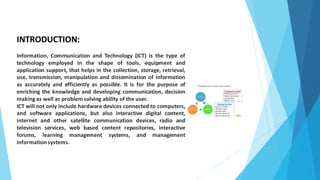
Information, Communication and Technology (ICT) is the type of
technology employed in the shape of tools, equipment and
application support, that helps in the collection, storage, retrieval,
use, transmission, manipulation and dissemination of information
as accurately and efficiently as possible. It is for the purpose of
enriching the knowledge and developing communication, decision
making as well as problem solving ability of the user.
ICT will not only include hardware devices connected to computers,
and software applications, but also interactive digital content,
internet and other satellite communication devices, radio and
television services, web based content repositories, interactive
forums, learning management systems, and management
informationsystems.
OBJECTIVES:
To examine the role of ICT in education.
To understand the benefits of using ICT to enhance
teaching and student learning.
To help students to become competent and
confident users.
To draw lessons for successful use of ICT.
ADVANTAGES:
ICT improve access to remote learning
resources .
ICTs help to transform the learning
environment into learner –centred.
Motivate to learn anytime, anywhere.
Enhancing teacher training and
collaborative learning.
DISADVANTAGES:
High cost of acquiring installing operating, maintain and replacing the
ICT.
Using unlicensed software can be very problematic.
It can be boring sitting in front of a computer for a long time.
CURRENT SCENARIO:
In the present era, we are living in a constantly developing
digital world. Now a day’s, ICT has revolutionized the social,
political and economic aspect of our life. ICT has an impact
on nearly every aspect of our lives – from working to
socializing and learning to playing. The digital age has
changed the way young people communicate, network, seek
help, access information and learn. We must know that
young people are now an online population and access is
through a variety of means such as computers, TV and
mobile phones.
NECESSITY IN INDIA:
For online learning or E-learning like swayam, swayam prabha,
Massive open online process (MOOCs), National Digital Library( NDL).
Open and distance learning.
To raise the quality of education
CONCLUSION:
ICT played significant role in improving the
standards in education, hence its inclusion in
the curriculum is a step in the right direction.
The implementation and use of ICTs in
education have a positive impact on teaching
and learning. Hasty changes in the technologies
are signifying the role of ICT in future will grow
extremely in the education. It will also increase
the flexibility so that learners can access the
education regardless of time and place in the
21st century. It would provide the prosperous
atmosphere and motivation for teaching-
learning process which seems to have a deep
impact on the process of learning in education
by offering new possibilities for learners and
teachers.
REFERENCES:
1. Dr. Gill, Arvind (2017). Role of ICT in effective
curriculum transaction and
evaluation, International journal of applied
research , ISSN 2394-7500 vol., Issue 1
2.Meenakshi(2013). Importance of ICT in
education, IOSR journal of research and
method in education ISSN-737X vol.1 Issue 4
3. Richard, J . Augustus (2015). The role of ICT
in higher education in the 21st
century, International journal of
multidisciplinary research and modern
education ISSN 2454-6119, Vol. 1, Issue 1.
THANK YOU

susmita.pdf

  • 1.
    INDIVIDUAL SEMINAR PRESENTATION ON IMPORTANCEOF ICT IN TEACHING LEARNING PROCESS DEBNARAYAN SHIKSHAN B.ED COLLEGE PRESENTED BY SUSMITA ROY
  • 2.
    ABSTRACT: There are certainunavoidable facts that need to be taken care of when we talk about the current trends and innovations in our system of education. Many educational reformations are also taking place. One amid is Information and Communication Technology (ICT). ICT stands for information and communication technology. ICT include the use of hardware and software for efficient management of information and it also includes communication devices like radio, television, cell phones, computer, satellite systems and many more. It refers to that technology which is used to transmit, store, share, create or exchange information. Innovations in technology and globalization have leaded to an enlarged the use of ICTs in all sectors. In modern era, the world is moving rapidly towards digitalization such as e-governance, e- health, e- education etc.
  • 3.
    INTRODUCTION: Information, Communication andTechnology (ICT) is the type of technology employed in the shape of tools, equipment and application support, that helps in the collection, storage, retrieval, use, transmission, manipulation and dissemination of information as accurately and efficiently as possible. It is for the purpose of enriching the knowledge and developing communication, decision making as well as problem solving ability of the user. ICT will not only include hardware devices connected to computers, and software applications, but also interactive digital content, internet and other satellite communication devices, radio and television services, web based content repositories, interactive forums, learning management systems, and management informationsystems.
  • 4.
    OBJECTIVES: To examine therole of ICT in education. To understand the benefits of using ICT to enhance teaching and student learning. To help students to become competent and confident users. To draw lessons for successful use of ICT.
  • 5.
    ADVANTAGES: ICT improve accessto remote learning resources . ICTs help to transform the learning environment into learner –centred. Motivate to learn anytime, anywhere. Enhancing teacher training and collaborative learning.
  • 6.
    DISADVANTAGES: High cost ofacquiring installing operating, maintain and replacing the ICT. Using unlicensed software can be very problematic. It can be boring sitting in front of a computer for a long time.
  • 7.
    CURRENT SCENARIO: In thepresent era, we are living in a constantly developing digital world. Now a day’s, ICT has revolutionized the social, political and economic aspect of our life. ICT has an impact on nearly every aspect of our lives – from working to socializing and learning to playing. The digital age has changed the way young people communicate, network, seek help, access information and learn. We must know that young people are now an online population and access is through a variety of means such as computers, TV and mobile phones.
  • 8.
    NECESSITY IN INDIA: Foronline learning or E-learning like swayam, swayam prabha, Massive open online process (MOOCs), National Digital Library( NDL). Open and distance learning. To raise the quality of education
  • 9.
    CONCLUSION: ICT played significantrole in improving the standards in education, hence its inclusion in the curriculum is a step in the right direction. The implementation and use of ICTs in education have a positive impact on teaching and learning. Hasty changes in the technologies are signifying the role of ICT in future will grow extremely in the education. It will also increase the flexibility so that learners can access the education regardless of time and place in the 21st century. It would provide the prosperous atmosphere and motivation for teaching- learning process which seems to have a deep impact on the process of learning in education by offering new possibilities for learners and teachers.
  • 10.
    REFERENCES: 1. Dr. Gill,Arvind (2017). Role of ICT in effective curriculum transaction and evaluation, International journal of applied research , ISSN 2394-7500 vol., Issue 1 2.Meenakshi(2013). Importance of ICT in education, IOSR journal of research and method in education ISSN-737X vol.1 Issue 4 3. Richard, J . Augustus (2015). The role of ICT in higher education in the 21st century, International journal of multidisciplinary research and modern education ISSN 2454-6119, Vol. 1, Issue 1.
  • 11.