ICT on Teaching and Learning
Dr. M. Senthilkumaran
Assistant Professor
Department of Educational Technology
Tamil Nadu Teachers Education University
Chennai – 600 097
Introduction
• Globalization and technological
changes have created a new global
economy
– powered by technology,
– fuelled by information and
– driven by knowledge.
Impact of Global
Change
• Due to Globalization, the information to be
collected from any sources and disseminate
those information to various parts of the
world has to be made so faster. This is
possible by means of technology.
• In the same way Globalisation and
technology has a great impact among the
educational institutions.
• So, the educational institutions planned to
integrate technology in their institutions for
both Academic and Administration
purposes.
ICT
• ICT stands for Information and
Communication Technology.
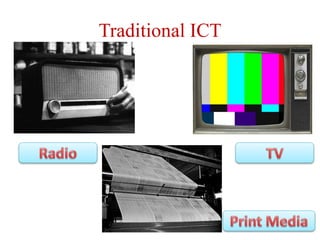
• During the olden days, ICT includes
Radio, Television and some digital
technologies.
• Later Computer and Internet played
a vital role.
• Nowadays every information is shared
through digital devices instantly.
ICT in Education
• ICT expand its services in educational
sector by
– access to education,
– strengthen the relevance of education
to the digital workspace and
– help in quality teaching learning
process.
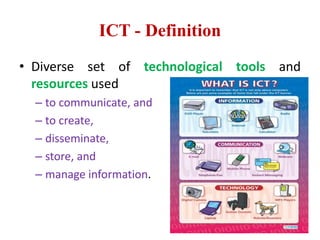
ICT - Definition
• Diverse set of technological tools and
resources used
– to communicate, and
– to create,
– disseminate,
– store, and
– manage information.
ICT in Education - Definition
• "Information and communications technology
(ICT) in education is the processing of
information and its communications facilities
and features that variously support teaching,
learning and a wide range of activities in
education.
Traditional ICT
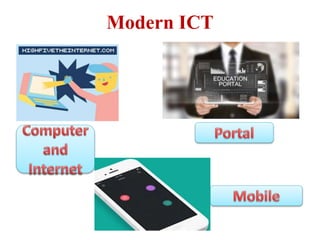
Modern ICT
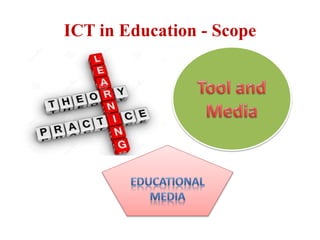
ICT in Education - Scope
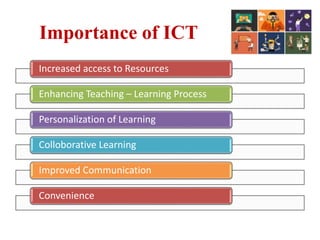
Importance of ICT
Increased access to Resources
Enhancing Teaching – Learning Process
Personalization of Learning
Colloborative Learning
Improved Communication
Convenience
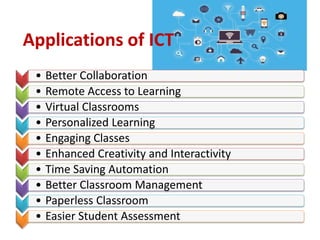
Applications of ICT
• Better Collaboration
• Remote Access to Learning
• Virtual Classrooms
• Personalized Learning
• Engaging Classes
• Enhanced Creativity and Interactivity
• Time Saving Automation
• Better Classroom Management
• Paperless Classroom
• Easier Student Assessment
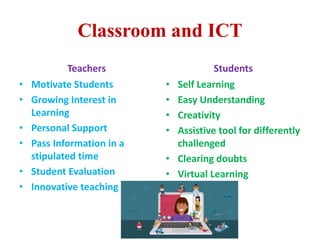
Classroom and ICT
Teachers
• Motivate Students
• Growing Interest in
Learning
• Personal Support
• Pass Information in a
stipulated time
• Student Evaluation
• Innovative teaching
Students
• Self Learning
• Easy Understanding
• Creativity
• Assistive tool for differently
challenged
• Clearing doubts
• Virtual Learning
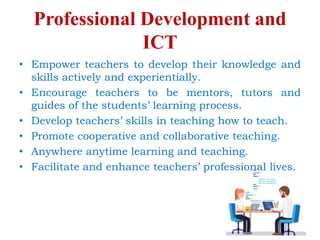
Professional Development and
ICT
• Empower teachers to develop their knowledge and
skills actively and experientially.
• Encourage teachers to be mentors, tutors and
guides of the students’ learning process.
• Develop teachers’ skills in teaching how to teach.
• Promote cooperative and collaborative teaching.
• Anywhere anytime learning and teaching.
• Facilitate and enhance teachers’ professional lives.
Emergence of Information
Technology
• Acquisition, Storage, manipulation,
management, transmission or reception of
data or information.
• Real time access to information.
• Easy availability of updated data.
• Connecting Geographically dispersed regions.
• Wider range of communication media.
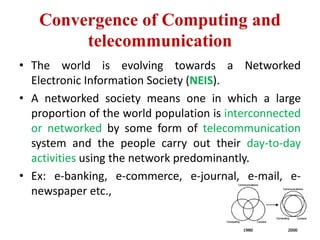
Convergence of Computing and
telecommunication
• The world is evolving towards a Networked
Electronic Information Society (NEIS).
• A networked society means one in which a large
proportion of the world population is interconnected
or networked by some form of telecommunication
system and the people carry out their day-to-day
activities using the network predominantly.
• Ex: e-banking, e-commerce, e-journal, e-mail, e-
newspaper etc.,
Conclusion
• Information and communication technology plays a vital
role in today’s educational institutions. It helps both the
teachers and students in their academic side.
• The Educational institutions has adopted ICT in their
institutions to compete with the other institutions.
• The MHRD has introduced SWAYAM Courses for the benefit
of the students.
• With the advent of ICT in the field of education most of the
teachers are regularly updating their technical skills.
• The students are nowadays self motivated and self
confident in using the ICT.
• Social Media helps the people to be interconnected as a
community group so as to share their views.
References
• https://archive.mu.ac.in/myweb_test/ma%20edu/ICT%
20-%20Edu..pdf
• https://www.easybiologyclass.com/importance-of-ict-
in-education/
• https://www.raijmr.com/ijre/wp-
content/uploads/2017/11/IJRE_2013_vol02_issue_09_
07.pdf
• https://egyankosh.ac.in/bitstream/123456789/35781/
5/Unit-4.pdf
• https://www.binaryblue.co.uk/blog/what-are-the-10-
uses-of-ict-in-education/
• www.googleimages.com
ICT.ppt

ICT.ppt

  • 1.
    ICT on Teachingand Learning Dr. M. Senthilkumaran Assistant Professor Department of Educational Technology Tamil Nadu Teachers Education University Chennai – 600 097
  • 2.
    Introduction • Globalization andtechnological changes have created a new global economy – powered by technology, – fuelled by information and – driven by knowledge.
  • 3.
    Impact of Global Change •Due to Globalization, the information to be collected from any sources and disseminate those information to various parts of the world has to be made so faster. This is possible by means of technology. • In the same way Globalisation and technology has a great impact among the educational institutions. • So, the educational institutions planned to integrate technology in their institutions for both Academic and Administration purposes.
  • 4.
    ICT • ICT standsfor Information and Communication Technology. • During the olden days, ICT includes Radio, Television and some digital technologies. • Later Computer and Internet played a vital role. • Nowadays every information is shared through digital devices instantly.
  • 5.
    ICT in Education •ICT expand its services in educational sector by – access to education, – strengthen the relevance of education to the digital workspace and – help in quality teaching learning process.
  • 6.
    ICT - Definition •Diverse set of technological tools and resources used – to communicate, and – to create, – disseminate, – store, and – manage information.
  • 7.
    ICT in Education- Definition • "Information and communications technology (ICT) in education is the processing of information and its communications facilities and features that variously support teaching, learning and a wide range of activities in education.
  • 8.
  • 9.
  • 10.
  • 11.
    Importance of ICT Increasedaccess to Resources Enhancing Teaching – Learning Process Personalization of Learning Colloborative Learning Improved Communication Convenience
  • 12.
    Applications of ICT •Better Collaboration • Remote Access to Learning • Virtual Classrooms • Personalized Learning • Engaging Classes • Enhanced Creativity and Interactivity • Time Saving Automation • Better Classroom Management • Paperless Classroom • Easier Student Assessment
  • 13.
    Classroom and ICT Teachers •Motivate Students • Growing Interest in Learning • Personal Support • Pass Information in a stipulated time • Student Evaluation • Innovative teaching Students • Self Learning • Easy Understanding • Creativity • Assistive tool for differently challenged • Clearing doubts • Virtual Learning
  • 14.
    Professional Development and ICT •Empower teachers to develop their knowledge and skills actively and experientially. • Encourage teachers to be mentors, tutors and guides of the students’ learning process. • Develop teachers’ skills in teaching how to teach. • Promote cooperative and collaborative teaching. • Anywhere anytime learning and teaching. • Facilitate and enhance teachers’ professional lives.
  • 15.
    Emergence of Information Technology •Acquisition, Storage, manipulation, management, transmission or reception of data or information. • Real time access to information. • Easy availability of updated data. • Connecting Geographically dispersed regions. • Wider range of communication media.
  • 16.
    Convergence of Computingand telecommunication • The world is evolving towards a Networked Electronic Information Society (NEIS). • A networked society means one in which a large proportion of the world population is interconnected or networked by some form of telecommunication system and the people carry out their day-to-day activities using the network predominantly. • Ex: e-banking, e-commerce, e-journal, e-mail, e- newspaper etc.,
  • 17.
    Conclusion • Information andcommunication technology plays a vital role in today’s educational institutions. It helps both the teachers and students in their academic side. • The Educational institutions has adopted ICT in their institutions to compete with the other institutions. • The MHRD has introduced SWAYAM Courses for the benefit of the students. • With the advent of ICT in the field of education most of the teachers are regularly updating their technical skills. • The students are nowadays self motivated and self confident in using the ICT. • Social Media helps the people to be interconnected as a community group so as to share their views.
  • 18.
    References • https://archive.mu.ac.in/myweb_test/ma%20edu/ICT% 20-%20Edu..pdf • https://www.easybiologyclass.com/importance-of-ict- in-education/ •https://www.raijmr.com/ijre/wp- content/uploads/2017/11/IJRE_2013_vol02_issue_09_ 07.pdf • https://egyankosh.ac.in/bitstream/123456789/35781/ 5/Unit-4.pdf • https://www.binaryblue.co.uk/blog/what-are-the-10- uses-of-ict-in-education/ • www.googleimages.com