STRUCTURE AND COMPOSITION OF
THE EARTH’S CRUST
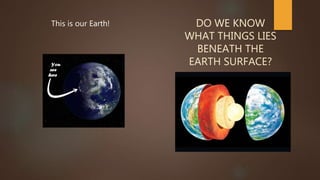
DO WE KNOW
WHAT THINGS LIES
BENEATH THE
EARTH SURFACE?
This is our Earth!
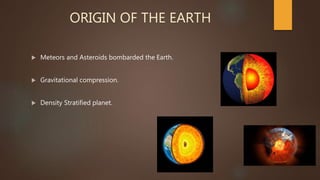
ORIGIN OF THE EARTH
 Meteors and Asteroids bombarded the Earth.
 Gravitational compression.
 Density Stratified planet.
EVIDENCE OF INTERNAL STRUCTURE
 Direct & Indirect
 Direct evidence:
From rock samples. Scientists drill up to 12 km into
the earth. Forces blast rock from as deep as 100 km.
 Indirect evidence:
From seismic waves
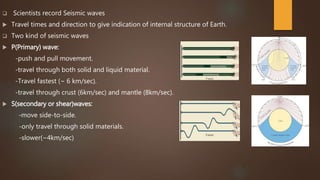
 Scientists record Seismic waves
 Travel times and direction to give indication of internal structure of Earth.
 Two kind of seismic waves
 P(Primary) wave:
-push and pull movement.
-travel through both solid and liquid material.
-Travel fastest (~ 6 km/sec).
-travel through crust (6km/sec) and mantle (8km/sec).
 S(secondary or shear)waves:
-move side-to-side.
-only travel through solid materials.
-slower(~4km/sec)
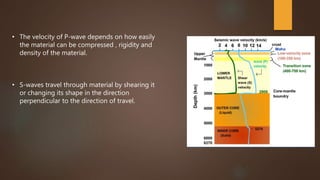
• The velocity of P-wave depends on how easily
the material can be compressed , rigidity and
density of the material.
• S-waves travel through material by shearing it
or changing its shape in the direction
perpendicular to the direction of travel.
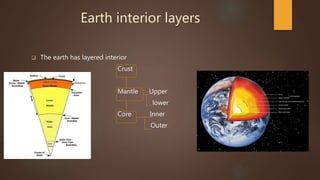
Earth interior layers
 The earth has layered interior
Crust
Mantle Upper
lower
Core Inner
Outer
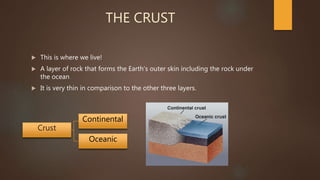
THE CRUST
 This is where we live!
 A layer of rock that forms the Earth’s outer skin including the rock under
the ocean
 It is very thin in comparison to the other three layers.
Crust
Continental
Oceanic
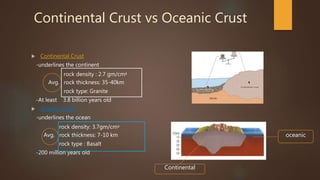
Continental Crust vs Oceanic Crust
 Continental Crust
-underlines the continent
rock density : 2.7 gm/cmᶟ
Avg. rock thickness: 35-40km
rock type: Granite
-At least 3.8 billion years old
 Oceanic Crust
-underlines the ocean
rock density: 3.7gm/cmᶟ
Avg. rock thickness: 7-10 km
rock type : Basalt
-200 million years old
Continental
oceanic
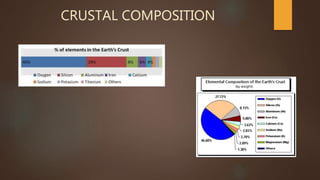
CRUSTAL COMPOSITION
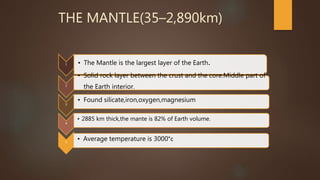
THE MANTLE(35–2,890km)
1 • The Mantle is the largest layer of the Earth.
2
• Solid rock layer between the crust and the core.Middle part of
the Earth interior.
3
• Found silicate,iron,oxygen,magnesium
4
• 2885 km thick,the mante is 82% of Earth volume.
5
• Average temperature is 3000°c
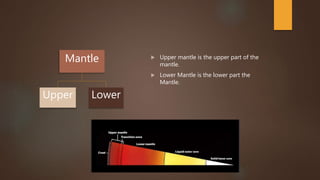
Mantle
Upper Lower
 Upper mantle is the upper part of the
mantle.
 Lower Mantle is the lower part the
Mantle.
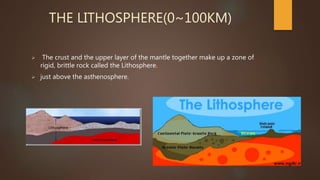
THE LITHOSPHERE(0~100KM)
 The crust and the upper layer of the mantle together make up a zone of
rigid, brittle rock called the Lithosphere.
 just above the asthenosphere.
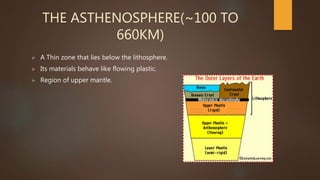
THE ASTHENOSPHERE(~100 TO
660KM)
 A Thin zone that lies below the lithosphere.
 Its materials behave like flowing plastic.
 Region of upper mantle.
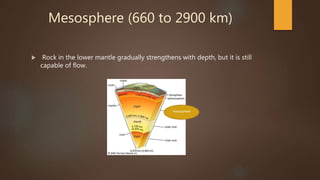
Mesosphere (660 to 2900 km)
 Rock in the lower mantle gradually strengthens with depth, but it is still
capable of flow.
mesosphere
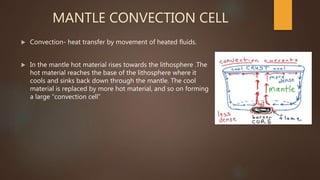
MANTLE CONVECTION CELL
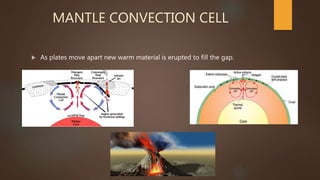
 Convection- heat transfer by movement of heated fluids.
 In the mantle hot material rises towards the lithosphere .The
hot material reaches the base of the lithosphere where it
cools and sinks back down through the mantle. The cool
material is replaced by more hot material, and so on forming
a large “convection cell”
MANTLE CONVECTION CELL
 As plates move apart new warm material is erupted to fill the gap.
THE CORE
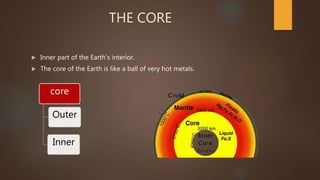
 Inner part of the Earth’s interior.
 The core of the Earth is like a ball of very hot metals.
core
Inner
Outer
OUTER CORE(2900 to 5170 km)
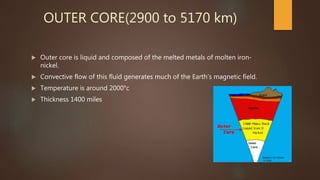
 Outer core is liquid and composed of the melted metals of molten iron-
nickel.
 Convective flow of this fluid generates much of the Earth’s magnetic field.
 Temperature is around 2000°c
 Thickness 1400 miles
INNER CORE(5170 to 6386 km)
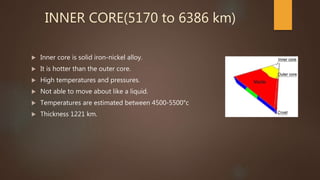
 Inner core is solid iron-nickel alloy.
 It is hotter than the outer core.
 High temperatures and pressures.
 Not able to move about like a liquid.
 Temperatures are estimated between 4500-5500°c
 Thickness 1221 km.
EARTH’S MAGNETIC FIELD
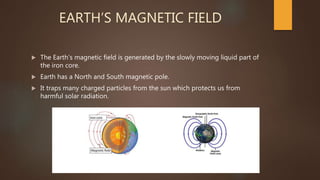
 The Earth’s magnetic field is generated by the slowly moving liquid part of
the iron core.
 Earth has a North and South magnetic pole.
 It traps many charged particles from the sun which protects us from
harmful solar radiation.
MOHO
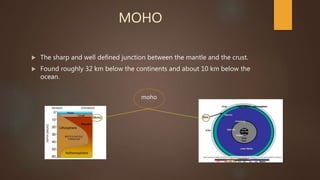
 The sharp and well defined junction between the mantle and the crust.
 Found roughly 32 km below the continents and about 10 km below the
ocean.
moho
THANK YOU

Earth internal structure

  • 1.
    STRUCTURE AND COMPOSITIONOF THE EARTH’S CRUST
  • 2.
    DO WE KNOW WHATTHINGS LIES BENEATH THE EARTH SURFACE? This is our Earth!
  • 3.
    ORIGIN OF THEEARTH  Meteors and Asteroids bombarded the Earth.  Gravitational compression.  Density Stratified planet.
  • 4.
    EVIDENCE OF INTERNALSTRUCTURE  Direct & Indirect  Direct evidence: From rock samples. Scientists drill up to 12 km into the earth. Forces blast rock from as deep as 100 km.  Indirect evidence: From seismic waves
  • 5.
     Scientists recordSeismic waves  Travel times and direction to give indication of internal structure of Earth.  Two kind of seismic waves  P(Primary) wave: -push and pull movement. -travel through both solid and liquid material. -Travel fastest (~ 6 km/sec). -travel through crust (6km/sec) and mantle (8km/sec).  S(secondary or shear)waves: -move side-to-side. -only travel through solid materials. -slower(~4km/sec)
  • 6.
    • The velocityof P-wave depends on how easily the material can be compressed , rigidity and density of the material. • S-waves travel through material by shearing it or changing its shape in the direction perpendicular to the direction of travel.
  • 7.
    Earth interior layers The earth has layered interior Crust Mantle Upper lower Core Inner Outer
  • 8.
    THE CRUST  Thisis where we live!  A layer of rock that forms the Earth’s outer skin including the rock under the ocean  It is very thin in comparison to the other three layers. Crust Continental Oceanic
  • 9.
    Continental Crust vsOceanic Crust  Continental Crust -underlines the continent rock density : 2.7 gm/cmᶟ Avg. rock thickness: 35-40km rock type: Granite -At least 3.8 billion years old  Oceanic Crust -underlines the ocean rock density: 3.7gm/cmᶟ Avg. rock thickness: 7-10 km rock type : Basalt -200 million years old Continental oceanic
  • 10.
  • 11.
    THE MANTLE(35–2,890km) 1 •The Mantle is the largest layer of the Earth. 2 • Solid rock layer between the crust and the core.Middle part of the Earth interior. 3 • Found silicate,iron,oxygen,magnesium 4 • 2885 km thick,the mante is 82% of Earth volume. 5 • Average temperature is 3000°c
  • 12.
    Mantle Upper Lower  Uppermantle is the upper part of the mantle.  Lower Mantle is the lower part the Mantle.
  • 13.
    THE LITHOSPHERE(0~100KM)  Thecrust and the upper layer of the mantle together make up a zone of rigid, brittle rock called the Lithosphere.  just above the asthenosphere.
  • 14.
    THE ASTHENOSPHERE(~100 TO 660KM) A Thin zone that lies below the lithosphere.  Its materials behave like flowing plastic.  Region of upper mantle.
  • 15.
    Mesosphere (660 to2900 km)  Rock in the lower mantle gradually strengthens with depth, but it is still capable of flow. mesosphere
  • 16.
    MANTLE CONVECTION CELL Convection- heat transfer by movement of heated fluids.  In the mantle hot material rises towards the lithosphere .The hot material reaches the base of the lithosphere where it cools and sinks back down through the mantle. The cool material is replaced by more hot material, and so on forming a large “convection cell”
  • 17.
    MANTLE CONVECTION CELL As plates move apart new warm material is erupted to fill the gap.
  • 18.
    THE CORE  Innerpart of the Earth’s interior.  The core of the Earth is like a ball of very hot metals. core Inner Outer
  • 19.
    OUTER CORE(2900 to5170 km)  Outer core is liquid and composed of the melted metals of molten iron- nickel.  Convective flow of this fluid generates much of the Earth’s magnetic field.  Temperature is around 2000°c  Thickness 1400 miles
  • 20.
    INNER CORE(5170 to6386 km)  Inner core is solid iron-nickel alloy.  It is hotter than the outer core.  High temperatures and pressures.  Not able to move about like a liquid.  Temperatures are estimated between 4500-5500°c  Thickness 1221 km.
  • 21.
    EARTH’S MAGNETIC FIELD The Earth’s magnetic field is generated by the slowly moving liquid part of the iron core.  Earth has a North and South magnetic pole.  It traps many charged particles from the sun which protects us from harmful solar radiation.
  • 22.
    MOHO  The sharpand well defined junction between the mantle and the crust.  Found roughly 32 km below the continents and about 10 km below the ocean. moho
  • 23.