Chapter 4 Rocks
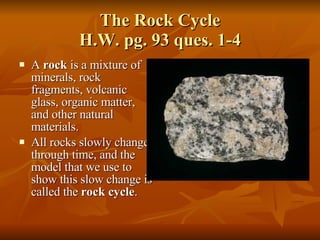
The Rock Cycle H.W. pg. 93 ques. 1-4 A  rock  is a mixture of minerals, rock fragments, volcanic glass, organic matter, and other natural materials. All rocks slowly change through time, and the model that we use to show this slow change is called the  rock cycle .
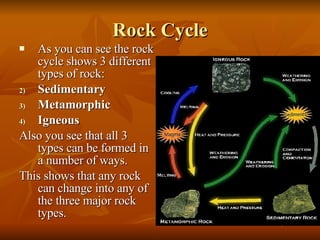
Rock Cycle As you can see the rock cycle shows 3 different types of rock:  Sedimentary  Metamorphic Igneous   Also you see that all 3 types can be formed in a number of ways. This shows that any rock can change into any of the three major rock types.
Igneous Rock Igneous rock  forms when magma cools and hardens.  At certain within the Earth, the temperature and pressure are just right for rocks to melt and form magma. Magma can be located at depths of 150km below the Earths surface.  The temperature of this magma can range between 650- 1,200 o C, depending on their chemical compositions and pressures exerted on them.
Igneous Rock The reason that these rocks melt is because of heat that is formed in the Earth’s interior. The heat comes from the decay of radioactive material inside the Earth. Another source of this heat is actually heat that is left over from the formation of the planet, which was originally molten. Since magma is less dense than the surrounding rocks it is forced upward toward the surface,  like in a volcano. When magma reaches the Earths surface and flows from volcanoes it is then called  lava
Igneous Rock So  magma  is melted rock material composed of common elements and fluids. As magma cools atoms and compounds rearrange themselves into new crystals called  mineral grains . And rocks form as these mineral grains grow together. So rocks that form from magma below the Earths surface are called intrusive. These intrusive rocks stay underground until the land above them are removed, either by erosion of by physical means, and exposed to the surface.
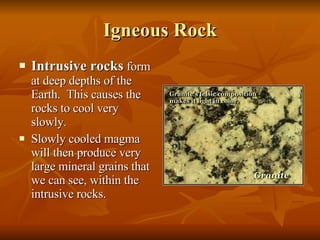
Igneous Rock Intrusive rocks  form at deep depths of the Earth.  This causes the rocks to cool very slowly.  Slowly cooled magma will then produce very large mineral grains that we can see, within the intrusive rocks.
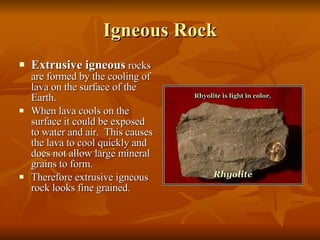
Igneous Rock Extrusive igneous  rocks are formed by the cooling of lava on the surface of the Earth.  When lava cools on the surface it could be exposed to water and air.  This causes the lava to cool quickly and does not allow large mineral grains to form. Therefore extrusive igneous rock looks fine grained.
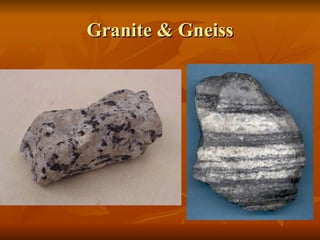
Metamorphic Rock Rocks that have changed because of changes in temperature and pressure or the presence of hot, watery fluids are called  Metamorphic Rock. These changes can be in the form of the rock or in its composition or both. Metamorphic rocks can form from igneous, sedimentary or from other metamorphic rocks. Ex: When you add heat and pressure to granite, the mineral grains are flattened and a metamorphic rock called gneiss is formed.
Granite & Gneiss
How to Classify Metamorphic Rock Metamorphic rocks  can form from igneous, sedimentary, or other metamorphic rocks through their interaction with heat pressure and hot fluids. We classify these rocks by their  composition and texture. First is  Foliated  rocks .  A metamorphic rock is said to have foliated texture when mineral grains in the rock line up in parallel layers.
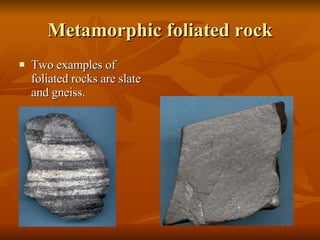
Metamorphic foliated rock Two examples of foliated rocks are slate and gneiss.
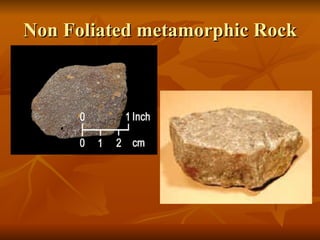
Non Foliated metamorphic Rock In  non foliated metamorphic rock  layering does not occur.  The mineral grains grow and rearrange but do not form layers. This produces a non foliated texture.  An example is when sandstone, a sedimentary rock composed of mostly quartz grains, is exposed to heat and pressure. The quartz grains here grow in size and become interlocking like a jigsaw puzzle. The resulting rock is called quartzite.
Non Foliated metamorphic Rock
Sedimentary Rock Igneous rocks are the most common rocks on Earth. However we don’t see them a lot because they are mostly beneath the Earths surface. 75% of the rocks that are exposed at the surface are  sedimentary rocks . Sediments are loose materials such as rock fragments, mineral grains, and bits and pieces of shell that have been moved by wind, water, or ice These sediments come from already existing rock that were weathered or eroded.  Sedimentary rock forms when these sediments are pressed together by great pressure, or when minerals form in solution.
Stacked Rocks Sedimentary rocks often form in layers.  The older layers are on the bottom layers because they were deposited first. Sometimes these layers can be disturbed by the forces of nature.  This will sometimes overturn the layered sedimentary rock and the oldest will no longer be on the bottom.
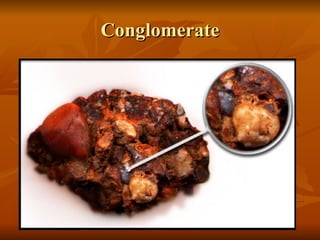
Conglomerate
Test on chapter 3 in one  week!!!!!!!!!!!!! Test in One Week!!!!!

6th Grade Chapter 15 Part 2

  • 1.
  • 2.
    The Rock CycleH.W. pg. 93 ques. 1-4 A rock is a mixture of minerals, rock fragments, volcanic glass, organic matter, and other natural materials. All rocks slowly change through time, and the model that we use to show this slow change is called the rock cycle .
  • 3.
    Rock Cycle Asyou can see the rock cycle shows 3 different types of rock: Sedimentary Metamorphic Igneous Also you see that all 3 types can be formed in a number of ways. This shows that any rock can change into any of the three major rock types.
  • 4.
    Igneous Rock Igneousrock forms when magma cools and hardens. At certain within the Earth, the temperature and pressure are just right for rocks to melt and form magma. Magma can be located at depths of 150km below the Earths surface. The temperature of this magma can range between 650- 1,200 o C, depending on their chemical compositions and pressures exerted on them.
  • 5.
    Igneous Rock Thereason that these rocks melt is because of heat that is formed in the Earth’s interior. The heat comes from the decay of radioactive material inside the Earth. Another source of this heat is actually heat that is left over from the formation of the planet, which was originally molten. Since magma is less dense than the surrounding rocks it is forced upward toward the surface, like in a volcano. When magma reaches the Earths surface and flows from volcanoes it is then called lava
  • 6.
    Igneous Rock So magma is melted rock material composed of common elements and fluids. As magma cools atoms and compounds rearrange themselves into new crystals called mineral grains . And rocks form as these mineral grains grow together. So rocks that form from magma below the Earths surface are called intrusive. These intrusive rocks stay underground until the land above them are removed, either by erosion of by physical means, and exposed to the surface.
  • 7.
    Igneous Rock Intrusiverocks form at deep depths of the Earth. This causes the rocks to cool very slowly. Slowly cooled magma will then produce very large mineral grains that we can see, within the intrusive rocks.
  • 8.
    Igneous Rock Extrusiveigneous rocks are formed by the cooling of lava on the surface of the Earth. When lava cools on the surface it could be exposed to water and air. This causes the lava to cool quickly and does not allow large mineral grains to form. Therefore extrusive igneous rock looks fine grained.
  • 9.
    Metamorphic Rock Rocksthat have changed because of changes in temperature and pressure or the presence of hot, watery fluids are called Metamorphic Rock. These changes can be in the form of the rock or in its composition or both. Metamorphic rocks can form from igneous, sedimentary or from other metamorphic rocks. Ex: When you add heat and pressure to granite, the mineral grains are flattened and a metamorphic rock called gneiss is formed.
  • 10.
  • 11.
    How to ClassifyMetamorphic Rock Metamorphic rocks can form from igneous, sedimentary, or other metamorphic rocks through their interaction with heat pressure and hot fluids. We classify these rocks by their composition and texture. First is Foliated rocks . A metamorphic rock is said to have foliated texture when mineral grains in the rock line up in parallel layers.
  • 12.
    Metamorphic foliated rockTwo examples of foliated rocks are slate and gneiss.
  • 13.
    Non Foliated metamorphicRock In non foliated metamorphic rock layering does not occur. The mineral grains grow and rearrange but do not form layers. This produces a non foliated texture. An example is when sandstone, a sedimentary rock composed of mostly quartz grains, is exposed to heat and pressure. The quartz grains here grow in size and become interlocking like a jigsaw puzzle. The resulting rock is called quartzite.
  • 14.
  • 15.
    Sedimentary Rock Igneousrocks are the most common rocks on Earth. However we don’t see them a lot because they are mostly beneath the Earths surface. 75% of the rocks that are exposed at the surface are sedimentary rocks . Sediments are loose materials such as rock fragments, mineral grains, and bits and pieces of shell that have been moved by wind, water, or ice These sediments come from already existing rock that were weathered or eroded. Sedimentary rock forms when these sediments are pressed together by great pressure, or when minerals form in solution.
  • 16.
    Stacked Rocks Sedimentaryrocks often form in layers. The older layers are on the bottom layers because they were deposited first. Sometimes these layers can be disturbed by the forces of nature. This will sometimes overturn the layered sedimentary rock and the oldest will no longer be on the bottom.
  • 17.
  • 18.
    Test on chapter3 in one week!!!!!!!!!!!!! Test in One Week!!!!!