ADVANCEMENT
TECHNOLOGY IN
ROBOTICS
GROUP MEMBERS:
MUHAMMAD TALHA MOHSIN.(L)
MUNEEB UR REHMAN.
MUHAMMAD SOHAIB SALEEM.
MUHAMMAD ANAS IQBAL.
WHAT IS ROBOTICS
•Robot:A robot is a type of automated
machine that can execute specific tasks
with little or no human intervention and
with speed and precision.
•Robotics:Robotics is a branch of
engineering that involves the conception,
design, manufacture and operation of
robots. The objective of the robotics field
is to create intelligent machines that can
assist humans in a variety of ways.
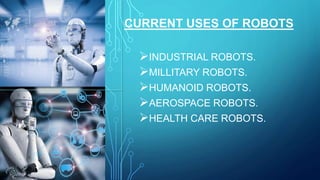
CURRENT USES OF ROBOTS
INDUSTRIAL ROBOTS.
MILLITARY ROBOTS.
HUMANOID ROBOTS.
AEROSPACE ROBOTS.
HEALTH CARE ROBOTS.
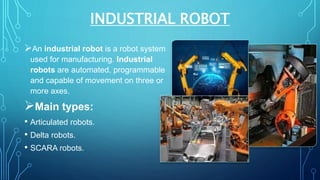
INDUSTRIAL ROBOT
An industrial robot is a robot system
used for manufacturing. Industrial
robots are automated, programmable
and capable of movement on three or
more axes.
Main types:
• Articulated robots.
• Delta robots.
• SCARA robots.
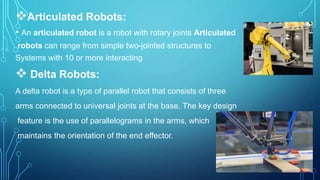
Articulated Robots:
• An articulated robot is a robot with rotary joints Articulated
robots can range from simple two-jointed structures to
Systems with 10 or more interacting
 Delta Robots:
A delta robot is a type of parallel robot that consists of three
arms connected to universal joints at the base. The key design
feature is the use of parallelograms in the arms, which
maintains the orientation of the end effector.
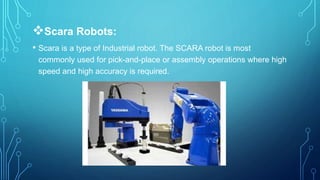
Scara Robots:
• Scara is a type of Industrial robot. The SCARA robot is most
commonly used for pick-and-place or assembly operations where high
speed and high accuracy is required.
APPLICATIONS OF INDUSTRIAL ROBOTS:
• Arc Welding
• Spot Welding
• Materials Handling
• Machine Tending
• Painting
• Picking, Packing and Palletizing
• Assembly
• Mechanical Cutting, Grinding, Deburring and Polishing
• Gluing, Adhesive Sealing and Spraying Materials
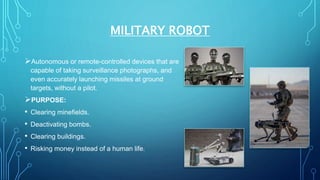
MILITARY ROBOT
Autonomous or remote-controlled devices that are
capable of taking surveillance photographs, and
even accurately launching missiles at ground
targets, without a pilot.
PURPOSE:
• Clearing minefields.
• Deactivating bombs.
• Clearing buildings.
• Risking money instead of a human life.
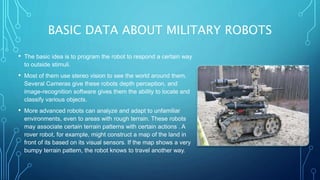
BASIC DATA ABOUT MILITARY ROBOTS
• The basic idea is to program the robot to respond a certain way
to outside stimuli.
• Most of them use stereo vision to see the world around them.
Several Cameras give these robots depth perception, and
image-recognition software gives them the ability to locate and
classify various objects.
• More advanced robots can analyze and adapt to unfamiliar
environments, even to areas with rough terrain. These robots
may associate certain terrain patterns with certain actions . A
rover robot, for example, might construct a map of the land in
front of its based on its visual sensors. If the map shows a very
bumpy terrain pattern, the robot knows to travel another way.
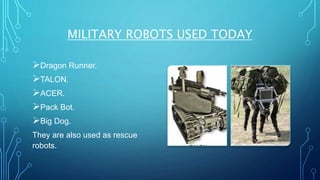
MILITARY ROBOTS USED TODAY
Dragon Runner.
TALON.
ACER.
Pack Bot.
Big Dog.
They are also used as rescue
robots.
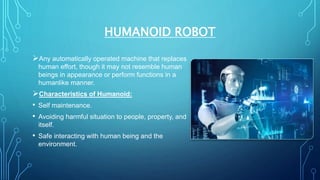
HUMANOID ROBOT
Any automatically operated machine that replaces
human effort, though it may not resemble human
beings in appearance or perform functions in a
humanlike manner.
Characteristics of Humanoid:
• Self maintenance.
• Avoiding harmful situation to people, property, and
itself.
• Safe interacting with human being and the
environment.
WHY DEVELOP HUMANOIDS
• They can work in human
environment without a red to adapt
themselves or to change the
environment.
• It is easier for a human being to
interact with a human like being.
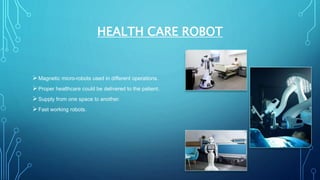
HEALTH CARE ROBOT
Magnetic micro-robots used in different operations.
Proper healthcare could be delivered to the patient.
Supply from one space to another.
Fast working robots.
AEROSPACE ROBOT
In aerospace robot are used for
outer space exploration.
Aerospace robots or unmanned
robotics spacecraft play a key in
outer space probe.
Scientists can explore in outer
space without putting themselves
in great danger considering the
risks involved if they go to outer
space themselves. With
controlled robots, the same
results can be achieved safely.
The risk to lose a human life in
outer space has been avoided.
ADVANTAGES
OF ROBOTS
Robots increase productivity, safety, efficiency,
quality and consistency of products.
Robots can work in hazardous environment without
the need.
Robots need no environmental comforts.
Robots continuously without experiencing fatigue of
problems.
Robots always have repeatable precision.
Robots can be much more accurate than human.
Robots can replace human workers.
Robots can process multiple stimuli or task
simultaneously.
DISADVANTAGES
OF ROBOTS
Robots lack capability to respond in
emergencies.
Robots, although superior in certain
senses, have limited capabilities in
Degrees of freedom, Dexterity, Sensors,
Vision system, real time response.
Robots are closely, due to Initial cost of
equipment, Installation costs, Need for
Peripheral Need for training , Need for
programming.
Advancement technology in Robotics.pptx

Advancement technology in Robotics.pptx

  • 1.
    ADVANCEMENT TECHNOLOGY IN ROBOTICS GROUP MEMBERS: MUHAMMADTALHA MOHSIN.(L) MUNEEB UR REHMAN. MUHAMMAD SOHAIB SALEEM. MUHAMMAD ANAS IQBAL.
  • 2.
    WHAT IS ROBOTICS •Robot:Arobot is a type of automated machine that can execute specific tasks with little or no human intervention and with speed and precision. •Robotics:Robotics is a branch of engineering that involves the conception, design, manufacture and operation of robots. The objective of the robotics field is to create intelligent machines that can assist humans in a variety of ways.
  • 3.
    CURRENT USES OFROBOTS INDUSTRIAL ROBOTS. MILLITARY ROBOTS. HUMANOID ROBOTS. AEROSPACE ROBOTS. HEALTH CARE ROBOTS.
  • 4.
    INDUSTRIAL ROBOT An industrialrobot is a robot system used for manufacturing. Industrial robots are automated, programmable and capable of movement on three or more axes. Main types: • Articulated robots. • Delta robots. • SCARA robots.
  • 5.
    Articulated Robots: • Anarticulated robot is a robot with rotary joints Articulated robots can range from simple two-jointed structures to Systems with 10 or more interacting  Delta Robots: A delta robot is a type of parallel robot that consists of three arms connected to universal joints at the base. The key design feature is the use of parallelograms in the arms, which maintains the orientation of the end effector.
  • 6.
    Scara Robots: • Scarais a type of Industrial robot. The SCARA robot is most commonly used for pick-and-place or assembly operations where high speed and high accuracy is required.
  • 7.
    APPLICATIONS OF INDUSTRIALROBOTS: • Arc Welding • Spot Welding • Materials Handling • Machine Tending • Painting • Picking, Packing and Palletizing • Assembly • Mechanical Cutting, Grinding, Deburring and Polishing • Gluing, Adhesive Sealing and Spraying Materials
  • 8.
    MILITARY ROBOT Autonomous orremote-controlled devices that are capable of taking surveillance photographs, and even accurately launching missiles at ground targets, without a pilot. PURPOSE: • Clearing minefields. • Deactivating bombs. • Clearing buildings. • Risking money instead of a human life.
  • 9.
    BASIC DATA ABOUTMILITARY ROBOTS • The basic idea is to program the robot to respond a certain way to outside stimuli. • Most of them use stereo vision to see the world around them. Several Cameras give these robots depth perception, and image-recognition software gives them the ability to locate and classify various objects. • More advanced robots can analyze and adapt to unfamiliar environments, even to areas with rough terrain. These robots may associate certain terrain patterns with certain actions . A rover robot, for example, might construct a map of the land in front of its based on its visual sensors. If the map shows a very bumpy terrain pattern, the robot knows to travel another way.
  • 10.
    MILITARY ROBOTS USEDTODAY Dragon Runner. TALON. ACER. Pack Bot. Big Dog. They are also used as rescue robots.
  • 11.
    HUMANOID ROBOT Any automaticallyoperated machine that replaces human effort, though it may not resemble human beings in appearance or perform functions in a humanlike manner. Characteristics of Humanoid: • Self maintenance. • Avoiding harmful situation to people, property, and itself. • Safe interacting with human being and the environment.
  • 12.
    WHY DEVELOP HUMANOIDS •They can work in human environment without a red to adapt themselves or to change the environment. • It is easier for a human being to interact with a human like being.
  • 13.
    HEALTH CARE ROBOT Magneticmicro-robots used in different operations. Proper healthcare could be delivered to the patient. Supply from one space to another. Fast working robots.
  • 14.
    AEROSPACE ROBOT In aerospacerobot are used for outer space exploration. Aerospace robots or unmanned robotics spacecraft play a key in outer space probe. Scientists can explore in outer space without putting themselves in great danger considering the risks involved if they go to outer space themselves. With controlled robots, the same results can be achieved safely. The risk to lose a human life in outer space has been avoided.
  • 15.
    ADVANTAGES OF ROBOTS Robots increaseproductivity, safety, efficiency, quality and consistency of products. Robots can work in hazardous environment without the need. Robots need no environmental comforts. Robots continuously without experiencing fatigue of problems. Robots always have repeatable precision. Robots can be much more accurate than human. Robots can replace human workers. Robots can process multiple stimuli or task simultaneously.
  • 16.
    DISADVANTAGES OF ROBOTS Robots lackcapability to respond in emergencies. Robots, although superior in certain senses, have limited capabilities in Degrees of freedom, Dexterity, Sensors, Vision system, real time response. Robots are closely, due to Initial cost of equipment, Installation costs, Need for Peripheral Need for training , Need for programming.