Nikhil Sapre  Tejas Puntambekar
INTRODUCTION The Need Types  Working Examples Research Objectives and Challenges Near Future References Background Image Courtesy Dawid Michalczyk http://www.art.eonworks.com/gallery/concept/concept_gallery_1.html
Why Military Robots? Job of Soldier is no walk in the PARK Difficult Tasks Walking through minefields deactivating unexploded bombs  clearing out hostile buildings Robots to do these jobs instead of humans To operate in a relatively unstructured, natural environment Replacing human in dangerous, dirty, or dull missions Bear cost to build the robot instead of losing a human life http://science.howstuffworks.com/military-robot.htm
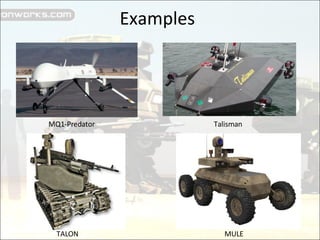
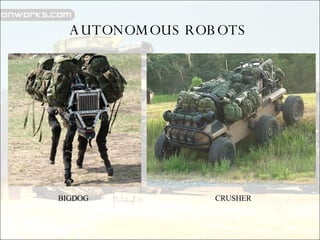
TYPES Today's military robots don't do a whole lot on their own.  Computer brains aren't very sophisticated in terms of artificial intelligence (AI). Instead of independent AI, most military robots are  remote-controlled  by human operators. Hence the term  Unmanned Vehicles UAV – Unmanned Aerial Vehicle UUV – Unmanned Underwater Vehicle UGV – Unmanned Ground Vehicles http://science.howstuffworks.com/military-robot.htm
Examples MQ1-Predator Talisman TALON MULE
BIGDOG CRUSHER AUTONOMOUS ROBOTS
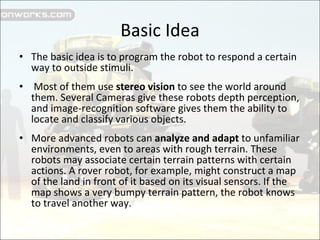
Basic Idea The basic idea is to program the robot to respond a certain way to outside stimuli. Most of them use  stereo vision  to see the world around them. Several Cameras give these robots depth perception, and image-recognition software gives them the ability to locate and classify various objects.  More advanced robots can  analyze and adapt  to unfamiliar environments, even to areas with rough terrain. These robots may associate certain terrain patterns with certain actions. A rover robot, for example, might construct a map of the land in front of it based on its visual sensors. If the map shows a very bumpy terrain pattern, the robot knows to travel another way.
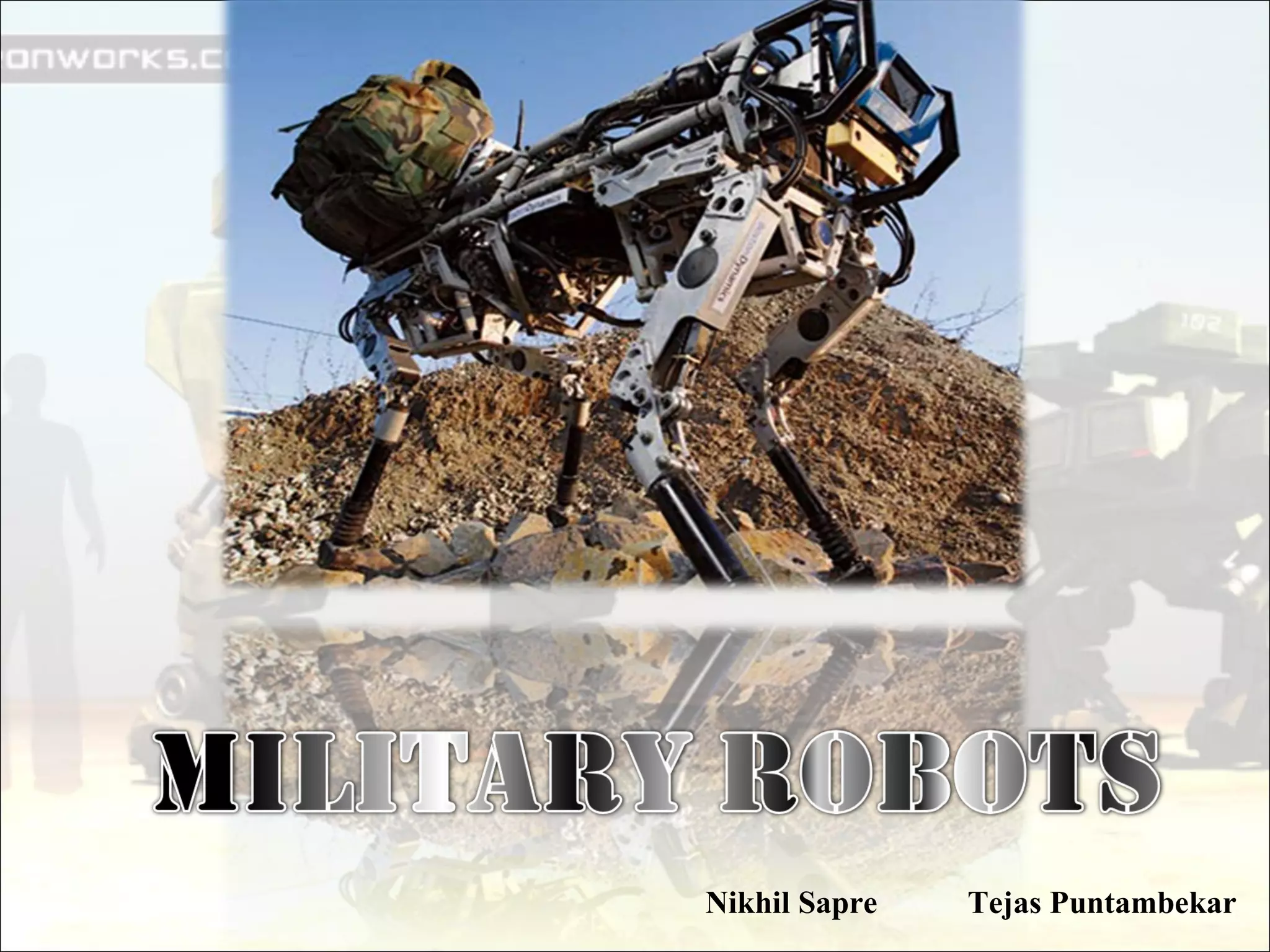
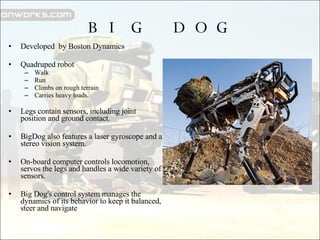
BIG DOG Developed  by Boston Dynamics Quadruped robot  Walk Run Climbs on rough terrain  Carries heavy loads. Legs contain sensors, including joint position and ground contact.  BigDog also features a laser gyroscope and a stereo vision system. On-board computer controls locomotion, servos the legs and handles a wide variety of sensors. Big Dog's control system manages the dynamics of its behavior to keep it balanced, steer and navigate
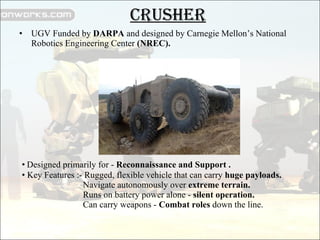
CRUSHER UGV Funded by  DARPA  and designed by Carnegie Mellon’s National Robotics Engineering Center  (NREC). Designed primarily for -  Reconnaissance and Support . Key Features :- Rugged, flexible vehicle that can carry  huge payloads.   Navigate autonomously over  extreme terrain.   Runs on battery power alone -  silent operation.   Can carry weapons -  Combat roles  down the line.
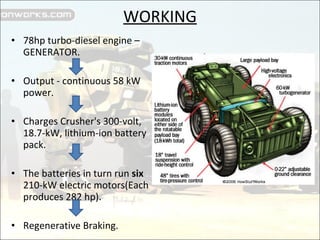
WORKING 78hp turbo-diesel engine – GENERATOR. Output - continuous 58 kW power.  Charges Crusher's 300-volt, 18.7-kW, lithium-ion battery pack. The batteries in turn run  six  210-kW electric motors(Each produces 282 hp). Regenerative Braking.
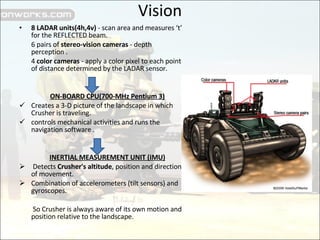
Vision 8 LADAR units(4h,4v)  - scan area and measures ‘t’ for the REFLECTED beam.  6 pairs of  stereo-vision cameras  - depth perception . 4  color cameras  - apply a color pixel to each point of distance determined by the LADAR sensor.  ON-BOARD CPU(700-MHz Pentium 3) Creates a 3-D picture of the landscape in which Crusher is traveling. controls mechanical activities and runs the navigation software . INERTIAL MEASUREMENT UNIT (IMU) Detects  Crusher's altitude , position and direction of movement. Combination of accelerometers (tilt sensors) and gyroscopes.   So Crusher is always aware of its own motion and position relative to the landscape.
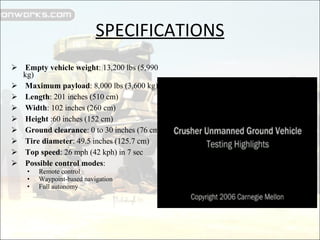
SPECIFICATIONS Empty vehicle weight : 13,200 lbs (5,990 kg) Maximum payload : 8,000 lbs (3,600 kg)  Length : 201 inches (510 cm)  Width : 102 inches (260 cm)  Height  :60 inches (152 cm)  Ground clearance : 0 to 30 inches (76 cm)  Tire diameter : 49.5 inches (125.7 cm)  Top speed : 26 mph (42 kph) in 7 sec  Possible control modes :  Remote control  Waypoint-based navigation  Full autonomy
Research Objectives Interacting with computation should be as natural as interacting with people Human-like interfaces need to be: modality-opportunistic mixed-initiative multi-lingual Military “robots” today lack autonomy Currently, many soldiers operate one robot Want few soldiers working with a  team  of  agile  robots, to achieve  force multiplication  even in  harsh  environments Put fewer soldiers in harm’s way Better robots for monitoring Enable  soldiers with persistent and pervasive Intelligence, Surveillance, and Reconnaissance (ISR), including from hard to reach Better robots for logistics Replace  soldiers in the supply chain with capable autonomous robots and vehicles MIT Computer Science and Artificial Intelligence Laboratory
Reliance on  centrally derived information  may lead to significant problems. Objects in the environment  should be  basic building blocks  of the robot operator for world Time for robotic planning  (path planning, task planning, and mission planning) The  operator  has significant and well-defined roles to play even if the robots are highly autonomous, and the  robot and user interfaces  must support these roles. Avoid lethal crossfire situation Utilize  local information  and not rely on a global source To navigate in complex indoor or outdoor environments and  build three-dimensional models for manipulation . Research Challenges
Robust, secure  communication links Safe, long duration, lightweight, power storage Perception for real-world  navigation and for mission operations Approach the performance of a human in performing  dexterous manipulation  of tools, weapons. Performing  real-time diagnosis  and  recovery  from anomalous conditions Keeping the system  safe Research Challenges
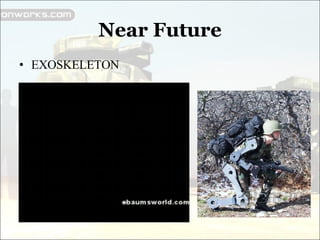
Near Future EXOSKELETON
References Journals AUTONOMOUS ROBOTS FOR MILITARY SYSTEMS(ARMS) - Surya P. N. Singh and Scott M. Thayer Carnegie Mellon University The First Law of Military Robotics: Avoid Collateral Damage  Autonomous Robots in SWAT Applications: Research, Design, and Operations Challenges – Stanford University Research Challenges  for the Next Decade –MIT Computer Science and Artificial Intelligence Laboratory Websites http://www.2dayblog.com/images/060409_robot_sherpa_02.jpg http://science.howstuffworks.com/military-robot.htm http://science.howstuffworks.com/robot6.htm# http://science.howstuffworks.com/future-military-technology.htm http://usmilitary.about.com/cs/weapons/a/robots.htm http://www.wtec.org/robotics/us_workshop/ http://www.art.eonworks.com/about/about.html http://www.gizmohighway.com/robotics/talon_robot.htm http://brainstuff.howstuffworks.com/2008/02/26/the-crusher-robot-vehicle/ http://science.howstuffworks.com/crusher1.htm http://usmilitary.about.com/od/armyweapons/a/crusher.htm http://www.telegraph.co.uk/news/worldnews/northamerica/usa/2687038/Robotic-BigDog-is-US-armys-best-friend.html
!! THANK YOU !! Nikhil Sapre Tejas Puntambekar

Military Robots

  • 1.
    Nikhil Sapre Tejas Puntambekar
  • 2.
    INTRODUCTION The NeedTypes Working Examples Research Objectives and Challenges Near Future References Background Image Courtesy Dawid Michalczyk http://www.art.eonworks.com/gallery/concept/concept_gallery_1.html
  • 3.
    Why Military Robots?Job of Soldier is no walk in the PARK Difficult Tasks Walking through minefields deactivating unexploded bombs clearing out hostile buildings Robots to do these jobs instead of humans To operate in a relatively unstructured, natural environment Replacing human in dangerous, dirty, or dull missions Bear cost to build the robot instead of losing a human life http://science.howstuffworks.com/military-robot.htm
  • 4.
    TYPES Today's militaryrobots don't do a whole lot on their own. Computer brains aren't very sophisticated in terms of artificial intelligence (AI). Instead of independent AI, most military robots are remote-controlled by human operators. Hence the term Unmanned Vehicles UAV – Unmanned Aerial Vehicle UUV – Unmanned Underwater Vehicle UGV – Unmanned Ground Vehicles http://science.howstuffworks.com/military-robot.htm
  • 5.
  • 6.
  • 7.
    Basic Idea Thebasic idea is to program the robot to respond a certain way to outside stimuli. Most of them use stereo vision to see the world around them. Several Cameras give these robots depth perception, and image-recognition software gives them the ability to locate and classify various objects. More advanced robots can analyze and adapt to unfamiliar environments, even to areas with rough terrain. These robots may associate certain terrain patterns with certain actions. A rover robot, for example, might construct a map of the land in front of it based on its visual sensors. If the map shows a very bumpy terrain pattern, the robot knows to travel another way.
  • 8.
    BIG DOG Developed by Boston Dynamics Quadruped robot Walk Run Climbs on rough terrain Carries heavy loads. Legs contain sensors, including joint position and ground contact. BigDog also features a laser gyroscope and a stereo vision system. On-board computer controls locomotion, servos the legs and handles a wide variety of sensors. Big Dog's control system manages the dynamics of its behavior to keep it balanced, steer and navigate
  • 9.
    CRUSHER UGV Fundedby DARPA and designed by Carnegie Mellon’s National Robotics Engineering Center (NREC). Designed primarily for - Reconnaissance and Support . Key Features :- Rugged, flexible vehicle that can carry huge payloads. Navigate autonomously over extreme terrain. Runs on battery power alone - silent operation. Can carry weapons - Combat roles down the line.
  • 10.
    WORKING 78hp turbo-dieselengine – GENERATOR. Output - continuous 58 kW power. Charges Crusher's 300-volt, 18.7-kW, lithium-ion battery pack. The batteries in turn run six 210-kW electric motors(Each produces 282 hp). Regenerative Braking.
  • 11.
    Vision 8 LADARunits(4h,4v) - scan area and measures ‘t’ for the REFLECTED beam. 6 pairs of stereo-vision cameras - depth perception . 4 color cameras - apply a color pixel to each point of distance determined by the LADAR sensor. ON-BOARD CPU(700-MHz Pentium 3) Creates a 3-D picture of the landscape in which Crusher is traveling. controls mechanical activities and runs the navigation software . INERTIAL MEASUREMENT UNIT (IMU) Detects Crusher's altitude , position and direction of movement. Combination of accelerometers (tilt sensors) and gyroscopes. So Crusher is always aware of its own motion and position relative to the landscape.
  • 12.
    SPECIFICATIONS Empty vehicleweight : 13,200 lbs (5,990 kg) Maximum payload : 8,000 lbs (3,600 kg) Length : 201 inches (510 cm) Width : 102 inches (260 cm) Height :60 inches (152 cm) Ground clearance : 0 to 30 inches (76 cm) Tire diameter : 49.5 inches (125.7 cm) Top speed : 26 mph (42 kph) in 7 sec Possible control modes : Remote control Waypoint-based navigation Full autonomy
  • 13.
    Research Objectives Interactingwith computation should be as natural as interacting with people Human-like interfaces need to be: modality-opportunistic mixed-initiative multi-lingual Military “robots” today lack autonomy Currently, many soldiers operate one robot Want few soldiers working with a team of agile robots, to achieve force multiplication even in harsh environments Put fewer soldiers in harm’s way Better robots for monitoring Enable soldiers with persistent and pervasive Intelligence, Surveillance, and Reconnaissance (ISR), including from hard to reach Better robots for logistics Replace soldiers in the supply chain with capable autonomous robots and vehicles MIT Computer Science and Artificial Intelligence Laboratory
  • 14.
    Reliance on centrally derived information may lead to significant problems. Objects in the environment should be basic building blocks of the robot operator for world Time for robotic planning (path planning, task planning, and mission planning) The operator has significant and well-defined roles to play even if the robots are highly autonomous, and the robot and user interfaces must support these roles. Avoid lethal crossfire situation Utilize local information and not rely on a global source To navigate in complex indoor or outdoor environments and build three-dimensional models for manipulation . Research Challenges
  • 15.
    Robust, secure communication links Safe, long duration, lightweight, power storage Perception for real-world navigation and for mission operations Approach the performance of a human in performing dexterous manipulation of tools, weapons. Performing real-time diagnosis and recovery from anomalous conditions Keeping the system safe Research Challenges
  • 16.
  • 17.
    References Journals AUTONOMOUSROBOTS FOR MILITARY SYSTEMS(ARMS) - Surya P. N. Singh and Scott M. Thayer Carnegie Mellon University The First Law of Military Robotics: Avoid Collateral Damage Autonomous Robots in SWAT Applications: Research, Design, and Operations Challenges – Stanford University Research Challenges for the Next Decade –MIT Computer Science and Artificial Intelligence Laboratory Websites http://www.2dayblog.com/images/060409_robot_sherpa_02.jpg http://science.howstuffworks.com/military-robot.htm http://science.howstuffworks.com/robot6.htm# http://science.howstuffworks.com/future-military-technology.htm http://usmilitary.about.com/cs/weapons/a/robots.htm http://www.wtec.org/robotics/us_workshop/ http://www.art.eonworks.com/about/about.html http://www.gizmohighway.com/robotics/talon_robot.htm http://brainstuff.howstuffworks.com/2008/02/26/the-crusher-robot-vehicle/ http://science.howstuffworks.com/crusher1.htm http://usmilitary.about.com/od/armyweapons/a/crusher.htm http://www.telegraph.co.uk/news/worldnews/northamerica/usa/2687038/Robotic-BigDog-is-US-armys-best-friend.html
  • 18.
    !! THANK YOU!! Nikhil Sapre Tejas Puntambekar