Chapter 12Chapter 12
Politics Of The 1920’sPolitics Of The 1920’s
• The Roaring 20'sThe Roaring 20's
• Republican EraRepublican Era
• The Jazz AgeThe Jazz Age
• The Lost GenerationThe Lost Generation
• Boom to BustBoom to Bust
• Decade of NormalcyDecade of Normalcy
• Prosperity DecadeProsperity Decade
• Prohibition EraProhibition Era
• The Advertising AgeThe Advertising Age
• The Golden Age of SportsThe Golden Age of Sports
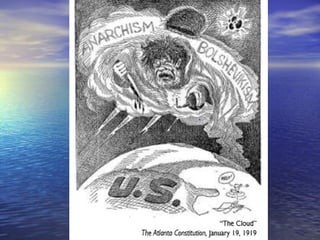
The Red ScareThe Red Scare
1919-19201919-1920
Karl MarxKarl Marx
Friedrich EngelsFriedrich Engels
Vladimir LeninVladimir Lenin
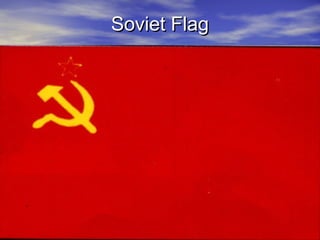
Soviet FlagSoviet Flag
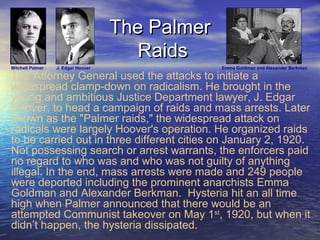
The PalmerThe Palmer
RaidsRaids
The Attorney General used the attacks to initiate a
widespread clamp-down on radicalism. He brought in the
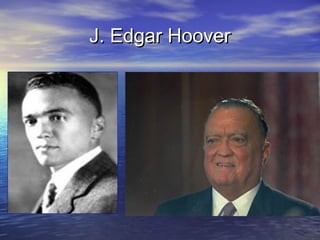
young and ambitious Justice Department lawyer, J. Edgar
Hoover, to head a campaign of raids and mass arrests. Later
known as the "Palmer raids," the widespread attack on
radicals were largely Hoover's operation. He organized raids
to be carried out in three different cities on January 2, 1920.
Not possessing search or arrest warrants, the enforcers paid
no regard to who was and who was not guilty of anything
illegal. In the end, mass arrests were made and 249 people
were deported including the prominent anarchists Emma
Goldman and Alexander Berkman. Hysteria hit an all time
high when Palmer announced that there would be an
attempted Communist takeover on May 1st
, 1920, but when it
didn’t happen, the hysteria dissipated.
Emma Goldman and Alexander BerkmanJ. Edgar HooverMitchell Palmer
Palmer House BombingPalmer House Bombing
J. Edgar HooverJ. Edgar Hoover
Sacco andSacco and
VanzettiVanzetti
On April 15, 1920, two men robbed and
murdered a paymaster and his guard as
they transferred $15,776 from the Slater
and Morrill Shoe factory. Three weeks
later, in the spirit of the anti-immigrant,
anti-communist times, two Italian immigrants and known
anarchists, Nicola Sacco and Bartolomeo Vanzetti, were
accused and arrested for the crime, despite the scant
evidence against them. Following a seven-week trial which
many considered very unfairly manipulated by Judge Thayer,
Sacco and Vanzetti were convicted on circumstantial
evidence of capital murder and sentenced to death. Sacco
and Vanzetti appealed their convictions and got a lot of
support from those who opposed the death penalty and
racism, but they lost and were executed in 1927.
Sacco and VanzettiSacco and Vanzetti
Ku Klux KlanKu Klux Klan
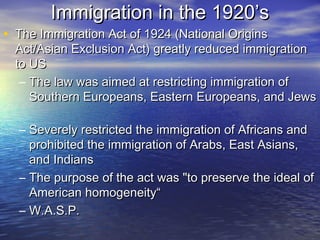
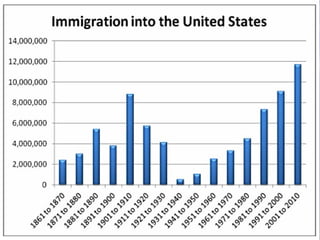
Immigration in the 1920’sImmigration in the 1920’s
• The Immigration Act of 1924 (National OriginsThe Immigration Act of 1924 (National Origins
Act/Asian Exclusion Act) greatly reduced immigrationAct/Asian Exclusion Act) greatly reduced immigration
to USto US
– The law was aimed at restricting immigration ofThe law was aimed at restricting immigration of
Southern Europeans, Eastern Europeans, and JewsSouthern Europeans, Eastern Europeans, and Jews
– Severely restricted the immigration of Africans andSeverely restricted the immigration of Africans and
prohibited the immigration of Arabs, East Asians,prohibited the immigration of Arabs, East Asians,
and Indiansand Indians
– The purpose of the act was "to preserve the ideal ofThe purpose of the act was "to preserve the ideal of
American homogeneity“American homogeneity“
– W.A.S.P.W.A.S.P.
President Harding, Coolidge andPresident Harding, Coolidge and
HooverHoover
Republican Philosophy-1920’sRepublican Philosophy-1920’s
•Trickle-down theoryTrickle-down theory
•Laissez-faire
•Rugged individualism
•Normalcy
Secretary of StateSecretary of State
Charles Evans HughesCharles Evans Hughes
4 Power Treaty4 Power Treaty
• US, GB, France, JapanUS, GB, France, Japan
• Each country would respect each otherEach country would respect each other
possessions in the Pacificpossessions in the Pacific
5 Power Treaty5 Power Treaty
• Same as 4 plus ItalySame as 4 plus Italy
• Freeze navies at 1921 levelsFreeze navies at 1921 levels
9 Power Treaty9 Power Treaty
• Above plus Netherlands, Portugal,Above plus Netherlands, Portugal,
Belgium and ChinaBelgium and China
• Keep “open door” in ChinaKeep “open door” in China
• Promise Chinese independencePromise Chinese independence
Kellogg-Briand Pact-1928Kellogg-Briand Pact-1928
• 62 countries pledged not to use war62 countries pledged not to use war
to settle disputesto settle disputes
Albert Fall-Teapot Dome ScandalAlbert Fall-Teapot Dome Scandal
Link to Teapot Dome VideoLink to Teapot Dome Video
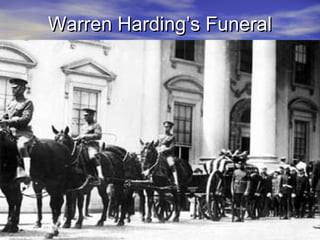
Warren Harding’s FuneralWarren Harding’s Funeral
President Calvin CoolidgePresident Calvin Coolidge
What impact did automobiles haveWhat impact did automobiles have
on the United States?on the United States?
• Link to 1920’s carsLink to 1920’s cars
Henry Ford and the Model THenry Ford and the Model T
1920 Model T Ford1920 Model T Ford
1927 Chrysler-Walter Chrysler1927 Chrysler-Walter Chrysler
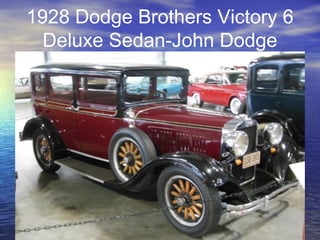
1928 Dodge Brothers Victory 6
Deluxe Sedan-John Dodge
1929 Buick 4-Door Sedan-David
Buick
Route 66 “The Mother Road”Route 66 “The Mother Road”
History of NASCARHistory of NASCAR
Airplanes in the 1920’sAirplanes in the 1920’s
• Mail carryingMail carrying
• Transporting small groups of peopleTransporting small groups of people
• MilitaryMilitary
• EntertainmentEntertainment
• Major featsMajor feats
Charles Lindbergh “Lucky Lindy”Charles Lindbergh “Lucky Lindy”
Lindbergh’s FlightLindbergh’s Flight
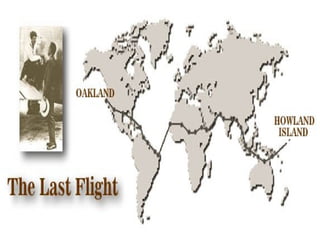
Amelia EarhartAmelia Earhart
Chapter 13Chapter 13
The Roaring Life ofThe Roaring Life of
the 1920’sthe 1920’s
Rural vs. UrbanRural vs. Urban
• 1920 Census- 51.2 people lived in cities of1920 Census- 51.2 people lived in cities of
2,500 or more2,500 or more
• 1922-1929-more than 2 million people1922-1929-more than 2 million people
moved from farms to the cities each yearmoved from farms to the cities each year
• Rural areas tried to hold on to moralRural areas tried to hold on to moral
values and close social relationshipsvalues and close social relationships
The Urban SceneThe Urban Scene
• Largest citiesLargest cities
1.1. New York City(5.6 million)New York City(5.6 million)
2.2. Chicago(3 million)Chicago(3 million)
3.3. Philadelphia(2 million)Philadelphia(2 million)
4.4. 65 other cities had over 100,000 people65 other cities had over 100,000 people
Cities tolerated drinking, gambling and casualCities tolerated drinking, gambling and casual
dating!!!dating!!!
Prohibition “The Noble Experiment”Prohibition “The Noble Experiment”
• 1818thth
Amendment(1920-1933)Amendment(1920-1933)
– The manufacture, sale and transportation ofThe manufacture, sale and transportation of
alcoholic beverages was illegalalcoholic beverages was illegal
– Supporters believed alcohol brought aboutSupporters believed alcohol brought about
corruption, crime, wife and child abuse andcorruption, crime, wife and child abuse and
accidentsaccidents
– Supporters came mostly from rural SouthSupporters came mostly from rural South
and West(areas with a lot of Protestants)and West(areas with a lot of Protestants)
– Anti-Saloon League and Women’s ChristianAnti-Saloon League and Women’s Christian
Temperence Union led the attack on alcoholTemperence Union led the attack on alcohol
ProhibitionProhibition
• Alcohol was allowed for medicinalAlcohol was allowed for medicinal
and religious purposesand religious purposes
• Prescriptions and sacramentalPrescriptions and sacramental
wine orders skyrocketedwine orders skyrocketed
ProhibitionProhibition
• At first saloons closed and drunkenessAt first saloons closed and drunkeness
went downwent down
• The Volstead Act created theThe Volstead Act created the
Prohibition Bureau to enforce the lawProhibition Bureau to enforce the law
• Prohibition failed for three reasons:Prohibition failed for three reasons:
1.1. People despised it. Saw it asPeople despised it. Saw it as
government meddling in people’sgovernment meddling in people’s
liveslives
2.2. The Prohibition Bureau wasThe Prohibition Bureau was
underfunded. Had 1,500 people tounderfunded. Had 1,500 people to
supervise the country.supervise the country.
3.3. Organized crime becameOrganized crime became
Homicide RatesHomicide Rates
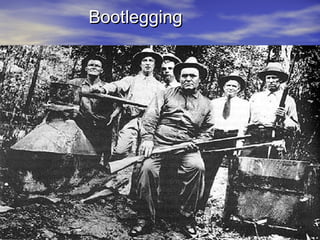
Bootlegging in the 1920'sBootlegging in the 1920's
• Illegally making or distributing alcoholIllegally making or distributing alcohol
• BootleggersBootleggers
- people that made or transported alcohol- people that made or transported alcohol
– Named because people carried liquor inNamed because people carried liquor in
the legs of bootsthe legs of boots
– Most imported alcohol came in fromMost imported alcohol came in from
Canada, Cuba or the West IndiesCanada, Cuba or the West Indies
BootleggingBootlegging
The biggest threat to the bootleggerThe biggest threat to the bootlegger
was not the Prohibition Bureau orwas not the Prohibition Bureau or
police but….police but….
HijackingHijacking
.
MoonshineMoonshine
• Alcohol made secretlyAlcohol made secretly
in home made stillsin home made stills
• Several hundredSeveral hundred
people a yearpeople a year dieddied
from drinkingfrom drinking
moonshine during themoonshine during the
1920s1920s
• In 1929 it is estimatedIn 1929 it is estimated
that 700 million gallonsthat 700 million gallons
of beer were producedof beer were produced
in American homesin American homes
SpeakeasiesSpeakeasies
• To obtain alcohol illegally, people wentTo obtain alcohol illegally, people went
underground to secret bars callunderground to secret bars call
speakeasiesspeakeasies(people spoke easily or(people spoke easily or
quietly about it)quietly about it)
• Speakeasies could be anywhereSpeakeasies could be anywhere
• To be admitted a card or password had toTo be admitted a card or password had to
be givenbe given
Organized CrimeOrganized Crime
• Came about as a result of ProhibitionCame about as a result of Prohibition
• Every major city had it’s gangEvery major city had it’s gang
• Al Capone’s bootlegging business inAl Capone’s bootlegging business in
Chicago made over $60 million a yearChicago made over $60 million a year
• Due to gang violence, only 19% ofDue to gang violence, only 19% of
Americans supported Prohibition by 1925Americans supported Prohibition by 1925
• Prohibition was repealed in 1933 by theProhibition was repealed in 1933 by the
2121stst
AmendmentAmendment
Al Capone-ScarfaceAl Capone-Scarface
St. Valentine’s Day MassacreSt. Valentine’s Day Massacre
Taken down by Tax EvasionTaken down by Tax Evasion
Story of Templeton RyeStory of Templeton Rye
Templeton, IATempleton, IA
Science vs ReligionScience vs Religion
• There was a struggle between theThere was a struggle between the
modern scientific people and themodern scientific people and the
Christian fundamentalistsChristian fundamentalists
• Fundamentalists believed everythingFundamentalists believed everything
could be explained by the Biblecould be explained by the Bible
• They disagreed with the theory ofThey disagreed with the theory of
evolution especiallyevolution especially
Charles DarwinCharles Darwin
The Scopes Monkey TrialThe Scopes Monkey Trial
• In 1925, Tennessee passed the first lawIn 1925, Tennessee passed the first law
making it illegal to teach evolution inmaking it illegal to teach evolution in
schoolschool
• The American Civil Liberties Union(ACLU)The American Civil Liberties Union(ACLU)
said it would defend any teacher willing tosaid it would defend any teacher willing to
break the lawbreak the law
• John Scopes, biology teacher fromJohn Scopes, biology teacher from
Dayton, accepted.Dayton, accepted.
John ScopesJohn Scopes
Scopes-Monkey TrialScopes-Monkey Trial
• Scopes taught evolution and was arrestedScopes taught evolution and was arrested
• Clarence Darrow was hired by the ACLUClarence Darrow was hired by the ACLU
to defend Scopesto defend Scopes
• William Jennings Bryan was the specialWilliam Jennings Bryan was the special
prosecutorprosecutor
• Scopes did not deny teaching evolutionScopes did not deny teaching evolution
• Trial was really about evolution in schoolsTrial was really about evolution in schools
Clarence DarrowClarence Darrow
William Jennings BryanWilliam Jennings Bryan
Scopes Monkey TrialScopes Monkey Trial
• Darrow called Bryan to the stand andDarrow called Bryan to the stand and
asked him questions about the Bibleasked him questions about the Bible
• Darrow made Bryan look foolishDarrow made Bryan look foolish
• In the end, Scopes was found guiltyIn the end, Scopes was found guilty
and fined $100and fined $100
The “Roaring” EconomyThe “Roaring” Economy
Buying on CreditBuying on Credit
• ““Buy now, pay later”Buy now, pay later”
• Stocks marketStocks market
was boomingwas booming
– Buying on marginBuying on margin
High Tariff PolicyHigh Tariff Policy
• What is a tariff?What is a tariff?
• Why did progressives want to lower tariffs inWhy did progressives want to lower tariffs in
the early 1900’s?the early 1900’s?
• Why did the Republicans raise tariffs in theWhy did the Republicans raise tariffs in the
1920’s?1920’s?
The Era of “Permanent Prosperity”The Era of “Permanent Prosperity”
• ““As long as everyone has faith, everythingAs long as everyone has faith, everything
will be fine.”will be fine.”
WOMEN IN THEWOMEN IN THE
1920’s1920’s
Cult of DomesticityCult of Domesticity
• Developed throughout 1800’sDeveloped throughout 1800’s
• The ideal of womanhood had fourThe ideal of womanhood had four
characteristics:characteristics:
• 1. Piety1. Piety
• 2. Purity2. Purity
• 3. Domesticity3. Domesticity
• 4. Submissiveness4. Submissiveness
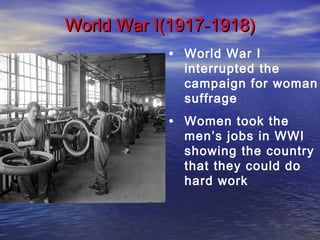
• World War I
interrupted the
campaign for woman
suffrage
• Women took the
men’s jobs in WWI
showing the country
that they could do
hard work
World War I(1917-1918)World War I(1917-1918)
Finally, on Aug. 20, 1920, the 19th
Amendment became part of the United
States Constitution when Tennessee
became the 36th
state to ratify it.
1919thth
AmendmentAmendment
““The right of citizens of the United States toThe right of citizens of the United States to
vote shall not be denied or abridged byvote shall not be denied or abridged by
the United States or by any State onthe United States or by any State on
account of sex. Congress shall haveaccount of sex. Congress shall have
power to enforce this article by appropriatepower to enforce this article by appropriate
legislation.legislation.””
The Roaring 20’sThe Roaring 20’s
• The 1920’s were aThe 1920’s were a
good decade forgood decade for
women’s rightswomen’s rights
• 1919thth
AmendmentAmendment
• Flapper girlsFlapper girls
• Going to collegeGoing to college
moremore
• Working more outsideWorking more outside
the homethe home
Margaret SangerMargaret Sanger
• In 1921, she founded theIn 1921, she founded the
American Birth ControlAmerican Birth Control
League (ABCL)League (ABCL)
– Today known asToday known as
Planned ParenthoodPlanned Parenthood
• Women were then able toWomen were then able to
control their own bodies.control their own bodies.
• This movement educatedThis movement educated
women about existingwomen about existing
birth control methods.birth control methods.
EducationEducation
• By 1928, women wereBy 1928, women were
earning 39% of theearning 39% of the
college degrees given incollege degrees given in
the United Statesthe United States
• In 1900, it was 19%In 1900, it was 19%
• What % do you think it isWhat % do you think it is
today?today?
• Almost 60%Almost 60%
1928 Olympics1928 Olympics
• These were the firstThese were the first
Olympics that women wereOlympics that women were
allowed to compete in.allowed to compete in.
• There were manyThere were many
arguments about thesearguments about these
actions.actions.
– Some argued that it wasSome argued that it was
historically inappropriatehistorically inappropriate
since women did notsince women did not
compete in ancientcompete in ancient
Greek Olympics.Greek Olympics.
– Others said that physicalOthers said that physical
competition wascompetition was
“injurious” to women.“injurious” to women.
The 1928 Dutch Women’s
Gymnastics team. They won the
gold medal in the group event.
““Pink Collared” Jobs-1920’s-1970’sPink Collared” Jobs-1920’s-1970’s
• Gave women a taste of theGave women a taste of the
work world.work world.
• Low paying serviceLow paying service
occupations.occupations.
• Made less money thanMade less money than
men did doing the samemen did doing the same
jobs.jobs.
– Examples of jobs:Examples of jobs:
• SecretariesSecretaries
• TeachersTeachers
• Telephone operatorsTelephone operators
• NursesNurses
The FlapperThe Flapper
• Short hairShort hair
• Short dressesShort dresses
• ShapelessShapeless
dresses-eliminateddresses-eliminated
corsets-see nextcorsets-see next
slideslide
• Smoked, drank inSmoked, drank in
public and earnedpublic and earned
their own moneytheir own money
• Author F. Scott Fitzgerald described flappers as
“Lovely, expensive and about 19”.
• “In the 1920’s, a new woman was born. She
smoked, drank, danced and voted. She cut her
hair, wore make-up, and went to petting parties.
She was giddy and took risks. She was a flapper.”
• Speaking to 1,500 students at Wellesley College in
1921, Mrs. Augustus Trowbridge condemned "the
vulgarity and revolting badness of petting parties."
• She said that these “loose-moraled gatherings —
along with jazz music, unchaperoned dancing and
lipstick — were symptomatic of a decadent
society.”
• Snugglepupping-Flappers--Link
• Snugglepupping was common in highSnugglepupping was common in high
schools and collegesschools and colleges
• "Girls like to be called snuggle-puppies,""Girls like to be called snuggle-puppies,"
one school administrator told a newsone school administrator told a news
reporter. "They grant the boys liberties.reporter. "They grant the boys liberties.
Encourage them to take them and if theEncourage them to take them and if the
young chaps do not, they are calledyoung chaps do not, they are called
'sissies‘ or a 'flat tire.' “'sissies‘ or a 'flat tire.' “
• Eventually spread to carsEventually spread to cars
• Died out by the end of the 1930’sDied out by the end of the 1930’s
Clara BowClara Bow
• Became THE flapperBecame THE flapper
of the 1920’sof the 1920’s
• She appeared in 58She appeared in 58
films between 1922films between 1922
and 1933and 1933
• Seen as the leadingSeen as the leading
sex symbol of thesex symbol of the
1920’s’1920’s’
FlapperFlapper
• Not all women in the 1920s were flappersNot all women in the 1920s were flappers
• Most were traditional-stay at home, do theMost were traditional-stay at home, do the
housework, etc.housework, etc.
• Flappers mostly were Northern, urban,Flappers mostly were Northern, urban,
single, young, middle-classsingle, young, middle-class
Flagpole Sitting-Alvin KellyFlagpole Sitting-Alvin Kelly
1920’s Slang1920’s Slang
Oxford BagsOxford Bags
Greta GarboGreta Garbo
Clara BowClara Bow
Mary PickfordMary Pickford
Charlie ChaplinCharlie Chaplin
Douglass FairbanksDouglass Fairbanks
Rudolph ValentinoRudolph Valentino
Al Jolson in The Jazz SingerAl Jolson in The Jazz Singer
The Marx BrothersThe Marx Brothers
Harry HoudiniHarry Houdini
Babe RuthBabe Ruth
Jack DempseyJack Dempsey
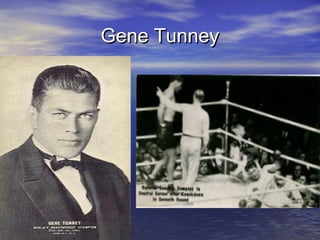
Gene TunneyGene Tunney
Bobby JonesBobby Jones
Bill TildenBill Tilden
Red GrangeRed Grange
F. Scott FitzgeraldF. Scott Fitzgerald
W.E.B. DuBoisW.E.B. DuBois
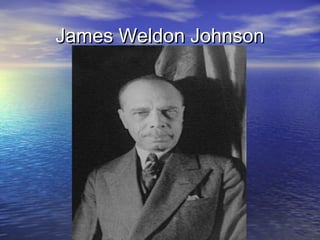
James Weldon JohnsonJames Weldon Johnson
Marcus GarveyMarcus Garvey
Harlem RenaissanceHarlem Renaissance
Lois M. JonesLois M. Jones
William JohnsonWilliam Johnson
Palmer HaydenPalmer Hayden
Louis ArmstrongLouis Armstrong
The Cotton ClubThe Cotton Club
Duke EllingtonDuke Ellington
Cab CallowayCab Calloway
Bessie SmithBessie Smith
Crash Course Video: 1920sCrash Course Video: 1920s
New York Stock ExchangeNew York Stock Exchange
Dow Jones 30Dow Jones 30
Causes of the Stock Market Crash-Causes of the Stock Market Crash-
19291929
• Stock prices were grossly inflated, did notStock prices were grossly inflated, did not
have real value-watered stock priceshave real value-watered stock prices
• Overspeculation during the 1920’sOverspeculation during the 1920’s
– Led to watered stockLed to watered stock
• ““Buying on margin”Buying on margin”
– Led to people being in debt and watered stockLed to people being in debt and watered stock
pricesprices
• Overproduction of goodsOverproduction of goods
• Uneven distribution of wealthUneven distribution of wealth
• Too much borrowing from banksToo much borrowing from banks
• Federal Reserve increased interestFederal Reserve increased interest
ratesrates
• Lack of government regulationLack of government regulation
Roaring 20's

Roaring 20's

  • 1.
    Chapter 12Chapter 12 PoliticsOf The 1920’sPolitics Of The 1920’s
  • 2.
    • The Roaring20'sThe Roaring 20's • Republican EraRepublican Era • The Jazz AgeThe Jazz Age • The Lost GenerationThe Lost Generation • Boom to BustBoom to Bust • Decade of NormalcyDecade of Normalcy • Prosperity DecadeProsperity Decade • Prohibition EraProhibition Era • The Advertising AgeThe Advertising Age • The Golden Age of SportsThe Golden Age of Sports
  • 4.
    The Red ScareTheRed Scare 1919-19201919-1920
  • 5.
  • 6.
  • 7.
  • 8.
  • 11.
    The PalmerThe Palmer RaidsRaids TheAttorney General used the attacks to initiate a widespread clamp-down on radicalism. He brought in the young and ambitious Justice Department lawyer, J. Edgar Hoover, to head a campaign of raids and mass arrests. Later known as the "Palmer raids," the widespread attack on radicals were largely Hoover's operation. He organized raids to be carried out in three different cities on January 2, 1920. Not possessing search or arrest warrants, the enforcers paid no regard to who was and who was not guilty of anything illegal. In the end, mass arrests were made and 249 people were deported including the prominent anarchists Emma Goldman and Alexander Berkman. Hysteria hit an all time high when Palmer announced that there would be an attempted Communist takeover on May 1st , 1920, but when it didn’t happen, the hysteria dissipated. Emma Goldman and Alexander BerkmanJ. Edgar HooverMitchell Palmer
  • 12.
  • 13.
    J. Edgar HooverJ.Edgar Hoover
  • 14.
    Sacco andSacco and VanzettiVanzetti OnApril 15, 1920, two men robbed and murdered a paymaster and his guard as they transferred $15,776 from the Slater and Morrill Shoe factory. Three weeks later, in the spirit of the anti-immigrant, anti-communist times, two Italian immigrants and known anarchists, Nicola Sacco and Bartolomeo Vanzetti, were accused and arrested for the crime, despite the scant evidence against them. Following a seven-week trial which many considered very unfairly manipulated by Judge Thayer, Sacco and Vanzetti were convicted on circumstantial evidence of capital murder and sentenced to death. Sacco and Vanzetti appealed their convictions and got a lot of support from those who opposed the death penalty and racism, but they lost and were executed in 1927.
  • 15.
  • 16.
    Ku Klux KlanKuKlux Klan
  • 17.
    Immigration in the1920’sImmigration in the 1920’s • The Immigration Act of 1924 (National OriginsThe Immigration Act of 1924 (National Origins Act/Asian Exclusion Act) greatly reduced immigrationAct/Asian Exclusion Act) greatly reduced immigration to USto US – The law was aimed at restricting immigration ofThe law was aimed at restricting immigration of Southern Europeans, Eastern Europeans, and JewsSouthern Europeans, Eastern Europeans, and Jews – Severely restricted the immigration of Africans andSeverely restricted the immigration of Africans and prohibited the immigration of Arabs, East Asians,prohibited the immigration of Arabs, East Asians, and Indiansand Indians – The purpose of the act was "to preserve the ideal ofThe purpose of the act was "to preserve the ideal of American homogeneity“American homogeneity“ – W.A.S.P.W.A.S.P.
  • 20.
    President Harding, CoolidgeandPresident Harding, Coolidge and HooverHoover
  • 21.
    Republican Philosophy-1920’sRepublican Philosophy-1920’s •Trickle-downtheoryTrickle-down theory •Laissez-faire •Rugged individualism •Normalcy
  • 22.
    Secretary of StateSecretaryof State Charles Evans HughesCharles Evans Hughes
  • 23.
    4 Power Treaty4Power Treaty • US, GB, France, JapanUS, GB, France, Japan • Each country would respect each otherEach country would respect each other possessions in the Pacificpossessions in the Pacific
  • 24.
    5 Power Treaty5Power Treaty • Same as 4 plus ItalySame as 4 plus Italy • Freeze navies at 1921 levelsFreeze navies at 1921 levels
  • 25.
    9 Power Treaty9Power Treaty • Above plus Netherlands, Portugal,Above plus Netherlands, Portugal, Belgium and ChinaBelgium and China • Keep “open door” in ChinaKeep “open door” in China • Promise Chinese independencePromise Chinese independence
  • 26.
    Kellogg-Briand Pact-1928Kellogg-Briand Pact-1928 •62 countries pledged not to use war62 countries pledged not to use war to settle disputesto settle disputes
  • 27.
    Albert Fall-Teapot DomeScandalAlbert Fall-Teapot Dome Scandal
  • 29.
    Link to TeapotDome VideoLink to Teapot Dome Video
  • 30.
  • 31.
  • 32.
    What impact didautomobiles haveWhat impact did automobiles have on the United States?on the United States? • Link to 1920’s carsLink to 1920’s cars
  • 33.
    Henry Ford andthe Model THenry Ford and the Model T
  • 34.
    1920 Model TFord1920 Model T Ford
  • 35.
    1927 Chrysler-Walter Chrysler1927Chrysler-Walter Chrysler
  • 36.
    1928 Dodge BrothersVictory 6 Deluxe Sedan-John Dodge
  • 37.
    1929 Buick 4-DoorSedan-David Buick
  • 38.
    Route 66 “TheMother Road”Route 66 “The Mother Road”
  • 40.
  • 41.
    Airplanes in the1920’sAirplanes in the 1920’s • Mail carryingMail carrying • Transporting small groups of peopleTransporting small groups of people • MilitaryMilitary • EntertainmentEntertainment • Major featsMajor feats
  • 42.
    Charles Lindbergh “LuckyLindy”Charles Lindbergh “Lucky Lindy”
  • 43.
  • 44.
  • 47.
    Chapter 13Chapter 13 TheRoaring Life ofThe Roaring Life of the 1920’sthe 1920’s
  • 48.
    Rural vs. UrbanRuralvs. Urban • 1920 Census- 51.2 people lived in cities of1920 Census- 51.2 people lived in cities of 2,500 or more2,500 or more • 1922-1929-more than 2 million people1922-1929-more than 2 million people moved from farms to the cities each yearmoved from farms to the cities each year • Rural areas tried to hold on to moralRural areas tried to hold on to moral values and close social relationshipsvalues and close social relationships
  • 49.
    The Urban SceneTheUrban Scene • Largest citiesLargest cities 1.1. New York City(5.6 million)New York City(5.6 million) 2.2. Chicago(3 million)Chicago(3 million) 3.3. Philadelphia(2 million)Philadelphia(2 million) 4.4. 65 other cities had over 100,000 people65 other cities had over 100,000 people Cities tolerated drinking, gambling and casualCities tolerated drinking, gambling and casual dating!!!dating!!!
  • 50.
    Prohibition “The NobleExperiment”Prohibition “The Noble Experiment” • 1818thth Amendment(1920-1933)Amendment(1920-1933) – The manufacture, sale and transportation ofThe manufacture, sale and transportation of alcoholic beverages was illegalalcoholic beverages was illegal – Supporters believed alcohol brought aboutSupporters believed alcohol brought about corruption, crime, wife and child abuse andcorruption, crime, wife and child abuse and accidentsaccidents – Supporters came mostly from rural SouthSupporters came mostly from rural South and West(areas with a lot of Protestants)and West(areas with a lot of Protestants) – Anti-Saloon League and Women’s ChristianAnti-Saloon League and Women’s Christian Temperence Union led the attack on alcoholTemperence Union led the attack on alcohol
  • 51.
    ProhibitionProhibition • Alcohol wasallowed for medicinalAlcohol was allowed for medicinal and religious purposesand religious purposes • Prescriptions and sacramentalPrescriptions and sacramental wine orders skyrocketedwine orders skyrocketed
  • 52.
    ProhibitionProhibition • At firstsaloons closed and drunkenessAt first saloons closed and drunkeness went downwent down • The Volstead Act created theThe Volstead Act created the Prohibition Bureau to enforce the lawProhibition Bureau to enforce the law • Prohibition failed for three reasons:Prohibition failed for three reasons: 1.1. People despised it. Saw it asPeople despised it. Saw it as government meddling in people’sgovernment meddling in people’s liveslives 2.2. The Prohibition Bureau wasThe Prohibition Bureau was underfunded. Had 1,500 people tounderfunded. Had 1,500 people to supervise the country.supervise the country. 3.3. Organized crime becameOrganized crime became
  • 53.
  • 57.
    Bootlegging in the1920'sBootlegging in the 1920's • Illegally making or distributing alcoholIllegally making or distributing alcohol • BootleggersBootleggers - people that made or transported alcohol- people that made or transported alcohol – Named because people carried liquor inNamed because people carried liquor in the legs of bootsthe legs of boots – Most imported alcohol came in fromMost imported alcohol came in from Canada, Cuba or the West IndiesCanada, Cuba or the West Indies
  • 59.
  • 60.
    The biggest threatto the bootleggerThe biggest threat to the bootlegger was not the Prohibition Bureau orwas not the Prohibition Bureau or police but….police but…. HijackingHijacking .
  • 61.
    MoonshineMoonshine • Alcohol madesecretlyAlcohol made secretly in home made stillsin home made stills • Several hundredSeveral hundred people a yearpeople a year dieddied from drinkingfrom drinking moonshine during themoonshine during the 1920s1920s • In 1929 it is estimatedIn 1929 it is estimated that 700 million gallonsthat 700 million gallons of beer were producedof beer were produced in American homesin American homes
  • 62.
    SpeakeasiesSpeakeasies • To obtainalcohol illegally, people wentTo obtain alcohol illegally, people went underground to secret bars callunderground to secret bars call speakeasiesspeakeasies(people spoke easily or(people spoke easily or quietly about it)quietly about it) • Speakeasies could be anywhereSpeakeasies could be anywhere • To be admitted a card or password had toTo be admitted a card or password had to be givenbe given
  • 66.
    Organized CrimeOrganized Crime •Came about as a result of ProhibitionCame about as a result of Prohibition • Every major city had it’s gangEvery major city had it’s gang • Al Capone’s bootlegging business inAl Capone’s bootlegging business in Chicago made over $60 million a yearChicago made over $60 million a year • Due to gang violence, only 19% ofDue to gang violence, only 19% of Americans supported Prohibition by 1925Americans supported Prohibition by 1925 • Prohibition was repealed in 1933 by theProhibition was repealed in 1933 by the 2121stst AmendmentAmendment
  • 67.
  • 68.
    St. Valentine’s DayMassacreSt. Valentine’s Day Massacre
  • 69.
    Taken down byTax EvasionTaken down by Tax Evasion
  • 71.
    Story of TempletonRyeStory of Templeton Rye Templeton, IATempleton, IA
  • 72.
    Science vs ReligionSciencevs Religion • There was a struggle between theThere was a struggle between the modern scientific people and themodern scientific people and the Christian fundamentalistsChristian fundamentalists • Fundamentalists believed everythingFundamentalists believed everything could be explained by the Biblecould be explained by the Bible • They disagreed with the theory ofThey disagreed with the theory of evolution especiallyevolution especially
  • 73.
  • 74.
    The Scopes MonkeyTrialThe Scopes Monkey Trial • In 1925, Tennessee passed the first lawIn 1925, Tennessee passed the first law making it illegal to teach evolution inmaking it illegal to teach evolution in schoolschool • The American Civil Liberties Union(ACLU)The American Civil Liberties Union(ACLU) said it would defend any teacher willing tosaid it would defend any teacher willing to break the lawbreak the law • John Scopes, biology teacher fromJohn Scopes, biology teacher from Dayton, accepted.Dayton, accepted.
  • 75.
  • 76.
    Scopes-Monkey TrialScopes-Monkey Trial •Scopes taught evolution and was arrestedScopes taught evolution and was arrested • Clarence Darrow was hired by the ACLUClarence Darrow was hired by the ACLU to defend Scopesto defend Scopes • William Jennings Bryan was the specialWilliam Jennings Bryan was the special prosecutorprosecutor • Scopes did not deny teaching evolutionScopes did not deny teaching evolution • Trial was really about evolution in schoolsTrial was really about evolution in schools
  • 77.
  • 78.
  • 79.
    Scopes Monkey TrialScopesMonkey Trial • Darrow called Bryan to the stand andDarrow called Bryan to the stand and asked him questions about the Bibleasked him questions about the Bible • Darrow made Bryan look foolishDarrow made Bryan look foolish • In the end, Scopes was found guiltyIn the end, Scopes was found guilty and fined $100and fined $100
  • 81.
    The “Roaring” EconomyThe“Roaring” Economy
  • 83.
    Buying on CreditBuyingon Credit • ““Buy now, pay later”Buy now, pay later” • Stocks marketStocks market was boomingwas booming – Buying on marginBuying on margin
  • 84.
    High Tariff PolicyHighTariff Policy • What is a tariff?What is a tariff? • Why did progressives want to lower tariffs inWhy did progressives want to lower tariffs in the early 1900’s?the early 1900’s? • Why did the Republicans raise tariffs in theWhy did the Republicans raise tariffs in the 1920’s?1920’s?
  • 85.
    The Era of“Permanent Prosperity”The Era of “Permanent Prosperity” • ““As long as everyone has faith, everythingAs long as everyone has faith, everything will be fine.”will be fine.”
  • 86.
    WOMEN IN THEWOMENIN THE 1920’s1920’s
  • 87.
    Cult of DomesticityCultof Domesticity • Developed throughout 1800’sDeveloped throughout 1800’s • The ideal of womanhood had fourThe ideal of womanhood had four characteristics:characteristics: • 1. Piety1. Piety • 2. Purity2. Purity • 3. Domesticity3. Domesticity • 4. Submissiveness4. Submissiveness
  • 88.
    • World WarI interrupted the campaign for woman suffrage • Women took the men’s jobs in WWI showing the country that they could do hard work World War I(1917-1918)World War I(1917-1918)
  • 89.
    Finally, on Aug.20, 1920, the 19th Amendment became part of the United States Constitution when Tennessee became the 36th state to ratify it.
  • 90.
    1919thth AmendmentAmendment ““The right ofcitizens of the United States toThe right of citizens of the United States to vote shall not be denied or abridged byvote shall not be denied or abridged by the United States or by any State onthe United States or by any State on account of sex. Congress shall haveaccount of sex. Congress shall have power to enforce this article by appropriatepower to enforce this article by appropriate legislation.legislation.””
  • 91.
    The Roaring 20’sTheRoaring 20’s • The 1920’s were aThe 1920’s were a good decade forgood decade for women’s rightswomen’s rights • 1919thth AmendmentAmendment • Flapper girlsFlapper girls • Going to collegeGoing to college moremore • Working more outsideWorking more outside the homethe home
  • 92.
    Margaret SangerMargaret Sanger •In 1921, she founded theIn 1921, she founded the American Birth ControlAmerican Birth Control League (ABCL)League (ABCL) – Today known asToday known as Planned ParenthoodPlanned Parenthood • Women were then able toWomen were then able to control their own bodies.control their own bodies. • This movement educatedThis movement educated women about existingwomen about existing birth control methods.birth control methods.
  • 93.
    EducationEducation • By 1928,women wereBy 1928, women were earning 39% of theearning 39% of the college degrees given incollege degrees given in the United Statesthe United States • In 1900, it was 19%In 1900, it was 19% • What % do you think it isWhat % do you think it is today?today? • Almost 60%Almost 60%
  • 94.
    1928 Olympics1928 Olympics •These were the firstThese were the first Olympics that women wereOlympics that women were allowed to compete in.allowed to compete in. • There were manyThere were many arguments about thesearguments about these actions.actions. – Some argued that it wasSome argued that it was historically inappropriatehistorically inappropriate since women did notsince women did not compete in ancientcompete in ancient Greek Olympics.Greek Olympics. – Others said that physicalOthers said that physical competition wascompetition was “injurious” to women.“injurious” to women. The 1928 Dutch Women’s Gymnastics team. They won the gold medal in the group event.
  • 95.
    ““Pink Collared” Jobs-1920’s-1970’sPinkCollared” Jobs-1920’s-1970’s • Gave women a taste of theGave women a taste of the work world.work world. • Low paying serviceLow paying service occupations.occupations. • Made less money thanMade less money than men did doing the samemen did doing the same jobs.jobs. – Examples of jobs:Examples of jobs: • SecretariesSecretaries • TeachersTeachers • Telephone operatorsTelephone operators • NursesNurses
  • 96.
    The FlapperThe Flapper •Short hairShort hair • Short dressesShort dresses • ShapelessShapeless dresses-eliminateddresses-eliminated corsets-see nextcorsets-see next slideslide • Smoked, drank inSmoked, drank in public and earnedpublic and earned their own moneytheir own money
  • 98.
    • Author F.Scott Fitzgerald described flappers as “Lovely, expensive and about 19”. • “In the 1920’s, a new woman was born. She smoked, drank, danced and voted. She cut her hair, wore make-up, and went to petting parties. She was giddy and took risks. She was a flapper.” • Speaking to 1,500 students at Wellesley College in 1921, Mrs. Augustus Trowbridge condemned "the vulgarity and revolting badness of petting parties." • She said that these “loose-moraled gatherings — along with jazz music, unchaperoned dancing and lipstick — were symptomatic of a decadent society.” • Snugglepupping-Flappers--Link
  • 100.
    • Snugglepupping wascommon in highSnugglepupping was common in high schools and collegesschools and colleges • "Girls like to be called snuggle-puppies,""Girls like to be called snuggle-puppies," one school administrator told a newsone school administrator told a news reporter. "They grant the boys liberties.reporter. "They grant the boys liberties. Encourage them to take them and if theEncourage them to take them and if the young chaps do not, they are calledyoung chaps do not, they are called 'sissies‘ or a 'flat tire.' “'sissies‘ or a 'flat tire.' “ • Eventually spread to carsEventually spread to cars • Died out by the end of the 1930’sDied out by the end of the 1930’s
  • 101.
    Clara BowClara Bow •Became THE flapperBecame THE flapper of the 1920’sof the 1920’s • She appeared in 58She appeared in 58 films between 1922films between 1922 and 1933and 1933 • Seen as the leadingSeen as the leading sex symbol of thesex symbol of the 1920’s’1920’s’
  • 102.
    FlapperFlapper • Not allwomen in the 1920s were flappersNot all women in the 1920s were flappers • Most were traditional-stay at home, do theMost were traditional-stay at home, do the housework, etc.housework, etc. • Flappers mostly were Northern, urban,Flappers mostly were Northern, urban, single, young, middle-classsingle, young, middle-class
  • 105.
  • 106.
  • 107.
  • 114.
  • 115.
  • 116.
  • 117.
  • 118.
  • 119.
  • 120.
    Al Jolson inThe Jazz SingerAl Jolson in The Jazz Singer
  • 121.
    The Marx BrothersTheMarx Brothers
  • 122.
  • 123.
  • 124.
  • 125.
  • 126.
  • 127.
  • 128.
  • 129.
    F. Scott FitzgeraldF.Scott Fitzgerald
  • 130.
  • 131.
  • 132.
  • 133.
  • 134.
  • 135.
  • 136.
  • 138.
    The Cotton ClubTheCotton Club
  • 141.
  • 142.
  • 143.
  • 144.
    Crash Course Video:1920sCrash Course Video: 1920s
  • 145.
    New York StockExchangeNew York Stock Exchange
  • 148.
  • 150.
    Causes of theStock Market Crash-Causes of the Stock Market Crash- 19291929 • Stock prices were grossly inflated, did notStock prices were grossly inflated, did not have real value-watered stock priceshave real value-watered stock prices • Overspeculation during the 1920’sOverspeculation during the 1920’s – Led to watered stockLed to watered stock • ““Buying on margin”Buying on margin” – Led to people being in debt and watered stockLed to people being in debt and watered stock pricesprices
  • 151.
    • Overproduction ofgoodsOverproduction of goods • Uneven distribution of wealthUneven distribution of wealth • Too much borrowing from banksToo much borrowing from banks • Federal Reserve increased interestFederal Reserve increased interest ratesrates • Lack of government regulationLack of government regulation

Editor's Notes

  • #91 Mount, Steve. "U.S Constitution- Amendment 19." The U.S. Constitution Online. 2007. 31 May 2007 <http://www.usconstitution.net/xconst_Am19.html>.
  • #93 -Eisenberg, Bonnie, and Mary Ruthsdotter. "Living the Legacy: the Women's Rights Movement 1848 - 1998." Women's Rights Movement. 1998. 5 June 2007 <http://www.legacy98.org/move-hist.html>.
  • #94 -Graduation. 1926. Historical Timeline of the University of Idaho. University of Idaho. 1 June 2007 <http://www.lib.uidaho.edu/special-collections/timeline.htm>. -"1920s." Women of the Century. 2006. Discovery Channel. 1 June 2007 <http://school.discovery.com/schooladventures/womenofthecentury/decadebydecade/1920s.html>.
  • #95 -"Sports: Track & Field--the 1928 Olympics." HerStory. 2007. 1 June 2007 <http://library2.usask.ca/herstory/field.html>. -1928 Olympics. 1928. Amsterdam. The Holocaust. 1 June 2007 <http://www.ushmm.org/museum/exhibit/online/olympics/zcd078.htm>.
  • #96 -Patterson, June. "Telephone Operators in Hazard 1961." Hazard Kentucky and Perry County; a Photo History. 1961. 29 May 2007 <http://hazardkentucky.com/haznet/index.shtml>.