Chapter 24 The New Era: 1920-1929 CJ Cayanan
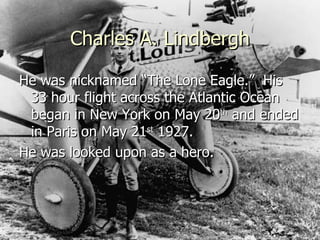
Charles A. Lindbergh He was nicknamed “The Lone Eagle.”  His 33 hour flight across the Atlantic Ocean began in New York on May 20 th  and ended in Paris on May 21 st  1927. He was looked upon as a hero.
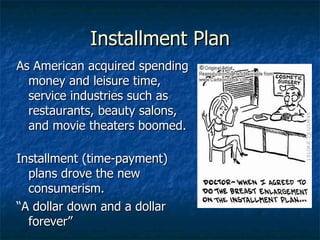
Installment Plan As American acquired spending money and leisure time, service industries such as restaurants, beauty salons, and movie theaters boomed.  Installment (time-payment) plans drove the new consumerism. “ A dollar down and a dollar forever”
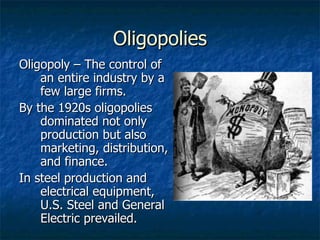
Oligopolies Oligopoly – The control of an entire industry by a few large firms. By the 1920s oligopolies dominated not only production but also marketing, distribution, and finance.  In steel production and electrical equipment, U.S. Steel and General Electric prevailed.
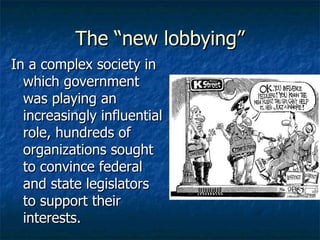
The “new lobbying” In a complex society in which government was playing an increasingly influential role, hundreds of organizations sought to convince federal and state legislators to support their interests.
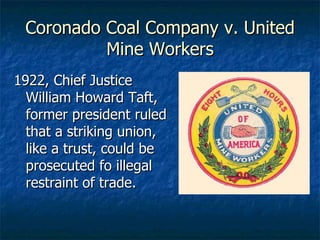
Coronado Coal Company v. United Mine Workers 1922, Chief Justice William Howard Taft, former president ruled that a striking union, like a trust, could be prosecuted fo illegal restraint of trade.
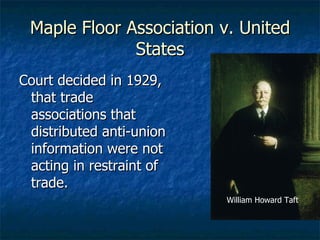
Maple Floor Association v. United States Court decided in 1929, that trade associations that distributed anti-union information were not acting in restraint of trade. William Howard Taft
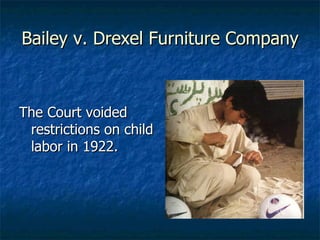
Bailey v. Drexel Furniture Company The Court voided restrictions on child labor in 1922.
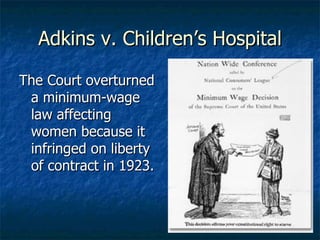
Adkins v. Children’s Hospital The Court overturned a minimum-wage law affecting women because it infringed on liberty of contract in 1923.
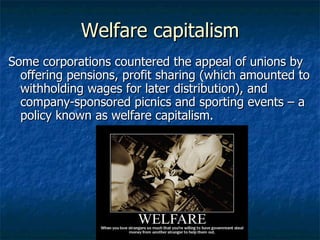
Welfare capitalism Some corporations countered the appeal of unions by offering pensions, profit sharing (which amounted to withholding wages for later distribution), and company-sponsored picnics and sporting events – a policy known as welfare capitalism.
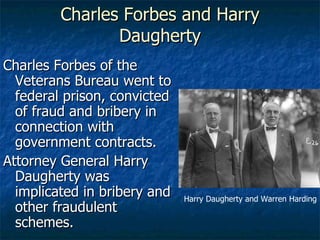
Charles Forbes and Harry Daugherty Charles Forbes of the Veterans Bureau went to federal prison, convicted of fraud and bribery in connection with government contracts. Attorney General Harry Daugherty was implicated in bribery and other fraudulent schemes. Harry Daugherty and Warren Harding
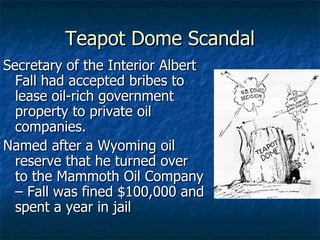
Teapot Dome Scandal Secretary of the Interior Albert Fall had accepted bribes to lease oil-rich government property to private oil companies.  Named after a Wyoming oil reserve that he turned over to the Mammoth Oil Company – Fall was fined $100,000 and spent a year in jail
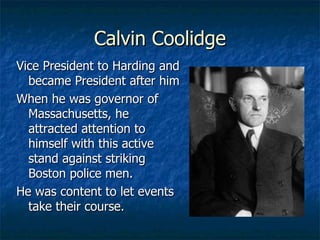
Calvin Coolidge Vice President to Harding and became President after him When he was governor of Massachusetts, he attracted attention to himself with this active stand against striking Boston police men. He was content to let events take their course.
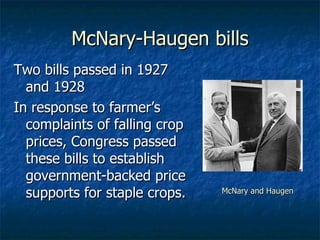
McNary-Haugen bills Two bills passed in 1927 and 1928 In response to farmer’s complaints of falling crop prices, Congress passed these bills to establish government-backed price supports for staple crops. McNary and Haugen
The 1924 Presidential Election Republicans nominated Calvin Coolidge Democrats finally nominated John W. Davis after debating between William G. McAdoo and Alfred E. Smith Progressive Party nominated Robert M. La Follette Coolidge won
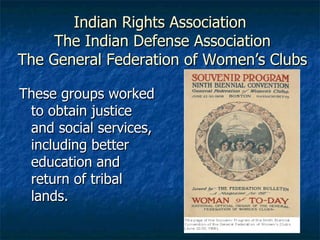
Indian Rights Association  The Indian Defense Association  The General Federation of Women’s Clubs These groups worked to obtain justice and social services, including better education and return of tribal lands.
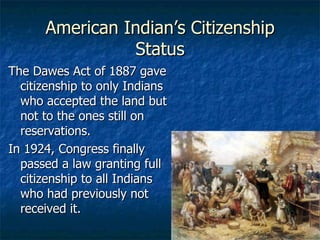
American Indian’s Citizenship Status The Dawes Act of 1887 gave citizenship to only Indians who accepted the land but not to the ones still on reservations. In 1924, Congress finally passed a law granting full citizenship to all Indians who had previously not received it.
Bureau of Indian Affairs President Herbert Hoover’s administration reorganized the Bureau of Indian Affairs and increased expenditures for health, education, and welfare. Much of the money, however, went to enlarge the bureaucracy rather than into Indian hands.
League of Women Voters It formed from the National American Woman Suffrage Association. They encouraged women to run for office. They were more actively as lobbyists for laws to improve conditions for employed women, the mentally ill, and the urban poor.
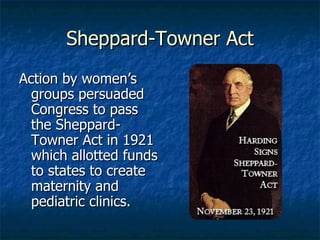
Sheppard-Towner Act Action by women’s groups persuaded Congress to pass the Sheppard-Towner Act in 1921 which allotted funds to states to create maternity and pediatric clinics.
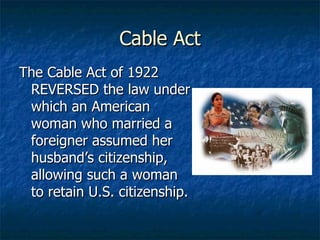
Cable Act The Cable Act of 1922 REVERSED the law under which an American woman who married a foreigner assumed her husband’s citizenship, allowing such a woman to retain U.S. citizenship.
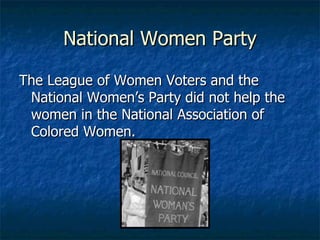
National Women Party The League of Women Voters and the National Women’s Party did not help the women in the National Association of Colored Women.
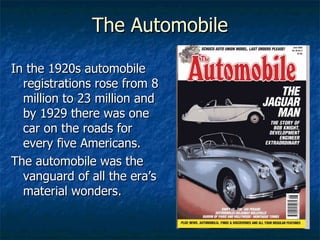
The Automobile In the 1920s automobile registrations rose from 8 million to 23 million and by 1929 there was one car on the roads for every five Americans. The automobile was the vanguard of all the era’s material wonders.
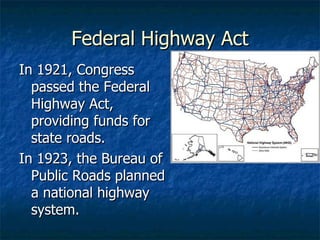
Federal Highway Act In 1921, Congress passed the Federal Highway Act, providing funds for state roads. In 1923, the Bureau of Public Roads planned a national highway system.
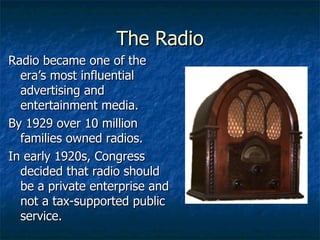
The Radio Radio became one of the era’s most influential advertising and entertainment media. By 1929 over 10 million families owned radios. In early 1920s, Congress decided that radio should be a private enterprise and not a tax-supported public service.
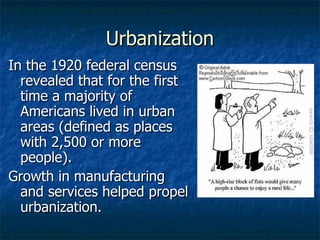
Urbanization In the 1920 federal census revealed that for the first time a majority of Americans lived in urban areas (defined as places with 2,500 or more people). Growth in manufacturing and services helped propel urbanization.
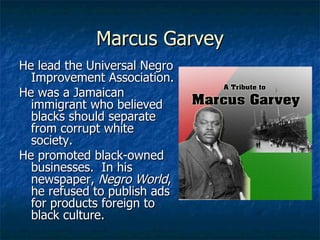
Marcus Garvey He lead the Universal Negro Improvement Association. He was a Jamaican immigrant who believed blacks should separate from corrupt white society. He promoted black-owned businesses.  In his newspaper,  Negro World , he refused to publish ads for products foreign to black culture.
Mexican Immigrants During the 1910s, Anglo farmers’ associations encouraged Mexican immigration to provide cheap agricultural labor, and by the 1920s Mexican migrants comprised three-fourths of farm labor in the West. They were treated like slaves; they had low wages and poor healthcare.
Puerto Rican Immigrants An influx of Puerto Rican immigrants occurred in the 1920s. Most Puerto Rican migrants moved to New York City, where they created Barrios in Brooklyn and Manhattan and found jobs in manufacturing and in hotels, restaurants, and domestic service.
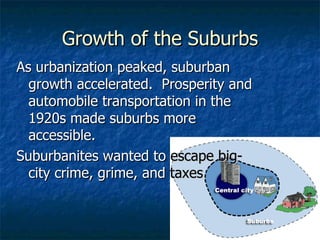
Growth of the Suburbs As urbanization peaked, suburban growth accelerated.  Prosperity and automobile transportation in the 1920s made suburbs more accessible. Suburbanites wanted to  escape   big- city crime, grime, and  taxes
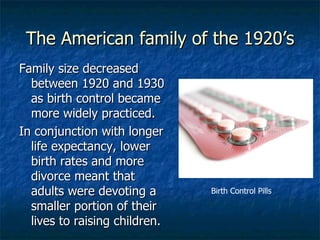
The American family of the 1920’s Family size decreased between 1920 and 1930 as birth control became more widely practiced. In conjunction with longer life expectancy, lower birth rates and more divorce meant that adults were devoting a smaller portion of their lives to raising children. Birth Control Pills
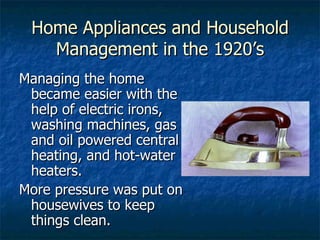
Home Appliances and Household Management in the 1920’s Managing the home became easier with the help of electric irons, washing machines, gas and oil powered central heating, and hot-water heaters. More pressure was put on housewives to keep things clean.
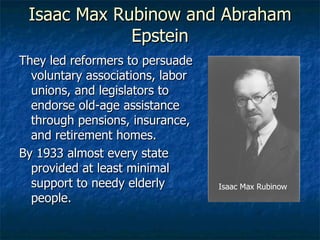
Isaac Max Rubinow and Abraham Epstein They led reformers to persuade voluntary associations, labor unions, and legislators to endorse old-age assistance through pensions, insurance, and retirement homes. By 1933 almost every state provided at least minimal support to needy elderly people. Isaac Max Rubinow
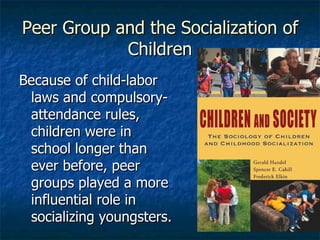
Peer Group and the Socialization of Children Because of child-labor laws and compulsory-attendance rules, children were in school longer than ever before, peer groups played a more influential role in socializing youngsters.
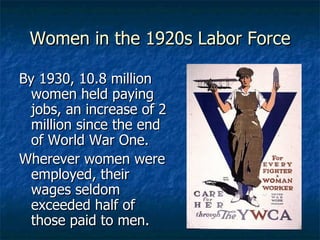
Women in the 1920s Labor Force By 1930, 10.8 million women held paying jobs, an increase of 2 million since the end of World War One. Wherever women were employed, their wages seldom exceeded half of those paid to men.
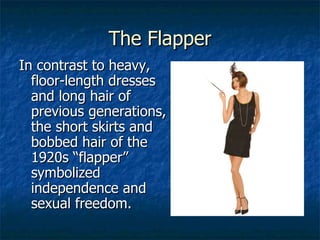
The Flapper In contrast to heavy, floor-length dresses and long hair of previous generations, the short skirts and bobbed hair of the 1920s “flapper” symbolized independence and sexual freedom.
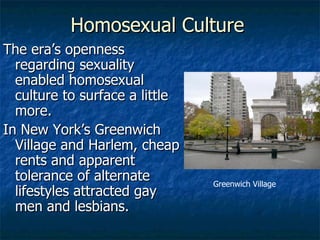
Homosexual Culture The era’s openness regarding sexuality enabled homosexual culture to surface a little more. In New York’s Greenwich Village and Harlem, cheap rents and apparent tolerance of alternate lifestyles attracted gay men and lesbians. Greenwich Village
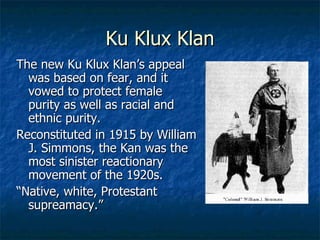
Ku Klux Klan The new Ku Klux Klan’s appeal was based on fear, and it vowed to protect female purity as well as racial and ethnic purity. Reconstituted in 1915 by William J. Simmons, the Kan was the most sinister reactionary movement of the 1920s. “ Native, white, Protestant supreamacy.”
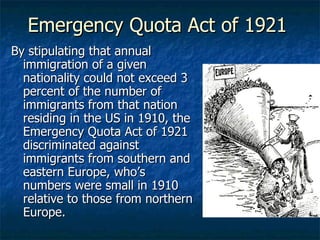
Emergency Quota Act of 1921 By stipulating that annual immigration of a given nationality could not exceed 3 percent of the number of immigrants from that nation residing in the US in 1910, the Emergency Quota Act of 1921 discriminated against immigrants from southern and eastern Europe, who’s numbers were small in 1910 relative to those from northern Europe.
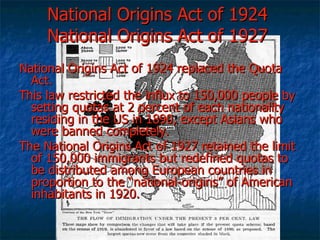
National Origins Act of 1924 National Origins Act of 1927 National Origins Act of 1924 replaced the Quota Act. This law restricted the influx to 150,000 people by setting quotas at 2 percent of each nationality residing in the US in 1890, except Asians who were banned completely. The National Origins Act of 1927 retained the limit of 150,000 immigrants but redefined quotas to be distributed among European countries in proportion to the “national-origins” of American inhabitants in 1920.
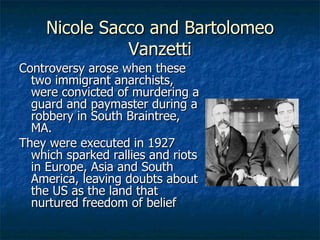
Nicole Sacco and Bartolomeo Vanzetti Controversy arose when these two immigrant anarchists, were convicted of murdering a guard and paymaster during a robbery in South Braintree, MA. They were executed in 1927 which sparked rallies and riots in Europe, Asia and South America, leaving doubts about the US as the land that nurtured freedom of belief
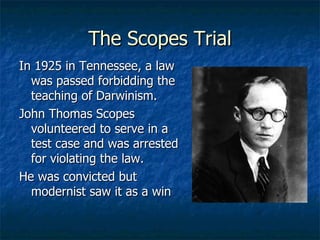
The Scopes Trial In 1925 in Tennessee, a law was passed forbidding the teaching of Darwinism. John Thomas Scopes volunteered to serve in a test case and was arrested for violating the law. He was convicted but modernist saw it as a win
Pentecostal Religion Cities also housed hundreds of Pentecostal churches, which attracted both blacks and whites struggling with economic insecurity, nervous about modernism’s attack on old-time religion, swayed by the pageantry and personal God such churches depicted.
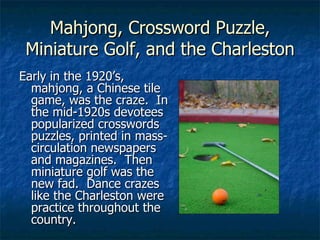
Mahjong, Crossword Puzzle, Miniature Golf, and the Charleston Early in the 1920’s, mahjong, a Chinese tile game, was the craze.  In the mid-1920s devotees popularized crosswords puzzles, printed in mass-circulation newspapers and magazines.  Then miniature golf was the new fad.  Dance crazes like the Charleston were practice throughout the country.
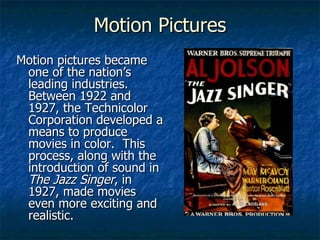
Motion Pictures Motion pictures became one of the nation’s leading industries.  Between 1922 and 1927, the Technicolor Corporation developed a means to produce movies in color.  This process, along with the introduction of sound in  The Jazz Singer , in 1927, made movies even more exciting and realistic.
Baseball Baseball’s drawn-out suspense, variety of plays, and potential for keeping statistics attracted a huge following. Millions gathered regularly to watch local teams, and even more listened to professional games on the radio.
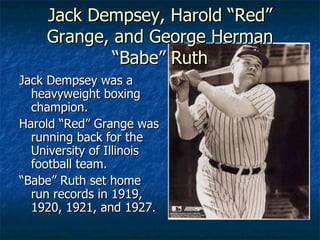
Jack Dempsey, Harold “Red” Grange, and George Herman “Babe” Ruth Jack Dempsey was a heavyweight boxing champion. Harold “Red” Grange was running back for the University of Illinois football team. “ Babe” Ruth set home run records in 1919, 1920, 1921, and 1927.
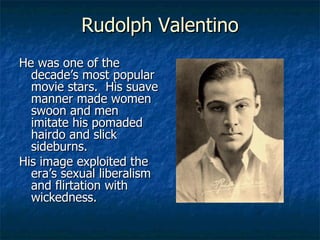
Rudolph Valentino He was one of the decade’s most popular movie stars.  His suave manner made women swoon and men imitate his pomaded hairdo and slick sideburns. His image exploited the era’s sexual liberalism and flirtation with wickedness.
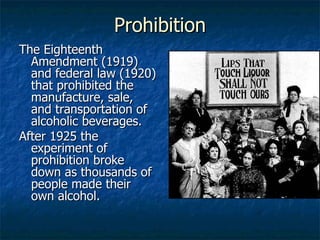
Prohibition The Eighteenth Amendment (1919) and federal law (1920) that prohibited the manufacture, sale, and transportation of alcoholic beverages. After 1925 the experiment of prohibition broke down as thousands of people made their own alcohol.
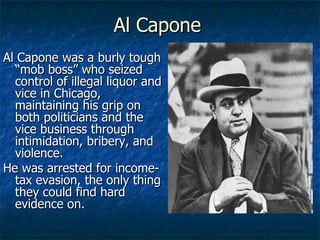
Al Capone Al Capone was a burly tough “mob boss” who seized control of illegal liquor and vice in Chicago, maintaining his grip on both politicians and the vice business through intimidation, bribery, and violence. He was arrested for income-tax evasion, the only thing they could find hard evidence on.
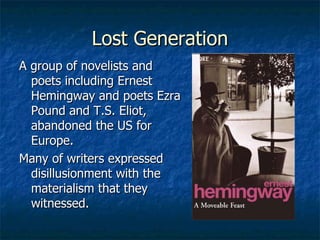
Lost Generation A group of novelists and poets including Ernest Hemingway and poets Ezra Pound and T.S. Eliot, abandoned the US for Europe. Many of writers expressed disillusionment with the materialism that they witnessed.
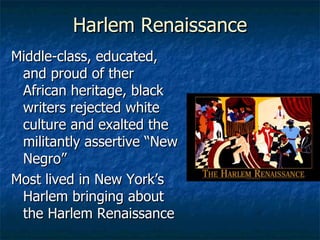
Harlem Renaissance Middle-class, educated, and proud of ther African heritage, black writers rejected white culture and exalted the militantly assertive “New Negro” Most lived in New York’s Harlem bringing about the Harlem Renaissance
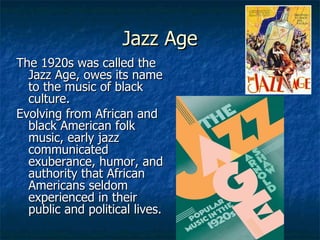
Jazz Age The 1920s was called the Jazz Age, owes its name to the music of black culture. Evolving from African and black American folk music, early jazz communicated exuberance, humor, and authority that African Americans seldom experienced in their public and political lives.
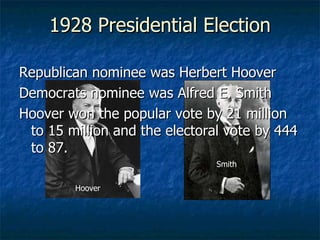
1928 Presidential Election Republican nominee was Herbert Hoover Democrats nominee was Alfred E. Smith Hoover won the popular vote by 21 million to 15 million and the electoral vote by 444 to 87. Hoover Smith
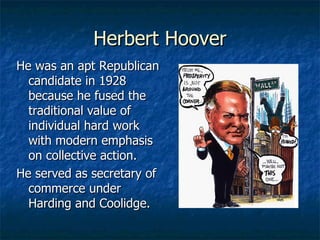
Herbert Hoover He was an apt Republican candidate in 1928 because he fused the traditional value of individual hard work with modern emphasis on collective action. He served as secretary of commerce under Harding and Coolidge.
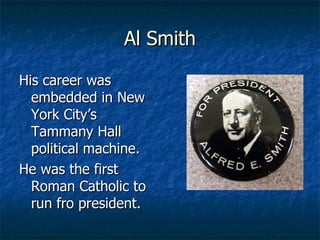
Al Smith His career was embedded in New York City’s Tammany Hall political machine. He was the first Roman Catholic to run fro president.
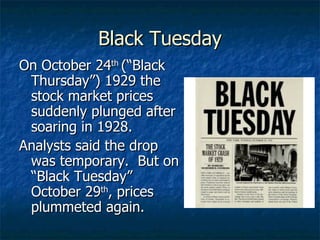
Black Tuesday On October 24 th  (“Black Thursday”) 1929 the stock market prices suddenly plunged after soaring in 1928. Analysts said the drop was temporary.  But on “Black Tuesday” October 29 th , prices plummeted again.
Stock Market Crash When Black Thursday occurred people were stunned and frantic. Prices of many stocks hit record lows; some sellers could find no buyers. Bankers put up $20 million and began buying stocks again.  The mood brightened and some stocks rallied but “Black Tuesday” occurred and the stock market crashed.

Chapter 24 AP American History

  • 1.
    Chapter 24 TheNew Era: 1920-1929 CJ Cayanan
  • 2.
    Charles A. LindberghHe was nicknamed “The Lone Eagle.” His 33 hour flight across the Atlantic Ocean began in New York on May 20 th and ended in Paris on May 21 st 1927. He was looked upon as a hero.
  • 3.
    Installment Plan AsAmerican acquired spending money and leisure time, service industries such as restaurants, beauty salons, and movie theaters boomed. Installment (time-payment) plans drove the new consumerism. “ A dollar down and a dollar forever”
  • 4.
    Oligopolies Oligopoly –The control of an entire industry by a few large firms. By the 1920s oligopolies dominated not only production but also marketing, distribution, and finance. In steel production and electrical equipment, U.S. Steel and General Electric prevailed.
  • 5.
    The “new lobbying”In a complex society in which government was playing an increasingly influential role, hundreds of organizations sought to convince federal and state legislators to support their interests.
  • 6.
    Coronado Coal Companyv. United Mine Workers 1922, Chief Justice William Howard Taft, former president ruled that a striking union, like a trust, could be prosecuted fo illegal restraint of trade.
  • 7.
    Maple Floor Associationv. United States Court decided in 1929, that trade associations that distributed anti-union information were not acting in restraint of trade. William Howard Taft
  • 8.
    Bailey v. DrexelFurniture Company The Court voided restrictions on child labor in 1922.
  • 9.
    Adkins v. Children’sHospital The Court overturned a minimum-wage law affecting women because it infringed on liberty of contract in 1923.
  • 10.
    Welfare capitalism Somecorporations countered the appeal of unions by offering pensions, profit sharing (which amounted to withholding wages for later distribution), and company-sponsored picnics and sporting events – a policy known as welfare capitalism.
  • 11.
    Charles Forbes andHarry Daugherty Charles Forbes of the Veterans Bureau went to federal prison, convicted of fraud and bribery in connection with government contracts. Attorney General Harry Daugherty was implicated in bribery and other fraudulent schemes. Harry Daugherty and Warren Harding
  • 12.
    Teapot Dome ScandalSecretary of the Interior Albert Fall had accepted bribes to lease oil-rich government property to private oil companies. Named after a Wyoming oil reserve that he turned over to the Mammoth Oil Company – Fall was fined $100,000 and spent a year in jail
  • 13.
    Calvin Coolidge VicePresident to Harding and became President after him When he was governor of Massachusetts, he attracted attention to himself with this active stand against striking Boston police men. He was content to let events take their course.
  • 14.
    McNary-Haugen bills Twobills passed in 1927 and 1928 In response to farmer’s complaints of falling crop prices, Congress passed these bills to establish government-backed price supports for staple crops. McNary and Haugen
  • 15.
    The 1924 PresidentialElection Republicans nominated Calvin Coolidge Democrats finally nominated John W. Davis after debating between William G. McAdoo and Alfred E. Smith Progressive Party nominated Robert M. La Follette Coolidge won
  • 16.
    Indian Rights Association The Indian Defense Association The General Federation of Women’s Clubs These groups worked to obtain justice and social services, including better education and return of tribal lands.
  • 17.
    American Indian’s CitizenshipStatus The Dawes Act of 1887 gave citizenship to only Indians who accepted the land but not to the ones still on reservations. In 1924, Congress finally passed a law granting full citizenship to all Indians who had previously not received it.
  • 18.
    Bureau of IndianAffairs President Herbert Hoover’s administration reorganized the Bureau of Indian Affairs and increased expenditures for health, education, and welfare. Much of the money, however, went to enlarge the bureaucracy rather than into Indian hands.
  • 19.
    League of WomenVoters It formed from the National American Woman Suffrage Association. They encouraged women to run for office. They were more actively as lobbyists for laws to improve conditions for employed women, the mentally ill, and the urban poor.
  • 20.
    Sheppard-Towner Act Actionby women’s groups persuaded Congress to pass the Sheppard-Towner Act in 1921 which allotted funds to states to create maternity and pediatric clinics.
  • 21.
    Cable Act TheCable Act of 1922 REVERSED the law under which an American woman who married a foreigner assumed her husband’s citizenship, allowing such a woman to retain U.S. citizenship.
  • 22.
    National Women PartyThe League of Women Voters and the National Women’s Party did not help the women in the National Association of Colored Women.
  • 23.
    The Automobile Inthe 1920s automobile registrations rose from 8 million to 23 million and by 1929 there was one car on the roads for every five Americans. The automobile was the vanguard of all the era’s material wonders.
  • 24.
    Federal Highway ActIn 1921, Congress passed the Federal Highway Act, providing funds for state roads. In 1923, the Bureau of Public Roads planned a national highway system.
  • 25.
    The Radio Radiobecame one of the era’s most influential advertising and entertainment media. By 1929 over 10 million families owned radios. In early 1920s, Congress decided that radio should be a private enterprise and not a tax-supported public service.
  • 26.
    Urbanization In the1920 federal census revealed that for the first time a majority of Americans lived in urban areas (defined as places with 2,500 or more people). Growth in manufacturing and services helped propel urbanization.
  • 27.
    Marcus Garvey Helead the Universal Negro Improvement Association. He was a Jamaican immigrant who believed blacks should separate from corrupt white society. He promoted black-owned businesses. In his newspaper, Negro World , he refused to publish ads for products foreign to black culture.
  • 28.
    Mexican Immigrants Duringthe 1910s, Anglo farmers’ associations encouraged Mexican immigration to provide cheap agricultural labor, and by the 1920s Mexican migrants comprised three-fourths of farm labor in the West. They were treated like slaves; they had low wages and poor healthcare.
  • 29.
    Puerto Rican ImmigrantsAn influx of Puerto Rican immigrants occurred in the 1920s. Most Puerto Rican migrants moved to New York City, where they created Barrios in Brooklyn and Manhattan and found jobs in manufacturing and in hotels, restaurants, and domestic service.
  • 30.
    Growth of theSuburbs As urbanization peaked, suburban growth accelerated. Prosperity and automobile transportation in the 1920s made suburbs more accessible. Suburbanites wanted to escape big- city crime, grime, and taxes
  • 31.
    The American familyof the 1920’s Family size decreased between 1920 and 1930 as birth control became more widely practiced. In conjunction with longer life expectancy, lower birth rates and more divorce meant that adults were devoting a smaller portion of their lives to raising children. Birth Control Pills
  • 32.
    Home Appliances andHousehold Management in the 1920’s Managing the home became easier with the help of electric irons, washing machines, gas and oil powered central heating, and hot-water heaters. More pressure was put on housewives to keep things clean.
  • 33.
    Isaac Max Rubinowand Abraham Epstein They led reformers to persuade voluntary associations, labor unions, and legislators to endorse old-age assistance through pensions, insurance, and retirement homes. By 1933 almost every state provided at least minimal support to needy elderly people. Isaac Max Rubinow
  • 34.
    Peer Group andthe Socialization of Children Because of child-labor laws and compulsory-attendance rules, children were in school longer than ever before, peer groups played a more influential role in socializing youngsters.
  • 35.
    Women in the1920s Labor Force By 1930, 10.8 million women held paying jobs, an increase of 2 million since the end of World War One. Wherever women were employed, their wages seldom exceeded half of those paid to men.
  • 36.
    The Flapper Incontrast to heavy, floor-length dresses and long hair of previous generations, the short skirts and bobbed hair of the 1920s “flapper” symbolized independence and sexual freedom.
  • 37.
    Homosexual Culture Theera’s openness regarding sexuality enabled homosexual culture to surface a little more. In New York’s Greenwich Village and Harlem, cheap rents and apparent tolerance of alternate lifestyles attracted gay men and lesbians. Greenwich Village
  • 38.
    Ku Klux KlanThe new Ku Klux Klan’s appeal was based on fear, and it vowed to protect female purity as well as racial and ethnic purity. Reconstituted in 1915 by William J. Simmons, the Kan was the most sinister reactionary movement of the 1920s. “ Native, white, Protestant supreamacy.”
  • 39.
    Emergency Quota Actof 1921 By stipulating that annual immigration of a given nationality could not exceed 3 percent of the number of immigrants from that nation residing in the US in 1910, the Emergency Quota Act of 1921 discriminated against immigrants from southern and eastern Europe, who’s numbers were small in 1910 relative to those from northern Europe.
  • 40.
    National Origins Actof 1924 National Origins Act of 1927 National Origins Act of 1924 replaced the Quota Act. This law restricted the influx to 150,000 people by setting quotas at 2 percent of each nationality residing in the US in 1890, except Asians who were banned completely. The National Origins Act of 1927 retained the limit of 150,000 immigrants but redefined quotas to be distributed among European countries in proportion to the “national-origins” of American inhabitants in 1920.
  • 41.
    Nicole Sacco andBartolomeo Vanzetti Controversy arose when these two immigrant anarchists, were convicted of murdering a guard and paymaster during a robbery in South Braintree, MA. They were executed in 1927 which sparked rallies and riots in Europe, Asia and South America, leaving doubts about the US as the land that nurtured freedom of belief
  • 42.
    The Scopes TrialIn 1925 in Tennessee, a law was passed forbidding the teaching of Darwinism. John Thomas Scopes volunteered to serve in a test case and was arrested for violating the law. He was convicted but modernist saw it as a win
  • 43.
    Pentecostal Religion Citiesalso housed hundreds of Pentecostal churches, which attracted both blacks and whites struggling with economic insecurity, nervous about modernism’s attack on old-time religion, swayed by the pageantry and personal God such churches depicted.
  • 44.
    Mahjong, Crossword Puzzle,Miniature Golf, and the Charleston Early in the 1920’s, mahjong, a Chinese tile game, was the craze. In the mid-1920s devotees popularized crosswords puzzles, printed in mass-circulation newspapers and magazines. Then miniature golf was the new fad. Dance crazes like the Charleston were practice throughout the country.
  • 45.
    Motion Pictures Motionpictures became one of the nation’s leading industries. Between 1922 and 1927, the Technicolor Corporation developed a means to produce movies in color. This process, along with the introduction of sound in The Jazz Singer , in 1927, made movies even more exciting and realistic.
  • 46.
    Baseball Baseball’s drawn-outsuspense, variety of plays, and potential for keeping statistics attracted a huge following. Millions gathered regularly to watch local teams, and even more listened to professional games on the radio.
  • 47.
    Jack Dempsey, Harold“Red” Grange, and George Herman “Babe” Ruth Jack Dempsey was a heavyweight boxing champion. Harold “Red” Grange was running back for the University of Illinois football team. “ Babe” Ruth set home run records in 1919, 1920, 1921, and 1927.
  • 48.
    Rudolph Valentino Hewas one of the decade’s most popular movie stars. His suave manner made women swoon and men imitate his pomaded hairdo and slick sideburns. His image exploited the era’s sexual liberalism and flirtation with wickedness.
  • 49.
    Prohibition The EighteenthAmendment (1919) and federal law (1920) that prohibited the manufacture, sale, and transportation of alcoholic beverages. After 1925 the experiment of prohibition broke down as thousands of people made their own alcohol.
  • 50.
    Al Capone AlCapone was a burly tough “mob boss” who seized control of illegal liquor and vice in Chicago, maintaining his grip on both politicians and the vice business through intimidation, bribery, and violence. He was arrested for income-tax evasion, the only thing they could find hard evidence on.
  • 51.
    Lost Generation Agroup of novelists and poets including Ernest Hemingway and poets Ezra Pound and T.S. Eliot, abandoned the US for Europe. Many of writers expressed disillusionment with the materialism that they witnessed.
  • 52.
    Harlem Renaissance Middle-class,educated, and proud of ther African heritage, black writers rejected white culture and exalted the militantly assertive “New Negro” Most lived in New York’s Harlem bringing about the Harlem Renaissance
  • 53.
    Jazz Age The1920s was called the Jazz Age, owes its name to the music of black culture. Evolving from African and black American folk music, early jazz communicated exuberance, humor, and authority that African Americans seldom experienced in their public and political lives.
  • 54.
    1928 Presidential ElectionRepublican nominee was Herbert Hoover Democrats nominee was Alfred E. Smith Hoover won the popular vote by 21 million to 15 million and the electoral vote by 444 to 87. Hoover Smith
  • 55.
    Herbert Hoover Hewas an apt Republican candidate in 1928 because he fused the traditional value of individual hard work with modern emphasis on collective action. He served as secretary of commerce under Harding and Coolidge.
  • 56.
    Al Smith Hiscareer was embedded in New York City’s Tammany Hall political machine. He was the first Roman Catholic to run fro president.
  • 57.
    Black Tuesday OnOctober 24 th (“Black Thursday”) 1929 the stock market prices suddenly plunged after soaring in 1928. Analysts said the drop was temporary. But on “Black Tuesday” October 29 th , prices plummeted again.
  • 58.
    Stock Market CrashWhen Black Thursday occurred people were stunned and frantic. Prices of many stocks hit record lows; some sellers could find no buyers. Bankers put up $20 million and began buying stocks again. The mood brightened and some stocks rallied but “Black Tuesday” occurred and the stock market crashed.