The 1920s: Prosperity & Depression
Chapters 20 & 21 Nativism Isolationism Communism Red Scare Anarchists Sacco & Vanzetti Installment Plan Prohibition Speakeasies Bootleggers Fundamentalism Scopes trial Flapper Charles Lindbergh Sinclair Lewis F. Scott Fitzgerald Ernest Hemingway James Weldon Johnson Marcus Garvey Harlem Renaissance Zora Neale Hurston Langston Hughes Louis Armstrong Duke Ellington
Starter: Monday, November 13 Read “Harding Struggles for Peace” on pages 625-626 and answer the questions below: Why was Russia excluded from the Washington Naval Conference? What did the Kellogg-Briand Pact do? Why did American loan Germany $2.5 billion?
Starter: Wednesday, November 15 Read “Scandal Hits Harding’s Administration” on pages 626-627 and answer the questions below: What do Harding’s appointments of the “Ohio gang” indicate about his judgment? What was the Teapot Dome scandal? How did the scandals in Harding’s administration effect him?
Starter: Tuesday, November 14  Read “Impact of the Automobile” on pages 629-630 and complete the diagram below: Impact of the Automobile
Starter: Wednesday, November 15  Read “Impact of the Automobile” on pages 629-630 and complete the diagram below: New industries (car, gas) Urban sprawl Vacations, shopping, & entertainment Tunnels Traffic signals Shopping centers Tourist camps Motels Car repair shops Gas stations New architectural  styles of homes (garages, carports, driveways) New towns due to new  highways Paved roads Impact of the Automobile
Starter: Thursday, November 16 Read “Rural & Urban Difference” on page 640-641 and complete the chart below  Urban Life Rural Life
Urban Life Rural Life
History of the 20 th  Century:  1920-1929 Why was Harding chosen as the presidential candidate? What problems did Prohibition cause society? What happened to the farmers after the war? What things made a person “modern” in the twenties? List 5 things people did in their leisure time. What kind of lifestyle did Coolidge enjoy? Why was Charles Lindbergh called a hero? What did radio do for African American performers?
What sort of things were captured on film? Why did we need more electricity? What did the electric refrigerator do for the health of the American family? How did women’s styles change? What did scouting do for kids? Overall, what was life like for most Americans during the 1920s? Would you have enjoyed living during this time?  Why or why not?
Starter 11/4 Read the flapper handout and answer the three questions at the bottom
Starter 11/5 Read page 562 Who are the two artists in the section? What did their works focus on? What influenced them? What did their works say about American culture of the time?
Primary Sources-Analysis Lyric What it means/refers to What we can learn from it about the period
Isolationism There was a desire for  “normalcy”  after the War In addition,  nativism  (prejudice against foreign-born people) thrived Fear of  communism  led to a  “Red Scare,”  which led to the  Palmer raids . The Palmer raids invaded private homes & offices and jailed communist suspects
Sacco & Vanzetti Two Italian immigrants (Nicola Sacco & Bartolomeo Vanzetti) were accused & found guilty of murder in Massachusetts. They were also believed to be  anarchists  (those that believe in anarchy, having a society without government or laws)  Although the evidence was disputable, they were executed in 1927.
 
The Rebirth of the KKK Fear of communism and immigrants led to the rise of the Ku Klux Klan Jews, Catholics, and immigrants were targeted They used intimidation and fear to pressure employers to fire immigrants & Black workers
 
Electrical Conveniences   New technologies led to electrical conveniences during the 1920s Cars, airplanes, radios, telephones were all innovative technologies of the time Women used new electric household appliances like refrigerators,  vacuum cleaners & electric stoves
The Advertising Industry The growth of business produced the  advertising industry Businesses offered the  installment plan , which allowed consumers to use  credit  to purchase expensive items a little at a time America became a  consumer society  for the first time (status was measure by how many “things” you owned However, people were going into debt and saving less money


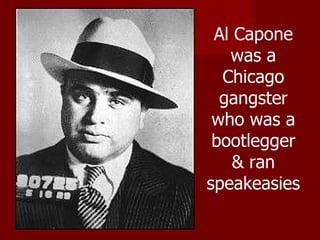
Prohibition In 1919, Congress passed the  18 th  Amendment  and the  Volstead Act , establishing Prohibition in America Prohibition  was the banning of purchase, manufacturing, and transporting alcohol  Bootleggers  (criminals who sold alcohol) supplied people with alcohol, despite the law Speakeasies  (illegal bars) were popular
Al Capone was a Chicago gangster who was a bootlegger & ran speakeasies
Fundamentalism Fundamentalism  is the belief that the Bible is literally true, because it was written by God and cannot contain contradictions or errors The rise of fundamentalism in the 1920s was caused by the belief that traditional life was under attack Fundamentalists attacked women’s suffrage, education, and science
Women’s suffrage was attacked by fundamentalists who believed that it upset traditional gender roles Evangelical ministers spread the word of the fundamentalists at revivals & over the radio Billy Sunday, Evangelical Preacher
The Scopes Trial New ideas & fundamentalism clashed during the Scopes Trial A Tennessee teacher,  John Scopes , was arrested and tried for teaching Darwin’s Theory of Evolution instead of the Bible’s account of Creation He was found guilty and the law banning the teaching of evolution remained in Tennessee
Scene from the Scopes Trial (Prosecutor William Jennings Bryan & Defense Attorney Clarence Darrow) John Scopes, a football coach and substitute biology teacher, agreed to be arrested and put on trial to challenge a new law against teaching evolution.
“ The Lost Generation” “ The Lost Generation”  was the term for a group of writers, who wrote about the greed and moral corruption of the 1920s Included authors such as Sinclair Lewis, Ernest Hemingway, and F. Scott Fitzgerald
Sinclair Lewis First American to win the Nobel Prize for literature
Ernest Hemingway A World War I veteran
F. Scott Fitzgerald Wrote  The Great Gatsby
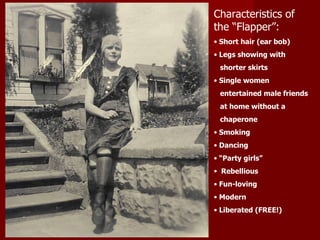
Women in the 1920s More women were in the workforce than ever before Women were still rarely given the opportunity for leadership positions in the workforce Women were seeking a more manageable & comfortable appearance, ushering in the “ flapper ”
Characteristics of the “Flapper”: Short hair (ear bob) Legs showing with  shorter skirts Single women  entertained male friends  at home without a  chaperone Smoking Dancing “ Party girls” Rebellious Fun-loving Modern Liberated (FREE!)


Margaret Sanger Sanger was a nurse who spread information about  birth control  as a way to fight poverty She established birth control clinics in areas of high minority populations because she considered minority people to be the source of the nation’s poverty She established the American Birth Control League, later known as Planned Parenthood
                                                           "When motherhood becomes the fruit of a deep yearning, not the result of ignorance or accident, its children will become the  foundation of a new race.“ - Margaret Sanger
Heroes Interest in spectator sports grew in the 1920s Boxer  Jack Dempsey  was the heavy-weight champion of the world Baseball player  Babe Ruth  was the greatest sports icon of the time Charles Lindbergh  became the most famous hero of the time, when he flew non-stop from the U.S. to Paris (1 st  person to fly solo across the Atlantic Ocean)
Boxer  Jack Dempsey
 
Babe Ruth Video!
Charles Lindbergh
Entertainment The first movie with sound ( talkie ),  The Jazz Singer , was released in 1927 Jazz  (started in southern cities in Mississippi & in New Orleans) became very popular, as African Americans moved to northern cities
Harlem Renaissance In the 1920s, African Americans found their intellectual voice The center of this artistic movement was in Harlem, NY, thus the  Harlem Renaissance An increase in racial pride & awareness led many African Americans to portray these feeling in art, literature, dance, acting and music These artists gained the attention of blacks and whites
Before the quiz, we will watch this video about Zora Neale Hurston & the Harlem Renaissance.  Complete these questions in your starter notebook.  “Jump at the Sun” What effect did World War I have on the attitudes of African Americans? What effect might growing up in Eatonville, Fl have had on Zora Neale Hurston? How did Hurston connect the study of anthropology with the world of her youth?
I, Too, Sing America  by  Langston Hughes   I, too, sing America.  I am the darker brother.  They send me to eat in the kitchen  When company comes,  But I laugh,  And eat well,  And grow strong.  Tomorrow,  I'll be at the table  When company comes.  Nobody'll dare  Say to me,  "Eat in the kitchen,"  Then.  Besides,  They'll see how beautiful I am  And be ashamed–  I, too, am America.
James Weldon Johnson Author of  “Lift Every Voice & Sing”  (Negro National Anthem)
Louis Armstrong & Bessie Smith “St. Louis Blues”
Duke Ellington “Mood Indigo”
Marcus Garvey A Jamaican-born activist who urged African Americans to build a separate society He founded the United Negro Improvement Association, which emphasized racial pride and the notion that “black is beautiful”
Group WORK!
4th J. Edgar Hoover (Stanley) A. Mitchell Palmer (Sharane) KKK member (Yarelin) Henry Ford (Colin) Sinclair Lewis (shaila) Bootlegger (Jonathan C) Al Capone (Evander) Gertrude Ederle (swimmer)(Krissia) Charles Lindbergh (Trey) Jack Dempsey (boxer)(David) Babe Ruth (baseball) (Blanca) Andrew “Rube” Foster (De’Trell) Helen Willis (tennis) (Keyi-nu) George Gershwin (Chaquita) Georgia O’Keefe (Isabel) F. Scott Fitzgerald (Cory) Edna St. Vincent Millay (Jessie) Marcus Garvey (Jasmine) Langston Hughes (Donavan) Louis Armstrong (Dylan) Duke Ellington (Jordan)
Paper Doll Project 2nd KKK member (Andres) Calvin Coolidge (Guillermo) Bootlegger (Vianna) Al Capone (Lupe) Jack Dempsey (boxer) (James) Babe Ruth (baseball) (colby) Andrew “Rube” Foster (baseball) (Jacob) Helen Willis (tennis) (Taylor) Ernest Hemingway (Eric) Zora Neale Hurston (Justice) James Weldon Johnson (wesley) Paul Robeson (actor) (demarco)
Paper Doll Project 3rd J. Edgar Hoover (Whitley) A. Mitchell Palmer (Brandon) KKK member (Julio) John Lewis (labor unions) (Arielle) Henry Ford (Brittany L) Bootlegger (Jonathan) Al Capone (Alex) Jack Dempsey (boxer) (Joseph) Babe Ruth (baseball) (Brittany W) F. Scott Fitzgerald (Josh) Ernest Hemingway (Kelly) James Weldon Johnson (James) Marcus Garvey (Sylvia) Langston Hughes (Jeneise) Louis Armstrong (Tyquan) Duke Ellington (Tasha) Bessie Smith (Devonta)
Paper Doll Project 4th Nicola Sacco or Bartolomeo Vanzetti J. Edgar Hoover A. Mitchell Palmer KKK member John Lewis (labor unions) Warren G. Harding Calvin Coolidge Henry Ford Charles Lindbergh Billy Sunday Aimee Semple McPherson (evangelist) Flapper Bootlegger Al Capone Clarence Darrow John Scopes  William Jennings Bryan  Margaret Sanger  Gertrude Ederle (swimmer) Jack Dempsey (boxer) Babe Ruth (baseball) Andrew “Rube” Foster (baseball) Helen Willis (tennis) George Gershwin (composer) Georgia O’Keefe (artist) Sinclair Lewis F. Scott Fitzgerald Edna St. Vincent Millay (poet) Ernest Hemingway Zora Neale Hurston James Weldon Johnson Marcus Garvey Claude McKay Langston Hughes Paul Robeson (actor) Louis Armstrong Duke Ellington Bessie Smith

1920s

  • 1.
  • 2.
    Chapters 20 &21 Nativism Isolationism Communism Red Scare Anarchists Sacco & Vanzetti Installment Plan Prohibition Speakeasies Bootleggers Fundamentalism Scopes trial Flapper Charles Lindbergh Sinclair Lewis F. Scott Fitzgerald Ernest Hemingway James Weldon Johnson Marcus Garvey Harlem Renaissance Zora Neale Hurston Langston Hughes Louis Armstrong Duke Ellington
  • 3.
    Starter: Monday, November13 Read “Harding Struggles for Peace” on pages 625-626 and answer the questions below: Why was Russia excluded from the Washington Naval Conference? What did the Kellogg-Briand Pact do? Why did American loan Germany $2.5 billion?
  • 4.
    Starter: Wednesday, November15 Read “Scandal Hits Harding’s Administration” on pages 626-627 and answer the questions below: What do Harding’s appointments of the “Ohio gang” indicate about his judgment? What was the Teapot Dome scandal? How did the scandals in Harding’s administration effect him?
  • 5.
    Starter: Tuesday, November14 Read “Impact of the Automobile” on pages 629-630 and complete the diagram below: Impact of the Automobile
  • 6.
    Starter: Wednesday, November15 Read “Impact of the Automobile” on pages 629-630 and complete the diagram below: New industries (car, gas) Urban sprawl Vacations, shopping, & entertainment Tunnels Traffic signals Shopping centers Tourist camps Motels Car repair shops Gas stations New architectural styles of homes (garages, carports, driveways) New towns due to new highways Paved roads Impact of the Automobile
  • 7.
    Starter: Thursday, November16 Read “Rural & Urban Difference” on page 640-641 and complete the chart below Urban Life Rural Life
  • 8.
  • 9.
    History of the20 th Century: 1920-1929 Why was Harding chosen as the presidential candidate? What problems did Prohibition cause society? What happened to the farmers after the war? What things made a person “modern” in the twenties? List 5 things people did in their leisure time. What kind of lifestyle did Coolidge enjoy? Why was Charles Lindbergh called a hero? What did radio do for African American performers?
  • 10.
    What sort ofthings were captured on film? Why did we need more electricity? What did the electric refrigerator do for the health of the American family? How did women’s styles change? What did scouting do for kids? Overall, what was life like for most Americans during the 1920s? Would you have enjoyed living during this time? Why or why not?
  • 11.
    Starter 11/4 Readthe flapper handout and answer the three questions at the bottom
  • 12.
    Starter 11/5 Readpage 562 Who are the two artists in the section? What did their works focus on? What influenced them? What did their works say about American culture of the time?
  • 13.
    Primary Sources-Analysis LyricWhat it means/refers to What we can learn from it about the period
  • 14.
    Isolationism There wasa desire for “normalcy” after the War In addition, nativism (prejudice against foreign-born people) thrived Fear of communism led to a “Red Scare,” which led to the Palmer raids . The Palmer raids invaded private homes & offices and jailed communist suspects
  • 15.
    Sacco & VanzettiTwo Italian immigrants (Nicola Sacco & Bartolomeo Vanzetti) were accused & found guilty of murder in Massachusetts. They were also believed to be anarchists (those that believe in anarchy, having a society without government or laws) Although the evidence was disputable, they were executed in 1927.
  • 16.
  • 17.
    The Rebirth ofthe KKK Fear of communism and immigrants led to the rise of the Ku Klux Klan Jews, Catholics, and immigrants were targeted They used intimidation and fear to pressure employers to fire immigrants & Black workers
  • 18.
  • 19.
    Electrical Conveniences New technologies led to electrical conveniences during the 1920s Cars, airplanes, radios, telephones were all innovative technologies of the time Women used new electric household appliances like refrigerators, vacuum cleaners & electric stoves
  • 20.
    The Advertising IndustryThe growth of business produced the advertising industry Businesses offered the installment plan , which allowed consumers to use credit to purchase expensive items a little at a time America became a consumer society for the first time (status was measure by how many “things” you owned However, people were going into debt and saving less money
  • 21.
  • 22.
  • 23.
  • 24.
  • 25.
  • 26.
    Prohibition In 1919,Congress passed the 18 th Amendment and the Volstead Act , establishing Prohibition in America Prohibition was the banning of purchase, manufacturing, and transporting alcohol Bootleggers (criminals who sold alcohol) supplied people with alcohol, despite the law Speakeasies (illegal bars) were popular
  • 27.
    Al Capone wasa Chicago gangster who was a bootlegger & ran speakeasies
  • 28.
    Fundamentalism Fundamentalism is the belief that the Bible is literally true, because it was written by God and cannot contain contradictions or errors The rise of fundamentalism in the 1920s was caused by the belief that traditional life was under attack Fundamentalists attacked women’s suffrage, education, and science
  • 29.
    Women’s suffrage wasattacked by fundamentalists who believed that it upset traditional gender roles Evangelical ministers spread the word of the fundamentalists at revivals & over the radio Billy Sunday, Evangelical Preacher
  • 30.
    The Scopes TrialNew ideas & fundamentalism clashed during the Scopes Trial A Tennessee teacher, John Scopes , was arrested and tried for teaching Darwin’s Theory of Evolution instead of the Bible’s account of Creation He was found guilty and the law banning the teaching of evolution remained in Tennessee
  • 31.
    Scene from theScopes Trial (Prosecutor William Jennings Bryan & Defense Attorney Clarence Darrow) John Scopes, a football coach and substitute biology teacher, agreed to be arrested and put on trial to challenge a new law against teaching evolution.
  • 32.
    “ The LostGeneration” “ The Lost Generation” was the term for a group of writers, who wrote about the greed and moral corruption of the 1920s Included authors such as Sinclair Lewis, Ernest Hemingway, and F. Scott Fitzgerald
  • 33.
    Sinclair Lewis FirstAmerican to win the Nobel Prize for literature
  • 34.
    Ernest Hemingway AWorld War I veteran
  • 35.
    F. Scott FitzgeraldWrote The Great Gatsby
  • 36.
    Women in the1920s More women were in the workforce than ever before Women were still rarely given the opportunity for leadership positions in the workforce Women were seeking a more manageable & comfortable appearance, ushering in the “ flapper ”
  • 37.
    Characteristics of the“Flapper”: Short hair (ear bob) Legs showing with shorter skirts Single women entertained male friends at home without a chaperone Smoking Dancing “ Party girls” Rebellious Fun-loving Modern Liberated (FREE!)
  • 38.
  • 39.
  • 40.
  • 41.
  • 42.
  • 43.
    Margaret Sanger Sangerwas a nurse who spread information about birth control as a way to fight poverty She established birth control clinics in areas of high minority populations because she considered minority people to be the source of the nation’s poverty She established the American Birth Control League, later known as Planned Parenthood
  • 44.
                                                              "When motherhood becomes the fruit of a deep yearning, not the result of ignorance or accident, its children will become the foundation of a new race.“ - Margaret Sanger
  • 45.
    Heroes Interest inspectator sports grew in the 1920s Boxer Jack Dempsey was the heavy-weight champion of the world Baseball player Babe Ruth was the greatest sports icon of the time Charles Lindbergh became the most famous hero of the time, when he flew non-stop from the U.S. to Paris (1 st person to fly solo across the Atlantic Ocean)
  • 46.
    Boxer JackDempsey
  • 47.
  • 48.
  • 49.
  • 50.
    Entertainment The firstmovie with sound ( talkie ), The Jazz Singer , was released in 1927 Jazz (started in southern cities in Mississippi & in New Orleans) became very popular, as African Americans moved to northern cities
  • 51.
    Harlem Renaissance Inthe 1920s, African Americans found their intellectual voice The center of this artistic movement was in Harlem, NY, thus the Harlem Renaissance An increase in racial pride & awareness led many African Americans to portray these feeling in art, literature, dance, acting and music These artists gained the attention of blacks and whites
  • 52.
    Before the quiz,we will watch this video about Zora Neale Hurston & the Harlem Renaissance. Complete these questions in your starter notebook. “Jump at the Sun” What effect did World War I have on the attitudes of African Americans? What effect might growing up in Eatonville, Fl have had on Zora Neale Hurston? How did Hurston connect the study of anthropology with the world of her youth?
  • 53.
    I, Too, SingAmerica by Langston Hughes I, too, sing America. I am the darker brother. They send me to eat in the kitchen When company comes, But I laugh, And eat well, And grow strong. Tomorrow, I'll be at the table When company comes. Nobody'll dare Say to me, "Eat in the kitchen," Then. Besides, They'll see how beautiful I am And be ashamed– I, too, am America.
  • 54.
    James Weldon JohnsonAuthor of “Lift Every Voice & Sing” (Negro National Anthem)
  • 55.
    Louis Armstrong &Bessie Smith “St. Louis Blues”
  • 56.
  • 57.
    Marcus Garvey AJamaican-born activist who urged African Americans to build a separate society He founded the United Negro Improvement Association, which emphasized racial pride and the notion that “black is beautiful”
  • 58.
  • 59.
    4th J. EdgarHoover (Stanley) A. Mitchell Palmer (Sharane) KKK member (Yarelin) Henry Ford (Colin) Sinclair Lewis (shaila) Bootlegger (Jonathan C) Al Capone (Evander) Gertrude Ederle (swimmer)(Krissia) Charles Lindbergh (Trey) Jack Dempsey (boxer)(David) Babe Ruth (baseball) (Blanca) Andrew “Rube” Foster (De’Trell) Helen Willis (tennis) (Keyi-nu) George Gershwin (Chaquita) Georgia O’Keefe (Isabel) F. Scott Fitzgerald (Cory) Edna St. Vincent Millay (Jessie) Marcus Garvey (Jasmine) Langston Hughes (Donavan) Louis Armstrong (Dylan) Duke Ellington (Jordan)
  • 60.
    Paper Doll Project2nd KKK member (Andres) Calvin Coolidge (Guillermo) Bootlegger (Vianna) Al Capone (Lupe) Jack Dempsey (boxer) (James) Babe Ruth (baseball) (colby) Andrew “Rube” Foster (baseball) (Jacob) Helen Willis (tennis) (Taylor) Ernest Hemingway (Eric) Zora Neale Hurston (Justice) James Weldon Johnson (wesley) Paul Robeson (actor) (demarco)
  • 61.
    Paper Doll Project3rd J. Edgar Hoover (Whitley) A. Mitchell Palmer (Brandon) KKK member (Julio) John Lewis (labor unions) (Arielle) Henry Ford (Brittany L) Bootlegger (Jonathan) Al Capone (Alex) Jack Dempsey (boxer) (Joseph) Babe Ruth (baseball) (Brittany W) F. Scott Fitzgerald (Josh) Ernest Hemingway (Kelly) James Weldon Johnson (James) Marcus Garvey (Sylvia) Langston Hughes (Jeneise) Louis Armstrong (Tyquan) Duke Ellington (Tasha) Bessie Smith (Devonta)
  • 62.
    Paper Doll Project4th Nicola Sacco or Bartolomeo Vanzetti J. Edgar Hoover A. Mitchell Palmer KKK member John Lewis (labor unions) Warren G. Harding Calvin Coolidge Henry Ford Charles Lindbergh Billy Sunday Aimee Semple McPherson (evangelist) Flapper Bootlegger Al Capone Clarence Darrow John Scopes William Jennings Bryan Margaret Sanger Gertrude Ederle (swimmer) Jack Dempsey (boxer) Babe Ruth (baseball) Andrew “Rube” Foster (baseball) Helen Willis (tennis) George Gershwin (composer) Georgia O’Keefe (artist) Sinclair Lewis F. Scott Fitzgerald Edna St. Vincent Millay (poet) Ernest Hemingway Zora Neale Hurston James Weldon Johnson Marcus Garvey Claude McKay Langston Hughes Paul Robeson (actor) Louis Armstrong Duke Ellington Bessie Smith