1920s Digital Book
What is a Digital Book? Students from my Honors US History II courses compiled information and pictures on a variety of topics from the 1920s in American History. Each group was given a specific topic to research and then design pages for the book. To move from page to page, use the arrows in the middle of the digital book. Read on to learn about the 1920s!
 
Nikki Caddick & Alex Gold Warren G. Harding
Warren Harding was the publisher and editor of the Ohio  Marion Star,  was active in politics throughout his life. He served as an Ohio state Senator (1900-1904), as Lieutenant Governor of Ohio (1904-1906), and as a United States Senator (1915-1921) The speech Harding made for his campaign was known for its’ famous plea for normalcy: "America's present need is not heroics but healing; not nostrums but normalcy; not revolution but restoration...not surgery but serenity."  In the 1920 election Harding ran against Democratic Ohio Governor James. M. Cox Presidential Election of 1920
Warren Harding was elected in 1921 He pushed for the establishment of the Bureau of Veteran Affairs He created the Bureau of the Budget, becoming the first president to take a role in federal expenditures Harding signed peace treaties with Germany, Austria and Hungary, formally ending World War I for the United States Harding's Presidency
Warren G. Harding
Calvin Coolidge By Sam Heo, Tyler D’Angelo
Calvin Coolidge   Calvin’s first political job was being the Governor of Massachusetts. In 1920, he was elected the 29 th  Vice President of the United States. Coolidge was a popular President. He had lots of support from the citizens of the US and this popularity was known as Coolidge Prosperity.
Calvin Coolidge “ The business of the American people is business” Calvin Coolidge supported foreign isolation Coolidge signed the Revenue Act of 1924 which cut personal income taxes.  He also signed the Immigration Act, which stopped Japanese immigration
 
Herbert Hoover By Eric “Johnny Burns” Boyer Alex “Jo Jo” Woodin
Hoover’s Early Politics Herbert Hoover entered the 1920 presidential election as a republican, but he lost in the California primary.  He threw his support behind republican Warren G. Harding, giving two speeches to support him. After Harding won, he rewarded Hoover by appointing him Secretary of Commerce. Because the Secretary of Commerce position was only eight years old, it was still considered a minor position.  Hoover aimed to change that, and got the authority from Harding to help coordinate economic affairs throughout the government. Hoover participated in many radio conferences and traffic conferences.  He helped out six states after the Great Mississippi Flood by mobilizing the  American Red Cross , the authorities, and the coast guard.
Hoover Presidency In 1928, Herbert Hoover beat out Alfred E. Smith and won the presidential election. He was a self-proclaimed Progressive and Reformer When Hoover entered the presidency, he was faced with a crashing stock market. Hoover was blamed for all that was going wrong and citizens began to criticize him. One positive aspect of Hoover’s presidency was that he gave all of his salary to charity.
Herbert Hoover Pics
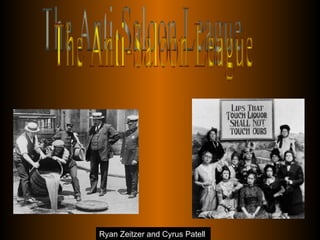
The Anti-Saloon League Ryan Zeitzer and Cyrus Patell
Anti-Saloon League The Anti-Saloon was founded by William Hyde Russell. In 1919 the Anti-Saloon Leagues ultimate goal was achieved. The 18 th  Amendment was past banning the transportation, sale, and manufacturing of alcohol. This was further supported by Volstead act which was drafted by the Anti-Saloon league leader Wayne Wheeler Many business leaders donated money to the cause. John D. Rockefeller alone donated over $350,000 to the cause.
Anti-Saloon League A large fraction of the Anti Saloon League was made up of women, however they had few leadership roles in the Anti-Saloon League. They often teamed up with other anti-alcohol groups such as the Women’s Temperance Movement and the Prohibition party. They defeated their opponents using pressure politics, or the use of mass media to persuaded the politicians that the public wants or demands a particular action, but may resort to intimidations threats and such methods.
Wayne Bidwell Wheeler William E. (pussyfoot) Johnson Anit-Saloon League Leaders Howard Hyde Russell
“ You can get much farther with a kind word and a gun than you can with a kind word alone.”  By: Cole Peltzman
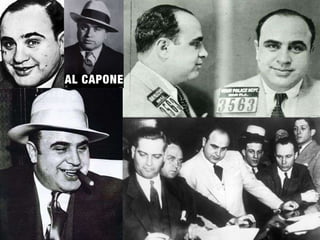
Al Capone was an American Gangster who led a crime syndicate committed to the bootlegging and smuggling of liquor during the Prohibition Era of the 1920s to 1930s. Al was the boss of the criminal organization known as the Chicago Outfit, but his business cards read used furniture salesman. In 1920 he was invited by Johnny Torrio, whom was his gang leader from when he joined a street gang in the 6 th  grade, to join the Colosimo Mob in Chicago.  FUN FACT: Al Capone joined Torrio’s street gang in 6 th  grade. Among him another gang member was the infamous “Lucky” Luciano. They both seeked opportunities in the new prohibition amendment, but also had interests in other businesses in the cleaning and dyeing fields. Capone was Torrio’s right hand man. After being shot at multiple times and hit once, Capone prompted his car with armor plating, bullet proof glass, run flat tires, and a police siren.   Al “Scarface” Capone
Al “Scarface” Capone Capone had much influence in Chicago. His puppet-like mayoral candidate won by a huge margin in 1924 due to his influence and intimidation. In 1925, Torrio was nearly killed by a rival gang. Scared for his live, he wanted out of the gangster lifestyle. He handed over his, “business” to Capone. Capone’s Outfit profited a revenue of 10 million dollars a year off the prohibition and other legal manners. Capone was a celebrity, he was one of the first men to shake Lindbergh's hand after his transatlantic flight. The  Saint Valentines Massacre  is the name given to the murder of 7 rival gang members of Capone. The massacre happened on Valentines day 1929.  It was a message to Bugs Moran, Capone’s rival leader. Capone’s men were dressed up as cops, pretending to “raid” the truck warehouse where this occurred.  They lined up Bug’s men and killed them execution style. Capone nor his men were ever convicted .
 
Charles Luciano Emily K. Stokes
By the late 1920's, Charles "Lucky" Luciano had become the chief aide to the largest crime family in the United States. After killing two of his bosses, Luciano became the leader, or “The Boss" of the New York mob. His circle of friends included big names in crime such as Bugsy Siegel, Joe Adonis, Vito Genovese, and Frank Costello.  LUCKY LUCIANO
Luciano is considered to be one of the most powerful people that has been involved in organized crime. His influence is still present in mob dealings today. He was the first mobster to challenge the ways of the “old mob”- he broke through ethnic barriers and created a network of crime families. LUCKY LUCIANO
 
By: Peter Vernacchio and Gabe Fellus Dutch Schultz
Nothin’ but a “G” Thang Arthur Flegenheimer ,also known as “ Dutch Schultz ”, was born in New York City, New York to Jewish-American immigrants on August 6 th,  1902. He became traumatized at the age of 14 when his  father abandoned him  and his family. After committing burglary and years of criminal acts  Schultz was sent to jail . He finally got his gangster name “Dutch Schultz” while spending time in prison after a famous thug. In 1928, Schultz became partners with gangster, Joey Noe, and the two started the group,  The Hub Social Club . The two opened operations in the city and began  distribution of beer  during the time of prohibition (illegal to buy, sell, or transport alcohol). The Hub Social Club met  opposition with the  Rock Brothers  and the two sides eventually went to war. Noe and Schultz  won  the war  after allegedly hanging one of the Rock Brothers by his thumbs on a meat hook.
Role in 1920’s Schultz played the role of the  rebellious gangster  of the 1920’s. At this time distribution of alcohol was illegal. Schultz showed his gangster side by disobeying this law and becoming one of the most  infamous bootleggers  ( someone who makes, transports, or sells illegal alcohol ) of his time. By the end of his career as a gangster he was known as one of the  largest beer distributors  of his time.  By his relentless effort to continue the  sale of alcohol in the United States  he made a strong impact on the decision to end prohibition in the United States. When Schultz died on October 23, 1935, he was estimated to be  worth 7 million dollars . Schultz defined the meaning of a true “G” ( Gangster ) and showed that alcohol would always have a huge impact on the economy.
 
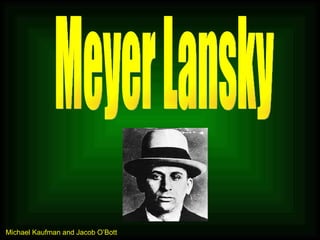
Michael Kaufman and Jacob O’Bott Meyer Lansky
He was born in Grodno, Russia He was considered one of the two “Godfathers” of the American mafia The other being Bugsy Siegel They organized the Bug and Meyer gang The gang was described as the most violent prohibition mobs in the East The gang worked as liquor hijackers and protectors of booze shipments Meyer was the financial mastermind behind the mob
Meyer and Bugsy formed Murder Inc. It resulted in hundreds of murders on behalf of the American mafia and their Jewish counterparts Together they formed the early organized crime groups  Lansky made 300 to 400 million dollars in the hotel industry Lansky never spent time behind bars
His Mug Shot Bugsy and He Him wearing his famous hat His Tombstone
Bugs Moran Andrew Dowdell & Greg Fry
Bugs Moran He had a nasty temper that earned him the name Bugs. By the time he was 20 he had been jailed three times. The crime that he was most famous for was bootlegging.  During prohibition he smuggled in booze.
Bugs Moran In the 20’s it was hard to find a gang shooting where Bugs Moran was not involved. He was involved in the famous Saint Valentines Day Massacre. Bugs and Al Capone were fierce rivals His and Capons unofficial war ended in a draw.
 
Ellsworth ‘Bumpy’ Johnson Justin Gaskey and Eric Harper
Notorious Gangster in Harlem Associate of Stephanie St. Claire, who ran a large number of rackets in the city Nicknamed ‘Bumpy’ for the large bump on his forehead Waged a mob war against Dutch Schultz War resulted in over 40 murders Corruption in City Hall and the Police Department resulted in Schultz dominating the Harlem Rackets. Switched sides, started working for the Mafia under Lucky Luciano
Corruption in City Hall and the Police Department resulted in Schultz dominating the Harlem Rackets. Switched sides, started working for the Mafia under Lucky Luciano Donated large sums of money to impoverished blacks in Harlem. After he served his sentence, he staged a sit-down strike in front of the Police Station, in response to their continued surveillance.
 
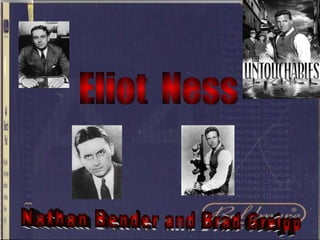
Eliot  Ness Nathan Bender and Brad Greipp
April 19, 1903, in Chicago, Illinois At an early age, Eliot was interested in law enforcement After college he got a job in the United States treasury. About a year later, he got a job on the prohibition bureau, a section of the justice department Many assassination attempts were made against Ness His close friend was killed as a result Eliot Ness
Eliot Ness and the Prohibition bureau sought to bring down gangster, Al Capone. He was the head of operations under the Volstead Act, seeking Al Capone’s supply roots The agency was called, “The Untouchables” because of an attempt of Al Capone to bribe the agency On October 6, 1931, Al Capone was tried for income tax evasion.   Eliot Ness vs Al Capone
Eliot Ness
Julie Apfelbaum Jazz Music
Originated in New Orleans in the early 1900’s Spread to the North to New York, Chicago, etc.  Called  “The Jazz Age”  but some believe it  should be called  “The Dance Age”  because people loved to dance to it The  Blues  derives from Jazz and was created by  black musicians  Jazz music was believed to be a treat because it was loosening morals and frightening dislocation  The  Cotton Club  was a famous night club in New York City during Prohibition HISTORY OF JAZZ
Phonograph  record and the radio became the primary method of spreading music Famous Jazz musicians Louis “ Satchmo ” Armstrong Hoagy Carmichael Bix Beiderbecke Joe " King " Oliver Coleman Hawkins Fletcher Henderson Duke Ellington More Information on Jazz Music
 
Mike Hyer and Jeff Ross
1916, Frank Conrad built a transmitter in his garage in Wilkinsburg, PA. This later was used to make the KDKA Radio  In on Nov. 2,1920, he broadcasted the us the presidential election. That was the first radio broadcast This was the election with Warren Harding winning against James Cox The station broadcasted from the Westinghouse building in Pittsburgh Over the years the station increased its range  The station still broadcasts today Radio's History
What would you hear on the radio? Played popular 20’s music Had the first live broadcast that had live commentary from the Jack Dempsey and George Carpentier fight from New Jersey This was a famous boxing match in 1921 They broadcasted Major League Baseball games Commercial advertisements Hosted guests such as comedian Will Rogers
KDKA's First Transmitter.  All 100 watts.   Frank Conrad
Bessie Smith Michelle Lee & Blair Broad
Known as “The Empress of the Blues”, Bessie Smith was famous for her powerful vocals. Originally nicknamed “The Queen of the Blues”, but P.R. executives from Columbia Records later changed it to “Empress” because they felt it was more fitting to her newfound popularity. Not only famous for her singing, she also danced and performed.  Her career began with performances in   a musical called  How Come? She later appeared on Broadway in the musical  Pansy. Throughout her career she accompanied many popular musicians including Louis Armstrong and Fletcher Henderson. Empress of the Blues
Empress of the Blues  Bessie Smith was one of the highest paid black performers of the 1920s and 30s. She achieved greater success than most black performers of her time. Smith signed to Columbia Records in 1923  she had sold over 800,000 copies with her first recording, “Down Hearted Blues” and saved the company from bankruptcy.  She had  and impact on the transition of the Jazz Era into the Swing Era.
 
Lindsey Schmidt & Michael Cognetti Louis Armstrong
Famous Jazz Musician of 1920’s African-American musician who played the trumpet Started career with “King” Oliver’s Creole Jazz Band in Chicago In the mid-1920’s he started recording and came out with his first record “My Heart” In 1926, Louis Armstrong earned the name “The World’s Greatest Trumpet Player” in Carroll Dickerson’s Orchestra In 1926, he was a headliner on radio and records and premiered in jazz clubs In 1929, he preformed in  Connie’s Hot Chocolates  on Broadway, which lead to his first nationwide hit recordings  On many occasions he was accompanied by pianist Earl “Fatha” Hines. Together they created a number of famous recording in the late-1920’s
The Memory of Louis Armstrong Used his horn like a singers voice and used his voice like a musical instrument Through his trumpet solos and vocal interpretations, jazz fans immortalized him He was the first jazz soloist to receive world-wide acclaim He was a strong force in spreading influence of jazz throughout his life
 
By Alex Ashery George Gershwin
George Gershwin was a Russian Jew from Brooklyn, New York.  Gershwin was a different kind of music composer; he wrote Broadway music, classical music, and jazz music.  He started his music career by working at a New York music publishing firm.  George traveled to Paris to study music theory.  Gershwin’s music was inspired by music from late romantic-era French composers and jazz composers.  Who was George Gershwin?
Gershwin helped the world transition into the age of jazz music.  George wrote many famous pieces of music during his short life (died at 38 from a brain tumor).  Gershwin’s famous works include  Porgy and Bess ,  Rhapsody in Blue ,   and  An American in Paris . How did Gershwin affect the '20s?
From left to right:  1.Gershwin composing music at a piano.  2.George (left) and his brother Ira (right). Ira wrote lyrics for many of George’s songs.  3.A portrait of George Gershwin. 1 2 3
Kalie Lauder & Olivia Yu   Duke Ellington
Duke Ellington Biography Born Edward Kennedy "Duke" Ellington (April 29, 1899 – May 24, 1974) was an American composer, pianist, and big band leader. Ellington had developed into a decent and fairly successful band leader earning about $10,000 a year to support his wife Edna and his one year old son Mercer.  In late January of 1923, Duke Ellington paid his way into the segregated section of the Howard Theatre in Washington D.C. to hear soprano saxophone master Sidney Bechet. This was Ellington's first encounter with authentic New Orleans Jazz. 1927, Ellington became the house band at Harlem’s Cotton Club. Ellington and his band thrived from the weekly radio broadcast and being the house band. His popularity increased during the 1930s because of his agent/publisher, Irving Mills. Weekly radio broadcasts from the club gave Ellington national exposure. In 1929, Ellington appeared in his first movie, a nineteen-minute all-African-American RKO short, Black and Tan.
Duke Ellington Biography As the Depression worsened, the recording industry was in crisis, dropping over 90% of its artists by 1933. Ellington and his orchestra survived the hard times by taking to the road in a series of tours. Radio exposure also helped maintain popularity.  Ellington led the orchestra by conducting from the keyboard using piano cues and visual gestures; very rarely did he conduct using a baton.  As a bandleader, Ellington was not a strict disciplinarian but he maintained control of his orchestra with a crafty combination of charm, humor, flattery, and astute psychology.  A complex, private person, he revealed his feelings to only his closest intimates and effectively used his public persona to deflect attention away from himself . The Ellington band had finally taken shape. At this point they played bonafide New York Jazz. Ellington forms a significant partnership with music publisher and band booker Irving Mills.  By the time of his passing, he was considered amongst the world’s greatest composers and musicians.  Ellington Influenced musicians, and composers for many years to come, and paved the way for future jazz performers to follow
 
By Ali Greenberg  and Brittani Berardi Flappers
Image After WWI, young woman were just as anxious as the men to avoid returning to society's rules and roles. Prohibition made them want to rebel.  The Beginning... Drastic and shocking changes in women's clothing and hair.  Best know for their style Young woman wore shorter skirts instead of long gowns, which were the norm at the time Short bob cuts Wore excessive amounts of makeup Lots of accessories including newsboy hats, cloche hats, layered necklaces and horn-rimmed glasses  High heels Often finished the ensemble with a felt, bell-shaped hat called a cloche.
Slang Attitude & Activities Characterized by stark truthfulness, fast living, and sexual behavior They took risks and were reckless Drank alcohol, although it was prohibited Smoked, something only men had done previously Dancing was one of the most popular past-times for flappers. Ex. Charleston, Black Bottom, and the Shimmy Sugar-  money Slat-  young man Cat’s Pajamas-  anything that’s good Dogs-  feet
 
By Anna Lauer and Jess Nealis Fads of the 1920’s
Dance Marathons – competitions lasted for  weeks  and sometimes  months Popular Dances – Charleston, Fox Trot, Shimmy, Swing dancing Baseball games became massively popular Sound movies made going to the theatre a popular pastime as well as drive in theatres because of cars that became popular KDKA, the first commercial radio station, began broadcasting 1920’s Fads
Popular women’s style was the “flapper” style – drop wasted dresses, red lipstick, ankle strap button shoes, and short bobbed hair Women began to wear pants and makeup Men wore sports clothing, “zoot” suits, and bowler hats Popular toys were yo-yo’s, pogo sticks, roller skates, and people began to enjoy crossword puzzles 1920’s Fads
 
Fashion of the 1920s By Colleen and Carolyn
Fashion’s Role for Women Due to the prosperous era, America entered after World War I, the clothing of Americans changed drastically. Women’s dresses evolved into a silhouette with pleats, gathers, or slits to allow motion. The corset became popular to make women look thinner. Until the women’s right movement they were then able to wear panties and camisoles as undergarments. For the first time in centuries, women showed their legs with hemlines rising to  the knee and dresses becoming more fitted.  Women’s hair began to be cut short to fit under popular hats. It was called the “bobbed” cut.  Low waisted dresses with fullness at the hemline allowed women to kick up their heels in new dances. Women’s fashion impacted the way women dressed in the 1920s which further enhanced the clothing and styles women wear today.
Fashion’s Role for Men Men wore short suit jackets; their old long jackets were only used for formal occasions.  In the early 20s, men’s fashion was characterized by extremely high waisted jackets that were often worn with belts.  The style of men’s jackets seemed to be greatly influenced by the military uniforms worn in World War I. Trousers were pants that were narrow and straight. They were rather short, often showing the man’s socks. Trousers also began to be cuffed at the bottom. By 1925, wider trousers were made that were called “Oxford Bags” Men had a variety of sports clothes available including, sweaters and short trousers which were commonly called knickers. For evening wear men preferred the short tuxedo instead of the tail-coat.  Men’s hats were worn depending on their class. Upper class citizens wore top hats, middle class wore a fedora or a trilby hat, and lower class wore a flat cap or no hat at all.  Men’s fashion impacted the way men dressed in the 1920s which led to the clothing and styles men wear today.
 
By: Tim Klein and Jesse Kohler Charles Lindbergh
Lindbergh in the 1920’s On May 20 th  to the 21 st , 1927: Charles Lindbergh, an American aviator, made the first non-stop, solo flight across the Atlantic Ocean.  This gained him immediate international fame. He also campaigned against voluntary American involvement in World War II. He was nicknamed “Lucky Lindy” and the “Lone Eagle” by the press. In 1924, Lindbergh enlisted in the United States Army so that he could be trained as an army air-service reserve pilot. In 1925, he graduated from the army’s flight training school at Brooks and Kelly, near San Antonio, as the best pilot in his class.  After Lindbergh completed his army training, the Robertson Aircraft Corp. of St. Louis, Missouri hired him to fly the mail between St. Louis and Chicago. He earned his reputation as a cautious and capable pilot.
May 20 th  thru the 21 st , 1927 More than anything else, Charles Lindbergh was known as the first person to fly across the Atlantic Ocean alone.  In the plane, the Spirit of St. Louis, he took off from Roosevelt field- near New York City- at 7:52 am. At this time Charles Lindbergh was a twenty-five year old man.  The highly famous flight took thirty-three-and-a-half hours and when he landed in Paris, France he had a hero’s welcome and permanent international fame.
 
Regina Jeon and  Andrea Lillo Amelia Earhart
In 1928, she was the first women to fly as a passenger across the Atlantic Ocean with Wilmer Stultz.  In 1932, she was the first woman to fly solo across the Atlantic Ocean and to receive  the Airforce Distinguished Flying Cross.  In 1935, Amelia became the first person to fly from Hawaii to the American mainland. She was also the first person to fly solo across both the  Atlantic   and  Pacific Oceans .  Across the Atlantic and Pacific Ocean
In 1937, Amelia and navigator, Frederick Noonan, took off from Lae, New Guinea, towards Howland Island. They tried to accomplish the first flight around the world  at the equator. However, they vanished after flying over 22,000 miles. A great naval, air and land search failed to locate Amelia, Noonan, or the aircraft, and it was assumed they were lost at sea. Some theorized the pair ran out of fuel or crashed landed on the small island. Amelia Earhart  was remembered because she inspired generations of women to do things that had never been done by women before. Remember her last flight…
 
Babe   Ruth By David Goosenberg and Eric Goldstein
George Herman Ruth Jr. Ruth earned the nickname “Babe” because of his young age at the time he became a professional baseball player He had a rough childhood, often getting in trouble, and was sent to reform school several times where he would discover the game of baseball Ruth played for 4 major league teams, the Orioles, the Yankees, the Red Sox and the Braves Babe started out at a pitcher but was then converted to a hitter
The Babe’s Legacy Babe Ruth is remembered as one of baseball’s greatest players ever He was a role model to children everywhere during and after his career At one point, Ruth held the record for most home runs in a career with 714 His legacy can be seen throughout modern media, solidifying the fact that he was one of the most influential figures of his time He was known for his boisterous personality Ruth was one of the first celebrity athletes He modernized the game of baseball because he was one of the first players to be known for hitting home runs Thousands of fans piled into stadiums just to see him play and helped cement the game of baseball as America’s pastime
 
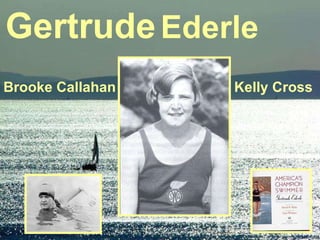
Gertrude   Ederle Brooke Callahan  Kelly Cross
Famous American swimmer  First woman to swim the English Channel In 1926, when she was 19 years old, she swam the  channel from France to England Took her 14 hours and 39 minutes for the entire 35 miles of the channel Set 29 US World Swimming Records from 1921 to 1925 Trudy in the Twenties
Called “America’s best girl” by President Calvin Coolidge Her accomplishment put her at the public’s affection level of Babe Ruth and many other public figures during the Roaring 20’s Helped women have more respect as competitive athletes She spread her talents by teaching children how to swim at the Lexington School for the deaf because she was becoming deaf too Gertrude’s Greatness
 
Jack Dempsey Alexa Singer and Tony Vernacchio
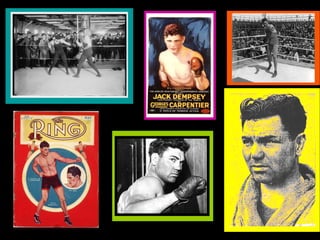
Jack Dempsey During the Roaring 20’s Roaring 20’s was the  Golden Age  of Sports Professional Boxer  Popularized  boxing  as a sport  Broadcasting  of Boxing began with Dempsey’s matches Helped create modern  mass spectator sports
Remembered Today Won the  title  in 1923, with a victory over “Wild Bull of the Pampas” One of the  best knock out  records  32-0 winning streak, 28 of which were knock outs Notorious for  “Left Hook Punch”
 
Red Grange Alex Stern and Chase Galerman
Football Career Harold Edward “Red” Grange was born in Forksville, Pennsylvania on June 13, 1903 After moving to Wheaton, Illinois, Grange attended Wheaton High School, earning sixteen varsity letters in four years Grange enrolled at the University of Illinois, where he ran for over 3,300 yards in twenty games, including 31 touchdowns Grange earned the nickname “Galloping Ghost” due to his allusiveness and agility as a halfback After having his number, 77, retired by the University of Illinois in 1925, he was signed by the Chicago Bears of the NFL one day after he graduated
Life and Legacy Grange won the  1932  and  1933  NFL championship Grange retired from football in  1934 He became a motivational speaker, sports announcer, and husband In  1931 , Grange visited Abington Senior High School, where they named their team after him, the Galloping Ghosts, which is also their mascot Grange developed Parkinson’s Disease and died on  January 28, 1991 His autobiography,  The Red Grange Story,  is still a big success today In  1978 , at Super Bowl XII, Grange became the first person, other than a referee, to toss the coin at a Super Bowl In  1969 , to celebrate college football’s 100 th  anniversary, the Football Writers Association of America chose an all-time All-American team, and Grange was the only unanimous choice In  1999 ,  The Sporting News  ranked Grange as the 80 th  best football player of all time In  2008 , ESPN ranked Grange as the best college football player of all time Grange was one of the most influential people of the  1920’s  because he demonstrated how people can look up to a very successful athlete
 
Maddie Ecker and Matt Graham The Life of Harry Houdini
Magic Career   His real name was Ehrich Weiss but adopted the stage name Harry Houdini once he became a professional.  He was heavily influenced by the French magician Jean Eugene Robert-Houdin. He astounded the world with his most with his most widely known trick called “The Handcuff Act.” He became known as “the Handcuff King.” He would free himself from jails, handcuffs, chains, ropes and straitjackets.  They booked him on the Orpheum vaudeville circuit. Vaudeville was a theatrical genre of variety entertainment in the United States. For many years he was the highest paid performer in American vaudeville.  He became president of America’s oldest magic company, Martinka & Co. Most of the 1920’s he dedicated his life to debunking self-proclaimed psychics and mediums, a pursuit that would inspire and be followed by later-day conjurers.
Claim to Fame; Magic Acts The Mirror Handcuff Challenge-   The Daily Mirror newspaper challenged Houdini to escape from a special handcuff that is claimed to had taken a locksmith five years to make. The escape attempt dragged on for over an hour. Houdini said it was the most difficult escape of his career.  The Milk Can-   Houdini would be handcuffed and sealed inside an over-sized mil can filled with water and make his escape behind a curtain.   Chinese Water Torture Cell-   In this escape, Houdini’s feet would be locked in stocks and he would be lowered upside down into a tank filled with water.   Suspended Straitjacket Escape-   He would have himself strapped into a regulation straitjacket and suspended by his ankles from a tall building or crane. Houdini would then make his escape in full view of the assembled crowd.
CHINESE WATER CELL MILK CAN STRAITJACKET  BURIED ALIVE
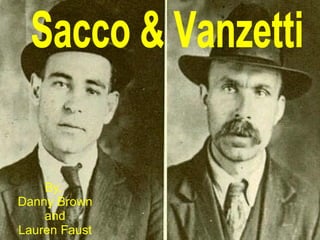
By, Danny Brown and Lauren Faust Sacco & Vanzetti
Sacco & Vanzetti Two Italian-born laborers and anarchists Followers of Luigi Galleani, an Italian anarchist who advocated revolutionary violence including bombing and assassination. Tried, convicted, and executed via electrocution for the 1920 armed robbery and murder of a pay-clerk and a security guard in Braintree, Massachusetts. There wasn’t enough evidence to prove that they were guilty, but were charged anyway.
Sacco & Vanzetti American’s had a fear of immigrants being in the United States. Many believe that the prosecution, trial and aftermath denied their political civil liberties because many of the aspects were highly prejudice. Judge Webster Thayer referred to them as, “anarchist bastards”. The executions provoked mass protests all over the world.
 
The KU Klux Klan in the roaring 20's Chrissy Sandilos & Zo ë  Landau
The Ku Klux Klan began in the 1860’s and started to rise again, even more powerful than before during the early 1920’s  With  Hiram W. Evans  leading the Klan as their Imperial Wizard, the group targeted Roman Catholics, Jews, African Americans, and other foreigners. They were supporters of prohibition. They took part in actions such as marching to support the KKK Also violent acts such as  publicly lynching and whipping,  burning crosses  tar and feathering  The Klan was the strongest in: The deep south, Oklahoma, and Indiana The  Ku  Klux  Klan
Klan continued to rapidly grow in size and gain power By 1924 the Klan consisted of about 4,000,000 members and had peaked to its most powerful place in history The  Ku  Klux  Klan American leaders and politicians began joining the Klan and publically supporting their beliefs which gained popularity for the harmful group Once  David C. Stephenson , a Klan leader, was convicted for murder the group began its downfall and by the late 1920’s they had only about 30,000 members left. TODAY The KKK is known today for their harsh treatments and radical beliefs towards other races and religions It is important that the Ku Klux Klan is still remembered so we are able to learn from their mistakes and try to prevent it from happening again
The  Ku  Klux  Klan
The Scopes Trial Chris Yang and  Steven Yang
Scopes vs. State of Tennessee John T. Scopes was a Dayton, Tennessee high school football coach who had substituted in a science class. Scopes violated the Butler Act that stated it was unlawful  “to teach any theory that denies the story of the Divine Creation of man as taught in the Bible, and to teach instead that man has descended from a lower order of animals”  in a Tennessee stated funded school. The ACLU backed Scopes in the trial; they opposed the Butler Act because it violated a teacher’s individual teaching rights which was unconstitutional. The court ordered Scopes to pay a fine of $100.
Aftermath of the Trial The trial had a major impact on the image of science and religion. Many people felt that Christians completely rejected science. Afterwards, many states tried to adopt the anti-evolution movement and states such as Arkansas and Mississippi adopted anti-evolution laws that outlive the Butler Act.
 
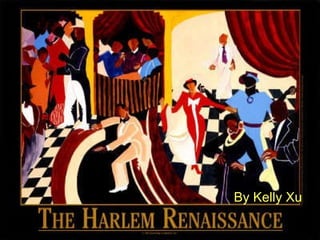
By Kelly Xu
The Harlem Renaissance An unprecedented era of flowering African-American culture, and written and artistic creativity in the areas of literature, drama, music, visual art, dance, sociology, and philosophy  Occurred after World War 1 and lasted until the 1930’s Depression Occurred in lower Manhattan (Greenwich Village) and upper Manhattan (Harlem)  Started around the time between 1919 and 1926- large numbers of black Americans left their rural southern states homes to move to urban areas in the north, including New York City, Chicago, and Washington,D.C., the movement was called the “Great Migration”
This migration of southern Blacks to the north changed the image of African-Americans from rural, undereducated peasants to one of urban, cosmopolitan sophistication  African-American artists and intellectuals rejected imitating the styles of Europeans and white Americans and instead celebrated black dignity and creativity even with racism and few economic opportunities Let to new forms of literature such as modernism and a new form of jazz poetry Let to new forms of music - blues and jazz Famous people include Langston Hughes, Louis Armstrong, Ella Fitzgerald
 
By: Jackie Rohrer W. E. B. DuBoís
Dr. William Edward Burghardt Du Boís He was born on February 23, 1868 in Great Barrington, Massachusetts. He was an attacker of injustice, a defender of freedom, and labeled as a radical. He was also an American civil rights activist, Pan-Africanist, sociologist, historian, author, and editor. He wrote 6 different books about African Americans and their rights.
In the 1920’s, he got into a feud with Marcus Garvey and looked at him as an enemy for blacks. He became an early member of Alpha Phi Alpha, the first intercollegiate Greek-letter fraternity, and another that focused on civil rights. He also held many meetings and conferences for Pan-Africanists. He died on August 27, 1963 at age 95. Dr. William Edward Burghardt Du Boís
 
Marcus Garvey Progress is the attraction that moves humanity -Marcus Garvey *Taylor Bryant*
What role did Marcus Garvey have in the Roaring 1920’s? Organized a chapter of the Universal Negro Improvement Association (UNIA) which he earlier founded in a Jamaican Organization after settling in New York in 1920.  Helped Jamaicans and African Americans by giving them economic standing and cultural independence. "Garveyism”, as the followers named it, eventually evolved into a religion of success, inspiring millions of black people worldwide to find relief from racism and colonialism. In 1920, with the help of the UNIA, he held a 31 day march in Madison Square Garden in New York promoting the Back to Africa program. This was designed to enlighten the Black American to return to the homeland of Africa.
Why is Marcus Garvey remembered today? In 1922 the federal government charged Garvey on mail fraud.  All his Black Star Line (BSL) operations were suspended.  Two years later, the UNIA created another line, the Black Cross Navigation and Trading Co., but it, too, failed.  Garvey was sentenced to prison. The government later commuted his sentence, only to deport him back to Jamaica in November 1927. He never returned to America Marcus Garvey dedicated his life to the “uplifting” of Black American by creating the UNIA. He believed the only way for Black Americans to ever become equal in the world was to have their own businesses, government, and industrial enterprises.
Marcus Garvey
By: Matt Brunetto and Zach Bohm The Lost Generation
The term is used for the period from the end of World War I to the beginning of the Great Depression, within the United States it is used for the generation of young people who came of age during and shortly after World War I, alternatively known as the World War I Generation. In Europe, they are mostly known as the "Generation of 1914", for the year World War I began. In France, the country in which many expatriates settled, they were sometimes called the Génération au Feu, the Generation in Flames. In Britain the term was originally used for those who died in the war, often implicitly referred to upper-class casualties who were perceived to have died disproportionately, robbing the country of a future elite. The "Lost Generation" is also a term used to characterize a general motif of disillusionment of American literary notables who lived in Europe, most notably Paris, after the First World War. Figures identified with the "Lost Generation" included authors and artists such as Ernest Hemingway, F. Scott Fitzgerald, Ezra Pound, Sherwood Anderson, Waldo Peirce, John Dos Passos, John Steinbeck. The Generation in Flames
The term was popularized and often credited to author and poet Gertrude Stein. Stein supposedly heard her French garage owner speak of his young auto mechanics, and their poor repair skills, as "une generation perdue." The term  is now being used as a generic shorthand for groups of young people disproportionately affected by economic shocks, often involving lengthy periods of unemployment, such as those affected by the Global financial crisis of 2008–2009. This is partly based on evidence that it can be difficult for those affected to get back into employment when economic activity picks up. The Generation that was Lost
Pictures of the Lost Generation or the Generation of 1914
By: Andrew Melville Parker Schroeder F. Scott Fitzgerald
Background Information Born September 24, 1896 in Saint Paul, Minnesota A famous author from the 1920’s through the 1940’s which is also known as the lost generation Attended Princeton University from 1913-1917 Died December 21, 1940 in Hollywood, California
Fitzgerald’s Literature The 1920’s or “The Jazz Age” was the most influential period during Fitzgerald’s life “The Great Gatsby” was considered his masterpiece The Great Gatsby is ranked second in the 100 best novels of the 20 th  century Fitzgerald’s frustrating relationship with his wife reflected many of his stories
 
By Jacqui Gallagher and Brigitte Belov TS Eliot William Faulkner Sinclair Lewis
Sinclair Lewis worked with Alfred Harcourt, the founder of Harcourt Publishing.  He eventually published his book, Main Street in 1920, making it the largest selling book ok the time period.  He became the first American writer to win the Nobel Prize for literature in 1930.  Best known fot being the author of the Wasteland, which was published in 1922.  He also won the Nobel Peace Prize in 1948. Although he was born in America, most of his career was accomplished in England. In 1922, he founded and became the editor of the literary magazine Criterion
In 1921, he wrote an eighty – eight page book of poems, entitled Vision in Spring. He became postmaster of Oxford University.  In 1924, he resigned from his post office job due to complaints about his excessive drinking. He won the Nobel Prize in 1949.  He worked on his novels and stories on a farm in Oxford.
 
Molly Redican & Madeline Price Ernest  Hemingway
Ernest Miller Hemingway… Was born on July 21,1889 in Oak Park, Illinois. Became a member of “The Group of Expatriate Americans” in Paris in the 1920s. Wrote his first important big piece of work in 1926 called  The Sun Also Rises . This book was originally named  Fiesta.  It was an autobiography that explained the post-war generation for future generations.
Ernest Miller Hemingway… Wrote his next book titled  A Farewell to Arms  in 1929. This book became equally successful as the first. It was about the study of an American ambulance officer and his disillusionment and role in the world. Received the Pulitzer Prize in 1953 for his book  The Old Man and the Sea. Also received a Nobel Peace Prize in Literature in 1954. Died on July 2, 1961.
 
H. L. Mencken By K. O’Donnell
Quotations The capacity of human beings to bore one another seems to be vastly greater than that of any other animal.   After all, all he did was string together a lot of old, well-known quotations.   There is always a well-known solution to every human problem--neat, plausible, and wrong.   To die for an idea; it is unquestionably noble. But how much nobler it would be if men died for ideas that were true! Puritanism: The haunting fear that someone, somewhere, may be happy.   Love is the triumph of imagination over intelligence.   I never lecture, not because I am shy or a bad speaker, but simply because I detest the sort of people who go to lectures and don't want to meet them.
Henry Louis Mencken   worked for two newspapers the  Baltimore Herald  and the  Baltimore Sun . He contribute to the  Sun  from 1906 till he stopped writing in 1948. He was known for writing editorials.  He was the critic for the  Smart Set  magazine and founded and edited the  American Mercury. As a hobby he wrote a novel, poetry and short stories .
 
Emily McVittie and Kathryn Hepp Georgia O’Keefe and Grant Wood
Georgia O’Keefe Georgia O’Keefe moved to New York in 1918 and started her life-changing career as an artist. She painted many paintings of Lake George in the Adirondacks during her first years in New York. Alfred Stieglitz, a photographer who introduced America to artists such Matisse and Picasso, arranged shows for O’Keefe. The two developed a close relationship and were later married. Stieglitz found inspiration in O’Keefe.  One of O’Keefe’s favorite subjects to paint was flowers. Living in New York helped her to paint beautifully realistic cityscapes. Her career took a turn when she travelled to Taos, New Mexico where the nature surroundings her overtook her artwork. She used the beautiful landscape as inspiration for new painting, including churches. She briefly returned to New York each summer to visit her husband. After his death in 1946, she moved back to New Mexico where she continued painting pictures of Churches and crosses.  In the 1920’s, O’Keefe was recognized for her contribution to modern American art. She brought about a new style of art, changing simple images to abstract masterpieces. Because her artwork even travelled to Europe, she became one of the first women to reach such success in the art industry.
Grant Wood  Searching for inspiration in Europe, Grant Wood travelled there four times to study painting styles. He didn’t find inspiration until he saw the work of Jan van Eyck. Wood had a steady income from painting advertisements, sketches of houses and overseeing the making of stained glass windows. The most known stain glass window he designed was for Veterans Memorial Building in Cedar Rapids. in 1924 Wood turned his home into his personal studio. He used his address and called it “5 Turner Alley”. Wood was one of the top three artist associated with regionalism. Wood helped fellow artists get through the Great Depression.  Later in his life, Wood taught at University of Iowa’s School of Art. He supervised mural projects and mentored young art students. He died one day before his 51 st  birthday of liver cancer.  His artistic style was American Gothic.
 
Allie Lunney and Michele DeVincent Movies of the 1920's
Film industry boomed in the 1920’s Very successful financially Most films were silent but in the late 20’s they were introduced to synchronized sound   Films were in major demand at the time and provided much entertainment The films made were a comic relief after the horrors of WW1.  Movie theaters were called Nickelodeons Were very basic at the time, not luxurious like today
Most film production in the U.S. developed in or near Hollywood, on the west coast Some films were being made in NJ and Long Island  By the mid1920’s the movie industry was worth over $2 million  The 1920’s decade was the greatest output of feature films in the U.S averaging about 800 film releases per year The five major film industries were: Warner Brothers Pictures MGM RKO Pictures Famous Players-Lasky  Fox Film
 
Actors The Roaring 20's By Jared Hirsch
Charlie Chaplin Charlie Chaplin was an British-American Filmmaker and actor who directed and starred in many films in the 1920’s.  Chaplin was a revolutionary filmmaker, and was one of the first to incorporate sound into the movies.  Chaplin was known as a socialist and also had non-American communistic views.  Chaplin was an extremely famous male known for his work as an actor and director, and he was extremely well known in the 20’s.
Harold Lloyd Harold Lloyd was one of the most famous American Filmmakers in the 1920’s.  He made silent films with no speaking.  He was extremely successful, especially in his action packed movies. He was extremely profitable, gaining near 15 million dollars, which for its time was an immense amount of money.  Lloyd eventually became a multi millionaire who retired at a young age.  He had many films that were very influential throughout the roaring twenties.


1920 Digital Book

  • 1.
  • 2.
    What is aDigital Book? Students from my Honors US History II courses compiled information and pictures on a variety of topics from the 1920s in American History. Each group was given a specific topic to research and then design pages for the book. To move from page to page, use the arrows in the middle of the digital book. Read on to learn about the 1920s!
  • 3.
  • 4.
    Nikki Caddick &Alex Gold Warren G. Harding
  • 5.
    Warren Harding wasthe publisher and editor of the Ohio Marion Star, was active in politics throughout his life. He served as an Ohio state Senator (1900-1904), as Lieutenant Governor of Ohio (1904-1906), and as a United States Senator (1915-1921) The speech Harding made for his campaign was known for its’ famous plea for normalcy: "America's present need is not heroics but healing; not nostrums but normalcy; not revolution but restoration...not surgery but serenity." In the 1920 election Harding ran against Democratic Ohio Governor James. M. Cox Presidential Election of 1920
  • 6.
    Warren Harding waselected in 1921 He pushed for the establishment of the Bureau of Veteran Affairs He created the Bureau of the Budget, becoming the first president to take a role in federal expenditures Harding signed peace treaties with Germany, Austria and Hungary, formally ending World War I for the United States Harding's Presidency
  • 7.
  • 8.
    Calvin Coolidge BySam Heo, Tyler D’Angelo
  • 9.
    Calvin Coolidge Calvin’s first political job was being the Governor of Massachusetts. In 1920, he was elected the 29 th Vice President of the United States. Coolidge was a popular President. He had lots of support from the citizens of the US and this popularity was known as Coolidge Prosperity.
  • 10.
    Calvin Coolidge “The business of the American people is business” Calvin Coolidge supported foreign isolation Coolidge signed the Revenue Act of 1924 which cut personal income taxes. He also signed the Immigration Act, which stopped Japanese immigration
  • 11.
  • 12.
    Herbert Hoover ByEric “Johnny Burns” Boyer Alex “Jo Jo” Woodin
  • 13.
    Hoover’s Early PoliticsHerbert Hoover entered the 1920 presidential election as a republican, but he lost in the California primary. He threw his support behind republican Warren G. Harding, giving two speeches to support him. After Harding won, he rewarded Hoover by appointing him Secretary of Commerce. Because the Secretary of Commerce position was only eight years old, it was still considered a minor position. Hoover aimed to change that, and got the authority from Harding to help coordinate economic affairs throughout the government. Hoover participated in many radio conferences and traffic conferences. He helped out six states after the Great Mississippi Flood by mobilizing the American Red Cross , the authorities, and the coast guard.
  • 14.
    Hoover Presidency In1928, Herbert Hoover beat out Alfred E. Smith and won the presidential election. He was a self-proclaimed Progressive and Reformer When Hoover entered the presidency, he was faced with a crashing stock market. Hoover was blamed for all that was going wrong and citizens began to criticize him. One positive aspect of Hoover’s presidency was that he gave all of his salary to charity.
  • 15.
  • 16.
    The Anti-Saloon LeagueRyan Zeitzer and Cyrus Patell
  • 17.
    Anti-Saloon League TheAnti-Saloon was founded by William Hyde Russell. In 1919 the Anti-Saloon Leagues ultimate goal was achieved. The 18 th Amendment was past banning the transportation, sale, and manufacturing of alcohol. This was further supported by Volstead act which was drafted by the Anti-Saloon league leader Wayne Wheeler Many business leaders donated money to the cause. John D. Rockefeller alone donated over $350,000 to the cause.
  • 18.
    Anti-Saloon League Alarge fraction of the Anti Saloon League was made up of women, however they had few leadership roles in the Anti-Saloon League. They often teamed up with other anti-alcohol groups such as the Women’s Temperance Movement and the Prohibition party. They defeated their opponents using pressure politics, or the use of mass media to persuaded the politicians that the public wants or demands a particular action, but may resort to intimidations threats and such methods.
  • 19.
    Wayne Bidwell WheelerWilliam E. (pussyfoot) Johnson Anit-Saloon League Leaders Howard Hyde Russell
  • 20.
    “ You canget much farther with a kind word and a gun than you can with a kind word alone.” By: Cole Peltzman
  • 21.
    Al Capone wasan American Gangster who led a crime syndicate committed to the bootlegging and smuggling of liquor during the Prohibition Era of the 1920s to 1930s. Al was the boss of the criminal organization known as the Chicago Outfit, but his business cards read used furniture salesman. In 1920 he was invited by Johnny Torrio, whom was his gang leader from when he joined a street gang in the 6 th grade, to join the Colosimo Mob in Chicago. FUN FACT: Al Capone joined Torrio’s street gang in 6 th grade. Among him another gang member was the infamous “Lucky” Luciano. They both seeked opportunities in the new prohibition amendment, but also had interests in other businesses in the cleaning and dyeing fields. Capone was Torrio’s right hand man. After being shot at multiple times and hit once, Capone prompted his car with armor plating, bullet proof glass, run flat tires, and a police siren. Al “Scarface” Capone
  • 22.
    Al “Scarface” CaponeCapone had much influence in Chicago. His puppet-like mayoral candidate won by a huge margin in 1924 due to his influence and intimidation. In 1925, Torrio was nearly killed by a rival gang. Scared for his live, he wanted out of the gangster lifestyle. He handed over his, “business” to Capone. Capone’s Outfit profited a revenue of 10 million dollars a year off the prohibition and other legal manners. Capone was a celebrity, he was one of the first men to shake Lindbergh's hand after his transatlantic flight. The Saint Valentines Massacre is the name given to the murder of 7 rival gang members of Capone. The massacre happened on Valentines day 1929. It was a message to Bugs Moran, Capone’s rival leader. Capone’s men were dressed up as cops, pretending to “raid” the truck warehouse where this occurred. They lined up Bug’s men and killed them execution style. Capone nor his men were ever convicted .
  • 23.
  • 24.
  • 25.
    By the late1920's, Charles "Lucky" Luciano had become the chief aide to the largest crime family in the United States. After killing two of his bosses, Luciano became the leader, or “The Boss" of the New York mob. His circle of friends included big names in crime such as Bugsy Siegel, Joe Adonis, Vito Genovese, and Frank Costello. LUCKY LUCIANO
  • 26.
    Luciano is consideredto be one of the most powerful people that has been involved in organized crime. His influence is still present in mob dealings today. He was the first mobster to challenge the ways of the “old mob”- he broke through ethnic barriers and created a network of crime families. LUCKY LUCIANO
  • 27.
  • 28.
    By: Peter Vernacchioand Gabe Fellus Dutch Schultz
  • 29.
    Nothin’ but a“G” Thang Arthur Flegenheimer ,also known as “ Dutch Schultz ”, was born in New York City, New York to Jewish-American immigrants on August 6 th, 1902. He became traumatized at the age of 14 when his father abandoned him and his family. After committing burglary and years of criminal acts Schultz was sent to jail . He finally got his gangster name “Dutch Schultz” while spending time in prison after a famous thug. In 1928, Schultz became partners with gangster, Joey Noe, and the two started the group, The Hub Social Club . The two opened operations in the city and began distribution of beer during the time of prohibition (illegal to buy, sell, or transport alcohol). The Hub Social Club met opposition with the Rock Brothers and the two sides eventually went to war. Noe and Schultz won the war after allegedly hanging one of the Rock Brothers by his thumbs on a meat hook.
  • 30.
    Role in 1920’sSchultz played the role of the rebellious gangster of the 1920’s. At this time distribution of alcohol was illegal. Schultz showed his gangster side by disobeying this law and becoming one of the most infamous bootleggers ( someone who makes, transports, or sells illegal alcohol ) of his time. By the end of his career as a gangster he was known as one of the largest beer distributors of his time. By his relentless effort to continue the sale of alcohol in the United States he made a strong impact on the decision to end prohibition in the United States. When Schultz died on October 23, 1935, he was estimated to be worth 7 million dollars . Schultz defined the meaning of a true “G” ( Gangster ) and showed that alcohol would always have a huge impact on the economy.
  • 31.
  • 32.
    Michael Kaufman andJacob O’Bott Meyer Lansky
  • 33.
    He was bornin Grodno, Russia He was considered one of the two “Godfathers” of the American mafia The other being Bugsy Siegel They organized the Bug and Meyer gang The gang was described as the most violent prohibition mobs in the East The gang worked as liquor hijackers and protectors of booze shipments Meyer was the financial mastermind behind the mob
  • 34.
    Meyer and Bugsyformed Murder Inc. It resulted in hundreds of murders on behalf of the American mafia and their Jewish counterparts Together they formed the early organized crime groups Lansky made 300 to 400 million dollars in the hotel industry Lansky never spent time behind bars
  • 35.
    His Mug ShotBugsy and He Him wearing his famous hat His Tombstone
  • 36.
    Bugs Moran AndrewDowdell & Greg Fry
  • 37.
    Bugs Moran Hehad a nasty temper that earned him the name Bugs. By the time he was 20 he had been jailed three times. The crime that he was most famous for was bootlegging. During prohibition he smuggled in booze.
  • 38.
    Bugs Moran Inthe 20’s it was hard to find a gang shooting where Bugs Moran was not involved. He was involved in the famous Saint Valentines Day Massacre. Bugs and Al Capone were fierce rivals His and Capons unofficial war ended in a draw.
  • 39.
  • 40.
    Ellsworth ‘Bumpy’ JohnsonJustin Gaskey and Eric Harper
  • 41.
    Notorious Gangster inHarlem Associate of Stephanie St. Claire, who ran a large number of rackets in the city Nicknamed ‘Bumpy’ for the large bump on his forehead Waged a mob war against Dutch Schultz War resulted in over 40 murders Corruption in City Hall and the Police Department resulted in Schultz dominating the Harlem Rackets. Switched sides, started working for the Mafia under Lucky Luciano
  • 42.
    Corruption in CityHall and the Police Department resulted in Schultz dominating the Harlem Rackets. Switched sides, started working for the Mafia under Lucky Luciano Donated large sums of money to impoverished blacks in Harlem. After he served his sentence, he staged a sit-down strike in front of the Police Station, in response to their continued surveillance.
  • 43.
  • 44.
    Eliot NessNathan Bender and Brad Greipp
  • 45.
    April 19, 1903,in Chicago, Illinois At an early age, Eliot was interested in law enforcement After college he got a job in the United States treasury. About a year later, he got a job on the prohibition bureau, a section of the justice department Many assassination attempts were made against Ness His close friend was killed as a result Eliot Ness
  • 46.
    Eliot Ness andthe Prohibition bureau sought to bring down gangster, Al Capone. He was the head of operations under the Volstead Act, seeking Al Capone’s supply roots The agency was called, “The Untouchables” because of an attempt of Al Capone to bribe the agency On October 6, 1931, Al Capone was tried for income tax evasion. Eliot Ness vs Al Capone
  • 47.
  • 48.
  • 49.
    Originated in NewOrleans in the early 1900’s Spread to the North to New York, Chicago, etc. Called “The Jazz Age” but some believe it should be called “The Dance Age” because people loved to dance to it The Blues derives from Jazz and was created by black musicians Jazz music was believed to be a treat because it was loosening morals and frightening dislocation The Cotton Club was a famous night club in New York City during Prohibition HISTORY OF JAZZ
  • 50.
    Phonograph recordand the radio became the primary method of spreading music Famous Jazz musicians Louis “ Satchmo ” Armstrong Hoagy Carmichael Bix Beiderbecke Joe " King " Oliver Coleman Hawkins Fletcher Henderson Duke Ellington More Information on Jazz Music
  • 51.
  • 52.
    Mike Hyer andJeff Ross
  • 53.
    1916, Frank Conradbuilt a transmitter in his garage in Wilkinsburg, PA. This later was used to make the KDKA Radio In on Nov. 2,1920, he broadcasted the us the presidential election. That was the first radio broadcast This was the election with Warren Harding winning against James Cox The station broadcasted from the Westinghouse building in Pittsburgh Over the years the station increased its range The station still broadcasts today Radio's History
  • 54.
    What would youhear on the radio? Played popular 20’s music Had the first live broadcast that had live commentary from the Jack Dempsey and George Carpentier fight from New Jersey This was a famous boxing match in 1921 They broadcasted Major League Baseball games Commercial advertisements Hosted guests such as comedian Will Rogers
  • 55.
    KDKA's First Transmitter. All 100 watts. Frank Conrad
  • 56.
    Bessie Smith MichelleLee & Blair Broad
  • 57.
    Known as “TheEmpress of the Blues”, Bessie Smith was famous for her powerful vocals. Originally nicknamed “The Queen of the Blues”, but P.R. executives from Columbia Records later changed it to “Empress” because they felt it was more fitting to her newfound popularity. Not only famous for her singing, she also danced and performed. Her career began with performances in a musical called How Come? She later appeared on Broadway in the musical Pansy. Throughout her career she accompanied many popular musicians including Louis Armstrong and Fletcher Henderson. Empress of the Blues
  • 58.
    Empress of theBlues Bessie Smith was one of the highest paid black performers of the 1920s and 30s. She achieved greater success than most black performers of her time. Smith signed to Columbia Records in 1923 she had sold over 800,000 copies with her first recording, “Down Hearted Blues” and saved the company from bankruptcy. She had and impact on the transition of the Jazz Era into the Swing Era.
  • 59.
  • 60.
    Lindsey Schmidt &Michael Cognetti Louis Armstrong
  • 61.
    Famous Jazz Musicianof 1920’s African-American musician who played the trumpet Started career with “King” Oliver’s Creole Jazz Band in Chicago In the mid-1920’s he started recording and came out with his first record “My Heart” In 1926, Louis Armstrong earned the name “The World’s Greatest Trumpet Player” in Carroll Dickerson’s Orchestra In 1926, he was a headliner on radio and records and premiered in jazz clubs In 1929, he preformed in Connie’s Hot Chocolates on Broadway, which lead to his first nationwide hit recordings On many occasions he was accompanied by pianist Earl “Fatha” Hines. Together they created a number of famous recording in the late-1920’s
  • 62.
    The Memory ofLouis Armstrong Used his horn like a singers voice and used his voice like a musical instrument Through his trumpet solos and vocal interpretations, jazz fans immortalized him He was the first jazz soloist to receive world-wide acclaim He was a strong force in spreading influence of jazz throughout his life
  • 63.
  • 64.
    By Alex AsheryGeorge Gershwin
  • 65.
    George Gershwin wasa Russian Jew from Brooklyn, New York. Gershwin was a different kind of music composer; he wrote Broadway music, classical music, and jazz music. He started his music career by working at a New York music publishing firm. George traveled to Paris to study music theory. Gershwin’s music was inspired by music from late romantic-era French composers and jazz composers. Who was George Gershwin?
  • 66.
    Gershwin helped theworld transition into the age of jazz music. George wrote many famous pieces of music during his short life (died at 38 from a brain tumor). Gershwin’s famous works include Porgy and Bess , Rhapsody in Blue , and An American in Paris . How did Gershwin affect the '20s?
  • 67.
    From left toright: 1.Gershwin composing music at a piano. 2.George (left) and his brother Ira (right). Ira wrote lyrics for many of George’s songs. 3.A portrait of George Gershwin. 1 2 3
  • 68.
    Kalie Lauder &Olivia Yu Duke Ellington
  • 69.
    Duke Ellington BiographyBorn Edward Kennedy "Duke" Ellington (April 29, 1899 – May 24, 1974) was an American composer, pianist, and big band leader. Ellington had developed into a decent and fairly successful band leader earning about $10,000 a year to support his wife Edna and his one year old son Mercer. In late January of 1923, Duke Ellington paid his way into the segregated section of the Howard Theatre in Washington D.C. to hear soprano saxophone master Sidney Bechet. This was Ellington's first encounter with authentic New Orleans Jazz. 1927, Ellington became the house band at Harlem’s Cotton Club. Ellington and his band thrived from the weekly radio broadcast and being the house band. His popularity increased during the 1930s because of his agent/publisher, Irving Mills. Weekly radio broadcasts from the club gave Ellington national exposure. In 1929, Ellington appeared in his first movie, a nineteen-minute all-African-American RKO short, Black and Tan.
  • 70.
    Duke Ellington BiographyAs the Depression worsened, the recording industry was in crisis, dropping over 90% of its artists by 1933. Ellington and his orchestra survived the hard times by taking to the road in a series of tours. Radio exposure also helped maintain popularity. Ellington led the orchestra by conducting from the keyboard using piano cues and visual gestures; very rarely did he conduct using a baton. As a bandleader, Ellington was not a strict disciplinarian but he maintained control of his orchestra with a crafty combination of charm, humor, flattery, and astute psychology. A complex, private person, he revealed his feelings to only his closest intimates and effectively used his public persona to deflect attention away from himself . The Ellington band had finally taken shape. At this point they played bonafide New York Jazz. Ellington forms a significant partnership with music publisher and band booker Irving Mills. By the time of his passing, he was considered amongst the world’s greatest composers and musicians. Ellington Influenced musicians, and composers for many years to come, and paved the way for future jazz performers to follow
  • 71.
  • 72.
    By Ali Greenberg and Brittani Berardi Flappers
  • 73.
    Image After WWI,young woman were just as anxious as the men to avoid returning to society's rules and roles. Prohibition made them want to rebel. The Beginning... Drastic and shocking changes in women's clothing and hair. Best know for their style Young woman wore shorter skirts instead of long gowns, which were the norm at the time Short bob cuts Wore excessive amounts of makeup Lots of accessories including newsboy hats, cloche hats, layered necklaces and horn-rimmed glasses High heels Often finished the ensemble with a felt, bell-shaped hat called a cloche.
  • 74.
    Slang Attitude &Activities Characterized by stark truthfulness, fast living, and sexual behavior They took risks and were reckless Drank alcohol, although it was prohibited Smoked, something only men had done previously Dancing was one of the most popular past-times for flappers. Ex. Charleston, Black Bottom, and the Shimmy Sugar- money Slat- young man Cat’s Pajamas- anything that’s good Dogs- feet
  • 75.
  • 76.
    By Anna Lauerand Jess Nealis Fads of the 1920’s
  • 77.
    Dance Marathons –competitions lasted for weeks and sometimes months Popular Dances – Charleston, Fox Trot, Shimmy, Swing dancing Baseball games became massively popular Sound movies made going to the theatre a popular pastime as well as drive in theatres because of cars that became popular KDKA, the first commercial radio station, began broadcasting 1920’s Fads
  • 78.
    Popular women’s stylewas the “flapper” style – drop wasted dresses, red lipstick, ankle strap button shoes, and short bobbed hair Women began to wear pants and makeup Men wore sports clothing, “zoot” suits, and bowler hats Popular toys were yo-yo’s, pogo sticks, roller skates, and people began to enjoy crossword puzzles 1920’s Fads
  • 79.
  • 80.
    Fashion of the1920s By Colleen and Carolyn
  • 81.
    Fashion’s Role forWomen Due to the prosperous era, America entered after World War I, the clothing of Americans changed drastically. Women’s dresses evolved into a silhouette with pleats, gathers, or slits to allow motion. The corset became popular to make women look thinner. Until the women’s right movement they were then able to wear panties and camisoles as undergarments. For the first time in centuries, women showed their legs with hemlines rising to the knee and dresses becoming more fitted. Women’s hair began to be cut short to fit under popular hats. It was called the “bobbed” cut. Low waisted dresses with fullness at the hemline allowed women to kick up their heels in new dances. Women’s fashion impacted the way women dressed in the 1920s which further enhanced the clothing and styles women wear today.
  • 82.
    Fashion’s Role forMen Men wore short suit jackets; their old long jackets were only used for formal occasions. In the early 20s, men’s fashion was characterized by extremely high waisted jackets that were often worn with belts. The style of men’s jackets seemed to be greatly influenced by the military uniforms worn in World War I. Trousers were pants that were narrow and straight. They were rather short, often showing the man’s socks. Trousers also began to be cuffed at the bottom. By 1925, wider trousers were made that were called “Oxford Bags” Men had a variety of sports clothes available including, sweaters and short trousers which were commonly called knickers. For evening wear men preferred the short tuxedo instead of the tail-coat. Men’s hats were worn depending on their class. Upper class citizens wore top hats, middle class wore a fedora or a trilby hat, and lower class wore a flat cap or no hat at all. Men’s fashion impacted the way men dressed in the 1920s which led to the clothing and styles men wear today.
  • 83.
  • 84.
    By: Tim Kleinand Jesse Kohler Charles Lindbergh
  • 85.
    Lindbergh in the1920’s On May 20 th to the 21 st , 1927: Charles Lindbergh, an American aviator, made the first non-stop, solo flight across the Atlantic Ocean. This gained him immediate international fame. He also campaigned against voluntary American involvement in World War II. He was nicknamed “Lucky Lindy” and the “Lone Eagle” by the press. In 1924, Lindbergh enlisted in the United States Army so that he could be trained as an army air-service reserve pilot. In 1925, he graduated from the army’s flight training school at Brooks and Kelly, near San Antonio, as the best pilot in his class. After Lindbergh completed his army training, the Robertson Aircraft Corp. of St. Louis, Missouri hired him to fly the mail between St. Louis and Chicago. He earned his reputation as a cautious and capable pilot.
  • 86.
    May 20 th thru the 21 st , 1927 More than anything else, Charles Lindbergh was known as the first person to fly across the Atlantic Ocean alone. In the plane, the Spirit of St. Louis, he took off from Roosevelt field- near New York City- at 7:52 am. At this time Charles Lindbergh was a twenty-five year old man. The highly famous flight took thirty-three-and-a-half hours and when he landed in Paris, France he had a hero’s welcome and permanent international fame.
  • 87.
  • 88.
    Regina Jeon and Andrea Lillo Amelia Earhart
  • 89.
    In 1928, shewas the first women to fly as a passenger across the Atlantic Ocean with Wilmer Stultz. In 1932, she was the first woman to fly solo across the Atlantic Ocean and to receive the Airforce Distinguished Flying Cross. In 1935, Amelia became the first person to fly from Hawaii to the American mainland. She was also the first person to fly solo across both the Atlantic and Pacific Oceans . Across the Atlantic and Pacific Ocean
  • 90.
    In 1937, Ameliaand navigator, Frederick Noonan, took off from Lae, New Guinea, towards Howland Island. They tried to accomplish the first flight around the world at the equator. However, they vanished after flying over 22,000 miles. A great naval, air and land search failed to locate Amelia, Noonan, or the aircraft, and it was assumed they were lost at sea. Some theorized the pair ran out of fuel or crashed landed on the small island. Amelia Earhart was remembered because she inspired generations of women to do things that had never been done by women before. Remember her last flight…
  • 91.
  • 92.
    Babe Ruth By David Goosenberg and Eric Goldstein
  • 93.
    George Herman RuthJr. Ruth earned the nickname “Babe” because of his young age at the time he became a professional baseball player He had a rough childhood, often getting in trouble, and was sent to reform school several times where he would discover the game of baseball Ruth played for 4 major league teams, the Orioles, the Yankees, the Red Sox and the Braves Babe started out at a pitcher but was then converted to a hitter
  • 94.
    The Babe’s LegacyBabe Ruth is remembered as one of baseball’s greatest players ever He was a role model to children everywhere during and after his career At one point, Ruth held the record for most home runs in a career with 714 His legacy can be seen throughout modern media, solidifying the fact that he was one of the most influential figures of his time He was known for his boisterous personality Ruth was one of the first celebrity athletes He modernized the game of baseball because he was one of the first players to be known for hitting home runs Thousands of fans piled into stadiums just to see him play and helped cement the game of baseball as America’s pastime
  • 95.
  • 96.
    Gertrude Ederle Brooke Callahan Kelly Cross
  • 97.
    Famous American swimmer First woman to swim the English Channel In 1926, when she was 19 years old, she swam the channel from France to England Took her 14 hours and 39 minutes for the entire 35 miles of the channel Set 29 US World Swimming Records from 1921 to 1925 Trudy in the Twenties
  • 98.
    Called “America’s bestgirl” by President Calvin Coolidge Her accomplishment put her at the public’s affection level of Babe Ruth and many other public figures during the Roaring 20’s Helped women have more respect as competitive athletes She spread her talents by teaching children how to swim at the Lexington School for the deaf because she was becoming deaf too Gertrude’s Greatness
  • 99.
  • 100.
    Jack Dempsey AlexaSinger and Tony Vernacchio
  • 101.
    Jack Dempsey Duringthe Roaring 20’s Roaring 20’s was the Golden Age of Sports Professional Boxer Popularized boxing as a sport Broadcasting of Boxing began with Dempsey’s matches Helped create modern mass spectator sports
  • 102.
    Remembered Today Wonthe title in 1923, with a victory over “Wild Bull of the Pampas” One of the best knock out records 32-0 winning streak, 28 of which were knock outs Notorious for “Left Hook Punch”
  • 103.
  • 104.
    Red Grange AlexStern and Chase Galerman
  • 105.
    Football Career HaroldEdward “Red” Grange was born in Forksville, Pennsylvania on June 13, 1903 After moving to Wheaton, Illinois, Grange attended Wheaton High School, earning sixteen varsity letters in four years Grange enrolled at the University of Illinois, where he ran for over 3,300 yards in twenty games, including 31 touchdowns Grange earned the nickname “Galloping Ghost” due to his allusiveness and agility as a halfback After having his number, 77, retired by the University of Illinois in 1925, he was signed by the Chicago Bears of the NFL one day after he graduated
  • 106.
    Life and LegacyGrange won the 1932 and 1933 NFL championship Grange retired from football in 1934 He became a motivational speaker, sports announcer, and husband In 1931 , Grange visited Abington Senior High School, where they named their team after him, the Galloping Ghosts, which is also their mascot Grange developed Parkinson’s Disease and died on January 28, 1991 His autobiography, The Red Grange Story, is still a big success today In 1978 , at Super Bowl XII, Grange became the first person, other than a referee, to toss the coin at a Super Bowl In 1969 , to celebrate college football’s 100 th anniversary, the Football Writers Association of America chose an all-time All-American team, and Grange was the only unanimous choice In 1999 , The Sporting News ranked Grange as the 80 th best football player of all time In 2008 , ESPN ranked Grange as the best college football player of all time Grange was one of the most influential people of the 1920’s because he demonstrated how people can look up to a very successful athlete
  • 107.
  • 108.
    Maddie Ecker andMatt Graham The Life of Harry Houdini
  • 109.
    Magic Career His real name was Ehrich Weiss but adopted the stage name Harry Houdini once he became a professional. He was heavily influenced by the French magician Jean Eugene Robert-Houdin. He astounded the world with his most with his most widely known trick called “The Handcuff Act.” He became known as “the Handcuff King.” He would free himself from jails, handcuffs, chains, ropes and straitjackets. They booked him on the Orpheum vaudeville circuit. Vaudeville was a theatrical genre of variety entertainment in the United States. For many years he was the highest paid performer in American vaudeville. He became president of America’s oldest magic company, Martinka & Co. Most of the 1920’s he dedicated his life to debunking self-proclaimed psychics and mediums, a pursuit that would inspire and be followed by later-day conjurers.
  • 110.
    Claim to Fame;Magic Acts The Mirror Handcuff Challenge- The Daily Mirror newspaper challenged Houdini to escape from a special handcuff that is claimed to had taken a locksmith five years to make. The escape attempt dragged on for over an hour. Houdini said it was the most difficult escape of his career. The Milk Can- Houdini would be handcuffed and sealed inside an over-sized mil can filled with water and make his escape behind a curtain. Chinese Water Torture Cell- In this escape, Houdini’s feet would be locked in stocks and he would be lowered upside down into a tank filled with water. Suspended Straitjacket Escape- He would have himself strapped into a regulation straitjacket and suspended by his ankles from a tall building or crane. Houdini would then make his escape in full view of the assembled crowd.
  • 111.
    CHINESE WATER CELLMILK CAN STRAITJACKET BURIED ALIVE
  • 112.
    By, Danny Brownand Lauren Faust Sacco & Vanzetti
  • 113.
    Sacco & VanzettiTwo Italian-born laborers and anarchists Followers of Luigi Galleani, an Italian anarchist who advocated revolutionary violence including bombing and assassination. Tried, convicted, and executed via electrocution for the 1920 armed robbery and murder of a pay-clerk and a security guard in Braintree, Massachusetts. There wasn’t enough evidence to prove that they were guilty, but were charged anyway.
  • 114.
    Sacco & VanzettiAmerican’s had a fear of immigrants being in the United States. Many believe that the prosecution, trial and aftermath denied their political civil liberties because many of the aspects were highly prejudice. Judge Webster Thayer referred to them as, “anarchist bastards”. The executions provoked mass protests all over the world.
  • 115.
  • 116.
    The KU KluxKlan in the roaring 20's Chrissy Sandilos & Zo ë Landau
  • 117.
    The Ku KluxKlan began in the 1860’s and started to rise again, even more powerful than before during the early 1920’s With Hiram W. Evans leading the Klan as their Imperial Wizard, the group targeted Roman Catholics, Jews, African Americans, and other foreigners. They were supporters of prohibition. They took part in actions such as marching to support the KKK Also violent acts such as publicly lynching and whipping, burning crosses tar and feathering The Klan was the strongest in: The deep south, Oklahoma, and Indiana The Ku Klux Klan
  • 118.
    Klan continued torapidly grow in size and gain power By 1924 the Klan consisted of about 4,000,000 members and had peaked to its most powerful place in history The Ku Klux Klan American leaders and politicians began joining the Klan and publically supporting their beliefs which gained popularity for the harmful group Once David C. Stephenson , a Klan leader, was convicted for murder the group began its downfall and by the late 1920’s they had only about 30,000 members left. TODAY The KKK is known today for their harsh treatments and radical beliefs towards other races and religions It is important that the Ku Klux Klan is still remembered so we are able to learn from their mistakes and try to prevent it from happening again
  • 119.
    The Ku Klux Klan
  • 120.
    The Scopes TrialChris Yang and Steven Yang
  • 121.
    Scopes vs. Stateof Tennessee John T. Scopes was a Dayton, Tennessee high school football coach who had substituted in a science class. Scopes violated the Butler Act that stated it was unlawful “to teach any theory that denies the story of the Divine Creation of man as taught in the Bible, and to teach instead that man has descended from a lower order of animals” in a Tennessee stated funded school. The ACLU backed Scopes in the trial; they opposed the Butler Act because it violated a teacher’s individual teaching rights which was unconstitutional. The court ordered Scopes to pay a fine of $100.
  • 122.
    Aftermath of theTrial The trial had a major impact on the image of science and religion. Many people felt that Christians completely rejected science. Afterwards, many states tried to adopt the anti-evolution movement and states such as Arkansas and Mississippi adopted anti-evolution laws that outlive the Butler Act.
  • 123.
  • 124.
  • 125.
    The Harlem RenaissanceAn unprecedented era of flowering African-American culture, and written and artistic creativity in the areas of literature, drama, music, visual art, dance, sociology, and philosophy Occurred after World War 1 and lasted until the 1930’s Depression Occurred in lower Manhattan (Greenwich Village) and upper Manhattan (Harlem) Started around the time between 1919 and 1926- large numbers of black Americans left their rural southern states homes to move to urban areas in the north, including New York City, Chicago, and Washington,D.C., the movement was called the “Great Migration”
  • 126.
    This migration ofsouthern Blacks to the north changed the image of African-Americans from rural, undereducated peasants to one of urban, cosmopolitan sophistication African-American artists and intellectuals rejected imitating the styles of Europeans and white Americans and instead celebrated black dignity and creativity even with racism and few economic opportunities Let to new forms of literature such as modernism and a new form of jazz poetry Let to new forms of music - blues and jazz Famous people include Langston Hughes, Louis Armstrong, Ella Fitzgerald
  • 127.
  • 128.
    By: Jackie RohrerW. E. B. DuBoís
  • 129.
    Dr. William EdwardBurghardt Du Boís He was born on February 23, 1868 in Great Barrington, Massachusetts. He was an attacker of injustice, a defender of freedom, and labeled as a radical. He was also an American civil rights activist, Pan-Africanist, sociologist, historian, author, and editor. He wrote 6 different books about African Americans and their rights.
  • 130.
    In the 1920’s,he got into a feud with Marcus Garvey and looked at him as an enemy for blacks. He became an early member of Alpha Phi Alpha, the first intercollegiate Greek-letter fraternity, and another that focused on civil rights. He also held many meetings and conferences for Pan-Africanists. He died on August 27, 1963 at age 95. Dr. William Edward Burghardt Du Boís
  • 131.
  • 132.
    Marcus Garvey Progressis the attraction that moves humanity -Marcus Garvey *Taylor Bryant*
  • 133.
    What role didMarcus Garvey have in the Roaring 1920’s? Organized a chapter of the Universal Negro Improvement Association (UNIA) which he earlier founded in a Jamaican Organization after settling in New York in 1920. Helped Jamaicans and African Americans by giving them economic standing and cultural independence. "Garveyism”, as the followers named it, eventually evolved into a religion of success, inspiring millions of black people worldwide to find relief from racism and colonialism. In 1920, with the help of the UNIA, he held a 31 day march in Madison Square Garden in New York promoting the Back to Africa program. This was designed to enlighten the Black American to return to the homeland of Africa.
  • 134.
    Why is MarcusGarvey remembered today? In 1922 the federal government charged Garvey on mail fraud. All his Black Star Line (BSL) operations were suspended. Two years later, the UNIA created another line, the Black Cross Navigation and Trading Co., but it, too, failed. Garvey was sentenced to prison. The government later commuted his sentence, only to deport him back to Jamaica in November 1927. He never returned to America Marcus Garvey dedicated his life to the “uplifting” of Black American by creating the UNIA. He believed the only way for Black Americans to ever become equal in the world was to have their own businesses, government, and industrial enterprises.
  • 135.
  • 136.
    By: Matt Brunettoand Zach Bohm The Lost Generation
  • 137.
    The term isused for the period from the end of World War I to the beginning of the Great Depression, within the United States it is used for the generation of young people who came of age during and shortly after World War I, alternatively known as the World War I Generation. In Europe, they are mostly known as the "Generation of 1914", for the year World War I began. In France, the country in which many expatriates settled, they were sometimes called the Génération au Feu, the Generation in Flames. In Britain the term was originally used for those who died in the war, often implicitly referred to upper-class casualties who were perceived to have died disproportionately, robbing the country of a future elite. The "Lost Generation" is also a term used to characterize a general motif of disillusionment of American literary notables who lived in Europe, most notably Paris, after the First World War. Figures identified with the "Lost Generation" included authors and artists such as Ernest Hemingway, F. Scott Fitzgerald, Ezra Pound, Sherwood Anderson, Waldo Peirce, John Dos Passos, John Steinbeck. The Generation in Flames
  • 138.
    The term waspopularized and often credited to author and poet Gertrude Stein. Stein supposedly heard her French garage owner speak of his young auto mechanics, and their poor repair skills, as "une generation perdue." The term is now being used as a generic shorthand for groups of young people disproportionately affected by economic shocks, often involving lengthy periods of unemployment, such as those affected by the Global financial crisis of 2008–2009. This is partly based on evidence that it can be difficult for those affected to get back into employment when economic activity picks up. The Generation that was Lost
  • 139.
    Pictures of theLost Generation or the Generation of 1914
  • 140.
    By: Andrew MelvilleParker Schroeder F. Scott Fitzgerald
  • 141.
    Background Information BornSeptember 24, 1896 in Saint Paul, Minnesota A famous author from the 1920’s through the 1940’s which is also known as the lost generation Attended Princeton University from 1913-1917 Died December 21, 1940 in Hollywood, California
  • 142.
    Fitzgerald’s Literature The1920’s or “The Jazz Age” was the most influential period during Fitzgerald’s life “The Great Gatsby” was considered his masterpiece The Great Gatsby is ranked second in the 100 best novels of the 20 th century Fitzgerald’s frustrating relationship with his wife reflected many of his stories
  • 143.
  • 144.
    By Jacqui Gallagherand Brigitte Belov TS Eliot William Faulkner Sinclair Lewis
  • 145.
    Sinclair Lewis workedwith Alfred Harcourt, the founder of Harcourt Publishing. He eventually published his book, Main Street in 1920, making it the largest selling book ok the time period. He became the first American writer to win the Nobel Prize for literature in 1930. Best known fot being the author of the Wasteland, which was published in 1922. He also won the Nobel Peace Prize in 1948. Although he was born in America, most of his career was accomplished in England. In 1922, he founded and became the editor of the literary magazine Criterion
  • 146.
    In 1921, hewrote an eighty – eight page book of poems, entitled Vision in Spring. He became postmaster of Oxford University. In 1924, he resigned from his post office job due to complaints about his excessive drinking. He won the Nobel Prize in 1949. He worked on his novels and stories on a farm in Oxford.
  • 147.
  • 148.
    Molly Redican &Madeline Price Ernest Hemingway
  • 149.
    Ernest Miller Hemingway…Was born on July 21,1889 in Oak Park, Illinois. Became a member of “The Group of Expatriate Americans” in Paris in the 1920s. Wrote his first important big piece of work in 1926 called The Sun Also Rises . This book was originally named Fiesta. It was an autobiography that explained the post-war generation for future generations.
  • 150.
    Ernest Miller Hemingway…Wrote his next book titled A Farewell to Arms in 1929. This book became equally successful as the first. It was about the study of an American ambulance officer and his disillusionment and role in the world. Received the Pulitzer Prize in 1953 for his book The Old Man and the Sea. Also received a Nobel Peace Prize in Literature in 1954. Died on July 2, 1961.
  • 151.
  • 152.
    H. L. MenckenBy K. O’Donnell
  • 153.
    Quotations The capacityof human beings to bore one another seems to be vastly greater than that of any other animal. After all, all he did was string together a lot of old, well-known quotations. There is always a well-known solution to every human problem--neat, plausible, and wrong. To die for an idea; it is unquestionably noble. But how much nobler it would be if men died for ideas that were true! Puritanism: The haunting fear that someone, somewhere, may be happy. Love is the triumph of imagination over intelligence. I never lecture, not because I am shy or a bad speaker, but simply because I detest the sort of people who go to lectures and don't want to meet them.
  • 154.
    Henry Louis Mencken worked for two newspapers the Baltimore Herald and the Baltimore Sun . He contribute to the Sun from 1906 till he stopped writing in 1948. He was known for writing editorials. He was the critic for the Smart Set magazine and founded and edited the American Mercury. As a hobby he wrote a novel, poetry and short stories .
  • 155.
  • 156.
    Emily McVittie andKathryn Hepp Georgia O’Keefe and Grant Wood
  • 157.
    Georgia O’Keefe GeorgiaO’Keefe moved to New York in 1918 and started her life-changing career as an artist. She painted many paintings of Lake George in the Adirondacks during her first years in New York. Alfred Stieglitz, a photographer who introduced America to artists such Matisse and Picasso, arranged shows for O’Keefe. The two developed a close relationship and were later married. Stieglitz found inspiration in O’Keefe. One of O’Keefe’s favorite subjects to paint was flowers. Living in New York helped her to paint beautifully realistic cityscapes. Her career took a turn when she travelled to Taos, New Mexico where the nature surroundings her overtook her artwork. She used the beautiful landscape as inspiration for new painting, including churches. She briefly returned to New York each summer to visit her husband. After his death in 1946, she moved back to New Mexico where she continued painting pictures of Churches and crosses. In the 1920’s, O’Keefe was recognized for her contribution to modern American art. She brought about a new style of art, changing simple images to abstract masterpieces. Because her artwork even travelled to Europe, she became one of the first women to reach such success in the art industry.
  • 158.
    Grant Wood Searching for inspiration in Europe, Grant Wood travelled there four times to study painting styles. He didn’t find inspiration until he saw the work of Jan van Eyck. Wood had a steady income from painting advertisements, sketches of houses and overseeing the making of stained glass windows. The most known stain glass window he designed was for Veterans Memorial Building in Cedar Rapids. in 1924 Wood turned his home into his personal studio. He used his address and called it “5 Turner Alley”. Wood was one of the top three artist associated with regionalism. Wood helped fellow artists get through the Great Depression. Later in his life, Wood taught at University of Iowa’s School of Art. He supervised mural projects and mentored young art students. He died one day before his 51 st birthday of liver cancer. His artistic style was American Gothic.
  • 159.
  • 160.
    Allie Lunney andMichele DeVincent Movies of the 1920's
  • 161.
    Film industry boomedin the 1920’s Very successful financially Most films were silent but in the late 20’s they were introduced to synchronized sound Films were in major demand at the time and provided much entertainment The films made were a comic relief after the horrors of WW1. Movie theaters were called Nickelodeons Were very basic at the time, not luxurious like today
  • 162.
    Most film productionin the U.S. developed in or near Hollywood, on the west coast Some films were being made in NJ and Long Island By the mid1920’s the movie industry was worth over $2 million The 1920’s decade was the greatest output of feature films in the U.S averaging about 800 film releases per year The five major film industries were: Warner Brothers Pictures MGM RKO Pictures Famous Players-Lasky Fox Film
  • 163.
  • 164.
    Actors The Roaring20's By Jared Hirsch
  • 165.
    Charlie Chaplin CharlieChaplin was an British-American Filmmaker and actor who directed and starred in many films in the 1920’s. Chaplin was a revolutionary filmmaker, and was one of the first to incorporate sound into the movies. Chaplin was known as a socialist and also had non-American communistic views. Chaplin was an extremely famous male known for his work as an actor and director, and he was extremely well known in the 20’s.
  • 166.
    Harold Lloyd HaroldLloyd was one of the most famous American Filmmakers in the 1920’s. He made silent films with no speaking. He was extremely successful, especially in his action packed movies. He was extremely profitable, gaining near 15 million dollars, which for its time was an immense amount of money. Lloyd eventually became a multi millionaire who retired at a young age. He had many films that were very influential throughout the roaring twenties.
  • 167.
  • 168.