The Roaring 20’s After today you should know: How women’s roles changed What major population shifts occurred How population shifts led to conflicts of values in America How fundamentalism influenced America
 
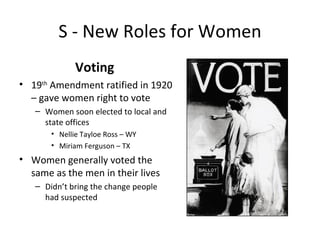
S - New Roles for Women Voting 19 th  Amendment ratified in 1920 – gave women right to vote Women soon elected to local and state offices Nellie Tayloe Ross – WY Miriam Ferguson – TX Women generally voted the same as the men in their lives Didn’t bring the change people had suspected
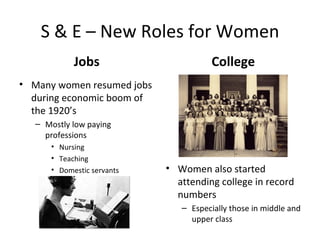
S & E – New Roles for Women Jobs Many women resumed jobs during economic boom of the 1920’s Mostly low paying professions Nursing Teaching Domestic servants Secretaries College Women also started attending college in record numbers Especially those in middle and upper class
The Flapper
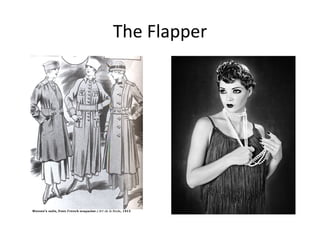
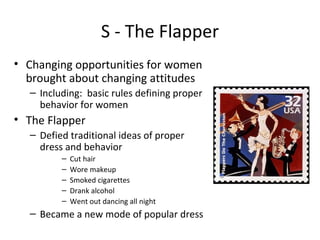
S - The Flapper Changing opportunities for women brought about changing attitudes Including:  basic rules defining proper behavior for women The Flapper Defied traditional ideas of proper dress and behavior Cut hair Wore makeup Smoked cigarettes Drank alcohol  Went out dancing all night Became a new mode of popular dress
S – The Flapper Also became a popular image reflecting the changes affecting women Suggested freedom and independence But some women didn’t approve, especially Women in rural areas Only seen pictures in magazines Conflicted with conservative values Older supporters of women’s rights Thought flappers disgraced the work that had been done to advance the cause of women
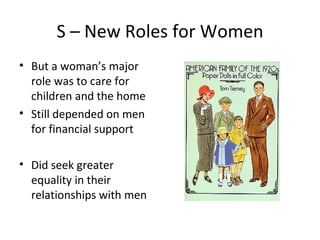
S – New Roles for Women But a woman’s major role was to care for children and the home Still depended on men for financial support Did seek greater equality in their relationships with men
G, S, R, I, E – Urbanization  Farmers experiencing hard times flocked to cities for new jobs 1920 census showed for the first time that more Americans lived in urban areas than rural areas http://www.census.gov/population/www/censusdata/files/table-4.pdf In 2008 – 79.2% urban, 20.8% rural 75% of Americans worked somewhere other than a farm Access to cars shrunk the distance between the country and the city Rural people less isolated, changed outlook
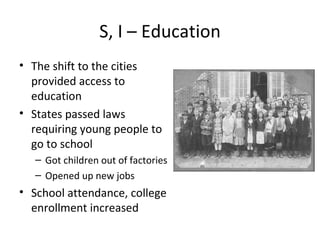
S, I – Education The shift to the cities provided access to education States passed laws requiring young people to go to school Got children out of factories Opened up new jobs School attendance, college enrollment increased
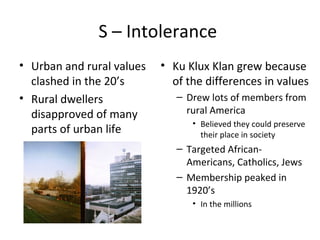
S – Intolerance  Urban and rural values clashed in the 20’s Rural dwellers disapproved of many parts of urban life Ku Klux Klan grew because of the differences in values Drew lots of members from rural America Believed they could preserve their place in society Targeted African-Americans, Catholics, Jews Membership peaked in 1920’s In the millions
How do people feel in times of change?
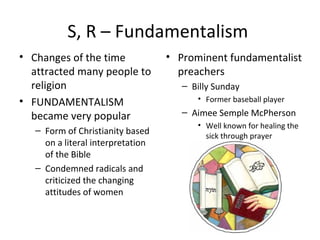
S, R – Fundamentalism  Changes of the time attracted many people to religion FUNDAMENTALISM became very popular Form of Christianity based on a literal interpretation of the Bible Condemned radicals and criticized the changing attitudes of women Prominent fundamentalist preachers Billy Sunday Former baseball player Aimee Semple McPherson Well known for healing the sick through prayer
S, I, P – Fundamentalism vs. Evolution Fundamentalism conflicted with modern science Especially Charles Darwin’s Theory of Evolution Fundamentalists believed evolution undermined religious faith Tried to prevent teaching evolution in schools Several states passed laws outlawing teaching evolution Law passed in Tennessee in 1925 made it illegal to teach evolution
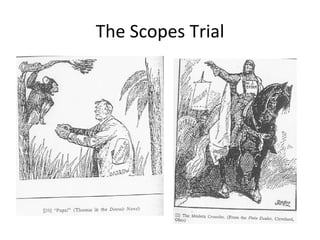
S, I, P – Scopes Trial Tennessee teacher John Scopes arrested for teaching evolution People all over the country followed his court case Guilt was never in question Two important lawyers faced off: Clarence Darrow defended John Scopes Famous criminal lawyer  Argued that teaching evolution was a matter of free speech William Jennings Bryan –  3 time candidate for president Fundamentalist Believer in rural values Argued that the ideas competed with Christianity
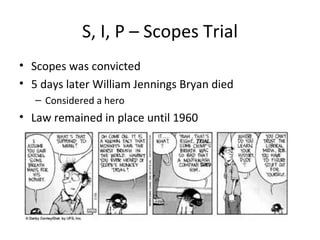
S, I, P – Scopes Trial Scopes was convicted 5 days later William Jennings Bryan died Considered a hero Law remained in place until 1960
The Scopes Trial
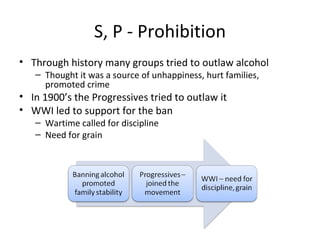
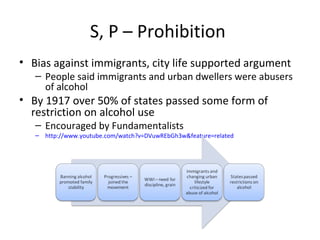
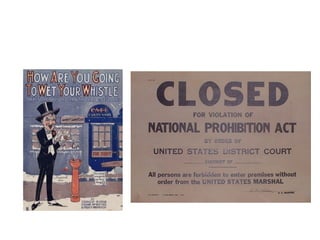
S, P - Prohibition Through history many groups tried to outlaw alcohol Thought it was a source of unhappiness, hurt families, promoted crime In 1900’s the Progressives tried to outlaw it WWI led to support for the ban Wartime called for discipline Need for grain
S, P – Prohibition  Bias against immigrants, city life supported argument People said immigrants and urban dwellers were abusers of alcohol By 1917 over 50% of states passed some form of restriction on alcohol use Encouraged by Fundamentalists http://www.youtube.com/watch?v=DVuwREbGh3w&feature=related
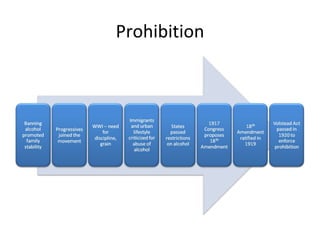
S, P – Prohibition  1917 – Congress proposed constitutional amendment making it illegal to  manufacture, transport or sell  alcohol 1919 – Amendment ratified 1920 – Volstead Act passed to enforce the amendment Prohibition became the law of the land
Prohibition
 
S, P – Prohibition  Virtually impossible to enforce Making, transporting, selling alcohol illegal, but  drinking  it was NOT Gave rise to huge smuggling operations 2 nd  biggest industry in Detroit in 1920’s Smugglers -  BOOTLEGGERS Illegal bars that served alcohol –  SPEAKEASIES
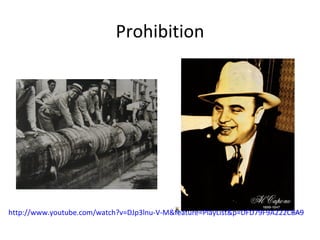
S, P – Prohibition  1925 – only 5% of liquor entering country had been stopped Illegal liquor business – foundation for great criminal empires Al Capone – Chicago  Federal government couldn’t compete with criminals Prohibition continued through the 1920’s without success Damaged government prestige
Prohibition http://www.youtube.com/watch?v=DJp3lnu-V-M&feature=PlayList&p=DFD79F9A222C8A9E&playnext=1&index=21
http://www.youtube.com/watch?v=OiYqFXmVAFg&feature=related http://video.search.yahoo.com/video/play?p=prohibition&ei=UTF-8&fr=b2ie7&fr2=tab-web&tnr=21&vid=000165489586
 

1920s Lecture 4 The Roaring 20s

  • 1.
    The Roaring 20’sAfter today you should know: How women’s roles changed What major population shifts occurred How population shifts led to conflicts of values in America How fundamentalism influenced America
  • 2.
  • 3.
    S - NewRoles for Women Voting 19 th Amendment ratified in 1920 – gave women right to vote Women soon elected to local and state offices Nellie Tayloe Ross – WY Miriam Ferguson – TX Women generally voted the same as the men in their lives Didn’t bring the change people had suspected
  • 4.
    S & E– New Roles for Women Jobs Many women resumed jobs during economic boom of the 1920’s Mostly low paying professions Nursing Teaching Domestic servants Secretaries College Women also started attending college in record numbers Especially those in middle and upper class
  • 5.
  • 6.
    S - TheFlapper Changing opportunities for women brought about changing attitudes Including: basic rules defining proper behavior for women The Flapper Defied traditional ideas of proper dress and behavior Cut hair Wore makeup Smoked cigarettes Drank alcohol Went out dancing all night Became a new mode of popular dress
  • 7.
    S – TheFlapper Also became a popular image reflecting the changes affecting women Suggested freedom and independence But some women didn’t approve, especially Women in rural areas Only seen pictures in magazines Conflicted with conservative values Older supporters of women’s rights Thought flappers disgraced the work that had been done to advance the cause of women
  • 8.
    S – NewRoles for Women But a woman’s major role was to care for children and the home Still depended on men for financial support Did seek greater equality in their relationships with men
  • 9.
    G, S, R,I, E – Urbanization Farmers experiencing hard times flocked to cities for new jobs 1920 census showed for the first time that more Americans lived in urban areas than rural areas http://www.census.gov/population/www/censusdata/files/table-4.pdf In 2008 – 79.2% urban, 20.8% rural 75% of Americans worked somewhere other than a farm Access to cars shrunk the distance between the country and the city Rural people less isolated, changed outlook
  • 10.
    S, I –Education The shift to the cities provided access to education States passed laws requiring young people to go to school Got children out of factories Opened up new jobs School attendance, college enrollment increased
  • 11.
    S – Intolerance Urban and rural values clashed in the 20’s Rural dwellers disapproved of many parts of urban life Ku Klux Klan grew because of the differences in values Drew lots of members from rural America Believed they could preserve their place in society Targeted African-Americans, Catholics, Jews Membership peaked in 1920’s In the millions
  • 12.
    How do peoplefeel in times of change?
  • 13.
    S, R –Fundamentalism Changes of the time attracted many people to religion FUNDAMENTALISM became very popular Form of Christianity based on a literal interpretation of the Bible Condemned radicals and criticized the changing attitudes of women Prominent fundamentalist preachers Billy Sunday Former baseball player Aimee Semple McPherson Well known for healing the sick through prayer
  • 14.
    S, I, P– Fundamentalism vs. Evolution Fundamentalism conflicted with modern science Especially Charles Darwin’s Theory of Evolution Fundamentalists believed evolution undermined religious faith Tried to prevent teaching evolution in schools Several states passed laws outlawing teaching evolution Law passed in Tennessee in 1925 made it illegal to teach evolution
  • 15.
    S, I, P– Scopes Trial Tennessee teacher John Scopes arrested for teaching evolution People all over the country followed his court case Guilt was never in question Two important lawyers faced off: Clarence Darrow defended John Scopes Famous criminal lawyer Argued that teaching evolution was a matter of free speech William Jennings Bryan – 3 time candidate for president Fundamentalist Believer in rural values Argued that the ideas competed with Christianity
  • 16.
    S, I, P– Scopes Trial Scopes was convicted 5 days later William Jennings Bryan died Considered a hero Law remained in place until 1960
  • 17.
  • 18.
    S, P -Prohibition Through history many groups tried to outlaw alcohol Thought it was a source of unhappiness, hurt families, promoted crime In 1900’s the Progressives tried to outlaw it WWI led to support for the ban Wartime called for discipline Need for grain
  • 19.
    S, P –Prohibition Bias against immigrants, city life supported argument People said immigrants and urban dwellers were abusers of alcohol By 1917 over 50% of states passed some form of restriction on alcohol use Encouraged by Fundamentalists http://www.youtube.com/watch?v=DVuwREbGh3w&feature=related
  • 20.
    S, P –Prohibition 1917 – Congress proposed constitutional amendment making it illegal to manufacture, transport or sell alcohol 1919 – Amendment ratified 1920 – Volstead Act passed to enforce the amendment Prohibition became the law of the land
  • 21.
  • 22.
  • 23.
    S, P –Prohibition Virtually impossible to enforce Making, transporting, selling alcohol illegal, but drinking it was NOT Gave rise to huge smuggling operations 2 nd biggest industry in Detroit in 1920’s Smugglers - BOOTLEGGERS Illegal bars that served alcohol – SPEAKEASIES
  • 24.
    S, P –Prohibition 1925 – only 5% of liquor entering country had been stopped Illegal liquor business – foundation for great criminal empires Al Capone – Chicago Federal government couldn’t compete with criminals Prohibition continued through the 1920’s without success Damaged government prestige
  • 25.
  • 26.
  • 27.