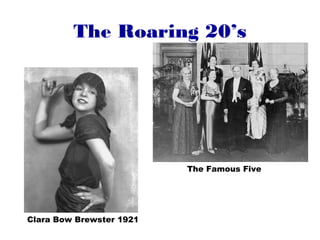
The Roaring 20’s 
Clara Bow Brewster 1921 
The Famous Five
Canada After the War 
• War propelled Canada into independence. 
• The war had changed the perception of war for so 
many people. 
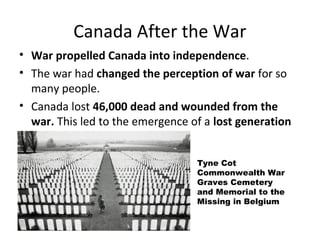
• Canada lost 46,000 dead and wounded from the 
war. This led to the emergence of a lost generation 
Tyne Cot 
Commonwealth War 
Graves Cemetery 
and Memorial to the 
Missing in Belgium
The League of Nations 
• Canada was a founding member of the newly 
created League of Nations 
• The League pledged every member to defend the 
boundaries established at Versailles, and ultimately 
an era of peace. 
• American Senate rejected the states from becoming 
members of the League, even though Wilson was 
responsible for its creation 
• Many were uncomfortable with Collective Security 
• Attempted to use economic sanctions against 
nations 
• Proved idealistic and without military force
Trouble for Canada 
• At the end of the war Munitions factories 
were shut down 
• Over a quarter million workers were suddenly 
out of jobs 
• Canadian government had to pay 250 million 
in back pay to soldiers returning from front 
• There was a distinct lack of support and 
employment for veterans
Trouble for Canada continued 
• Membership in unions increased during the 
war from 143,000 in 1915 to 378,000 by 1919. 
• Many workers talked of a revolution like the 
one in Russia 
• The government became scared of threat of 
Communism (Red Scare)
Winnipeg General Strike 
• A general strike began in Winnipeg on May 15, 1919. 
• 30,000 metal and building workers walked off the 
job together 
• The general strike spread across Canada 
• Most employees wanted to bargain with employer 
not a revolution 
Winnipeg General Strike
Striker Demands 
• The strikers had stiff demands. 
• Strikers wanted higher wages and a shorter 
work week. 
• They also wanted Collective Bargaining, which 
meant the companies had to negotiate with 
the workers as a whole.
Crowd gathered outside old City Hall 
during the Winnipeg General Strike, June 
21, 1919
Business Backlash 
• Business leaders, politicians and 
industrialists wanted to protect their own 
interests. 
• They formed the Citizen’s Committee of One 
Thousand to attack the strike in the press. 
• The committee 
had the support 
of the government.
Winnipeg Strike Continued 
• Parliament made it illegal to even talk about a 
revolution. 
• Government ordered the leaders of the strike 
arrested June 17th. 
• Protestors organized a mass rally. 
• On June 21, 1919, mounted police charged the 
crowds on Main Street Winnipeg, in a Confrontation 
that became known as Bloody Saturday.
Disgruntled Canadian Farmers 
• Farmers were very unhappy 
• The price of wheat was determined by government 
Wheat Board. 
• In 1919 the board set the price at $2.15 per bushel just 
when world price rose to $3.15 per bushel 
• The next year the government dissolved the board just as 
a bumper crop in Europe dropped the price of wheat to 
$1.11 per bushel, forcing many farmers who had 
borrowed money on the original price into bankruptcy 
• Farmers wanted Free trade with the US in order to buy 
cheaper machinery
The Election of 1921 
• Borden didn’t run in the election. 
• Liberal party leader: William Lyon Mackenzie 
King. 
• Conservative party leader: Arthur Meighen 
• And a new party representing the needs of 
farmers known as the Progressives
The Election 1921 Continued 
• For the first time, Canadians had three choices. 
• The election brought in the creation of Regionalism as a 
result of different parts of the country having such 
different needs. 
• King won with a minority government and led Canada 
into a time of economic boom 
• Review: What does minority government mean?
Government and Crisis 
• The Progressives did not last long but they were 
influential in creating pensions. 
• In 1922 when Britain announced its planned 
invasion of Turkey, PM Mackenzie King said 
Canada would not support Britain. 
• This is known as the Chanak Crisis 
• We had officially challenged Britain’s 
stranglehold on Canadian international affairs.
The Improving Economy 
• The 1920’s started in depression. 
• Then the US started investing in Canada and our 
economy grew. 
• US Companies set up ‘Branch Plants’ which operated 
here but for American business men. 
• With the increase in employment and economic 
prosperity few Canadians questioned the long term 
effects of American involvement.
Bootlegging the Border 
• The Women’s Christian Temperance Union (WCTU) 
pushed prohibition into legislation in Canada and the 
US. 
• By 1921 provincial governments were overturning the 
decision because of its unpopularity. 
• The US, however, enforced it until 1933. Canadians 
sold illegal alcohol over the border for about 10 years.
Prosperous Times 
• With the new booming economy Canadians were 
afforded more opportunities to enjoy the luxuries 
of life. 
• Motor cars were becoming affordable and 
popular. 
• Telephone lines were becoming commonplace for 
all houses in cities. 
• Professional sports were also increasing in 
popularity.
Changing Attitudes and Culture 
• How does war change a Country? 
An individual? 
• Now mix that up with prosperity and 
new luxuries, and what do you get? 
• here's a glimpse
Fashion ad. 
US 1910 
1920s
• Pre-WWI 1920s
The Roaring 20’s 
A nation of 10 million was buying 2 million 
movie tickets a week (for mostly American 
movies) 
American pro baseball became the big pass 
time in North America 
The NHL had 6 teams, (2 Canadian) 
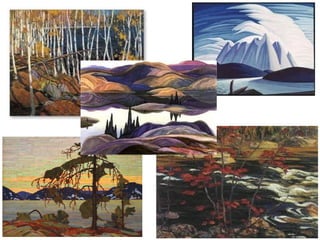
Canadian Artwork began to be recognized and 
work such as that by the Group of 7 and Emily 
Carr became well known. 
This was seen as a much needed Canadian 
expression of Culture.
The Group of Seven 
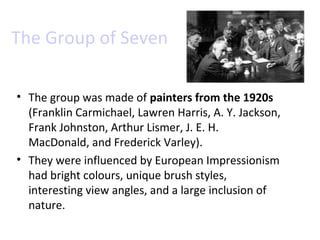
• The group was made of painters from the 1920s 
(Franklin Carmichael, Lawren Harris, A. Y. Jackson, 
Frank Johnston, Arthur Lismer, J. E. H. 
MacDonald, and Frederick Varley). 
• They were influenced by European Impressionism 
had bright colours, unique brush styles, 
interesting view angles, and a large inclusion of 
nature.
Emily Carr 
• Emily Carr was from Victoria and is considered 
one of Canada’s most important painters ever. 
She was also a writer. 
• She was impressed by the Group of 7 and took 
this style to her paintings of the west coast 
lifestyle. 
• Visited remote First Nations' communities; 
inspired by and documented the art and lifestyle 
of indigenous people.
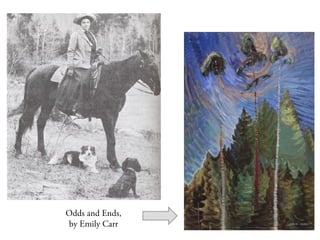
Odds and Ends, 
by Emily Carr
“Blue Sky” by Emily 
Carr, 1936
The roaring 20s were not so fun and roaring for 
everyone....
The Forgotten Ones… 
Aboriginal peoples 
• Even after serving in WWI Aboriginal people were still 
not legally considered adult people. 
• They were wards of the state and the government had 
been taking land from Aboriginal people as they saw fit, 
providing reserves for them to live on where conditions 
were very poor. 
• Review: What is assimilation? 
• Aboriginal peoples were split on whether they should 
accept a British style of living. 
• The Potlatch, an important Aboriginal celebration, was 
banned and people were thrown in jail.
The Forgotten Ones… 
Aboriginal peoples 
• In 1920, under the Indian Act, it became 
mandatory for every Indian child to 
attend a residential school and illegal for 
them to attend any other educational 
institution. 
• More about Residential schools later, but the abuses 
that occurred in the schools and the forced 
separation of families have had detrimental and 
destructive consequences for the individuals and the 
following generations, effects that we still see today.
The Forgotten Ones… 
The Allied Tribes 
• Formed in 1916 to protect Aboriginal land and protest 
the racist decisions they faced from the government. 
• They wanted to seek a resolution to land claims in BC 
through negotiations with the federal and provincial 
governments. 
• In 1927 they were made illegal by the federal 
government who changed the Indian Act. 
• For more extensive information, see “Native Issues” 
power point, in a file folder near you.
The Forgotten Ones… 
African Canadians 
• African immigrants were discouraged but never blocked from 
immigrating. 
• Some provinces set up a separate school system and many 
public areas excluded coloured minorities. 
• The Klu Klux Klan had a 2nd flourish in the states in the 
1920s, spreading non-white and non-Protestant hatred 
and violence, adding the distinctive white hooded 
costumes and the act of cross burning. The KKK 
established some local branches in Canada in the 
1920s
The Forgotten Ones… 
Other Immigrants 
• Employers often welcomed new immigrants to 
Canada because it was assumed they would work 
cheaper. 
• For this reason unions hated immigrants. They 
believed immigrants cut down the wages they could 
achieve. 
• In 1923 the federal government passed the Chinese 
Exclusion Act barring all immigrants from China 
• Japanese immigrants were also limited
And Then It Crashed… 
• By 1927 the price of wheat was dropping 
and the world market showed weakness. 
• People still believed that the post-war 
world had infinite economic possibilities 
and that things would keep getting better.
Stock Market Crash 
of 1929 
• Then, on ‘Black Tuesday,’ a flurry of stocks 
suddenly plummeted. 
• People lost billions and rushed to protect 
the money they had. 
• The great depression was on… 
Crowd gathering on Wall 
Street after the 1929 crash

1. roaring 20s presentation

  • 1.
    The Roaring 20’s Clara Bow Brewster 1921 The Famous Five
  • 2.
    Canada After theWar • War propelled Canada into independence. • The war had changed the perception of war for so many people. • Canada lost 46,000 dead and wounded from the war. This led to the emergence of a lost generation Tyne Cot Commonwealth War Graves Cemetery and Memorial to the Missing in Belgium
  • 3.
    The League ofNations • Canada was a founding member of the newly created League of Nations • The League pledged every member to defend the boundaries established at Versailles, and ultimately an era of peace. • American Senate rejected the states from becoming members of the League, even though Wilson was responsible for its creation • Many were uncomfortable with Collective Security • Attempted to use economic sanctions against nations • Proved idealistic and without military force
  • 4.
    Trouble for Canada • At the end of the war Munitions factories were shut down • Over a quarter million workers were suddenly out of jobs • Canadian government had to pay 250 million in back pay to soldiers returning from front • There was a distinct lack of support and employment for veterans
  • 5.
    Trouble for Canadacontinued • Membership in unions increased during the war from 143,000 in 1915 to 378,000 by 1919. • Many workers talked of a revolution like the one in Russia • The government became scared of threat of Communism (Red Scare)
  • 6.
    Winnipeg General Strike • A general strike began in Winnipeg on May 15, 1919. • 30,000 metal and building workers walked off the job together • The general strike spread across Canada • Most employees wanted to bargain with employer not a revolution Winnipeg General Strike
  • 7.
    Striker Demands •The strikers had stiff demands. • Strikers wanted higher wages and a shorter work week. • They also wanted Collective Bargaining, which meant the companies had to negotiate with the workers as a whole.
  • 8.
    Crowd gathered outsideold City Hall during the Winnipeg General Strike, June 21, 1919
  • 9.
    Business Backlash •Business leaders, politicians and industrialists wanted to protect their own interests. • They formed the Citizen’s Committee of One Thousand to attack the strike in the press. • The committee had the support of the government.
  • 10.
    Winnipeg Strike Continued • Parliament made it illegal to even talk about a revolution. • Government ordered the leaders of the strike arrested June 17th. • Protestors organized a mass rally. • On June 21, 1919, mounted police charged the crowds on Main Street Winnipeg, in a Confrontation that became known as Bloody Saturday.
  • 11.
    Disgruntled Canadian Farmers • Farmers were very unhappy • The price of wheat was determined by government Wheat Board. • In 1919 the board set the price at $2.15 per bushel just when world price rose to $3.15 per bushel • The next year the government dissolved the board just as a bumper crop in Europe dropped the price of wheat to $1.11 per bushel, forcing many farmers who had borrowed money on the original price into bankruptcy • Farmers wanted Free trade with the US in order to buy cheaper machinery
  • 12.
    The Election of1921 • Borden didn’t run in the election. • Liberal party leader: William Lyon Mackenzie King. • Conservative party leader: Arthur Meighen • And a new party representing the needs of farmers known as the Progressives
  • 13.
    The Election 1921Continued • For the first time, Canadians had three choices. • The election brought in the creation of Regionalism as a result of different parts of the country having such different needs. • King won with a minority government and led Canada into a time of economic boom • Review: What does minority government mean?
  • 14.
    Government and Crisis • The Progressives did not last long but they were influential in creating pensions. • In 1922 when Britain announced its planned invasion of Turkey, PM Mackenzie King said Canada would not support Britain. • This is known as the Chanak Crisis • We had officially challenged Britain’s stranglehold on Canadian international affairs.
  • 15.
    The Improving Economy • The 1920’s started in depression. • Then the US started investing in Canada and our economy grew. • US Companies set up ‘Branch Plants’ which operated here but for American business men. • With the increase in employment and economic prosperity few Canadians questioned the long term effects of American involvement.
  • 16.
    Bootlegging the Border • The Women’s Christian Temperance Union (WCTU) pushed prohibition into legislation in Canada and the US. • By 1921 provincial governments were overturning the decision because of its unpopularity. • The US, however, enforced it until 1933. Canadians sold illegal alcohol over the border for about 10 years.
  • 17.
    Prosperous Times •With the new booming economy Canadians were afforded more opportunities to enjoy the luxuries of life. • Motor cars were becoming affordable and popular. • Telephone lines were becoming commonplace for all houses in cities. • Professional sports were also increasing in popularity.
  • 19.
    Changing Attitudes andCulture • How does war change a Country? An individual? • Now mix that up with prosperity and new luxuries, and what do you get? • here's a glimpse
  • 20.
    Fashion ad. US1910 1920s
  • 21.
  • 22.
    The Roaring 20’s A nation of 10 million was buying 2 million movie tickets a week (for mostly American movies) American pro baseball became the big pass time in North America The NHL had 6 teams, (2 Canadian) Canadian Artwork began to be recognized and work such as that by the Group of 7 and Emily Carr became well known. This was seen as a much needed Canadian expression of Culture.
  • 23.
    The Group ofSeven • The group was made of painters from the 1920s (Franklin Carmichael, Lawren Harris, A. Y. Jackson, Frank Johnston, Arthur Lismer, J. E. H. MacDonald, and Frederick Varley). • They were influenced by European Impressionism had bright colours, unique brush styles, interesting view angles, and a large inclusion of nature.
  • 25.
    Emily Carr •Emily Carr was from Victoria and is considered one of Canada’s most important painters ever. She was also a writer. • She was impressed by the Group of 7 and took this style to her paintings of the west coast lifestyle. • Visited remote First Nations' communities; inspired by and documented the art and lifestyle of indigenous people.
  • 26.
    Odds and Ends, by Emily Carr
  • 28.
    “Blue Sky” byEmily Carr, 1936
  • 29.
    The roaring 20swere not so fun and roaring for everyone....
  • 30.
    The Forgotten Ones… Aboriginal peoples • Even after serving in WWI Aboriginal people were still not legally considered adult people. • They were wards of the state and the government had been taking land from Aboriginal people as they saw fit, providing reserves for them to live on where conditions were very poor. • Review: What is assimilation? • Aboriginal peoples were split on whether they should accept a British style of living. • The Potlatch, an important Aboriginal celebration, was banned and people were thrown in jail.
  • 31.
    The Forgotten Ones… Aboriginal peoples • In 1920, under the Indian Act, it became mandatory for every Indian child to attend a residential school and illegal for them to attend any other educational institution. • More about Residential schools later, but the abuses that occurred in the schools and the forced separation of families have had detrimental and destructive consequences for the individuals and the following generations, effects that we still see today.
  • 33.
    The Forgotten Ones… The Allied Tribes • Formed in 1916 to protect Aboriginal land and protest the racist decisions they faced from the government. • They wanted to seek a resolution to land claims in BC through negotiations with the federal and provincial governments. • In 1927 they were made illegal by the federal government who changed the Indian Act. • For more extensive information, see “Native Issues” power point, in a file folder near you.
  • 34.
    The Forgotten Ones… African Canadians • African immigrants were discouraged but never blocked from immigrating. • Some provinces set up a separate school system and many public areas excluded coloured minorities. • The Klu Klux Klan had a 2nd flourish in the states in the 1920s, spreading non-white and non-Protestant hatred and violence, adding the distinctive white hooded costumes and the act of cross burning. The KKK established some local branches in Canada in the 1920s
  • 35.
    The Forgotten Ones… Other Immigrants • Employers often welcomed new immigrants to Canada because it was assumed they would work cheaper. • For this reason unions hated immigrants. They believed immigrants cut down the wages they could achieve. • In 1923 the federal government passed the Chinese Exclusion Act barring all immigrants from China • Japanese immigrants were also limited
  • 36.
    And Then ItCrashed… • By 1927 the price of wheat was dropping and the world market showed weakness. • People still believed that the post-war world had infinite economic possibilities and that things would keep getting better.
  • 37.
    Stock Market Crash of 1929 • Then, on ‘Black Tuesday,’ a flurry of stocks suddenly plummeted. • People lost billions and rushed to protect the money they had. • The great depression was on… Crowd gathering on Wall Street after the 1929 crash