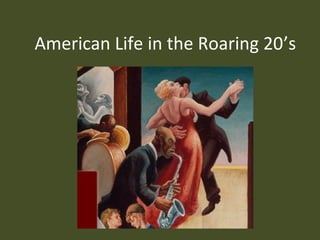
American Life in the Roaring 20’s
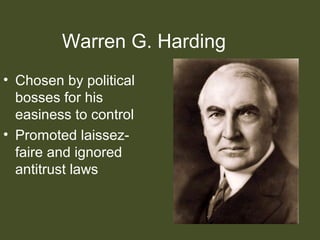
Warren G. Harding
• Chosen by political
bosses for his
easiness to control
• Promoted laissez-
faire and ignored
antitrust laws
Return to Normalcy
• Harding’s idea of returning the U.S. to
the period of peace and prosperity
prior to World War I
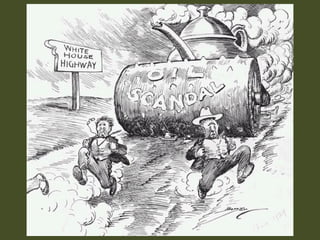
Teapot Dome Scandal
• Secretary of Interior Albert B. Fall
secretly leases oil-rich public land to
private companies for drilling
• In return he received money and land
• Caused public to lose trust in the
Harding administration
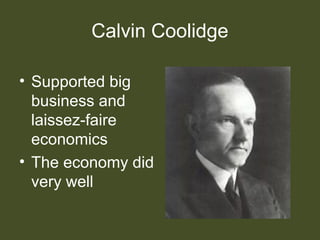
Calvin Coolidge
• Supported big
business and
laissez-faire
economics
• The economy did
very well
Purchasing Stocks
• Speculation: making high risk
investments in hopes of making high
returns on their money
• Buying on Margin: buying stocks for
only a portion of what they cost and
borrowing the difference
Mechanization
• Increase in use of machinery for
production allowed manufacturers to
produce more and charge less
Consumerism
• Advertisers convinced Americans that
they not only wanted, but needed
certain products
• Installment Plan: allowed consumers
to pay a little at a time
–Meant people could purchase more
expensive items
Economic Boom
• People began to purchase more cars,
clothes, appliances, and other
goods…….on credit
• Easy credit allowed the economy to
boom in the 1920’s
Farmers
• During WWI farmers did well because of a
high demand for their products
• After WWI overproduction caused prices
to fall
• Many farmers could not repay their loans
and many lost their homes and land
The Red Scare
• After WWI, the Russian Revolution
brought a Communist government to
power in Russia
• Americans feared the spread of
communist ideas to the U.S.
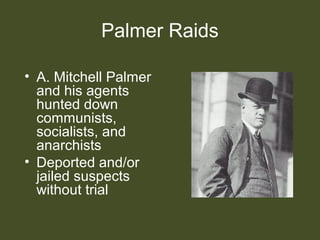
Palmer Raids
• A. Mitchell Palmer
and his agents
hunted down
communists,
socialists, and
anarchists
• Deported and/or
jailed suspects
without trial
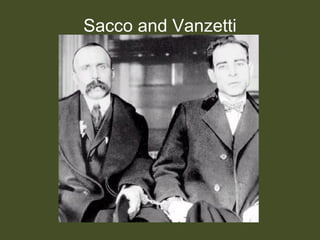
Sacco and Vanzetti
• Italian born immigrants
• Convicted of murder based on
circumstantial evidence
• Became the symbol of nativist
distrust of foreigners during the
1920’s
Sacco and Vanzetti
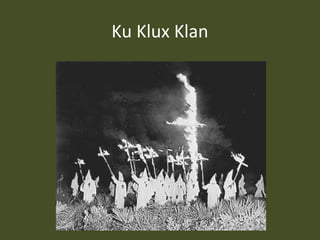
Ku Klux Klan
• Originally targeted African Americans
• In 1920’s they began to attack Jews,
Catholics, and immigrants
Ku Klux Klan
Schenk v. U.S.
• Schenk was arrested for urging
draftees not to report for duty during
WWI
• Supreme Court said government
could silent free speech when “clear
and present danger” was involved
Emergency Quota Act of 1921
• Passed to curb the number of
immigrants from Eastern and Southern
Europe
• Restricted newcomers to 3% of the
population for that nationality
Immigration Act of 1924
• Dropped the immigration number down
to 2% and based it on the population in
1890
• Old Immigrants vs. New Immigrants
Prohibition
• 1920, 18th Amendment passed that
forbade the manufacturing and sale of
alcohol in the U.S.
• Law was controversial and was in
place until 1933
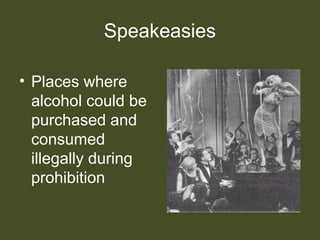
Speakeasies
• Places where
alcohol could be
purchased and
consumed
illegally during
prohibition
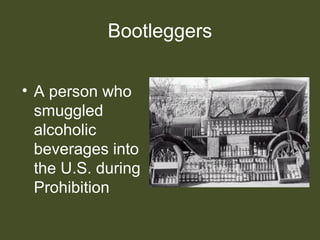
Bootleggers
• A person who
smuggled
alcoholic
beverages into
the U.S. during
Prohibition
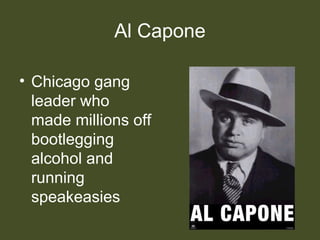
Al Capone
• Chicago gang
leader who
made millions off
bootlegging
alcohol and
running
speakeasies
Fundamentalism
• The belief that everything in The Bible
is true
• Many people saw advances in
technology and science as an attack
on Christianity
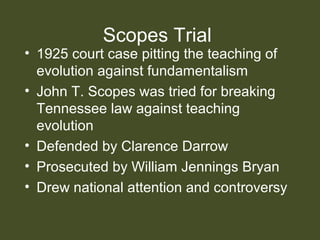
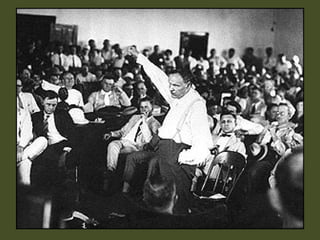
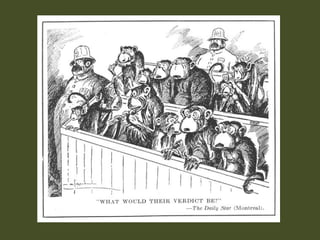
Scopes Trial
• 1925 court case pitting the teaching of
evolution against fundamentalism
• John T. Scopes was tried for breaking
Tennessee law against teaching
evolution
• Defended by Clarence Darrow
• Prosecuted by William Jennings Bryan
• Drew national attention and controversy
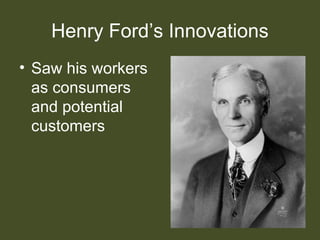
Henry Ford’s Innovations
• Saw his workers
as consumers
and potential
customers
Henry Ford’s Innovations
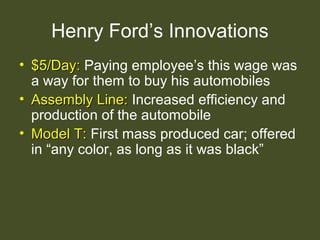
• $5/Day:$5/Day: Paying employee’s this wage was
a way for them to buy his automobiles
• Assembly Line:Assembly Line: Increased efficiency and
production of the automobile
• Model T:Model T: First mass produced car; offered
in “any color, as long as it was black”
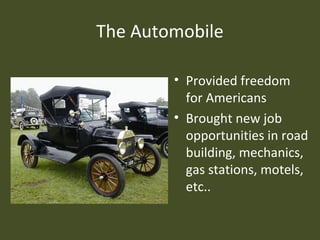
The Automobile
• Provided freedom
for Americans
• Brought new job
opportunities in road
building, mechanics,
gas stations, motels,
etc..
Consumer Society
• Americans began purchasing through
credit or installment plans
• This plunged Americans into deep
consumer debt
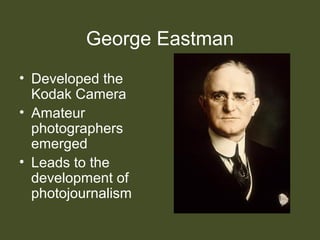
George Eastman
• Developed the
Kodak Camera
• Amateur
photographers
emerged
• Leads to the
development of
photojournalism
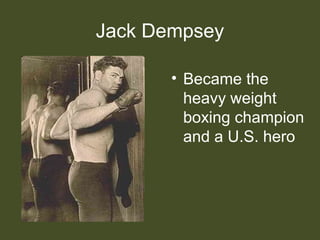
Jack Dempsey
• Became the
heavy weight
boxing champion
and a U.S. hero
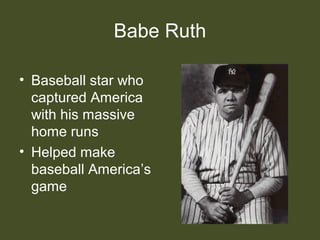
Babe Ruth
• Baseball star who
captured America
with his massive
home runs
• Helped make
baseball America’s
game
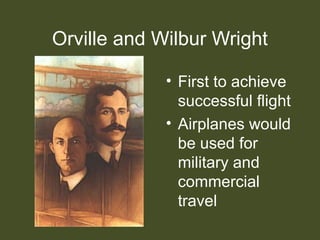
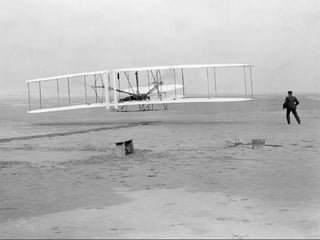
Orville and Wilbur Wright
• First to achieve
successful flight
• Airplanes would
be used for
military and
commercial
travel
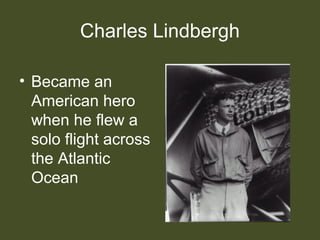
Charles Lindbergh
• Became an
American hero
when he flew a
solo flight across
the Atlantic
Ocean
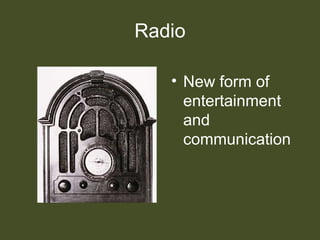
Radio
• New form of
entertainment
and
communication
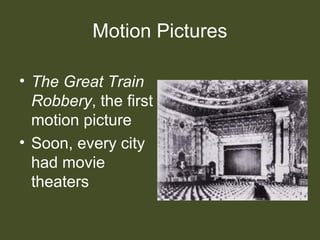
Motion Pictures
• The Great Train
Robbery, the first
motion picture
• Soon, every city
had movie
theaters
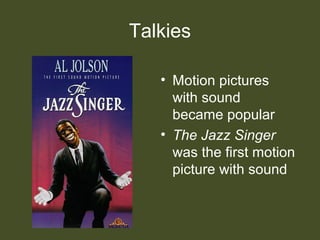
Talkies
• Motion pictures
with sound
became popular
• The Jazz Singer
was the first motion
picture with sound
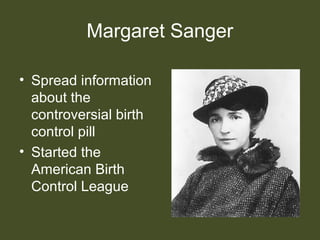
Margaret Sanger
• Spread information
about the
controversial birth
control pill
• Started the
American Birth
Control League
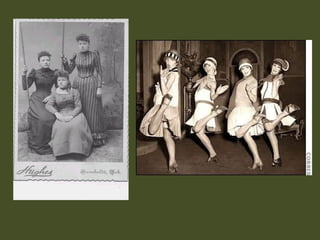
Changes Surrounding Women
• An increase in women entering the
workforce during the 1920’s
• Women started wearing shorter hair
and shorter skirts
Changes Surrounding Women
• Flappers:Flappers: challenged traditional
gender roles, would have men visit
their homes, changed the way women
dressed and looked
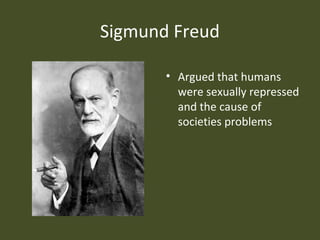
Sigmund Freud
• Argued that humans
were sexually repressed
and the cause of
societies problems
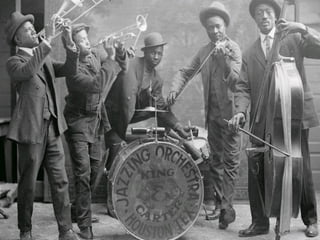
Harlem Renaissance
• A literary and artistic movement
celebrating African-American culture
• Saw the rise of African-American
poets, writers, artists, singers, and the
birth of jazz
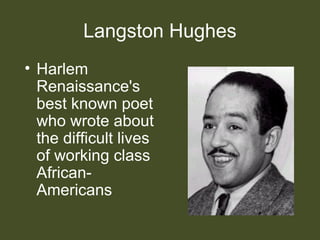
Langston Hughes
• Harlem
Renaissance's
best known poet
who wrote about
the difficult lives
of working class
African-
Americans
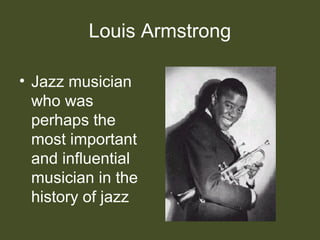
Louis Armstrong
• Jazz musician
who was
perhaps the
most important
and influential
musician in the
history of jazz
“Lost Generation”
• Disenchanted writers from the 1920’s
• Many were disillusioned by WWI
• Wrote about the pitfalls of materialism
and greed of the 1920’s
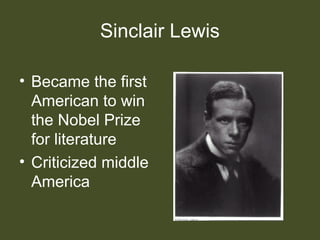
Sinclair Lewis
• Became the first
American to win
the Nobel Prize
for literature
• Criticized middle
America
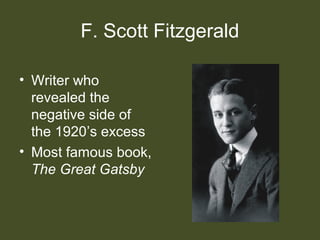
F. Scott Fitzgerald
• Writer who
revealed the
negative side of
the 1920’s excess
• Most famous book,
The Great Gatsby
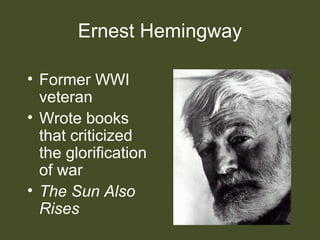
Ernest Hemingway
• Former WWI
veteran
• Wrote books
that criticized
the glorification
of war
• The Sun Also
Rises

Roaring twenties

  • 1.
    American Life inthe Roaring 20’s
  • 2.
    Warren G. Harding •Chosen by political bosses for his easiness to control • Promoted laissez- faire and ignored antitrust laws
  • 3.
    Return to Normalcy •Harding’s idea of returning the U.S. to the period of peace and prosperity prior to World War I
  • 4.
    Teapot Dome Scandal •Secretary of Interior Albert B. Fall secretly leases oil-rich public land to private companies for drilling • In return he received money and land • Caused public to lose trust in the Harding administration
  • 6.
    Calvin Coolidge • Supportedbig business and laissez-faire economics • The economy did very well
  • 7.
    Purchasing Stocks • Speculation:making high risk investments in hopes of making high returns on their money • Buying on Margin: buying stocks for only a portion of what they cost and borrowing the difference
  • 8.
    Mechanization • Increase inuse of machinery for production allowed manufacturers to produce more and charge less
  • 9.
    Consumerism • Advertisers convincedAmericans that they not only wanted, but needed certain products • Installment Plan: allowed consumers to pay a little at a time –Meant people could purchase more expensive items
  • 10.
    Economic Boom • Peoplebegan to purchase more cars, clothes, appliances, and other goods…….on credit • Easy credit allowed the economy to boom in the 1920’s
  • 11.
    Farmers • During WWIfarmers did well because of a high demand for their products • After WWI overproduction caused prices to fall • Many farmers could not repay their loans and many lost their homes and land
  • 12.
    The Red Scare •After WWI, the Russian Revolution brought a Communist government to power in Russia • Americans feared the spread of communist ideas to the U.S.
  • 13.
    Palmer Raids • A.Mitchell Palmer and his agents hunted down communists, socialists, and anarchists • Deported and/or jailed suspects without trial
  • 14.
    Sacco and Vanzetti •Italian born immigrants • Convicted of murder based on circumstantial evidence • Became the symbol of nativist distrust of foreigners during the 1920’s
  • 15.
  • 16.
    Ku Klux Klan •Originally targeted African Americans • In 1920’s they began to attack Jews, Catholics, and immigrants
  • 17.
  • 18.
    Schenk v. U.S. •Schenk was arrested for urging draftees not to report for duty during WWI • Supreme Court said government could silent free speech when “clear and present danger” was involved
  • 19.
    Emergency Quota Actof 1921 • Passed to curb the number of immigrants from Eastern and Southern Europe • Restricted newcomers to 3% of the population for that nationality
  • 20.
    Immigration Act of1924 • Dropped the immigration number down to 2% and based it on the population in 1890 • Old Immigrants vs. New Immigrants
  • 21.
    Prohibition • 1920, 18thAmendment passed that forbade the manufacturing and sale of alcohol in the U.S. • Law was controversial and was in place until 1933
  • 22.
    Speakeasies • Places where alcoholcould be purchased and consumed illegally during prohibition
  • 23.
    Bootleggers • A personwho smuggled alcoholic beverages into the U.S. during Prohibition
  • 24.
    Al Capone • Chicagogang leader who made millions off bootlegging alcohol and running speakeasies
  • 32.
    Fundamentalism • The beliefthat everything in The Bible is true • Many people saw advances in technology and science as an attack on Christianity
  • 33.
    Scopes Trial • 1925court case pitting the teaching of evolution against fundamentalism • John T. Scopes was tried for breaking Tennessee law against teaching evolution • Defended by Clarence Darrow • Prosecuted by William Jennings Bryan • Drew national attention and controversy
  • 36.
    Henry Ford’s Innovations •Saw his workers as consumers and potential customers
  • 37.
    Henry Ford’s Innovations •$5/Day:$5/Day: Paying employee’s this wage was a way for them to buy his automobiles • Assembly Line:Assembly Line: Increased efficiency and production of the automobile • Model T:Model T: First mass produced car; offered in “any color, as long as it was black”
  • 38.
    The Automobile • Providedfreedom for Americans • Brought new job opportunities in road building, mechanics, gas stations, motels, etc..
  • 39.
    Consumer Society • Americansbegan purchasing through credit or installment plans • This plunged Americans into deep consumer debt
  • 40.
    George Eastman • Developedthe Kodak Camera • Amateur photographers emerged • Leads to the development of photojournalism
  • 41.
    Jack Dempsey • Becamethe heavy weight boxing champion and a U.S. hero
  • 42.
    Babe Ruth • Baseballstar who captured America with his massive home runs • Helped make baseball America’s game
  • 43.
    Orville and WilburWright • First to achieve successful flight • Airplanes would be used for military and commercial travel
  • 45.
    Charles Lindbergh • Becamean American hero when he flew a solo flight across the Atlantic Ocean
  • 46.
    Radio • New formof entertainment and communication
  • 47.
    Motion Pictures • TheGreat Train Robbery, the first motion picture • Soon, every city had movie theaters
  • 48.
    Talkies • Motion pictures withsound became popular • The Jazz Singer was the first motion picture with sound
  • 49.
    Margaret Sanger • Spreadinformation about the controversial birth control pill • Started the American Birth Control League
  • 50.
    Changes Surrounding Women •An increase in women entering the workforce during the 1920’s • Women started wearing shorter hair and shorter skirts
  • 51.
    Changes Surrounding Women •Flappers:Flappers: challenged traditional gender roles, would have men visit their homes, changed the way women dressed and looked
  • 53.
    Sigmund Freud • Arguedthat humans were sexually repressed and the cause of societies problems
  • 54.
    Harlem Renaissance • Aliterary and artistic movement celebrating African-American culture • Saw the rise of African-American poets, writers, artists, singers, and the birth of jazz
  • 56.
    Langston Hughes • Harlem Renaissance's bestknown poet who wrote about the difficult lives of working class African- Americans
  • 57.
    Louis Armstrong • Jazzmusician who was perhaps the most important and influential musician in the history of jazz
  • 58.
    “Lost Generation” • Disenchantedwriters from the 1920’s • Many were disillusioned by WWI • Wrote about the pitfalls of materialism and greed of the 1920’s
  • 59.
    Sinclair Lewis • Becamethe first American to win the Nobel Prize for literature • Criticized middle America
  • 60.
    F. Scott Fitzgerald •Writer who revealed the negative side of the 1920’s excess • Most famous book, The Great Gatsby
  • 61.
    Ernest Hemingway • FormerWWI veteran • Wrote books that criticized the glorification of war • The Sun Also Rises