Moderator:
Dr.Nayana S
Assistant professor
Presentor:
Dr. Vanmathi A
Post graduate
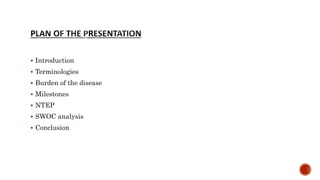
 Introduction
 Terminologies
 Burden of the disease
 Milestones
 NTEP
 SWOC analysis
 Conclusion
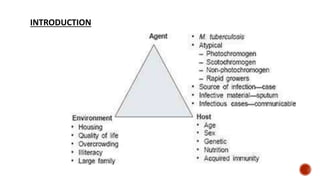
INTRODUCTION
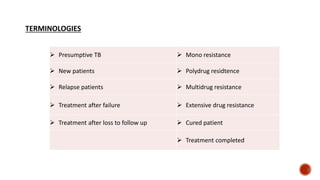
TERMINOLOGIES
 Presumptive TB  Mono resistance
 New patients  Polydrug residtence
 Relapse patients  Multidrug resistance
 Treatment after failure  Extensive drug resistance
 Treatment after loss to follow up  Cured patient
 Treatment completed
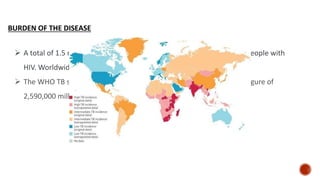
BURDEN OF THE DISEASE
 A total of 1.5 million people died from TB in 2020 (including 214 000 people with
HIV. Worldwide,
 The WHO TB statistics for India for 2021 give an estimated incidence figure of
2,590,000 million cases. this is a rate of 188 per 100,000 population
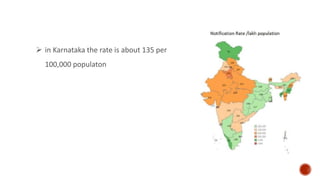
 in Karnataka the rate is about 135 per
100,000 populaton
MILESTONES IN INDIA
 1939: TB association India
 1959: National TB Institute (NTI) in Bangalore
 1962: Govt. of India launched the National TB Programand set up DistrictTB Centres
 1997:GoI revised NTP to RNTCP – introduction ofDOTS
 2006 – 11:Second phase of RNTCP
 2012 -17:National Strategic Plan
 2017 – 25:NSP (2017 – 25)
 2020:In January 2020, GoI revised RNTCP to NationalTB Elimination Program
(NTEP)
 2021:TB Mukt Bharat Abhiyaan
DOTS
Components:
 Political will and commitment
 Diagnosis by quality assured sputum smear microscopy
 Directly observed treatment
 Adequate supply of quality-assured short course chemotherapy
 Systemic monitoring and accountability
RNTCP
Objectives:
Achieve at least 85% cure rate among new smear-positive cases initiated on Rx
Case detection rate of at least 70% of such cases
END TB STRATEGY:
Vision:
A world free of tuberculosis – zero deaths, disease
and suffering due to tuberculosis
Goal:
End the global tuberculosis epidemic
Indicators:
•95% reduction by 2035 in the number of TB deaths compared with 2015.
•90% reduction by 2035 in TB incidence rate compared with 2015.
•Zero TB-affected families facing catastrophic costs due to TB by 2035.
NATIONAL STRATEGIC PLAN
VISION:
TB-Free India with zero deaths, disease and poverty due to TB
GOAL:
To achieve a rapid decline in burden of TB, morbidity and mortality while working towards
elimination of TB in India by 2025.
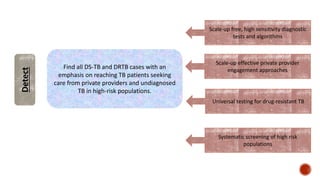
Detect
Find all DS-TB and DRTB cases with an
emphasis on reaching TB patients seeking
care from private providers and undiagnosed
TB in high-risk populations.
Scale-up free, high sensitivity diagnostic
tests and algorithms
Scale-up effective private provider
engagement approaches
Universal testing for drug-resistant TB
Systematic screening of high risk
populations
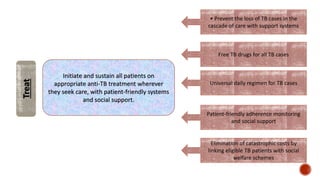
Elimination of catastrophic costs by
linking eligible TB patients with social
welfare schemes
Treat
Initiate and sustain all patients on
appropriate anti-TB treatment wherever
they seek care, with patient-friendly systems
and social support.
• Prevent the loss of TB cases in the
cascade of care with support systems
Free TB drugs for all TB cases
Universal daily regimen for TB cases
Patient-friendly adherence monitoring
and social support
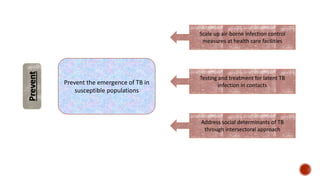
Address social determinants of TB
through intersectoral approach
Testing and treatment for latent TB
infection in contacts
Scale up air-borne infection control
measures at health care facilities
Prevent
Prevent the emergence of TB in
susceptible populations
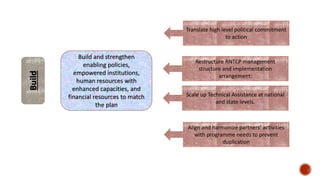
Align and harmonize partners’ activities
with programme needs to prevent
duplication
Scale up Technical Assistance at national
and state levels.
Translate high level political commitment
to action
Build
Build and strengthen
enabling policies,
empowered institutions,
human resources with
enhanced capacities, and
financial resources to match
the plan
Restructure RNTCP management
structure and implementation
arrangement:
NTEP
 In view of the end TB strategy, RNTCP has been renamed as National TB
elimination programme in the year 2020
 It functions as a flagship component of NHM
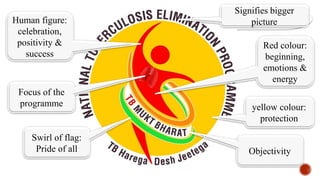
Rebranding RNTCP
Red colour:
beginning,
emotions &
energy
yellow colour:
protection
Objectivity
Swirl of flag:
Pride of all
Focus of the
programme
Human figure:
celebration,
positivity &
success
Signifies bigger
picture
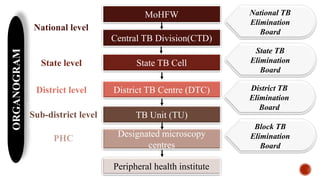
MoHFW
Central TB Division(CTD)
State TB Cell
District TB Centre (DTC)
TB Unit (TU)
Designated microscopy
centres
Peripheral health institute
ORGANOGRAM
National level
State level
District level
Sub-district level
PHC
National TB
Elimination
Board
State TB
Elimination
Board
District TB
Elimination
Board
Block TB
Elimination
Board
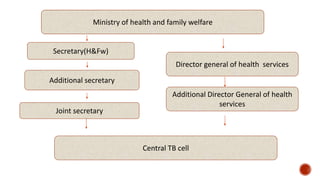
Ministry of health and family welfare
Secretary(H&Fw)
Director general of health services
Additional secretary
Additional Director General of health
services
Joint secretary
Central TB cell
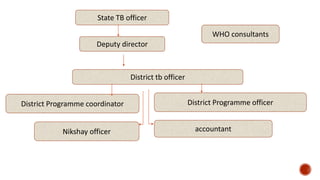
State TB officer
Deputy director
WHO consultants
District tb officer
District Programme coordinator District Programme officer
Nikshay officer accountant
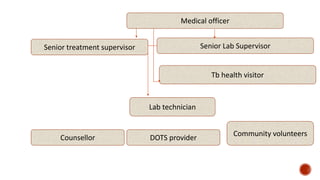
Medical officer
Senior treatment supervisor Senior Lab Supervisor
Tb health visitor
Community volunteers
Counsellor
Lab technician
DOTS provider
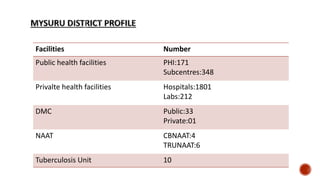
Facilities Number
Public health facilities PHI:171
Subcentres:348
Privalte health facilities Hospitals:1801
Labs:212
DMC Public:33
Private:01
NAAT CBNAAT:4
TRUNAAT:6
Tuberculosis Unit 10
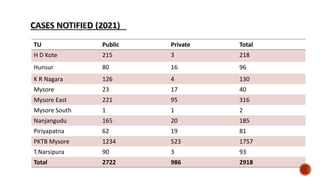
TU Public Private Total
H D Kote 215 3 218
Hunsur 80 16 96
K R Nagara 126 4 130
Mysore 23 17 40
Mysore East 221 95 316
Mysore South 1 1 2
Nanjangudu 165 20 185
Piriyapatna 62 19 81
PKTB Mysore 1234 523 1757
T.Narsipura 90 3 93
Total 2722 986 2918
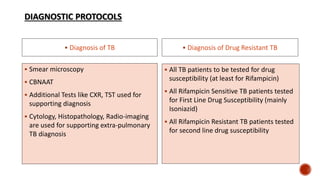
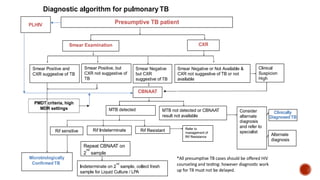
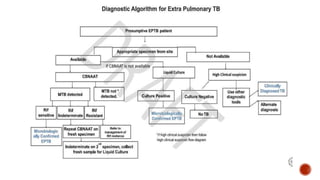
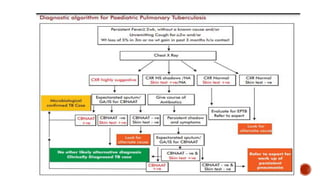
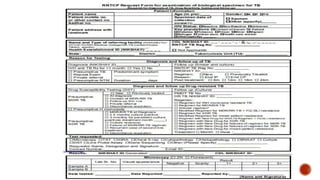
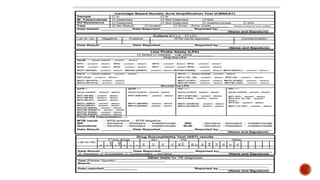
DIAGNOSTIC PROTOCOLS
 Diagnosis of TB
 Smear microscopy
 CBNAAT
 Additional Tests like CXR, TST used for
supporting diagnosis
 Cytology, Histopathology, Radio-imaging
are used for supporting extra-pulmonary
TB diagnosis
 Diagnosis of Drug Resistant TB
 All TB patients to be tested for drug
susceptibility (at least for Rifampicin)
 All Rifampicin Sensitive TB patients tested
for First Line Drug Susceptibility (mainly
Isoniazid)
 All Rifampicin Resistant TB patients tested
for second line drug susceptibility
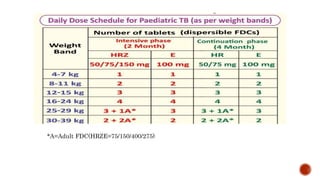
*A=Adult FDC(HRZE=75/150/400/275)
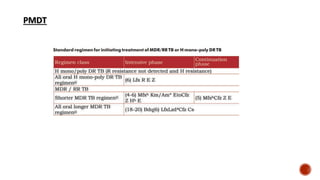
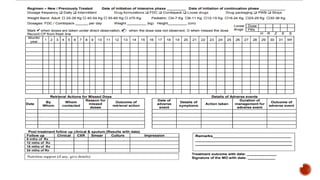
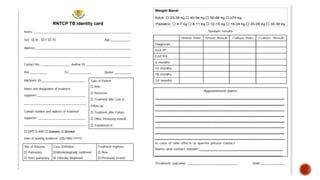
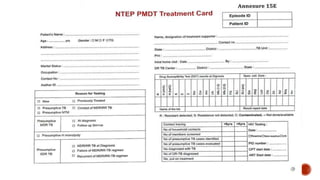
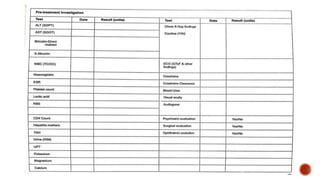
PMDT
NEW INITIATIVES
 TB notification
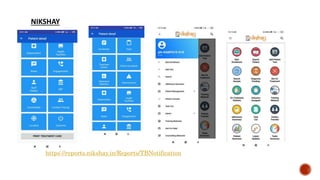
 NIKSHAY
 Ban on TB serology
 Direct benefit transfer
NIKSHAY
https://reports.nikshay.in/Reports/TBNotification
1. Honorarium to Treatment Supporters – For the provision of treatment support to TB
patients (Adherence, ADR monitoring, counselling Rs.1000/- to Rs.5000/-)
2. Patient Support to Tribal TB Patients - Rs750/-
3. Nutritional Support to All TB patients -Rs.500/-month- Nikshay Poshan Yojana
4. Incentives to Private Providers (Rs.500/- for Notification & Rs.500/- for reporting of
Treatment Outcome
5. Incentives to Informants (Rs. 500/- is given on diagnosis of TB among referrals from the
community to public sector health facility)
DBT
Cont.
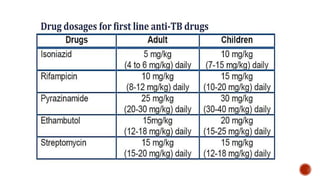
 Daily regimen for pediatric tb
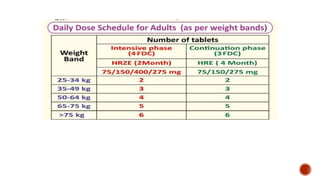
 Daily regimen for all forms of tb
 Pilots for universal access to TB cases
 Universal drug susceptibility testing
 Shorter regimen and bedaquiline
 Campaign mode- Active case finding
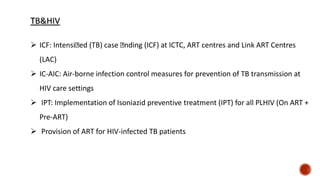
 ICF: Intensi ed (TB) case nding (ICF) at ICTC, ART centres and Link ART Centres
(LAC)
 IC-AIC: Air-borne infection control measures for prevention of TB transmission at
HIV care settings
 IPT: Implementation of Isoniazid preventive treatment (IPT) for all PLHIV (On ART +
Pre-ART)
 Provision of ART for HIV-infected TB patients
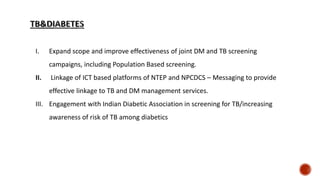
I. Expand scope and improve effectiveness of joint DM and TB screening
campaigns, including Population Based screening.
II. Linkage of ICT based platforms of NTEP and NPCDCS – Messaging to provide
effective linkage to TB and DM management services.
III. Engagement with Indian Diabetic Association in screening for TB/increasing
awareness of risk of TB among diabetics
I. Develop collaborative mechanism between NTEP and MCH for addressing TB among
pregnant women.
II. Ensure screening and detection of active TB cases among pregnant and postpartum
women.
III. Providing appropriate counselling to address nutrition and lifestyle aspects.
IV. Strengthen referral linkages between NTEP and MCH program
V. Augment treatment of TB among pregnant women.
VI. Address TB and obstetric complications.
SWOC ANALYSIS
Strength:
1. Highest level of political and administrative commitment with deep engagement in the TB
elimination efforts of the country.
2. State Strategic plans based on the NSP
3. Availability of much greater financial resources for TB elimination
4. Availability of new drugs, regimens, diagnostics, approaches and strategies to end TB.
5. Rapid adoption of global best practices
Weakness:
1. Insufficient human resource .
2. Competing priorities in the states result in lack of focus and thrust on TB care activities
3. Significant provision of TB care continues to be provided by a fragmented and
relatively unregulated private sector.
4. Low coverage of basic program services for patients accessing care in the private
sector, and weak systems for contracting partners
Opportunities:
1. The COVID-19 pandemic response by the government focuses attention on
communicable diseases and the necessity of strengthening public health systems at all
levels. Also, the current momentum to fix the long-standing problems of the Indian
health system presents a good opportunity for NTEP to further improve the national
response.
2. Potential of leveraging the programmes of other ministries to complement NTEPs actions
to end TB
4. Increased enforcement of mandatory notification / Schedule H-1
5. Emerging business models: consolidation, chains, e-pharmacies, etc. for
engaging the private sector
6. Expansion of Ayushman Bharat and Pradhan Mantri Jan Arogya Yojana
(PMJAY) to cover TB
Challenges:
1. The socio-cultural-economic effects. The stigmas associated with TB
2. impact of COIVD19 isn’t yet well understood however it has the potential to derail the TB
programme which will have an impact on reaching the targets of END TB.
3. Economic slowdown owing to the pandemic
4. Repurposing of infrastructure and existing TB human resources for emergent needs
5. Rapid urbanization, poor living conditions, ever-increasing migrant population
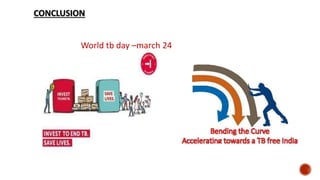
World tb day –march 24
CONCLUSION
1. Park K. Park’s Textbook of Preventive and Social Medicine. 26th ed. Jabalpur: M/s
Banarsidas Bhanot; 2021
2. TB statistics India [Internet]. TBFacts. 2018 [cited 2022 Jun 28]. Available from:
https://tbfacts.org/tb-statistics-india/
3. The end TB strategy [Internet]. Who.int.. Available from:
https://www.who.int/teams/global-tuberculosis-programme/the-end-tb-strategy
4. NTEP training modules [Internet]. Gov.in. Available from:
https://tbcindia.gov.in/WriteReadData/NTEPTrainingModules1to4
5. Revised national tuberculosis control programme NATIONAL STRATEGIC PLAN FOR
TUBERCULOSIS ELIMINATION 2017-2025 [Internet]. Gov.in. Available from:
https://tbcindia.gov.in/WriteReadData/NSP%20Draft%2020.02.2017%201.pdf
6. Taywade M, Pisudde P. New National Tuberculosis Elimination Program (NTEP) logo:
Observation and comments. Indian Journal of Tuberculosis. 2021 Jan 1;68(1):146-8.
7. Nikshay Ecosystem Login [Internet]. Nikshay.in. [cited 2022 Jun 28]. Available from:
https://sso.nikshay.in/v1/sso/login?returnUrl=https://www.nikshay.in/Home&clientId=1
Thank You

National tuberculosis elimination programme [Autosaved].pptx

  • 1.
  • 2.
     Introduction  Terminologies Burden of the disease  Milestones  NTEP  SWOC analysis  Conclusion
  • 3.
  • 5.
    TERMINOLOGIES  Presumptive TB Mono resistance  New patients  Polydrug residtence  Relapse patients  Multidrug resistance  Treatment after failure  Extensive drug resistance  Treatment after loss to follow up  Cured patient  Treatment completed
  • 6.
    BURDEN OF THEDISEASE  A total of 1.5 million people died from TB in 2020 (including 214 000 people with HIV. Worldwide,  The WHO TB statistics for India for 2021 give an estimated incidence figure of 2,590,000 million cases. this is a rate of 188 per 100,000 population
  • 7.
     in Karnatakathe rate is about 135 per 100,000 populaton
  • 8.
    MILESTONES IN INDIA 1939: TB association India  1959: National TB Institute (NTI) in Bangalore  1962: Govt. of India launched the National TB Programand set up DistrictTB Centres  1997:GoI revised NTP to RNTCP – introduction ofDOTS  2006 – 11:Second phase of RNTCP  2012 -17:National Strategic Plan
  • 9.
     2017 –25:NSP (2017 – 25)  2020:In January 2020, GoI revised RNTCP to NationalTB Elimination Program (NTEP)  2021:TB Mukt Bharat Abhiyaan
  • 10.
    DOTS Components:  Political willand commitment  Diagnosis by quality assured sputum smear microscopy  Directly observed treatment  Adequate supply of quality-assured short course chemotherapy  Systemic monitoring and accountability
  • 11.
    RNTCP Objectives: Achieve at least85% cure rate among new smear-positive cases initiated on Rx Case detection rate of at least 70% of such cases
  • 12.
    END TB STRATEGY: Vision: Aworld free of tuberculosis – zero deaths, disease and suffering due to tuberculosis Goal: End the global tuberculosis epidemic Indicators: •95% reduction by 2035 in the number of TB deaths compared with 2015. •90% reduction by 2035 in TB incidence rate compared with 2015. •Zero TB-affected families facing catastrophic costs due to TB by 2035.
  • 13.
    NATIONAL STRATEGIC PLAN VISION: TB-FreeIndia with zero deaths, disease and poverty due to TB GOAL: To achieve a rapid decline in burden of TB, morbidity and mortality while working towards elimination of TB in India by 2025.
  • 14.
    Detect Find all DS-TBand DRTB cases with an emphasis on reaching TB patients seeking care from private providers and undiagnosed TB in high-risk populations. Scale-up free, high sensitivity diagnostic tests and algorithms Scale-up effective private provider engagement approaches Universal testing for drug-resistant TB Systematic screening of high risk populations
  • 15.
    Elimination of catastrophiccosts by linking eligible TB patients with social welfare schemes Treat Initiate and sustain all patients on appropriate anti-TB treatment wherever they seek care, with patient-friendly systems and social support. • Prevent the loss of TB cases in the cascade of care with support systems Free TB drugs for all TB cases Universal daily regimen for TB cases Patient-friendly adherence monitoring and social support
  • 16.
    Address social determinantsof TB through intersectoral approach Testing and treatment for latent TB infection in contacts Scale up air-borne infection control measures at health care facilities Prevent Prevent the emergence of TB in susceptible populations
  • 17.
    Align and harmonizepartners’ activities with programme needs to prevent duplication Scale up Technical Assistance at national and state levels. Translate high level political commitment to action Build Build and strengthen enabling policies, empowered institutions, human resources with enhanced capacities, and financial resources to match the plan Restructure RNTCP management structure and implementation arrangement:
  • 18.
    NTEP  In viewof the end TB strategy, RNTCP has been renamed as National TB elimination programme in the year 2020  It functions as a flagship component of NHM
  • 19.
    Rebranding RNTCP Red colour: beginning, emotions& energy yellow colour: protection Objectivity Swirl of flag: Pride of all Focus of the programme Human figure: celebration, positivity & success Signifies bigger picture
  • 20.
    MoHFW Central TB Division(CTD) StateTB Cell District TB Centre (DTC) TB Unit (TU) Designated microscopy centres Peripheral health institute ORGANOGRAM National level State level District level Sub-district level PHC National TB Elimination Board State TB Elimination Board District TB Elimination Board Block TB Elimination Board
  • 21.
    Ministry of healthand family welfare Secretary(H&Fw) Director general of health services Additional secretary Additional Director General of health services Joint secretary Central TB cell
  • 22.
    State TB officer Deputydirector WHO consultants District tb officer District Programme coordinator District Programme officer Nikshay officer accountant
  • 23.
    Medical officer Senior treatmentsupervisor Senior Lab Supervisor Tb health visitor Community volunteers Counsellor Lab technician DOTS provider
  • 24.
    Facilities Number Public healthfacilities PHI:171 Subcentres:348 Privalte health facilities Hospitals:1801 Labs:212 DMC Public:33 Private:01 NAAT CBNAAT:4 TRUNAAT:6 Tuberculosis Unit 10
  • 25.
    TU Public PrivateTotal H D Kote 215 3 218 Hunsur 80 16 96 K R Nagara 126 4 130 Mysore 23 17 40 Mysore East 221 95 316 Mysore South 1 1 2 Nanjangudu 165 20 185 Piriyapatna 62 19 81 PKTB Mysore 1234 523 1757 T.Narsipura 90 3 93 Total 2722 986 2918
  • 26.
    DIAGNOSTIC PROTOCOLS  Diagnosisof TB  Smear microscopy  CBNAAT  Additional Tests like CXR, TST used for supporting diagnosis  Cytology, Histopathology, Radio-imaging are used for supporting extra-pulmonary TB diagnosis  Diagnosis of Drug Resistant TB  All TB patients to be tested for drug susceptibility (at least for Rifampicin)  All Rifampicin Sensitive TB patients tested for First Line Drug Susceptibility (mainly Isoniazid)  All Rifampicin Resistant TB patients tested for second line drug susceptibility
  • 32.
  • 33.
  • 34.
    NEW INITIATIVES  TBnotification  NIKSHAY  Ban on TB serology  Direct benefit transfer
  • 35.
  • 36.
    1. Honorarium toTreatment Supporters – For the provision of treatment support to TB patients (Adherence, ADR monitoring, counselling Rs.1000/- to Rs.5000/-) 2. Patient Support to Tribal TB Patients - Rs750/- 3. Nutritional Support to All TB patients -Rs.500/-month- Nikshay Poshan Yojana 4. Incentives to Private Providers (Rs.500/- for Notification & Rs.500/- for reporting of Treatment Outcome 5. Incentives to Informants (Rs. 500/- is given on diagnosis of TB among referrals from the community to public sector health facility) DBT
  • 37.
    Cont.  Daily regimenfor pediatric tb  Daily regimen for all forms of tb  Pilots for universal access to TB cases  Universal drug susceptibility testing  Shorter regimen and bedaquiline  Campaign mode- Active case finding
  • 48.
     ICF: Intensied (TB) case nding (ICF) at ICTC, ART centres and Link ART Centres (LAC)  IC-AIC: Air-borne infection control measures for prevention of TB transmission at HIV care settings  IPT: Implementation of Isoniazid preventive treatment (IPT) for all PLHIV (On ART + Pre-ART)  Provision of ART for HIV-infected TB patients
  • 49.
    I. Expand scopeand improve effectiveness of joint DM and TB screening campaigns, including Population Based screening. II. Linkage of ICT based platforms of NTEP and NPCDCS – Messaging to provide effective linkage to TB and DM management services. III. Engagement with Indian Diabetic Association in screening for TB/increasing awareness of risk of TB among diabetics
  • 50.
    I. Develop collaborativemechanism between NTEP and MCH for addressing TB among pregnant women. II. Ensure screening and detection of active TB cases among pregnant and postpartum women. III. Providing appropriate counselling to address nutrition and lifestyle aspects. IV. Strengthen referral linkages between NTEP and MCH program V. Augment treatment of TB among pregnant women. VI. Address TB and obstetric complications.
  • 51.
    SWOC ANALYSIS Strength: 1. Highestlevel of political and administrative commitment with deep engagement in the TB elimination efforts of the country. 2. State Strategic plans based on the NSP 3. Availability of much greater financial resources for TB elimination 4. Availability of new drugs, regimens, diagnostics, approaches and strategies to end TB. 5. Rapid adoption of global best practices
  • 52.
    Weakness: 1. Insufficient humanresource . 2. Competing priorities in the states result in lack of focus and thrust on TB care activities 3. Significant provision of TB care continues to be provided by a fragmented and relatively unregulated private sector. 4. Low coverage of basic program services for patients accessing care in the private sector, and weak systems for contracting partners
  • 53.
    Opportunities: 1. The COVID-19pandemic response by the government focuses attention on communicable diseases and the necessity of strengthening public health systems at all levels. Also, the current momentum to fix the long-standing problems of the Indian health system presents a good opportunity for NTEP to further improve the national response. 2. Potential of leveraging the programmes of other ministries to complement NTEPs actions to end TB
  • 54.
    4. Increased enforcementof mandatory notification / Schedule H-1 5. Emerging business models: consolidation, chains, e-pharmacies, etc. for engaging the private sector 6. Expansion of Ayushman Bharat and Pradhan Mantri Jan Arogya Yojana (PMJAY) to cover TB
  • 55.
    Challenges: 1. The socio-cultural-economiceffects. The stigmas associated with TB 2. impact of COIVD19 isn’t yet well understood however it has the potential to derail the TB programme which will have an impact on reaching the targets of END TB. 3. Economic slowdown owing to the pandemic 4. Repurposing of infrastructure and existing TB human resources for emergent needs 5. Rapid urbanization, poor living conditions, ever-increasing migrant population
  • 56.
    World tb day–march 24 CONCLUSION
  • 57.
    1. Park K.Park’s Textbook of Preventive and Social Medicine. 26th ed. Jabalpur: M/s Banarsidas Bhanot; 2021 2. TB statistics India [Internet]. TBFacts. 2018 [cited 2022 Jun 28]. Available from: https://tbfacts.org/tb-statistics-india/ 3. The end TB strategy [Internet]. Who.int.. Available from: https://www.who.int/teams/global-tuberculosis-programme/the-end-tb-strategy 4. NTEP training modules [Internet]. Gov.in. Available from: https://tbcindia.gov.in/WriteReadData/NTEPTrainingModules1to4
  • 58.
    5. Revised nationaltuberculosis control programme NATIONAL STRATEGIC PLAN FOR TUBERCULOSIS ELIMINATION 2017-2025 [Internet]. Gov.in. Available from: https://tbcindia.gov.in/WriteReadData/NSP%20Draft%2020.02.2017%201.pdf 6. Taywade M, Pisudde P. New National Tuberculosis Elimination Program (NTEP) logo: Observation and comments. Indian Journal of Tuberculosis. 2021 Jan 1;68(1):146-8. 7. Nikshay Ecosystem Login [Internet]. Nikshay.in. [cited 2022 Jun 28]. Available from: https://sso.nikshay.in/v1/sso/login?returnUrl=https://www.nikshay.in/Home&clientId=1
  • 59.