NATIONAL GUINEA
WORM ERADICATION
PROGRAMME
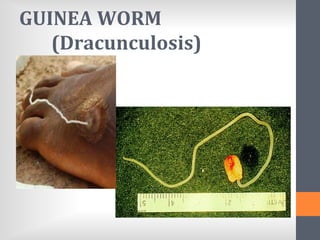
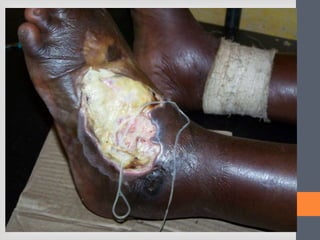
GUINEA WORM
(Dracunculosis)
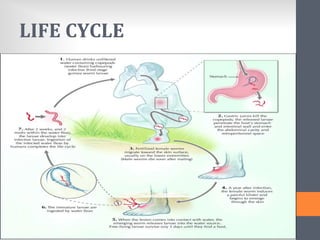
LIFE CYCLE
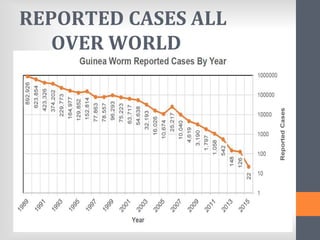
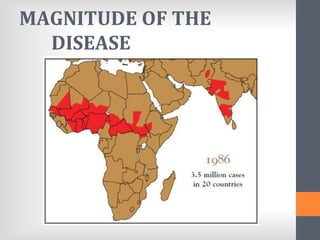
REPORTED CASES ALL
OVER WORLD
MAGNITUDE OF THE
DISEASE
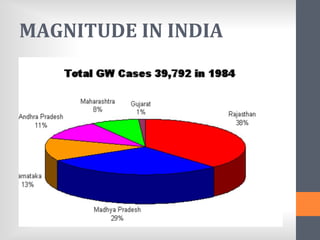
MAGNITUDE IN INDIA
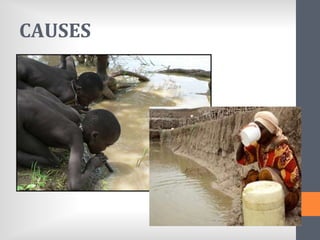
CAUSES
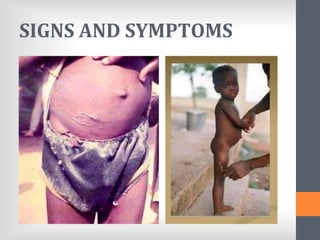
SIGNS AND SYMPTOMS
NATIONAL GUINEA WORM
ERADICATION PROGRAMME
• Implemented in 1984
• Assisted by WHO and UNICEF
• Integrated with National health system at Village
level
• centrally sponsored scheme on a 50:50 sharing
• India has reported zero cases since 1960
• In February 2000, the International Commission
for the certification of Dracunculiasis
Eradication certified India free of dracunculiasis
transmission.
Contd..,
•Ministry of Rural Development,
•Govt. of India, State Public Health
Engineering Departments, and
•The Rajiv Gandhi National Drinking
Water Mission (Rural Water Supply)
STRATEGIES
• Case detection and continuous surveillance
• Regular monthly reporting
• Application of Temephos (50% EC) in unsafe
water sources eight times a year
• Use of fine nylon mesh/double layered cloth
strainers
• Provision of safe drinking water supply
• Trained manpower development and
• Intensive health education
• Concurrent evaluation and operational
research.
NGEP PRESENT ACTIVITIES
• Health education activities
• Rumour registration and rumour
investigation
• Maintenance of guinea worm disease on
list of notifiable disease
• Continuous surveillance in previously
affected area
• Careful supervision of water sources

National guinea worm disease control programme

  • 1.
  • 2.
  • 3.
  • 4.
  • 5.
  • 6.
  • 7.
  • 8.
  • 10.
    NATIONAL GUINEA WORM ERADICATIONPROGRAMME • Implemented in 1984 • Assisted by WHO and UNICEF • Integrated with National health system at Village level • centrally sponsored scheme on a 50:50 sharing • India has reported zero cases since 1960 • In February 2000, the International Commission for the certification of Dracunculiasis Eradication certified India free of dracunculiasis transmission.
  • 11.
    Contd.., •Ministry of RuralDevelopment, •Govt. of India, State Public Health Engineering Departments, and •The Rajiv Gandhi National Drinking Water Mission (Rural Water Supply)
  • 12.
    STRATEGIES • Case detectionand continuous surveillance • Regular monthly reporting • Application of Temephos (50% EC) in unsafe water sources eight times a year • Use of fine nylon mesh/double layered cloth strainers • Provision of safe drinking water supply • Trained manpower development and • Intensive health education • Concurrent evaluation and operational research.
  • 13.
    NGEP PRESENT ACTIVITIES •Health education activities • Rumour registration and rumour investigation • Maintenance of guinea worm disease on list of notifiable disease • Continuous surveillance in previously affected area • Careful supervision of water sources