INTRODUCTION
• Assessment of health status and health
problems is the first require for any planned
effort develop to health care services.
• The data required for the analysis of health
situation and health problems comprise of
mortality , morbidity , demographic condition,
socioeconomic factors etc.
DEFINITION
• HEALTH:- Acc. to WHO health is a state of
complete physical, mental, social and spiritual
well-being and not merely the absence of
disease or infirmity.
• HEALTH PROBLEM :- it is a state in which we
are unable to function normally ( state of ill
health, unhealthiness)
MAJOR HEALTH PROBLEMS
Communicable disease problem
Nutritional problem
Environmental sanitation problem
Medical care problem
Population problem
Communicable disease is one of the major
health problem in india. The communicable
disease problems are:-
1. Malaria :- malaria is caused by a parasite that
is anopheles mosquitoes. Malaria cases has
increased in goa, madhya pradesh and orissa.
During 2005 there were 940 reported malaria
deaths in the country.
COMMUNICABLE DISEASE PROBLEMS
2. TUBERCULOSIS:- Pulmonary tuberculosis is a
contagious bacterial infection that involves the
lungs, but may spread to other organs. It is caused
by mycobacterium tuberculosis.
3. DIARRHOEAL DISEASE :- Diarrheal disease is the
second leading cause of death in children under
five years old. It by infection( bacterial, viral, and
parasitic organisms )
4. ARI :- acute respiratory disease one of the
major causes of mortality and morbidity in
children below 5 years of age. It is estimated that
about 13.6% hospital admissions and 13% in
death in pediatric ward are due to ARI
LEPROSY :- Leprosy is another major public health
problem in india. During the year 2003-2004,
total of 2.20 lakh new cases were detected.
AIDS :- The problem of aids is increasing in
magnitude every year. It is estimated that by the
end of year 2005 there were about 5-7 million
HIV positive cases in the country.
FILARIA:-
OTHERS :- kala-azar, meningitis, viral hepatitis,
helminthic are among the other important
communicable disease problems in india.
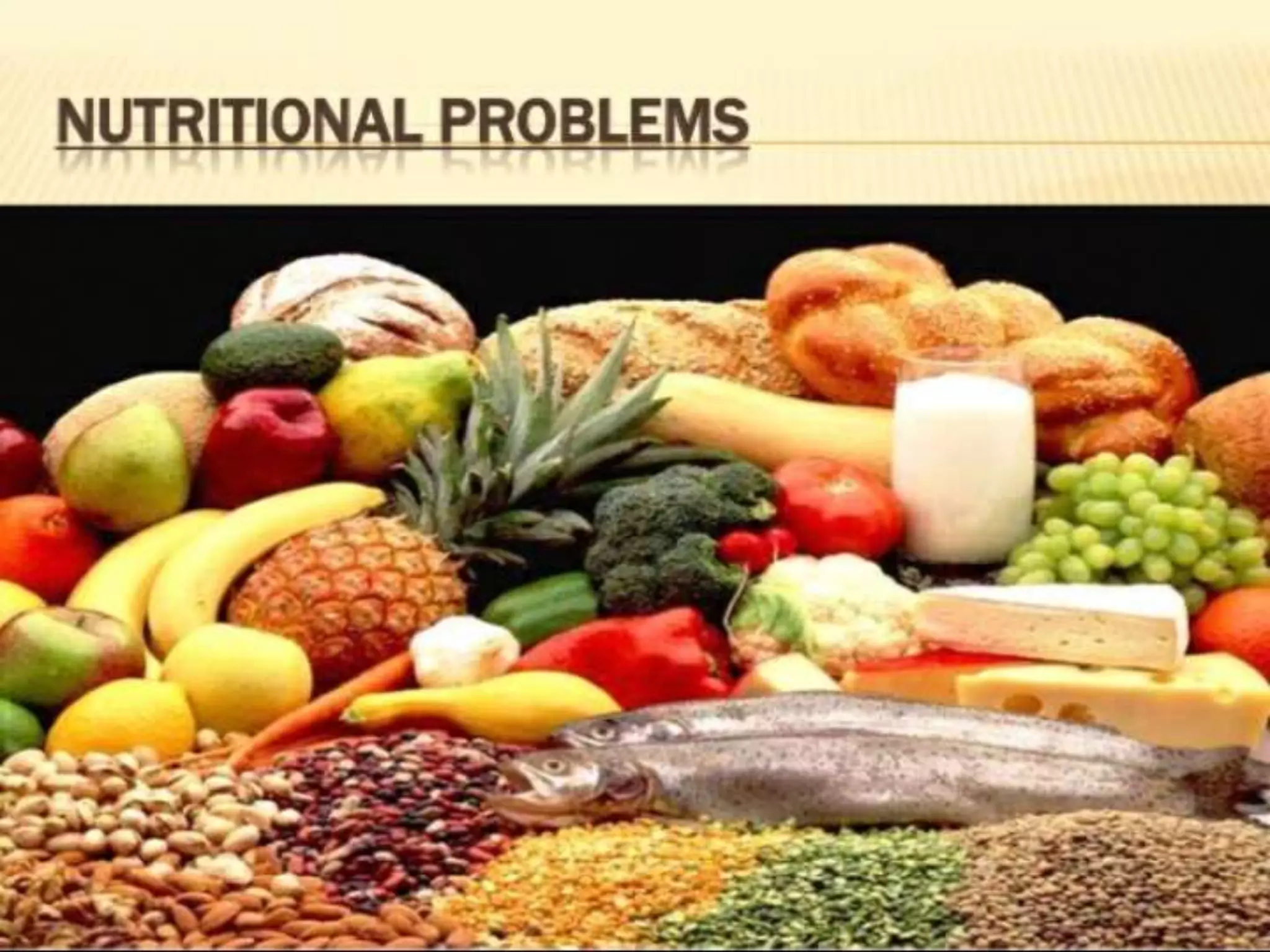
NUTRITIONAL PROBLEM
The specific nutritional problems in the country.
PROTINE-ENERGY MALNUTRITION :- insufficiency of
the so called “food gap” appears to be the chief
cause of PEM which in a major health problem
particularly in the first year of life.
NUTRITIONAL ANEMIA :- india has probably the
highest prevalence of nutritional anemia in women
and children about one half of non pregnant
women and young children are estimated to suffer-
conti…
Form anemia. 60-80% of pregnant women are
anaemic. 20-40% of maternal death are attributed
to anaemia.
LOW BIRTH WEIGHT :- This is a major public heath
problem in many developing countries 30% of
babies born are of low birth weight as compared
to about 4% in some developed countries.
XEROPHTHALMIA (NUTRITIONAL BLINDNESS):-
about 0.04% of total blindness in India in
attributed to nutritional deficiency of vita.A,
keratomalacia has been the major cause of
nutritional blindness in children.
IODINE DEFICIENCY DISORDER:- goitre and other
iodine iodine deficiency disorder(IDD) have been
known to be highly endemic in sub-Himalayan
reigns.
OTHERS :- other nutritional problem of importance
are lathyrism and endemic fluorosis in certain part
of the country.
ENVIRONMENAL SANITATION
The main problems:-
1. Lack of safe water in many areas of the
country.
2. Primitive methods of excreta disposal.
Beside these has been a growing concern
about the impact of new problems resulting
from population explosion, urbanization and
industrialization leading to hazards to human
health in air , in water , and in food chain.
MEDICAL CARE PROBLEM
Inadequate financial sources.
Health benefits to the urban population.
Uneven distribution
Migration to the urban, health problem have
been.
Aggravated like overcrowding in hospital,
inadequate staffing.
Scarcity of certain drugs and medicine.
POPULATION BPROBLEM
The population problem is one of the biggest
problems the country with its inevitable
consequences on all aspects of development,
especially employment, education, housing,
health care, sanitation and environment.
Health problems in india

Health problems in india

  • 2.
    INTRODUCTION • Assessment ofhealth status and health problems is the first require for any planned effort develop to health care services. • The data required for the analysis of health situation and health problems comprise of mortality , morbidity , demographic condition, socioeconomic factors etc.
  • 3.
    DEFINITION • HEALTH:- Acc.to WHO health is a state of complete physical, mental, social and spiritual well-being and not merely the absence of disease or infirmity. • HEALTH PROBLEM :- it is a state in which we are unable to function normally ( state of ill health, unhealthiness)
  • 4.
    MAJOR HEALTH PROBLEMS Communicabledisease problem Nutritional problem Environmental sanitation problem Medical care problem Population problem
  • 5.
    Communicable disease isone of the major health problem in india. The communicable disease problems are:- 1. Malaria :- malaria is caused by a parasite that is anopheles mosquitoes. Malaria cases has increased in goa, madhya pradesh and orissa. During 2005 there were 940 reported malaria deaths in the country. COMMUNICABLE DISEASE PROBLEMS
  • 6.
    2. TUBERCULOSIS:- Pulmonarytuberculosis is a contagious bacterial infection that involves the lungs, but may spread to other organs. It is caused by mycobacterium tuberculosis. 3. DIARRHOEAL DISEASE :- Diarrheal disease is the second leading cause of death in children under five years old. It by infection( bacterial, viral, and parasitic organisms ) 4. ARI :- acute respiratory disease one of the major causes of mortality and morbidity in children below 5 years of age. It is estimated that about 13.6% hospital admissions and 13% in death in pediatric ward are due to ARI
  • 7.
    LEPROSY :- Leprosyis another major public health problem in india. During the year 2003-2004, total of 2.20 lakh new cases were detected. AIDS :- The problem of aids is increasing in magnitude every year. It is estimated that by the end of year 2005 there were about 5-7 million HIV positive cases in the country. FILARIA:- OTHERS :- kala-azar, meningitis, viral hepatitis, helminthic are among the other important communicable disease problems in india.
  • 9.
    NUTRITIONAL PROBLEM The specificnutritional problems in the country. PROTINE-ENERGY MALNUTRITION :- insufficiency of the so called “food gap” appears to be the chief cause of PEM which in a major health problem particularly in the first year of life. NUTRITIONAL ANEMIA :- india has probably the highest prevalence of nutritional anemia in women and children about one half of non pregnant women and young children are estimated to suffer-
  • 10.
    conti… Form anemia. 60-80%of pregnant women are anaemic. 20-40% of maternal death are attributed to anaemia. LOW BIRTH WEIGHT :- This is a major public heath problem in many developing countries 30% of babies born are of low birth weight as compared to about 4% in some developed countries. XEROPHTHALMIA (NUTRITIONAL BLINDNESS):- about 0.04% of total blindness in India in attributed to nutritional deficiency of vita.A, keratomalacia has been the major cause of nutritional blindness in children.
  • 11.
    IODINE DEFICIENCY DISORDER:-goitre and other iodine iodine deficiency disorder(IDD) have been known to be highly endemic in sub-Himalayan reigns. OTHERS :- other nutritional problem of importance are lathyrism and endemic fluorosis in certain part of the country.
  • 13.
    ENVIRONMENAL SANITATION The mainproblems:- 1. Lack of safe water in many areas of the country. 2. Primitive methods of excreta disposal. Beside these has been a growing concern about the impact of new problems resulting from population explosion, urbanization and industrialization leading to hazards to human health in air , in water , and in food chain.
  • 14.
    MEDICAL CARE PROBLEM Inadequatefinancial sources. Health benefits to the urban population. Uneven distribution Migration to the urban, health problem have been. Aggravated like overcrowding in hospital, inadequate staffing. Scarcity of certain drugs and medicine.
  • 16.
    POPULATION BPROBLEM The populationproblem is one of the biggest problems the country with its inevitable consequences on all aspects of development, especially employment, education, housing, health care, sanitation and environment.