SARAH ASHFAQ
BSADP-BT51F21
BS 6th Sem. ADP Replica
Presented To : Prof. Dr. Zahoor Ahmad Sajid
Topic: RNA Synthesis and Splicing
Institute of Botany , University of the Punjab 1
6/oct/2022
‫يم‬ ِ‫ح‬َّ‫الر‬ ِ‫ن‬ ٰ‫حم‬َّ‫الر‬ ِ‫ہللا‬ ِ‫سم‬ِ‫ب‬
Contents
1. Introduction 11. Spliceosomal introns and spliceosome
2. RNA synthesis 12. Small nuclear RNAs
3. Ribozymes 13. Splicing mechanism in mRNA transcipt
4. Primary transcript 14. Polyadenylate polymerase
5. RNA splicing 15. Splicing Diversity
6. Eukaryotic mRNA 16. Cellular RNA
7. Role of Intron and Exons contents flow chart
8. Self-splicing 17. Conclusion
9. Group 1 Introns and reactions 19. References
10. Group 2 Introns and reactions
2
6/oct/2022
1.Introduction
• Many of the RNA molecules in bacteria and virtually all RNA molecules in
eukaryotes are processed to some degree after synthesis. Some of the most
interesting molecular events in RNA metabolism occur during the post
synthetic processing. Synthesis takes place within the nucleus of eukaryotic
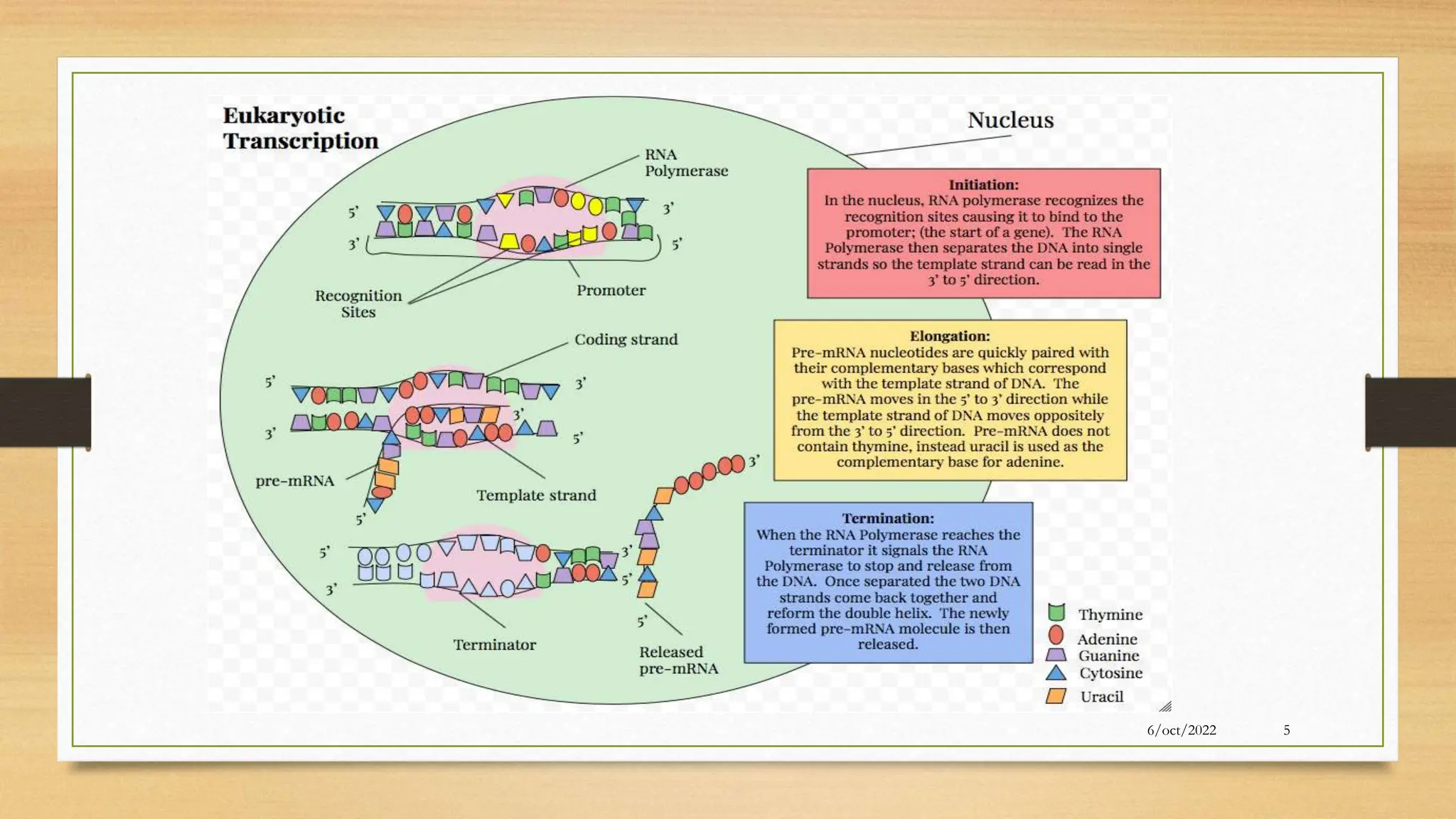
cells or in the cytoplasm of prokaryotes and converts the genetic code from
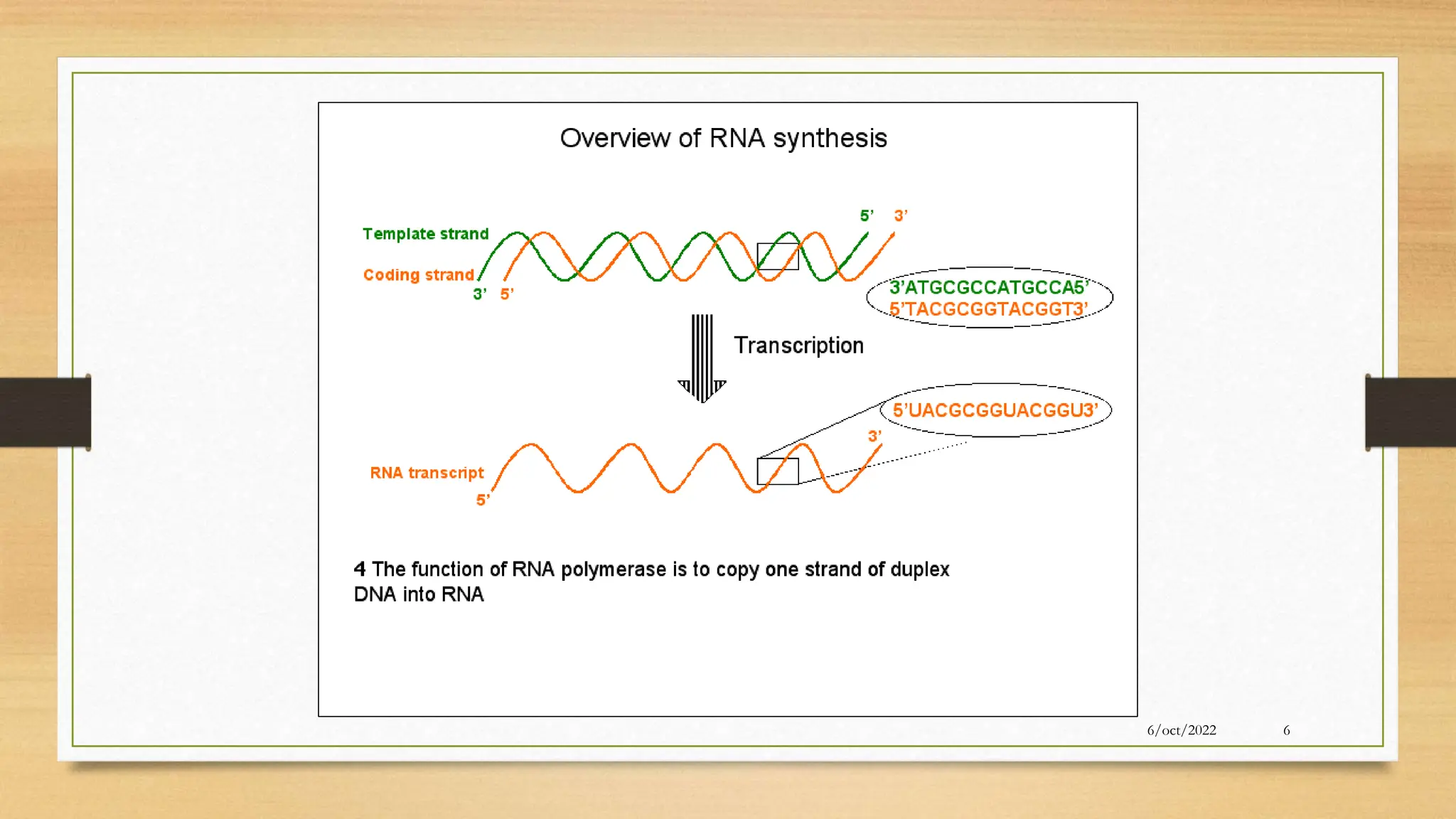
a gene in deoxyribonucleic acid (DNA ) to a strand of RNA that then directs
protein synthesis.
3
6/oct/2022
6/oct/2022 4
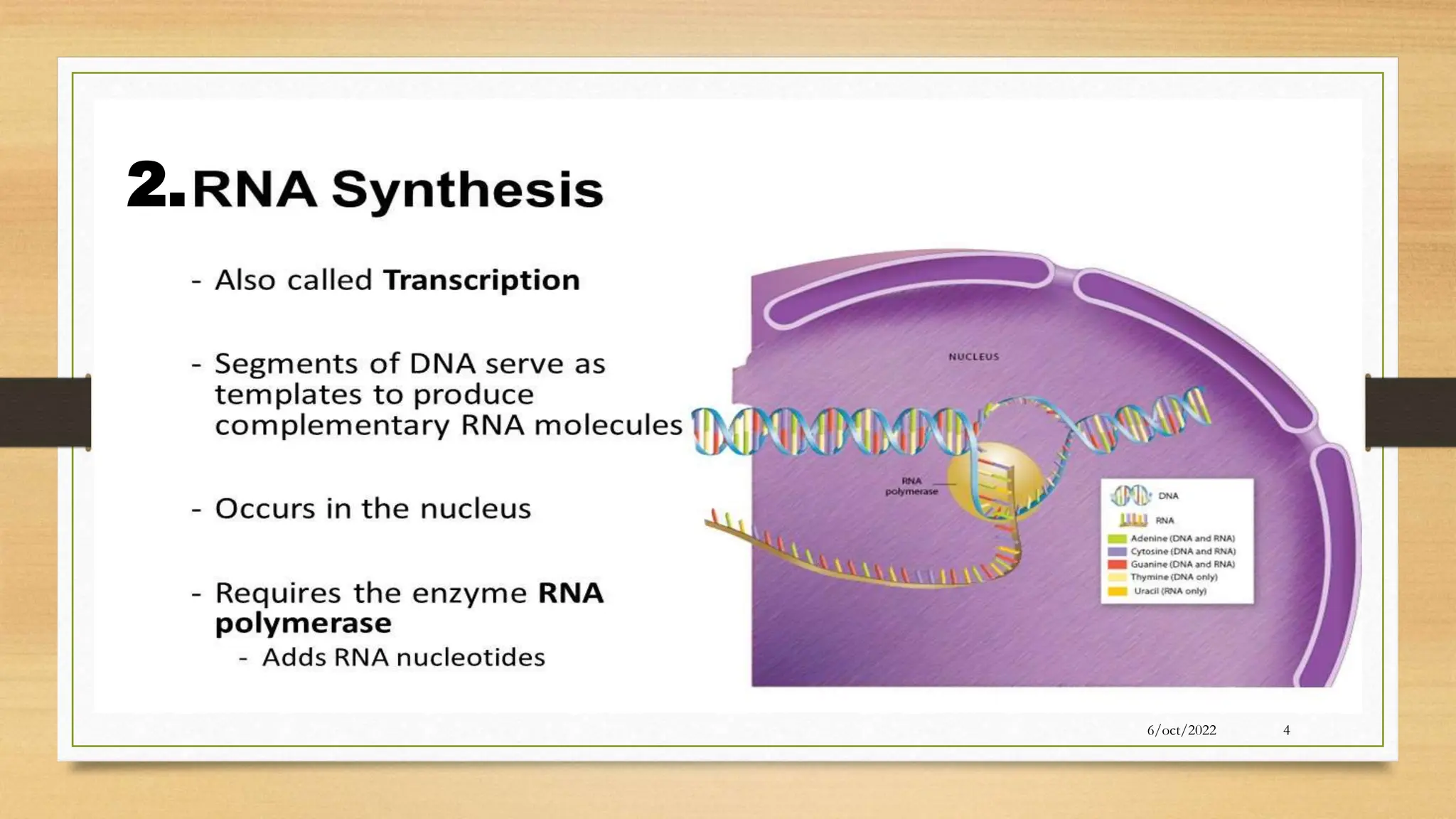
2.
6/oct/2022 5
6/oct/2022 6
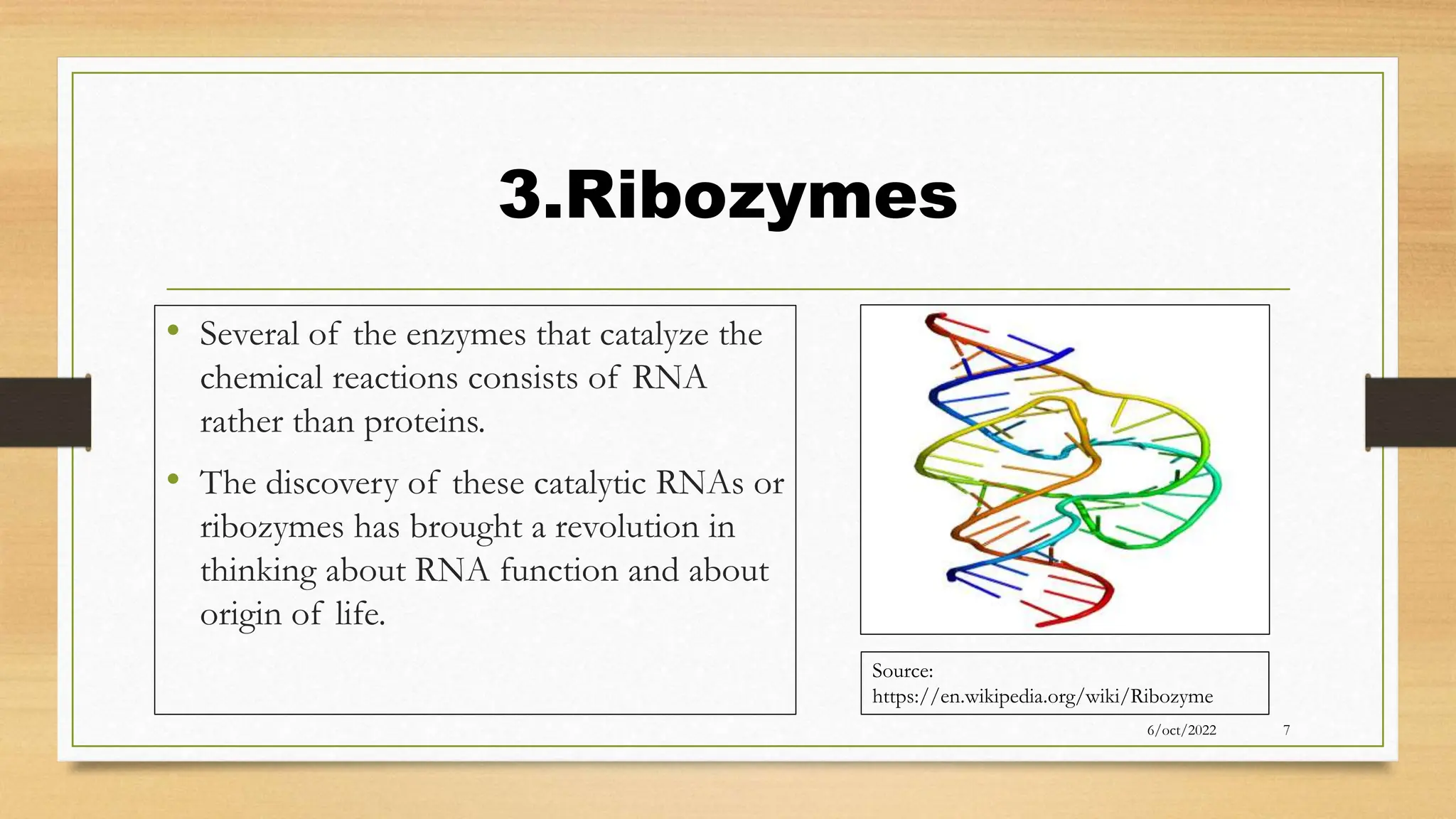
3.Ribozymes
• Several of the enzymes that catalyze the
chemical reactions consists of RNA
rather than proteins.
• The discovery of these catalytic RNAs or
ribozymes has brought a revolution in
thinking about RNA function and about
origin of life.
6/oct/2022 7
Source:
https://en.wikipedia.org/wiki/Ribozyme
4.Primary transcript
• A newly synthesized RNA molecule is called as primary transcript.
• The primary transcript for eukaryotic mRNA typically contains sequences
encompassing one genes, although the sequence encoding the polypeptide
may be contiguous.
• Special function RNAs are also processed.
6/oct/2022 8
5.RNA splicing
• “RNA splicing is the process by which the newly synthesized pre-mRNA,
also known as hnRNA, (heterogeneous nuclear RNA) is processed and
forms the mature mRNA.”
• Exons are the coding segments.
• Noncoding tracts that breakup the coding region of the transcript are called
as introns.
• During RNA splicing the primary transcript and the exons are joined to form
a continuous sequence that specifies a functional polypeptide.
6/oct/2022 9
6.Eukaryotic mRNA
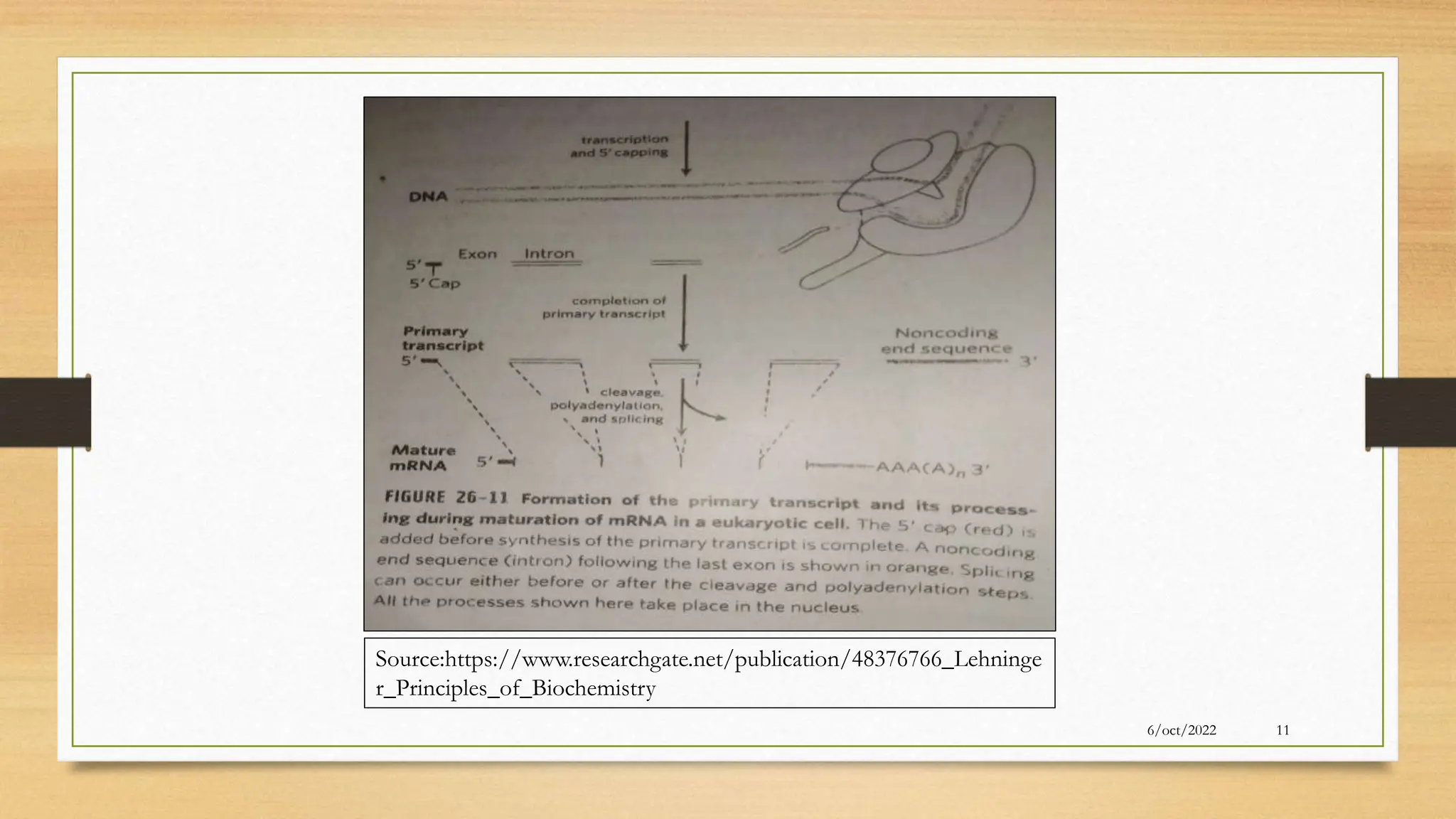
• Eukaryotic mRNAs are also modified at each end.
• A modified residue called a 5' cap is added in the 5' end.
• The 3' end is cleaved and 80 to 250 residues are added to create poly (A)
tail.
6/oct/2022 10
6/oct/2022 11
Source:https://www.researchgate.net/publication/48376766_Lehninge
r_Principles_of_Biochemistry
7.Role of Introns and Exons
• The introns in the primary RNA transcript are spliced and the exons are
joined to form mature functional RNA.
• In eukaryotic mRNAs most exons are less than 1000 nucleotides long wit
many to the 100 to 200 nucleotide size range encoding 50 to 20000
nucleotides.
6/oct/2022 12
8. Self-splicing
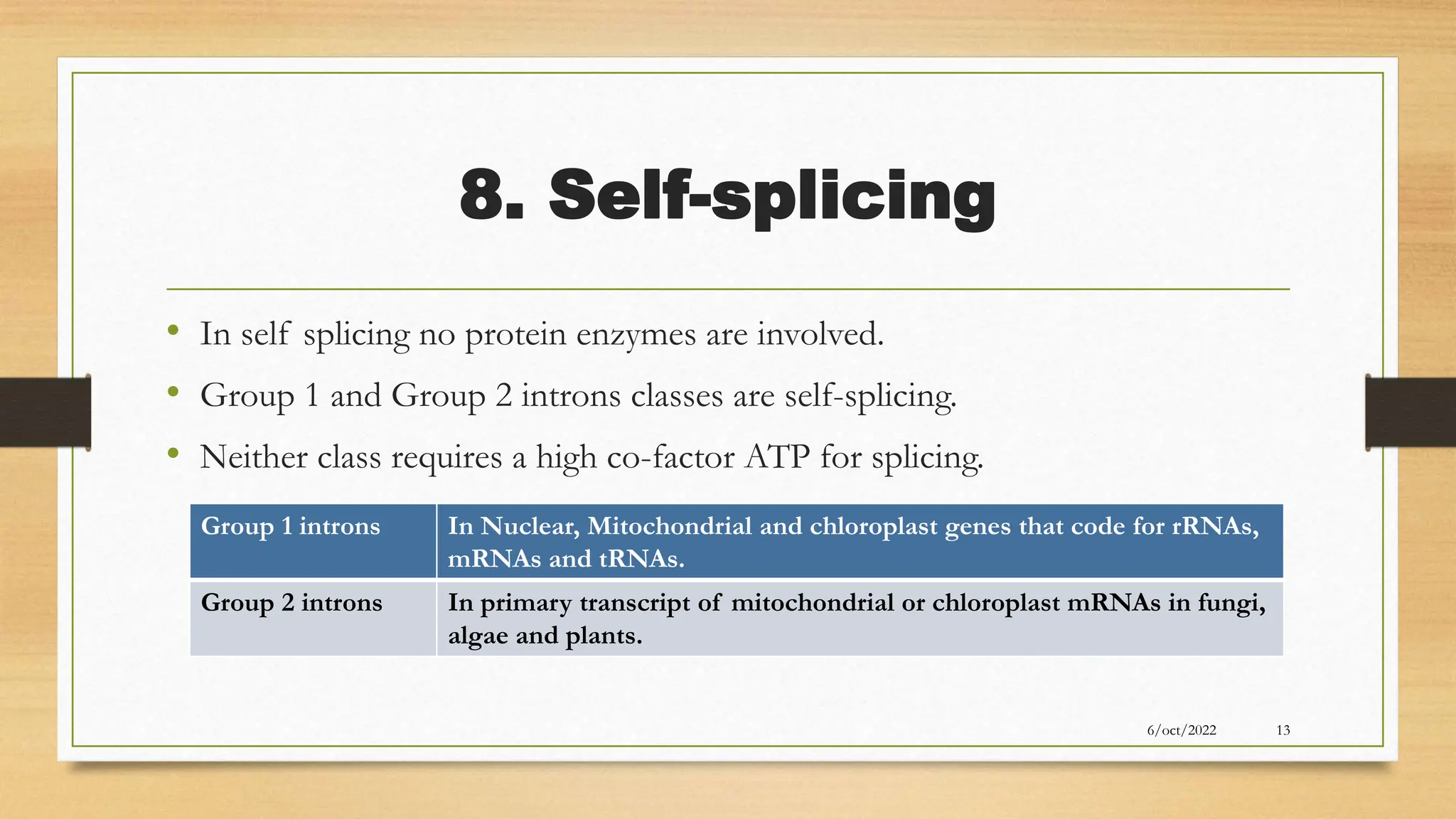
• In self splicing no protein enzymes are involved.
• Group 1 and Group 2 introns classes are self-splicing.
• Neither class requires a high co-factor ATP for splicing.
6/oct/2022 13
Group 1 introns In Nuclear, Mitochondrial and chloroplast genes that code for rRNAs,
mRNAs and tRNAs.
Group 2 introns In primary transcript of mitochondrial or chloroplast mRNAs in fungi,
algae and plants.
9.Group 1 introns and reactions
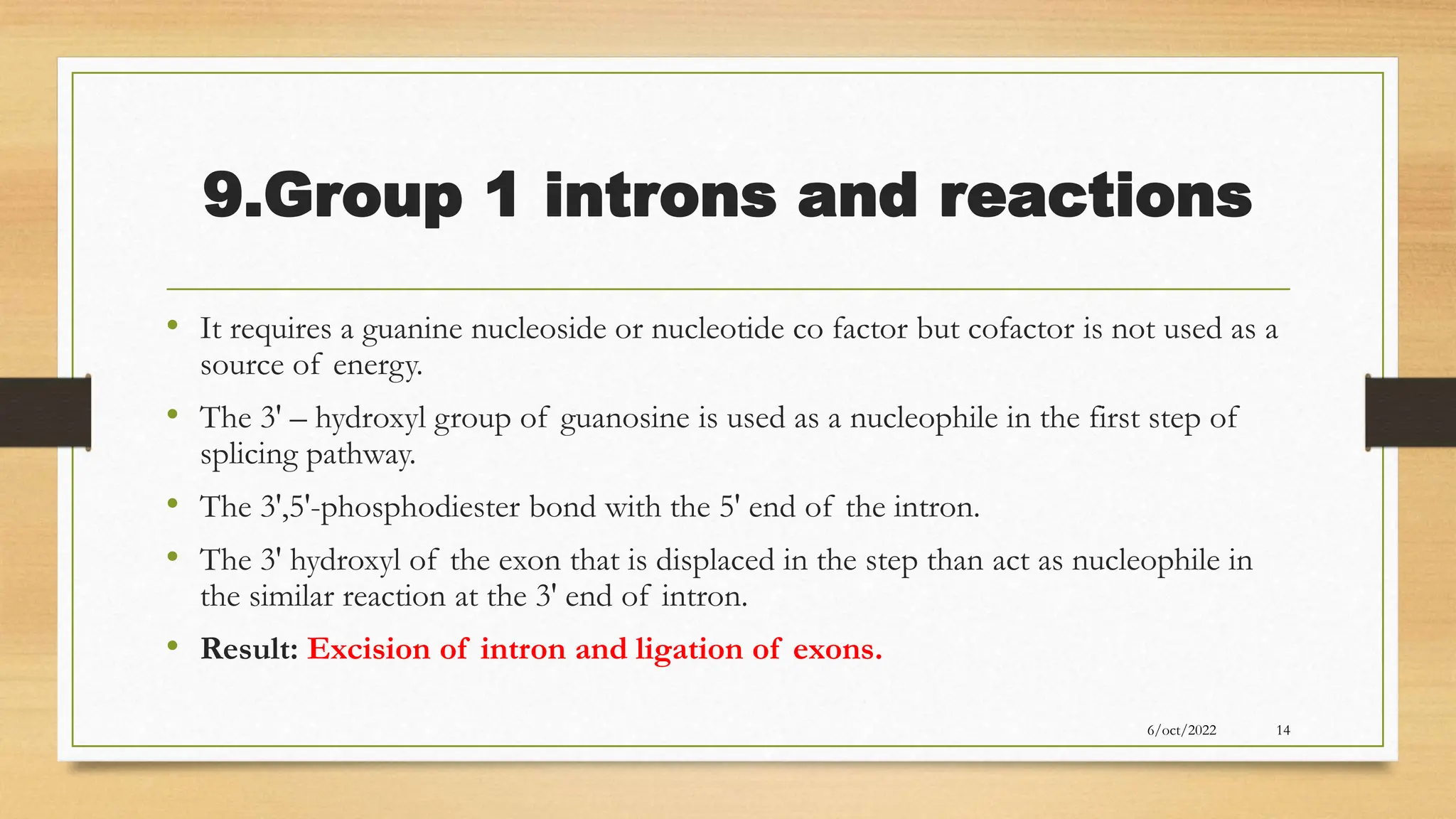
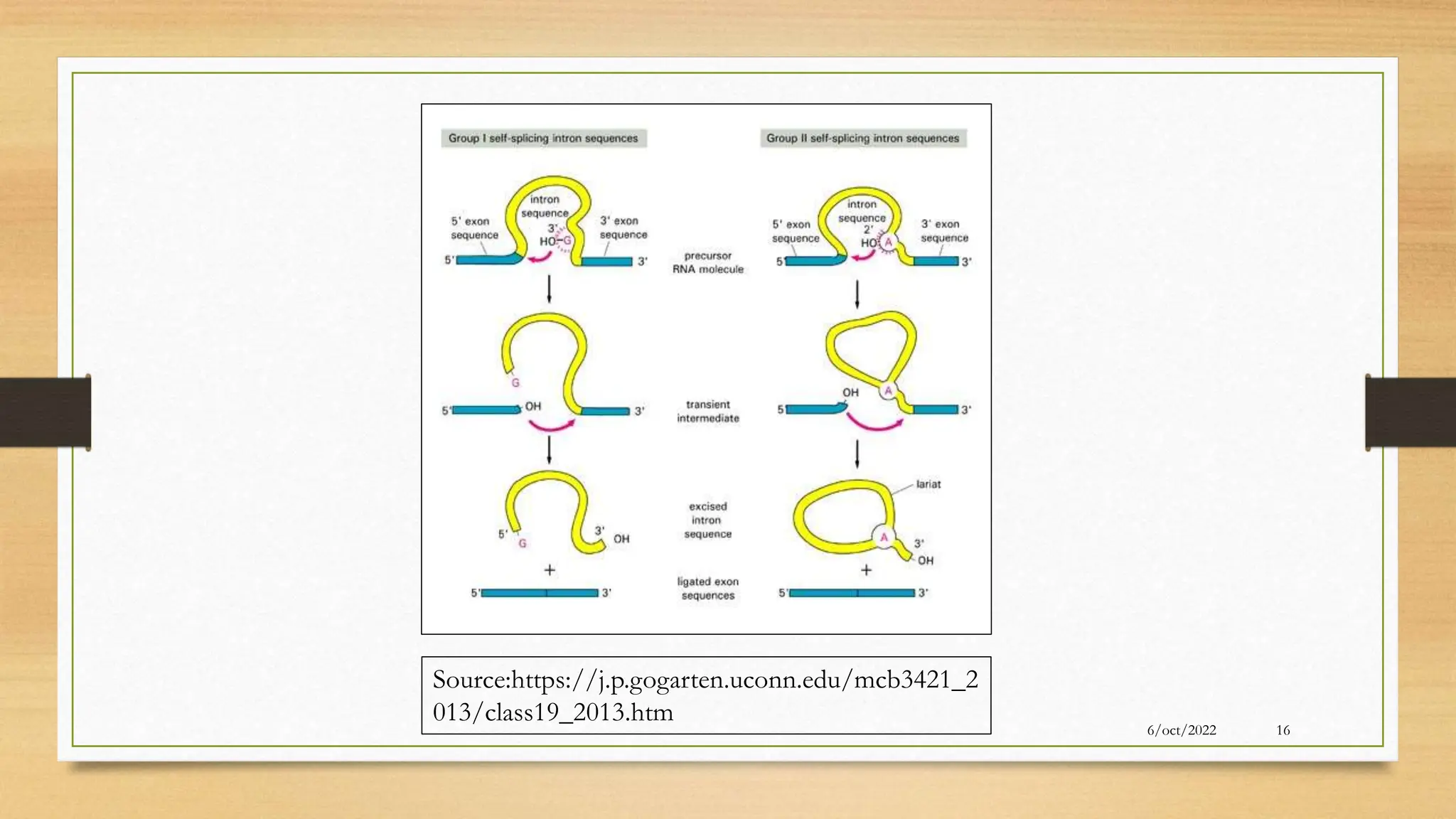
• It requires a guanine nucleoside or nucleotide co factor but cofactor is not used as a
source of energy.
• The 3' – hydroxyl group of guanosine is used as a nucleophile in the first step of
splicing pathway.
• The 3',5'-phosphodiester bond with the 5' end of the intron.
• The 3' hydroxyl of the exon that is displaced in the step than act as nucleophile in
the similar reaction at the 3' end of intron.
• Result: Excision of intron and ligation of exons.
6/oct/2022 14
10. Group 2 introns and reactions
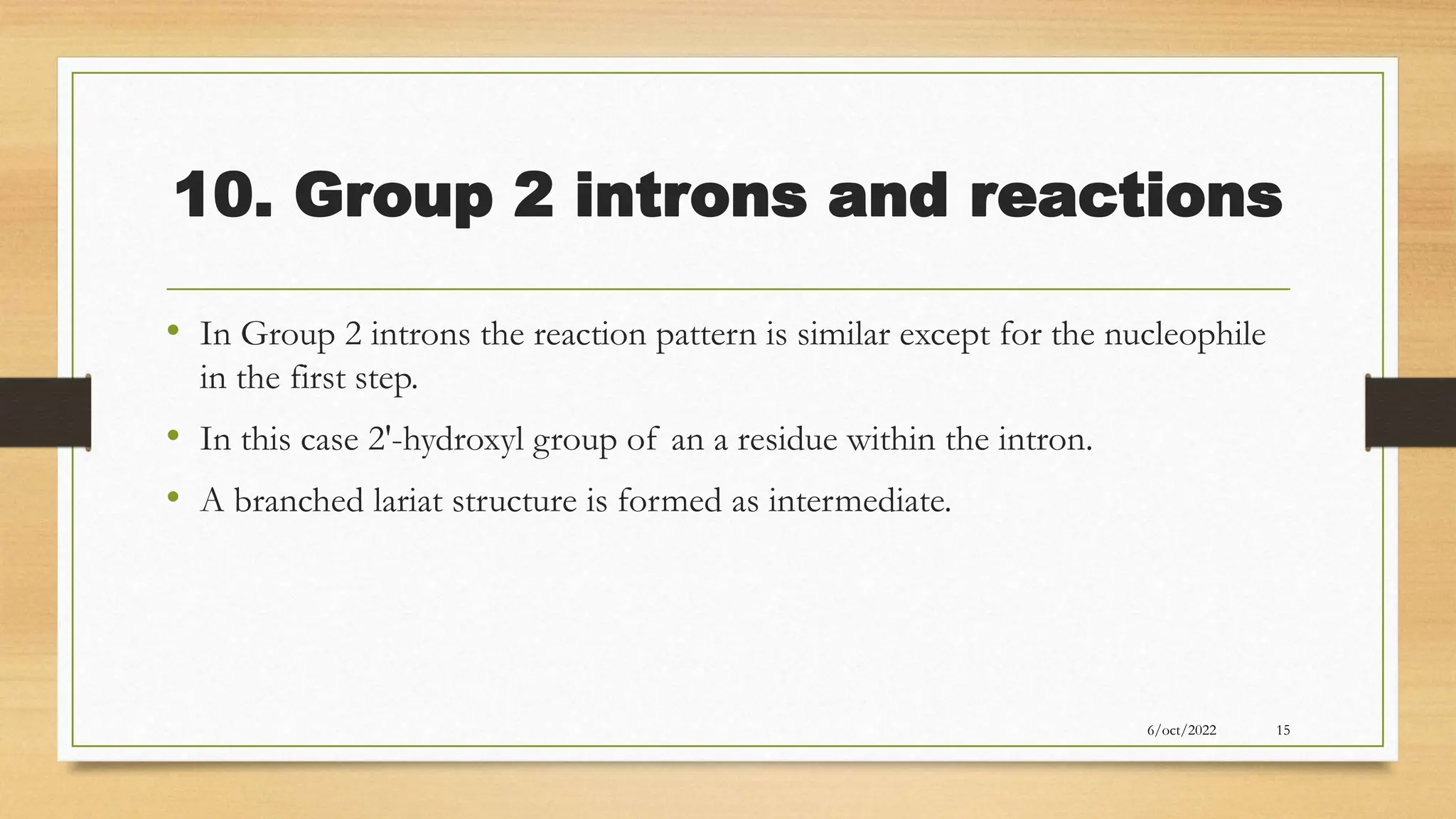
• In Group 2 introns the reaction pattern is similar except for the nucleophile
in the first step.
• In this case 2'-hydroxyl group of an a residue within the intron.
• A branched lariat structure is formed as intermediate.
6/oct/2022 15
6/oct/2022 16
Source:https://j.p.gogarten.uconn.edu/mcb3421_2
013/class19_2013.htm
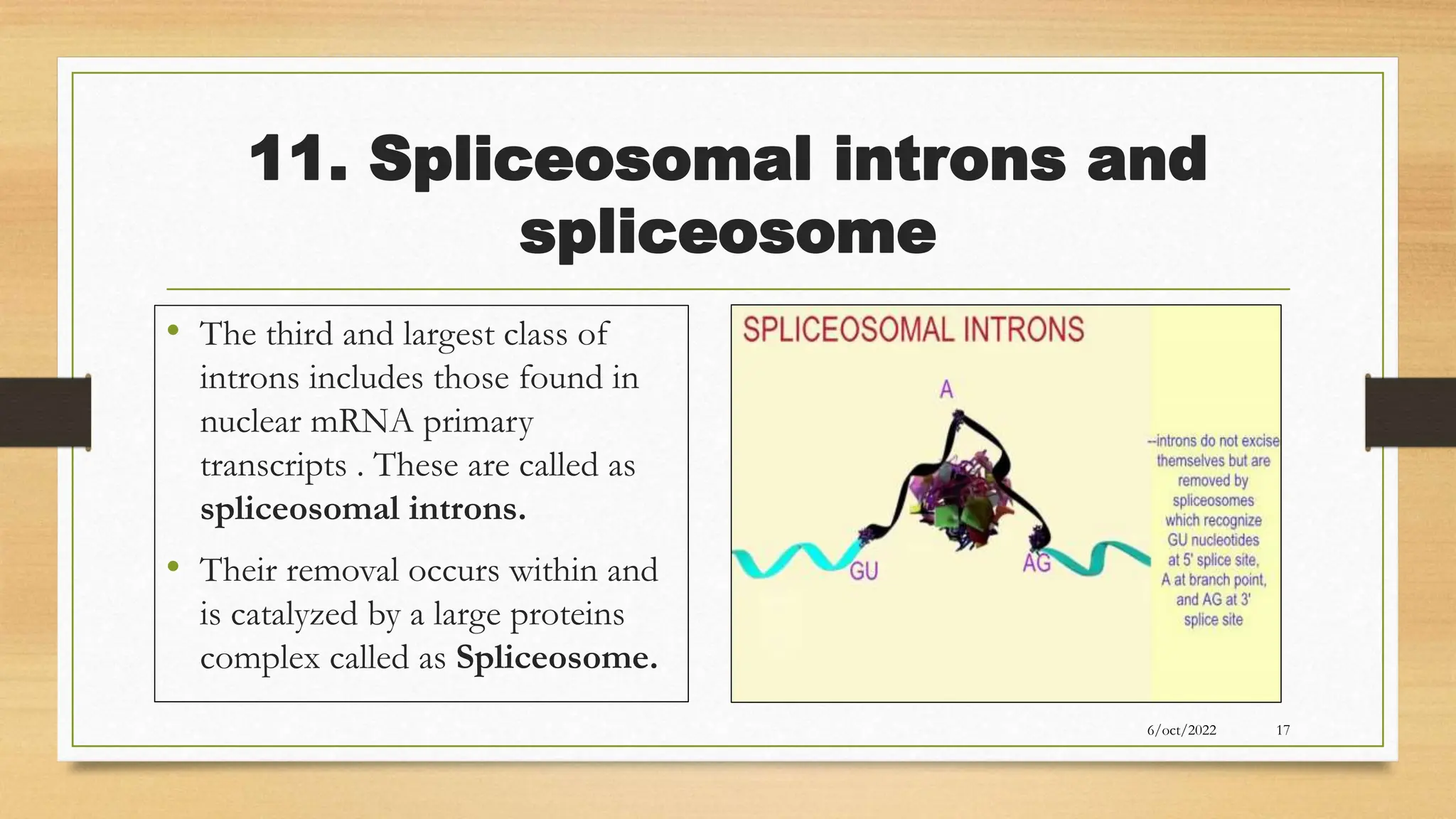
11. Spliceosomal introns and
spliceosome
• The third and largest class of
introns includes those found in
nuclear mRNA primary
transcripts . These are called as
spliceosomal introns.
• Their removal occurs within and
is catalyzed by a large proteins
complex called as Spliceosome.
6/oct/2022 17
12.Small nuclear RNAs
• The spliceosome is made up of specialized RNA-protein complexes,
snRNAs.
• Each snRNP contains one of a class of eukaryotic RNAs 100 to 200
nucleotides long known as small nuclear RNAs.
• Five snRNAs (U1,U2,U3,U4,U5 and U6) involved in splicing reactions found
in eukaryotic nuclei.
• RNAs and proteins are highly conserved.
6/oct/2022 18
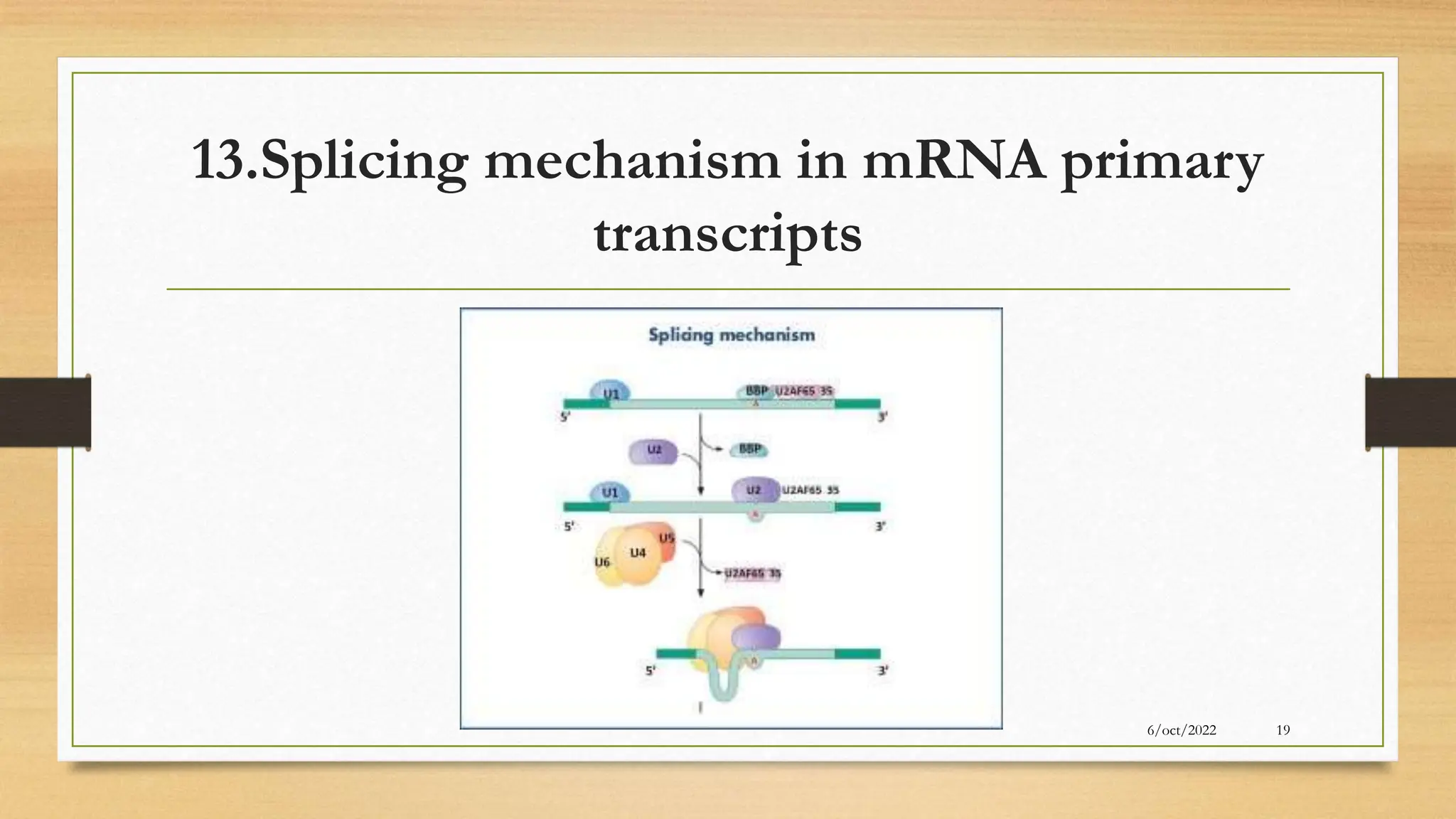
13.Splicing mechanism in mRNA primary
transcripts
6/oct/2022 19
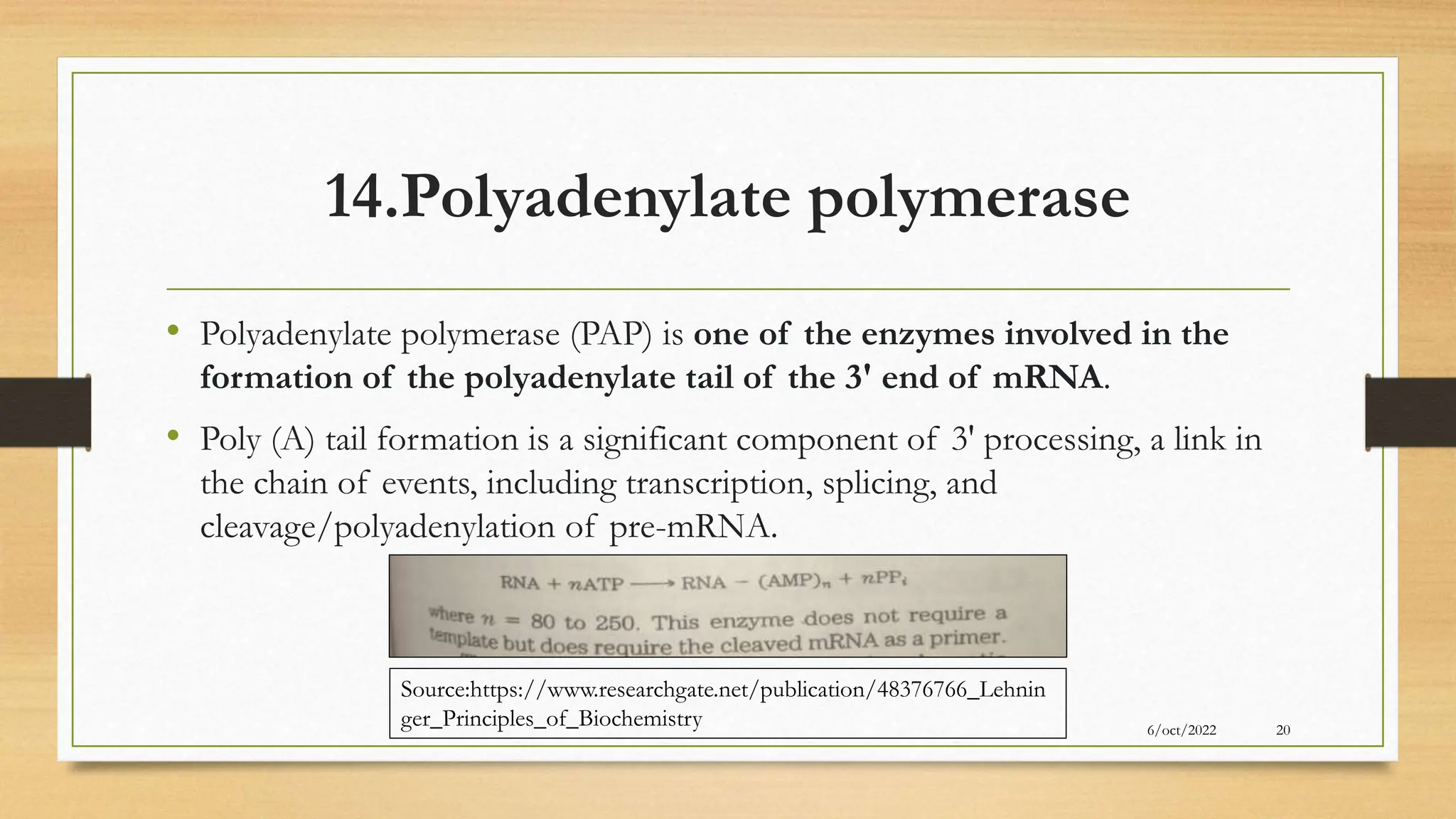
14.Polyadenylate polymerase
• Polyadenylate polymerase (PAP) is one of the enzymes involved in the
formation of the polyadenylate tail of the 3' end of mRNA.
• Poly (A) tail formation is a significant component of 3' processing, a link in
the chain of events, including transcription, splicing, and
cleavage/polyadenylation of pre-mRNA.
6/oct/2022 20
Source:https://www.researchgate.net/publication/48376766_Lehnin
ger_Principles_of_Biochemistry
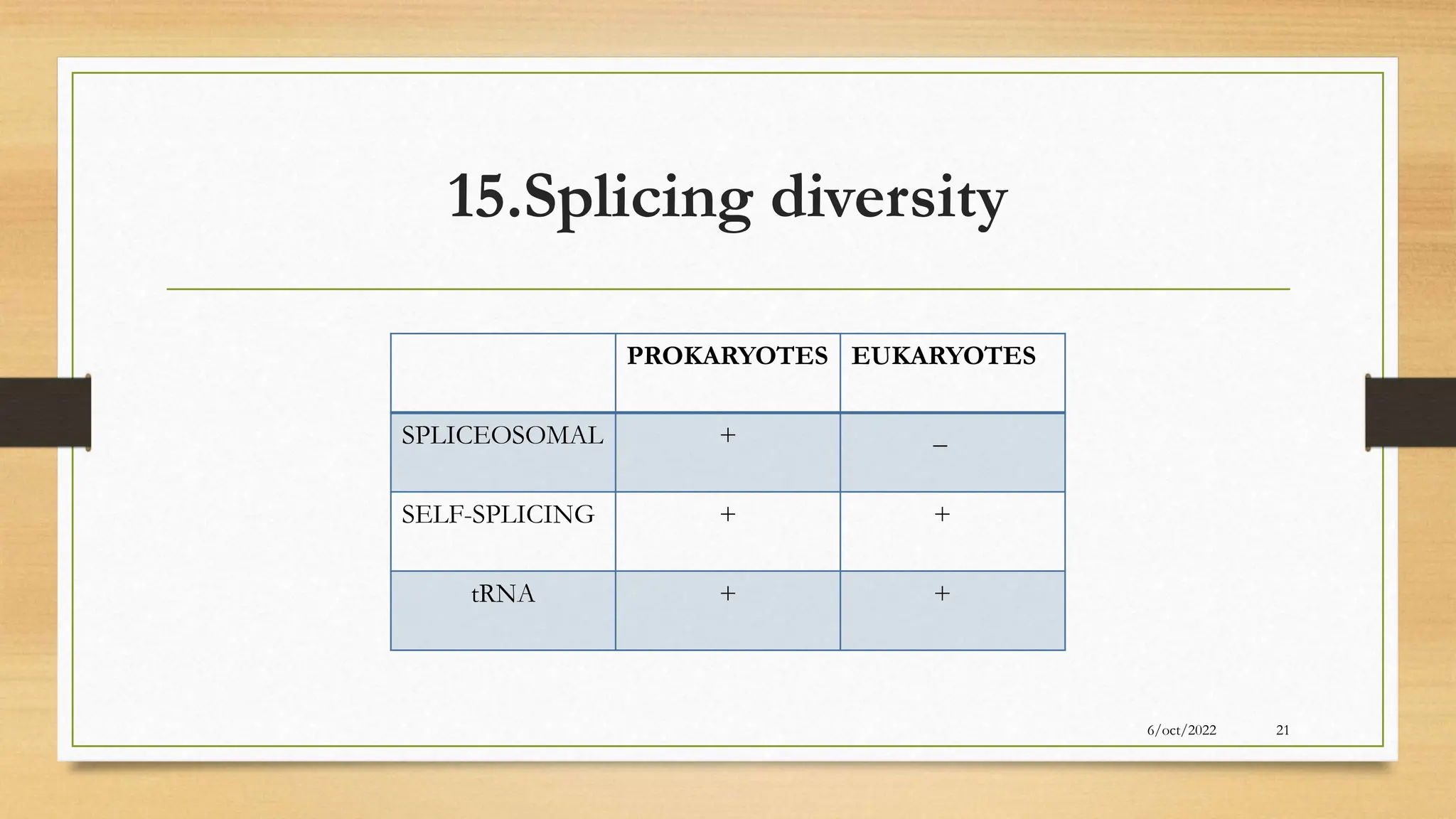
15.Splicing diversity
6/oct/2022 21
PROKARYOTES EUKARYOTES
SPLICEOSOMAL + _
SELF-SPLICING + +
tRNA + +
6/oct/2022 22
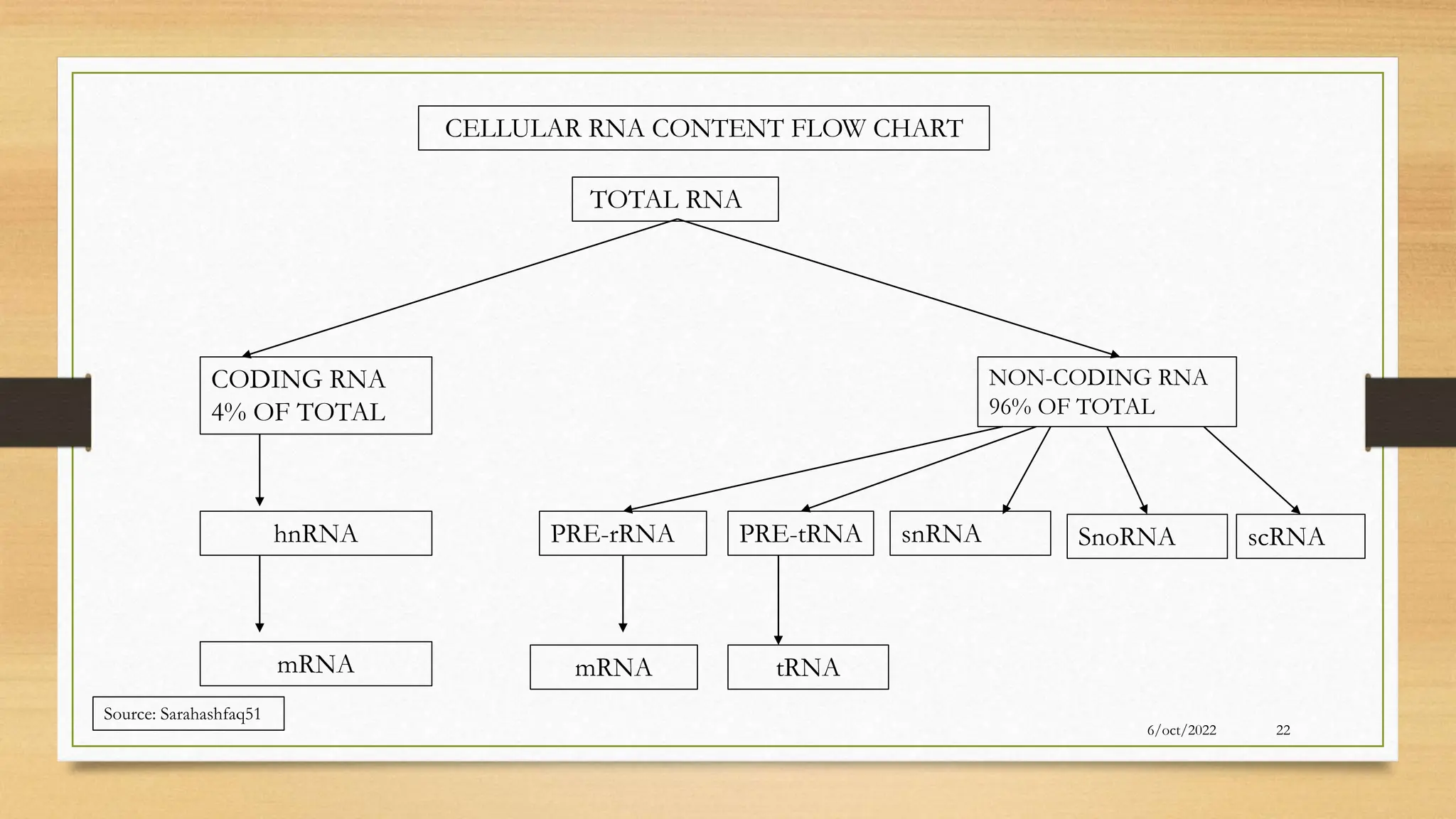
CELLULAR RNA CONTENT FLOW CHART
TOTAL RNA
CODING RNA
4% OF TOTAL
NON-CODING RNA
96% OF TOTAL
hnRNA
mRNA
PRE-rRNA PRE-tRNA snRNA SnoRNA scRNA
mRNA tRNA
Source: Sarahashfaq51
References
• Lehninger Principles of Biochemistry Eighth Edition.
• Berget, S. M., et al. Spliced segments at the 5' terminus of adenovirus 2 late mRNA. Proceedings of
the National Academy of Sciences 74, 3171–3175 (1977)
• Chow, L. T., et al. An amazing sequence arrangement at the 5′ ends of adenovirus 2 messenger
RNA. Cell 12, 1–8 (1977)
• Darnell, J. E., Jr. Implications of RNA–RNA splicing in evolution of eukaryotic cells. Science 202,
1257–1260 (1978) doi:10.1126/science.364651
• Early, P., et al. Two mRNAs can be produced from a single immunoglobulin chain by alternative RNA
processing pathways. Cell 20, 313–319 (1980)
• Knapp, G., et al. Transcription and processing of intervening sequences in yeast tRNA
genes. Cell 14, 221–236 (1978)
6/oct/2022 23
6/oct/2022 24
THANKYOU
AHUMDULILLAH

RNA SYNTHESIS AND SPLICING "biochemistry

  • 1.
    SARAH ASHFAQ BSADP-BT51F21 BS 6thSem. ADP Replica Presented To : Prof. Dr. Zahoor Ahmad Sajid Topic: RNA Synthesis and Splicing Institute of Botany , University of the Punjab 1 6/oct/2022
  • 2.
    ‫يم‬ ِ‫ح‬َّ‫الر‬ ِ‫ن‬ٰ‫حم‬َّ‫الر‬ ِ‫ہللا‬ ِ‫سم‬ِ‫ب‬ Contents 1. Introduction 11. Spliceosomal introns and spliceosome 2. RNA synthesis 12. Small nuclear RNAs 3. Ribozymes 13. Splicing mechanism in mRNA transcipt 4. Primary transcript 14. Polyadenylate polymerase 5. RNA splicing 15. Splicing Diversity 6. Eukaryotic mRNA 16. Cellular RNA 7. Role of Intron and Exons contents flow chart 8. Self-splicing 17. Conclusion 9. Group 1 Introns and reactions 19. References 10. Group 2 Introns and reactions 2 6/oct/2022
  • 3.
    1.Introduction • Many ofthe RNA molecules in bacteria and virtually all RNA molecules in eukaryotes are processed to some degree after synthesis. Some of the most interesting molecular events in RNA metabolism occur during the post synthetic processing. Synthesis takes place within the nucleus of eukaryotic cells or in the cytoplasm of prokaryotes and converts the genetic code from a gene in deoxyribonucleic acid (DNA ) to a strand of RNA that then directs protein synthesis. 3 6/oct/2022
  • 4.
  • 5.
  • 6.
  • 7.
    3.Ribozymes • Several ofthe enzymes that catalyze the chemical reactions consists of RNA rather than proteins. • The discovery of these catalytic RNAs or ribozymes has brought a revolution in thinking about RNA function and about origin of life. 6/oct/2022 7 Source: https://en.wikipedia.org/wiki/Ribozyme
  • 8.
    4.Primary transcript • Anewly synthesized RNA molecule is called as primary transcript. • The primary transcript for eukaryotic mRNA typically contains sequences encompassing one genes, although the sequence encoding the polypeptide may be contiguous. • Special function RNAs are also processed. 6/oct/2022 8
  • 9.
    5.RNA splicing • “RNAsplicing is the process by which the newly synthesized pre-mRNA, also known as hnRNA, (heterogeneous nuclear RNA) is processed and forms the mature mRNA.” • Exons are the coding segments. • Noncoding tracts that breakup the coding region of the transcript are called as introns. • During RNA splicing the primary transcript and the exons are joined to form a continuous sequence that specifies a functional polypeptide. 6/oct/2022 9
  • 10.
    6.Eukaryotic mRNA • EukaryoticmRNAs are also modified at each end. • A modified residue called a 5' cap is added in the 5' end. • The 3' end is cleaved and 80 to 250 residues are added to create poly (A) tail. 6/oct/2022 10
  • 11.
  • 12.
    7.Role of Intronsand Exons • The introns in the primary RNA transcript are spliced and the exons are joined to form mature functional RNA. • In eukaryotic mRNAs most exons are less than 1000 nucleotides long wit many to the 100 to 200 nucleotide size range encoding 50 to 20000 nucleotides. 6/oct/2022 12
  • 13.
    8. Self-splicing • Inself splicing no protein enzymes are involved. • Group 1 and Group 2 introns classes are self-splicing. • Neither class requires a high co-factor ATP for splicing. 6/oct/2022 13 Group 1 introns In Nuclear, Mitochondrial and chloroplast genes that code for rRNAs, mRNAs and tRNAs. Group 2 introns In primary transcript of mitochondrial or chloroplast mRNAs in fungi, algae and plants.
  • 14.
    9.Group 1 intronsand reactions • It requires a guanine nucleoside or nucleotide co factor but cofactor is not used as a source of energy. • The 3' – hydroxyl group of guanosine is used as a nucleophile in the first step of splicing pathway. • The 3',5'-phosphodiester bond with the 5' end of the intron. • The 3' hydroxyl of the exon that is displaced in the step than act as nucleophile in the similar reaction at the 3' end of intron. • Result: Excision of intron and ligation of exons. 6/oct/2022 14
  • 15.
    10. Group 2introns and reactions • In Group 2 introns the reaction pattern is similar except for the nucleophile in the first step. • In this case 2'-hydroxyl group of an a residue within the intron. • A branched lariat structure is formed as intermediate. 6/oct/2022 15
  • 16.
  • 17.
    11. Spliceosomal intronsand spliceosome • The third and largest class of introns includes those found in nuclear mRNA primary transcripts . These are called as spliceosomal introns. • Their removal occurs within and is catalyzed by a large proteins complex called as Spliceosome. 6/oct/2022 17
  • 18.
    12.Small nuclear RNAs •The spliceosome is made up of specialized RNA-protein complexes, snRNAs. • Each snRNP contains one of a class of eukaryotic RNAs 100 to 200 nucleotides long known as small nuclear RNAs. • Five snRNAs (U1,U2,U3,U4,U5 and U6) involved in splicing reactions found in eukaryotic nuclei. • RNAs and proteins are highly conserved. 6/oct/2022 18
  • 19.
    13.Splicing mechanism inmRNA primary transcripts 6/oct/2022 19
  • 20.
    14.Polyadenylate polymerase • Polyadenylatepolymerase (PAP) is one of the enzymes involved in the formation of the polyadenylate tail of the 3' end of mRNA. • Poly (A) tail formation is a significant component of 3' processing, a link in the chain of events, including transcription, splicing, and cleavage/polyadenylation of pre-mRNA. 6/oct/2022 20 Source:https://www.researchgate.net/publication/48376766_Lehnin ger_Principles_of_Biochemistry
  • 21.
    15.Splicing diversity 6/oct/2022 21 PROKARYOTESEUKARYOTES SPLICEOSOMAL + _ SELF-SPLICING + + tRNA + +
  • 22.
    6/oct/2022 22 CELLULAR RNACONTENT FLOW CHART TOTAL RNA CODING RNA 4% OF TOTAL NON-CODING RNA 96% OF TOTAL hnRNA mRNA PRE-rRNA PRE-tRNA snRNA SnoRNA scRNA mRNA tRNA Source: Sarahashfaq51
  • 23.
    References • Lehninger Principlesof Biochemistry Eighth Edition. • Berget, S. M., et al. Spliced segments at the 5' terminus of adenovirus 2 late mRNA. Proceedings of the National Academy of Sciences 74, 3171–3175 (1977) • Chow, L. T., et al. An amazing sequence arrangement at the 5′ ends of adenovirus 2 messenger RNA. Cell 12, 1–8 (1977) • Darnell, J. E., Jr. Implications of RNA–RNA splicing in evolution of eukaryotic cells. Science 202, 1257–1260 (1978) doi:10.1126/science.364651 • Early, P., et al. Two mRNAs can be produced from a single immunoglobulin chain by alternative RNA processing pathways. Cell 20, 313–319 (1980) • Knapp, G., et al. Transcription and processing of intervening sequences in yeast tRNA genes. Cell 14, 221–236 (1978) 6/oct/2022 23
  • 24.