1
Dr.Reddivari Manjula
Assistant Professor
JNTUA College of Engineering
Anantapur
2
Interview Skills
Target Audience : B.Tech& MCA Students
This OER is developed on Interview skills followed by
self assessment questions and graded activities.
After following this OER students are able to understand
strategies of interview.
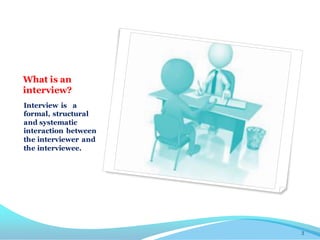
What is an
interview?
Interview is a
formal, structural
and systematic
interaction between
the interviewer and
the interviewee.
3
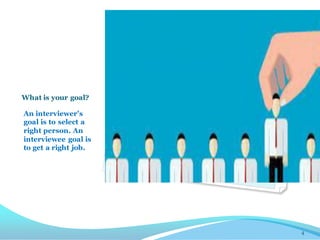
What is your goal?
An interviewer’s
goal is to select a
right person. An
interviewee goal is
to get a right job.
4
What is the purpose of an interview?
 Interview is not only concerned with subject
knowledge. It is test to assess your
 Communicative skills
 Confidence
 Positive attitude
 Team working skills
 Adoptability
 Over all personality
5
Three stages of interview preparation.
 Before the Interview
 During the Interview
 After the Interview
6
l. Before the Interview
 1.Prepare a detailed resume:
 Know the specific position you are applying for.
 Prepare a resume keeping employer goal in
mind.
 Don’t give fake information in resume.
 Focus on job related skills
 Resume should be simple and self explanatory.
 Make sure there are no spelling or grammar
mistakes in resume.
 Update your resume from time to time 7
2.Research the Organization
 Study about the company that you applied for a job.
 Use Company website or brochures to find out
information.
 Know about its products and services.
 How old is the company?
 How large is the company?
 What training programs are offered?
 What are its short- and long-term goals?
 What is the public profile of the company?
8
3. Know about yourself
 Make your own self assessment. Prepare for the
interview by assessing your self.
 Self assessment is an evaluation of one self, or one’s
performance. This helps you to handle the following
questions
 1.Tell me about yourself?
 2.What are your weaknesses?
 3. What are your strengths?
 4.What is your long term goal?
 5. What is important to you money or work?
 6.What do you want to achieve in your life?
9
4.Organize your key documents
 Stay Organized
 Make a check list of all your documents.
 qualification certificates
 Latest achievementrecords
 Identity proofs
 Recent photographs
 Have extra copies of resume
10
5. Study the venue
 Find out the interview location in advance
 Study the distance to interview location.
 Find out the travel time just a day before the
interview
11
6.Preparation leads to confidence
 Do practice for common questions asked in interviews
 Get knowledge about the company and job
 Prepare lines to introduce your self
 Conduct mock interviews with your friends
 Practice good body language long before the interview
12
Achievement is talent plus preparation—Malcolm Gladwel
 Studies shows that those who seriously prepare for
the interviews are better able to handle difficult
questions.
 They stand out from other applicants who don’t take
time to prepare.
 Preparation is the key to success.
13
ll. During the interview
 1.Time sense proves your Punctuality
 Reach the venue of the interview at least 15 minutes
before the interview
 late arrival for the job interview is never excusable.
 Study the venue, plan your route. Allow a plenty of
travel time.
 If interview is out of station it is better to reach the
location one day before.
14
2. Etiquettes enhance your personality
 Take care of mannerism and behavior during the interview
 Use professional etiquettes like
 May I come in? – Etiquette of permission
 Excuse me—Etiqutte of information.
 Sorry—Etiquette of helplessness.
 Please- Etiquette of request.
 Thank you- Etiquette of gratitude.
15
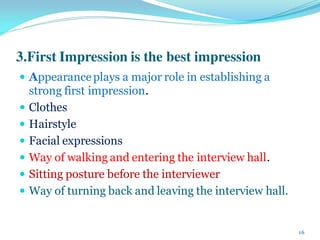
3.First Impression is the best impression
 Appearanceplays a major role in establishing a
strong first impression.
 Clothes
 Hairstyle
 Facial expressions
 Way of walking and entering the interview hall.
 Sitting posture before the interviewer
 Way of turning back and leaving the interview hall.
16
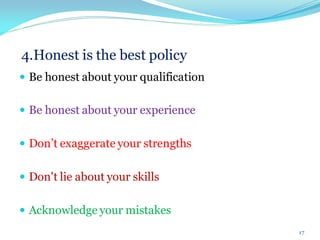
4.Honest is the best policy
 Be honest about your qualification
 Be honest about your experience
 Don’t exaggerate your strengths
 Don't lie about your skills
 Acknowledge your mistakes
17
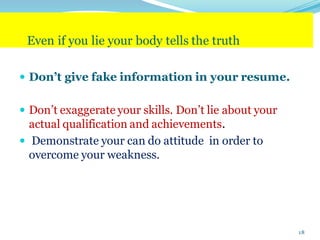
Even if you lie your body tells the truth
 Don’t give fake information in your resume.
 Don’t exaggerate your skills. Don’t lie about your
actual qualification and achievements.
 Demonstrate your can do attitude in order to
overcome your weakness.
18
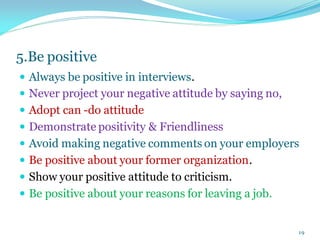
5.Be positive
 Always be positive in interviews.
 Never project your negative attitude by saying no,
 Adopt can -do attitude
 Demonstrate positivity & Friendliness
 Avoid making negative comments on your employers
 Be positive about your former organization.
 Show your positive attitude to criticism.
 Be positive about your reasons for leaving a job.
19
6.Body language reveals your attitude
 “The body never lies”---Martha Graham
 According to research made byAlbert
Mehrabian Body language impact on the
audience is 93% and only 7% of words will
have an impact on audience mind.
 A candidate’s body language speaks a lot about his
personality. handshake - postures- gestures smile-
eye contact -facial expressions will send certain
message to the interviewer.
20
 Your body language reflect your attitudes, feelings,
emotions, confidence levels, respect, happiness,
nervousness, comfort, discomfort, friendliness
reservedness, joy and anger in interviews
 Open postures and gestures indicates a higher
degree of confidence.
 where as closed posture create negative impression
on the interviewer.
21
 Open posture indicates
 Status-interest-
 Friendliness
 Confidence
 strong personality
 Eg: Open palm indicate blessing, generosity,
peace. It is an ancient secret.

22
23
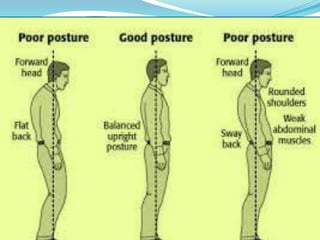
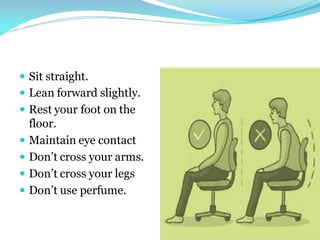
 Sit straight.
 Lean forward slightly.
 Rest your foot on the
floor.
 Maintain eye contact
 Don’t cross your arms.
 Don’t cross your legs
 Don’t use perfume.
24
Establish eye contact
 Eye contact-communicates-honesty-
transparency- confidence-interest-
friendliness- respect-trust-openness-
sincerity
 Lack of eye contact indicates- shyness-
submissiveness- lack of confidence-lack of
interest- lack of trust
 Maintain eye contact 50% of the time while speaking
and 70% of the time while listening.Listen with eyes.
25
Negative non verbal symbols
 Swindling the chair- tapping legs, yawning, leaning
 back ward, slouching- sitting with crossed legs ,
biting nails, crossing your arms.violating the
personal space, Chewing gum, smelling cigarette,
watching time, looking down, laughing, pointing
finger, staring, keeping your elbows on interviewer’s
desk, listening to phone calls, all these negative non
verbal symbols sends wrong message to the
interviewer.
26
7.Do &Don'ts in interview
 Don’t look at the watch during the interview
 Don’t swindle the chair
 Don’t show your finger at the interviewer
 Switch off your mobile
 Don’t sit cross legged
27
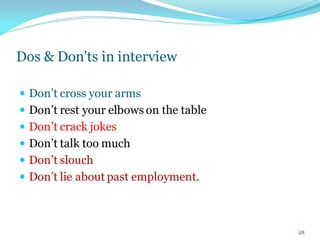
Dos & Don'ts in interview
 Don’t cross your arms
 Don’t rest your elbows on the table
 Don’t crack jokes
 Don’t talk too much
 Don’t slouch
 Don’t lie about past employment.
28
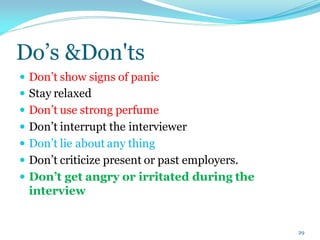
Do’s &Don'ts
 Don’t show signs of panic
 Stay relaxed
 Don’t use strong perfume
 Don’t interrupt the interviewer
 Don’t lie about any thing
 Don’t criticize present or past employers.
 Don’t get angry or irritated during the
interview
29
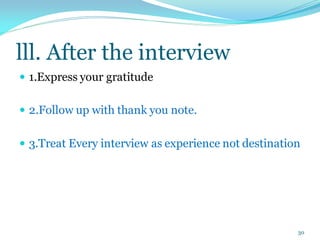
lll. After the interview
 1.Express your gratitude
 2.Follow up with thank you note.
 3.Treat Every interview as experience not destination
30
31
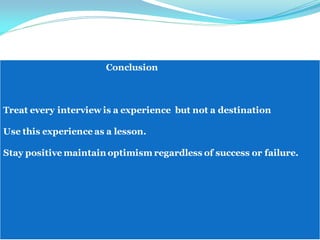
Conclusion
Treat every interview is a experience but not a destination
Use this experience as a lesson.
Stay positive maintain optimism regardless of success or failure.
Self Assessment
 1. what is your strength?
 2. What is your weakness?
 3. What makes you different from others?
 4.What is your greatest achievement?
 5.How did you spend your time during lock down
period?
 6. What is your ideal job?
 7. Who are the most significant people in your life?
 What is their impact on your life?
 8. What do you want to achieve in your life?
32
 8. Make a list of things that you value most?
 9.What kind of work environment would you enjoy
doing?
 10. Describe a situation that you worked under
pressure ?
 11.How do you handle stress?
 12. What is your biggest achievement?
33
Questions
 1. What is an interview? What aretheetiquettestobe followed in interview?
 2. Writea detailed note on interview preparation?
 3. Discussthe importantaspectsofresumewriting.
 4. Prepareyour own resume?
 5. What arethe non-verbal skills necessaryto be successful in interview?
 6. How do you demonstratepositiveattitudeininterviews?
 7.What arethedo’s and don'tsin an interview?
 8. What doyou mean by self assessment? How do you evalute your self?
 9. Writea note on theimportanceofpunctualityininterviews?
 10. Honest is the best policy. How canyou demonstratehonestyduring interviews?
34
References
 1.http://www.canr.msu.edu/news/eye_contact_dont_make_these_mistakes.
 2.merriam-webster.com/dictionary/self-assessment.
35
Manjula
36

R.Manjula---Interview skills

  • 1.
    1 Dr.Reddivari Manjula Assistant Professor JNTUACollege of Engineering Anantapur
  • 2.
    2 Interview Skills Target Audience: B.Tech& MCA Students This OER is developed on Interview skills followed by self assessment questions and graded activities. After following this OER students are able to understand strategies of interview.
  • 3.
    What is an interview? Interviewis a formal, structural and systematic interaction between the interviewer and the interviewee. 3
  • 4.
    What is yourgoal? An interviewer’s goal is to select a right person. An interviewee goal is to get a right job. 4
  • 5.
    What is thepurpose of an interview?  Interview is not only concerned with subject knowledge. It is test to assess your  Communicative skills  Confidence  Positive attitude  Team working skills  Adoptability  Over all personality 5
  • 6.
    Three stages ofinterview preparation.  Before the Interview  During the Interview  After the Interview 6
  • 7.
    l. Before theInterview  1.Prepare a detailed resume:  Know the specific position you are applying for.  Prepare a resume keeping employer goal in mind.  Don’t give fake information in resume.  Focus on job related skills  Resume should be simple and self explanatory.  Make sure there are no spelling or grammar mistakes in resume.  Update your resume from time to time 7
  • 8.
    2.Research the Organization Study about the company that you applied for a job.  Use Company website or brochures to find out information.  Know about its products and services.  How old is the company?  How large is the company?  What training programs are offered?  What are its short- and long-term goals?  What is the public profile of the company? 8
  • 9.
    3. Know aboutyourself  Make your own self assessment. Prepare for the interview by assessing your self.  Self assessment is an evaluation of one self, or one’s performance. This helps you to handle the following questions  1.Tell me about yourself?  2.What are your weaknesses?  3. What are your strengths?  4.What is your long term goal?  5. What is important to you money or work?  6.What do you want to achieve in your life? 9
  • 10.
    4.Organize your keydocuments  Stay Organized  Make a check list of all your documents.  qualification certificates  Latest achievementrecords  Identity proofs  Recent photographs  Have extra copies of resume 10
  • 11.
    5. Study thevenue  Find out the interview location in advance  Study the distance to interview location.  Find out the travel time just a day before the interview 11
  • 12.
    6.Preparation leads toconfidence  Do practice for common questions asked in interviews  Get knowledge about the company and job  Prepare lines to introduce your self  Conduct mock interviews with your friends  Practice good body language long before the interview 12
  • 13.
    Achievement is talentplus preparation—Malcolm Gladwel  Studies shows that those who seriously prepare for the interviews are better able to handle difficult questions.  They stand out from other applicants who don’t take time to prepare.  Preparation is the key to success. 13
  • 14.
    ll. During theinterview  1.Time sense proves your Punctuality  Reach the venue of the interview at least 15 minutes before the interview  late arrival for the job interview is never excusable.  Study the venue, plan your route. Allow a plenty of travel time.  If interview is out of station it is better to reach the location one day before. 14
  • 15.
    2. Etiquettes enhanceyour personality  Take care of mannerism and behavior during the interview  Use professional etiquettes like  May I come in? – Etiquette of permission  Excuse me—Etiqutte of information.  Sorry—Etiquette of helplessness.  Please- Etiquette of request.  Thank you- Etiquette of gratitude. 15
  • 16.
    3.First Impression isthe best impression  Appearanceplays a major role in establishing a strong first impression.  Clothes  Hairstyle  Facial expressions  Way of walking and entering the interview hall.  Sitting posture before the interviewer  Way of turning back and leaving the interview hall. 16
  • 17.
    4.Honest is thebest policy  Be honest about your qualification  Be honest about your experience  Don’t exaggerate your strengths  Don't lie about your skills  Acknowledge your mistakes 17
  • 18.
    Even if youlie your body tells the truth  Don’t give fake information in your resume.  Don’t exaggerate your skills. Don’t lie about your actual qualification and achievements.  Demonstrate your can do attitude in order to overcome your weakness. 18
  • 19.
    5.Be positive  Alwaysbe positive in interviews.  Never project your negative attitude by saying no,  Adopt can -do attitude  Demonstrate positivity & Friendliness  Avoid making negative comments on your employers  Be positive about your former organization.  Show your positive attitude to criticism.  Be positive about your reasons for leaving a job. 19
  • 20.
    6.Body language revealsyour attitude  “The body never lies”---Martha Graham  According to research made byAlbert Mehrabian Body language impact on the audience is 93% and only 7% of words will have an impact on audience mind.  A candidate’s body language speaks a lot about his personality. handshake - postures- gestures smile- eye contact -facial expressions will send certain message to the interviewer. 20
  • 21.
     Your bodylanguage reflect your attitudes, feelings, emotions, confidence levels, respect, happiness, nervousness, comfort, discomfort, friendliness reservedness, joy and anger in interviews  Open postures and gestures indicates a higher degree of confidence.  where as closed posture create negative impression on the interviewer. 21
  • 22.
     Open postureindicates  Status-interest-  Friendliness  Confidence  strong personality  Eg: Open palm indicate blessing, generosity, peace. It is an ancient secret.  22
  • 23.
  • 24.
     Sit straight. Lean forward slightly.  Rest your foot on the floor.  Maintain eye contact  Don’t cross your arms.  Don’t cross your legs  Don’t use perfume. 24
  • 25.
    Establish eye contact Eye contact-communicates-honesty- transparency- confidence-interest- friendliness- respect-trust-openness- sincerity  Lack of eye contact indicates- shyness- submissiveness- lack of confidence-lack of interest- lack of trust  Maintain eye contact 50% of the time while speaking and 70% of the time while listening.Listen with eyes. 25
  • 26.
    Negative non verbalsymbols  Swindling the chair- tapping legs, yawning, leaning  back ward, slouching- sitting with crossed legs , biting nails, crossing your arms.violating the personal space, Chewing gum, smelling cigarette, watching time, looking down, laughing, pointing finger, staring, keeping your elbows on interviewer’s desk, listening to phone calls, all these negative non verbal symbols sends wrong message to the interviewer. 26
  • 27.
    7.Do &Don'ts ininterview  Don’t look at the watch during the interview  Don’t swindle the chair  Don’t show your finger at the interviewer  Switch off your mobile  Don’t sit cross legged 27
  • 28.
    Dos & Don'tsin interview  Don’t cross your arms  Don’t rest your elbows on the table  Don’t crack jokes  Don’t talk too much  Don’t slouch  Don’t lie about past employment. 28
  • 29.
    Do’s &Don'ts  Don’tshow signs of panic  Stay relaxed  Don’t use strong perfume  Don’t interrupt the interviewer  Don’t lie about any thing  Don’t criticize present or past employers.  Don’t get angry or irritated during the interview 29
  • 30.
    lll. After theinterview  1.Express your gratitude  2.Follow up with thank you note.  3.Treat Every interview as experience not destination 30
  • 31.
    31 Conclusion Treat every interviewis a experience but not a destination Use this experience as a lesson. Stay positive maintain optimism regardless of success or failure.
  • 32.
    Self Assessment  1.what is your strength?  2. What is your weakness?  3. What makes you different from others?  4.What is your greatest achievement?  5.How did you spend your time during lock down period?  6. What is your ideal job?  7. Who are the most significant people in your life?  What is their impact on your life?  8. What do you want to achieve in your life? 32
  • 33.
     8. Makea list of things that you value most?  9.What kind of work environment would you enjoy doing?  10. Describe a situation that you worked under pressure ?  11.How do you handle stress?  12. What is your biggest achievement? 33
  • 34.
    Questions  1. Whatis an interview? What aretheetiquettestobe followed in interview?  2. Writea detailed note on interview preparation?  3. Discussthe importantaspectsofresumewriting.  4. Prepareyour own resume?  5. What arethe non-verbal skills necessaryto be successful in interview?  6. How do you demonstratepositiveattitudeininterviews?  7.What arethedo’s and don'tsin an interview?  8. What doyou mean by self assessment? How do you evalute your self?  9. Writea note on theimportanceofpunctualityininterviews?  10. Honest is the best policy. How canyou demonstratehonestyduring interviews? 34
  • 35.
  • 36.