The document provides tips for job interviews. It discusses preparing for different types of interviews like screening, telephone, one-on-one, sequential, panel, and group interviews. The tips include researching the organization and position, anticipating questions, having examples to demonstrate skills and accomplishments, practicing responses, dressing appropriately, and following up with a thank you letter. Interviews are an opportunity for the interviewee to convey their qualifications and for the interviewer to evaluate fit for the position. Thorough preparation is key to making a strong impression.
The interview isyour opportunity to
convince an employer that you are the
right person for the job
3.
As the interviewee
•Communicate information about yourself, your
experience and your abilities
• Seek further information about the position and the
organization
• Evaluate the match between your needs and what the
job offers
4.
For the interviewer
•Interview preparation - interest in and knowledge of
the industry, the position and the organization
• Communication skills - oral presentation skills and the
ability to interact with others
• Qualifications - academic, work, volunteer and other
experience
• Leadership potential and teamwork - demonstrated
ability to work with others and to get others to work
together
5.
For the interviewer
•Clear and realistic career goals - future plans and
awareness of career paths
• Self awareness - realistic appraisal of self
• Motivation and success potential - enthusiasm for the
position; demonstrated patterns of accomplishment
• Work ethic - acceptance of responsibility, ability to
keep commitments and attitude of the importance of
work
Screening Interview
These areusually short interviews used to
screen for specific experience, skills and/or
education.
Job offers do not come as a result of
this interaction.
8.
Telephone Interview
• Thistype of interview can happen
unexpectedly or be planned.
• No matter how it occurs, you must answer the
questions effectively in order to move to the
next stage
9.
Guidelines for atelephone interview:
1. If it is scheduled, make it for a time when you can
give 100% of your attention.
2. If it is not scheduled, and the timing is not
convenient, let the employer know. Ask if you can
call back at a more convenient time.
3. Take the call in a quiet place.
4. Jot down key points you want to make and
questions you want to ask ahead of time.
5. Keep a copy of your resume and the job description
nearby.
10.
One-on-One interview
• Youand one interviewer.
• You may have individual interviews with
several members of an organization.
11.
Sequential Interviews
• Youmay be passed from one department or
manager to another.
• one-on-one interview taking place at each
step
12.
Panel Interview
• Youare interviewed by a committee
• two to six members from several different
departments who have varying levels of
responsibility
• It is important to make eye contact with each
panel member
13.
Group Interview
• youand other interviewees are interviewed
simultaneously.
• It gives the interviewer the opportunity to
screen many applicants at one time and also
provides an opportunity to observe group
interactions.
14.
Preparing for theInterview
•
•
•
•
•
•
verbal and nonverbal behaviors
Self-expression
self-confidence
Enthusiasm
knowledge of the organization ,and
your ability to relate to the interviewer will
create a positive impression.
Know the opportunity
Mission,customers, programs, staffing, new
products and services, acquisitions.
*organization’s website is a potential source for this
information
17.
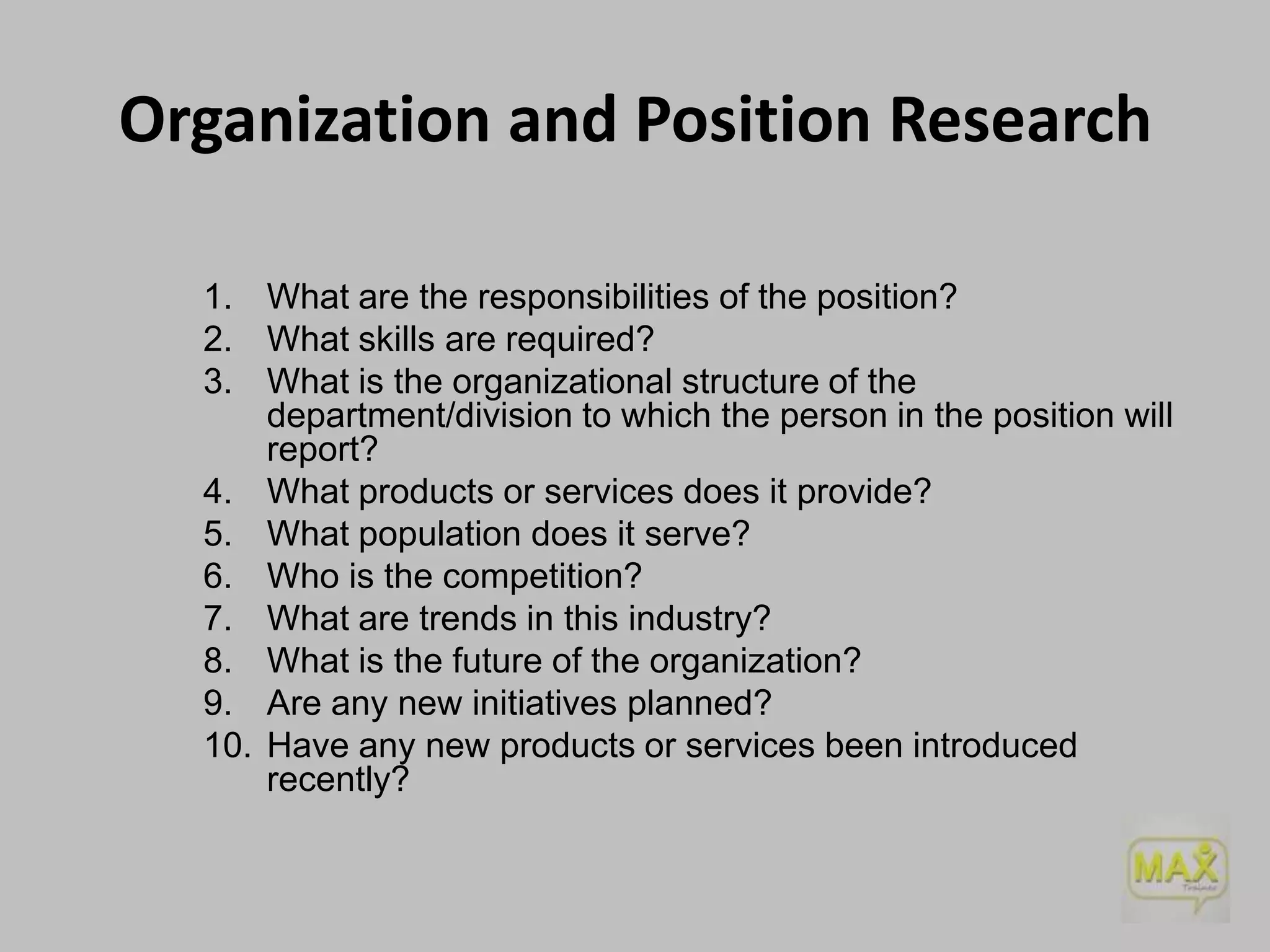
Organization and PositionResearch
1. What are the responsibilities of the position?
2. What skills are required?
3. What is the organizational structure of the
department/division to which the person in the position will
report?
4. What products or services does it provide?
5. What population does it serve?
6. Who is the competition?
7. What are trends in this industry?
8. What is the future of the organization?
9. Are any new initiatives planned?
10. Have any new products or services been introduced
recently?
18.
Prepare for interviewquestions
Standard Interview Questions
– Tell me/us about yourself.
– Why did you apply for this position?
– What are your major strengths?
– What are your weaknesses?
– What accomplishments are you most proud of in
your career?
– Do you have any questions?
19.
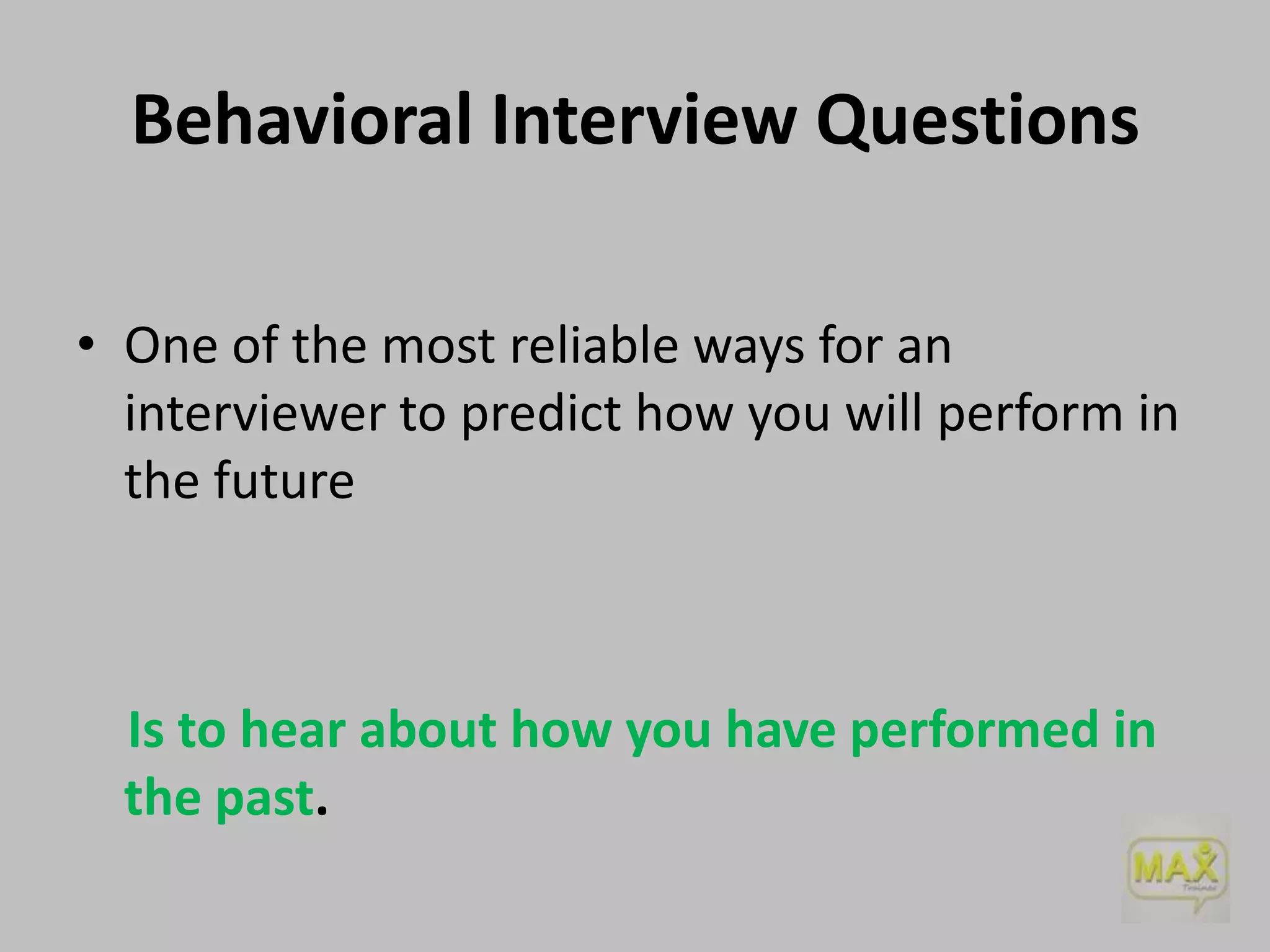
Behavioral Interview Questions
•One of the most reliable ways for an
interviewer to predict how you will perform in
the future
Is to hear about how you have performed in
the past.
20.
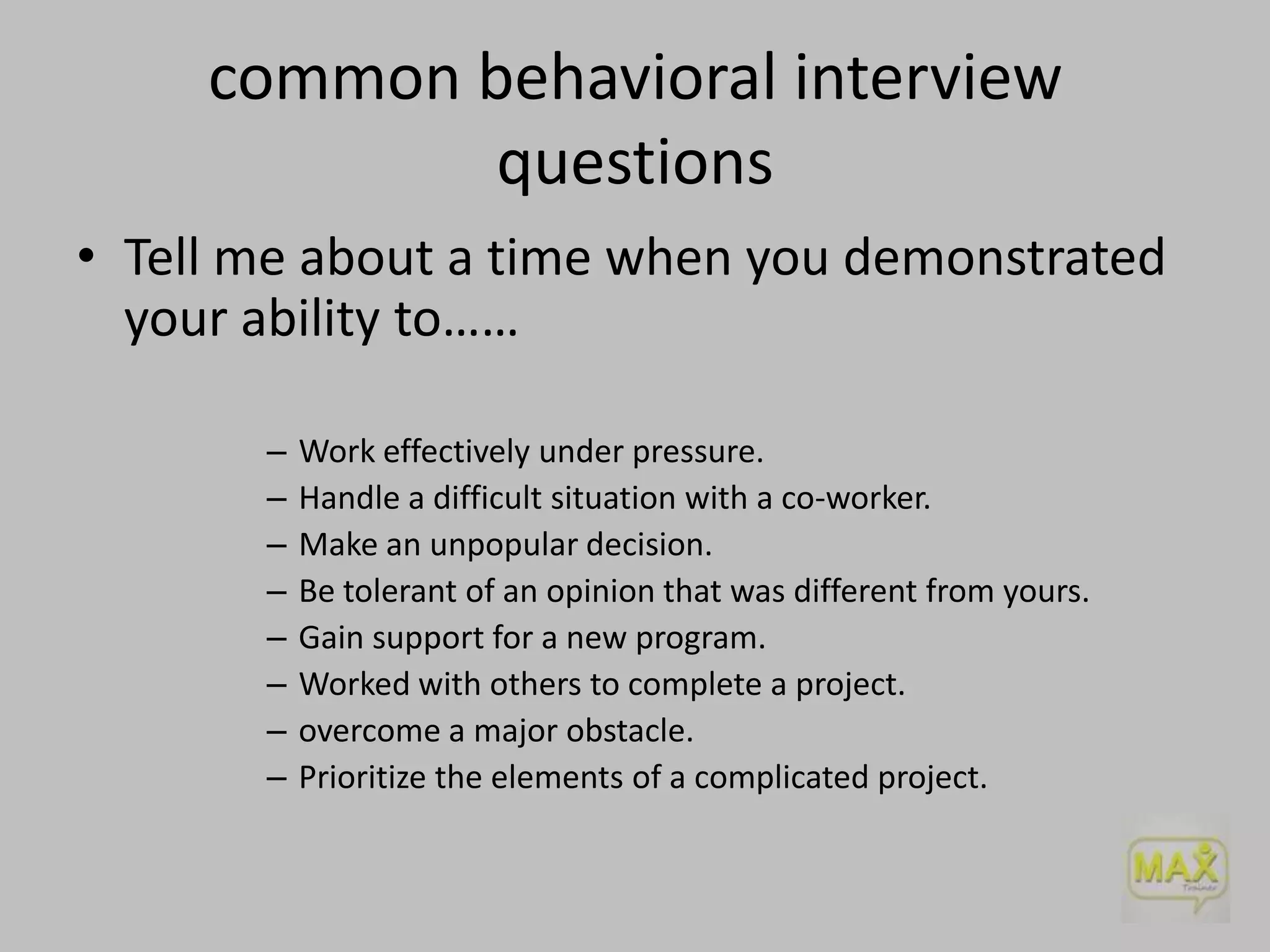
common behavioral interview
questions
•Tell me about a time when you demonstrated
your ability to……
–
–
–
–
–
–
–
–
Work effectively under pressure.
Handle a difficult situation with a co-worker.
Make an unpopular decision.
Be tolerant of an opinion that was different from yours.
Gain support for a new program.
Worked with others to complete a project.
overcome a major obstacle.
Prioritize the elements of a complicated project.
21.
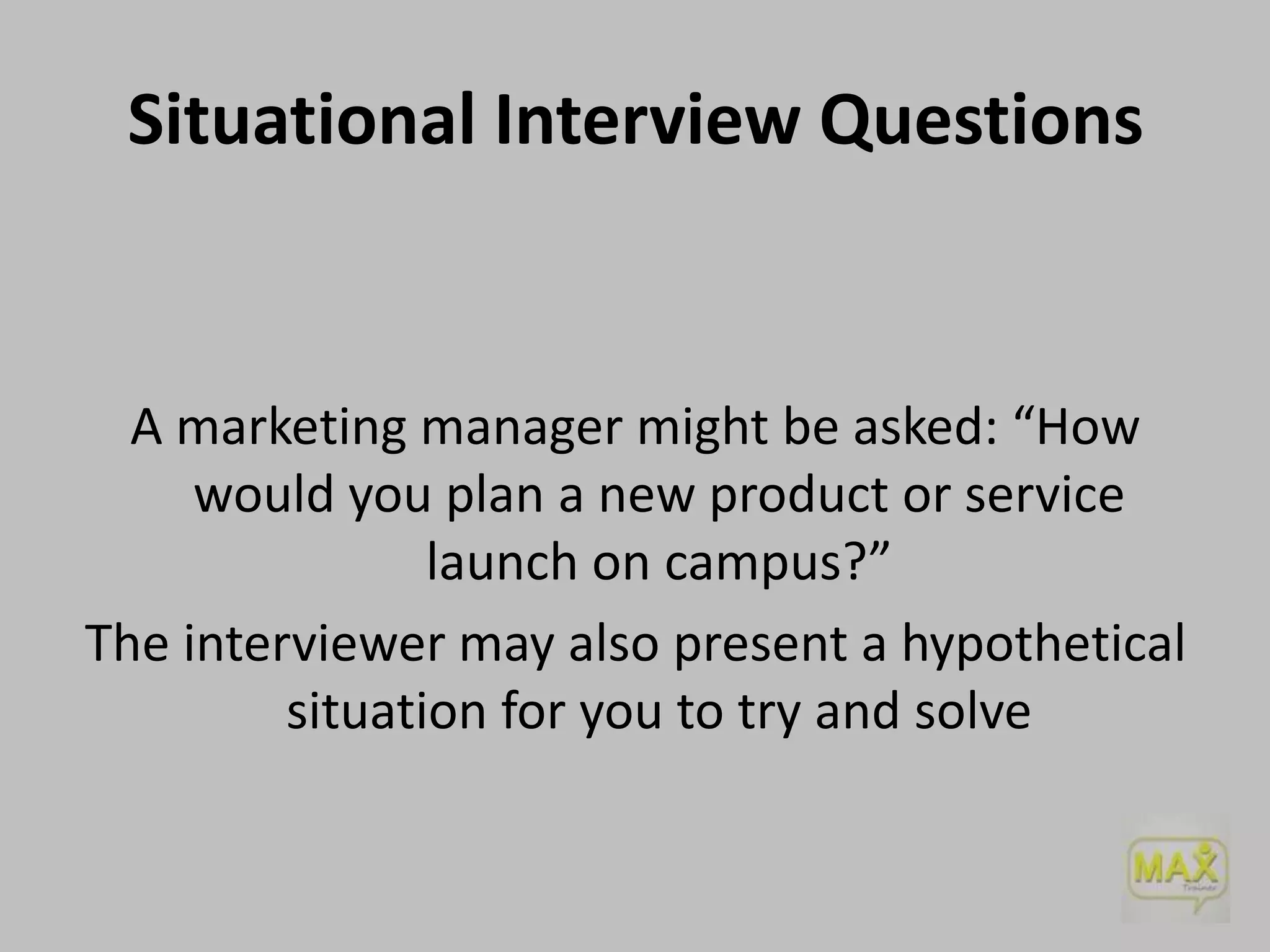
Situational Interview Questions
Amarketing manager might be asked: “How
would you plan a new product or service
launch on campus?”
The interviewer may also present a hypothetical
situation for you to try and solve
22.
The best wayto prepare
• Thoroughly research the position and try to
anticipate interview questions.
• Review past experiences that reflect positively
on your behavior.
• Jot down ideas about each experience and
examine your role
• Select some challenging experiences
23.
What maks youto crack the Interview
Practice
Practice
Practice
Know where theinterview is located and how
long it will take to get there
Allow time for traffic, parking and last minute
distractions. Arrive at least 15 minutes early
Be professional
• Remember,your interview starts when you
enter the building.
• When you shake hands, include eye contact
and a smile.
• Handshakes should be firm but not aggressive;
try matching the grip of the interviewer.
32.
Anticipate the unexpected
Youmay be asked an unexpected question; try
to determine why it is being asked.
“That’s a good question; I would like to take a
moment to think about it.”
After the Interview
Itis time to evaluate your interview and send a
follow-up thank you.
36.
Evaluate your interview
•What questions were asked?
• What questions did you wish you had answered differently?
• Did you present your qualifications in the best manner
possible, giving appropriate examples as evidence?
• Did you emphasize how your skills are related to the role?
• Did you talk too much? Too little?
• What questions do you wish you had asked the interviewer?
• What changes can you make for your next interview?