The interview
News involves people. Whatever news story you are
researching, there will be a person or some people
who know what you need to know, or who have
relevant opinions.
The interview
“Great
reporters are
great
listeners.”
Carl Bernstein
The interview
From 1999 until August
this year, Jon Stewart was
the host of a satirical news
program, The Daily Show
with Jon Stewart.
Despite the critical and
comedic aspect of this
program, Jon Stewart’s
skills as an interviewer are
first class.
Let’s learn from a master
The interview
● Tone of voice
● Interview pace
● Rapport
● Body language
○ Facial expressions
○ Gestures and movement
○ Eye contact
○ Space
● Questions asked
○ ‘Open’ or ‘Closed’
○ Topics/ content
○ Structure/ style
When watching this interview pay
attention to the following:
The interview
Jon Stewart interviews
Malala Yousafzai
October 9, 2013
The interview
● Tone of voice
● Interview pace
● Rapport
● Body language
○ Facial expressions
○ Gestures and movement
○ Eye contact
○ Space
● Questions asked
○ ‘Open’ or ‘Closed’
○ Topics/ content
○ Structure/ style
Evaluating the interview
In your group, discuss your
observations about these aspects
during the interview.
Write down your observations and
be ready to present this to the class.
The interview
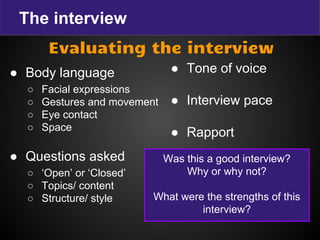
● Tone of voice
● Interview pace
● Rapport
● Body language
○ Facial expressions
○ Gestures and movement
○ Eye contact
○ Space
● Questions asked
○ ‘Open’ or ‘Closed’
○ Topics/ content
○ Structure/ style
Evaluating the interview
Was this a good interview?
Why or why not?
What were the strengths of this
interview?
The interview
YOUTUBE
As you are watching this,
identify the problems with
this interview.
If you were interviewing
this woman, what would
you do differently?
Let’s watch another interview ...
Journalism/Yearbook
Agenda:
● Warm up:
● The interview formula
● Interview assignment
● Committee: Meeting #5
Tuesday, 6th October 2015
Warm up
Body language
Let’s explore the power of
body language.
Form pairs or groups of 3
Each group will be given a
piece of paper. This will
have a specific type of body
language written on it.
Your group will need to
demonstrate both a positive
and a negative example of
this type of body language to
the class.
You will have 5 minutes to
prepare.
The entire class will be
asked to comment why this
is positive or negative.
The interview
“Great
reporters are
great
listeners.”
Carl Bernstein
The interview
1. Preparation
2. Open and closed questions
3. Manners matter
4. Establish a rapport
5. Smile like you mean it!
6. Listen …
7. Before you go
8. Take accurate notes
9. THANK YOU!
The interview formula
The interview
Brainstorm:
■ What do you know?
■ What do you need to know?
■ What is the purpose of the article?
■ Who are the best people for this information?
● Do some research on these people.
● Choose who will best meet your needs.
Step 1: Preparation
The interview
Step 2: Open and closed questions
Open questions Closed questions
Seek opinions,
thoughts, ideas,
knowledge, and
insights.
Conclude a point,
establish a fact or
confirm an
understanding.
The interview
These questions often require specific
answers with limited room to elaborate.
Usually a “yes” or “no answer.
Q. Do you like to play basketball?
A. Yes.
Q. When did the accident happen?
A. It was at 10 o’clock.
Q. Who is Marie?
A. She is my cat.
Closed-ended questions
The interview
These questions will encourage
conversation as it offers the interviewee
to elaborate and explain their answer.
Q. How have the training drills improved your game performance?
Q. What were some things you liked about the trip to Busan?
Q. How has this improved the lives of animals on Jeju?
Open-ended questions
The interview
“Nobody is obliged to be interviewed by a
journalist, so be grateful and polite.”
Step 3: Manners matter
● Be punctual.
● Dress appropriately.
● Be organised (pen and notepad)
● Turn your phone off.
● Thank the person for their time at
the start and end of the interview.
The interview
Make small talk
● Indicates that you care about the person
● Generates a more relaxed atmosphere
● Be general with the topics, don’t get too personal
Use complements where necessary
If someone is relaxed, they will be easier to
interview and to give more insightful answers to
your questions.
Step 4: Establish a rapport
The interview
Your body language speaks as louder
than your mouth.
● Smile
● Maintain eye contact
● Appropriate posture
● Be mindful of your facial
gestures and mannerisms
Click here for more tips
Step 5: Smile like you mean it!
The interview
Step 6: Listen ...
The interview
● Have a notebook and pen. If you are recording
(audio or video) seek permission first.
● Write down the main points (not everything).
● Listen for the good quotes.
“A good quote is when someone says something interesting
and says it in an interesting way”.
● If you miss something, ask the person to repeat it.
Step 7: Take accurate notes
The interview
Recap:
Briefly summarise your notes to your interviewee.
● Do your notes makes sense?
● Do you have all the details?
● Is this an accurate record?
● Have you quoted correctly?
Contact details
● To enable either you or your interviewee to contact each
other.
● Name, mobile, email.
Step 8: Before you go
The interview
Say ‘thank you’ and shake hands.
“... part as friends -
you may well need another interview
from the same person at some future date.”
Step 9: THANK YOU!
The interview
You will be interviewing someone in this class.
Who you interview will be randomly selected
(therefore it is unlikely to be your best friend).
You will write an article of three paragraphs.
This is structured using the inverted pyramid format.
From your interview, your article will require:
Two (2) direct quotes
Two (2) paraphrases
You will need to submit your interview questions and notes (which should
include the direct quotes) with the article.
DUE: Monday, 12th October 2015 (before class)
YOUR TASK: The Interview
The interview
1. You need to choose one of these areas for the
focus of your interview:
i. AP course
ii. Club involvement
iii. Sport
2. Create a list of 12-15 questions. These must be a
mixture open and closed questions.
3. Once you have finished these questions, you need
to see Ms Georgi or Ms Cave. You will be assigned
someone to interview.
YOUR TASK: The Interview
The interview
4. You will need to arrange a time to interview this person. There will be
some class time this lesson and next lesson BUT this will be limited.
5. Ensure that you take notes during the interview as you will need to
submit these with your article.
● Remember that you will need two direct quotes.
6. Write your article using inverted pyramid.
7. Submit before class on Monday, 12th October.
If your notes are handwritten, you will need to give these to the teachers
at the beginning of class. Please write your name on them.
YOUR TASK: The Interview

Interview Tips

  • 1.
    The interview News involvespeople. Whatever news story you are researching, there will be a person or some people who know what you need to know, or who have relevant opinions.
  • 2.
  • 3.
    The interview From 1999until August this year, Jon Stewart was the host of a satirical news program, The Daily Show with Jon Stewart. Despite the critical and comedic aspect of this program, Jon Stewart’s skills as an interviewer are first class. Let’s learn from a master
  • 4.
    The interview ● Toneof voice ● Interview pace ● Rapport ● Body language ○ Facial expressions ○ Gestures and movement ○ Eye contact ○ Space ● Questions asked ○ ‘Open’ or ‘Closed’ ○ Topics/ content ○ Structure/ style When watching this interview pay attention to the following:
  • 5.
    The interview Jon Stewartinterviews Malala Yousafzai October 9, 2013
  • 6.
    The interview ● Toneof voice ● Interview pace ● Rapport ● Body language ○ Facial expressions ○ Gestures and movement ○ Eye contact ○ Space ● Questions asked ○ ‘Open’ or ‘Closed’ ○ Topics/ content ○ Structure/ style Evaluating the interview In your group, discuss your observations about these aspects during the interview. Write down your observations and be ready to present this to the class.
  • 7.
    The interview ● Toneof voice ● Interview pace ● Rapport ● Body language ○ Facial expressions ○ Gestures and movement ○ Eye contact ○ Space ● Questions asked ○ ‘Open’ or ‘Closed’ ○ Topics/ content ○ Structure/ style Evaluating the interview Was this a good interview? Why or why not? What were the strengths of this interview?
  • 8.
    The interview YOUTUBE As youare watching this, identify the problems with this interview. If you were interviewing this woman, what would you do differently? Let’s watch another interview ...
  • 9.
    Journalism/Yearbook Agenda: ● Warm up: ●The interview formula ● Interview assignment ● Committee: Meeting #5 Tuesday, 6th October 2015
  • 10.
    Warm up Body language Let’sexplore the power of body language. Form pairs or groups of 3 Each group will be given a piece of paper. This will have a specific type of body language written on it. Your group will need to demonstrate both a positive and a negative example of this type of body language to the class. You will have 5 minutes to prepare. The entire class will be asked to comment why this is positive or negative.
  • 11.
  • 12.
    The interview 1. Preparation 2.Open and closed questions 3. Manners matter 4. Establish a rapport 5. Smile like you mean it! 6. Listen … 7. Before you go 8. Take accurate notes 9. THANK YOU! The interview formula
  • 13.
    The interview Brainstorm: ■ Whatdo you know? ■ What do you need to know? ■ What is the purpose of the article? ■ Who are the best people for this information? ● Do some research on these people. ● Choose who will best meet your needs. Step 1: Preparation
  • 14.
    The interview Step 2:Open and closed questions Open questions Closed questions Seek opinions, thoughts, ideas, knowledge, and insights. Conclude a point, establish a fact or confirm an understanding.
  • 15.
    The interview These questionsoften require specific answers with limited room to elaborate. Usually a “yes” or “no answer. Q. Do you like to play basketball? A. Yes. Q. When did the accident happen? A. It was at 10 o’clock. Q. Who is Marie? A. She is my cat. Closed-ended questions
  • 16.
    The interview These questionswill encourage conversation as it offers the interviewee to elaborate and explain their answer. Q. How have the training drills improved your game performance? Q. What were some things you liked about the trip to Busan? Q. How has this improved the lives of animals on Jeju? Open-ended questions
  • 17.
    The interview “Nobody isobliged to be interviewed by a journalist, so be grateful and polite.” Step 3: Manners matter ● Be punctual. ● Dress appropriately. ● Be organised (pen and notepad) ● Turn your phone off. ● Thank the person for their time at the start and end of the interview.
  • 18.
    The interview Make smalltalk ● Indicates that you care about the person ● Generates a more relaxed atmosphere ● Be general with the topics, don’t get too personal Use complements where necessary If someone is relaxed, they will be easier to interview and to give more insightful answers to your questions. Step 4: Establish a rapport
  • 19.
    The interview Your bodylanguage speaks as louder than your mouth. ● Smile ● Maintain eye contact ● Appropriate posture ● Be mindful of your facial gestures and mannerisms Click here for more tips Step 5: Smile like you mean it!
  • 20.
  • 21.
    The interview ● Havea notebook and pen. If you are recording (audio or video) seek permission first. ● Write down the main points (not everything). ● Listen for the good quotes. “A good quote is when someone says something interesting and says it in an interesting way”. ● If you miss something, ask the person to repeat it. Step 7: Take accurate notes
  • 22.
    The interview Recap: Briefly summariseyour notes to your interviewee. ● Do your notes makes sense? ● Do you have all the details? ● Is this an accurate record? ● Have you quoted correctly? Contact details ● To enable either you or your interviewee to contact each other. ● Name, mobile, email. Step 8: Before you go
  • 23.
    The interview Say ‘thankyou’ and shake hands. “... part as friends - you may well need another interview from the same person at some future date.” Step 9: THANK YOU!
  • 24.
    The interview You willbe interviewing someone in this class. Who you interview will be randomly selected (therefore it is unlikely to be your best friend). You will write an article of three paragraphs. This is structured using the inverted pyramid format. From your interview, your article will require: Two (2) direct quotes Two (2) paraphrases You will need to submit your interview questions and notes (which should include the direct quotes) with the article. DUE: Monday, 12th October 2015 (before class) YOUR TASK: The Interview
  • 25.
    The interview 1. Youneed to choose one of these areas for the focus of your interview: i. AP course ii. Club involvement iii. Sport 2. Create a list of 12-15 questions. These must be a mixture open and closed questions. 3. Once you have finished these questions, you need to see Ms Georgi or Ms Cave. You will be assigned someone to interview. YOUR TASK: The Interview
  • 26.
    The interview 4. Youwill need to arrange a time to interview this person. There will be some class time this lesson and next lesson BUT this will be limited. 5. Ensure that you take notes during the interview as you will need to submit these with your article. ● Remember that you will need two direct quotes. 6. Write your article using inverted pyramid. 7. Submit before class on Monday, 12th October. If your notes are handwritten, you will need to give these to the teachers at the beginning of class. Please write your name on them. YOUR TASK: The Interview