1
Kiran Joshi
Risk Assessment and Management &
Risk Based Audit Approaches
1
2
3
4
5
6
Table of
Contents
• Introduction
• Risk
• Risk Based Audit Approaches
• Keep it touch!
• Risk Assessment and Calculations
• Losses & Controls
• Risk Management Model
• Things to Consider
• Risk Treatments
• Types of Treatments
• Methodology
• How to manage the Risk?
2
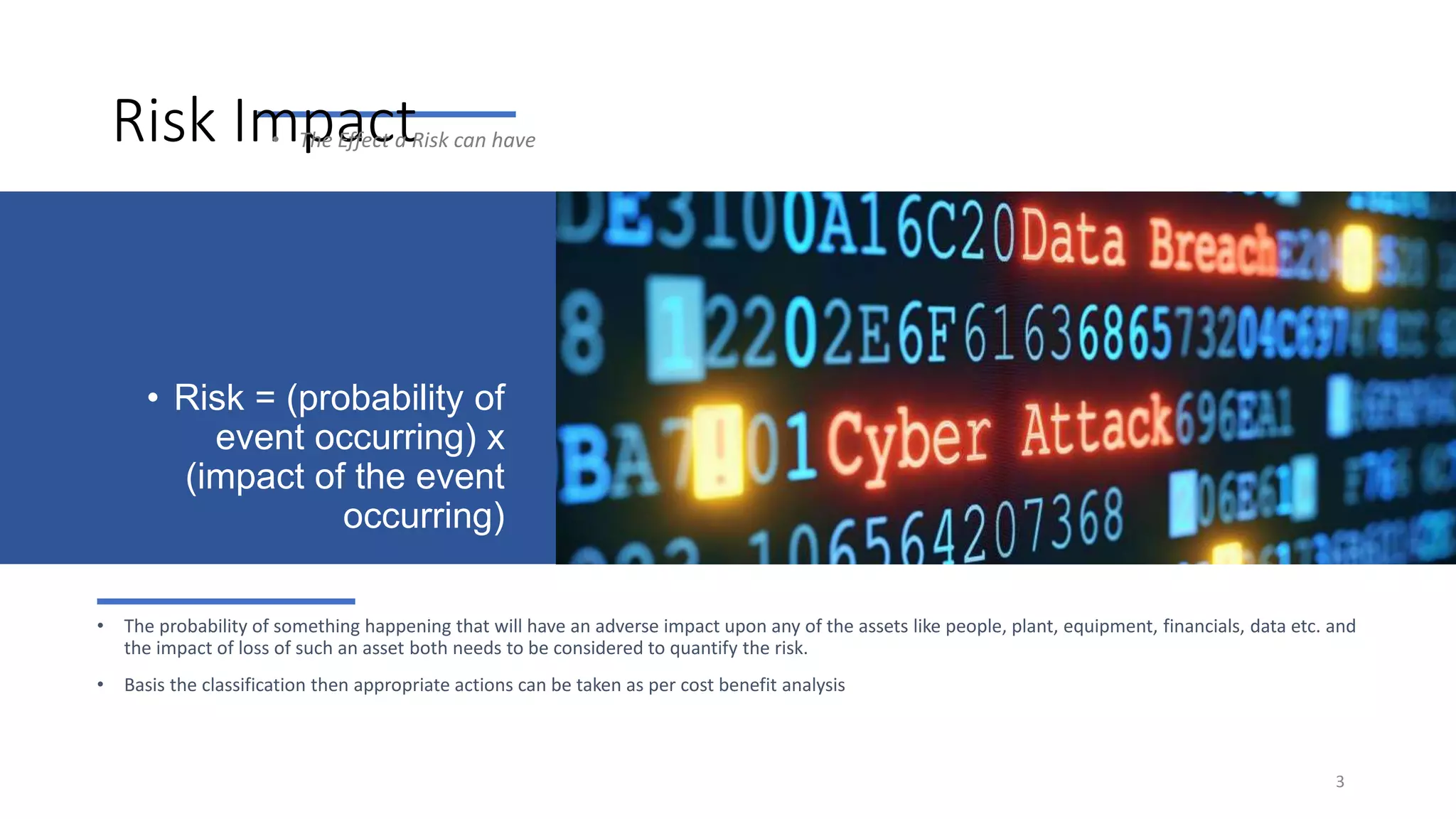
Risk Impact• The Effect a Risk can have
• The probability of something happening that will have an adverse impact upon any of the assets like people, plant, equipment, financials, data etc. and
the impact of loss of such an asset both needs to be considered to quantify the risk.
• Basis the classification then appropriate actions can be taken as per cost benefit analysis
• Risk = (probability of
event occurring) x
(impact of the event
occurring)
3
Risk Assessment – a
definition
•“The process of identifying the risks to system security and determining
•the probability of occurrence, the resulting impact,
•and additional safeguards that would mitigate this impact.”
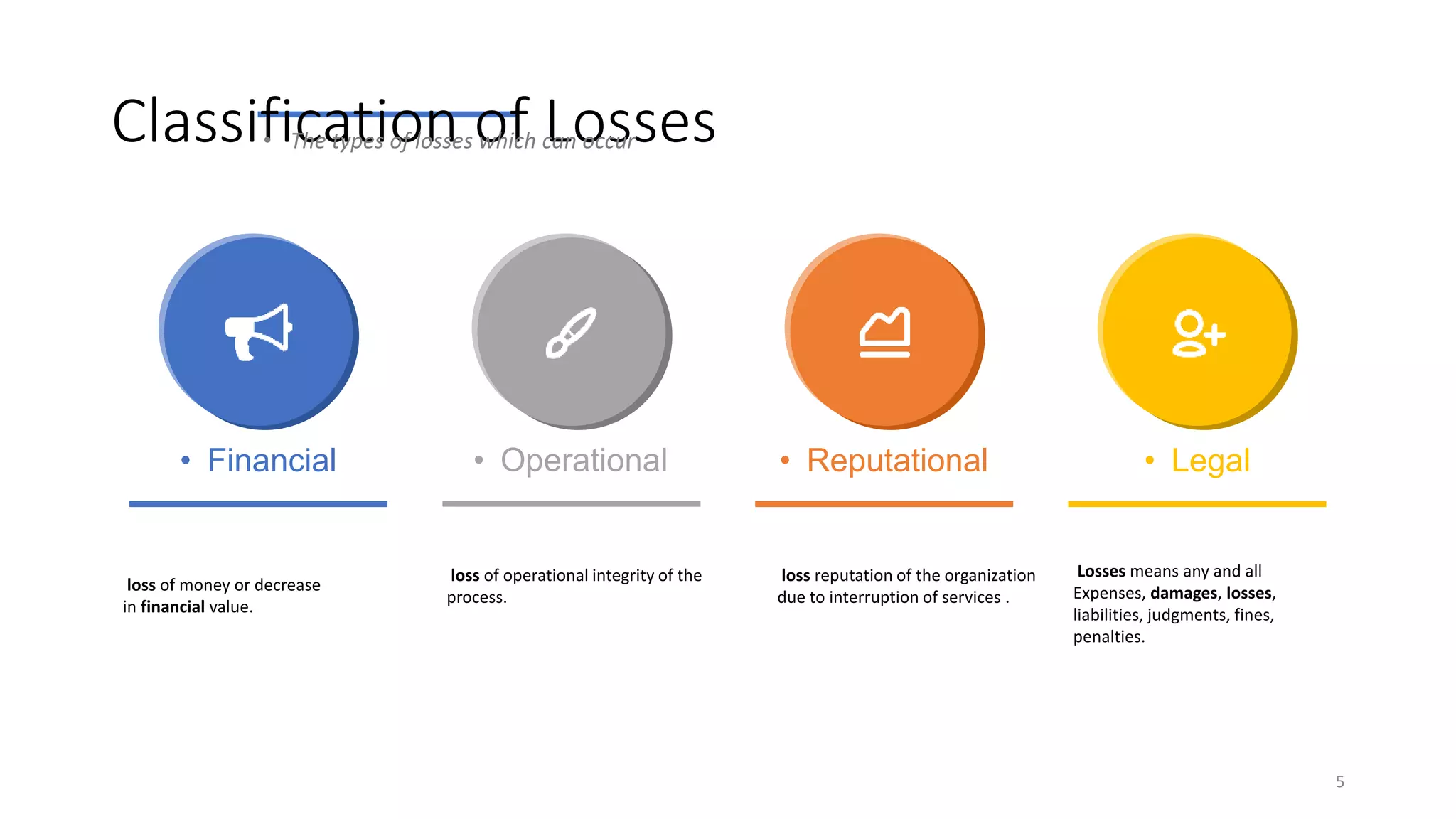
Classification of Losses• The types of losses which can occur
• Financial • Operational • Reputational • Legal
5
loss of money or decrease
in financial value.
loss of operational integrity of the
process.
loss reputation of the organization
due to interruption of services .
Losses means any and all
Expenses, damages, losses,
liabilities, judgments, fines,
penalties.
The Power of PowerPoint | thepopp.com 6
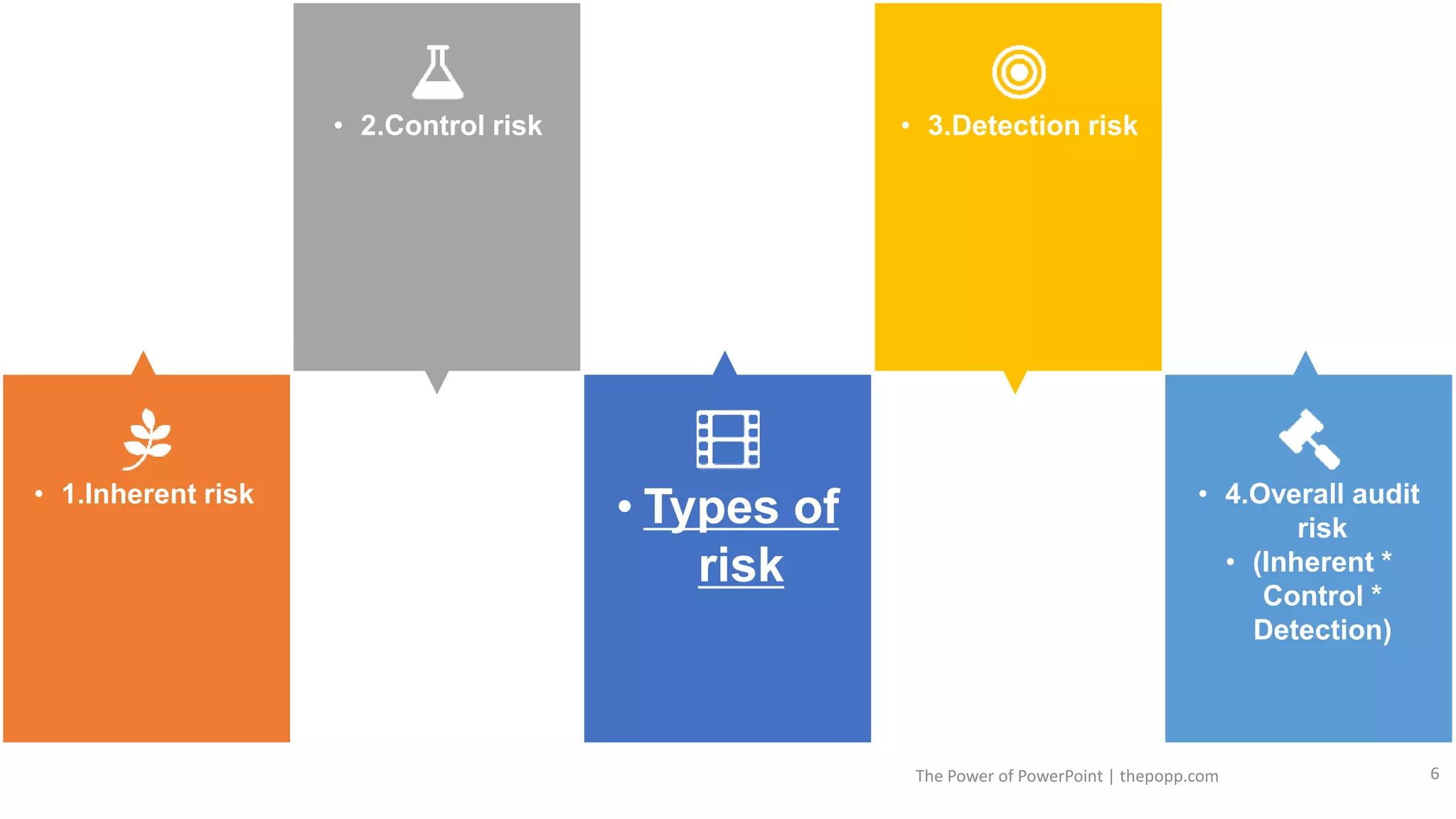
• 1.Inherent risk
• 2.Control risk • 3.Detection risk
• Types of
risk
• 4.Overall audit
risk
• (Inherent *
Control *
Detection)
7
8
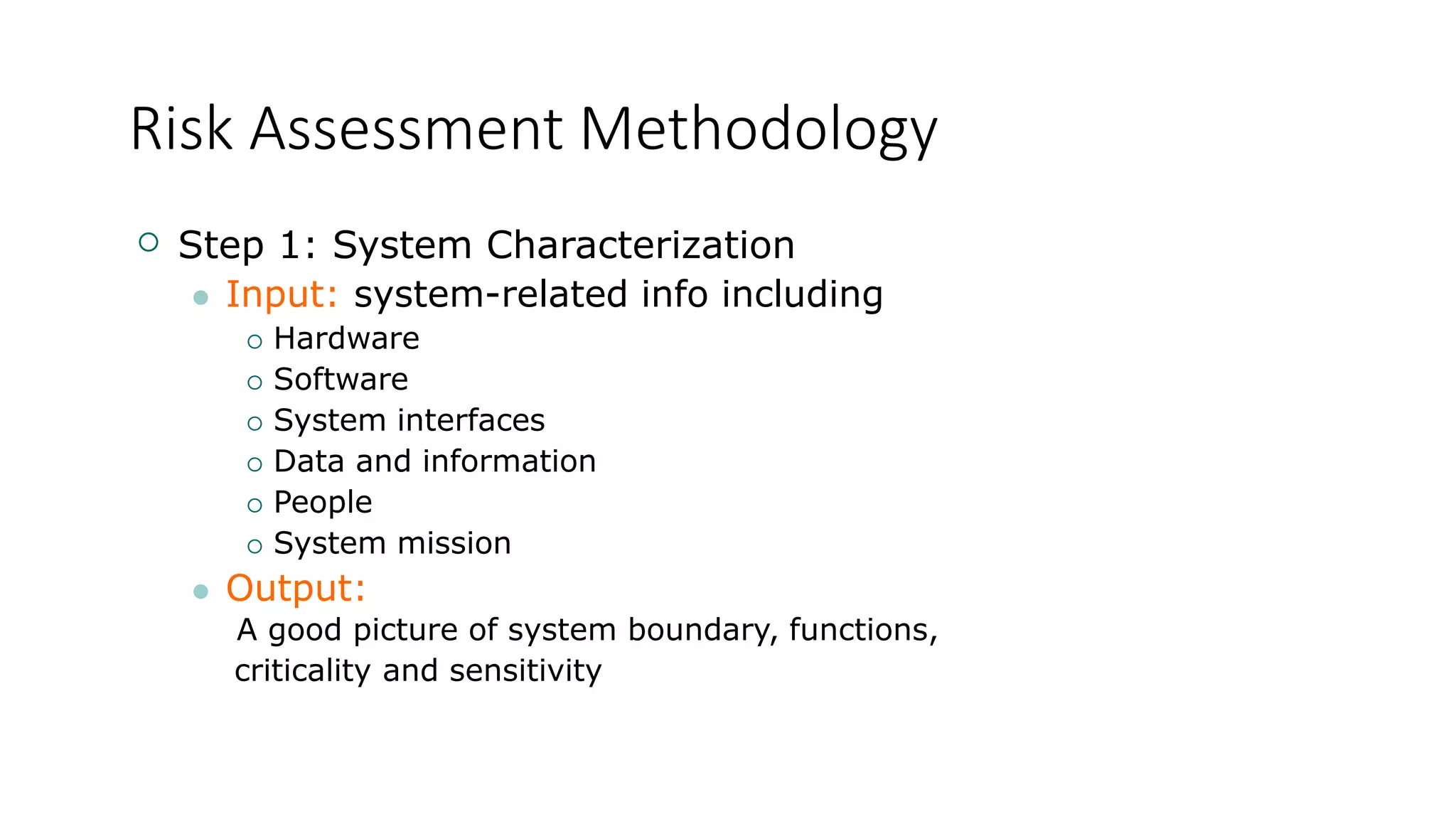
Risk Assessment Methodology
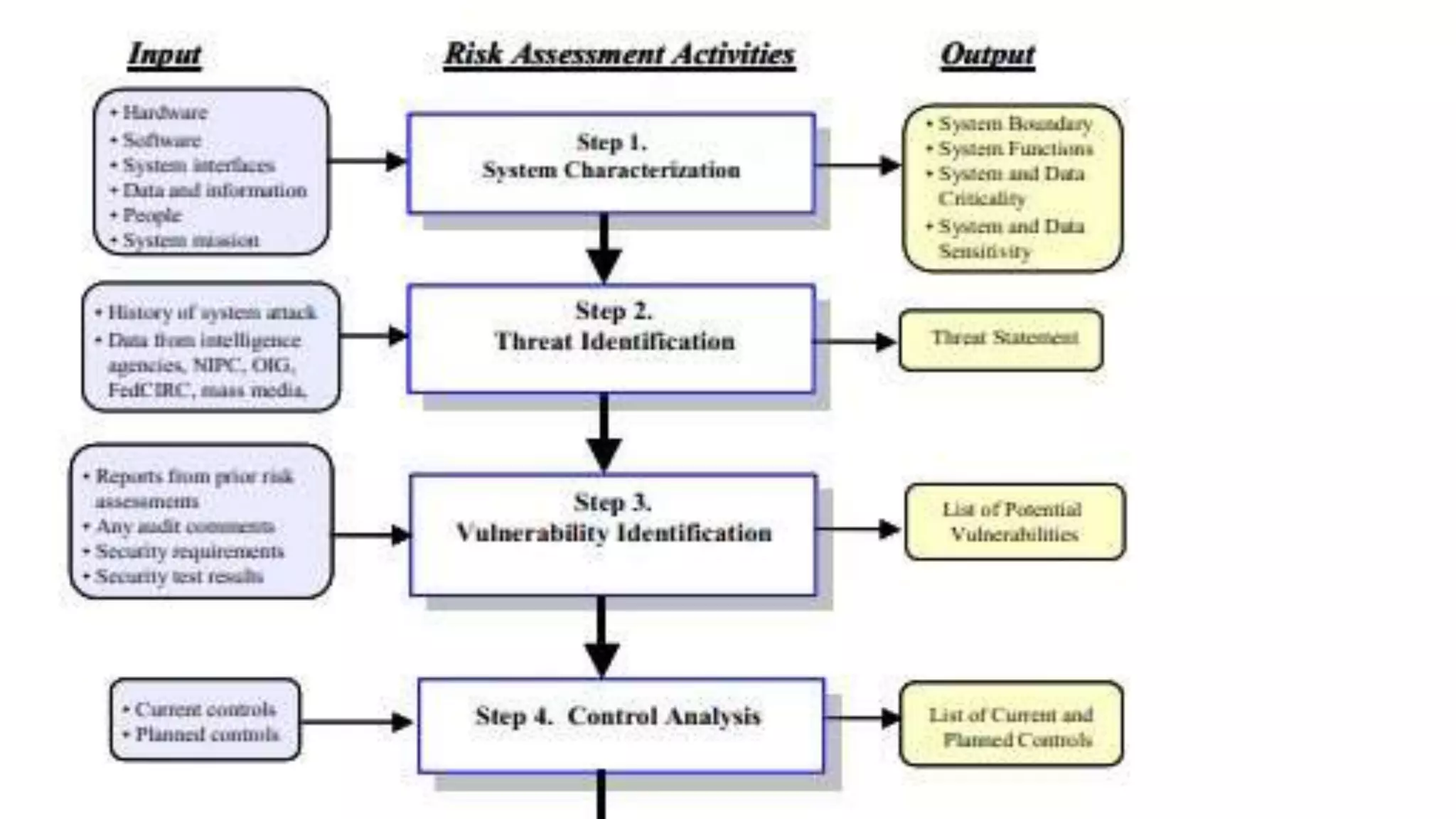
 Step 1: System Characterization
 Input: system-related info including
 Hardware
 Software
 System interfaces
 Data and information
 People
 System mission
 Output:
A good picture of system boundary, functions,
criticality and sensitivity
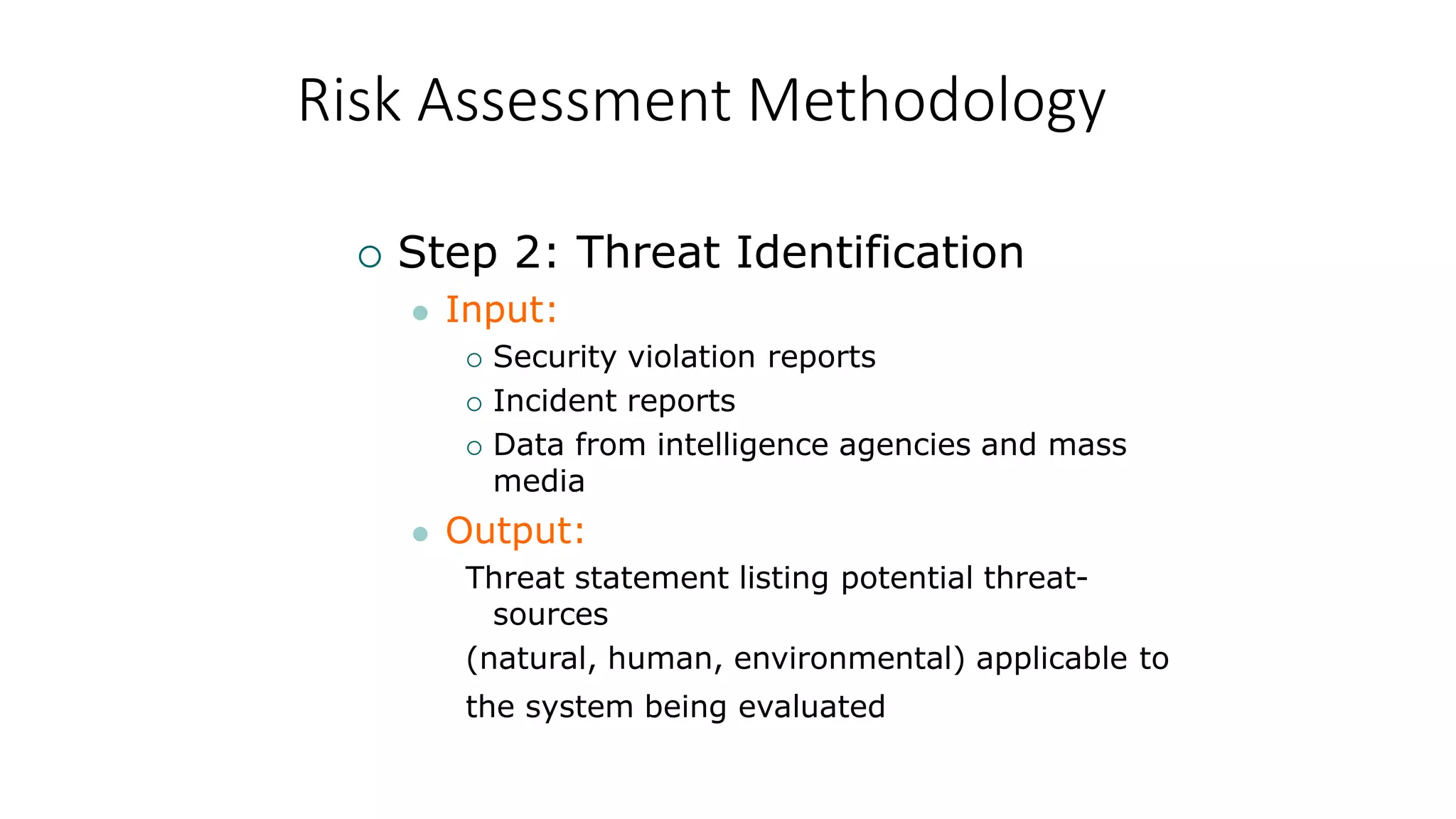
Risk Assessment Methodology
 Step 2: Threat Identification
 Input:
 Security violation reports
 Incident reports
 Data from intelligence agencies and mass
media
 Output:
Threat statement listing potential threat-
sources
(natural, human, environmental) applicable to
the system being evaluated
Risk Assessment Methodology
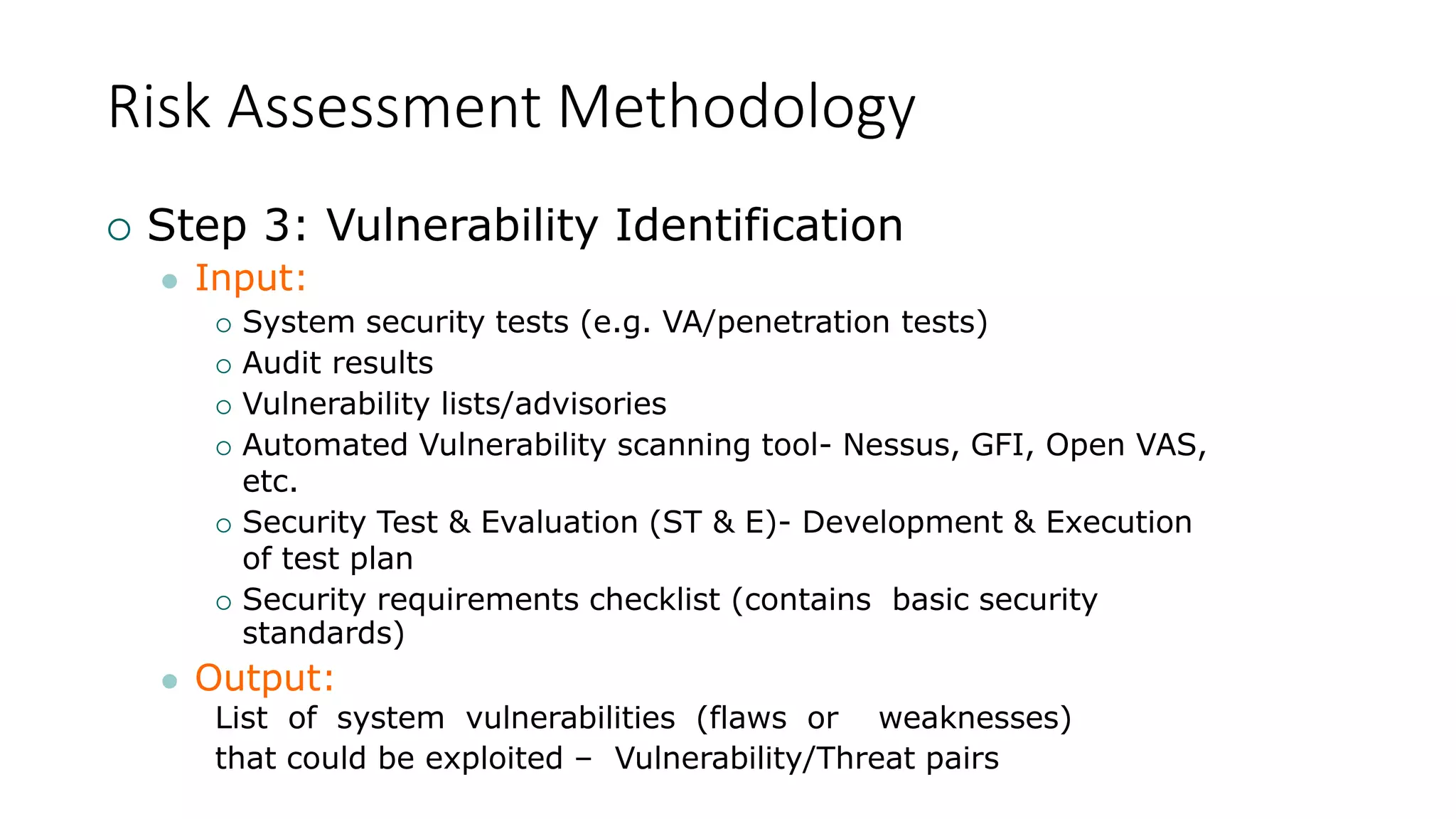
 Step 3: Vulnerability Identification
 Input:
 System security tests (e.g. VA/penetration tests)
 Audit results
 Vulnerability lists/advisories
 Automated Vulnerability scanning tool- Nessus, GFI, Open VAS,
etc.
 Security Test & Evaluation (ST & E)- Development & Execution
of test plan
 Security requirements checklist (contains basic security
standards)
 Output:
List of system vulnerabilities (flaws or weaknesses)
that could be exploited – Vulnerability/Threat pairs
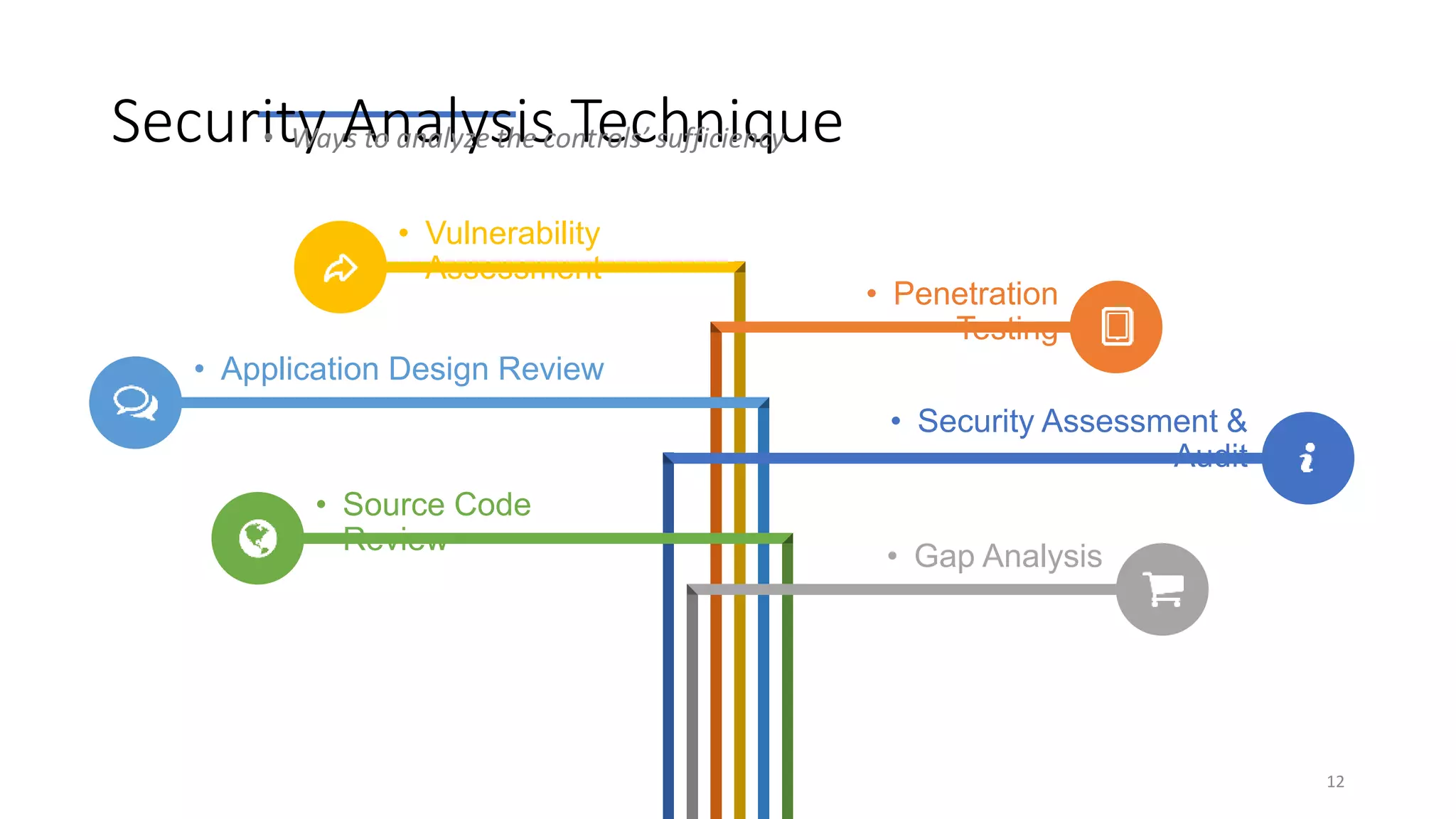
Security Analysis Technique
12
• Ways to analyze the controls’ sufficiency
• Vulnerability
Assessment
• Application Design Review
• Source Code
Review
• Penetration
Testing
• Security Assessment &
Audit
• Gap Analysis
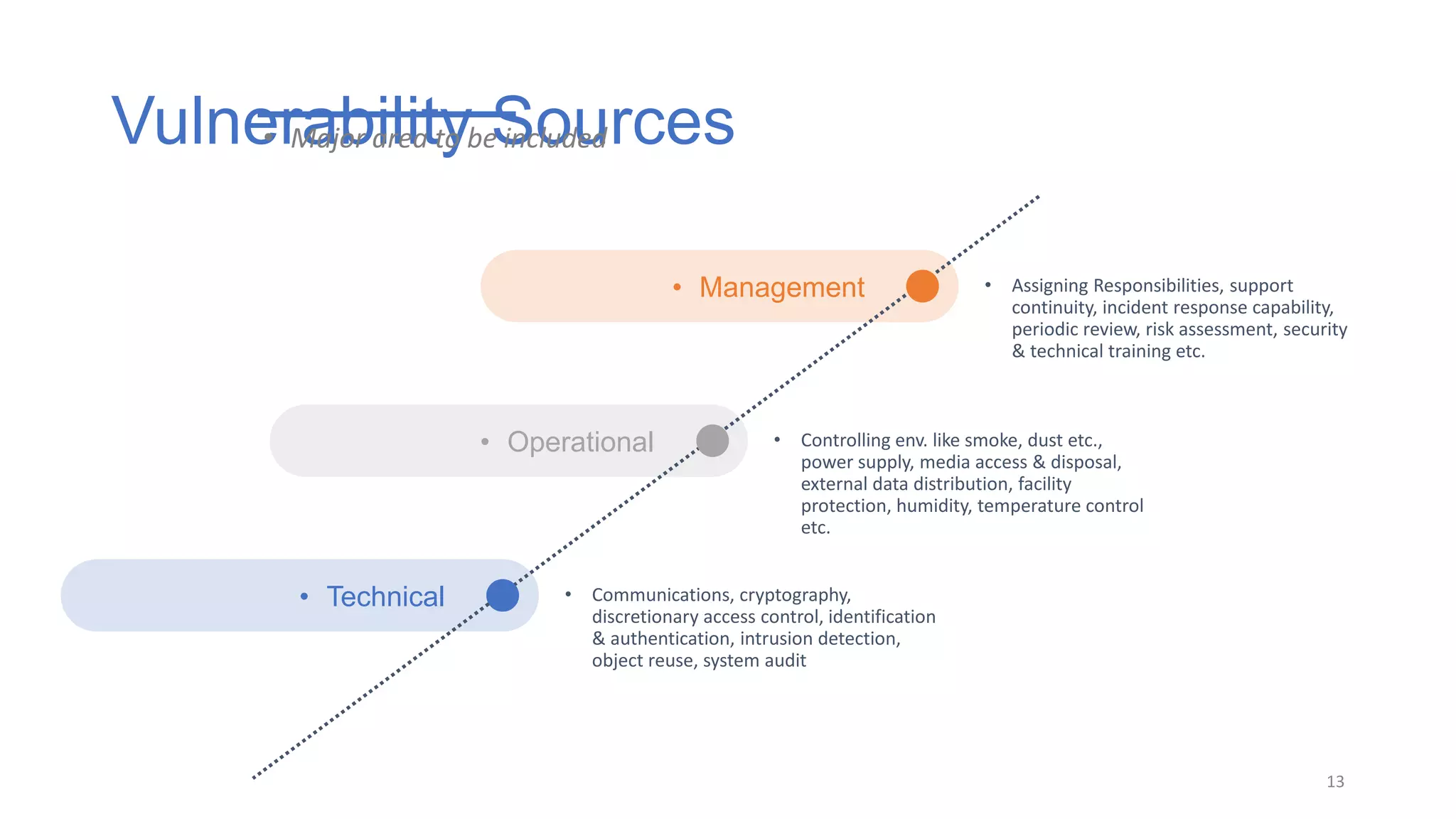
• Operational • Controlling env. like smoke, dust etc.,
power supply, media access & disposal,
external data distribution, facility
protection, humidity, temperature control
etc.
Vulnerability Sources
13
• Major area to be included
• Technical • Communications, cryptography,
discretionary access control, identification
& authentication, intrusion detection,
object reuse, system audit
• Management • Assigning Responsibilities, support
continuity, incident response capability,
periodic review, risk assessment, security
& technical training etc.
Risk Assessment Methodology
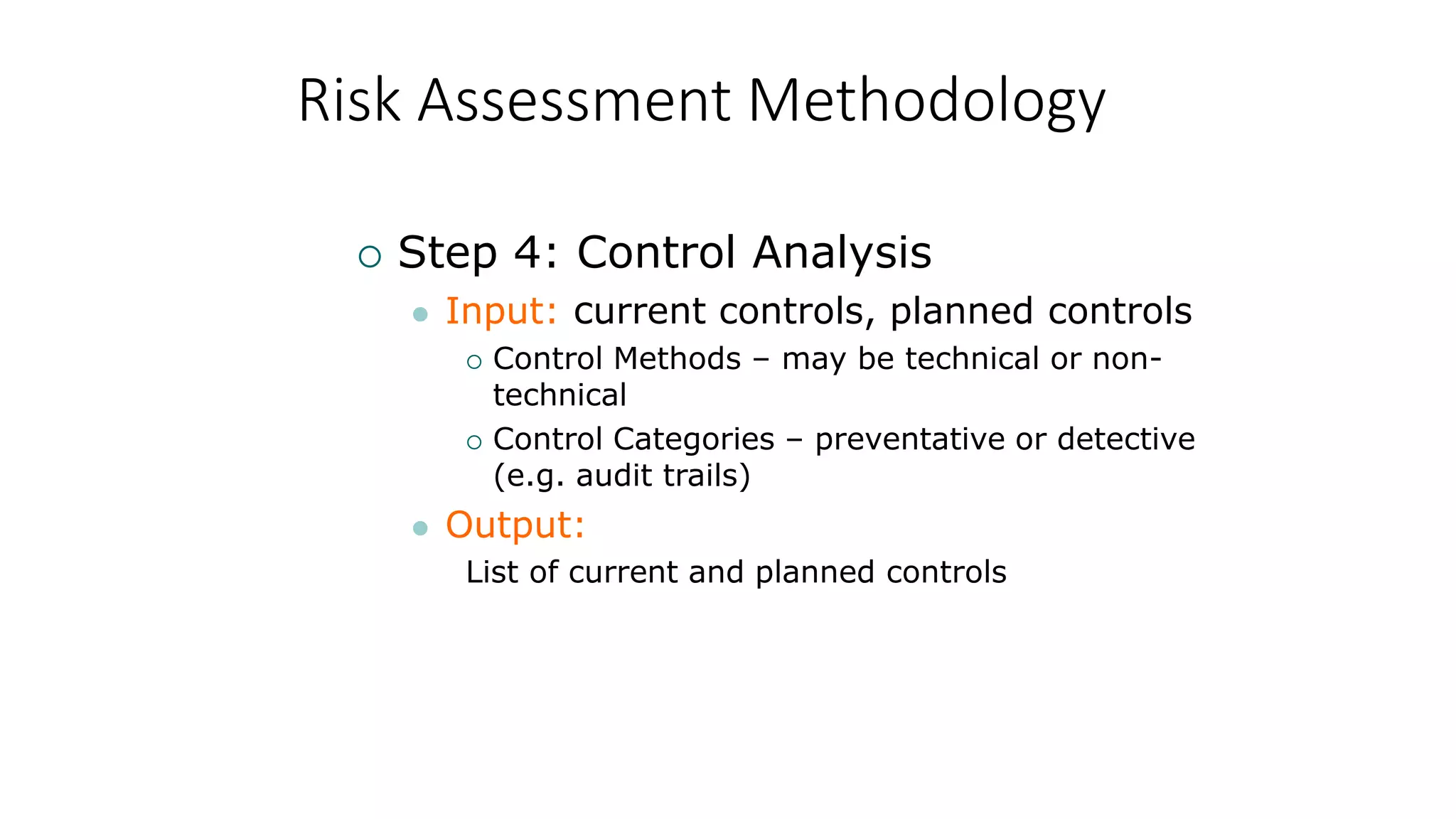
 Step 4: Control Analysis
 Input: current controls, planned controls
 Control Methods – may be technical or non-
technical
 Control Categories – preventative or detective
(e.g. audit trails)
 Output:
List of current and planned controls
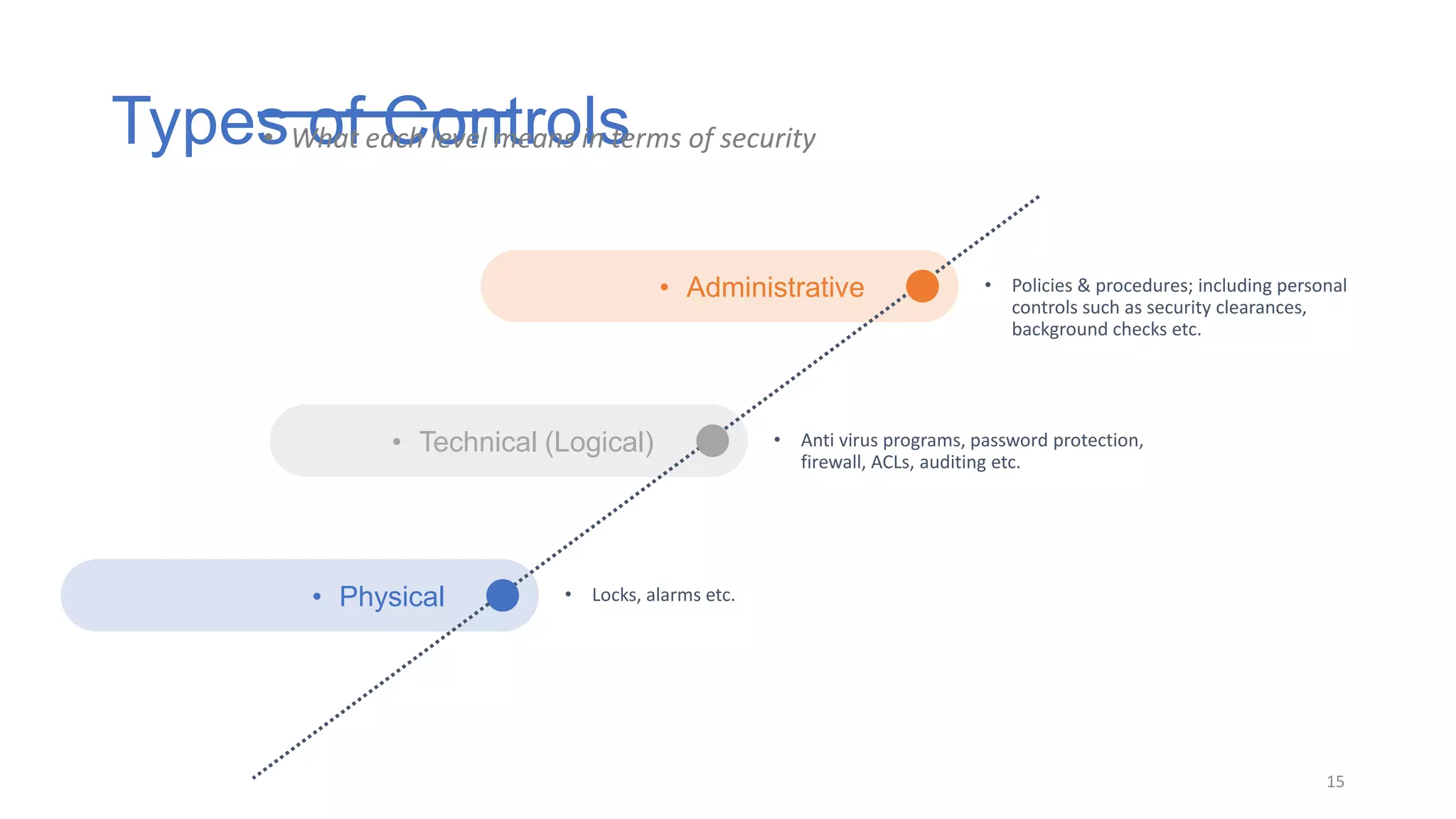
• Technical (Logical) • Anti virus programs, password protection,
firewall, ACLs, auditing etc.
Types of Controls
15
• What each level means in terms of security
• Physical • Locks, alarms etc.
• Administrative • Policies & procedures; including personal
controls such as security clearances,
background checks etc.
Risk Assessment Methodology
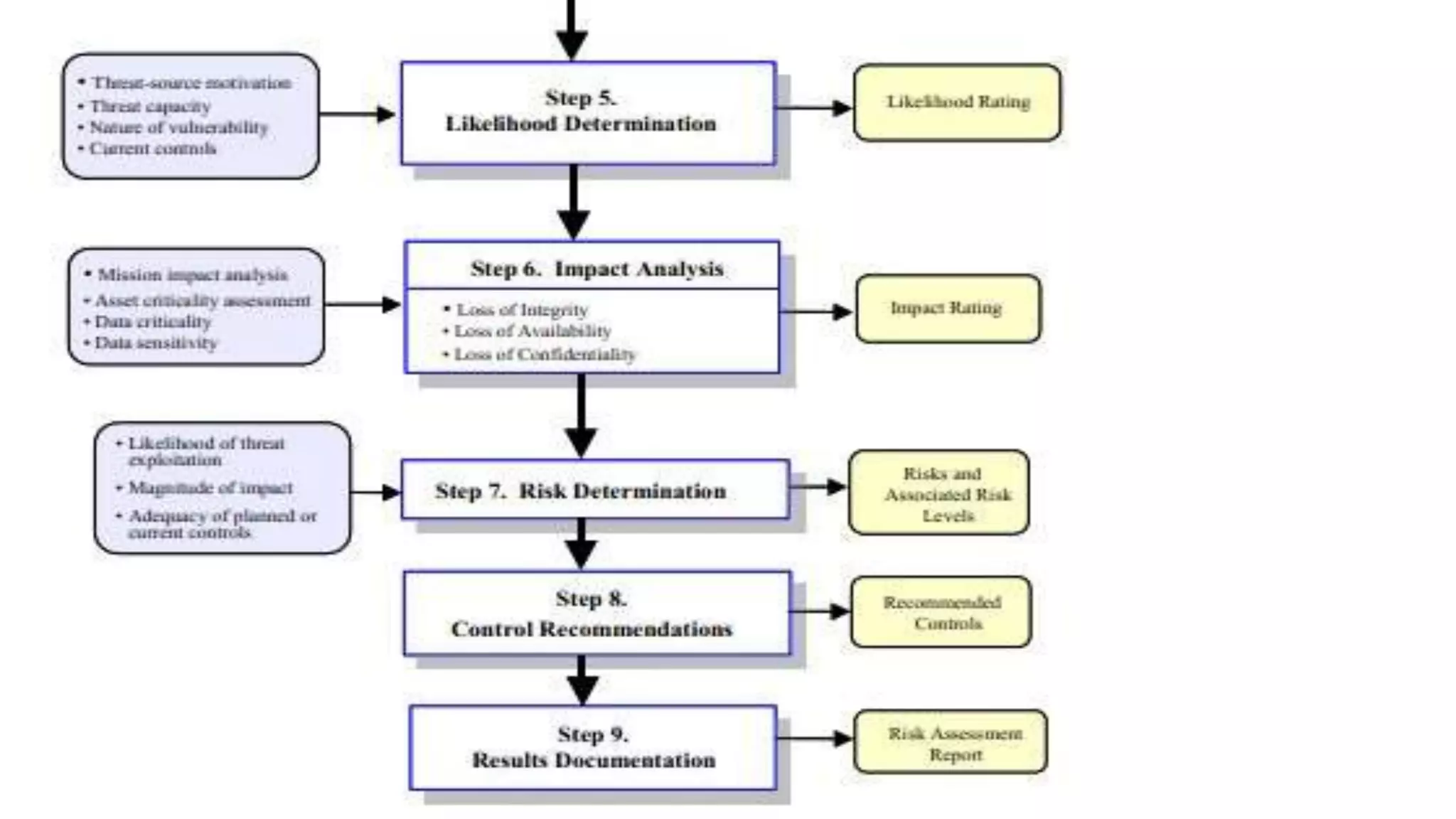
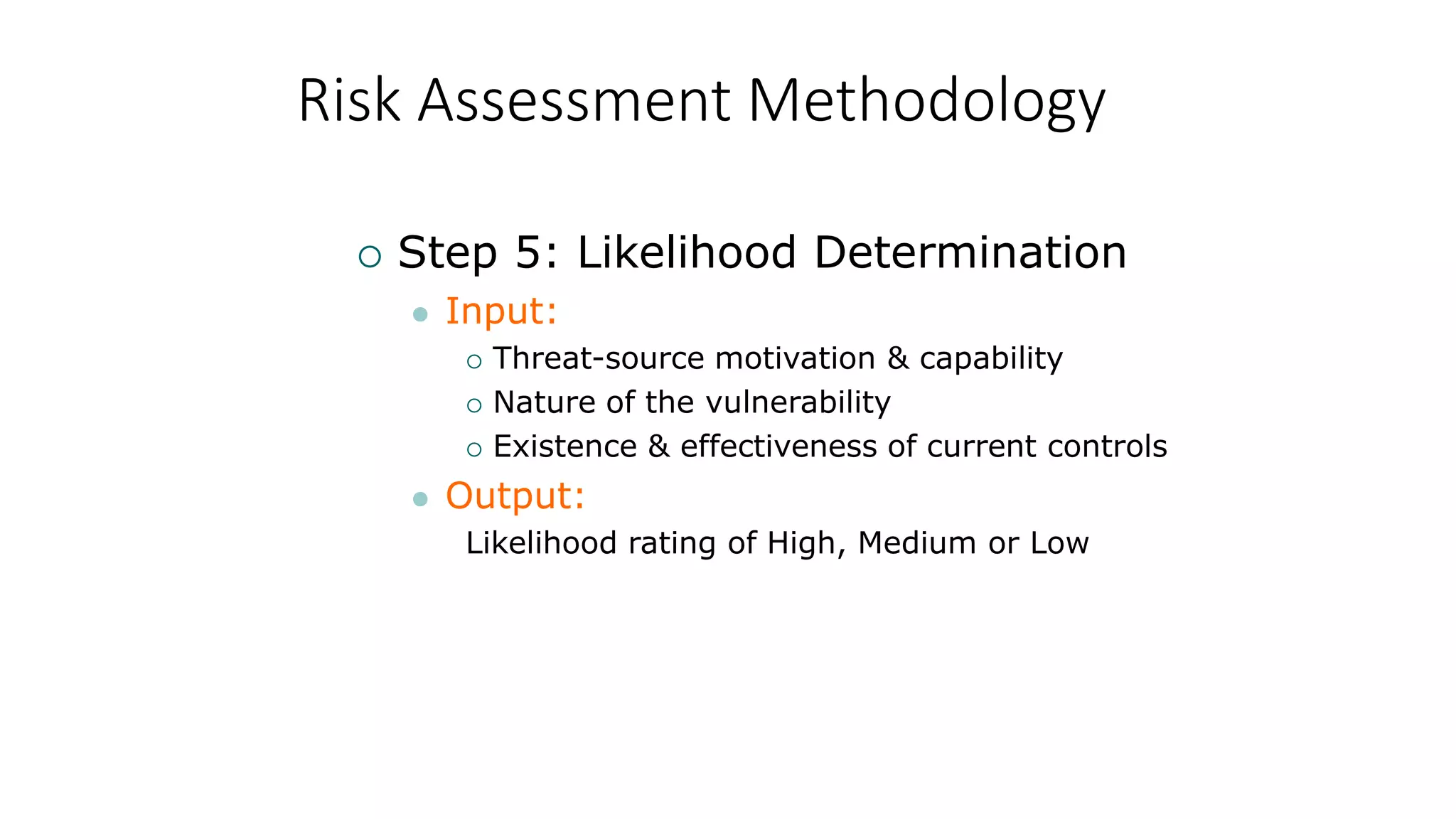
 Step 5: Likelihood Determination
 Input:
 Threat-source motivation & capability
 Nature of the vulnerability
 Existence & effectiveness of current controls
 Output:
Likelihood rating of High, Medium or Low
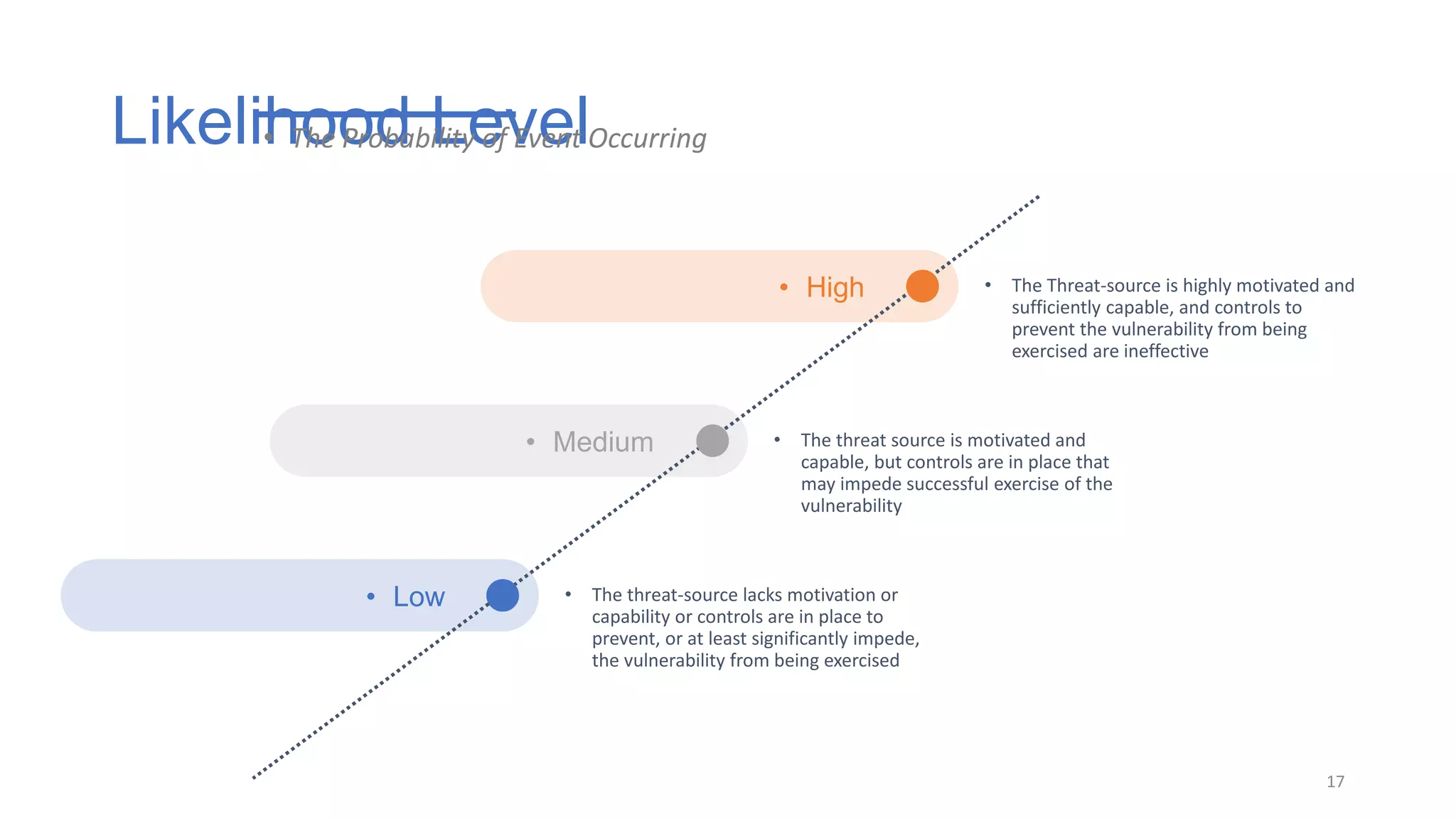
• Medium • The threat source is motivated and
capable, but controls are in place that
may impede successful exercise of the
vulnerability
Likelihood Level
17
• The Probability of Event Occurring
• Low • The threat-source lacks motivation or
capability or controls are in place to
prevent, or at least significantly impede,
the vulnerability from being exercised
• High • The Threat-source is highly motivated and
sufficiently capable, and controls to
prevent the vulnerability from being
exercised are ineffective
Risk Assessment Methodology
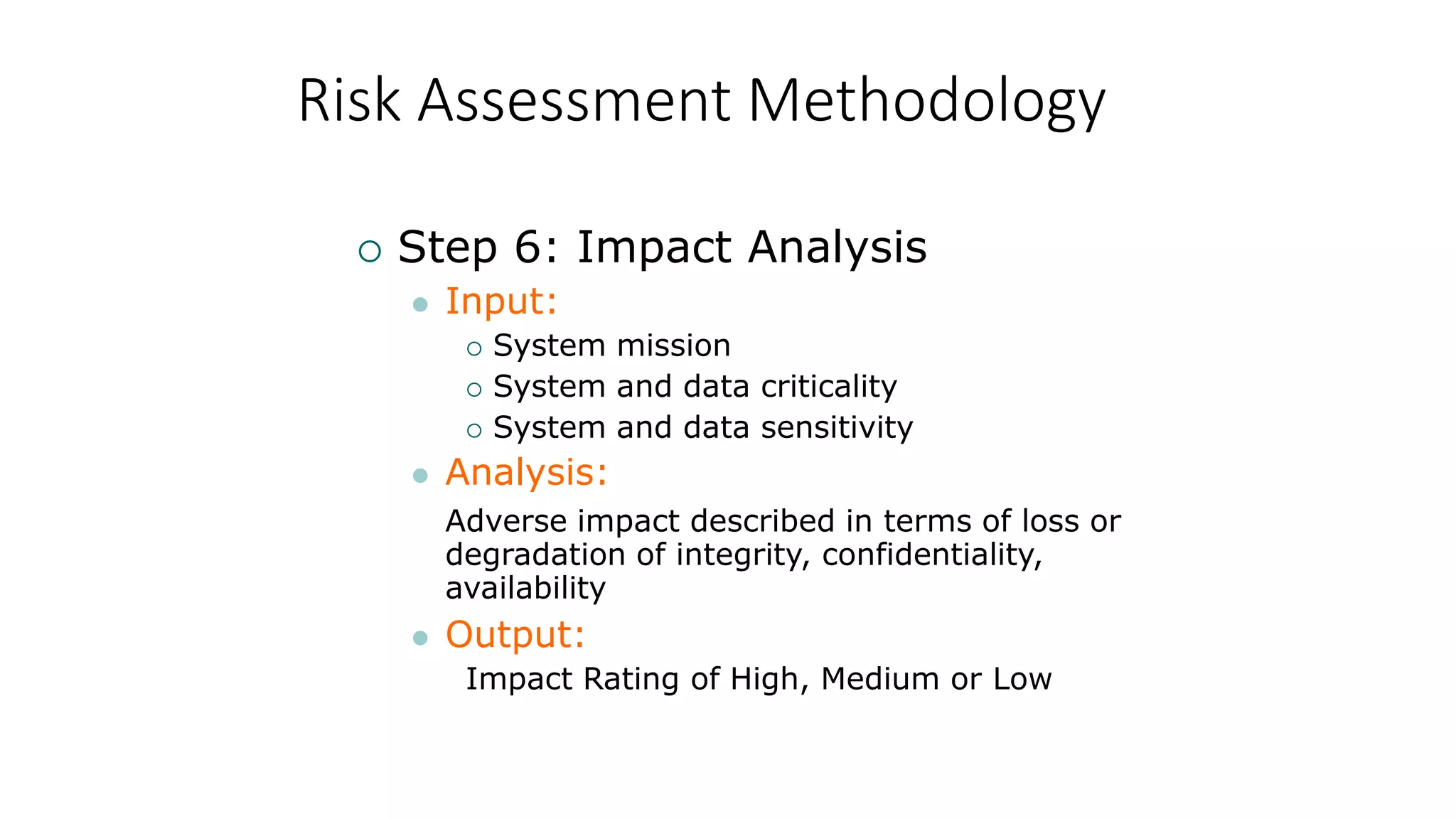
 Step 6: Impact Analysis
 Input:
 System mission
 System and data criticality
 System and data sensitivity
 Analysis:
Adverse impact described in terms of loss or
degradation of integrity, confidentiality,
availability
 Output:
Impact Rating of High, Medium or Low
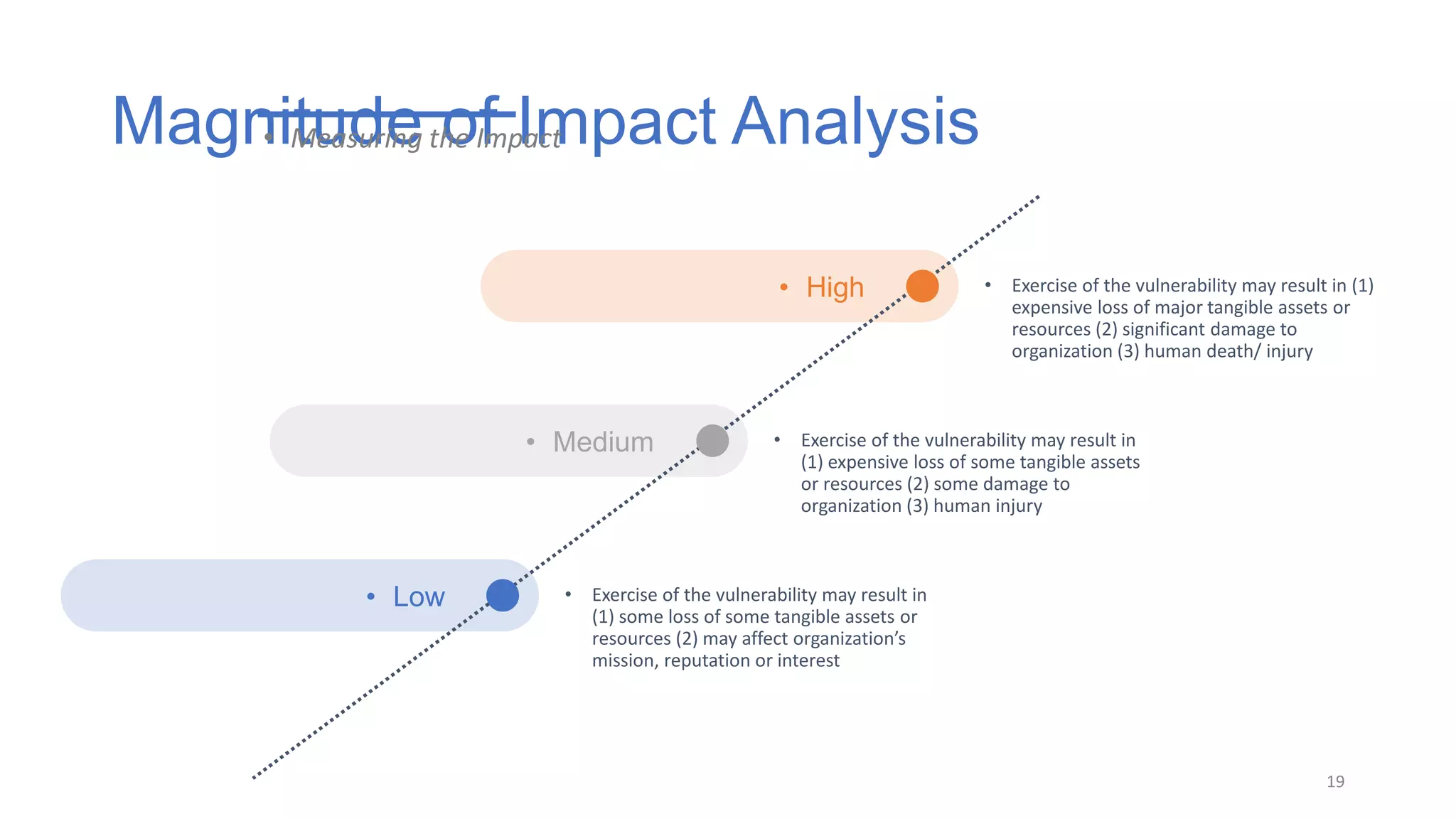
• Medium • Exercise of the vulnerability may result in
(1) expensive loss of some tangible assets
or resources (2) some damage to
organization (3) human injury
Magnitude of Impact Analysis
19
• Measuring the Impact
• Low • Exercise of the vulnerability may result in
(1) some loss of some tangible assets or
resources (2) may affect organization’s
mission, reputation or interest
• High • Exercise of the vulnerability may result in (1)
expensive loss of major tangible assets or
resources (2) significant damage to
organization (3) human death/ injury
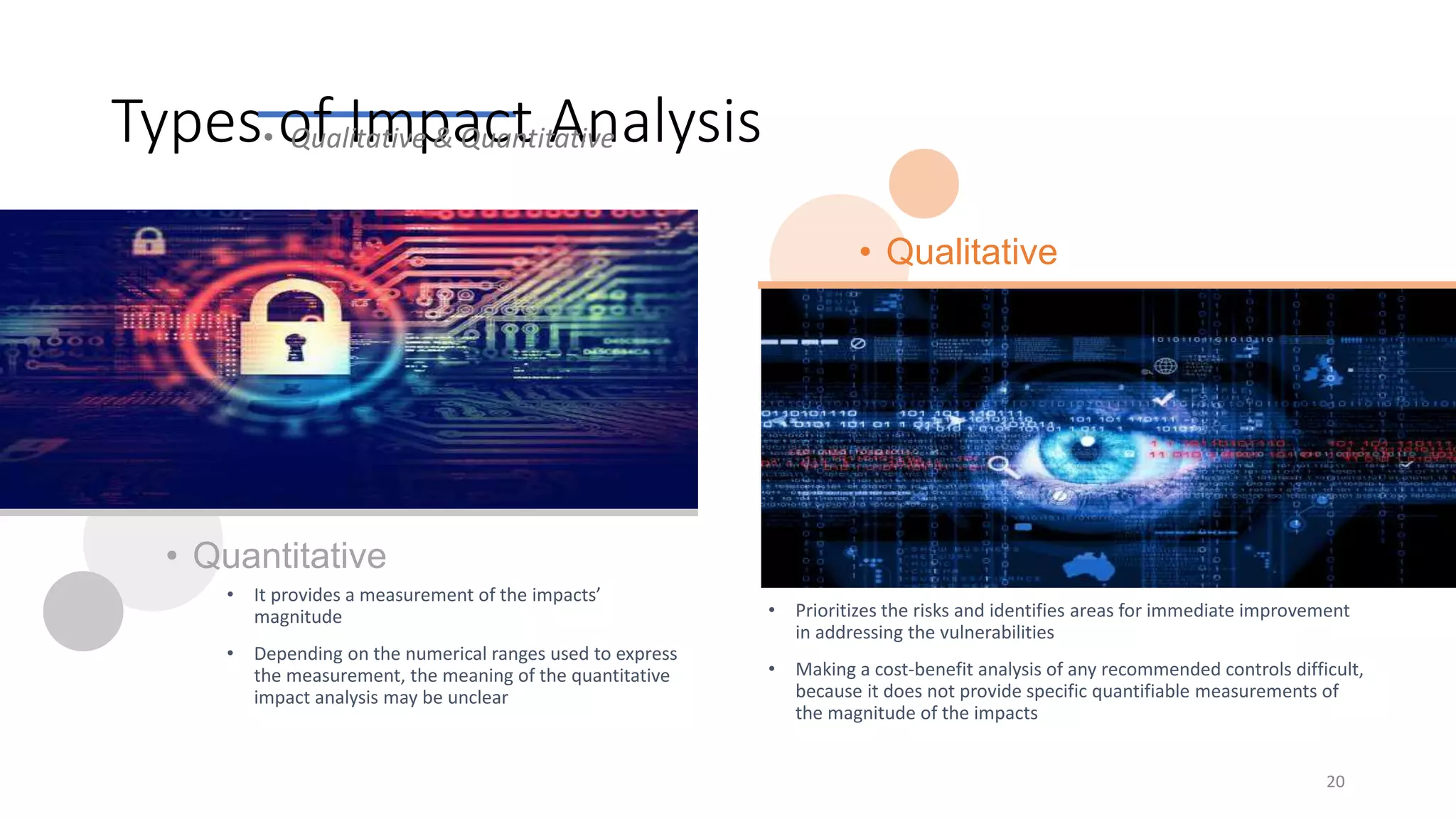
Types of Impact Analysis
20
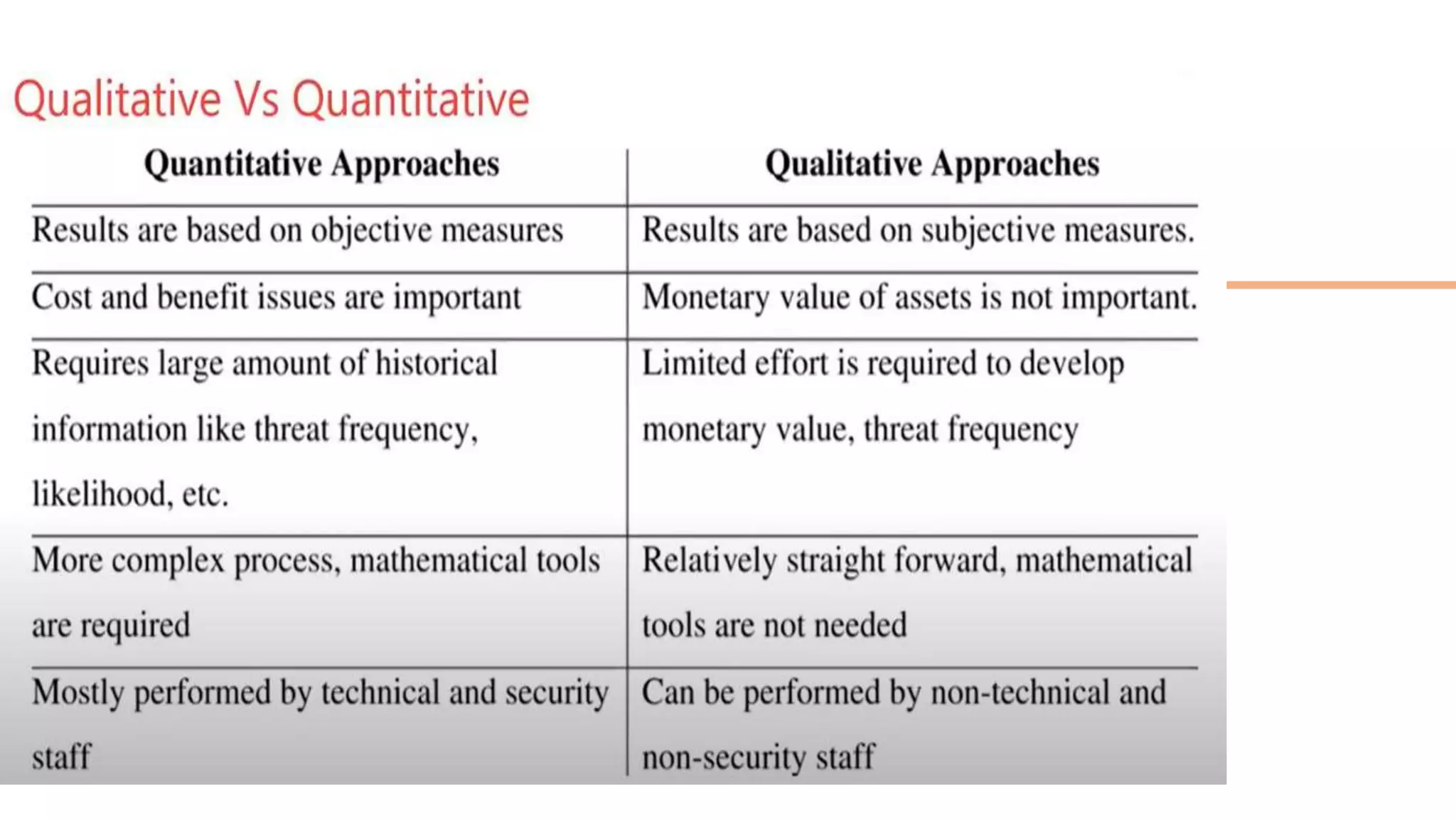
• Qualitative & Quantitative
• Quantitative
• It provides a measurement of the impacts’
magnitude
• Depending on the numerical ranges used to express
the measurement, the meaning of the quantitative
impact analysis may be unclear
• Qualitative
• Prioritizes the risks and identifies areas for immediate improvement
in addressing the vulnerabilities
• Making a cost-benefit analysis of any recommended controls difficult,
because it does not provide specific quantifiable measurements of
the magnitude of the impacts
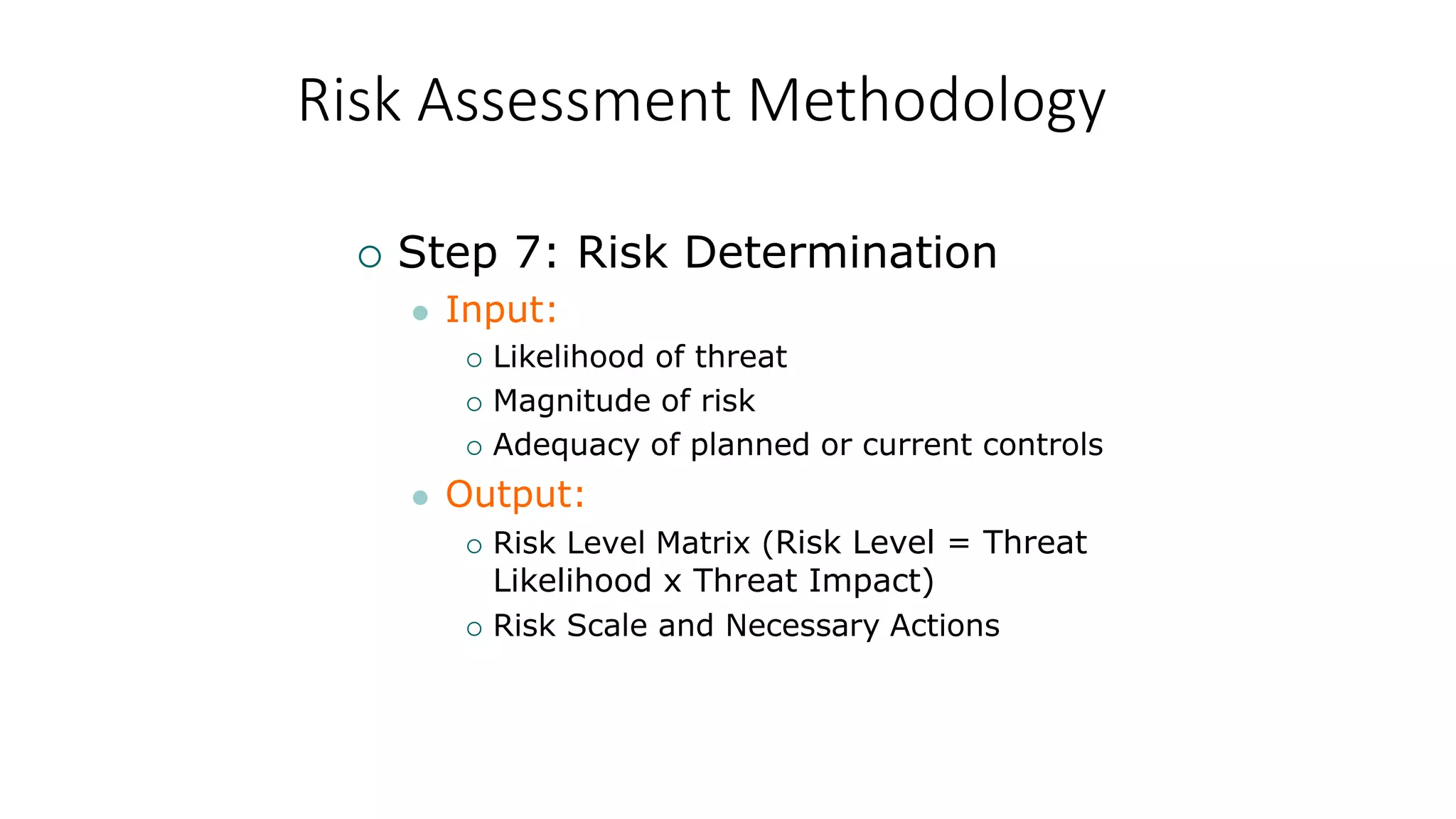
Risk Assessment Methodology
 Step 7: Risk Determination
 Input:
 Likelihood of threat
 Magnitude of risk
 Adequacy of planned or current controls
 Output:
 Risk Level Matrix (Risk Level = Threat
Likelihood x Threat Impact)
 Risk Scale and Necessary Actions
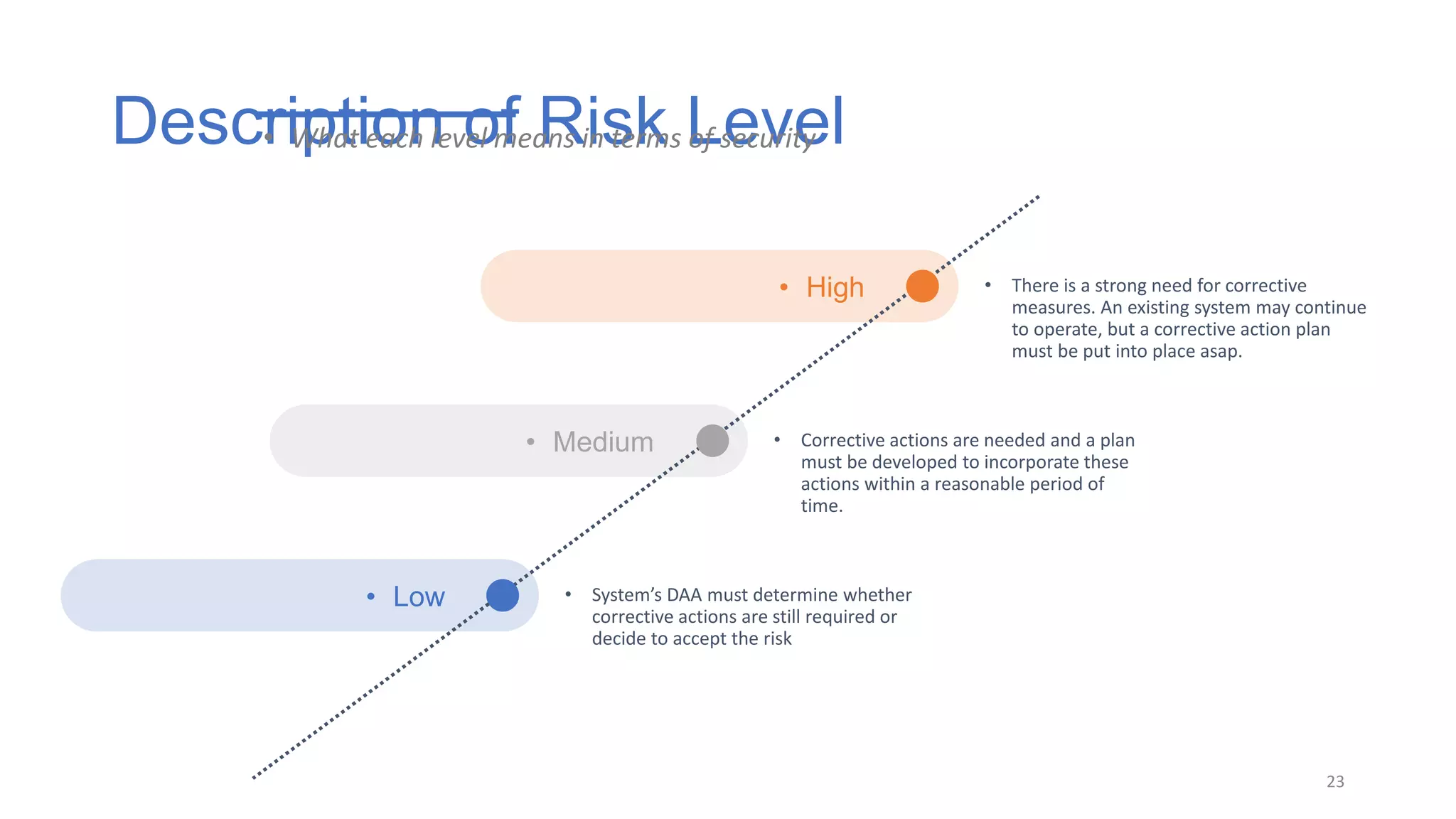
• Medium • Corrective actions are needed and a plan
must be developed to incorporate these
actions within a reasonable period of
time.
Description of Risk Level
23
• What each level means in terms of security
• Low • System’s DAA must determine whether
corrective actions are still required or
decide to accept the risk
• High • There is a strong need for corrective
measures. An existing system may continue
to operate, but a corrective action plan
must be put into place asap.
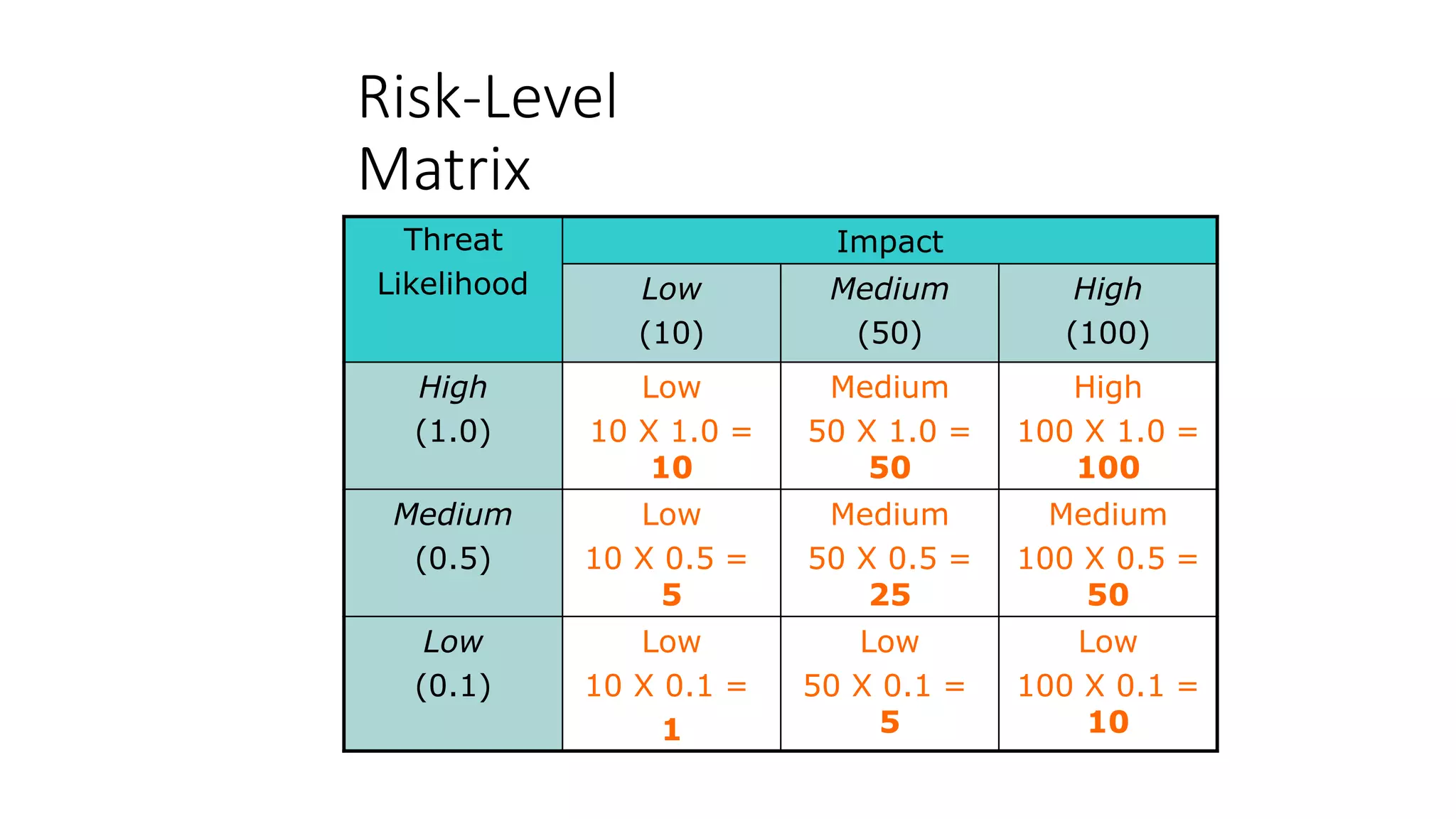
Risk-Level
Matrix
Threat
Likelihood
Impact
Low
(10)
Medium
(50)
High
(100)
High Low Medium High
(1.0) 10 X 1.0 =
10
50 X 1.0 =
50
100 X 1.0 =
100
Medium Low Medium Medium
(0.5) 10 X 0.5 =
5
50 X 0.5 =
25
100 X 0.5 =
50
Low Low Low Low
(0.1) 10 X 0.1 =
1
50 X 0.1 =
5
100 X 0.1 =
10
Risk Assessment Methodology
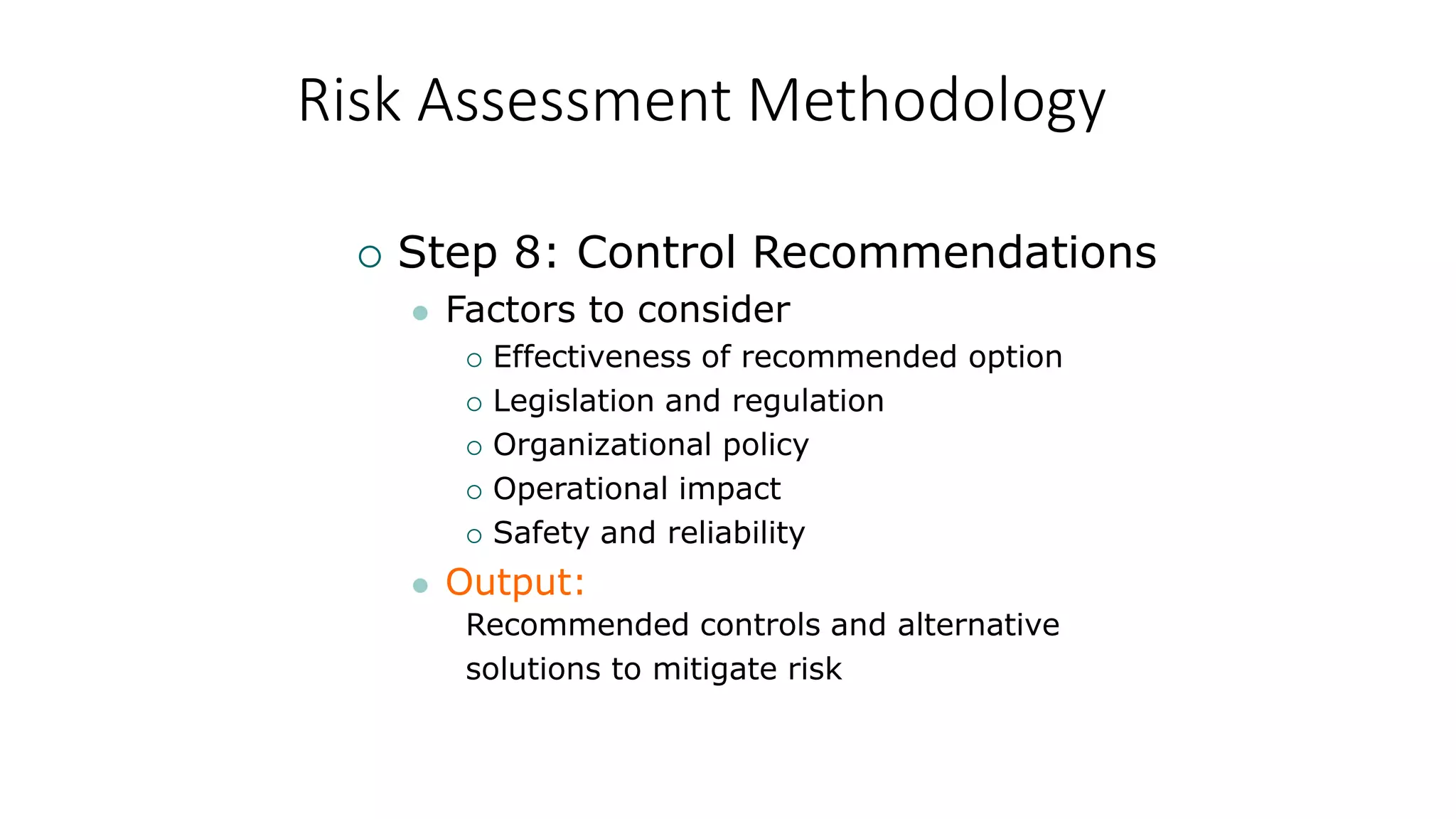
 Step 8: Control Recommendations
 Factors to consider
 Effectiveness of recommended option
 Legislation and regulation
 Organizational policy
 Operational impact
 Safety and reliability
 Output:
Recommended controls and alternative
solutions to mitigate risk
Control Recommendation
26
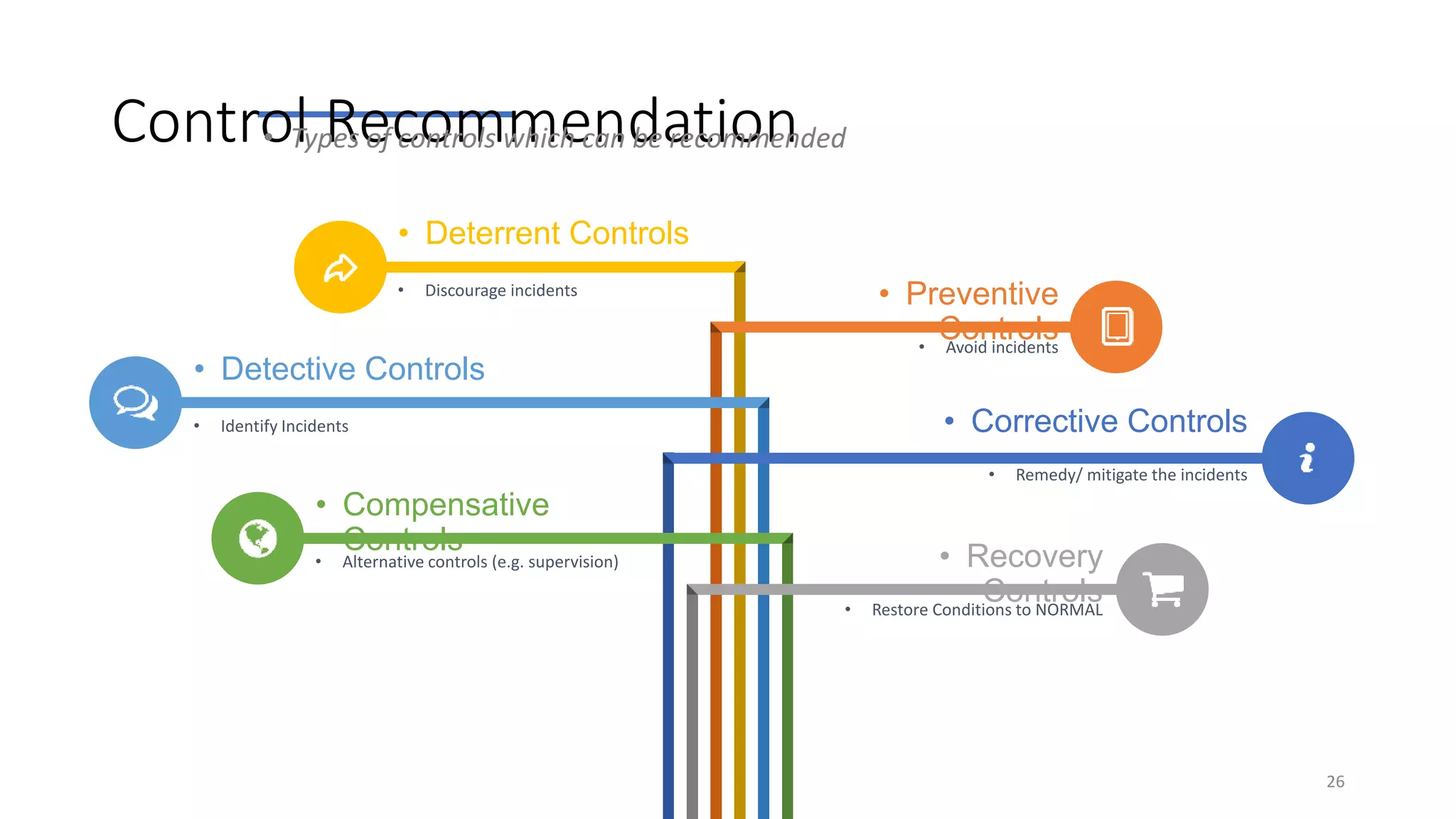
• Types of controls which can be recommended
• Deterrent Controls
• Discourage incidents
• Detective Controls
• Identify Incidents
• Compensative
Controls
• Alternative controls (e.g. supervision)
• Preventive
Controls• Avoid incidents
• Corrective Controls
• Remedy/ mitigate the incidents
• Recovery
Controls• Restore Conditions to NORMAL
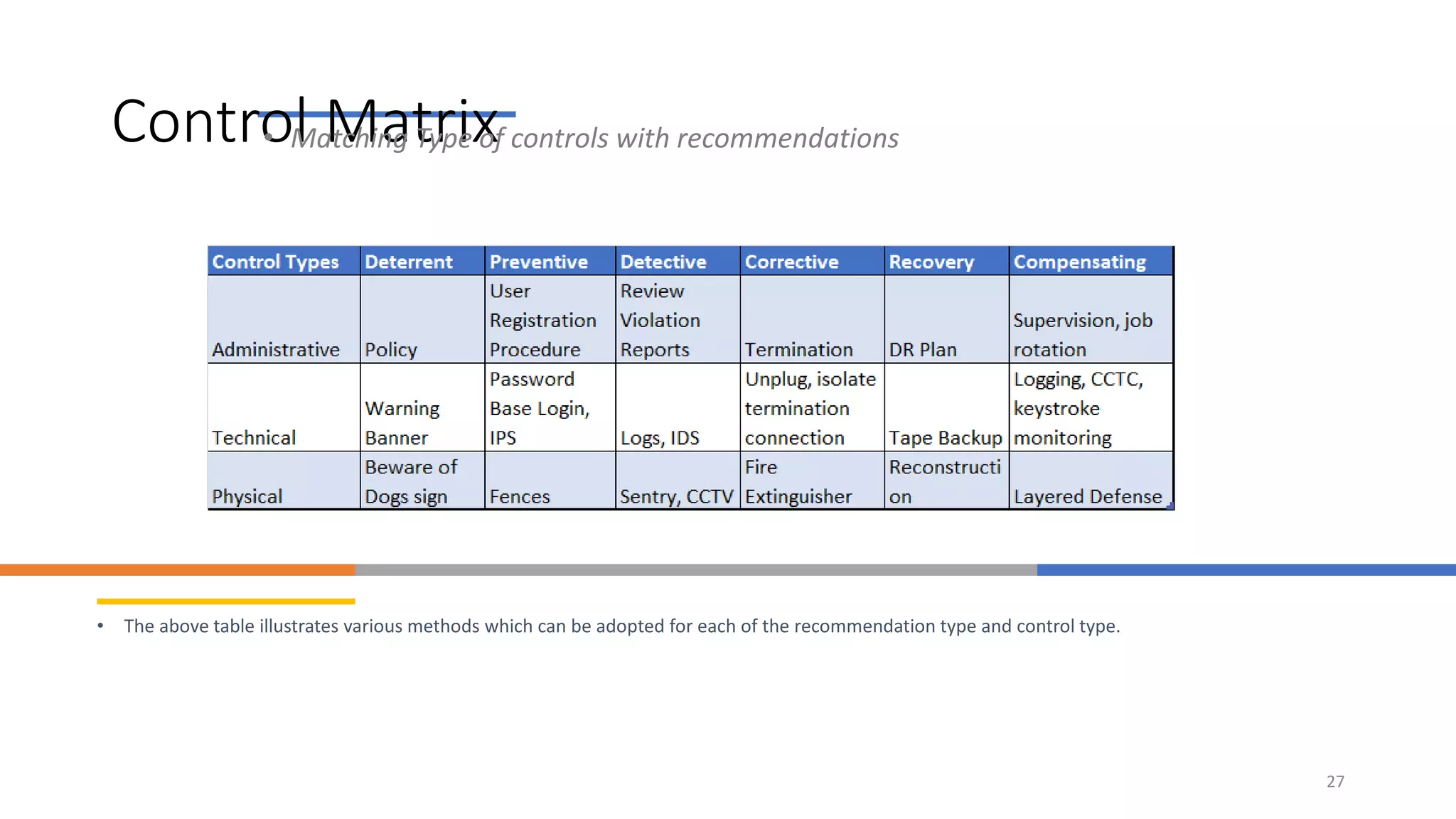
Control Matrix• Matching Type of controls with recommendations
• The above table illustrates various methods which can be adopted for each of the recommendation type and control type.
27
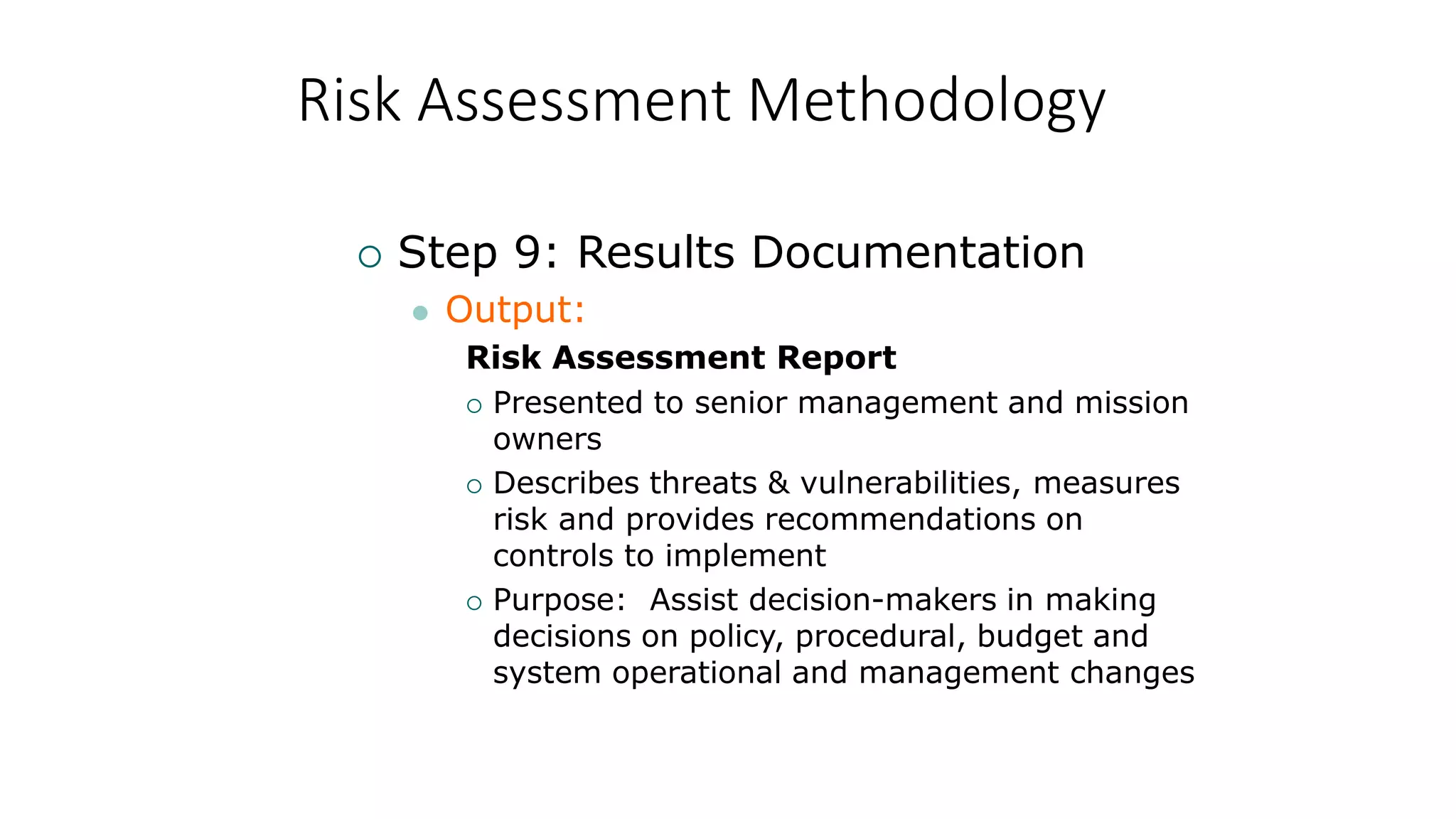
Risk Assessment Methodology
 Step 9: Results Documentation
 Output:
Risk Assessment Report
 Presented to senior management and mission
owners
 Describes threats & vulnerabilities, measures
risk and provides recommendations on
controls to implement
 Purpose: Assist decision-makers in making
decisions on policy, procedural, budget and
system operational and management changes
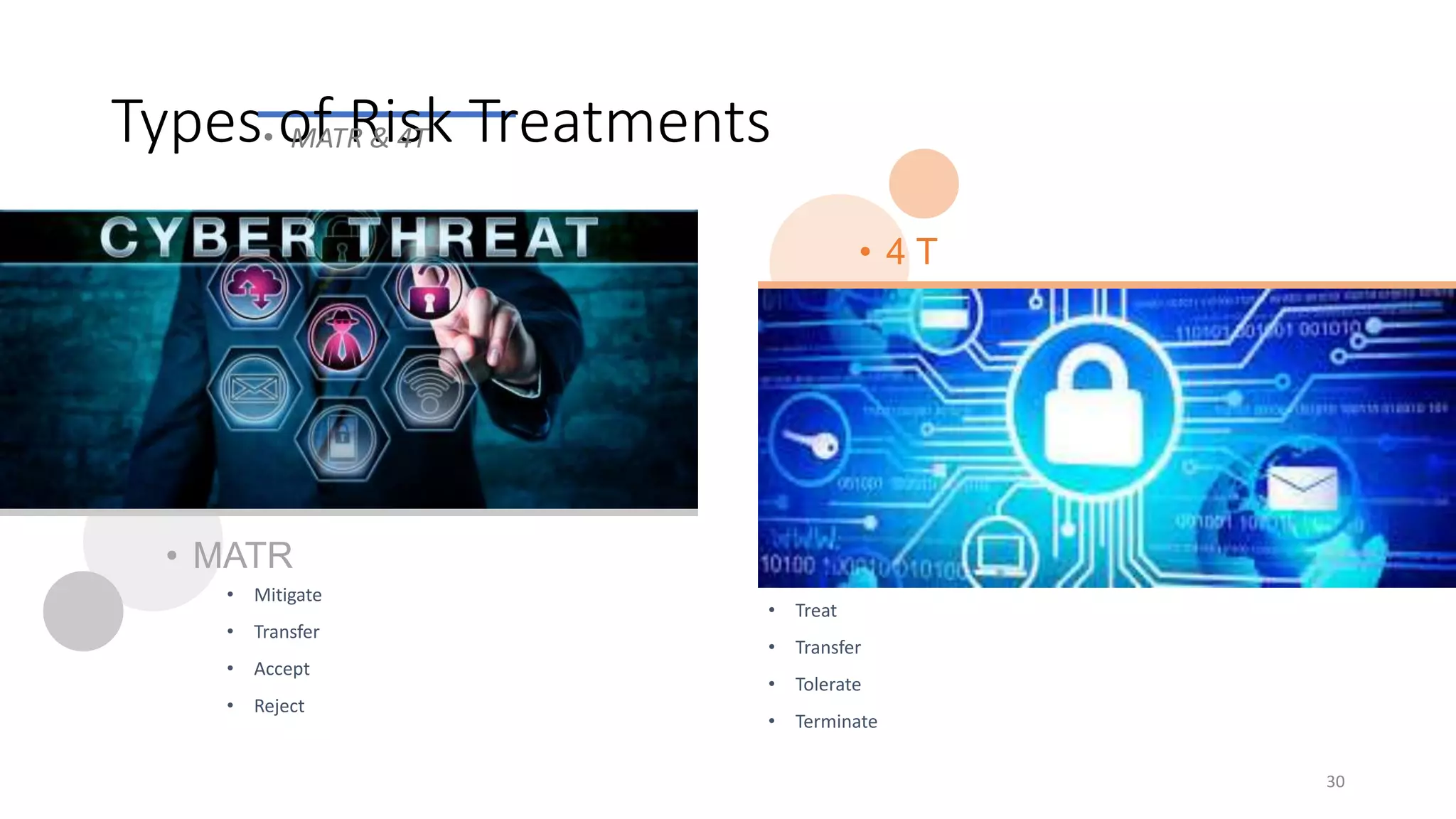
Types of Risk Treatments
30
• MATR & 4T
• MATR
• Mitigate
• Transfer
• Accept
• Reject
• 4 T
• Treat
• Transfer
• Tolerate
• Terminate
Risk Mitigation
31
• Mitigating the risks identified
• Risk Assumption
• Accepting potential risk & continue
operating the IT system or lower risk
to acceptable level
• Risk Limitation
• Controls which limit the risk by using supporting,
preventive detective controls
• Risk Planning
• Manage the risk by developing plans
which prioritize, implement and
manage controls
• Risk Avoidance
• Shout down/ forego some
systems/ functions when the
risks are identified.
• Research &
Acknowledgement• To lower the risk of loss by acknowledging the
vulnerability or flaw & researching controls to correct
the vulnerability
• Risk
Transference• Transfer the risk by using options
such as insurance
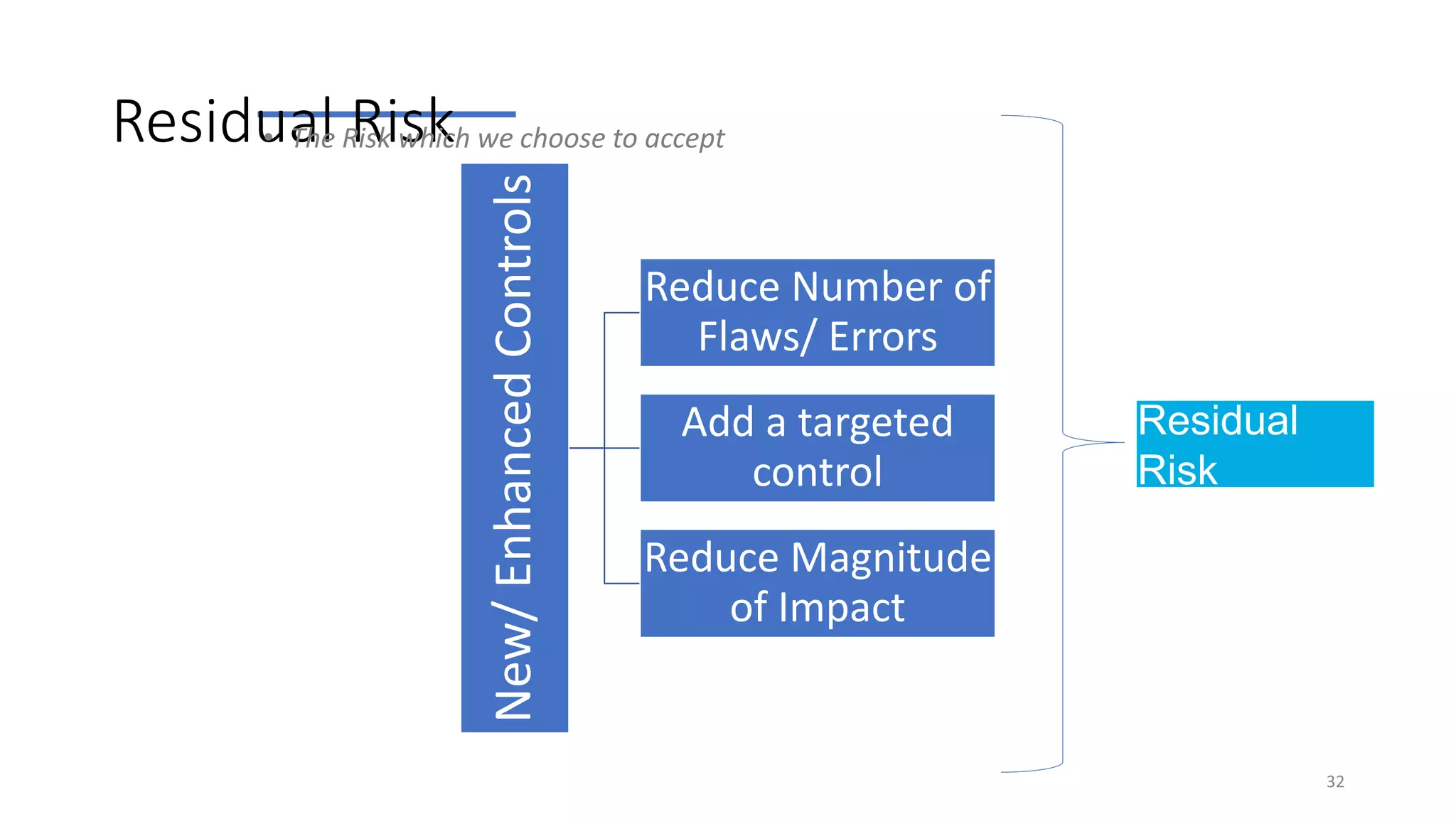
Residual Risk• The Risk which we choose to accept
32
New/EnhancedControls
Reduce Number of
Flaws/ Errors
Add a targeted
control
Reduce Magnitude
of Impact
Residual
Risk
33
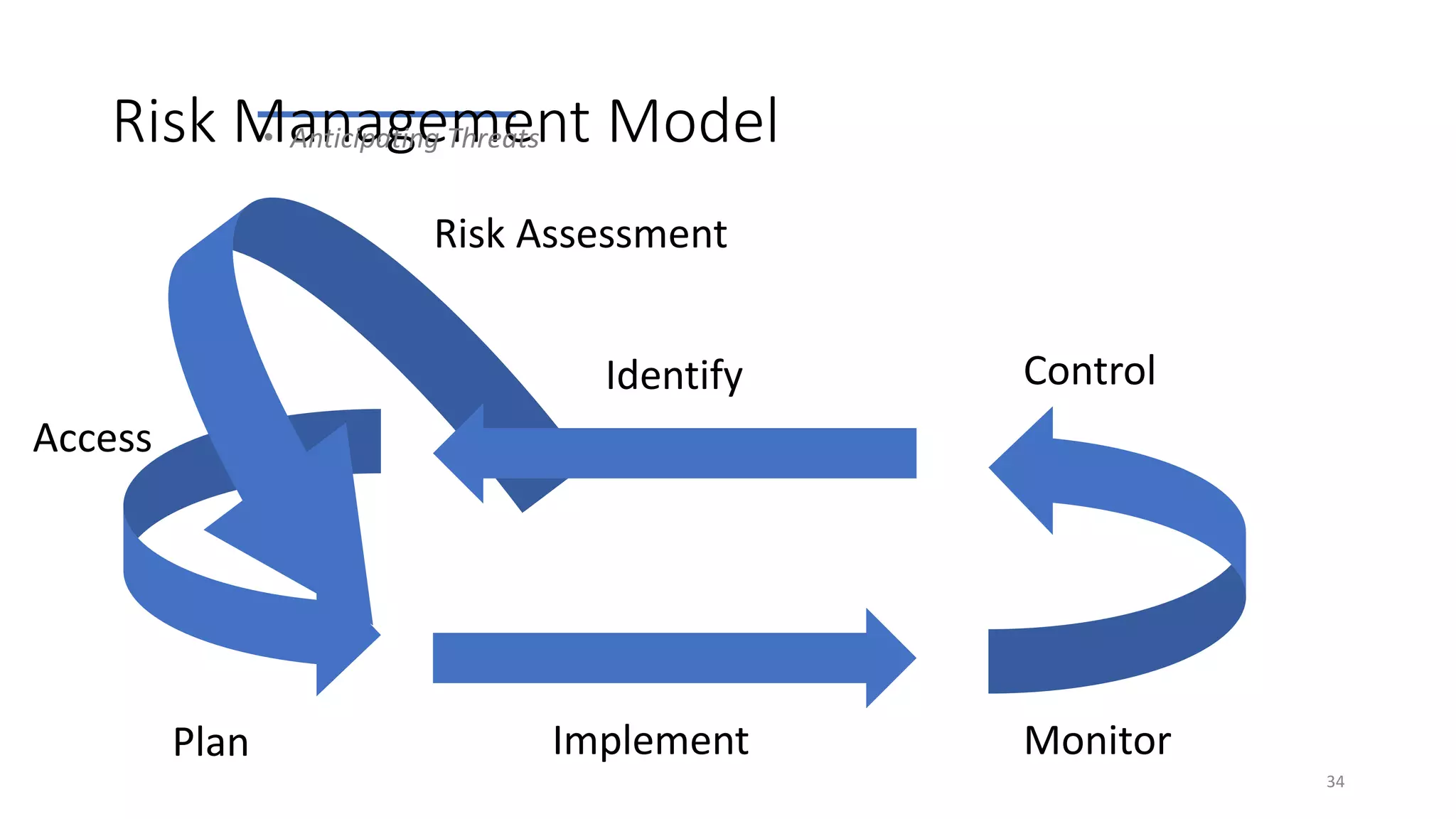
Risk Management Model• Anticipating Threats
34
Plan Implement Monitor
ControlIdentify
Access
Risk Assessment
•1
• INTRODUCTION
Risk assessment managment and risk based audit approach

Risk assessment managment and risk based audit approach

  • 1.
    1 Kiran Joshi Risk Assessmentand Management & Risk Based Audit Approaches
  • 2.
    1 2 3 4 5 6 Table of Contents • Introduction •Risk • Risk Based Audit Approaches • Keep it touch! • Risk Assessment and Calculations • Losses & Controls • Risk Management Model • Things to Consider • Risk Treatments • Types of Treatments • Methodology • How to manage the Risk? 2
  • 3.
    Risk Impact• TheEffect a Risk can have • The probability of something happening that will have an adverse impact upon any of the assets like people, plant, equipment, financials, data etc. and the impact of loss of such an asset both needs to be considered to quantify the risk. • Basis the classification then appropriate actions can be taken as per cost benefit analysis • Risk = (probability of event occurring) x (impact of the event occurring) 3
  • 4.
    Risk Assessment –a definition •“The process of identifying the risks to system security and determining •the probability of occurrence, the resulting impact, •and additional safeguards that would mitigate this impact.”
  • 5.
    Classification of Losses•The types of losses which can occur • Financial • Operational • Reputational • Legal 5 loss of money or decrease in financial value. loss of operational integrity of the process. loss reputation of the organization due to interruption of services . Losses means any and all Expenses, damages, losses, liabilities, judgments, fines, penalties.
  • 6.
    The Power ofPowerPoint | thepopp.com 6 • 1.Inherent risk • 2.Control risk • 3.Detection risk • Types of risk • 4.Overall audit risk • (Inherent * Control * Detection)
  • 7.
  • 8.
  • 9.
    Risk Assessment Methodology Step 1: System Characterization  Input: system-related info including  Hardware  Software  System interfaces  Data and information  People  System mission  Output: A good picture of system boundary, functions, criticality and sensitivity
  • 10.
    Risk Assessment Methodology Step 2: Threat Identification  Input:  Security violation reports  Incident reports  Data from intelligence agencies and mass media  Output: Threat statement listing potential threat- sources (natural, human, environmental) applicable to the system being evaluated
  • 11.
    Risk Assessment Methodology Step 3: Vulnerability Identification  Input:  System security tests (e.g. VA/penetration tests)  Audit results  Vulnerability lists/advisories  Automated Vulnerability scanning tool- Nessus, GFI, Open VAS, etc.  Security Test & Evaluation (ST & E)- Development & Execution of test plan  Security requirements checklist (contains basic security standards)  Output: List of system vulnerabilities (flaws or weaknesses) that could be exploited – Vulnerability/Threat pairs
  • 12.
    Security Analysis Technique 12 •Ways to analyze the controls’ sufficiency • Vulnerability Assessment • Application Design Review • Source Code Review • Penetration Testing • Security Assessment & Audit • Gap Analysis
  • 13.
    • Operational •Controlling env. like smoke, dust etc., power supply, media access & disposal, external data distribution, facility protection, humidity, temperature control etc. Vulnerability Sources 13 • Major area to be included • Technical • Communications, cryptography, discretionary access control, identification & authentication, intrusion detection, object reuse, system audit • Management • Assigning Responsibilities, support continuity, incident response capability, periodic review, risk assessment, security & technical training etc.
  • 14.
    Risk Assessment Methodology Step 4: Control Analysis  Input: current controls, planned controls  Control Methods – may be technical or non- technical  Control Categories – preventative or detective (e.g. audit trails)  Output: List of current and planned controls
  • 15.
    • Technical (Logical)• Anti virus programs, password protection, firewall, ACLs, auditing etc. Types of Controls 15 • What each level means in terms of security • Physical • Locks, alarms etc. • Administrative • Policies & procedures; including personal controls such as security clearances, background checks etc.
  • 16.
    Risk Assessment Methodology Step 5: Likelihood Determination  Input:  Threat-source motivation & capability  Nature of the vulnerability  Existence & effectiveness of current controls  Output: Likelihood rating of High, Medium or Low
  • 17.
    • Medium •The threat source is motivated and capable, but controls are in place that may impede successful exercise of the vulnerability Likelihood Level 17 • The Probability of Event Occurring • Low • The threat-source lacks motivation or capability or controls are in place to prevent, or at least significantly impede, the vulnerability from being exercised • High • The Threat-source is highly motivated and sufficiently capable, and controls to prevent the vulnerability from being exercised are ineffective
  • 18.
    Risk Assessment Methodology Step 6: Impact Analysis  Input:  System mission  System and data criticality  System and data sensitivity  Analysis: Adverse impact described in terms of loss or degradation of integrity, confidentiality, availability  Output: Impact Rating of High, Medium or Low
  • 19.
    • Medium •Exercise of the vulnerability may result in (1) expensive loss of some tangible assets or resources (2) some damage to organization (3) human injury Magnitude of Impact Analysis 19 • Measuring the Impact • Low • Exercise of the vulnerability may result in (1) some loss of some tangible assets or resources (2) may affect organization’s mission, reputation or interest • High • Exercise of the vulnerability may result in (1) expensive loss of major tangible assets or resources (2) significant damage to organization (3) human death/ injury
  • 20.
    Types of ImpactAnalysis 20 • Qualitative & Quantitative • Quantitative • It provides a measurement of the impacts’ magnitude • Depending on the numerical ranges used to express the measurement, the meaning of the quantitative impact analysis may be unclear • Qualitative • Prioritizes the risks and identifies areas for immediate improvement in addressing the vulnerabilities • Making a cost-benefit analysis of any recommended controls difficult, because it does not provide specific quantifiable measurements of the magnitude of the impacts
  • 22.
    Risk Assessment Methodology Step 7: Risk Determination  Input:  Likelihood of threat  Magnitude of risk  Adequacy of planned or current controls  Output:  Risk Level Matrix (Risk Level = Threat Likelihood x Threat Impact)  Risk Scale and Necessary Actions
  • 23.
    • Medium •Corrective actions are needed and a plan must be developed to incorporate these actions within a reasonable period of time. Description of Risk Level 23 • What each level means in terms of security • Low • System’s DAA must determine whether corrective actions are still required or decide to accept the risk • High • There is a strong need for corrective measures. An existing system may continue to operate, but a corrective action plan must be put into place asap.
  • 24.
    Risk-Level Matrix Threat Likelihood Impact Low (10) Medium (50) High (100) High Low MediumHigh (1.0) 10 X 1.0 = 10 50 X 1.0 = 50 100 X 1.0 = 100 Medium Low Medium Medium (0.5) 10 X 0.5 = 5 50 X 0.5 = 25 100 X 0.5 = 50 Low Low Low Low (0.1) 10 X 0.1 = 1 50 X 0.1 = 5 100 X 0.1 = 10
  • 25.
    Risk Assessment Methodology Step 8: Control Recommendations  Factors to consider  Effectiveness of recommended option  Legislation and regulation  Organizational policy  Operational impact  Safety and reliability  Output: Recommended controls and alternative solutions to mitigate risk
  • 26.
    Control Recommendation 26 • Typesof controls which can be recommended • Deterrent Controls • Discourage incidents • Detective Controls • Identify Incidents • Compensative Controls • Alternative controls (e.g. supervision) • Preventive Controls• Avoid incidents • Corrective Controls • Remedy/ mitigate the incidents • Recovery Controls• Restore Conditions to NORMAL
  • 27.
    Control Matrix• MatchingType of controls with recommendations • The above table illustrates various methods which can be adopted for each of the recommendation type and control type. 27
  • 28.
    Risk Assessment Methodology Step 9: Results Documentation  Output: Risk Assessment Report  Presented to senior management and mission owners  Describes threats & vulnerabilities, measures risk and provides recommendations on controls to implement  Purpose: Assist decision-makers in making decisions on policy, procedural, budget and system operational and management changes
  • 30.
    Types of RiskTreatments 30 • MATR & 4T • MATR • Mitigate • Transfer • Accept • Reject • 4 T • Treat • Transfer • Tolerate • Terminate
  • 31.
    Risk Mitigation 31 • Mitigatingthe risks identified • Risk Assumption • Accepting potential risk & continue operating the IT system or lower risk to acceptable level • Risk Limitation • Controls which limit the risk by using supporting, preventive detective controls • Risk Planning • Manage the risk by developing plans which prioritize, implement and manage controls • Risk Avoidance • Shout down/ forego some systems/ functions when the risks are identified. • Research & Acknowledgement• To lower the risk of loss by acknowledging the vulnerability or flaw & researching controls to correct the vulnerability • Risk Transference• Transfer the risk by using options such as insurance
  • 32.
    Residual Risk• TheRisk which we choose to accept 32 New/EnhancedControls Reduce Number of Flaws/ Errors Add a targeted control Reduce Magnitude of Impact Residual Risk
  • 33.
  • 34.
    Risk Management Model•Anticipating Threats 34 Plan Implement Monitor ControlIdentify Access Risk Assessment
  • 35.