Microsoft©
Information
Security - Cloud & Mobile
Presented by
Vijay Mohire
1
Introduction
2
Information Security and Risk
Management (IS&RM)
• Microsoft’s Information Security (InfoSec) organization
• Responsible for information security risk management
• Information protection, enterprise business continuity
planning
• Accelerate secure and reliable business for Microsoft,
partners and customers
• Publisher of The Security Risk Management Guide
3
ACE team
• The ACE (Assessment, Consulting & Engineering) team
is the assessment arm of Microsoft’s Information
Security & Risk Mgmt. (IS&RM) organization
• Provides security assessment services to both Microsoft
and Microsoft’s enterprise + public sector customers
• Shares and showcases with external customers how
Microsoft manages risks
• Learns and brings back best practices from Microsoft’s
customers
4
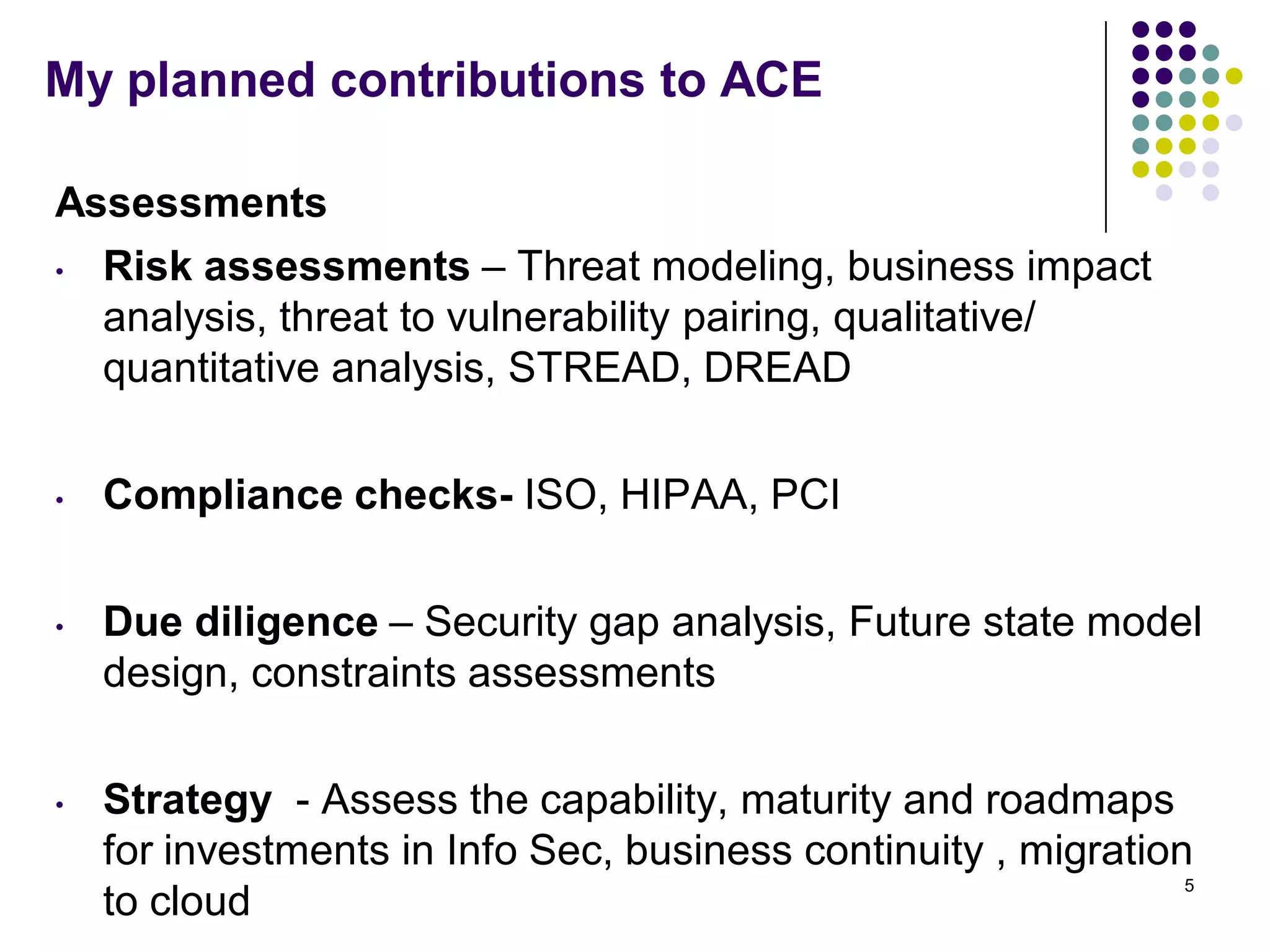
My planned contributions to ACE
Assessments
• Risk assessments – Threat modeling, business impact
analysis, threat to vulnerability pairing, qualitative/
quantitative analysis, STREAD, DREAD
• Compliance checks- ISO, HIPAA, PCI
• Due diligence – Security gap analysis, Future state model
design, constraints assessments
• Strategy - Assess the capability, maturity and roadmaps
for investments in Info Sec, business continuity , migration
to cloud
5
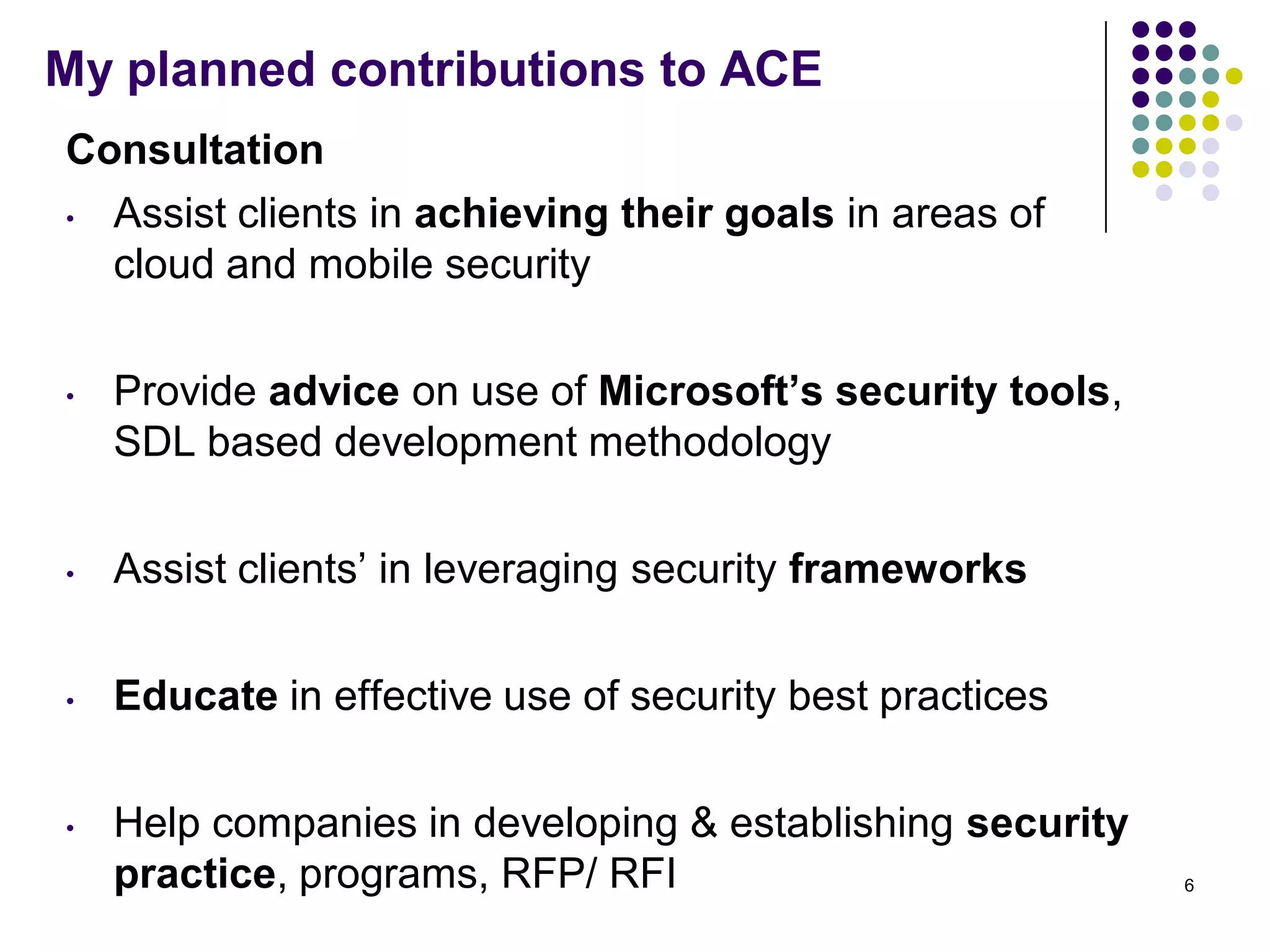
My planned contributions to ACE
Consultation
• Assist clients in achieving their goals in areas of
cloud and mobile security
• Provide advice on use of Microsoft’s security tools,
SDL based development methodology
• Assist clients’ in leveraging security frameworks
• Educate in effective use of security best practices
• Help companies in developing & establishing security
practice, programs, RFP/ RFI 6
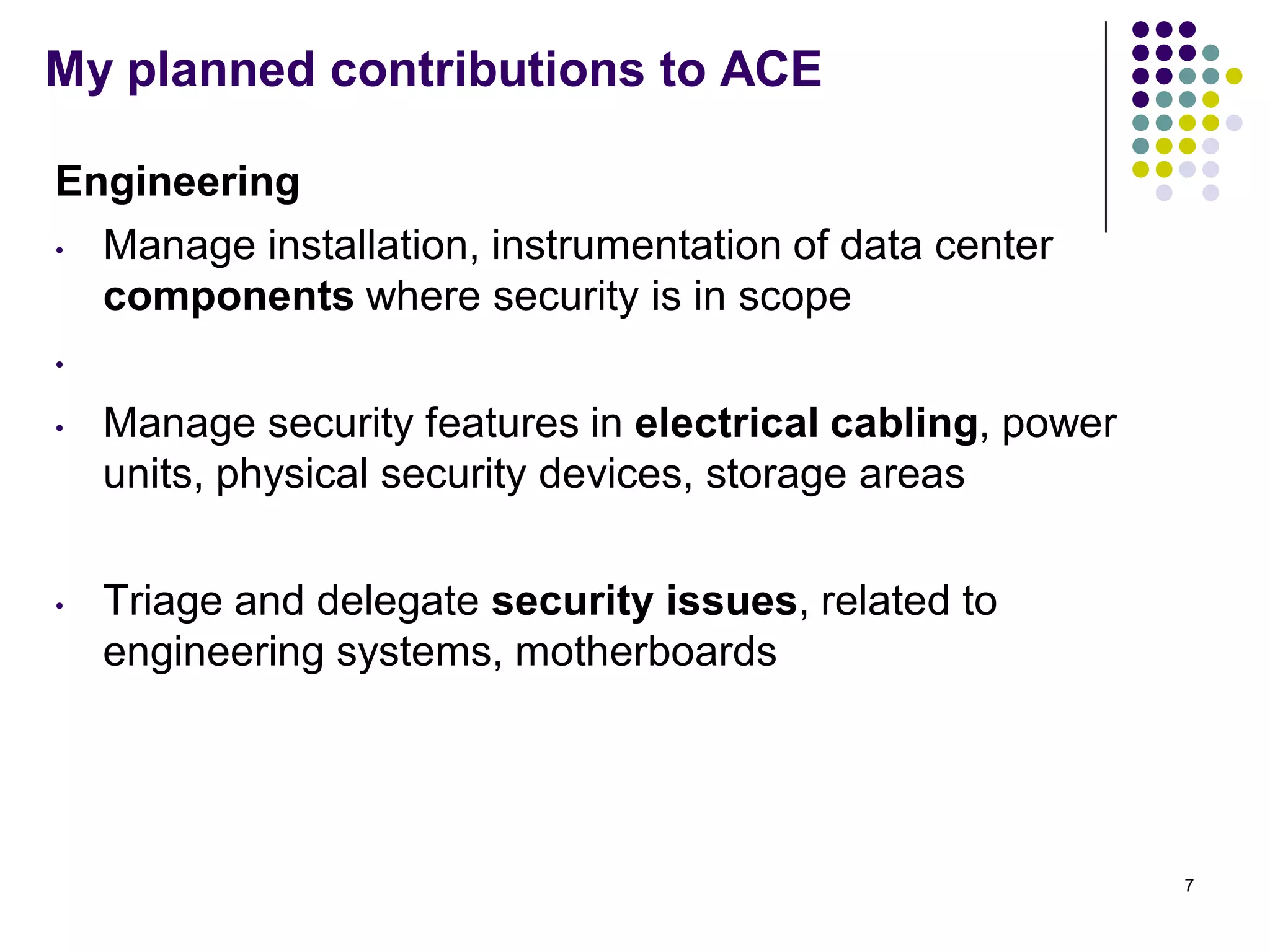
My planned contributions to ACE
Engineering
• Manage installation, instrumentation of data center
components where security is in scope
•
• Manage security features in electrical cabling, power
units, physical security devices, storage areas
• Triage and delegate security issues, related to
engineering systems, motherboards
7
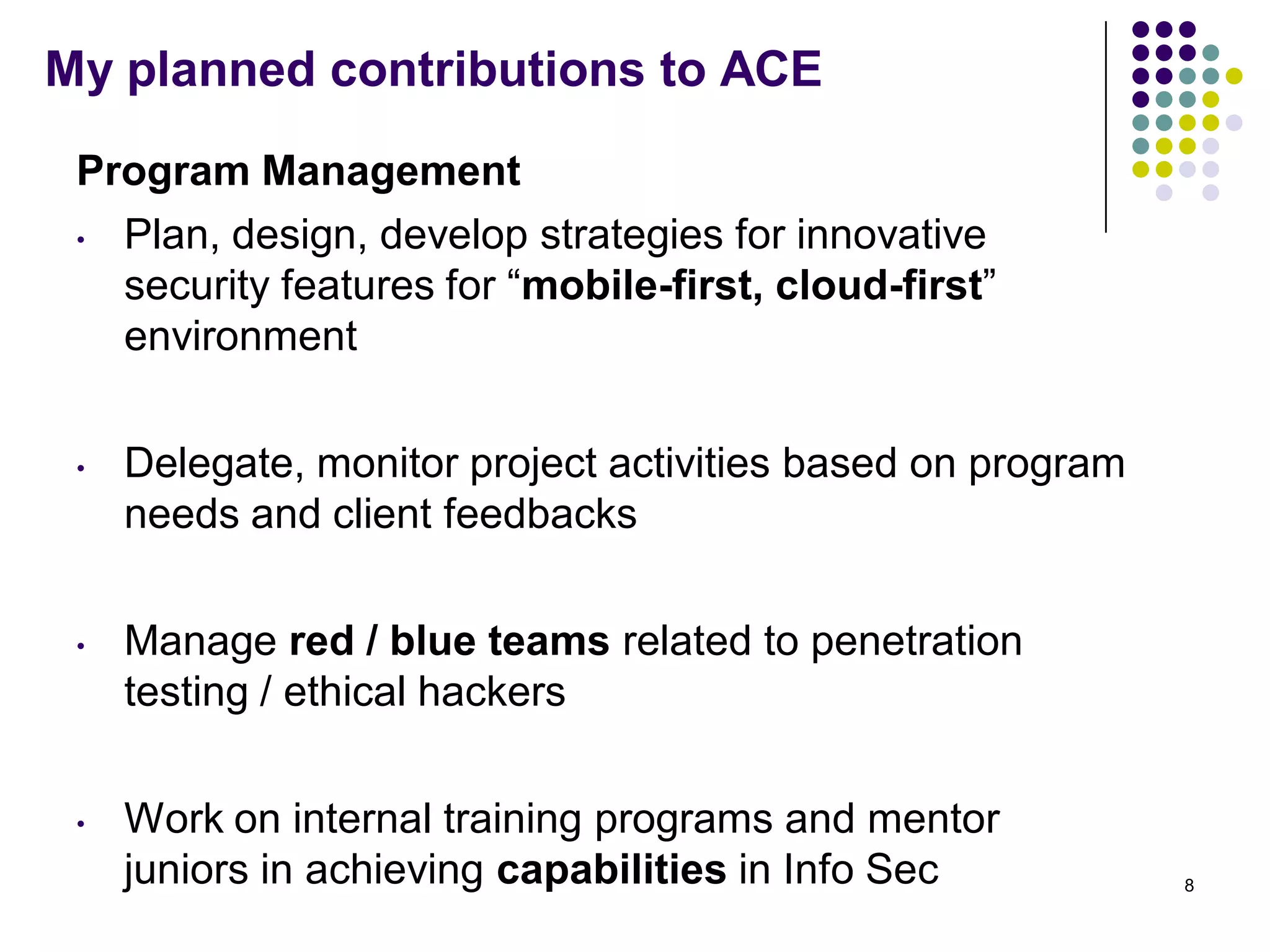
My planned contributions to ACE
Program Management
• Plan, design, develop strategies for innovative
security features for ―mobile-first, cloud-first‖
environment
• Delegate, monitor project activities based on program
needs and client feedbacks
• Manage red / blue teams related to penetration
testing / ethical hackers
• Work on internal training programs and mentor
juniors in achieving capabilities in Info Sec 8
Info-Sec basics
9
Risk
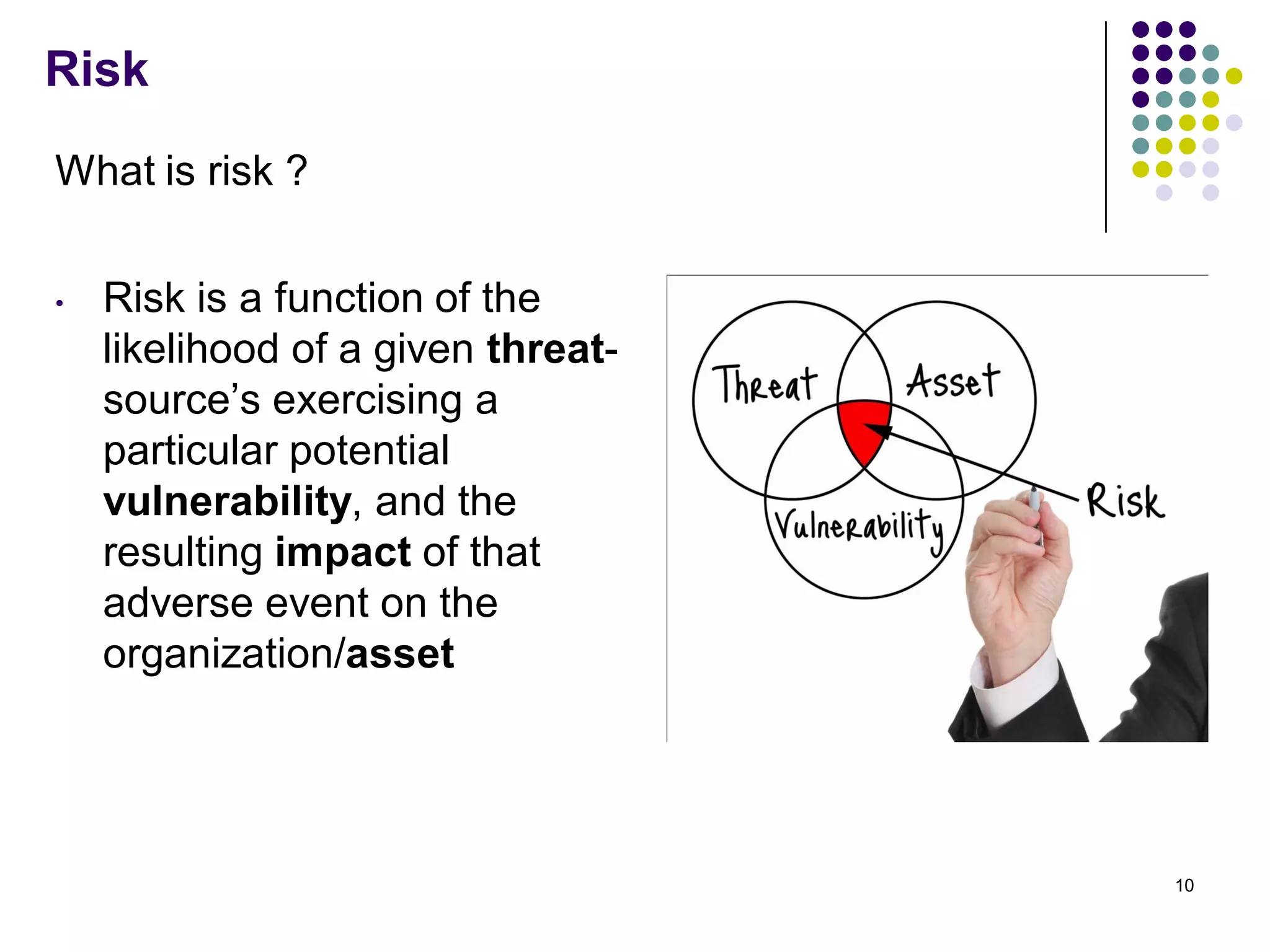
What is risk ?
• Risk is a function of the
likelihood of a given threat-
source’s exercising a
particular potential
vulnerability, and the
resulting impact of that
adverse event on the
organization/asset
10
Threat-sources
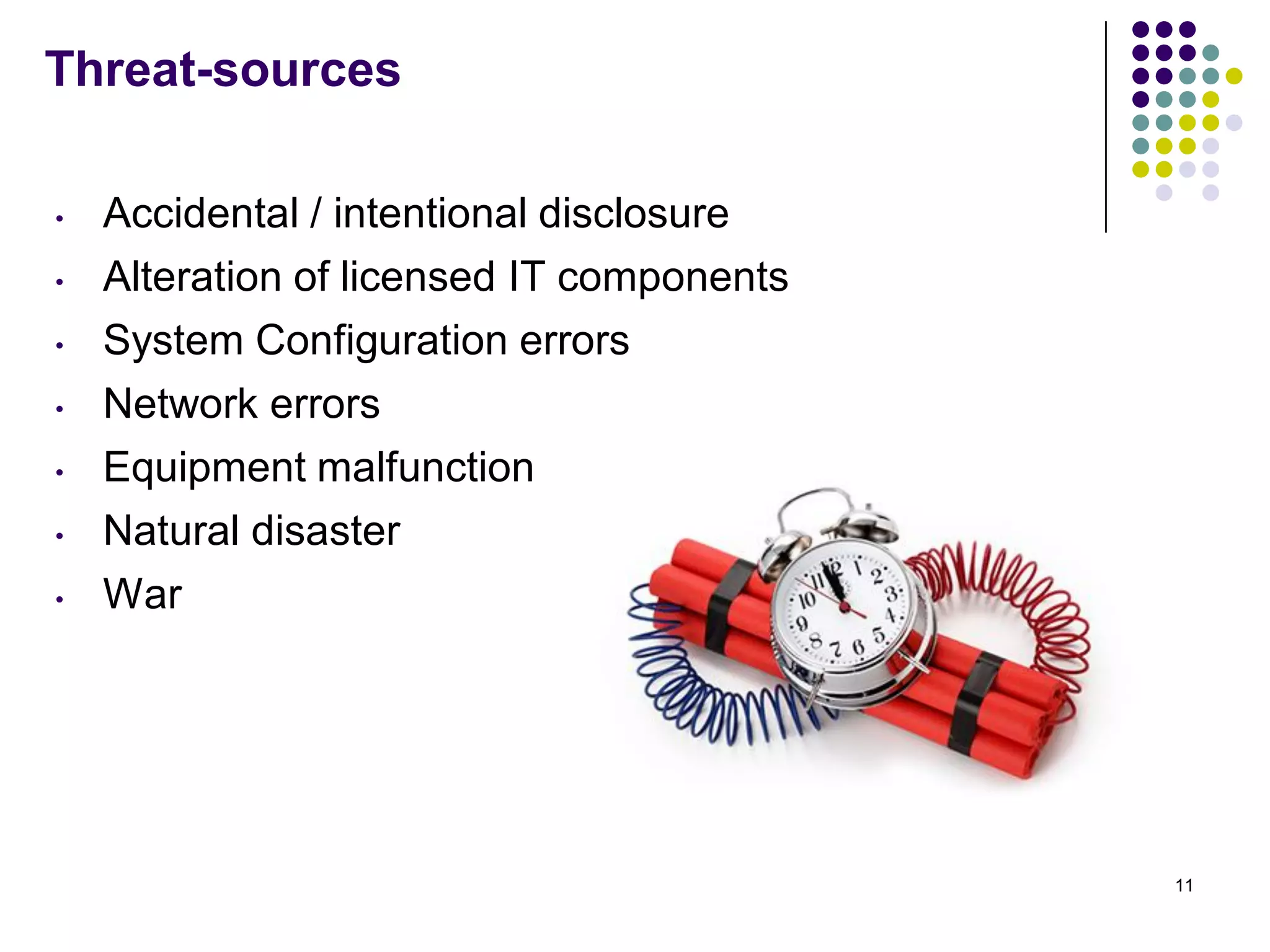
• Accidental / intentional disclosure
• Alteration of licensed IT components
• System Configuration errors
• Network errors
• Equipment malfunction
• Natural disaster
• War
11
Vulnerability
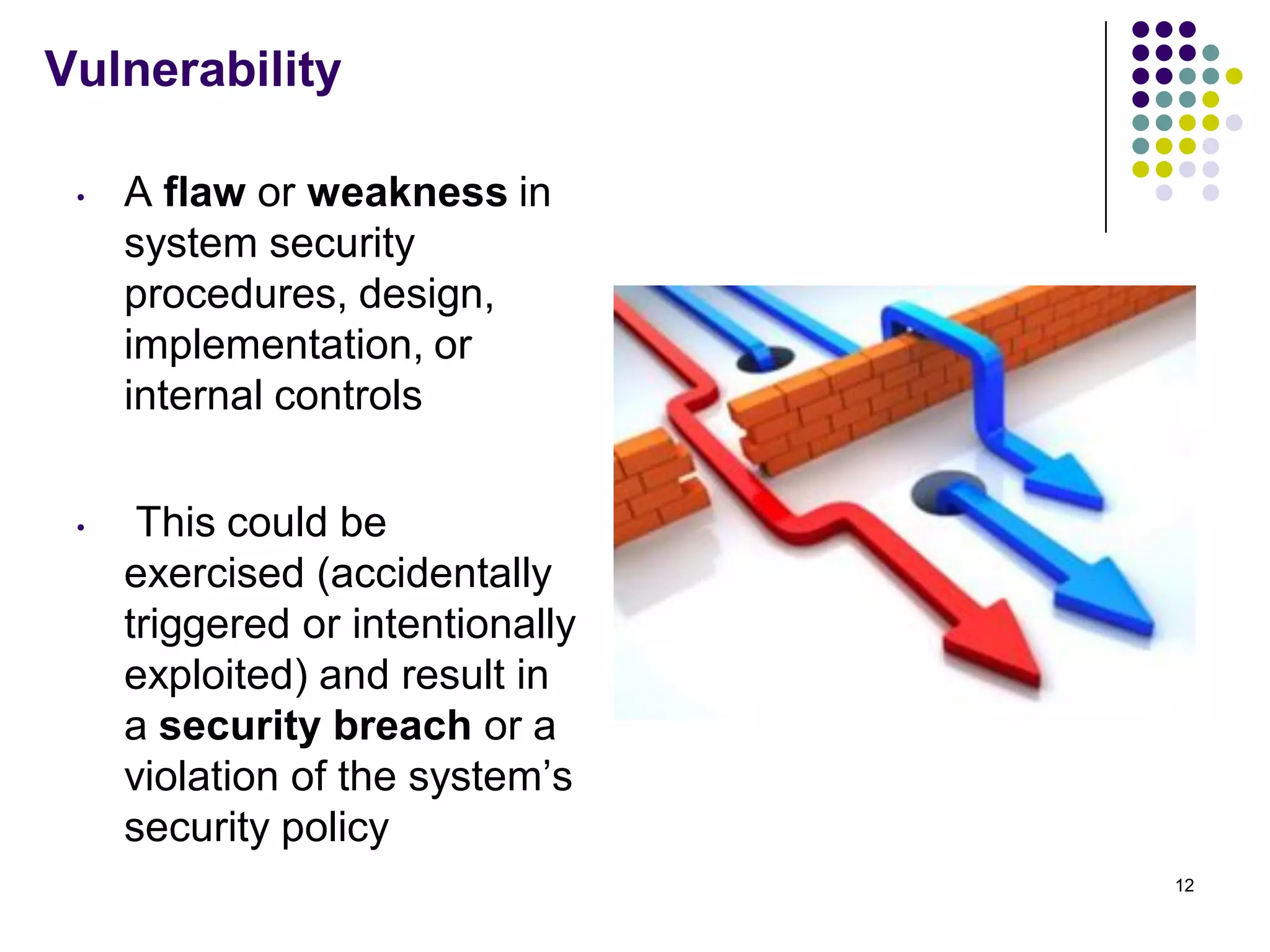
• A flaw or weakness in
system security
procedures, design,
implementation, or
internal controls
• This could be
exercised (accidentally
triggered or intentionally
exploited) and result in
a security breach or a
violation of the system’s
security policy
12
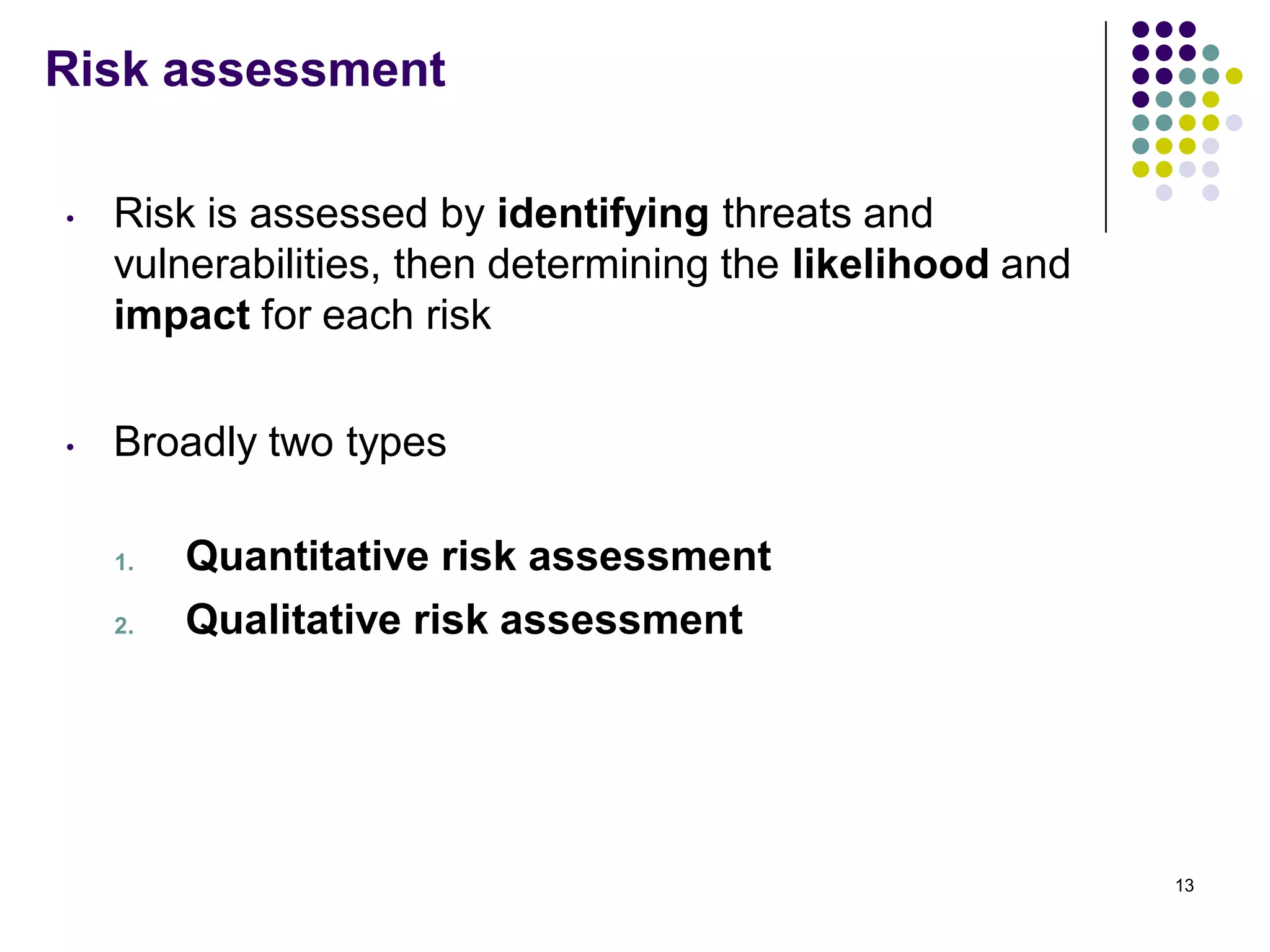
Risk assessment
• Risk is assessed by identifying threats and
vulnerabilities, then determining the likelihood and
impact for each risk
• Broadly two types
1. Quantitative risk assessment
2. Qualitative risk assessment
13
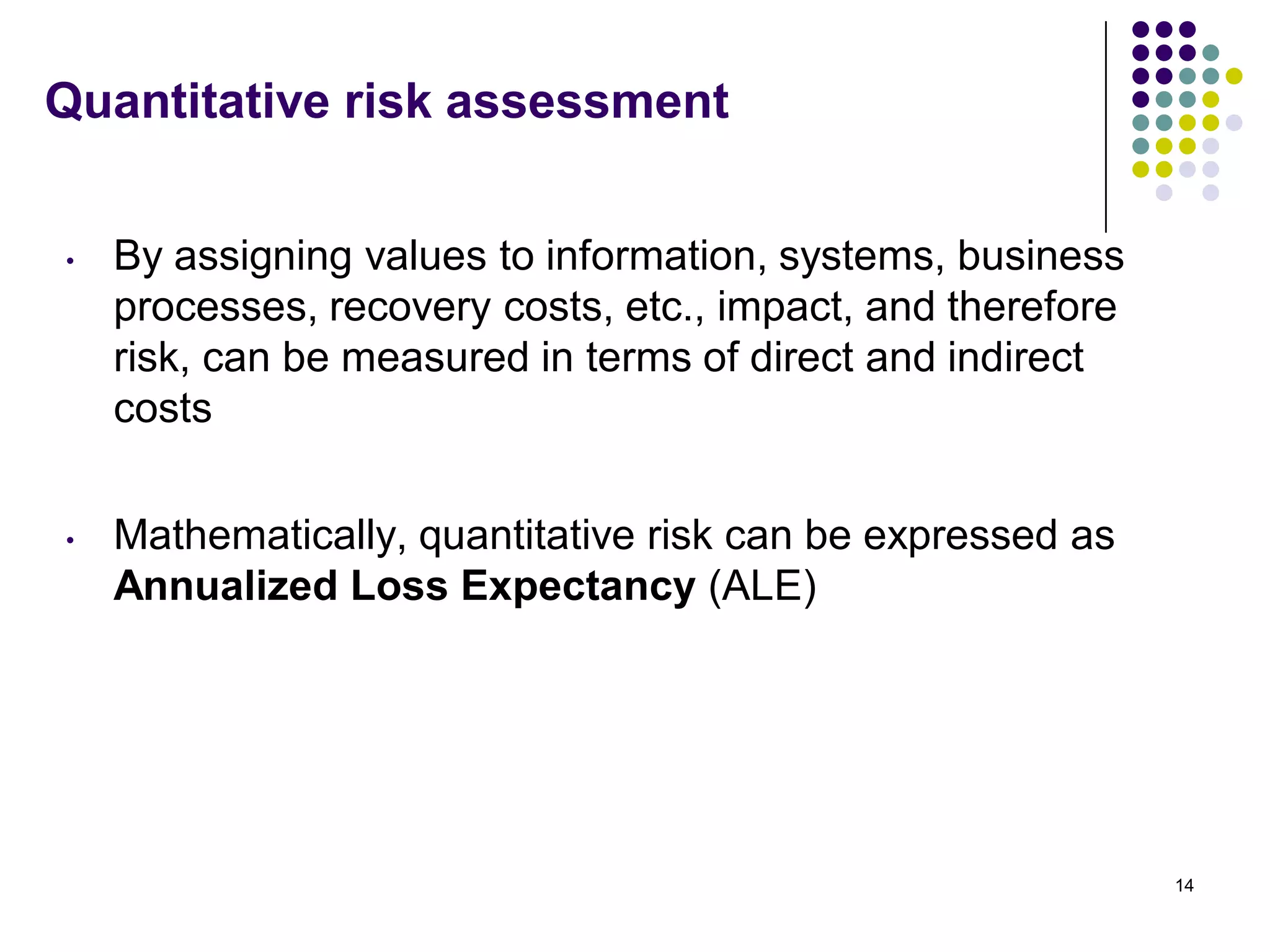
Quantitative risk assessment
• By assigning values to information, systems, business
processes, recovery costs, etc., impact, and therefore
risk, can be measured in terms of direct and indirect
costs
• Mathematically, quantitative risk can be expressed as
Annualized Loss Expectancy (ALE)
14
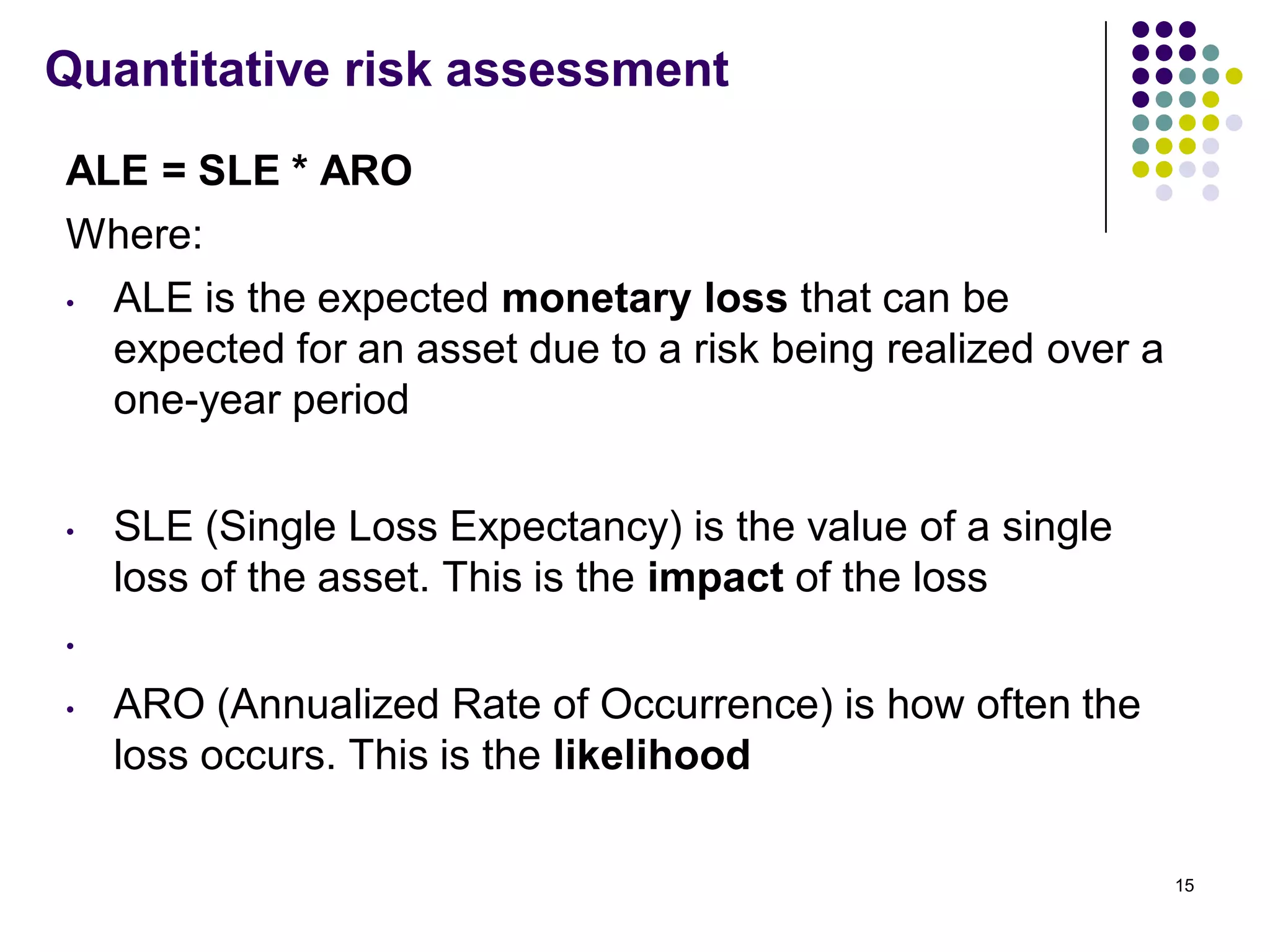
Quantitative risk assessment
ALE = SLE * ARO
Where:
• ALE is the expected monetary loss that can be
expected for an asset due to a risk being realized over a
one-year period
• SLE (Single Loss Expectancy) is the value of a single
loss of the asset. This is the impact of the loss
•
• ARO (Annualized Rate of Occurrence) is how often the
loss occurs. This is the likelihood
15
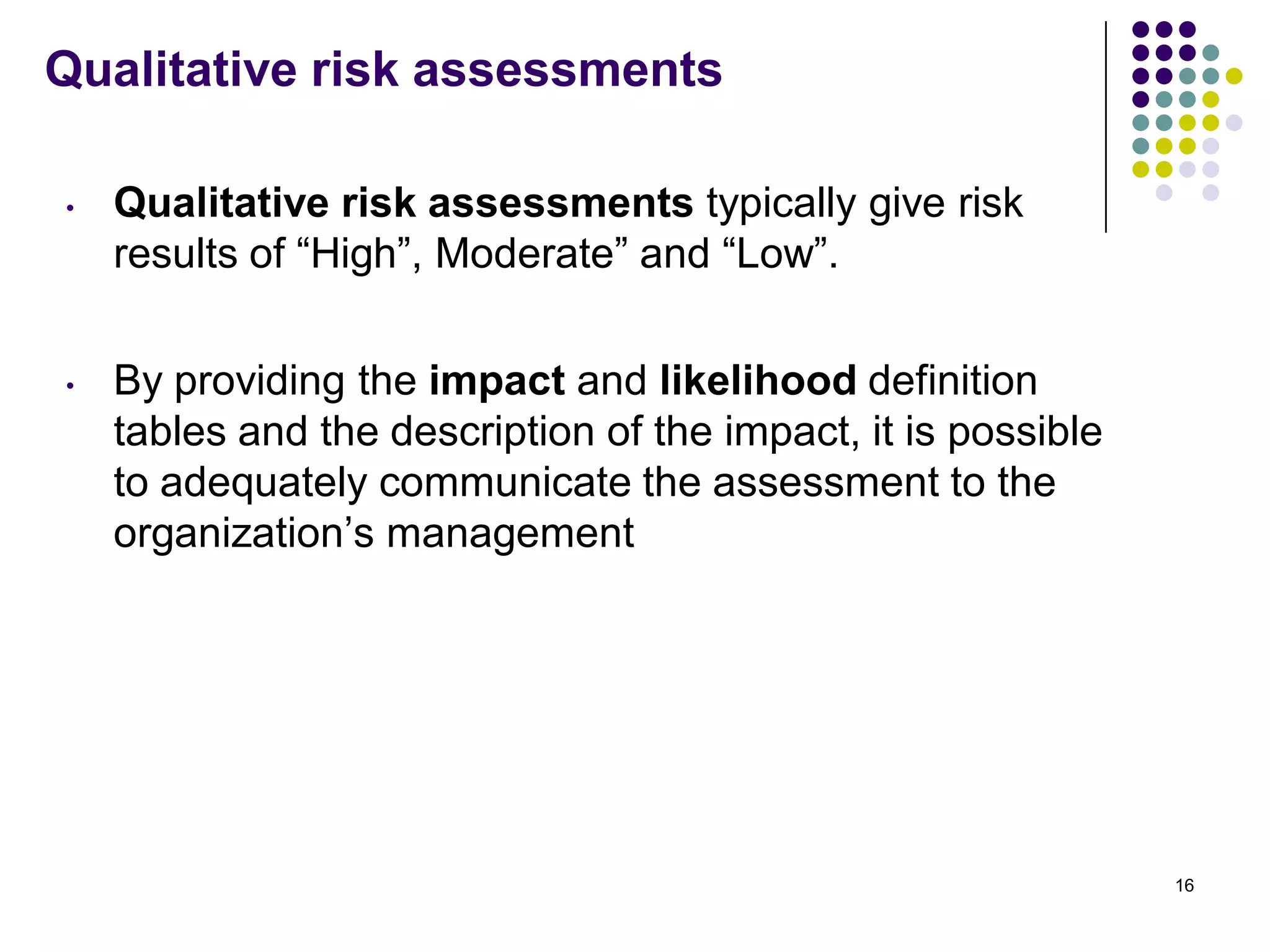
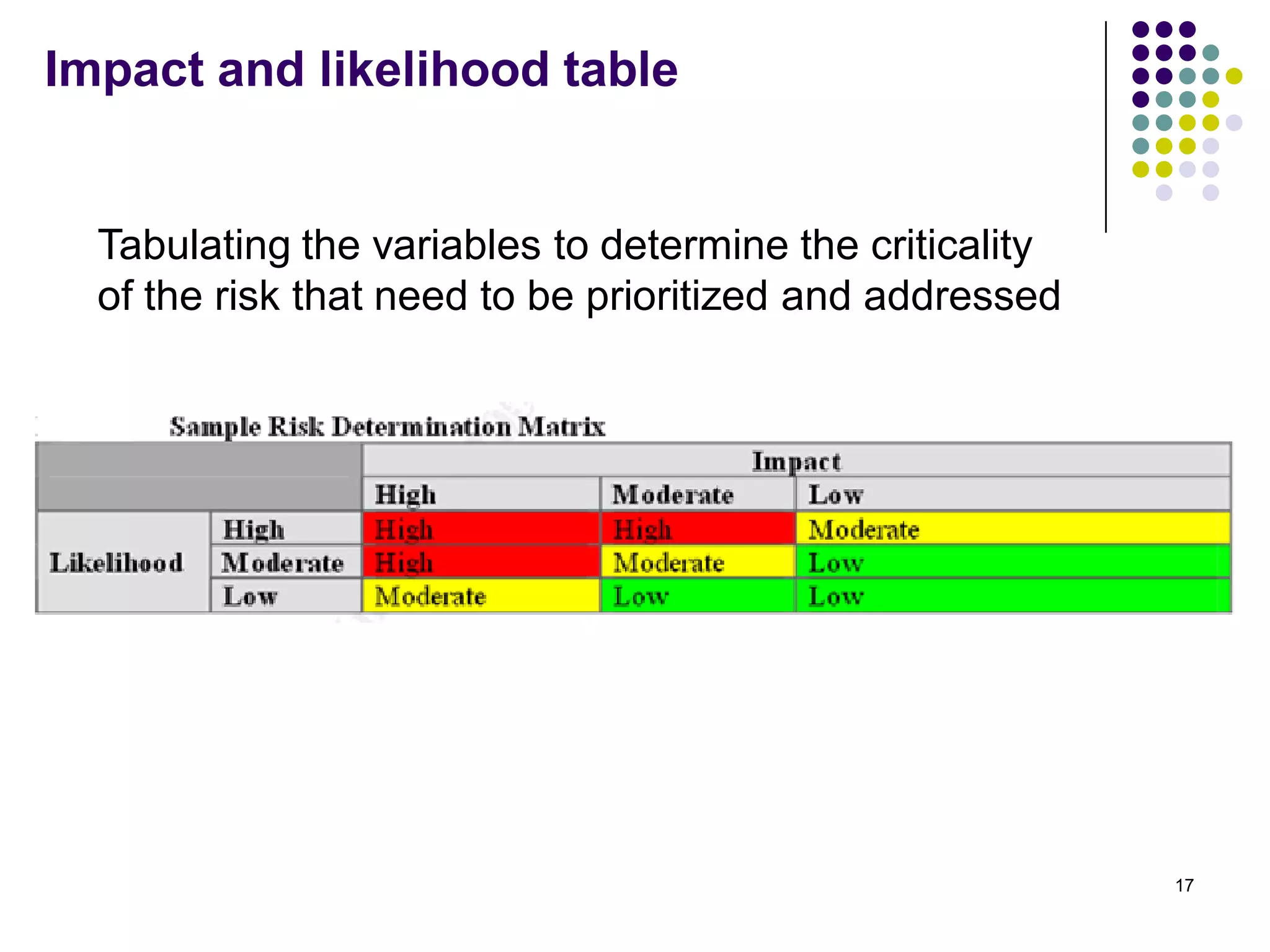
Qualitative risk assessments
• Qualitative risk assessments typically give risk
results of ―High‖, Moderate‖ and ―Low‖.
• By providing the impact and likelihood definition
tables and the description of the impact, it is possible
to adequately communicate the assessment to the
organization’s management
16
Impact and likelihood table
Tabulating the variables to determine the criticality
of the risk that need to be prioritized and addressed
17
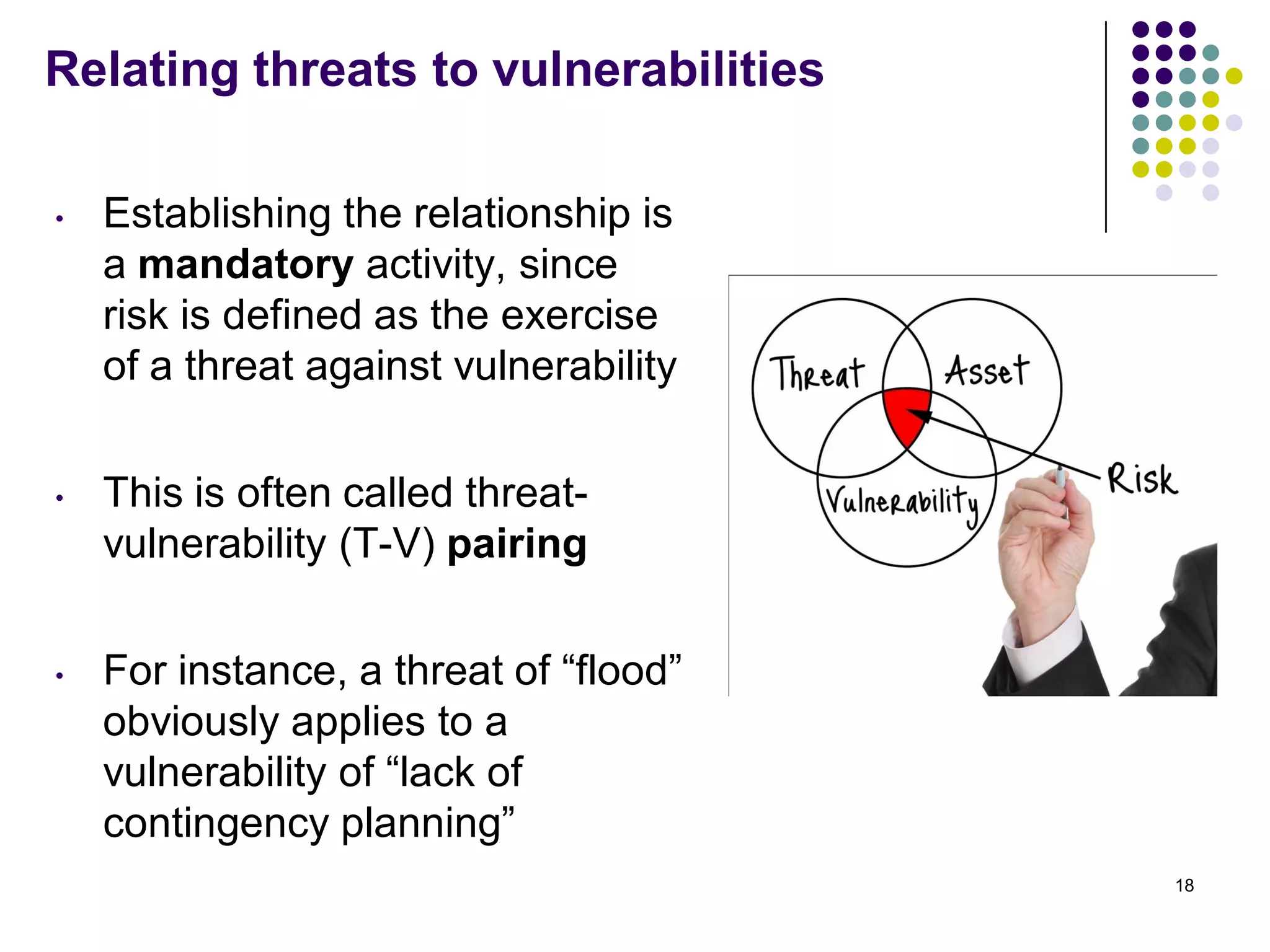
Relating threats to vulnerabilities
• Establishing the relationship is
a mandatory activity, since
risk is defined as the exercise
of a threat against vulnerability
• This is often called threat-
vulnerability (T-V) pairing
• For instance, a threat of ―flood‖
obviously applies to a
vulnerability of ―lack of
contingency planning‖
18
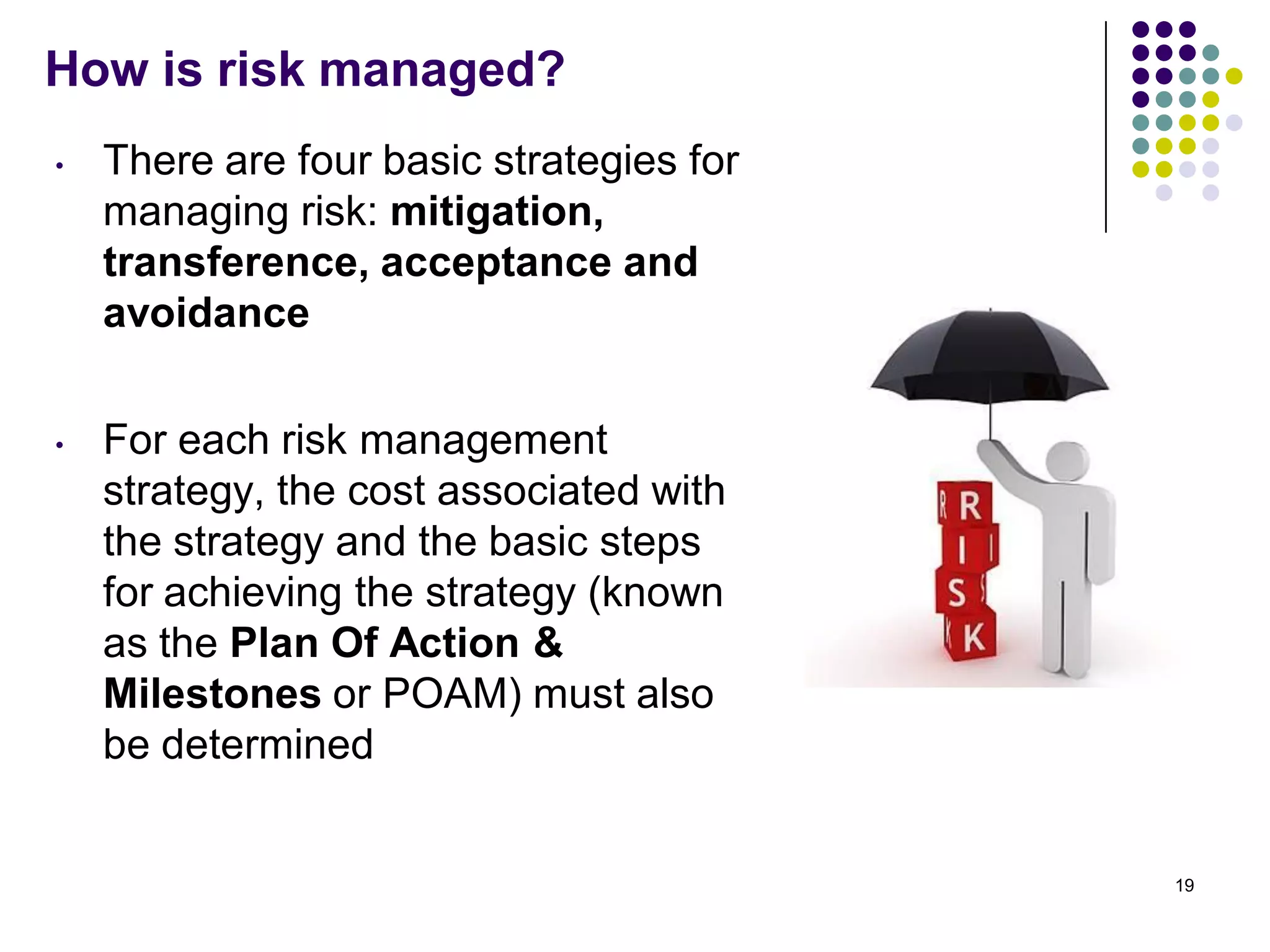
How is risk managed?
• There are four basic strategies for
managing risk: mitigation,
transference, acceptance and
avoidance
• For each risk management
strategy, the cost associated with
the strategy and the basic steps
for achieving the strategy (known
as the Plan Of Action &
Milestones or POAM) must also
be determined
19
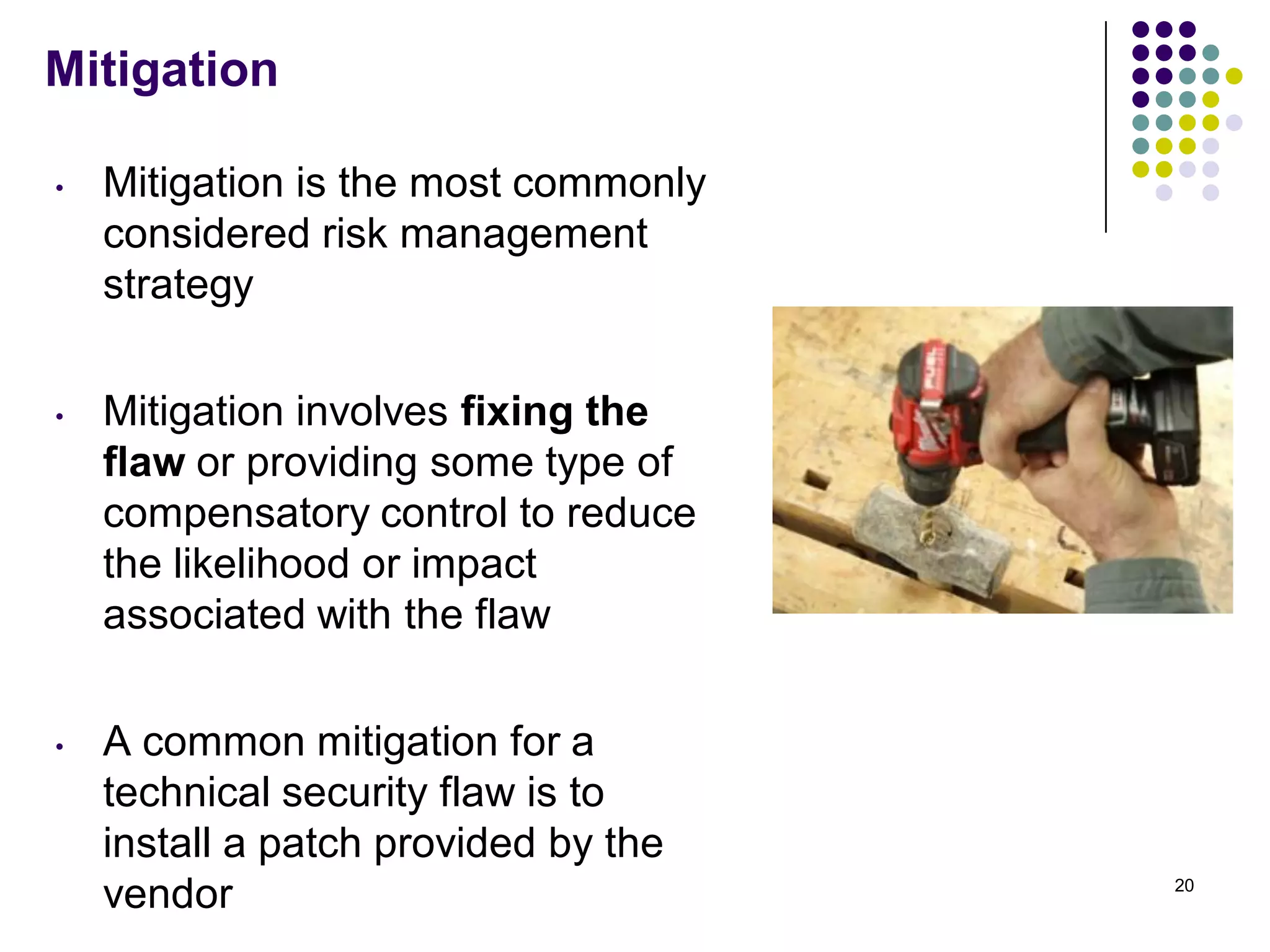
Mitigation
• Mitigation is the most commonly
considered risk management
strategy
• Mitigation involves fixing the
flaw or providing some type of
compensatory control to reduce
the likelihood or impact
associated with the flaw
• A common mitigation for a
technical security flaw is to
install a patch provided by the
vendor 20
Transference
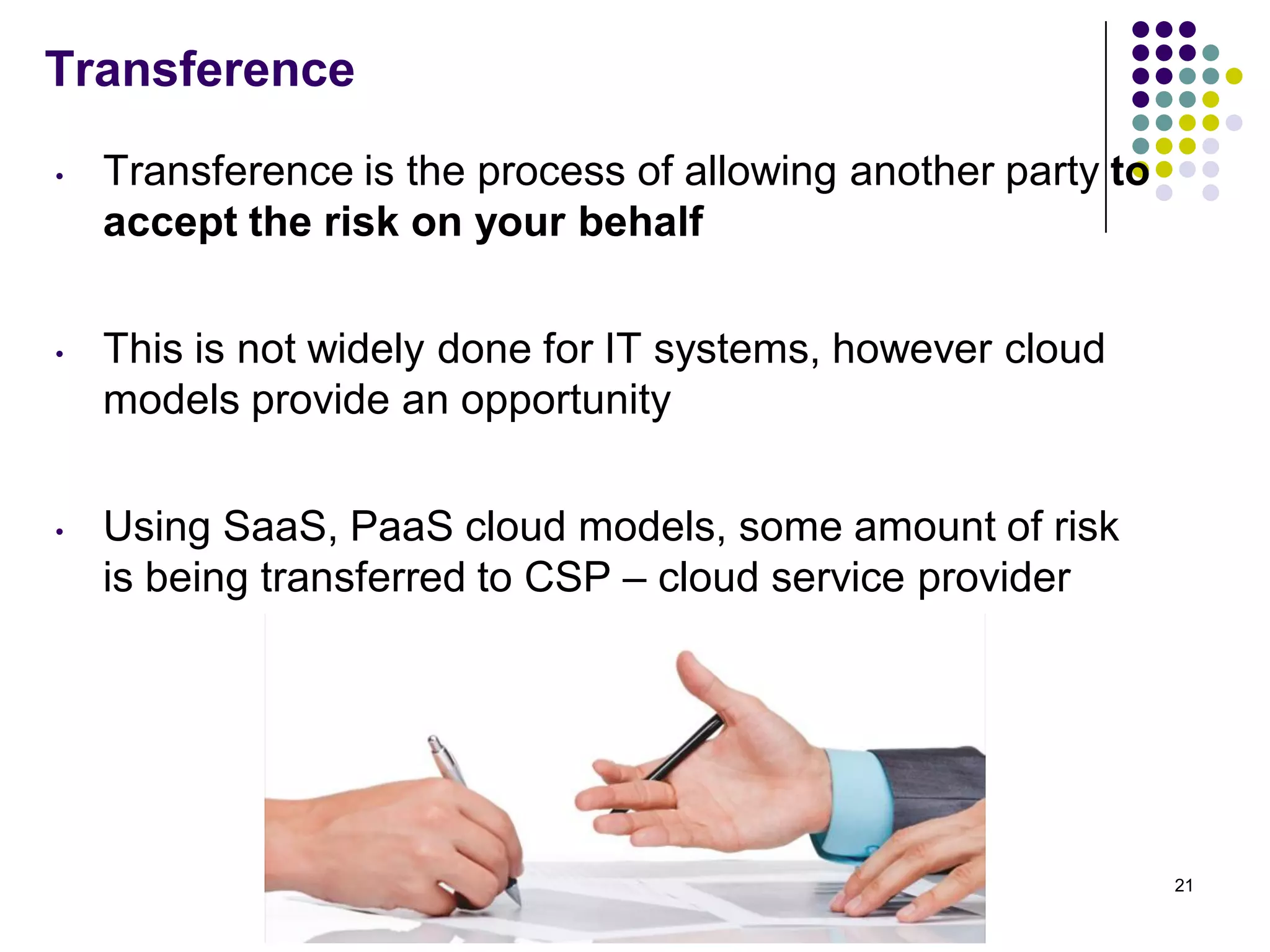
• Transference is the process of allowing another party to
accept the risk on your behalf
• This is not widely done for IT systems, however cloud
models provide an opportunity
• Using SaaS, PaaS cloud models, some amount of risk
is being transferred to CSP – cloud service provider
21
Acceptance
• Acceptance is the practice of
simply allowing the system to
operate with a known risk
• Many low risks are simply
accepted
• Risks that have an extremely
high cost to mitigate are also
often accepted
22
Avoidance
• Avoidance is the practice of
removing the vulnerable
aspect of the system or even
the system itself
• Example is removing a legacy
admin system that is causing
hi-impact errors in operations
23
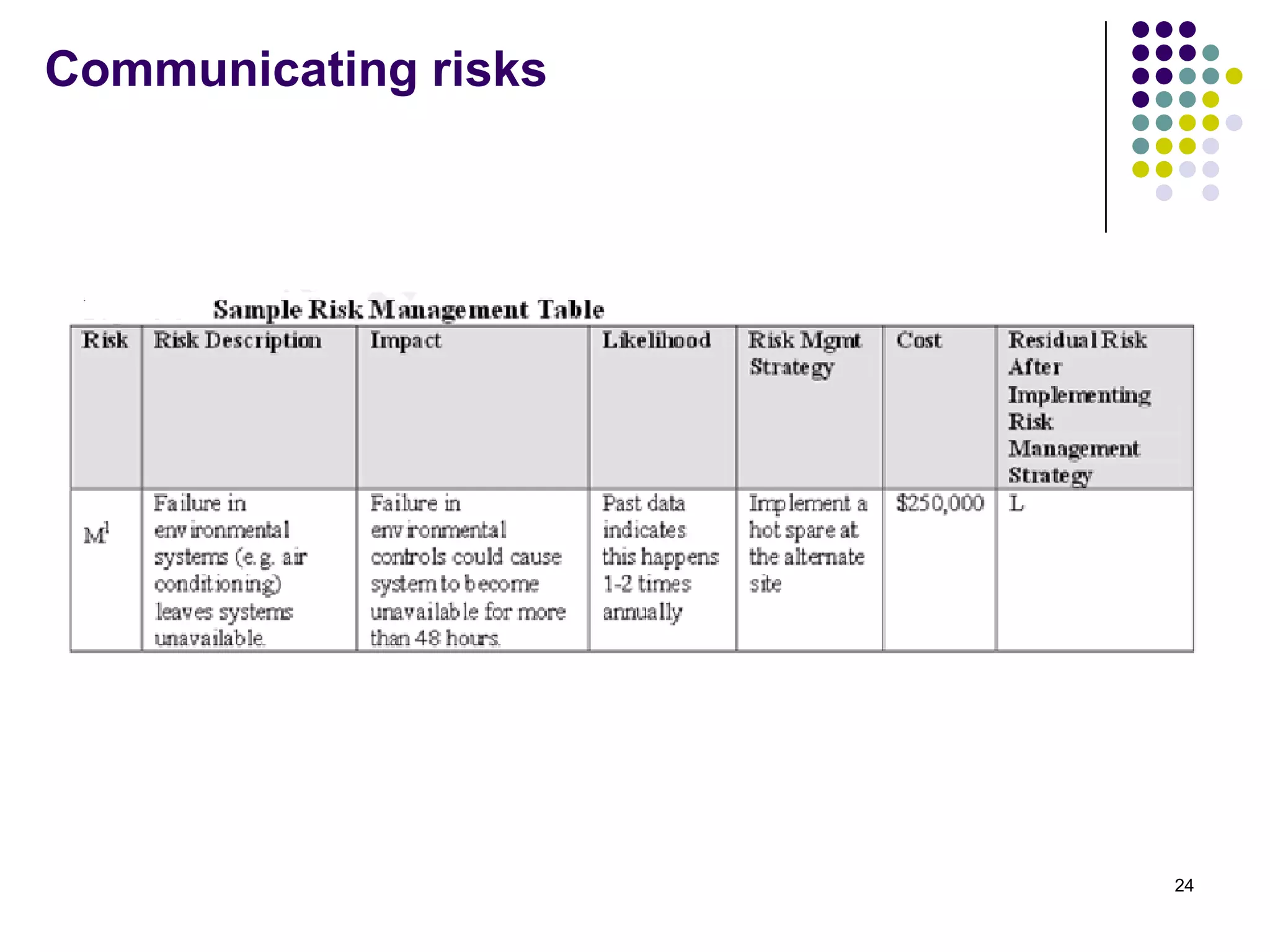
Communicating risks
24
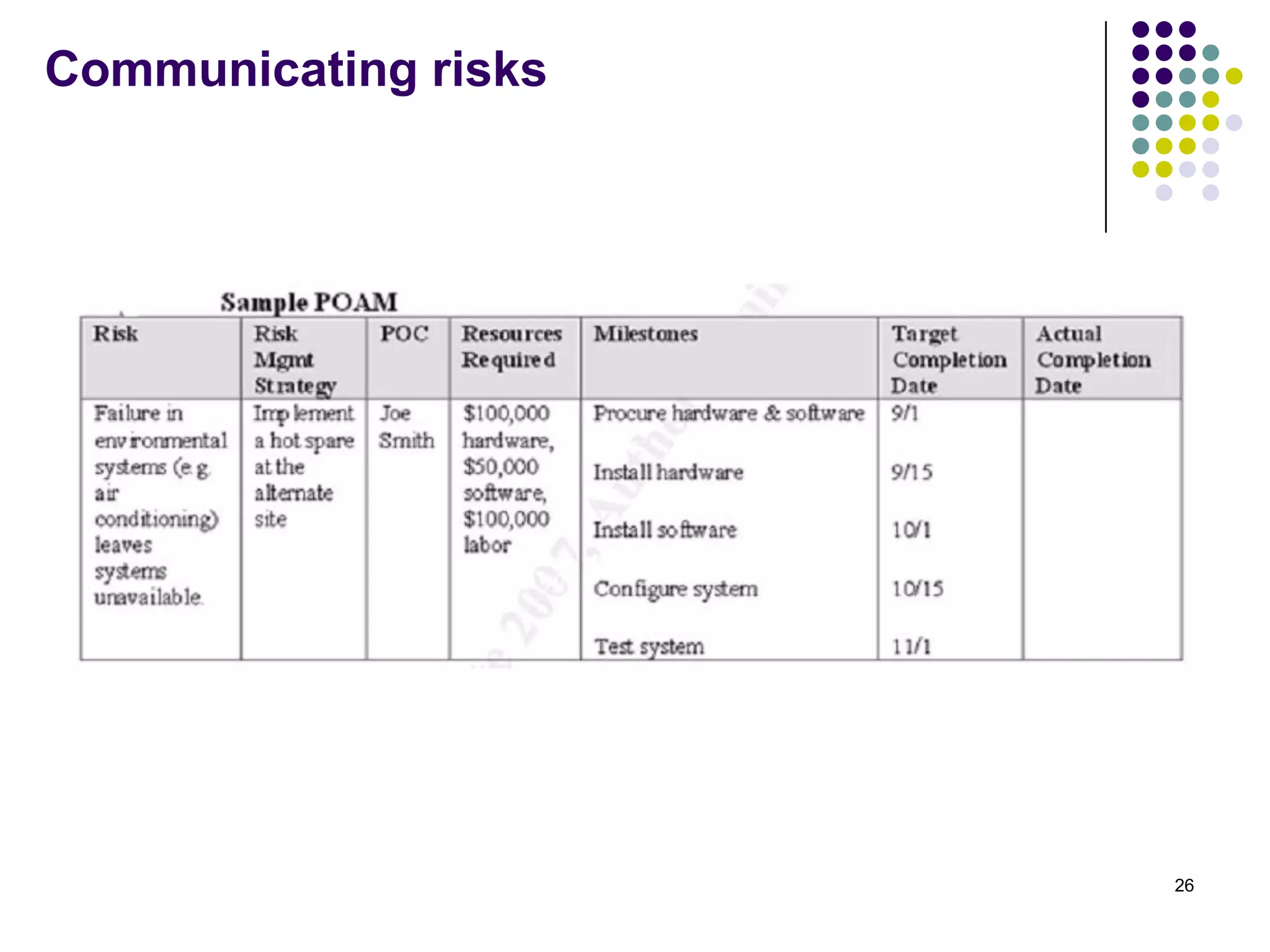
Communicating risks
• A Plan Of Action & Milestones (POAM) should be
part of the risk assessment report presented to
management
• The POAM is a tool to communicate to management
on the proposed and actual completion of the
implementation of the risk management strategies
25
Communicating risks
26
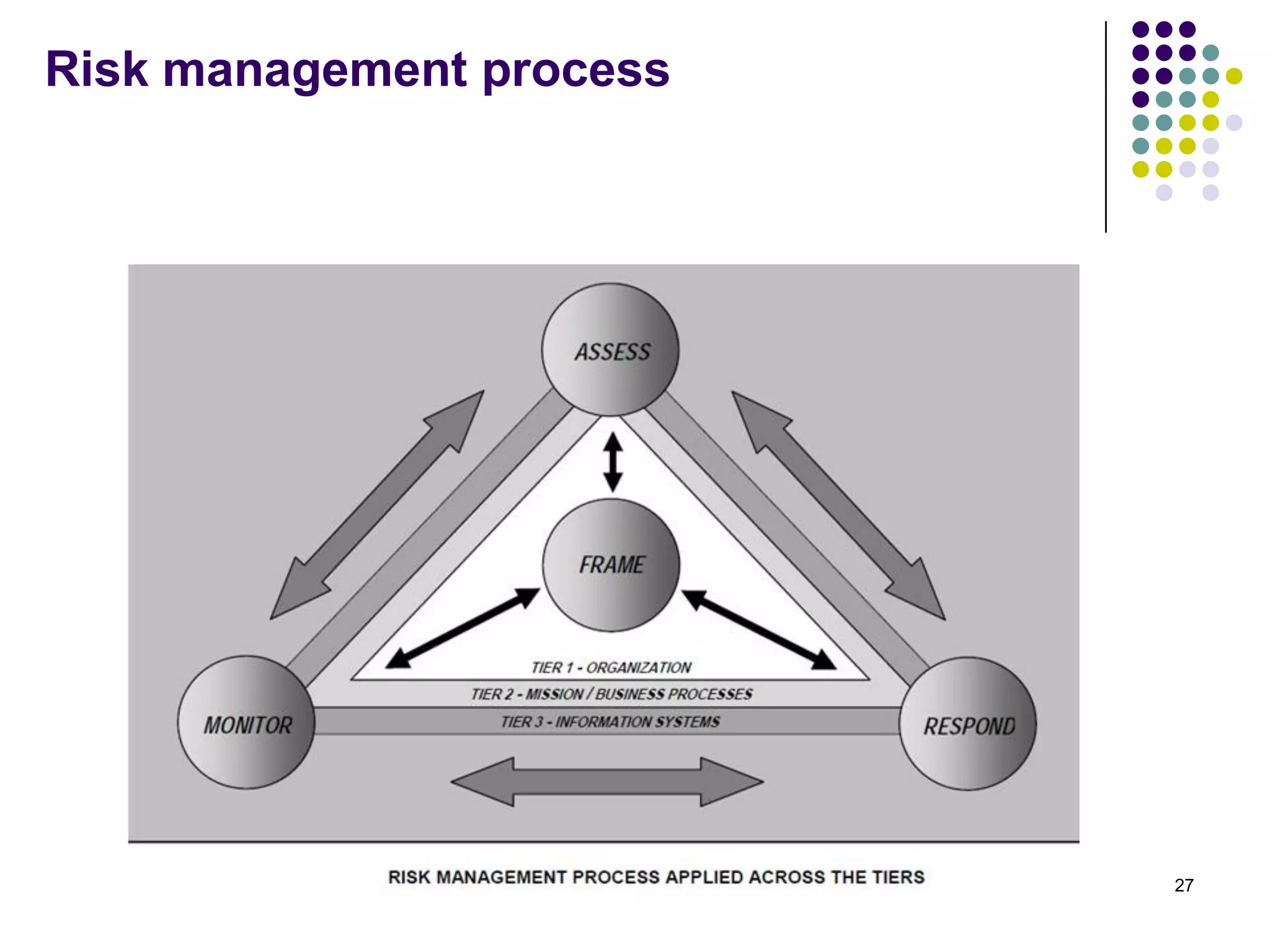
Risk management process
27
Framing risk
• Risk framing establishes the context and provides a
common perspective on how organizations manage risk
•
• Risk framing, as its principal output, produces a risk
management strategy that addresses how
organizations intend to assess risk, respond to risk, and
monitor risk
• Mainly senior leaders, program manager at Tier 1 & 2
are responsible
28
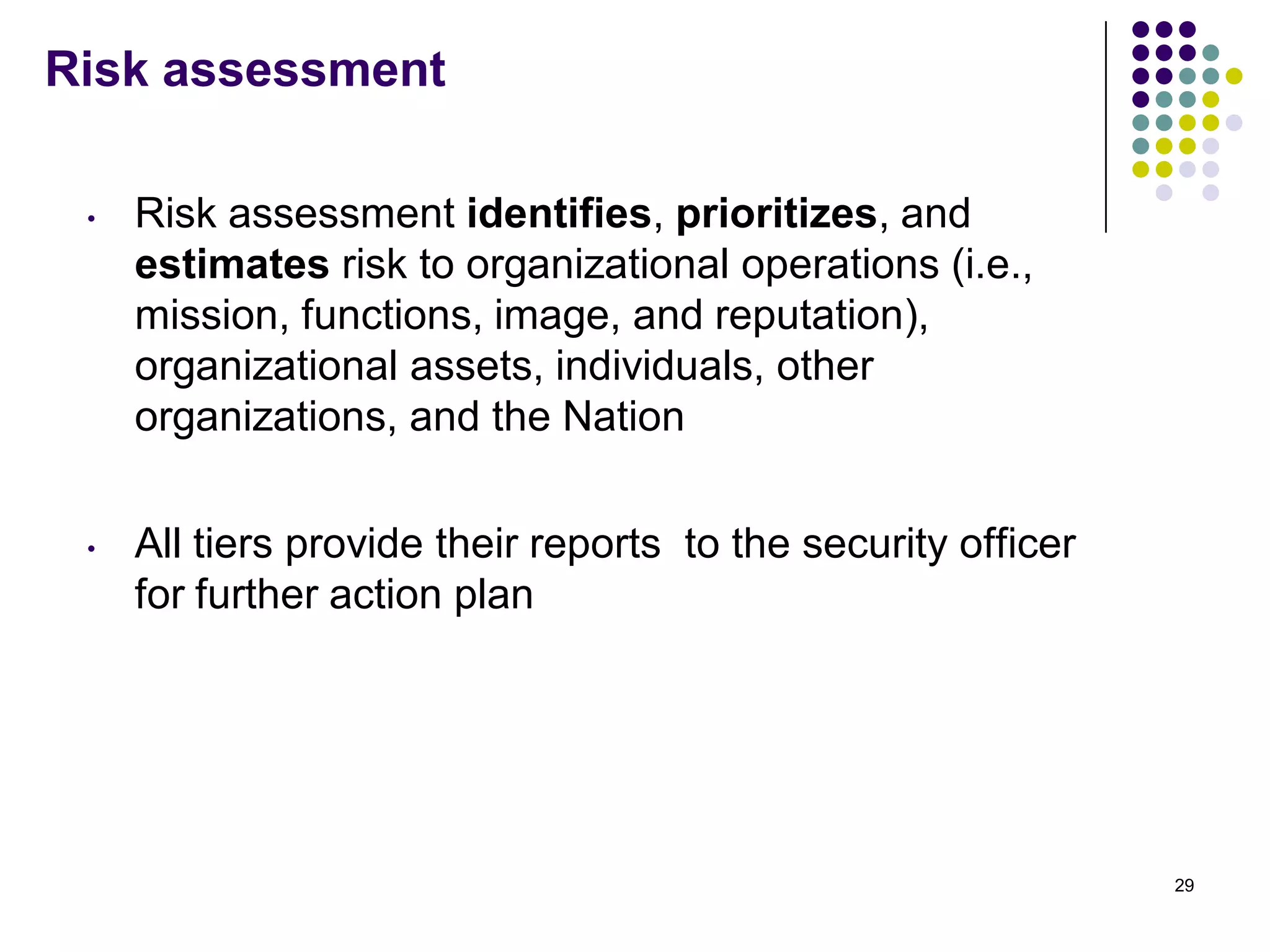
Risk assessment
• Risk assessment identifies, prioritizes, and
estimates risk to organizational operations (i.e.,
mission, functions, image, and reputation),
organizational assets, individuals, other
organizations, and the Nation
• All tiers provide their reports to the security officer
for further action plan
29
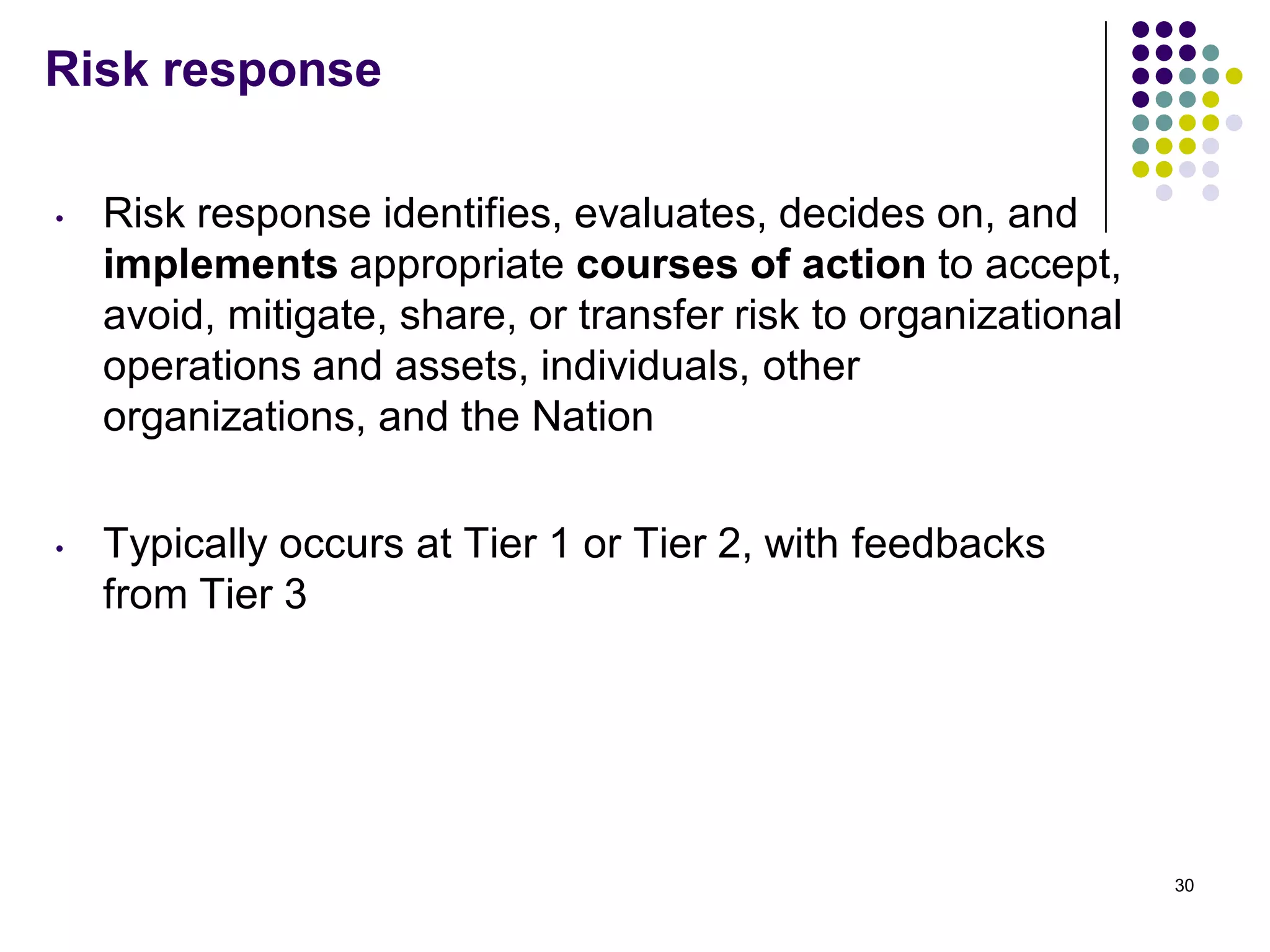
Risk response
• Risk response identifies, evaluates, decides on, and
implements appropriate courses of action to accept,
avoid, mitigate, share, or transfer risk to organizational
operations and assets, individuals, other
organizations, and the Nation
• Typically occurs at Tier 1 or Tier 2, with feedbacks
from Tier 3
30
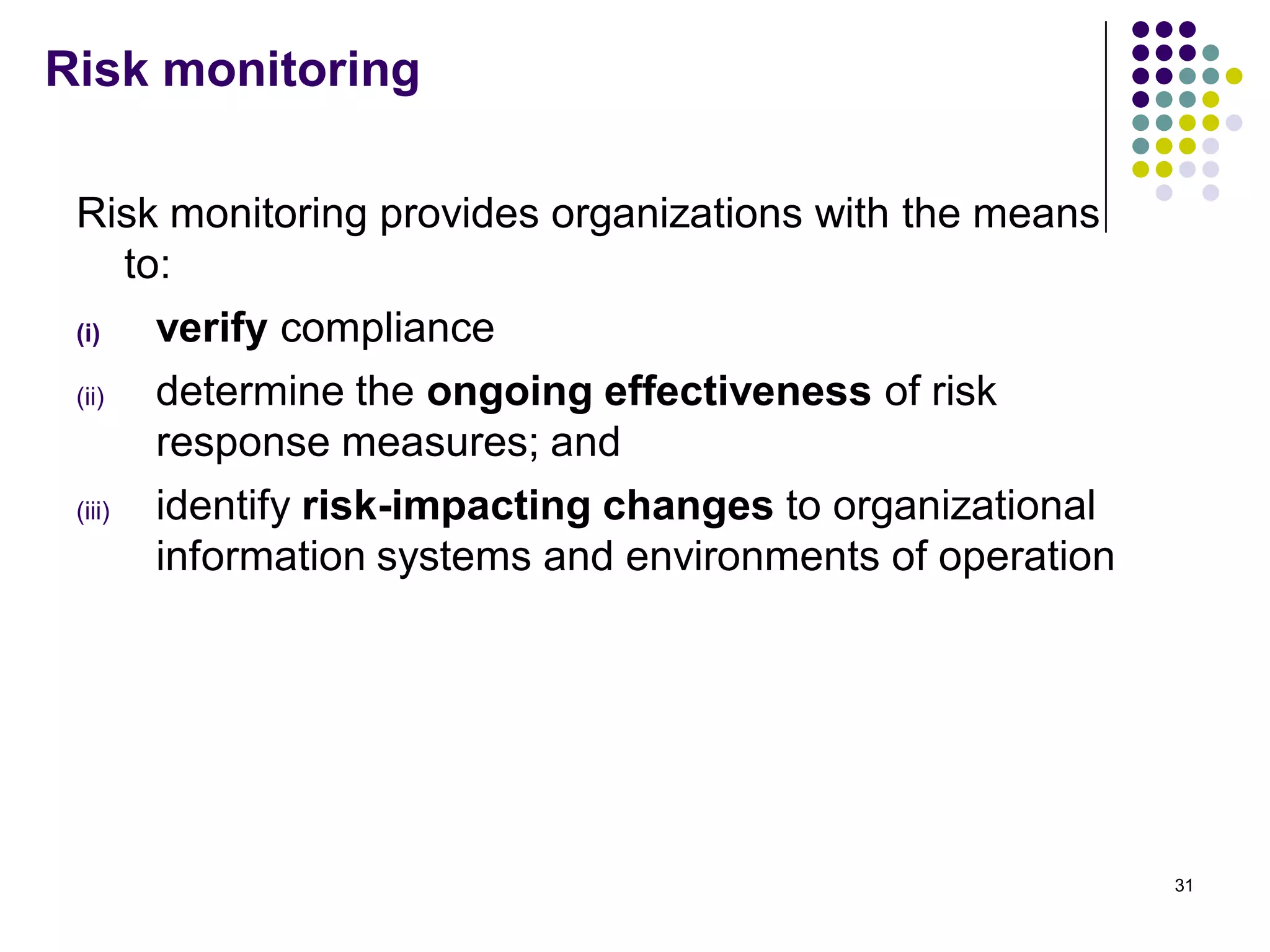
Risk monitoring
Risk monitoring provides organizations with the means
to:
(i) verify compliance
(ii) determine the ongoing effectiveness of risk
response measures; and
(iii) identify risk-impacting changes to organizational
information systems and environments of operation
31
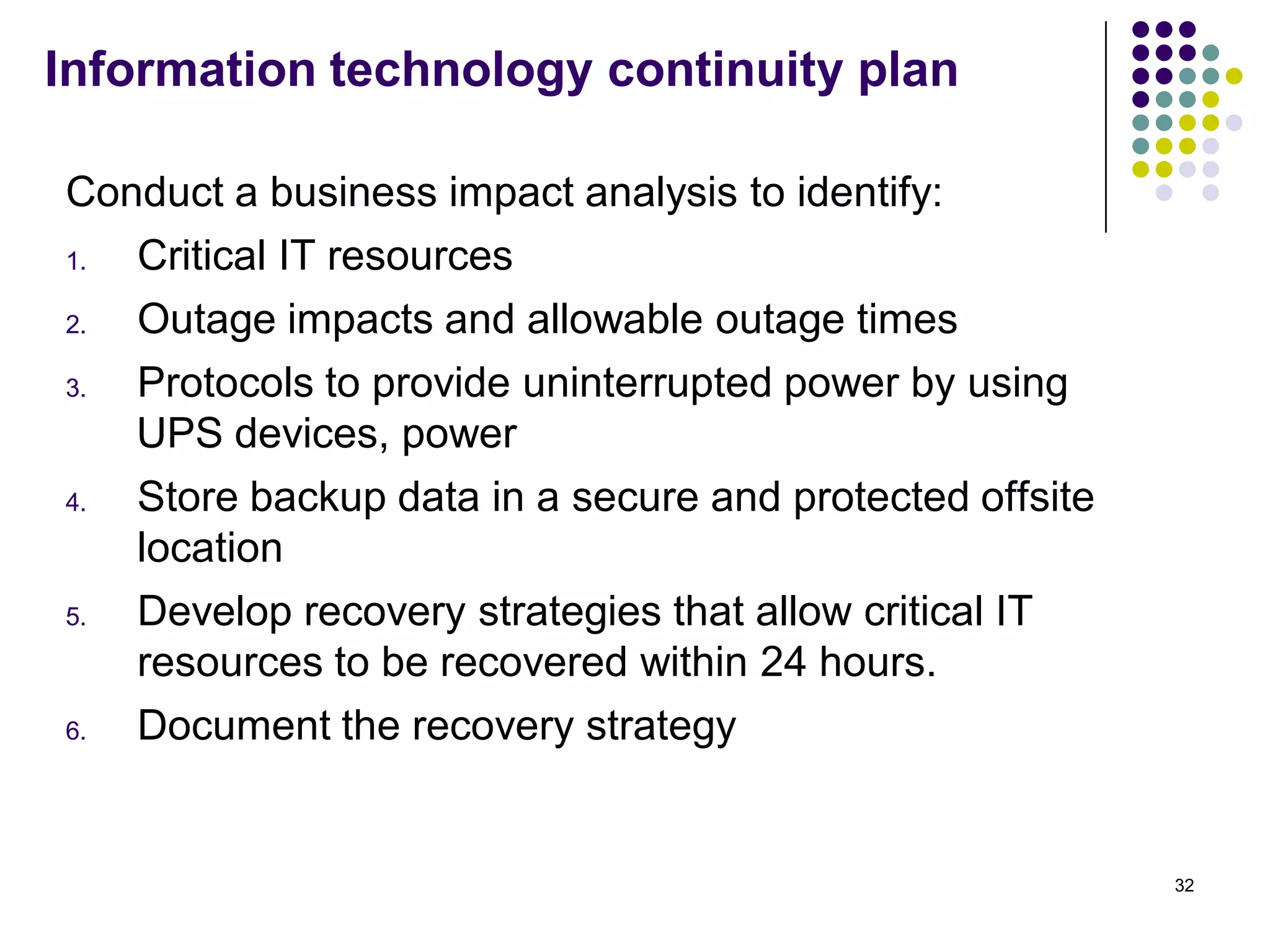
Information technology continuity plan
Conduct a business impact analysis to identify:
1. Critical IT resources
2. Outage impacts and allowable outage times
3. Protocols to provide uninterrupted power by using
UPS devices, power
4. Store backup data in a secure and protected offsite
location
5. Develop recovery strategies that allow critical IT
resources to be recovered within 24 hours.
6. Document the recovery strategy
32
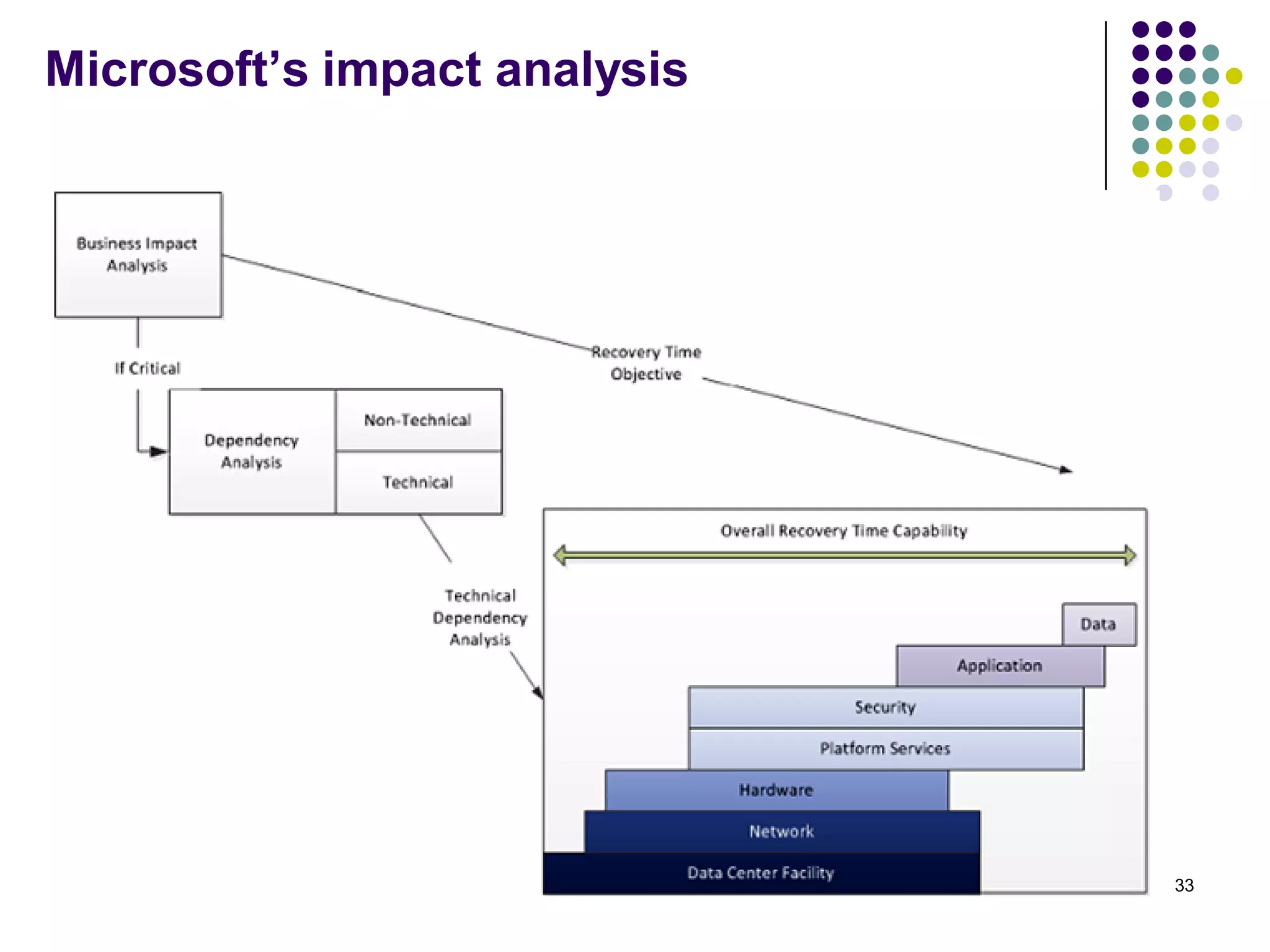
Microsoft’s impact analysis
33
General risk assessment tools
• National Institute of Standards & Technology (NIST)
Methodology – US Federal based
• OCTAVE
®
- The Software Engineering Institute (SEI) at
Carnegie Mellon University developed the Operationally
Critical, Threat, Asset and Vulnerability Evaluation
(OCTAVE) process
• FRAP - The Facilitated Risk Assessment Process (FRAP)
is the creation of Thomas Peltier. FRAP uses formal
qualitative risk analysis methodologies using Vulnerability
Analysis, Hazard Impact Analysis, Threat Analysis and
Questionnaires
34
General risk assessment tools
• COBRA - The Consultative, Objective and Bi-functional
Risk Analysis (COBRA) process was created by C & A
Systems Security Ltd.. Risk assessment is a business
issue rather than a technical issue, tools that can be
purchased and utilized to perform self-assessments of
risk
• Risk Watch- Uses an expert knowledge database to
walk the user through a risk assessment and provide
reports on compliance as well as advice on managing
the risks
35
Microsoft security stack / tools
36
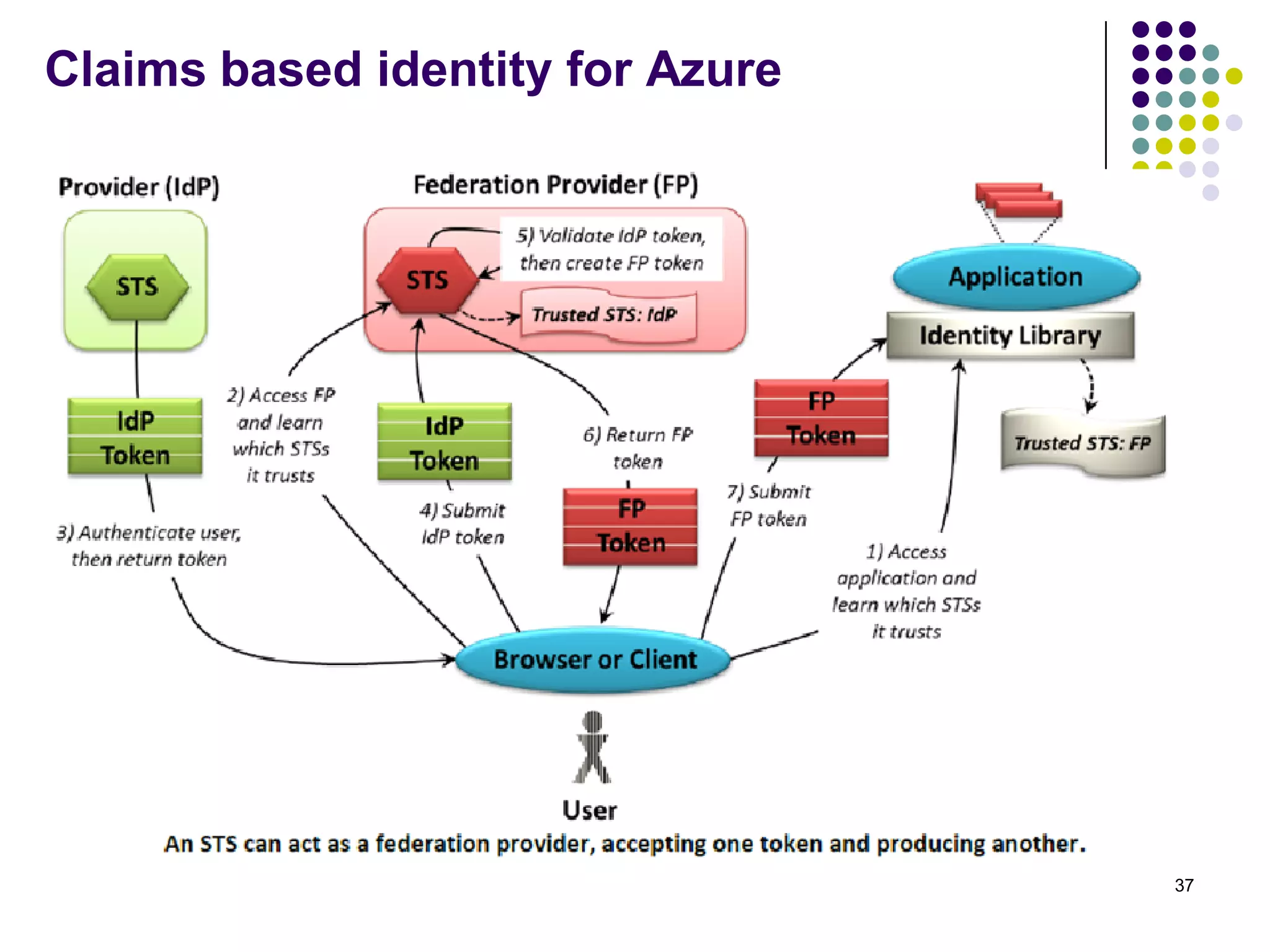
Claims based identity for Azure
37
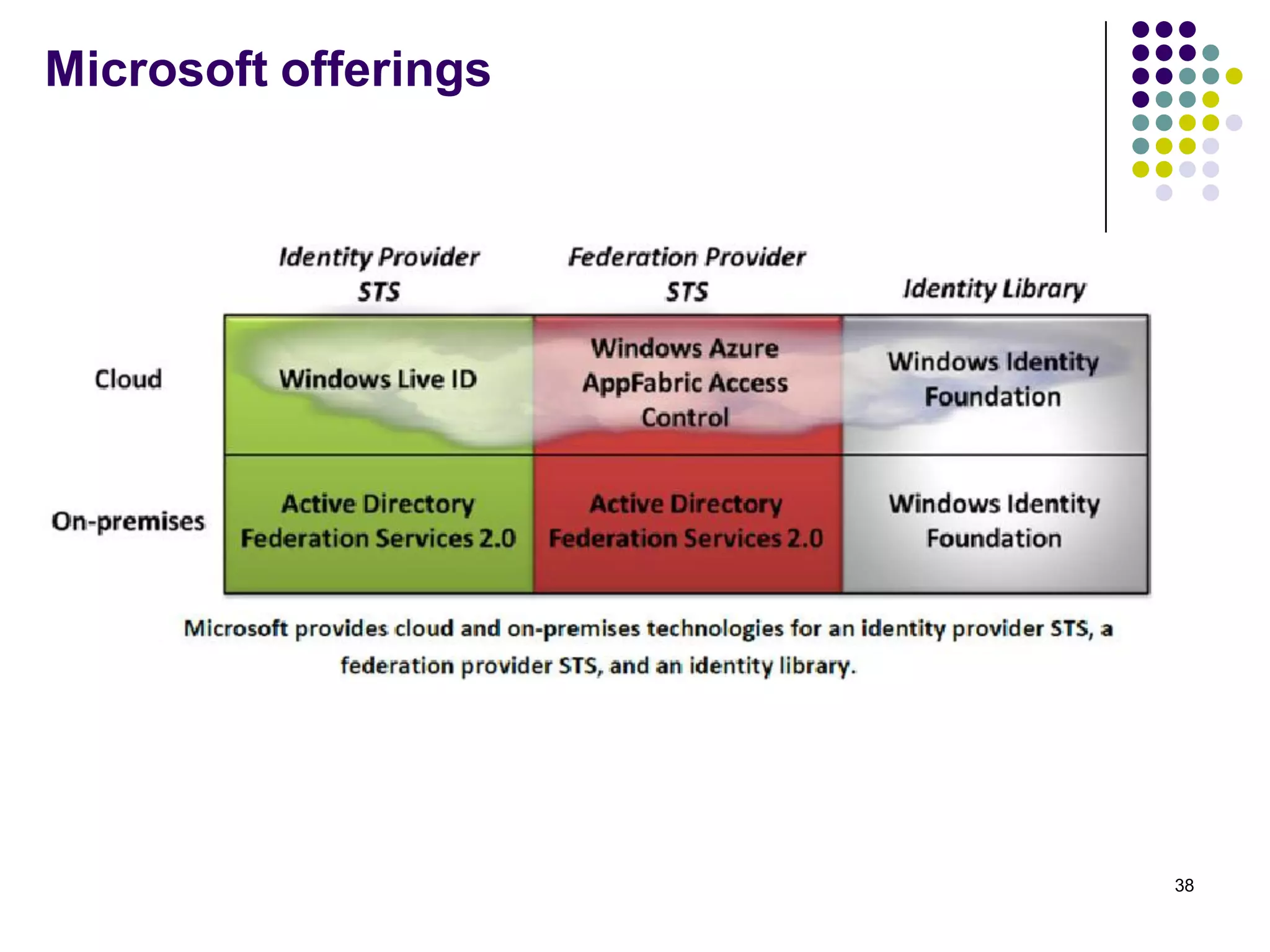
Microsoft offerings
38
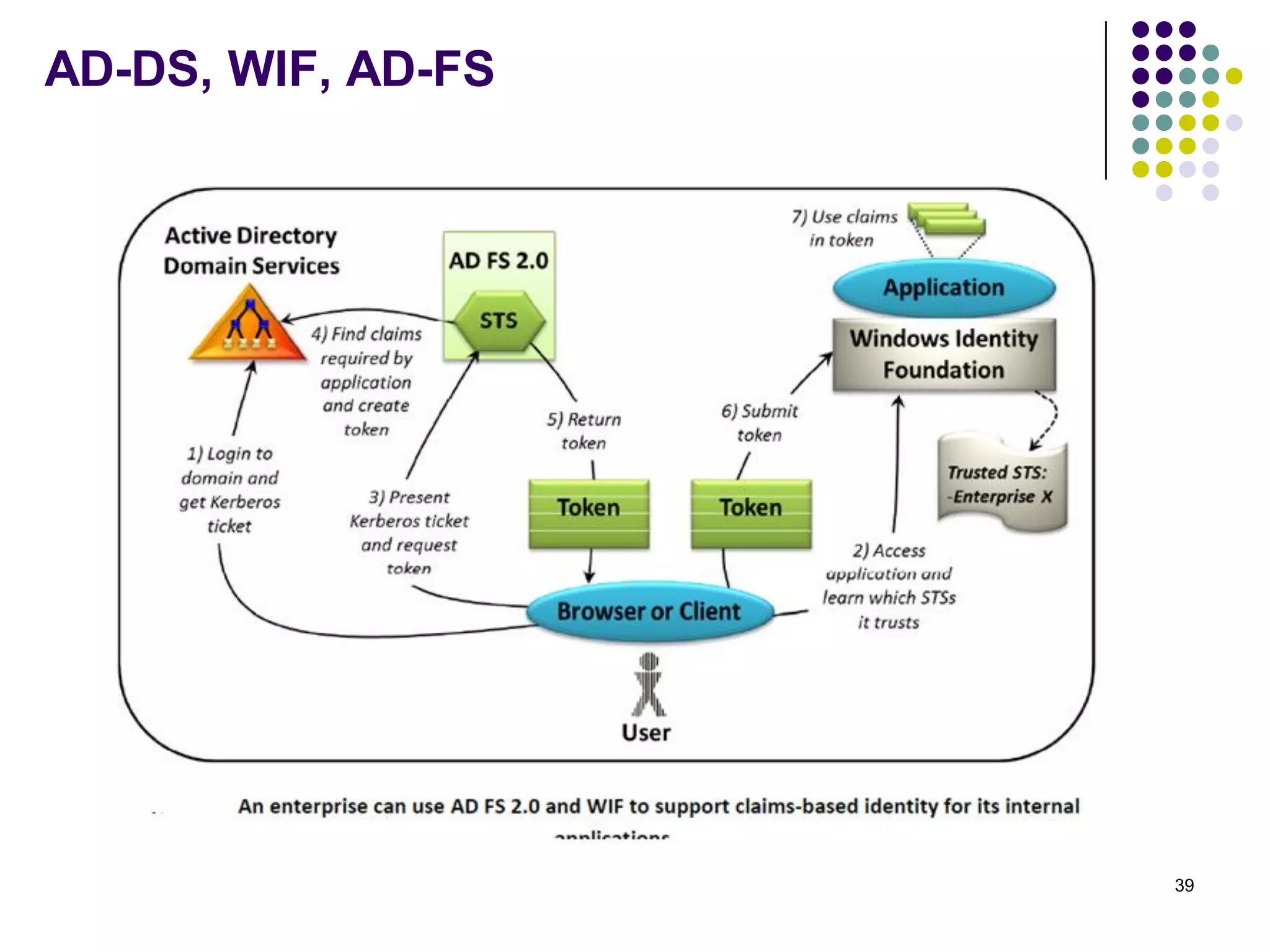
AD-DS, WIF, AD-FS
39
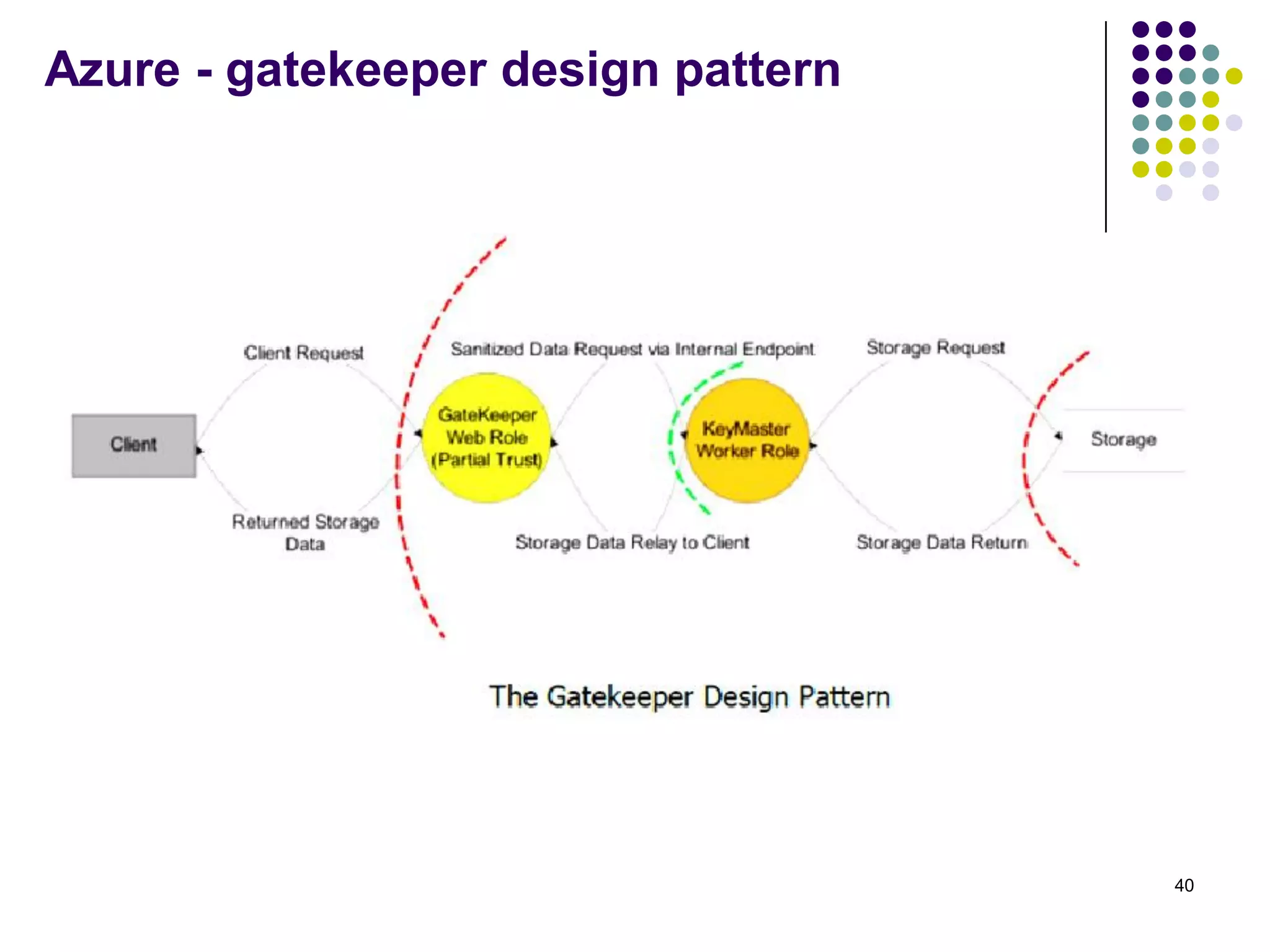
Azure - gatekeeper design pattern
40
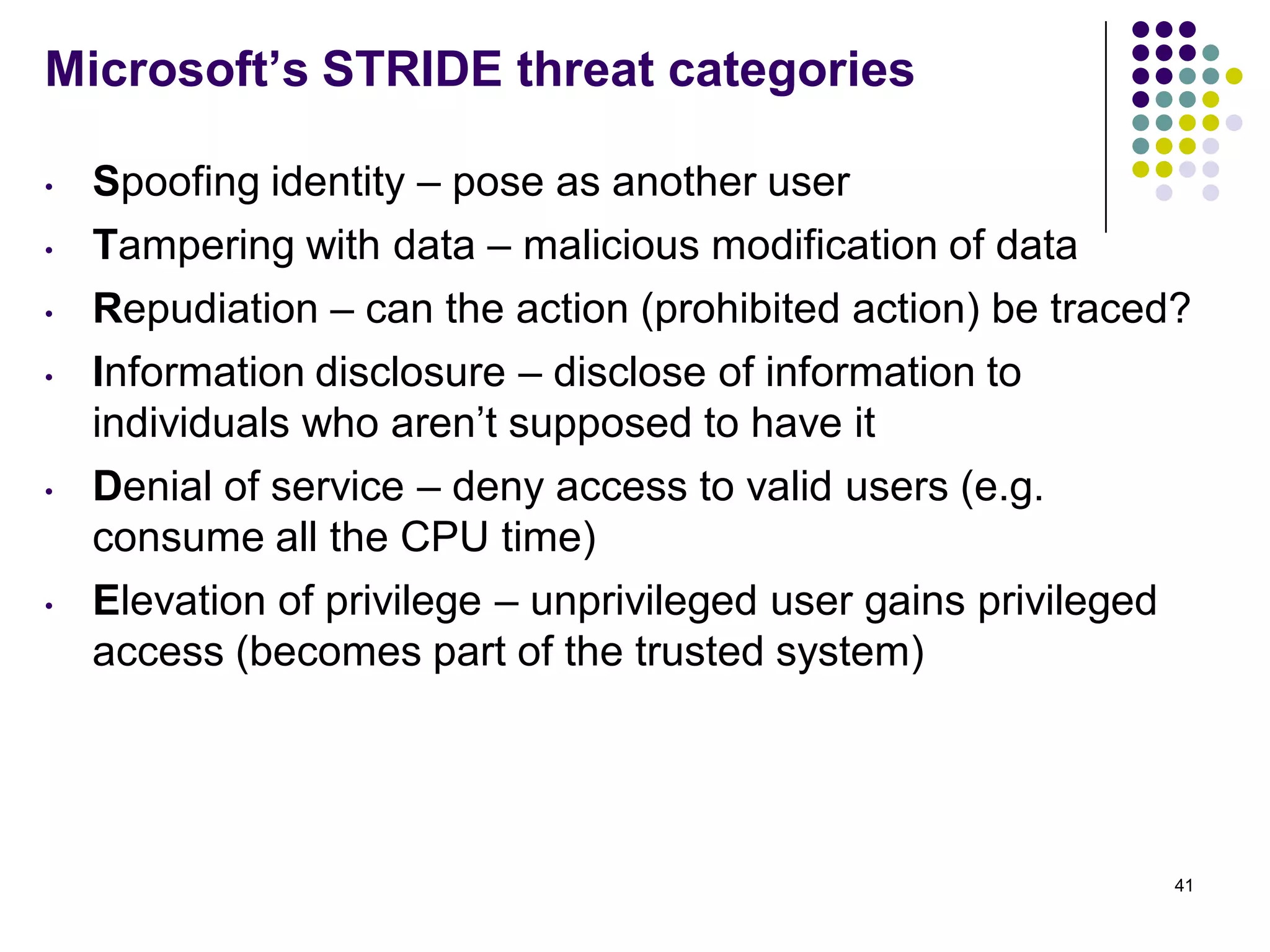
Microsoft’s STRIDE threat categories
• Spoofing identity – pose as another user
• Tampering with data – malicious modification of data
• Repudiation – can the action (prohibited action) be traced?
• Information disclosure – disclose of information to
individuals who aren’t supposed to have it
• Denial of service – deny access to valid users (e.g.
consume all the CPU time)
• Elevation of privilege – unprivileged user gains privileged
access (becomes part of the trusted system)
41
Microsoft’s DREAD model to rank threat’s
severity
• Damage potential: The extent of the damage if
vulnerability is exploited
• Reproducibility: How often an attempt at exploiting
vulnerability works
• Exploitability: How much effort is required? Is
authentication required?
• Affected users: How widespread could the exploit
become?
• Discoverability: The likelihood that the researcher or
hacker will find it
42
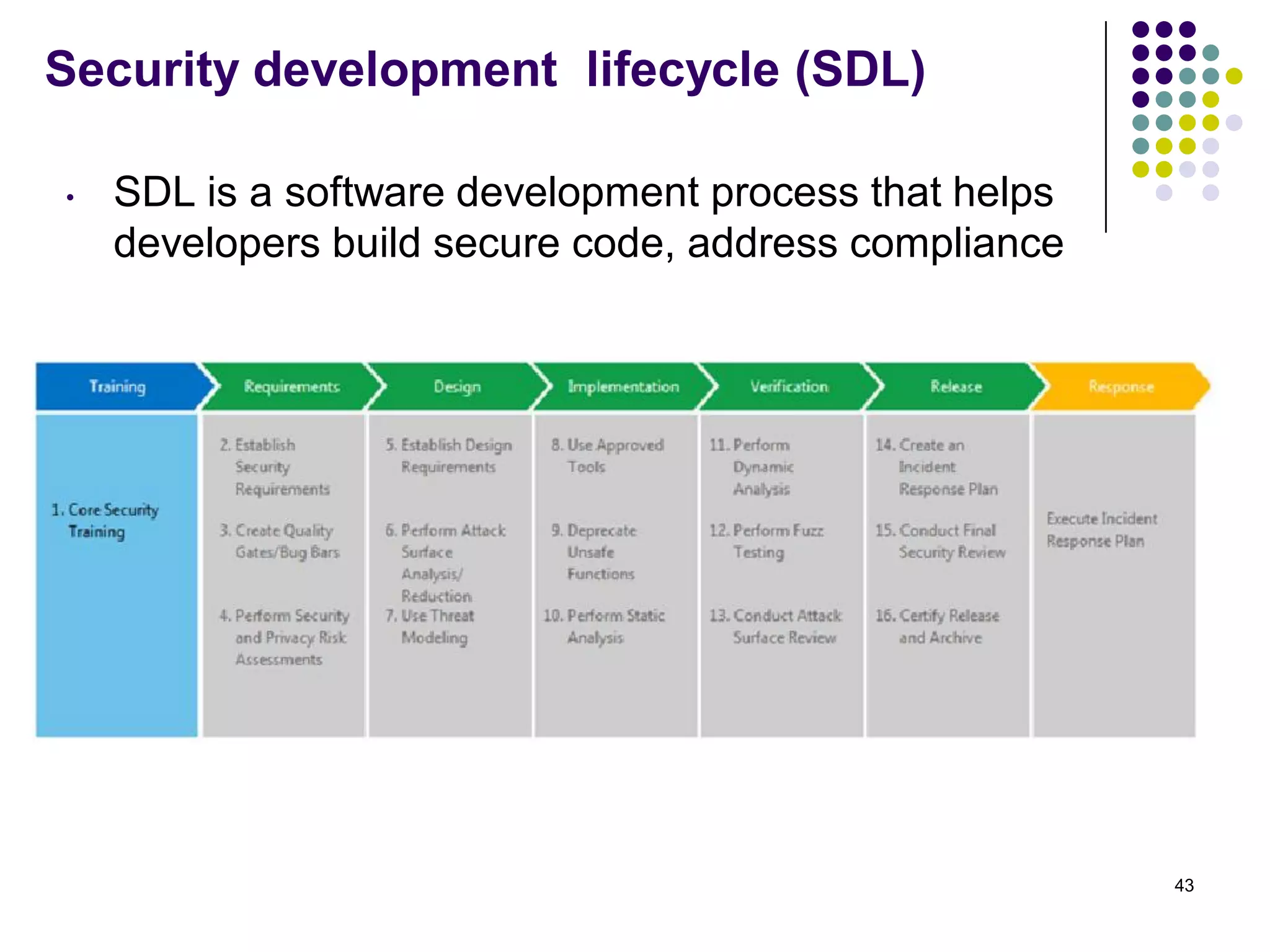
Security development lifecycle (SDL)
• SDL is a software development process that helps
developers build secure code, address compliance
43
SDL tools
Requirements tools
• Microsoft Solutions Framework (MSF) for Capability
Maturity Model Integration (CMMI) / Microsoft
Solutions Framework (MSF) for Agile
Design tool
• Microsoft Threat Modeling Tool 2014 / 2016
44
SDL tools
Implementation tools
• banned.h
• Code Analysis for C/C++
• SiteLock ATL Template
• Anti-Cross Site Scripting (Anti-XSS) Library
• FxCop (assemblies)
• Microsoft Code Analysis Tool .NET (CAT.NET) - binary
code analysis for XSS, SQL Injection
45
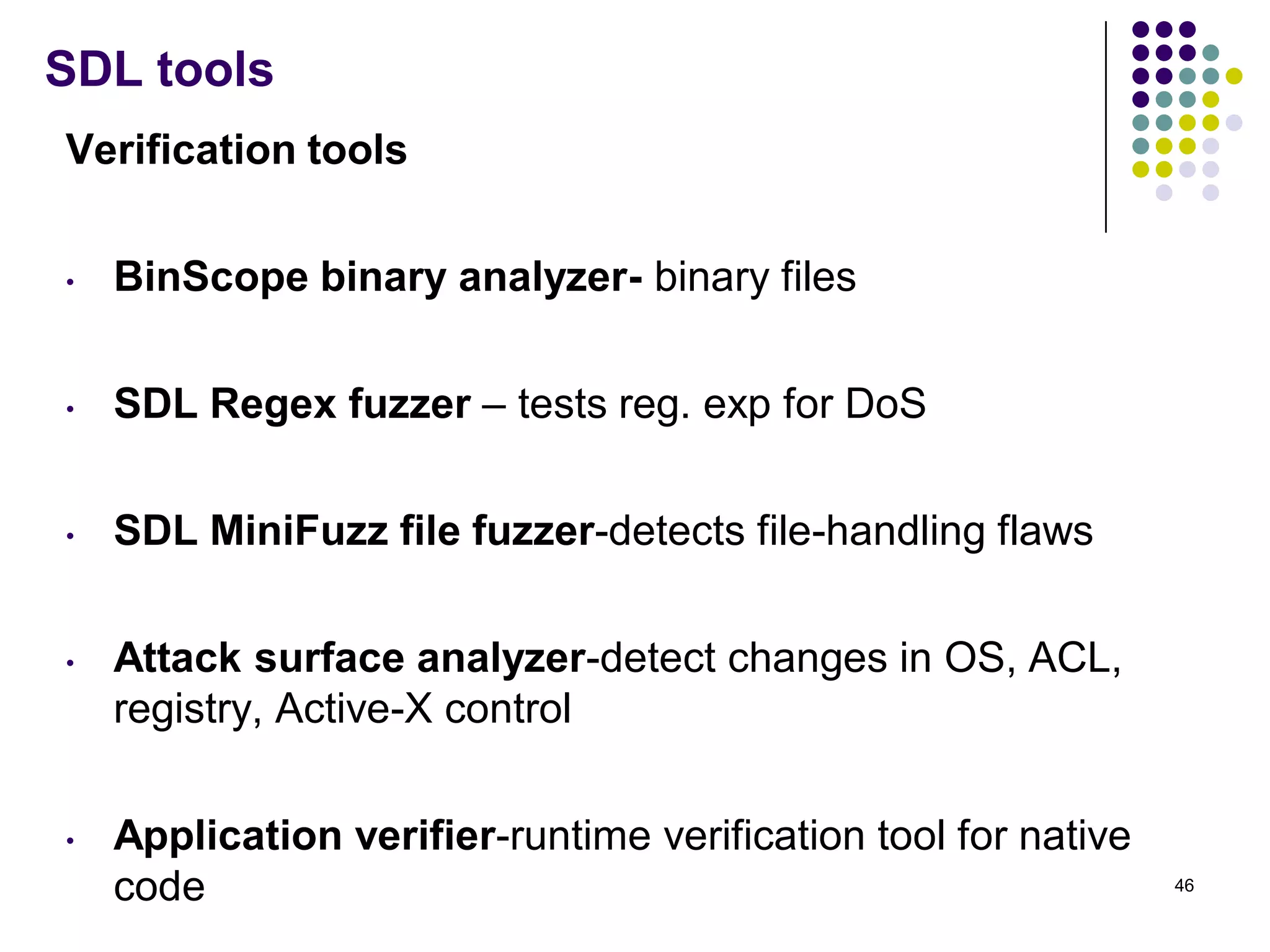
SDL tools
Verification tools
• BinScope binary analyzer- binary files
• SDL Regex fuzzer – tests reg. exp for DoS
• SDL MiniFuzz file fuzzer-detects file-handling flaws
• Attack surface analyzer-detect changes in OS, ACL,
registry, Active-X control
• Application verifier-runtime verification tool for native
code 46
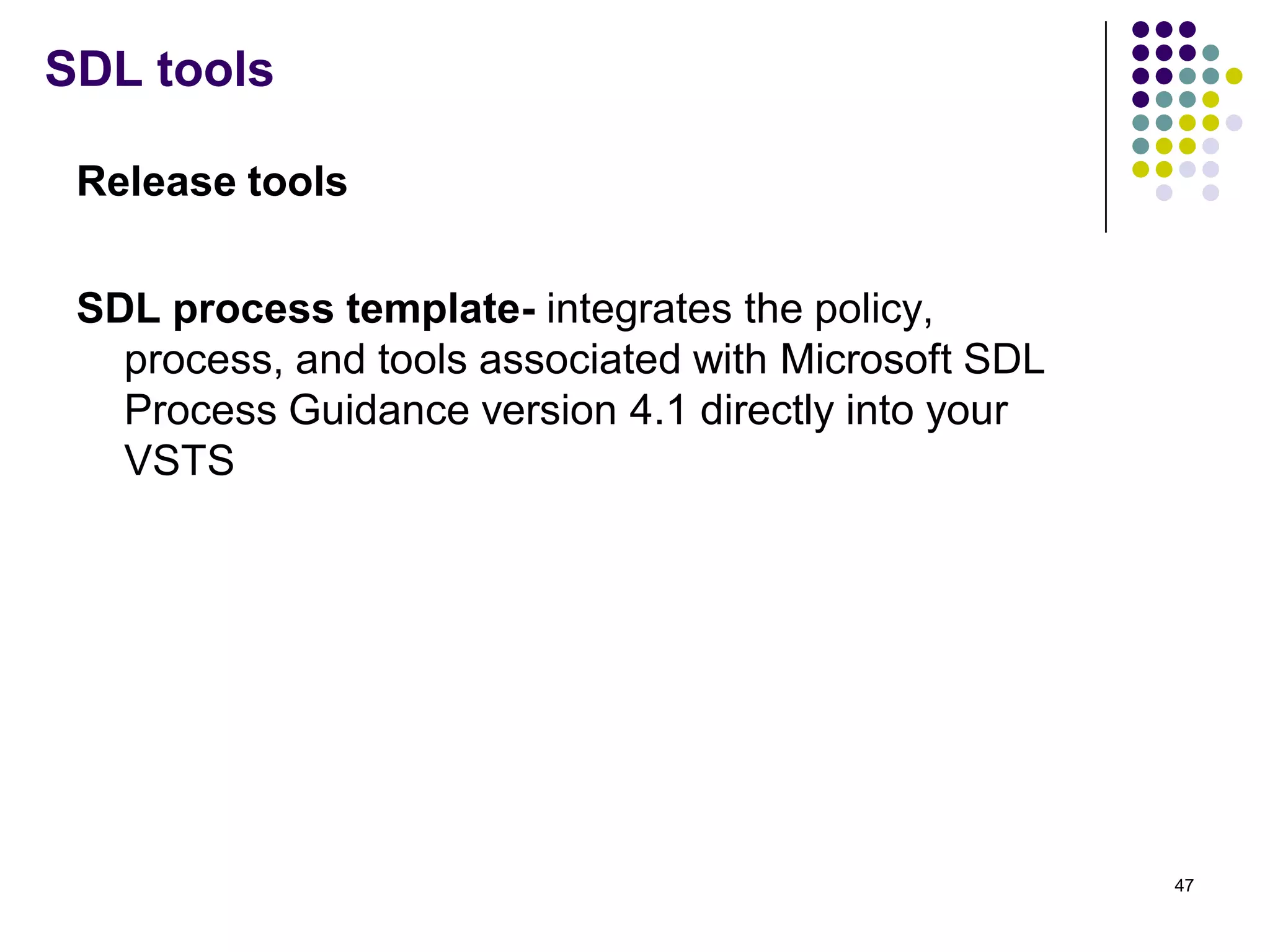
SDL tools
Release tools
SDL process template- integrates the policy,
process, and tools associated with Microsoft SDL
Process Guidance version 4.1 directly into your
VSTS
47
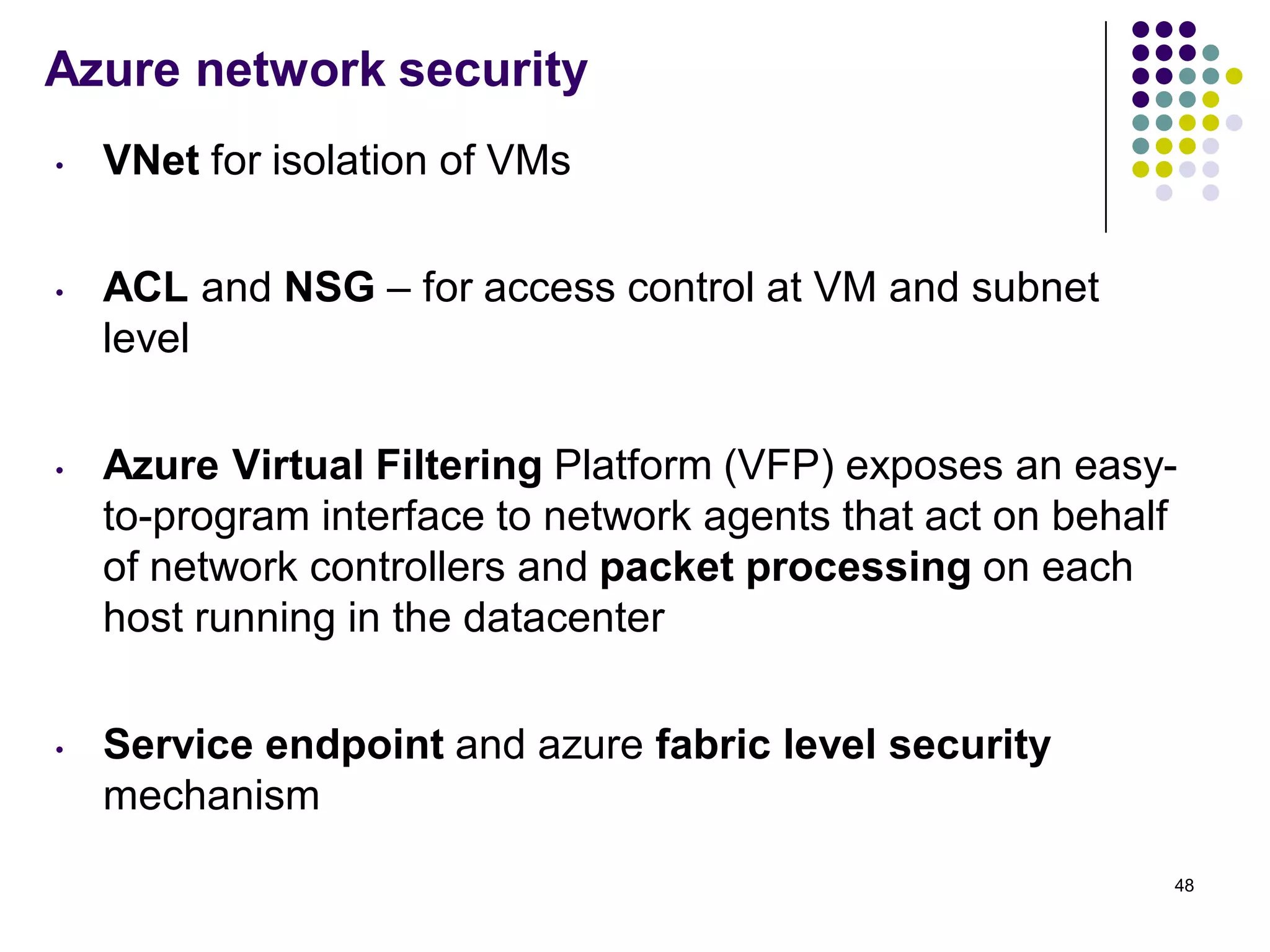
Azure network security
• VNet for isolation of VMs
• ACL and NSG – for access control at VM and subnet
level
• Azure Virtual Filtering Platform (VFP) exposes an easy-
to-program interface to network agents that act on behalf
of network controllers and packet processing on each
host running in the datacenter
• Service endpoint and azure fabric level security
mechanism
48
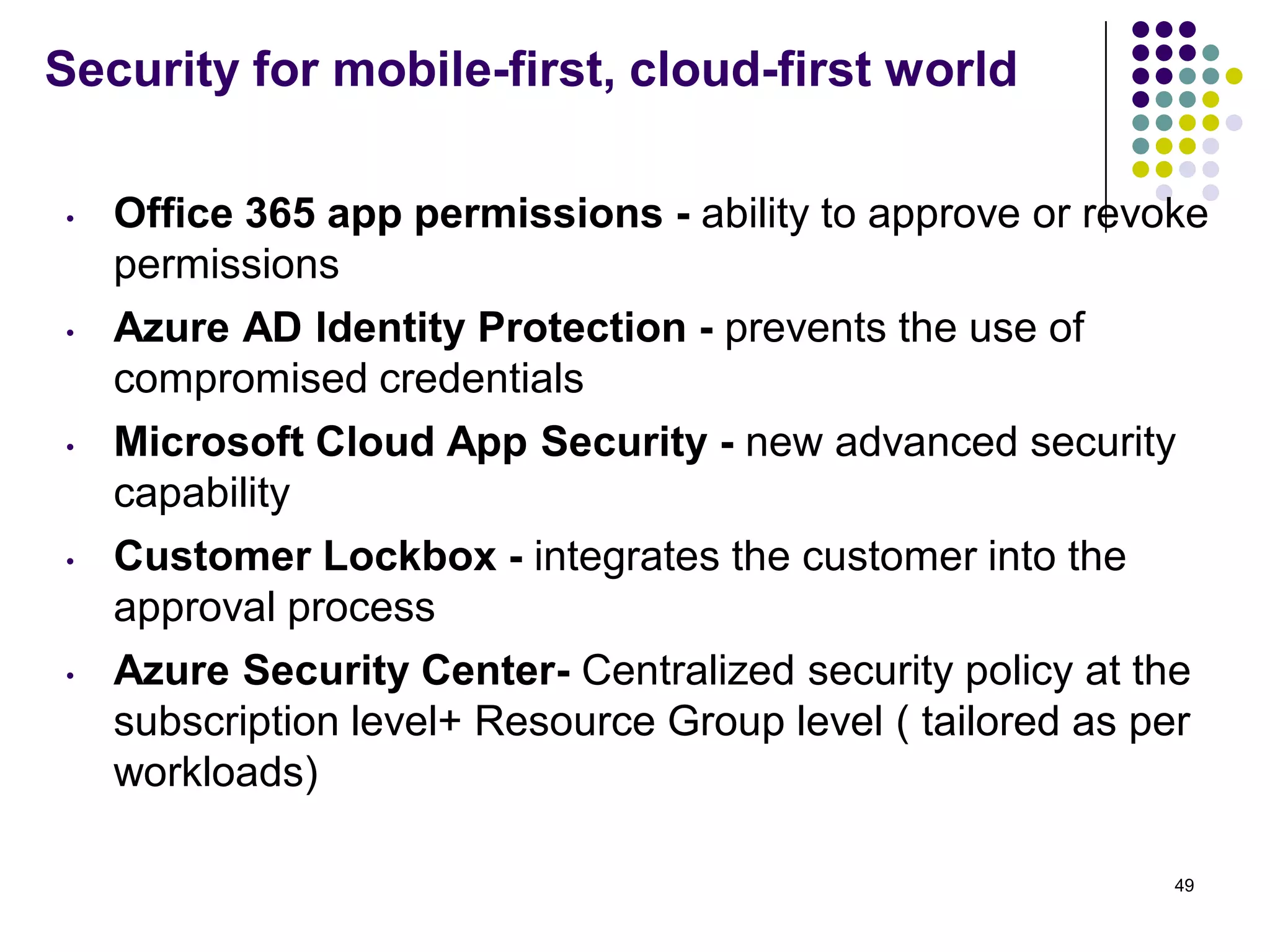
Security for mobile-first, cloud-first world
• Office 365 app permissions - ability to approve or revoke
permissions
• Azure AD Identity Protection - prevents the use of
compromised credentials
• Microsoft Cloud App Security - new advanced security
capability
• Customer Lockbox - integrates the customer into the
approval process
• Azure Security Center- Centralized security policy at the
subscription level+ Resource Group level ( tailored as per
workloads)
49
Security for mobile-first, cloud-first world
• Azure Active Directory Identity Protection - detects
suspicious act, user risk severity is calculated and risk-
based policies can be configured at user level
• WindowsAzure.MobileServices.Backend.Security-
security extensions for your .NET mobile backend (
controller code level permissions)hosted in Microsoft
Azure
• System Center 2012 and InTune- mobile device
management (MDM), BYOD policies, remote wipe out
of data in case of theft
50
Industrial standards
51
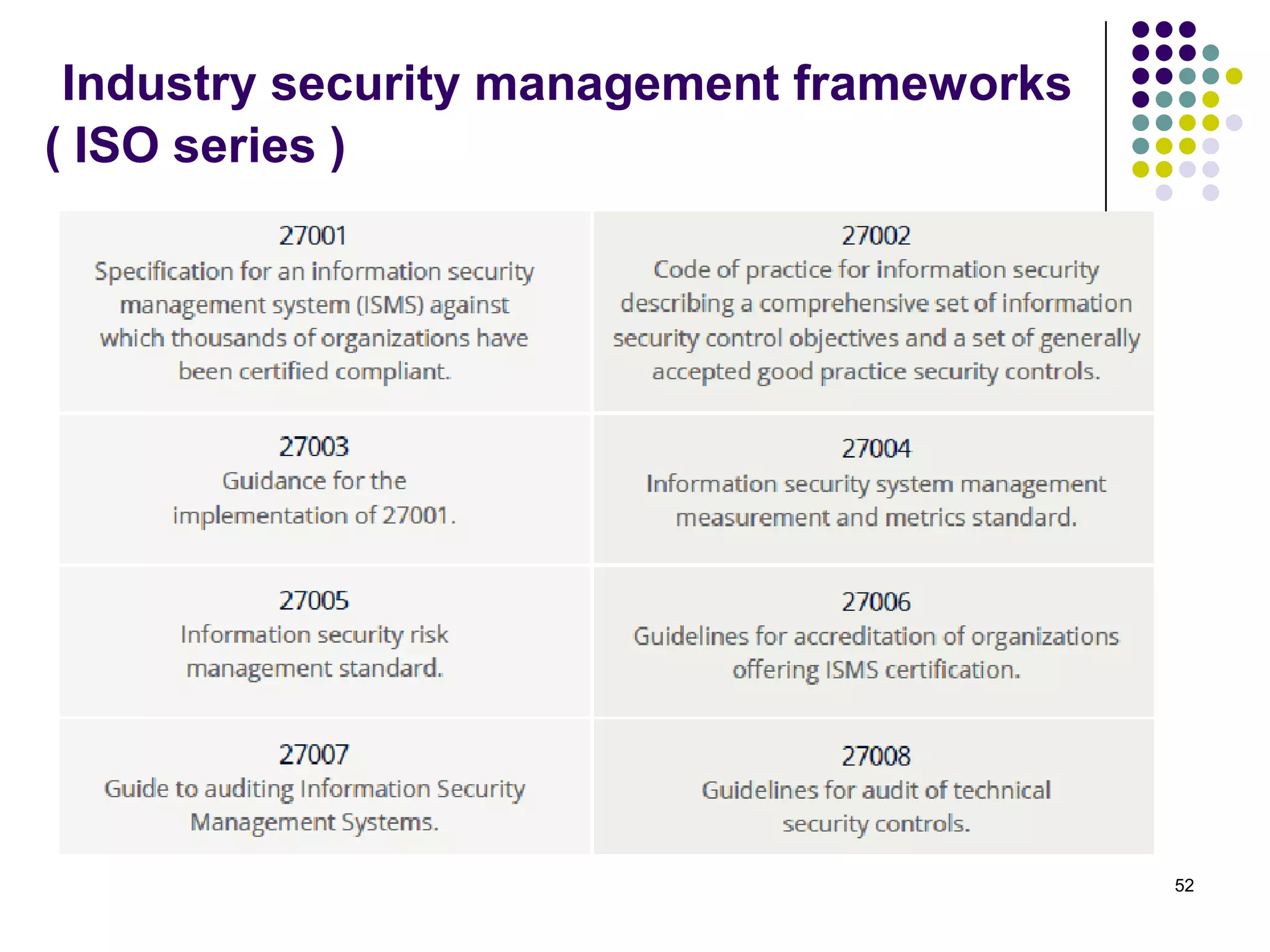
Industry security management frameworks
( ISO series )
52
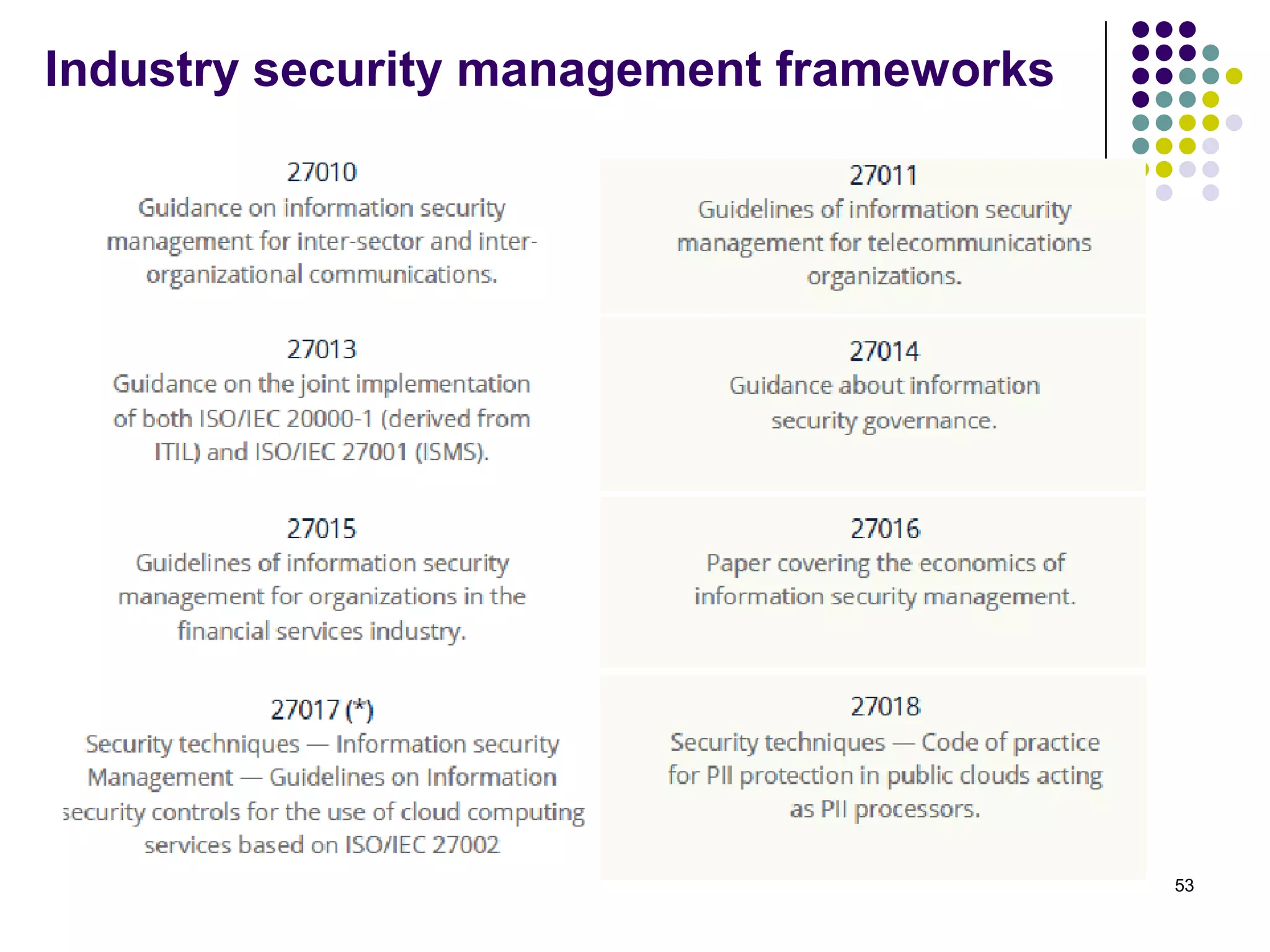
Industry security management frameworks
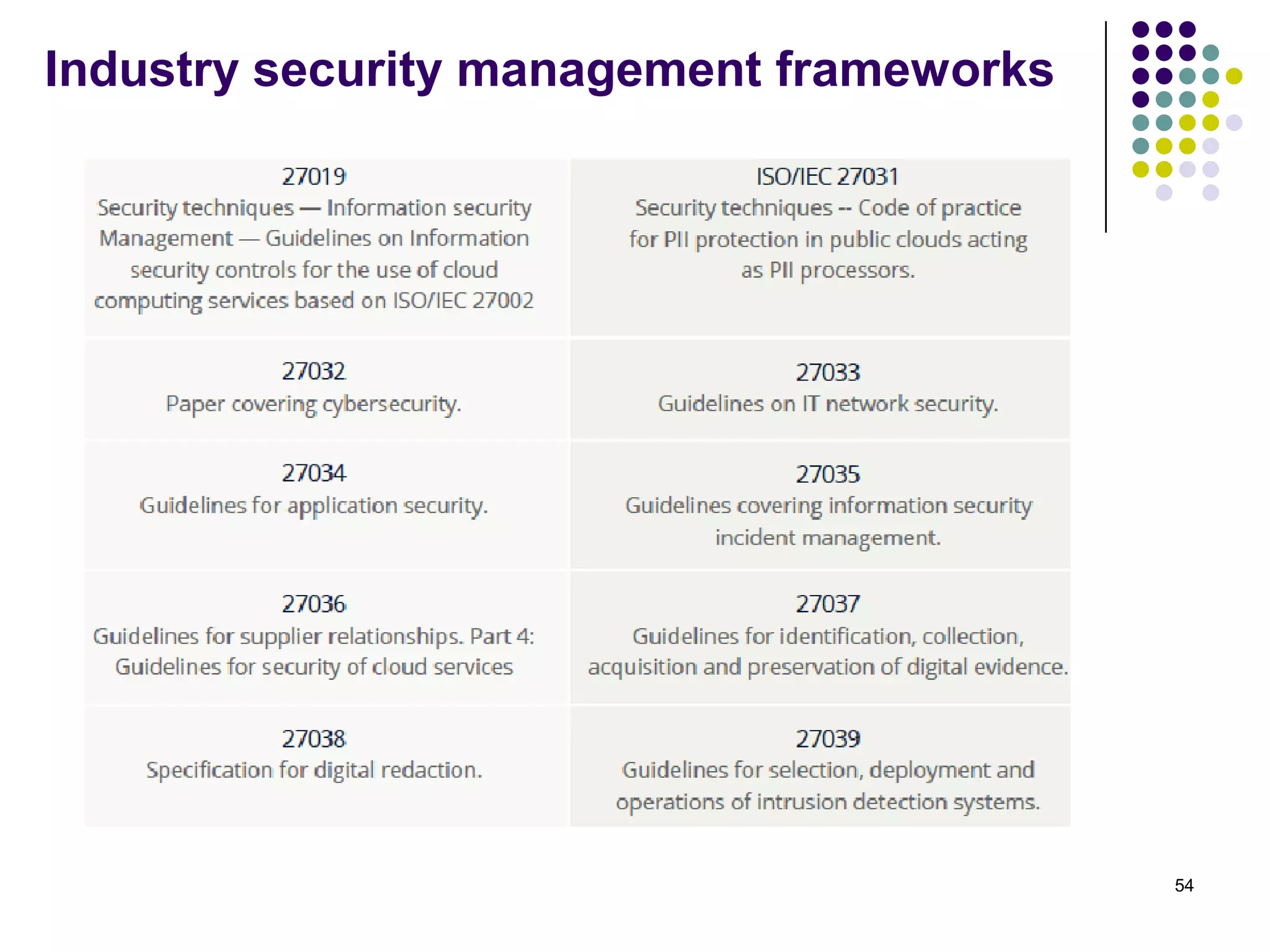
53
Industry security management frameworks
54
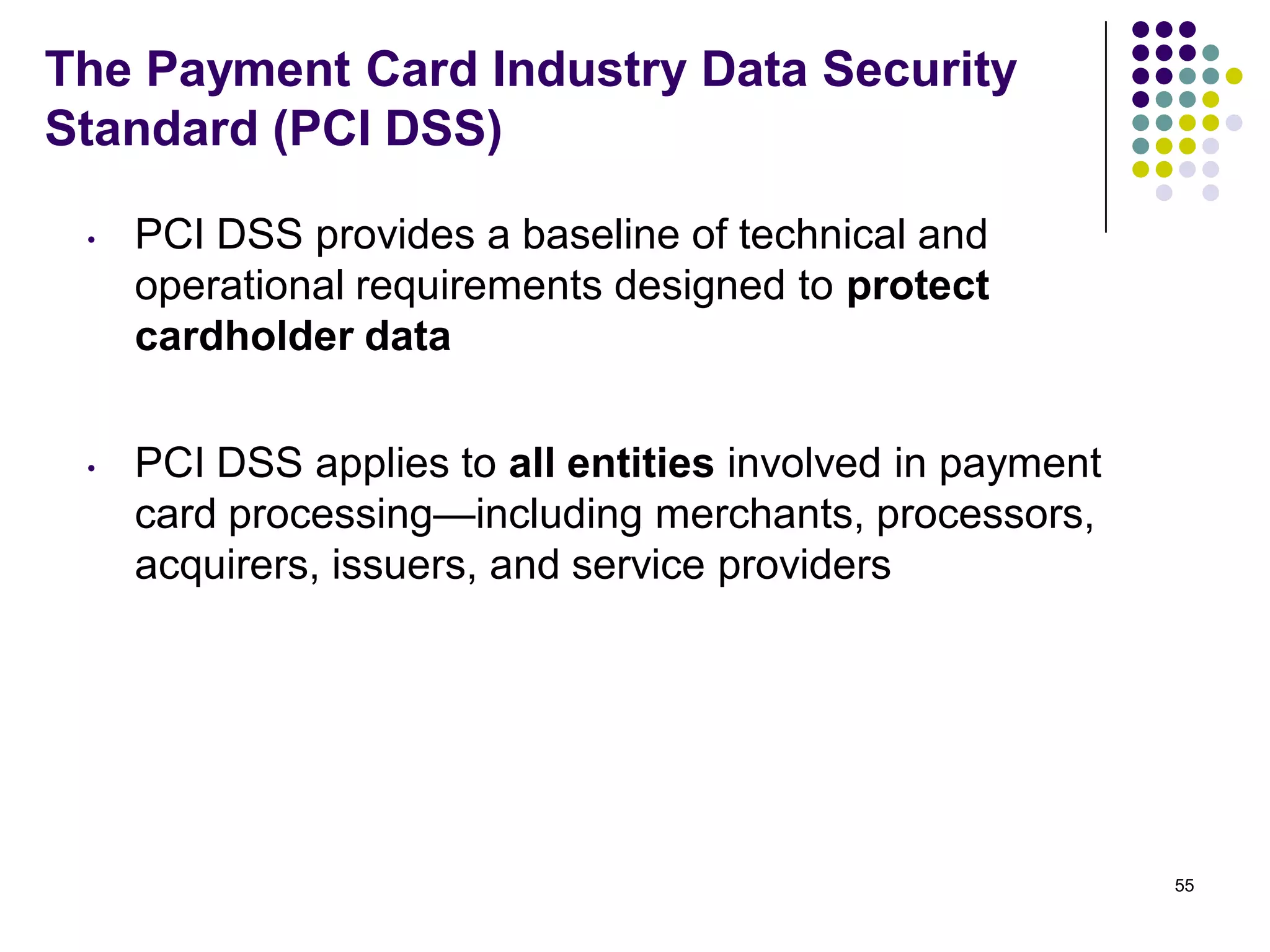
The Payment Card Industry Data Security
Standard (PCI DSS)
• PCI DSS provides a baseline of technical and
operational requirements designed to protect
cardholder data
• PCI DSS applies to all entities involved in payment
card processing—including merchants, processors,
acquirers, issuers, and service providers
55
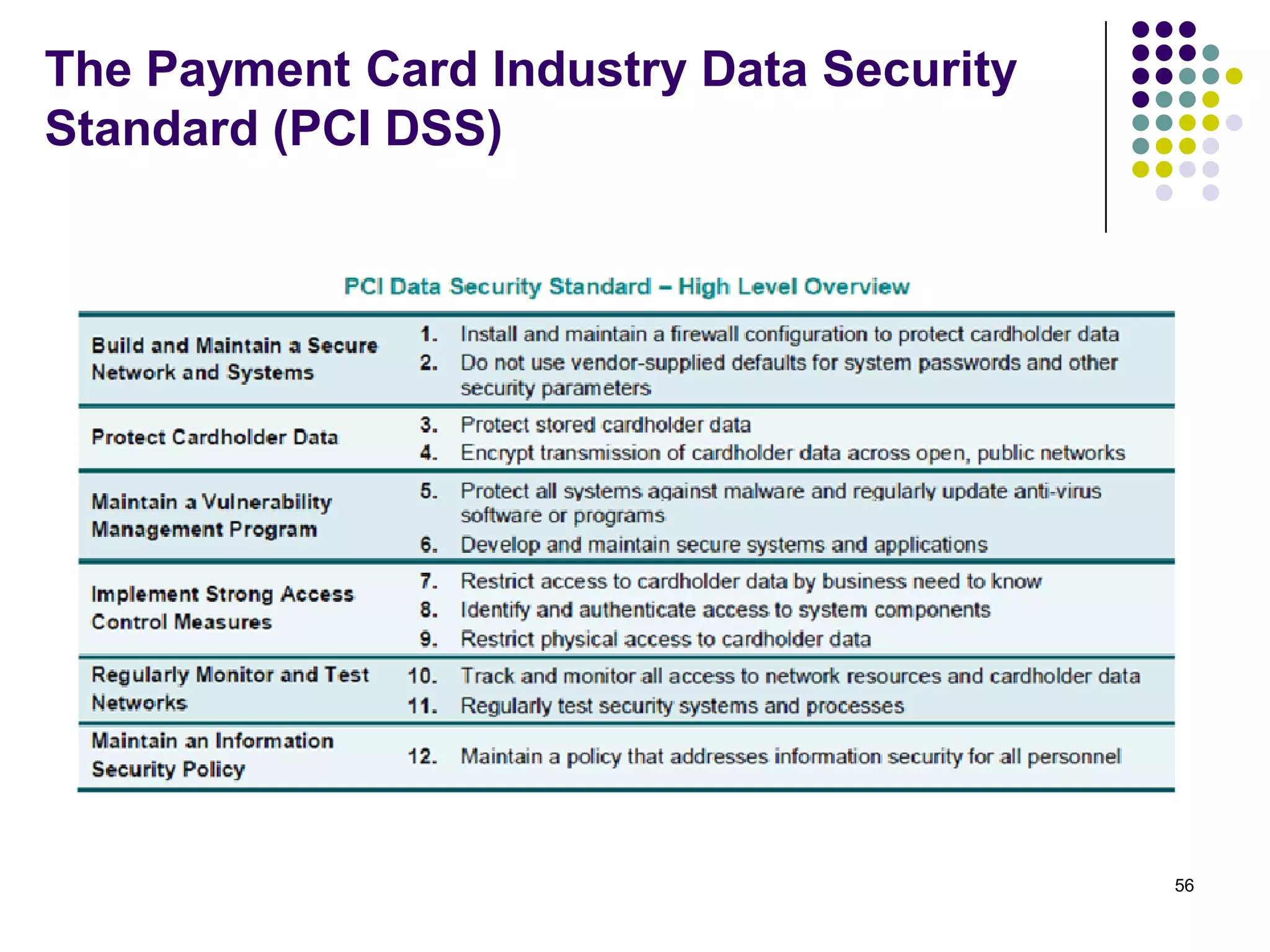
The Payment Card Industry Data Security
Standard (PCI DSS)
56
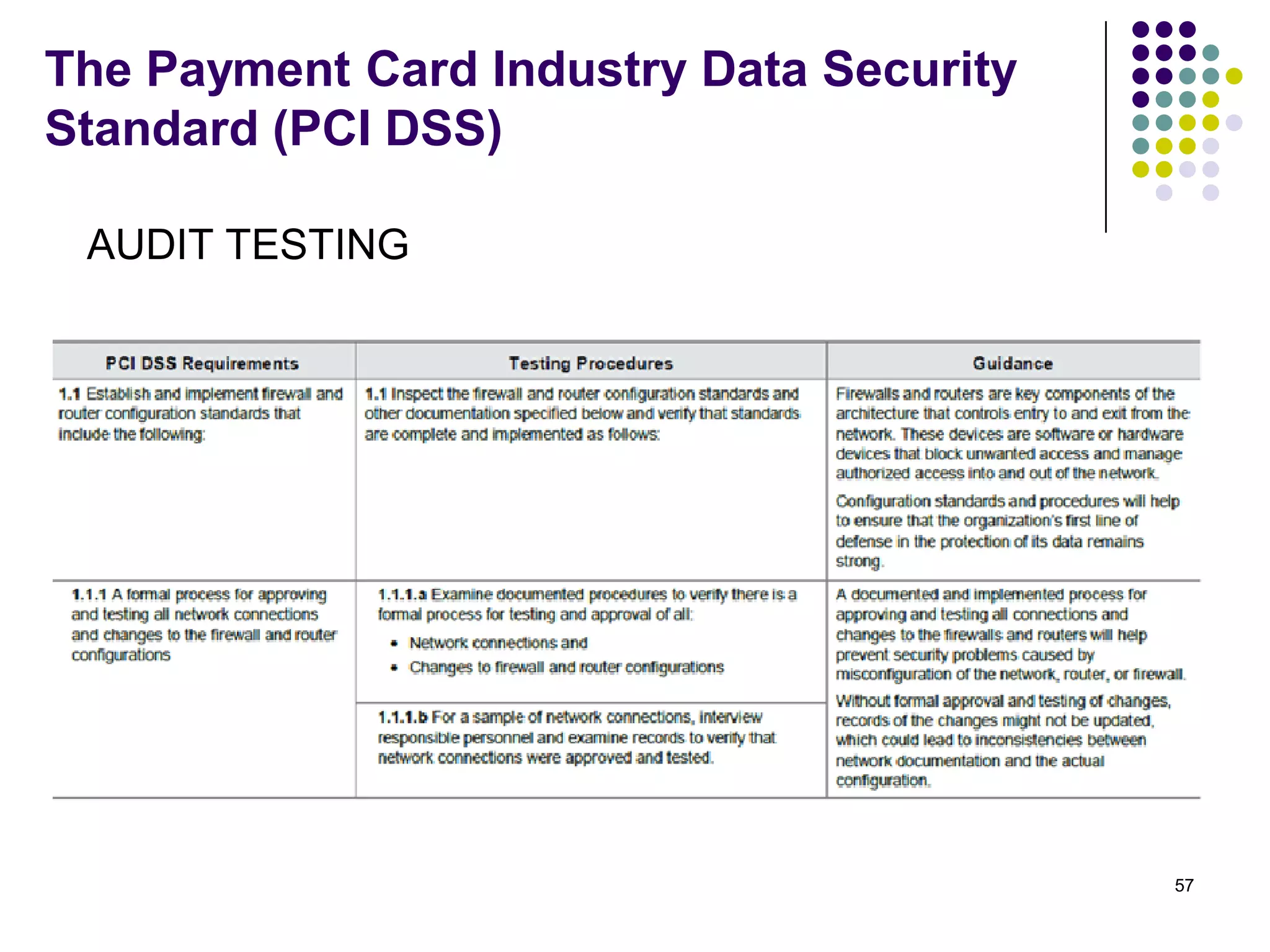
The Payment Card Industry Data Security
Standard (PCI DSS)
AUDIT TESTING
57
Disclaimer
• Logos, images, text have been referenced from various sources
like NIST, SANS, PCI journals, David Chappell, Microsoft
websites, and internet data that is freely available. Full rights
belong to the individual owners. References are made strictly for
educational and illustration purposes only and for non-commercial
use. Please take advice of original authors before using them. I
am not responsible for any damages, monetary loss arising from
the use of this document
58
Q & A
59
Thank you
60

Microsoft InfoSec for cloud and mobile

  • 1.
    Microsoft© Information Security - Cloud& Mobile Presented by Vijay Mohire 1
  • 2.
  • 3.
    Information Security andRisk Management (IS&RM) • Microsoft’s Information Security (InfoSec) organization • Responsible for information security risk management • Information protection, enterprise business continuity planning • Accelerate secure and reliable business for Microsoft, partners and customers • Publisher of The Security Risk Management Guide 3
  • 4.
    ACE team • TheACE (Assessment, Consulting & Engineering) team is the assessment arm of Microsoft’s Information Security & Risk Mgmt. (IS&RM) organization • Provides security assessment services to both Microsoft and Microsoft’s enterprise + public sector customers • Shares and showcases with external customers how Microsoft manages risks • Learns and brings back best practices from Microsoft’s customers 4
  • 5.
    My planned contributionsto ACE Assessments • Risk assessments – Threat modeling, business impact analysis, threat to vulnerability pairing, qualitative/ quantitative analysis, STREAD, DREAD • Compliance checks- ISO, HIPAA, PCI • Due diligence – Security gap analysis, Future state model design, constraints assessments • Strategy - Assess the capability, maturity and roadmaps for investments in Info Sec, business continuity , migration to cloud 5
  • 6.
    My planned contributionsto ACE Consultation • Assist clients in achieving their goals in areas of cloud and mobile security • Provide advice on use of Microsoft’s security tools, SDL based development methodology • Assist clients’ in leveraging security frameworks • Educate in effective use of security best practices • Help companies in developing & establishing security practice, programs, RFP/ RFI 6
  • 7.
    My planned contributionsto ACE Engineering • Manage installation, instrumentation of data center components where security is in scope • • Manage security features in electrical cabling, power units, physical security devices, storage areas • Triage and delegate security issues, related to engineering systems, motherboards 7
  • 8.
    My planned contributionsto ACE Program Management • Plan, design, develop strategies for innovative security features for ―mobile-first, cloud-first‖ environment • Delegate, monitor project activities based on program needs and client feedbacks • Manage red / blue teams related to penetration testing / ethical hackers • Work on internal training programs and mentor juniors in achieving capabilities in Info Sec 8
  • 9.
  • 10.
    Risk What is risk? • Risk is a function of the likelihood of a given threat- source’s exercising a particular potential vulnerability, and the resulting impact of that adverse event on the organization/asset 10
  • 11.
    Threat-sources • Accidental /intentional disclosure • Alteration of licensed IT components • System Configuration errors • Network errors • Equipment malfunction • Natural disaster • War 11
  • 12.
    Vulnerability • A flawor weakness in system security procedures, design, implementation, or internal controls • This could be exercised (accidentally triggered or intentionally exploited) and result in a security breach or a violation of the system’s security policy 12
  • 13.
    Risk assessment • Riskis assessed by identifying threats and vulnerabilities, then determining the likelihood and impact for each risk • Broadly two types 1. Quantitative risk assessment 2. Qualitative risk assessment 13
  • 14.
    Quantitative risk assessment •By assigning values to information, systems, business processes, recovery costs, etc., impact, and therefore risk, can be measured in terms of direct and indirect costs • Mathematically, quantitative risk can be expressed as Annualized Loss Expectancy (ALE) 14
  • 15.
    Quantitative risk assessment ALE= SLE * ARO Where: • ALE is the expected monetary loss that can be expected for an asset due to a risk being realized over a one-year period • SLE (Single Loss Expectancy) is the value of a single loss of the asset. This is the impact of the loss • • ARO (Annualized Rate of Occurrence) is how often the loss occurs. This is the likelihood 15
  • 16.
    Qualitative risk assessments •Qualitative risk assessments typically give risk results of ―High‖, Moderate‖ and ―Low‖. • By providing the impact and likelihood definition tables and the description of the impact, it is possible to adequately communicate the assessment to the organization’s management 16
  • 17.
    Impact and likelihoodtable Tabulating the variables to determine the criticality of the risk that need to be prioritized and addressed 17
  • 18.
    Relating threats tovulnerabilities • Establishing the relationship is a mandatory activity, since risk is defined as the exercise of a threat against vulnerability • This is often called threat- vulnerability (T-V) pairing • For instance, a threat of ―flood‖ obviously applies to a vulnerability of ―lack of contingency planning‖ 18
  • 19.
    How is riskmanaged? • There are four basic strategies for managing risk: mitigation, transference, acceptance and avoidance • For each risk management strategy, the cost associated with the strategy and the basic steps for achieving the strategy (known as the Plan Of Action & Milestones or POAM) must also be determined 19
  • 20.
    Mitigation • Mitigation isthe most commonly considered risk management strategy • Mitigation involves fixing the flaw or providing some type of compensatory control to reduce the likelihood or impact associated with the flaw • A common mitigation for a technical security flaw is to install a patch provided by the vendor 20
  • 21.
    Transference • Transference isthe process of allowing another party to accept the risk on your behalf • This is not widely done for IT systems, however cloud models provide an opportunity • Using SaaS, PaaS cloud models, some amount of risk is being transferred to CSP – cloud service provider 21
  • 22.
    Acceptance • Acceptance isthe practice of simply allowing the system to operate with a known risk • Many low risks are simply accepted • Risks that have an extremely high cost to mitigate are also often accepted 22
  • 23.
    Avoidance • Avoidance isthe practice of removing the vulnerable aspect of the system or even the system itself • Example is removing a legacy admin system that is causing hi-impact errors in operations 23
  • 24.
  • 25.
    Communicating risks • APlan Of Action & Milestones (POAM) should be part of the risk assessment report presented to management • The POAM is a tool to communicate to management on the proposed and actual completion of the implementation of the risk management strategies 25
  • 26.
  • 27.
  • 28.
    Framing risk • Riskframing establishes the context and provides a common perspective on how organizations manage risk • • Risk framing, as its principal output, produces a risk management strategy that addresses how organizations intend to assess risk, respond to risk, and monitor risk • Mainly senior leaders, program manager at Tier 1 & 2 are responsible 28
  • 29.
    Risk assessment • Riskassessment identifies, prioritizes, and estimates risk to organizational operations (i.e., mission, functions, image, and reputation), organizational assets, individuals, other organizations, and the Nation • All tiers provide their reports to the security officer for further action plan 29
  • 30.
    Risk response • Riskresponse identifies, evaluates, decides on, and implements appropriate courses of action to accept, avoid, mitigate, share, or transfer risk to organizational operations and assets, individuals, other organizations, and the Nation • Typically occurs at Tier 1 or Tier 2, with feedbacks from Tier 3 30
  • 31.
    Risk monitoring Risk monitoringprovides organizations with the means to: (i) verify compliance (ii) determine the ongoing effectiveness of risk response measures; and (iii) identify risk-impacting changes to organizational information systems and environments of operation 31
  • 32.
    Information technology continuityplan Conduct a business impact analysis to identify: 1. Critical IT resources 2. Outage impacts and allowable outage times 3. Protocols to provide uninterrupted power by using UPS devices, power 4. Store backup data in a secure and protected offsite location 5. Develop recovery strategies that allow critical IT resources to be recovered within 24 hours. 6. Document the recovery strategy 32
  • 33.
  • 34.
    General risk assessmenttools • National Institute of Standards & Technology (NIST) Methodology – US Federal based • OCTAVE ® - The Software Engineering Institute (SEI) at Carnegie Mellon University developed the Operationally Critical, Threat, Asset and Vulnerability Evaluation (OCTAVE) process • FRAP - The Facilitated Risk Assessment Process (FRAP) is the creation of Thomas Peltier. FRAP uses formal qualitative risk analysis methodologies using Vulnerability Analysis, Hazard Impact Analysis, Threat Analysis and Questionnaires 34
  • 35.
    General risk assessmenttools • COBRA - The Consultative, Objective and Bi-functional Risk Analysis (COBRA) process was created by C & A Systems Security Ltd.. Risk assessment is a business issue rather than a technical issue, tools that can be purchased and utilized to perform self-assessments of risk • Risk Watch- Uses an expert knowledge database to walk the user through a risk assessment and provide reports on compliance as well as advice on managing the risks 35
  • 36.
  • 37.
  • 38.
  • 39.
  • 40.
    Azure - gatekeeperdesign pattern 40
  • 41.
    Microsoft’s STRIDE threatcategories • Spoofing identity – pose as another user • Tampering with data – malicious modification of data • Repudiation – can the action (prohibited action) be traced? • Information disclosure – disclose of information to individuals who aren’t supposed to have it • Denial of service – deny access to valid users (e.g. consume all the CPU time) • Elevation of privilege – unprivileged user gains privileged access (becomes part of the trusted system) 41
  • 42.
    Microsoft’s DREAD modelto rank threat’s severity • Damage potential: The extent of the damage if vulnerability is exploited • Reproducibility: How often an attempt at exploiting vulnerability works • Exploitability: How much effort is required? Is authentication required? • Affected users: How widespread could the exploit become? • Discoverability: The likelihood that the researcher or hacker will find it 42
  • 43.
    Security development lifecycle(SDL) • SDL is a software development process that helps developers build secure code, address compliance 43
  • 44.
    SDL tools Requirements tools •Microsoft Solutions Framework (MSF) for Capability Maturity Model Integration (CMMI) / Microsoft Solutions Framework (MSF) for Agile Design tool • Microsoft Threat Modeling Tool 2014 / 2016 44
  • 45.
    SDL tools Implementation tools •banned.h • Code Analysis for C/C++ • SiteLock ATL Template • Anti-Cross Site Scripting (Anti-XSS) Library • FxCop (assemblies) • Microsoft Code Analysis Tool .NET (CAT.NET) - binary code analysis for XSS, SQL Injection 45
  • 46.
    SDL tools Verification tools •BinScope binary analyzer- binary files • SDL Regex fuzzer – tests reg. exp for DoS • SDL MiniFuzz file fuzzer-detects file-handling flaws • Attack surface analyzer-detect changes in OS, ACL, registry, Active-X control • Application verifier-runtime verification tool for native code 46
  • 47.
    SDL tools Release tools SDLprocess template- integrates the policy, process, and tools associated with Microsoft SDL Process Guidance version 4.1 directly into your VSTS 47
  • 48.
    Azure network security •VNet for isolation of VMs • ACL and NSG – for access control at VM and subnet level • Azure Virtual Filtering Platform (VFP) exposes an easy- to-program interface to network agents that act on behalf of network controllers and packet processing on each host running in the datacenter • Service endpoint and azure fabric level security mechanism 48
  • 49.
    Security for mobile-first,cloud-first world • Office 365 app permissions - ability to approve or revoke permissions • Azure AD Identity Protection - prevents the use of compromised credentials • Microsoft Cloud App Security - new advanced security capability • Customer Lockbox - integrates the customer into the approval process • Azure Security Center- Centralized security policy at the subscription level+ Resource Group level ( tailored as per workloads) 49
  • 50.
    Security for mobile-first,cloud-first world • Azure Active Directory Identity Protection - detects suspicious act, user risk severity is calculated and risk- based policies can be configured at user level • WindowsAzure.MobileServices.Backend.Security- security extensions for your .NET mobile backend ( controller code level permissions)hosted in Microsoft Azure • System Center 2012 and InTune- mobile device management (MDM), BYOD policies, remote wipe out of data in case of theft 50
  • 51.
  • 52.
    Industry security managementframeworks ( ISO series ) 52
  • 53.
  • 54.
  • 55.
    The Payment CardIndustry Data Security Standard (PCI DSS) • PCI DSS provides a baseline of technical and operational requirements designed to protect cardholder data • PCI DSS applies to all entities involved in payment card processing—including merchants, processors, acquirers, issuers, and service providers 55
  • 56.
    The Payment CardIndustry Data Security Standard (PCI DSS) 56
  • 57.
    The Payment CardIndustry Data Security Standard (PCI DSS) AUDIT TESTING 57
  • 58.
    Disclaimer • Logos, images,text have been referenced from various sources like NIST, SANS, PCI journals, David Chappell, Microsoft websites, and internet data that is freely available. Full rights belong to the individual owners. References are made strictly for educational and illustration purposes only and for non-commercial use. Please take advice of original authors before using them. I am not responsible for any damages, monetary loss arising from the use of this document 58
  • 59.
  • 60.