13/01/1444 1
Risk Identification
&
Assessment
Submitted
To : Dr Loai Tawalbeh
From : Muna
Ahmed
13/01/1444 2
Main topics
 What is Risk & Risk management?
 Risk Management Cycle
 Risk Identification
 Primary sources of Risk Items
 What is Risk Assessment ?
 How to assess the risks ?
 Risk Assessment methodologies
 Methods of Risk Assessment
 Who is responsible in risk assessment?
 Two Case Studies
 Conclusion
13/01/1444 3
What is Risk & Risk
Management?
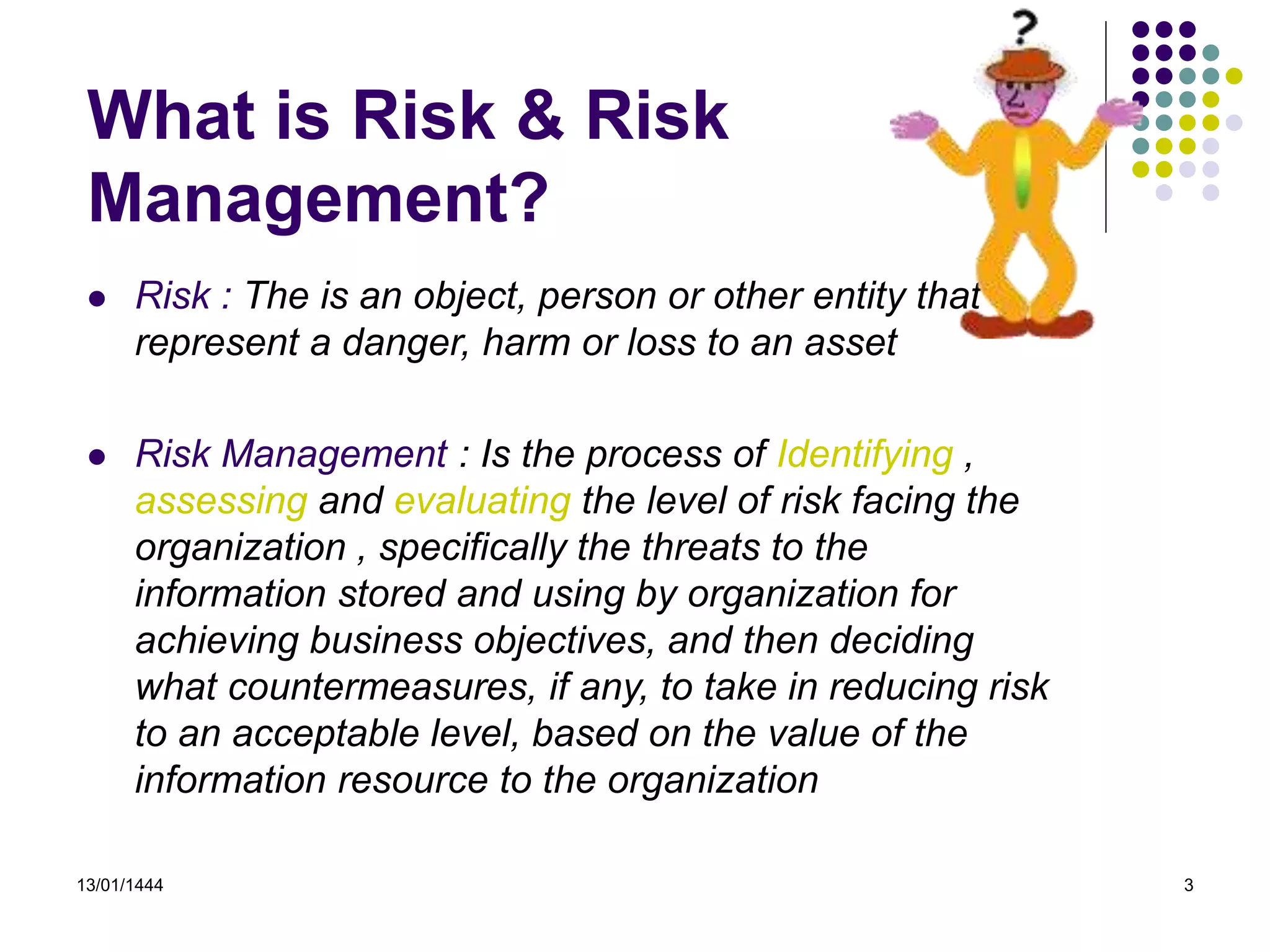
 Risk : The is an object, person or other entity that
represent a danger, harm or loss to an asset
 Risk Management : Is the process of Identifying ,
assessing and evaluating the level of risk facing the
organization , specifically the threats to the
information stored and using by organization for
achieving business objectives, and then deciding
what countermeasures, if any, to take in reducing risk
to an acceptable level, based on the value of the
information resource to the organization
13/01/1444 4
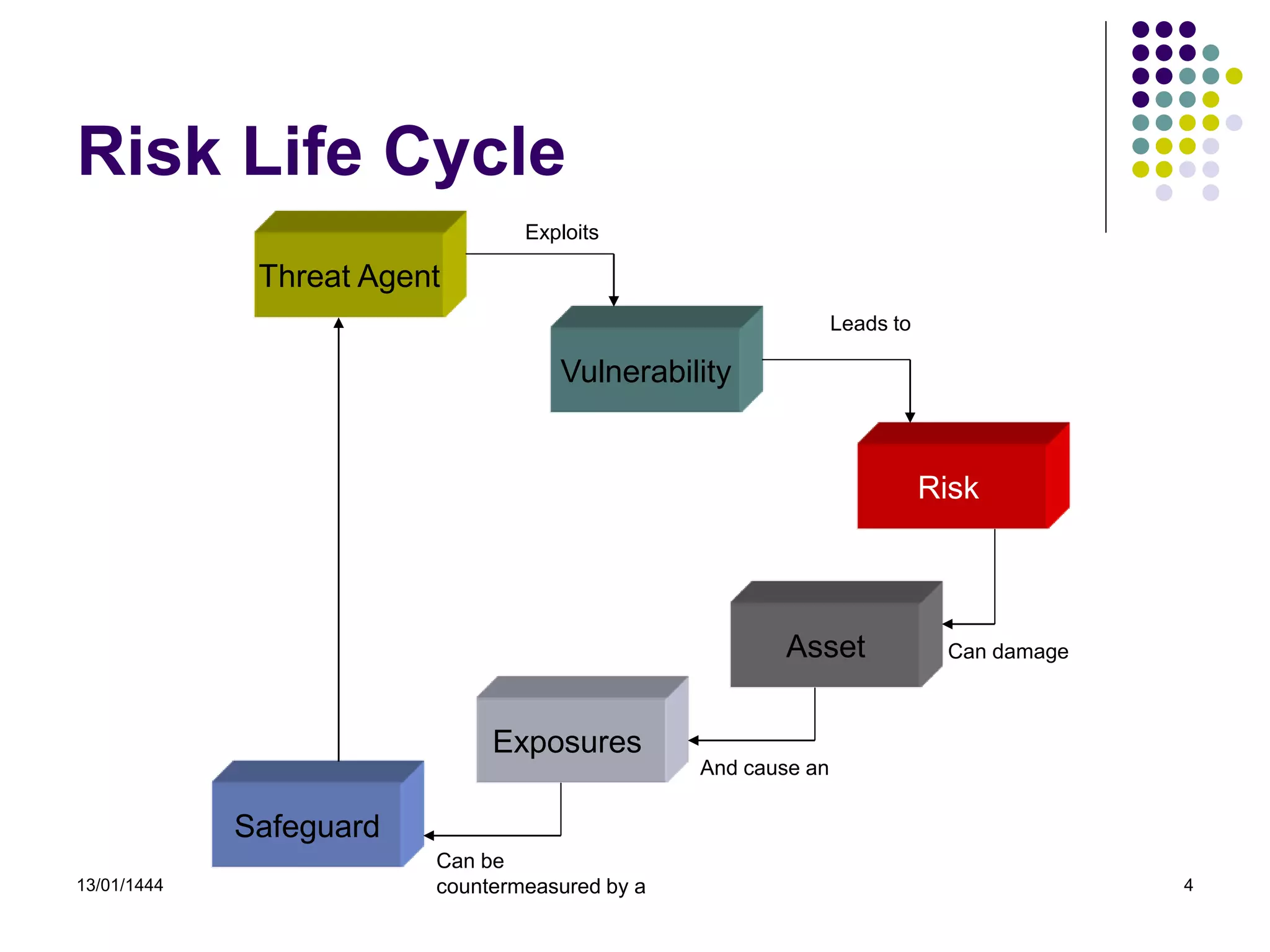
Risk Life Cycle
Threat Agent
Vulnerability
Risk
Asset
Exposures
Safeguard
Exploits
Leads to
Can damage
And cause an
Can be
countermeasured by a
13/01/1444 5
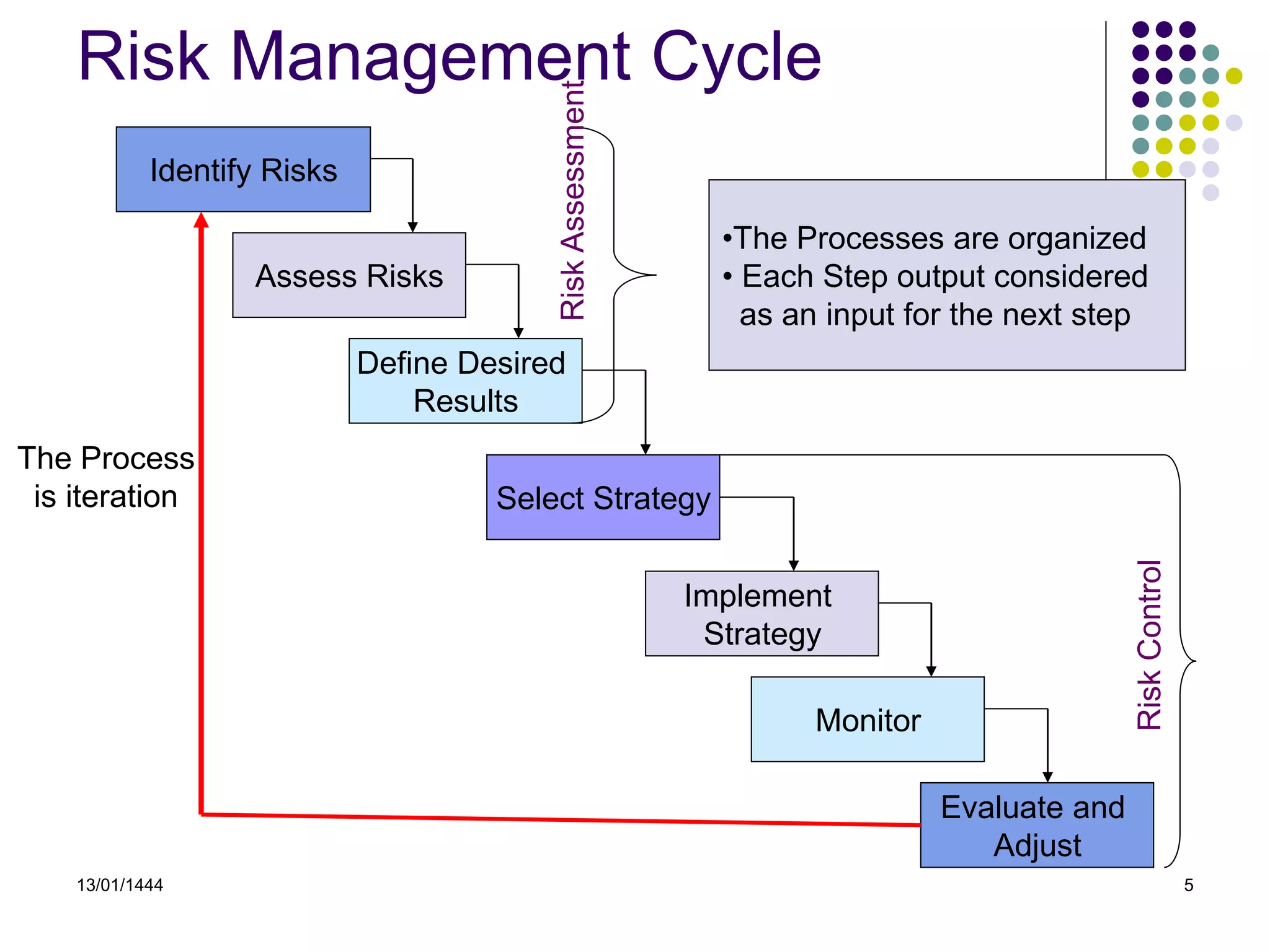
Risk Management Cycle
Identify Risks
Assess Risks
Define Desired
Results
Select Strategy
Implement
Strategy
Monitor
Evaluate and
Adjust
The Process
is iteration
•The Processes are organized
• Each Step output considered
as an input for the next step
Risk
Control
Risk
Assessment
13/01/1444 6
13/01/1444 7
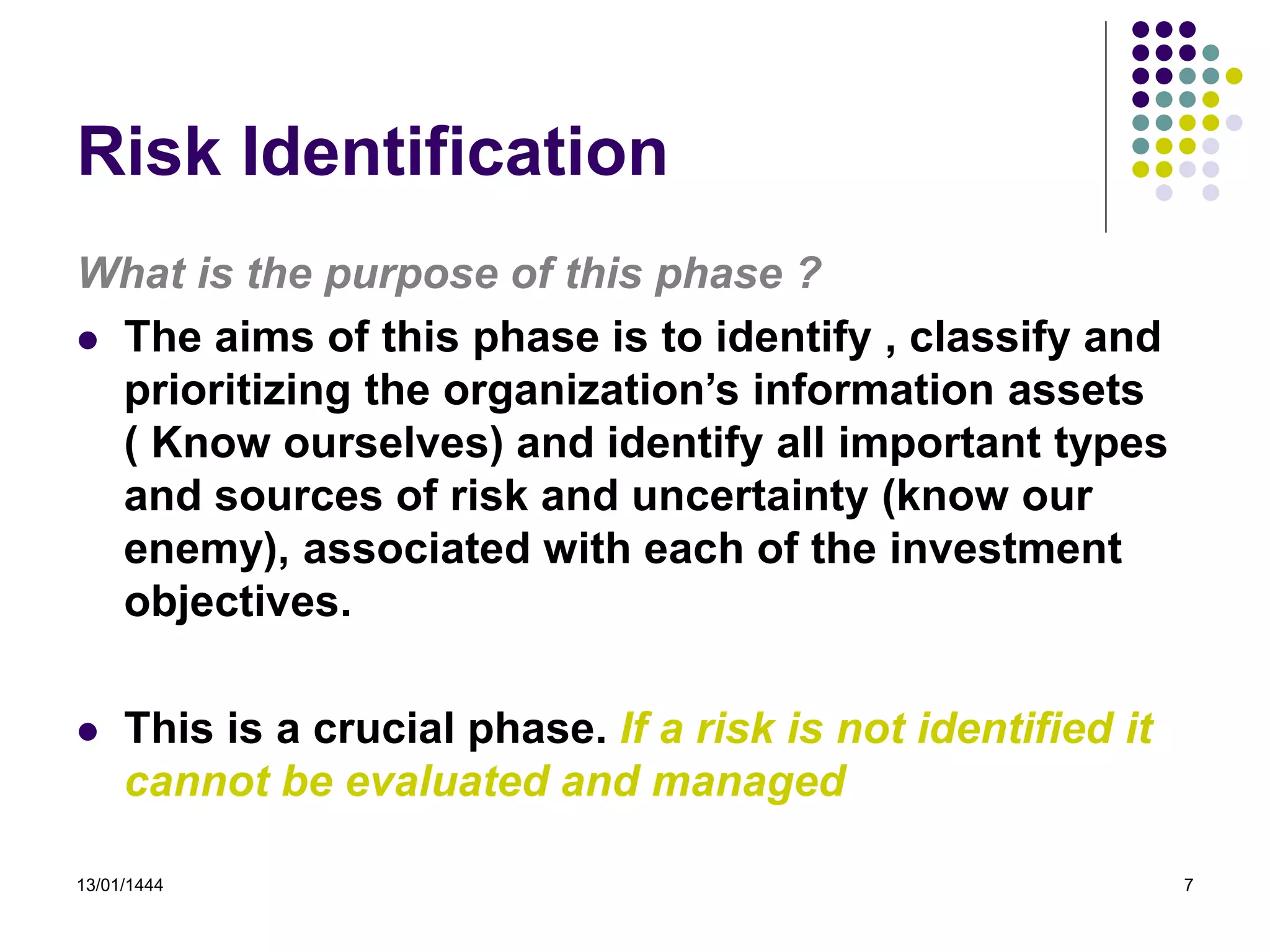
Risk Identification
What is the purpose of this phase ?
 The aims of this phase is to identify , classify and
prioritizing the organization’s information assets
( Know ourselves) and identify all important types
and sources of risk and uncertainty (know our
enemy), associated with each of the investment
objectives.
 This is a crucial phase. If a risk is not identified it
cannot be evaluated and managed
13/01/1444 8
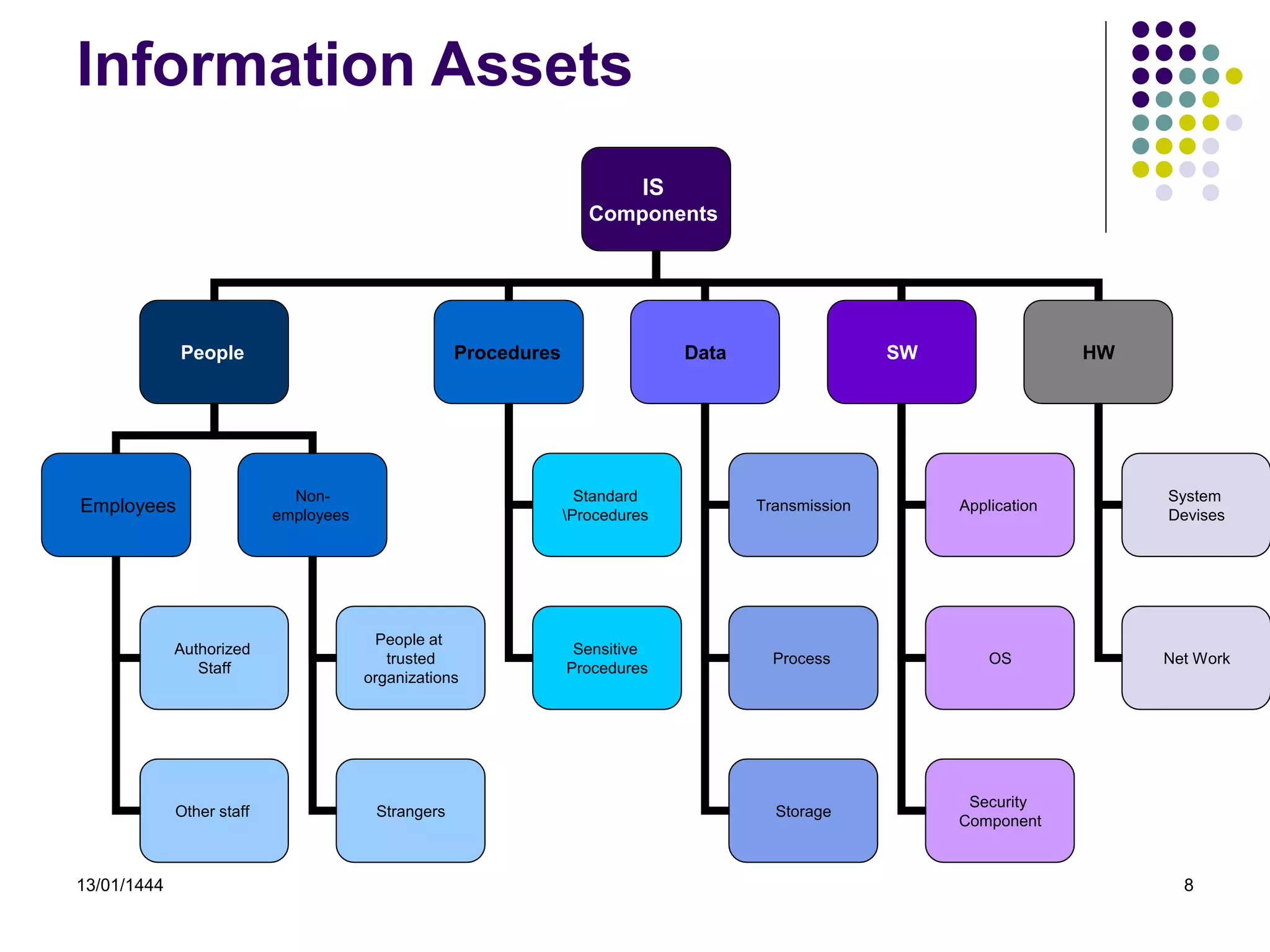
Information Assets
IS
Components
People Procedures Data
Transmission
HW
SW
Employees
Non-
employees
People at
trusted
organizations
Authorized
Staff
Other staff Strangers
Standard
Procedures
Sensitive
Procedures
Process
Storage
Application
OS
Security
Component
System
Devises
Net Work
13/01/1444 9
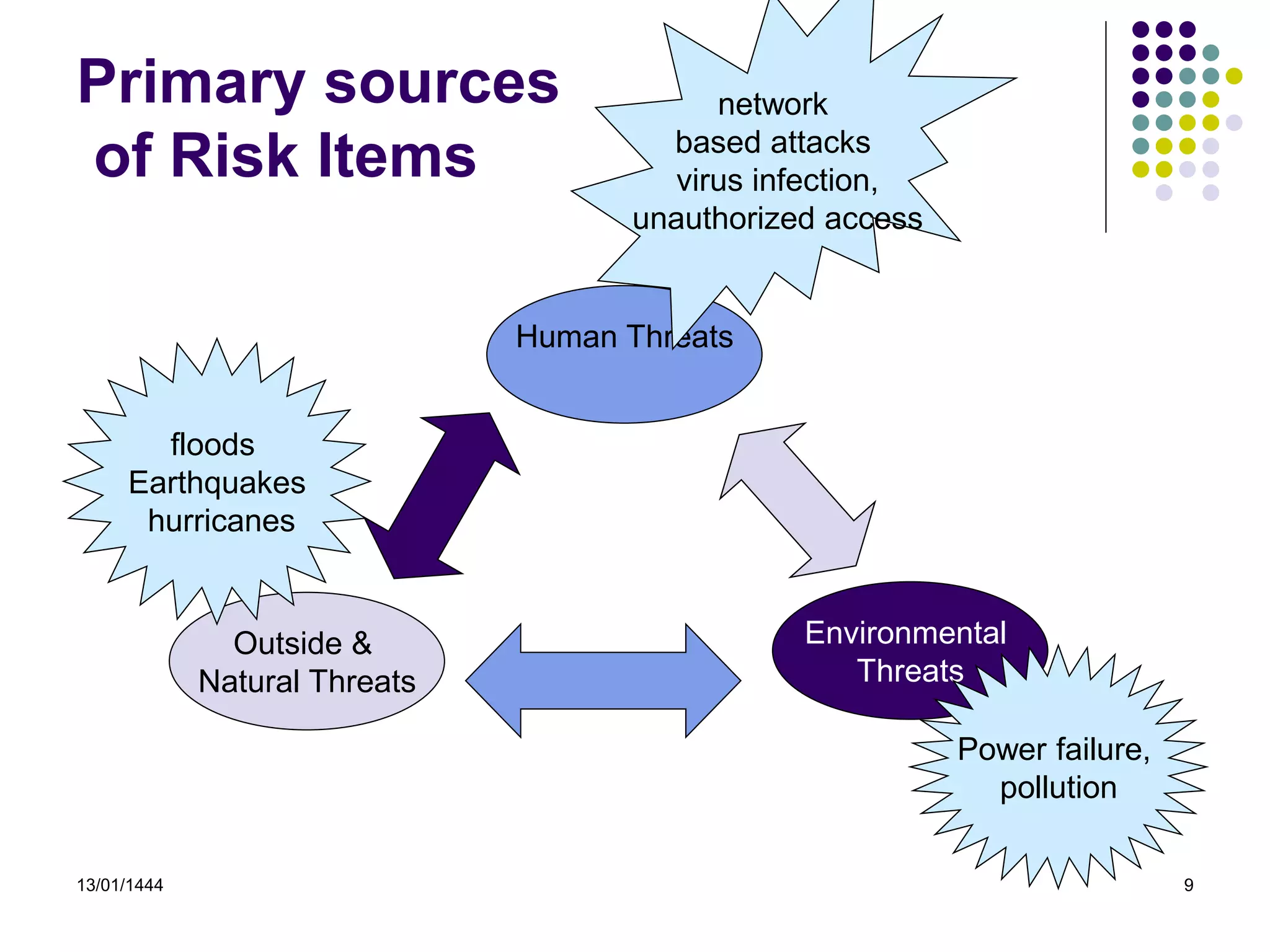
Primary sources
of Risk Items
Human Threats
Environmental
Threats
Outside &
Natural Threats
network
based attacks
virus infection,
unauthorized access
floods
Earthquakes
hurricanes
Power failure,
pollution
13/01/1444 10
Risk Assessment
 For each identified component & risk, which
has a 'clearly significant' or 'possibly
significant' position, each should be assess to
establish qualitatively and Estimate the value
13/01/1444 11
What is Risk Assessment ?
 Assessing risk is the process of determining the likelihood of
the threat being exercised against the vulnerability and the
resulting impact from a successful compromise , i.e determine
the relative risk for each of the vulnerabilities
 Risk assessment assigns a risk rating or score to each specific
information asset, useful in evaluating the relative risk and
making comparative ratings later in the risk control process
• Although all elements of the risk management cycle are important,
risk assessments provide the foundation for other elements of the
cycle. In particular, risk assessments provide a basis for establishing
appropriate policies and selecting cost-effective techniques to
implement these policies
13/01/1444 12
Methods of Risk Assessment
There are various methods assessing risk,
First : Quantitative risk assessment :
generally estimates values of Information Systems components as ;
information, systems, business processes, recovery costs, etc.,
risk can be measured in terms of direct and indirect costs , based on
(1) the likelihood that a damaging event will occur
(2) the costs of potential losses
(3) the costs of mitigating actions that could be taken.
,
13/01/1444 13
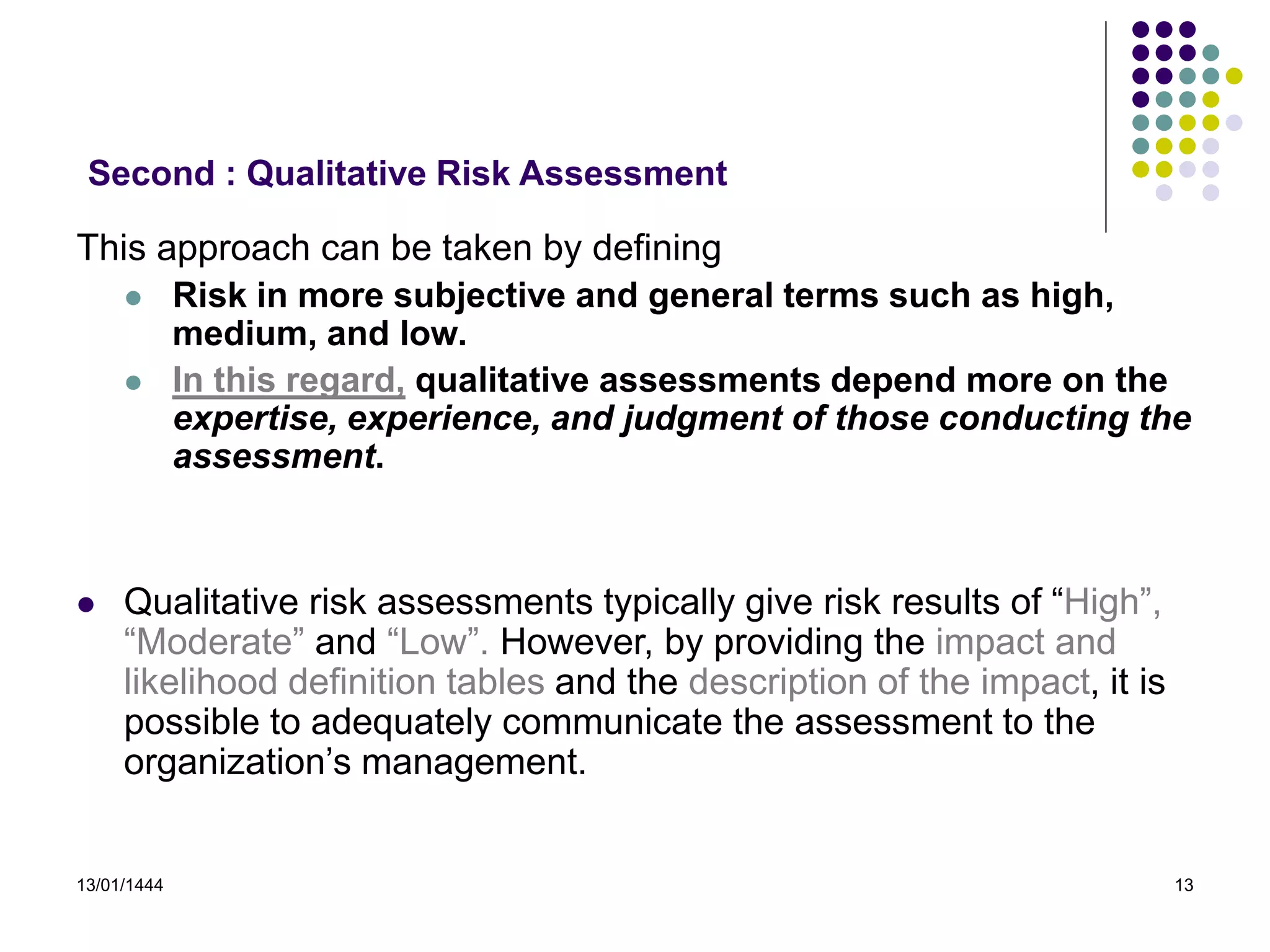
This approach can be taken by defining
 Risk in more subjective and general terms such as high,
medium, and low.
 In this regard, qualitative assessments depend more on the
expertise, experience, and judgment of those conducting the
assessment.
 Qualitative risk assessments typically give risk results of “High”,
“Moderate” and “Low”. However, by providing the impact and
likelihood definition tables and the description of the impact, it is
possible to adequately communicate the assessment to the
organization’s management.
Second : Qualitative Risk Assessment
13/01/1444 14
Third :Quantitative and Qualitative
 It is also possible to use a combination of
quantitative and qualitative method
13/01/1444 15
 Quantitative risk measurement is the standard way of measuring risk
in many fields, such as insurance, but it is not commonly used to
measure risk in information systems.
 Two of the reasons claimed for this are
 1) the difficulties in identifying and assigning a value of all
components
 2) Moral Effects couldn’t measured by quantitative
measurements
 2) the lack of statistical information that would make it
possible to determine frequency.
 Thus, most of the risk assessment tools that are used today for
information systems are measurements of qualitative risk.
13/01/1444 16
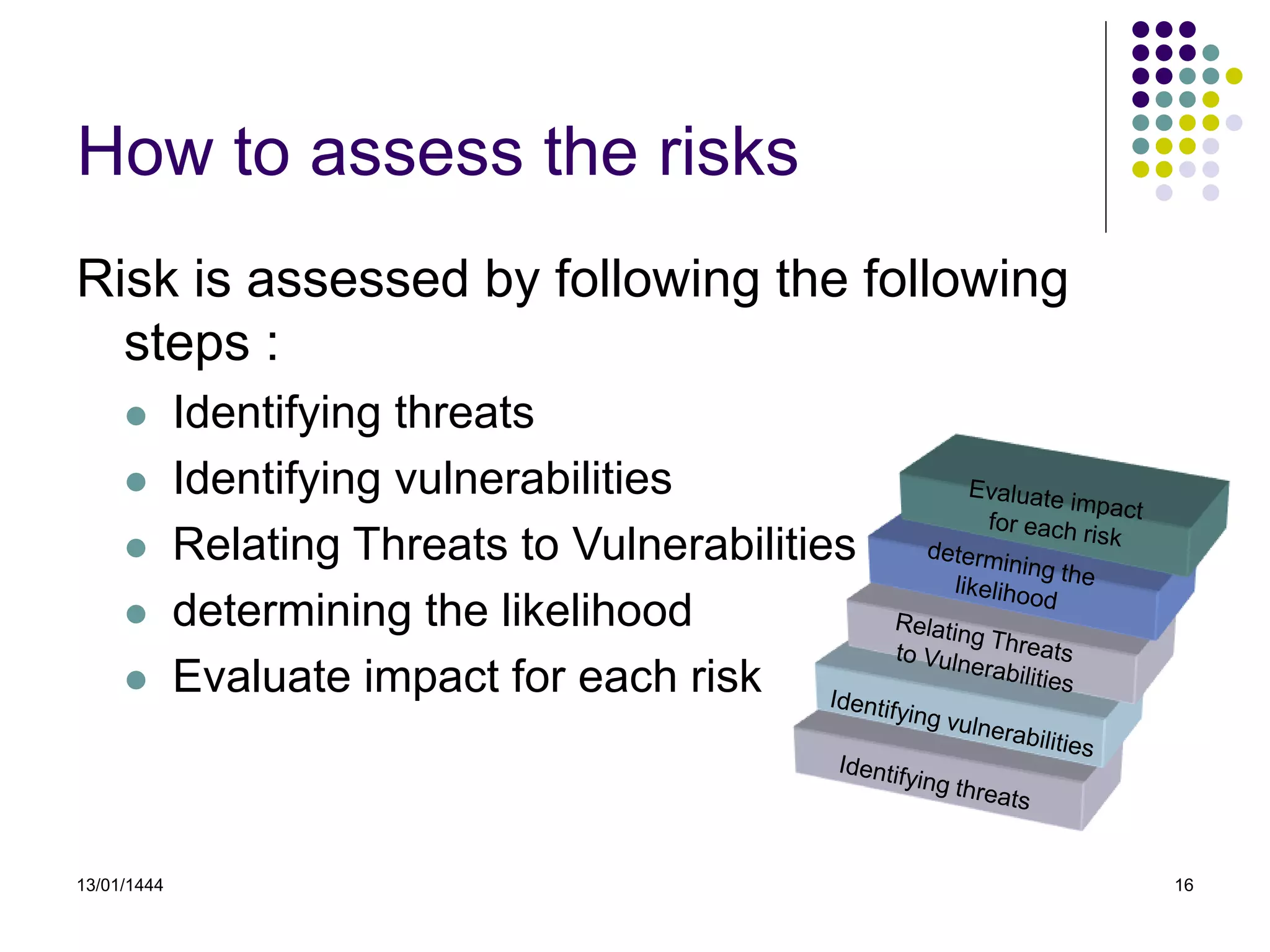
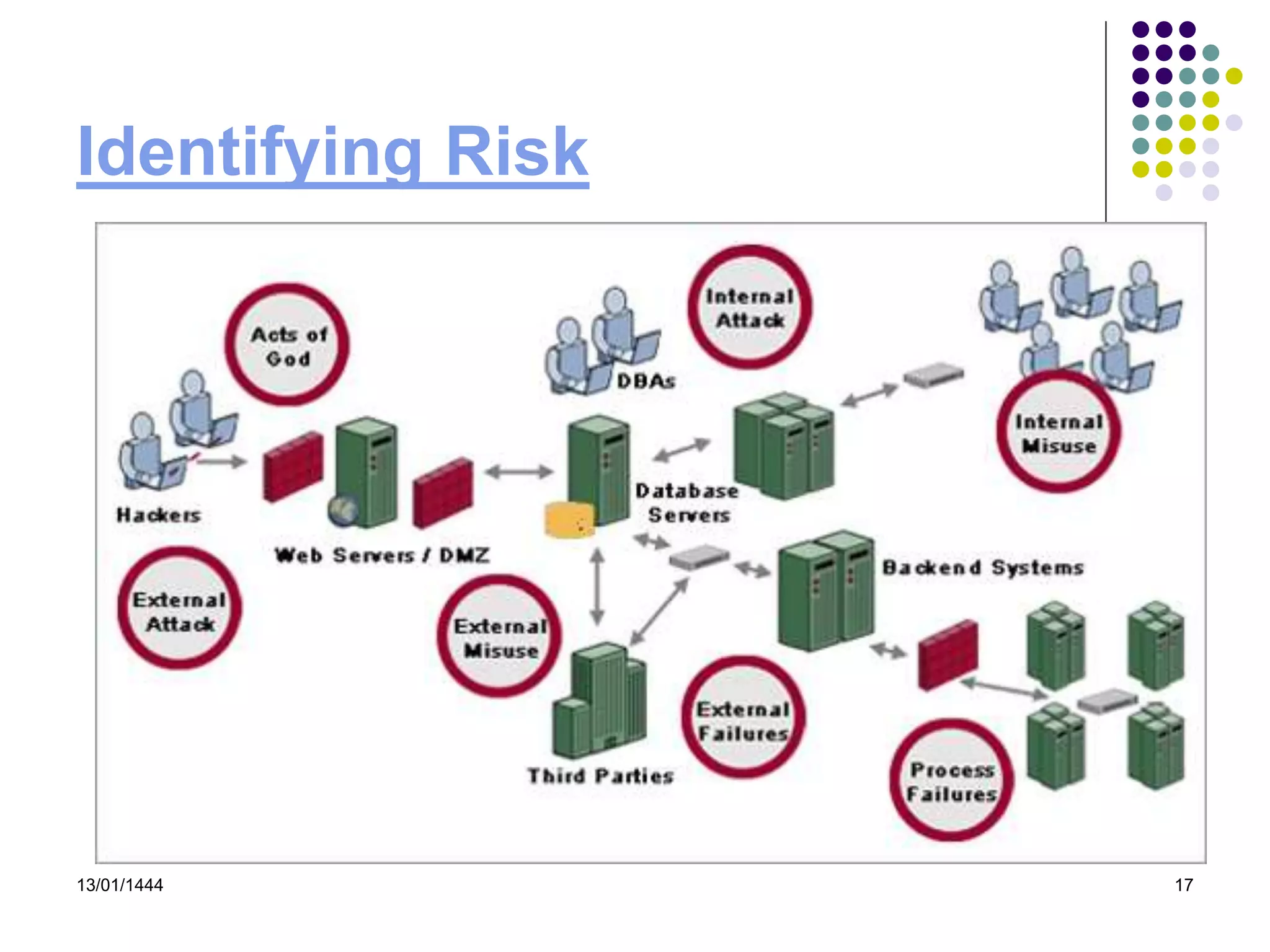
How to assess the risks
Risk is assessed by following the following
steps :
 Identifying threats
 Identifying vulnerabilities
 Relating Threats to Vulnerabilities
 determining the likelihood
 Evaluate impact for each risk
13/01/1444 17
Identifying Risk
13/01/1444 18
Identifying Vulnerabilities
 Identifying Vulnerabilities : how each of the threats that are
possible or likely could be perpetrated , and list the organization’s
assets and their vulnerabilities
 Vulnerabilities can be identified by numerous means.
 Different methodologies for identifying vulnerabilities.
 start with commonly available vulnerability lists.
 Then, working with the system owners or other individuals with
knowledge of the system or organization, start to identify the
vulnerabilities that apply to the system.
 Specific vulnerabilities can be found by reviewing vendor web sites and
public vulnerability archives, such as Common Vulnerabilities and
Exposures (CVE - http://cve.mitre.org) or the National Vulnerability
Database (NVD - http://nvd.nist.gov).
13/01/1444 19
Relating Threats to Vulnerabilities
 Not every threat-action/threat can be
exercised against every vulnerability.
 For example, a threat of “flood” obviously
applies to a vulnerability of “lack of
contingency planning”, but not to a
vulnerability of “failure to change default
authenticators.”
13/01/1444 20
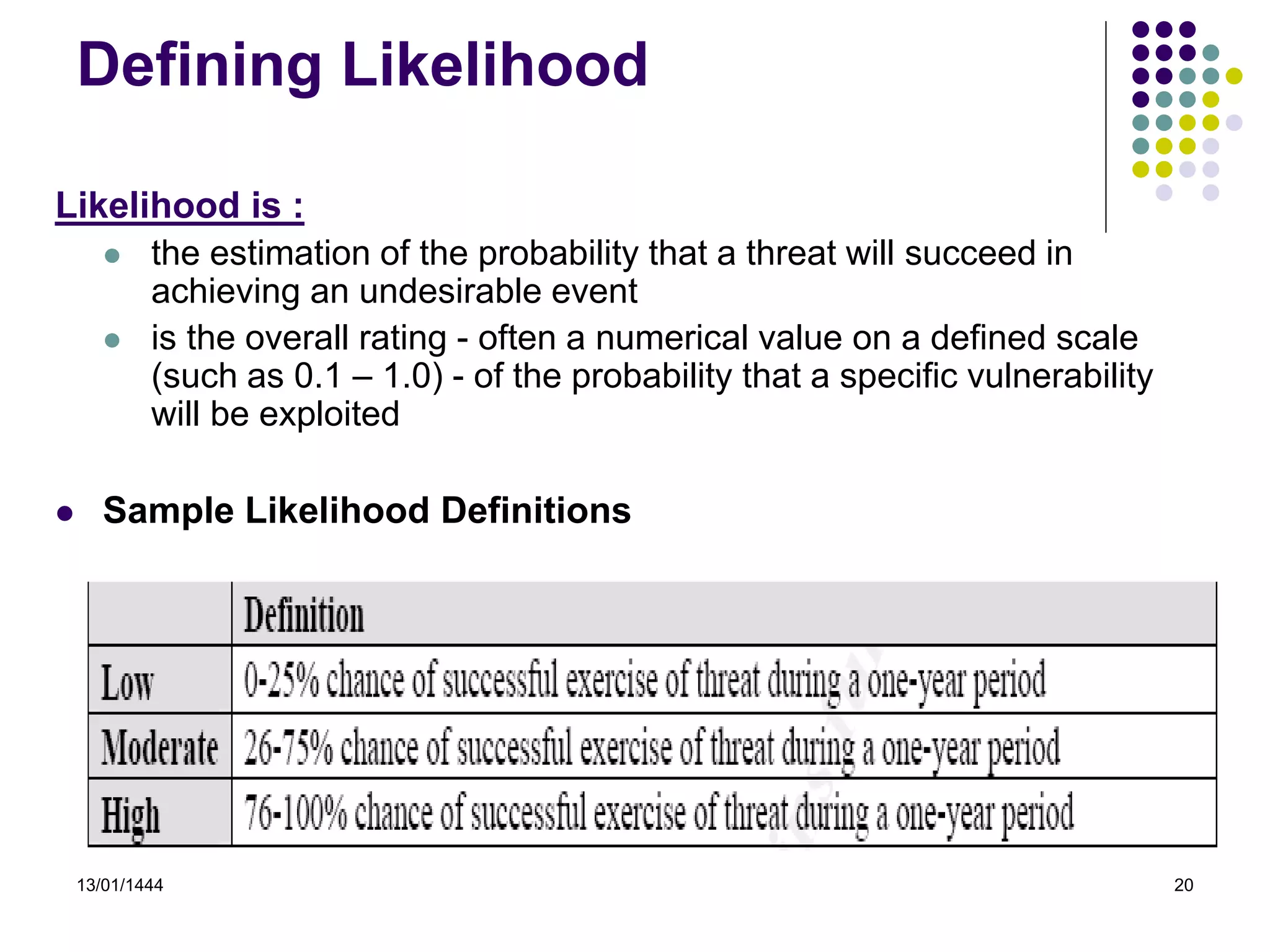
Defining Likelihood
Likelihood is :
 the estimation of the probability that a threat will succeed in
achieving an undesirable event
 is the overall rating - often a numerical value on a defined scale
(such as 0.1 – 1.0) - of the probability that a specific vulnerability
will be exploited
 Sample Likelihood Definitions
13/01/1444 21
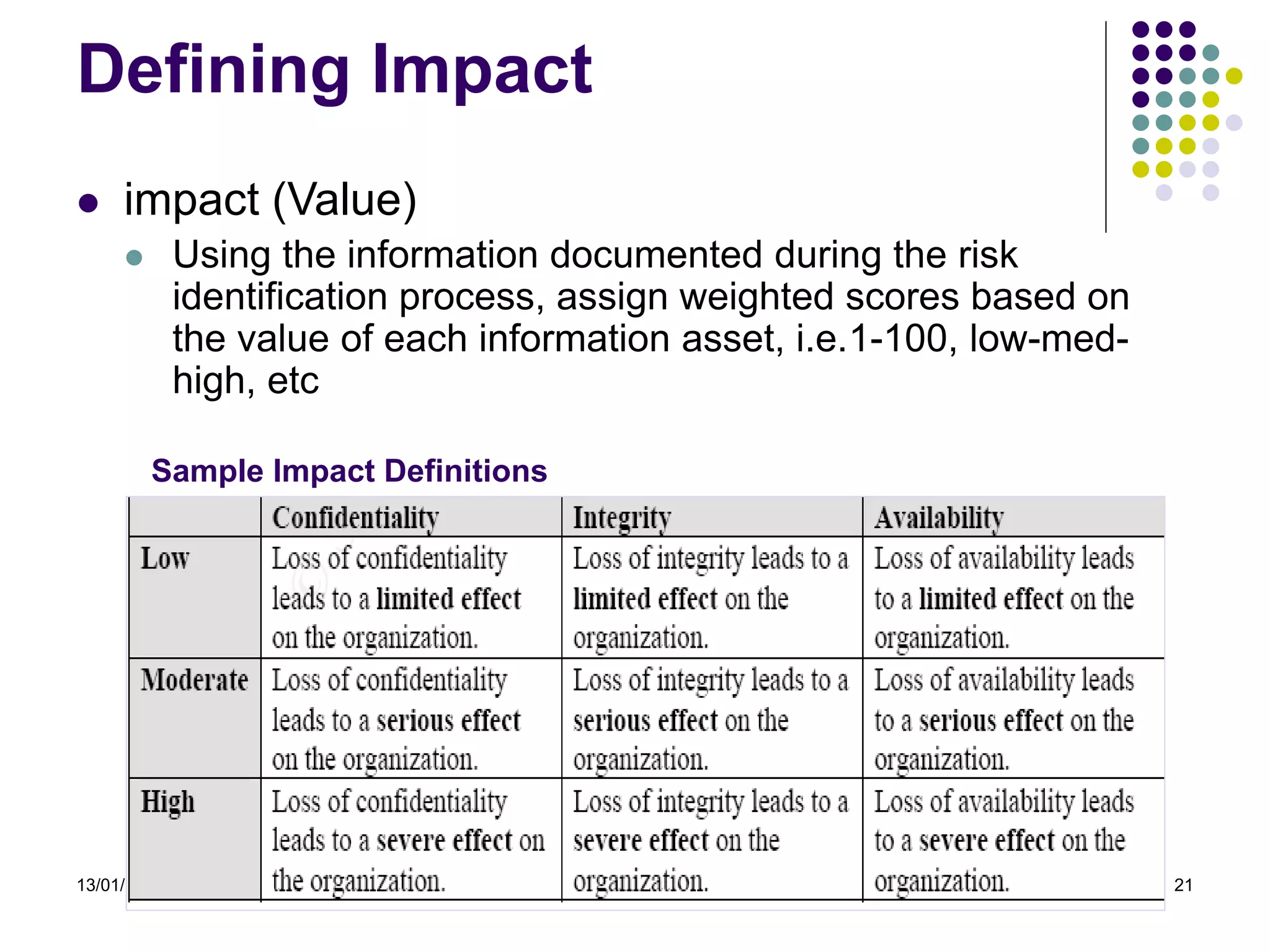
Defining Impact
 impact (Value)
 Using the information documented during the risk
identification process, assign weighted scores based on
the value of each information asset, i.e.1-100, low-med-
high, etc
Sample Impact Definitions
13/01/1444 22
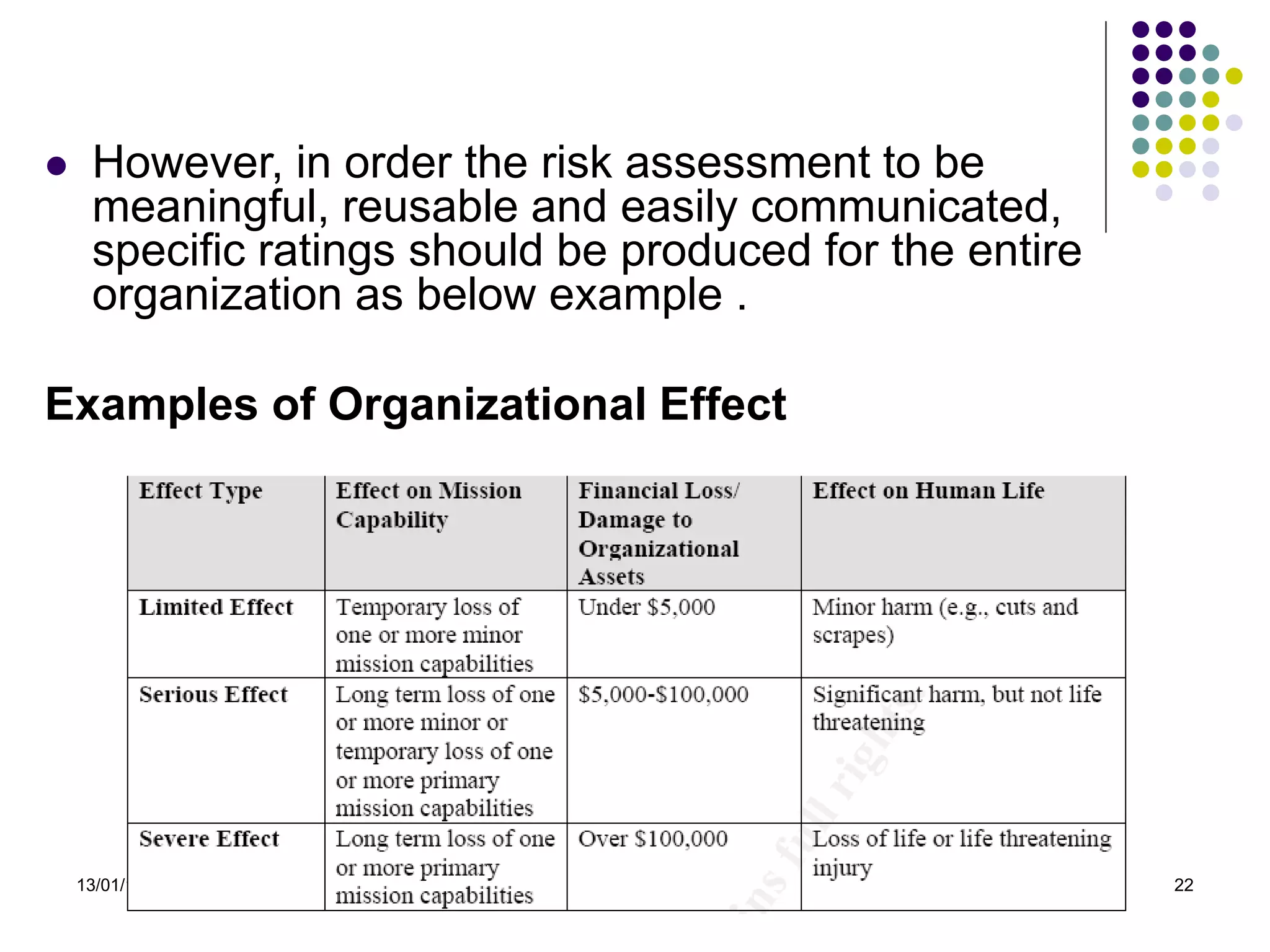
 However, in order the risk assessment to be
meaningful, reusable and easily communicated,
specific ratings should be produced for the entire
organization as below example .
Examples of Organizational Effect
13/01/1444 23
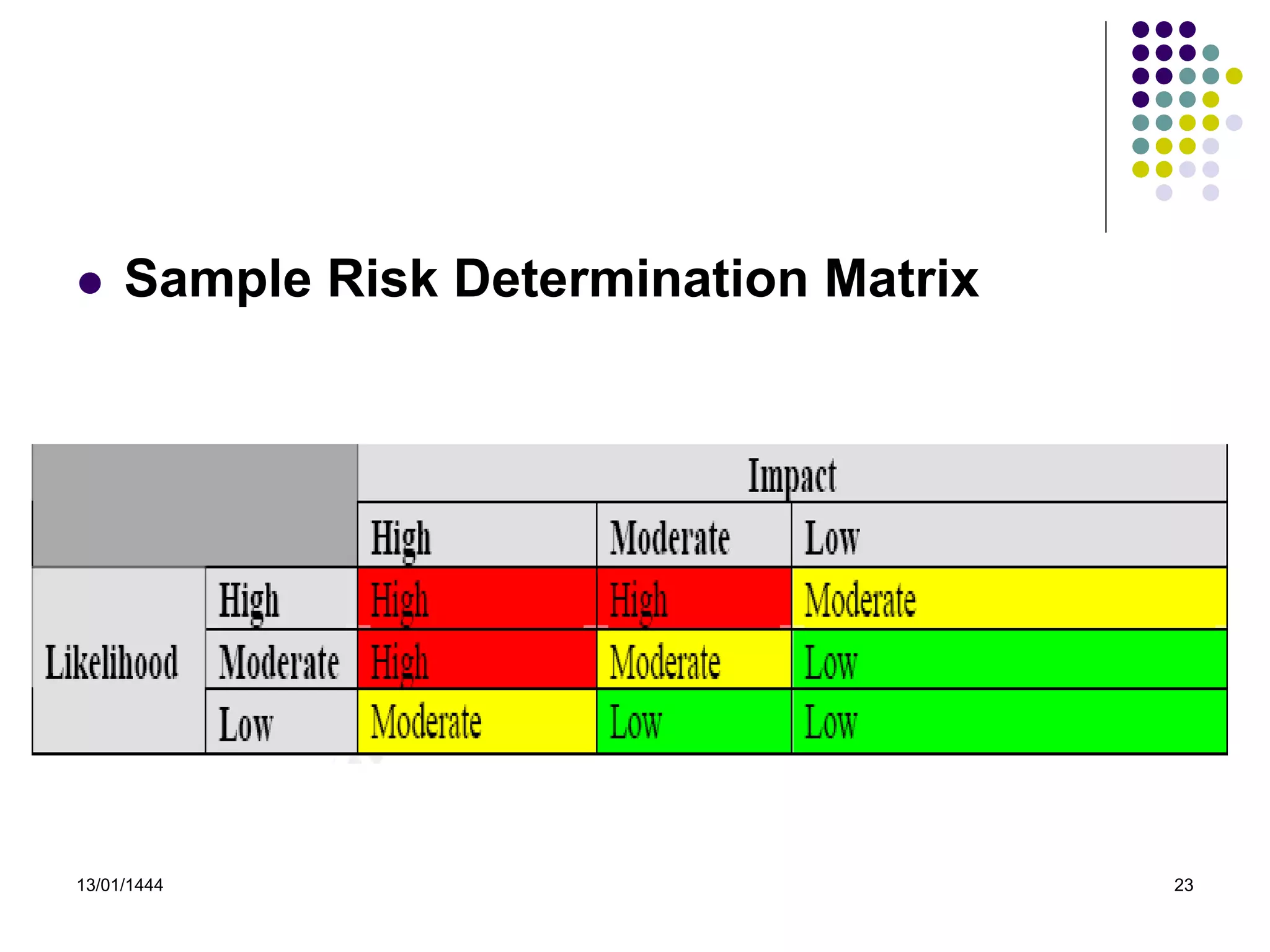
 Sample Risk Determination Matrix
13/01/1444 24
Some Common Risk Assessment
methodologies
 The following methodologies and tools were developed for
managing risks in information systems:
 National Institute of Standards & Technology (NIST) Methodology
 OCTAVE®
 FRAP
 COBRA
 Risk Watch
 The First one will be explained
13/01/1444 25
National Institute of Standards &
Technology
 (NIST) Methodology
 NIST Special Publication (SP) 800-30, Risk
Management Guide for Information Technology
Systems is the US Federal Government’s standard.
 This methodology is primarily designed to be
qualitative and is based upon skilled security
analysts working with system owners and technical
experts to thoroughly identify, evaluate and manage
risk in IT systems.
13/01/1444 26
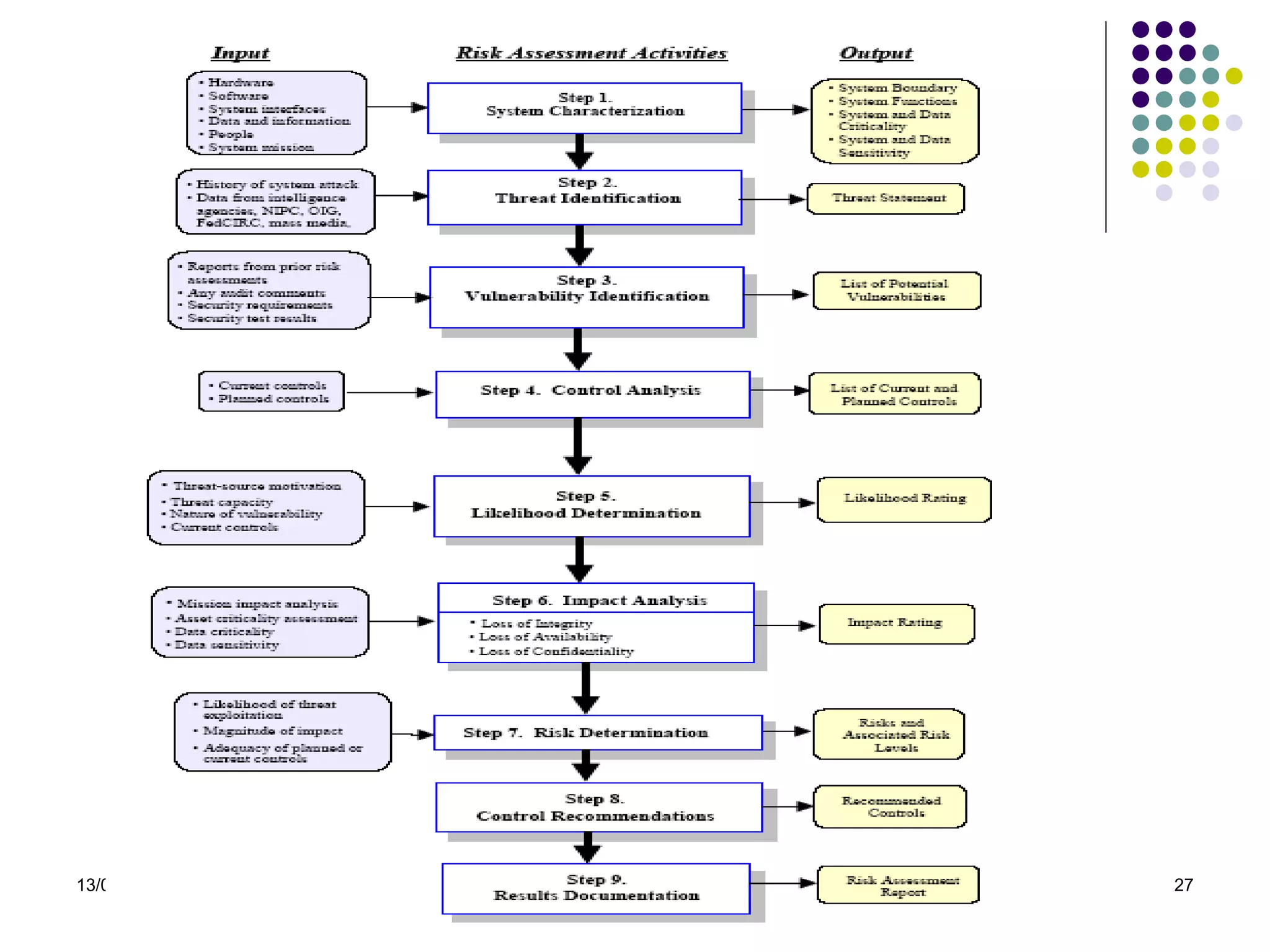
 The NIST methodology consists of 9 steps each has
inputs and out puts:
 • Step 1: System Characterization
 • Step 2: Threat Identification
 • Step 3: Vulnerability Identification
 • Step 4: Control Analysis
 • Step 5: Likelihood Determination
 • Step 6: Impact Analysis
 • Step 7: Risk Determination
 • Step 8: Control Recommendations
 • Step 9: Results Documentation
13/01/1444 27
13/01/1444 28
Who do the Assessment ?
 A risk assessment is carried out by a team of people who have
knowledge of specific areas of the business.
 It is the responsibility of each community of interest to manage
risks
 Each community has a role to play:
 Information Security - best understands the threats and attacks
that introduce risk into the organization
 Management and Users – play a part in the early detection and
response process - they also insure sufficient resources are
allocated
 Information Technology – must assist in building secure systems
and operating them safely
13/01/1444 29
Summary of Risk Assessment Practices and
Related Benefits
13/01/1444 30
Case Study
Risk Assessment
“Regulatory Organization”
13/01/1444 31
Regulatory Organization
The organization’s objectives in its’ risk management plan are : :
 To face any risk
 concerned with loss of customer confidence, as well as monetary and productivity
losses.
 Risk assessments have always been a part of doing business that leads to determine the
level of risk associated with a business function or process in order to determine the
applicable security controls.
 The organization consists of a
 central office who issues organization wide information security risk assessment
guidelines and establishes minimum control requirements
 regional offices throughout the United States with , who facilitates the process in its
geographic area; and individual business units are responsible for conducting the
assessments.
 The organization’s policy guidelines require
 business units to conduct risk assessment at least once a year.
 when a new business operation is established or when significant operational changes
occur.
13/01/1444 32
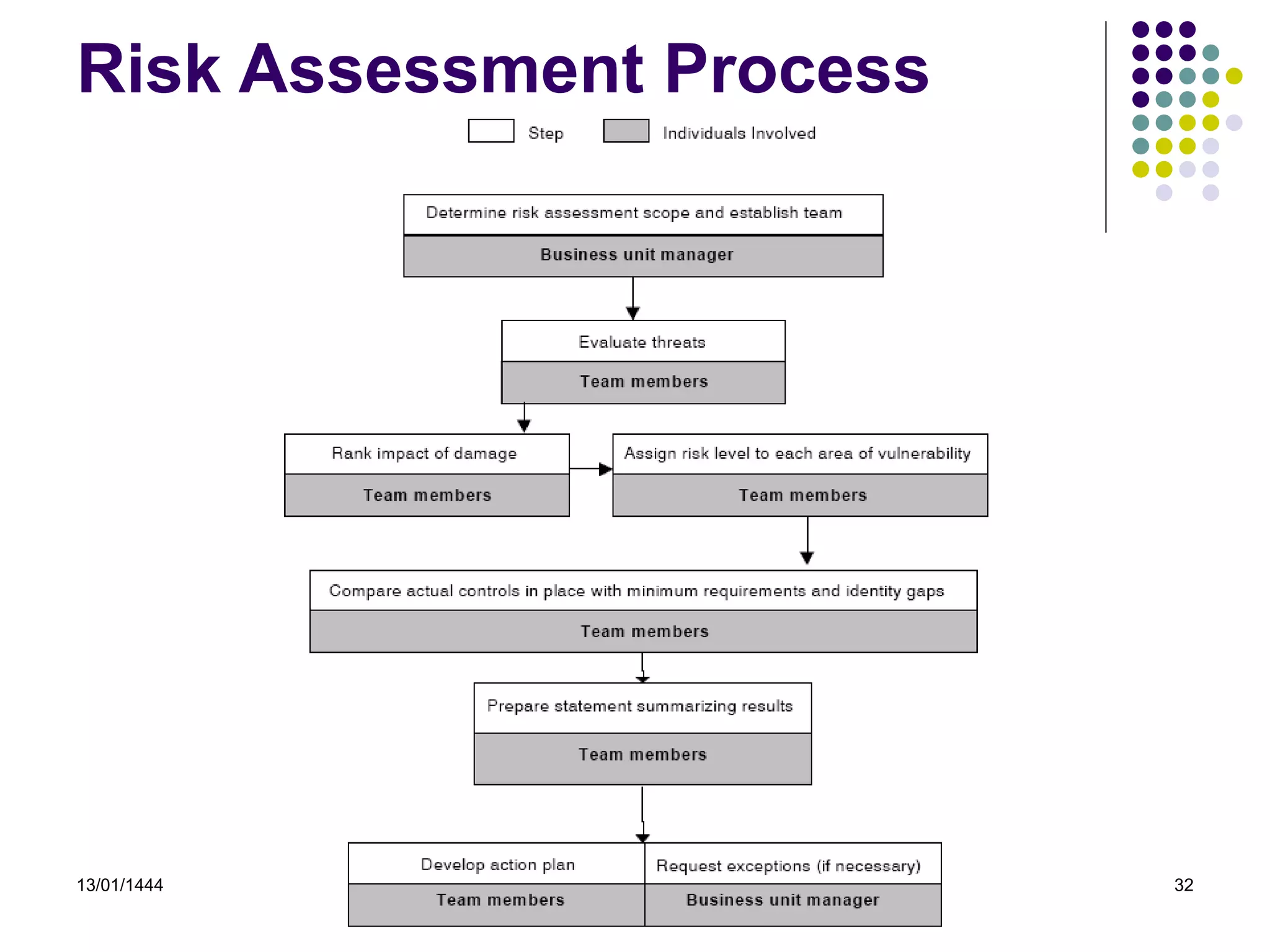
Risk Assessment Process
13/01/1444 33
Conducting and Documenting the Assessment
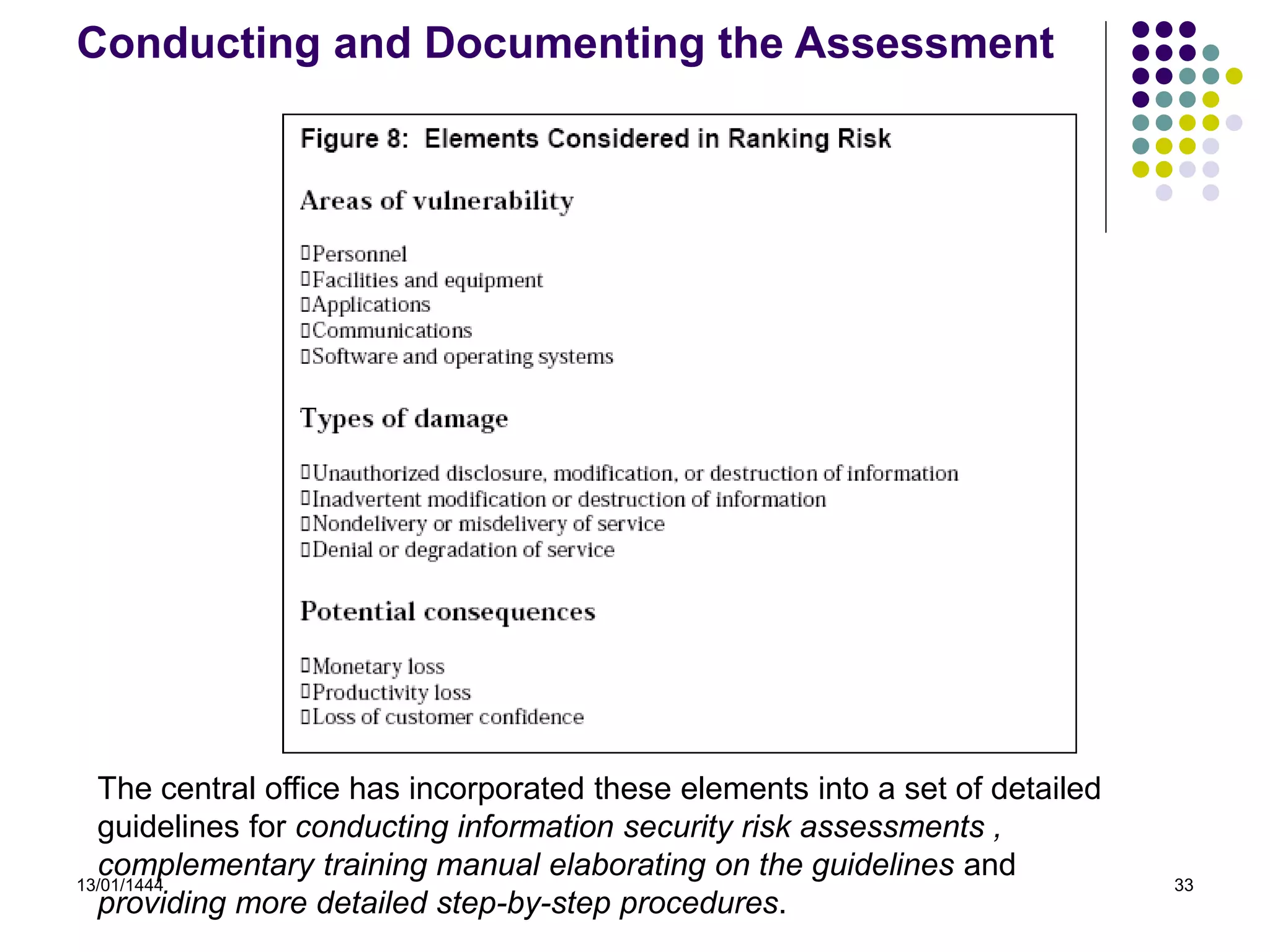
The central office has incorporated these elements into a set of detailed
guidelines for conducting information security risk assessments ,
complementary training manual elaborating on the guidelines and
providing more detailed step-by-step procedures.
13/01/1444 34
Determining Risk Level
 The team's first step is to evaluate possible threats
to information security that may affect the unit's
operations.
 The team assigns a risk level of high, moderate, or
low for each area of vulnerability to show the
possible effect of damage if the threat were to occur.
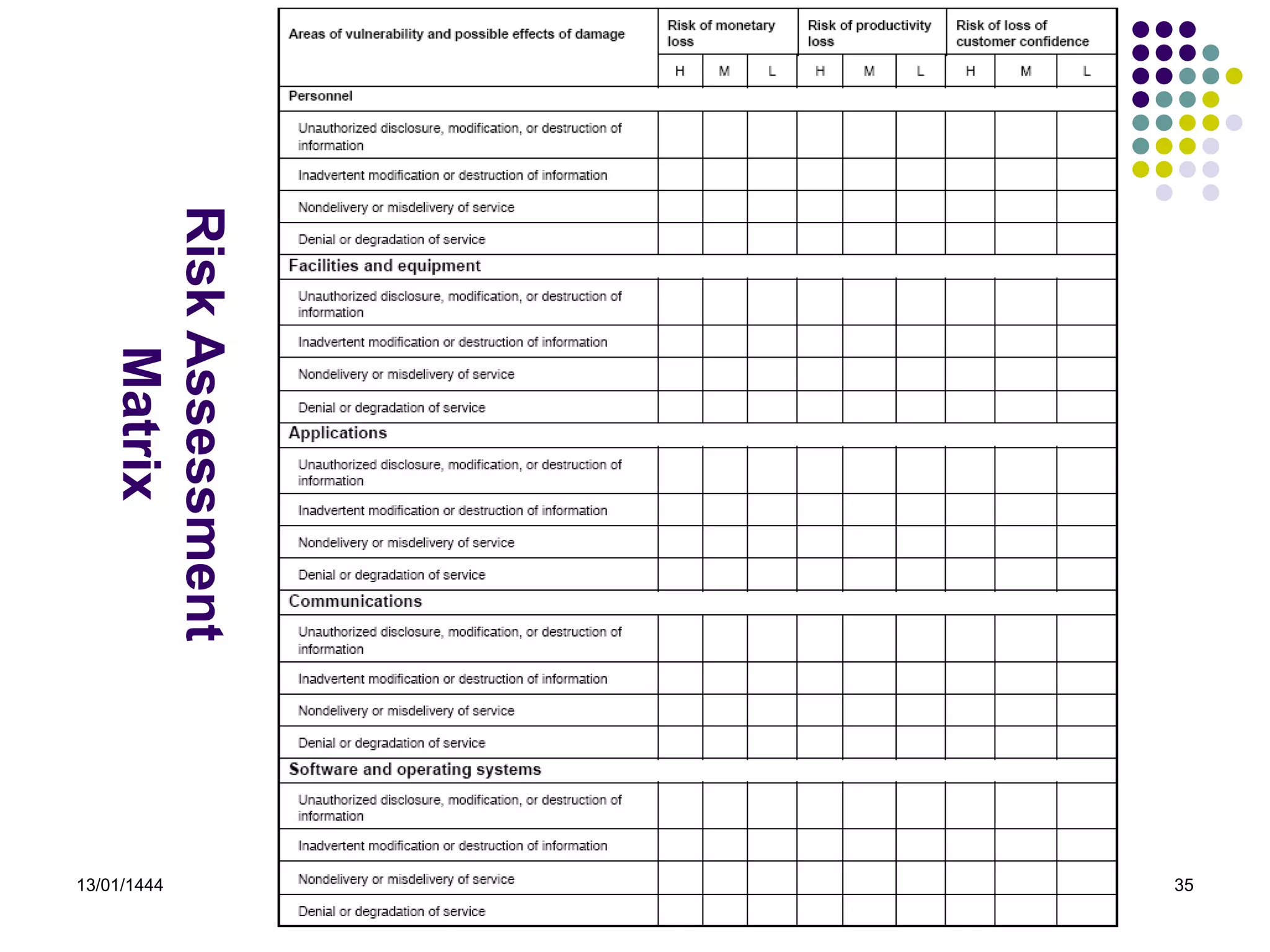
 The team uses a matrix to assist in its analysis of
risk as shown in the following table:
13/01/1444 35
Risk
Assessment
Matrix
13/01/1444 36
Risk Assessment Table
 After completing the matrix, the team summarizes its findings by
assigning a composite risk level to each of the five areas of
vulnerability on the matrix.
13/01/1444 37
Identifying Needed Controls Based
on Predetermined Requirements
 After determining the overall risk level for
each area of vulnerability, the team identifies
the minimum applicable controls that are
prescribed in its organizational guidelines.
13/01/1444 38
Reporting and Ensuring That
Agreed Actions Are Taken
 After determining the minimum set of
controls, the team compares those required
controls with controls already in place and
identifies any gaps.
 The team prepares a short statement
summarizing the outcome and documenting
its decisions and decision making process. It
then provides the regional office a copy of the
risk assessment table.
13/01/1444 39
Case Study
Information Security Plan (“Plan”)
“Arizona State University’s
safeguards”
13/01/1444 40
 Main Goal :Protect information and data
 Details Goals :
 Protect the security and confidentiality of Protected Information;
 Protect against anticipated threats or hazards to the security or integrity of
such information
 Protect against unauthorized access to or use of Protected Information
 Provides for mechanisms to: Identify and assess the risks that may threaten
Protected Information maintained by Arizona State University;
 Designate employees responsible for coordinating the program;
 Design and implement a safeguards program
 Manage the selection of appropriate service providers
 Adjust the plan to reflect changes in technology, the sensitivity of Protected
Information, and internal or external threats to information security; and
reference related policies, standards, and guidelines.
Goals of Security Plan
13/01/1444 41
Identification and Assessment of
Risks to Customer Information
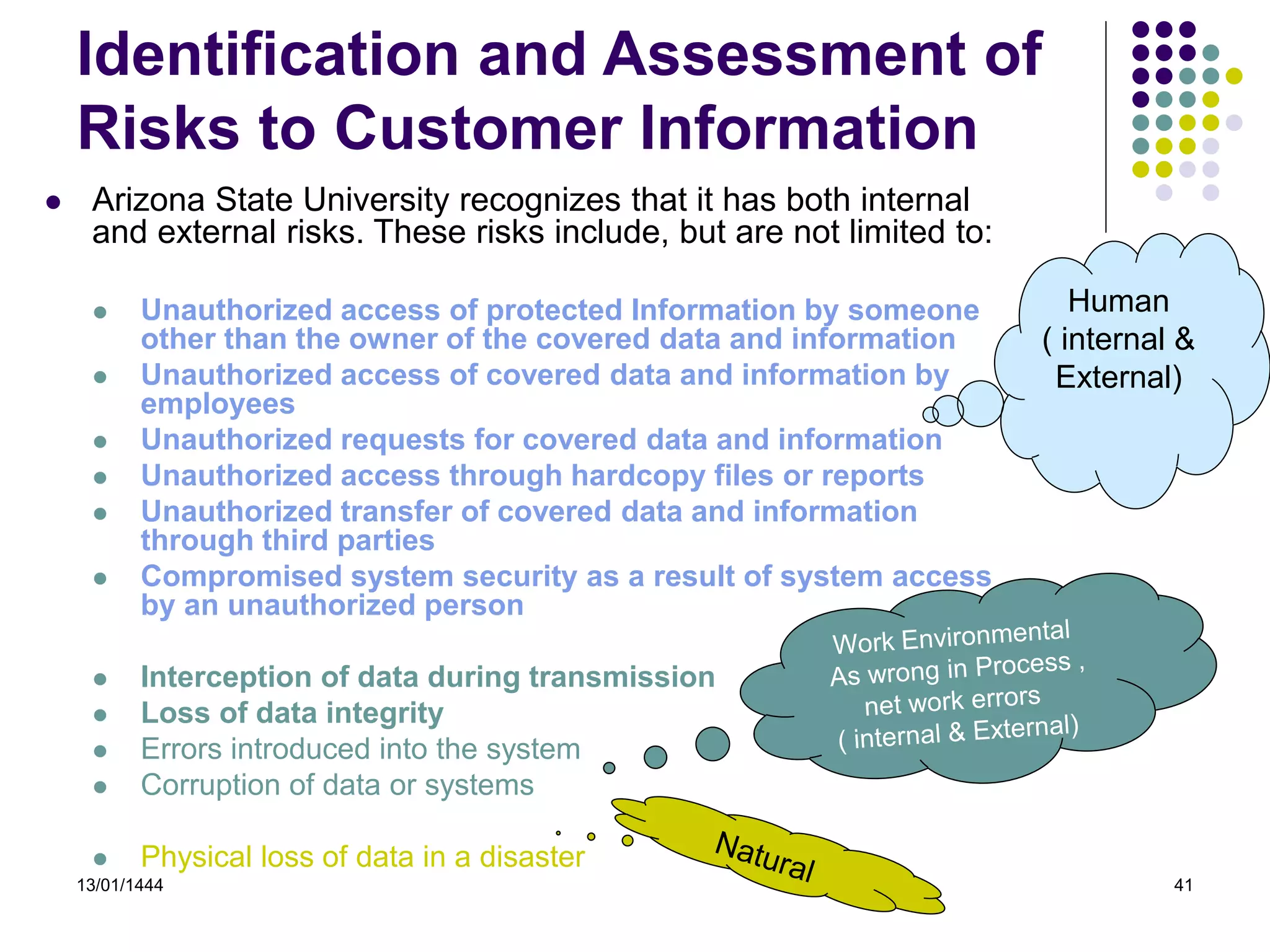
 Arizona State University recognizes that it has both internal
and external risks. These risks include, but are not limited to:
 Unauthorized access of protected Information by someone
other than the owner of the covered data and information
 Unauthorized access of covered data and information by
employees
 Unauthorized requests for covered data and information
 Unauthorized access through hardcopy files or reports
 Unauthorized transfer of covered data and information
through third parties
 Compromised system security as a result of system access
by an unauthorized person
 Interception of data during transmission
 Loss of data integrity
 Errors introduced into the system
 Corruption of data or systems
 Physical loss of data in a disaster
Human
( internal &
External)
13/01/1444 42
 Arizona State University recognizes that this may not be a
complete list of the risks associated with the protection of
Protected Information.
 Since technology growth is not static, new risks are created
regularly. Accordingly, the University Technology Office and the
Office of Student Affairs will actively participate with and seek
advice from an advisory committee made up of university
representatives for identification of new risks.
 Arizona State University believes current safeguards used by the
University Technology Office are reasonable and, in light of
current risk assessments are sufficient to provide security and
confidentiality to Protected Information maintained by the
University.
13/01/1444 43
Who has the responsibility of
assessing the risk
 The University Technology Officer, in consultation with an advisory
committee, is responsible for the maintenance of information security
and privacy.
 The advisory committee will include representatives from the
departments primarily responsible for safeguarding Protected
Information.
 Each department responsible for safeguarding Protected Information
will provide an annual update report indicating the status of its
safeguarding procedures.
 The Coordinators, in conjunction with the advisory committee, are
responsible for assessing the risks associated with unauthorized
transfers of Protected Information and implementing procedures to
minimize those
13/01/1444 44
Design and Implementation of Safeguards Program
 Minimizing risk and safeguarding covered data and information security can be
achieved by Employee Management and Training
 Physical Security can be achieved by limiting access to only those employees who
have a business reason to know such information and requiring signed
acknowledgement of the requirement to keep Protected Information private
 Information systems include network and software design, as well as information
processing, storage, transmission, retrieval, and disposal. Arizona State University
has policies, standards, and guidelines governing the use of electronic resources
and firewall and wireless policies
 The University maintain effective systems to prevent, detect, and respond to attacks,
intrusions and other system failures. Such systems may include maintaining and
implementing current anti-virus software; checking with software vendors and
others to regularly obtain and install patches to correct software vulnerabilities;
maintaining appropriate filtering or firewall technologies …
13/01/1444 45
Conclusion
13/01/1444 46
Summary notes
The knowledge of the following are important to do the useful risk
assessment
 who was responsible for initiating and conducting risk
assessments
 who was to participate
 what steps were to be followed
 how disagreements were to be resolved
 what approvals were needed
 how assessments were to be documented
 how documentation was to be maintained
 to whom reports were to be provided.
13/01/1444 47
Very Important Note
 Since risks and threats change over time, it is
important that organizations periodically
reassess risks and reconsider the suitability
and effectiveness of the policies and controls
they have selected.

RiskAssesment.ppt

  • 1.
  • 2.
    13/01/1444 2 Main topics What is Risk & Risk management?  Risk Management Cycle  Risk Identification  Primary sources of Risk Items  What is Risk Assessment ?  How to assess the risks ?  Risk Assessment methodologies  Methods of Risk Assessment  Who is responsible in risk assessment?  Two Case Studies  Conclusion
  • 3.
    13/01/1444 3 What isRisk & Risk Management?  Risk : The is an object, person or other entity that represent a danger, harm or loss to an asset  Risk Management : Is the process of Identifying , assessing and evaluating the level of risk facing the organization , specifically the threats to the information stored and using by organization for achieving business objectives, and then deciding what countermeasures, if any, to take in reducing risk to an acceptable level, based on the value of the information resource to the organization
  • 4.
    13/01/1444 4 Risk LifeCycle Threat Agent Vulnerability Risk Asset Exposures Safeguard Exploits Leads to Can damage And cause an Can be countermeasured by a
  • 5.
    13/01/1444 5 Risk ManagementCycle Identify Risks Assess Risks Define Desired Results Select Strategy Implement Strategy Monitor Evaluate and Adjust The Process is iteration •The Processes are organized • Each Step output considered as an input for the next step Risk Control Risk Assessment
  • 6.
  • 7.
    13/01/1444 7 Risk Identification Whatis the purpose of this phase ?  The aims of this phase is to identify , classify and prioritizing the organization’s information assets ( Know ourselves) and identify all important types and sources of risk and uncertainty (know our enemy), associated with each of the investment objectives.  This is a crucial phase. If a risk is not identified it cannot be evaluated and managed
  • 8.
    13/01/1444 8 Information Assets IS Components PeopleProcedures Data Transmission HW SW Employees Non- employees People at trusted organizations Authorized Staff Other staff Strangers Standard Procedures Sensitive Procedures Process Storage Application OS Security Component System Devises Net Work
  • 9.
    13/01/1444 9 Primary sources ofRisk Items Human Threats Environmental Threats Outside & Natural Threats network based attacks virus infection, unauthorized access floods Earthquakes hurricanes Power failure, pollution
  • 10.
    13/01/1444 10 Risk Assessment For each identified component & risk, which has a 'clearly significant' or 'possibly significant' position, each should be assess to establish qualitatively and Estimate the value
  • 11.
    13/01/1444 11 What isRisk Assessment ?  Assessing risk is the process of determining the likelihood of the threat being exercised against the vulnerability and the resulting impact from a successful compromise , i.e determine the relative risk for each of the vulnerabilities  Risk assessment assigns a risk rating or score to each specific information asset, useful in evaluating the relative risk and making comparative ratings later in the risk control process • Although all elements of the risk management cycle are important, risk assessments provide the foundation for other elements of the cycle. In particular, risk assessments provide a basis for establishing appropriate policies and selecting cost-effective techniques to implement these policies
  • 12.
    13/01/1444 12 Methods ofRisk Assessment There are various methods assessing risk, First : Quantitative risk assessment : generally estimates values of Information Systems components as ; information, systems, business processes, recovery costs, etc., risk can be measured in terms of direct and indirect costs , based on (1) the likelihood that a damaging event will occur (2) the costs of potential losses (3) the costs of mitigating actions that could be taken. ,
  • 13.
    13/01/1444 13 This approachcan be taken by defining  Risk in more subjective and general terms such as high, medium, and low.  In this regard, qualitative assessments depend more on the expertise, experience, and judgment of those conducting the assessment.  Qualitative risk assessments typically give risk results of “High”, “Moderate” and “Low”. However, by providing the impact and likelihood definition tables and the description of the impact, it is possible to adequately communicate the assessment to the organization’s management. Second : Qualitative Risk Assessment
  • 14.
    13/01/1444 14 Third :Quantitativeand Qualitative  It is also possible to use a combination of quantitative and qualitative method
  • 15.
    13/01/1444 15  Quantitativerisk measurement is the standard way of measuring risk in many fields, such as insurance, but it is not commonly used to measure risk in information systems.  Two of the reasons claimed for this are  1) the difficulties in identifying and assigning a value of all components  2) Moral Effects couldn’t measured by quantitative measurements  2) the lack of statistical information that would make it possible to determine frequency.  Thus, most of the risk assessment tools that are used today for information systems are measurements of qualitative risk.
  • 16.
    13/01/1444 16 How toassess the risks Risk is assessed by following the following steps :  Identifying threats  Identifying vulnerabilities  Relating Threats to Vulnerabilities  determining the likelihood  Evaluate impact for each risk
  • 17.
  • 18.
    13/01/1444 18 Identifying Vulnerabilities Identifying Vulnerabilities : how each of the threats that are possible or likely could be perpetrated , and list the organization’s assets and their vulnerabilities  Vulnerabilities can be identified by numerous means.  Different methodologies for identifying vulnerabilities.  start with commonly available vulnerability lists.  Then, working with the system owners or other individuals with knowledge of the system or organization, start to identify the vulnerabilities that apply to the system.  Specific vulnerabilities can be found by reviewing vendor web sites and public vulnerability archives, such as Common Vulnerabilities and Exposures (CVE - http://cve.mitre.org) or the National Vulnerability Database (NVD - http://nvd.nist.gov).
  • 19.
    13/01/1444 19 Relating Threatsto Vulnerabilities  Not every threat-action/threat can be exercised against every vulnerability.  For example, a threat of “flood” obviously applies to a vulnerability of “lack of contingency planning”, but not to a vulnerability of “failure to change default authenticators.”
  • 20.
    13/01/1444 20 Defining Likelihood Likelihoodis :  the estimation of the probability that a threat will succeed in achieving an undesirable event  is the overall rating - often a numerical value on a defined scale (such as 0.1 – 1.0) - of the probability that a specific vulnerability will be exploited  Sample Likelihood Definitions
  • 21.
    13/01/1444 21 Defining Impact impact (Value)  Using the information documented during the risk identification process, assign weighted scores based on the value of each information asset, i.e.1-100, low-med- high, etc Sample Impact Definitions
  • 22.
    13/01/1444 22  However,in order the risk assessment to be meaningful, reusable and easily communicated, specific ratings should be produced for the entire organization as below example . Examples of Organizational Effect
  • 23.
    13/01/1444 23  SampleRisk Determination Matrix
  • 24.
    13/01/1444 24 Some CommonRisk Assessment methodologies  The following methodologies and tools were developed for managing risks in information systems:  National Institute of Standards & Technology (NIST) Methodology  OCTAVE®  FRAP  COBRA  Risk Watch  The First one will be explained
  • 25.
    13/01/1444 25 National Instituteof Standards & Technology  (NIST) Methodology  NIST Special Publication (SP) 800-30, Risk Management Guide for Information Technology Systems is the US Federal Government’s standard.  This methodology is primarily designed to be qualitative and is based upon skilled security analysts working with system owners and technical experts to thoroughly identify, evaluate and manage risk in IT systems.
  • 26.
    13/01/1444 26  TheNIST methodology consists of 9 steps each has inputs and out puts:  • Step 1: System Characterization  • Step 2: Threat Identification  • Step 3: Vulnerability Identification  • Step 4: Control Analysis  • Step 5: Likelihood Determination  • Step 6: Impact Analysis  • Step 7: Risk Determination  • Step 8: Control Recommendations  • Step 9: Results Documentation
  • 27.
  • 28.
    13/01/1444 28 Who dothe Assessment ?  A risk assessment is carried out by a team of people who have knowledge of specific areas of the business.  It is the responsibility of each community of interest to manage risks  Each community has a role to play:  Information Security - best understands the threats and attacks that introduce risk into the organization  Management and Users – play a part in the early detection and response process - they also insure sufficient resources are allocated  Information Technology – must assist in building secure systems and operating them safely
  • 29.
    13/01/1444 29 Summary ofRisk Assessment Practices and Related Benefits
  • 30.
    13/01/1444 30 Case Study RiskAssessment “Regulatory Organization”
  • 31.
    13/01/1444 31 Regulatory Organization Theorganization’s objectives in its’ risk management plan are : :  To face any risk  concerned with loss of customer confidence, as well as monetary and productivity losses.  Risk assessments have always been a part of doing business that leads to determine the level of risk associated with a business function or process in order to determine the applicable security controls.  The organization consists of a  central office who issues organization wide information security risk assessment guidelines and establishes minimum control requirements  regional offices throughout the United States with , who facilitates the process in its geographic area; and individual business units are responsible for conducting the assessments.  The organization’s policy guidelines require  business units to conduct risk assessment at least once a year.  when a new business operation is established or when significant operational changes occur.
  • 32.
  • 33.
    13/01/1444 33 Conducting andDocumenting the Assessment The central office has incorporated these elements into a set of detailed guidelines for conducting information security risk assessments , complementary training manual elaborating on the guidelines and providing more detailed step-by-step procedures.
  • 34.
    13/01/1444 34 Determining RiskLevel  The team's first step is to evaluate possible threats to information security that may affect the unit's operations.  The team assigns a risk level of high, moderate, or low for each area of vulnerability to show the possible effect of damage if the threat were to occur.  The team uses a matrix to assist in its analysis of risk as shown in the following table:
  • 35.
  • 36.
    13/01/1444 36 Risk AssessmentTable  After completing the matrix, the team summarizes its findings by assigning a composite risk level to each of the five areas of vulnerability on the matrix.
  • 37.
    13/01/1444 37 Identifying NeededControls Based on Predetermined Requirements  After determining the overall risk level for each area of vulnerability, the team identifies the minimum applicable controls that are prescribed in its organizational guidelines.
  • 38.
    13/01/1444 38 Reporting andEnsuring That Agreed Actions Are Taken  After determining the minimum set of controls, the team compares those required controls with controls already in place and identifies any gaps.  The team prepares a short statement summarizing the outcome and documenting its decisions and decision making process. It then provides the regional office a copy of the risk assessment table.
  • 39.
    13/01/1444 39 Case Study InformationSecurity Plan (“Plan”) “Arizona State University’s safeguards”
  • 40.
    13/01/1444 40  MainGoal :Protect information and data  Details Goals :  Protect the security and confidentiality of Protected Information;  Protect against anticipated threats or hazards to the security or integrity of such information  Protect against unauthorized access to or use of Protected Information  Provides for mechanisms to: Identify and assess the risks that may threaten Protected Information maintained by Arizona State University;  Designate employees responsible for coordinating the program;  Design and implement a safeguards program  Manage the selection of appropriate service providers  Adjust the plan to reflect changes in technology, the sensitivity of Protected Information, and internal or external threats to information security; and reference related policies, standards, and guidelines. Goals of Security Plan
  • 41.
    13/01/1444 41 Identification andAssessment of Risks to Customer Information  Arizona State University recognizes that it has both internal and external risks. These risks include, but are not limited to:  Unauthorized access of protected Information by someone other than the owner of the covered data and information  Unauthorized access of covered data and information by employees  Unauthorized requests for covered data and information  Unauthorized access through hardcopy files or reports  Unauthorized transfer of covered data and information through third parties  Compromised system security as a result of system access by an unauthorized person  Interception of data during transmission  Loss of data integrity  Errors introduced into the system  Corruption of data or systems  Physical loss of data in a disaster Human ( internal & External)
  • 42.
    13/01/1444 42  ArizonaState University recognizes that this may not be a complete list of the risks associated with the protection of Protected Information.  Since technology growth is not static, new risks are created regularly. Accordingly, the University Technology Office and the Office of Student Affairs will actively participate with and seek advice from an advisory committee made up of university representatives for identification of new risks.  Arizona State University believes current safeguards used by the University Technology Office are reasonable and, in light of current risk assessments are sufficient to provide security and confidentiality to Protected Information maintained by the University.
  • 43.
    13/01/1444 43 Who hasthe responsibility of assessing the risk  The University Technology Officer, in consultation with an advisory committee, is responsible for the maintenance of information security and privacy.  The advisory committee will include representatives from the departments primarily responsible for safeguarding Protected Information.  Each department responsible for safeguarding Protected Information will provide an annual update report indicating the status of its safeguarding procedures.  The Coordinators, in conjunction with the advisory committee, are responsible for assessing the risks associated with unauthorized transfers of Protected Information and implementing procedures to minimize those
  • 44.
    13/01/1444 44 Design andImplementation of Safeguards Program  Minimizing risk and safeguarding covered data and information security can be achieved by Employee Management and Training  Physical Security can be achieved by limiting access to only those employees who have a business reason to know such information and requiring signed acknowledgement of the requirement to keep Protected Information private  Information systems include network and software design, as well as information processing, storage, transmission, retrieval, and disposal. Arizona State University has policies, standards, and guidelines governing the use of electronic resources and firewall and wireless policies  The University maintain effective systems to prevent, detect, and respond to attacks, intrusions and other system failures. Such systems may include maintaining and implementing current anti-virus software; checking with software vendors and others to regularly obtain and install patches to correct software vulnerabilities; maintaining appropriate filtering or firewall technologies …
  • 45.
  • 46.
    13/01/1444 46 Summary notes Theknowledge of the following are important to do the useful risk assessment  who was responsible for initiating and conducting risk assessments  who was to participate  what steps were to be followed  how disagreements were to be resolved  what approvals were needed  how assessments were to be documented  how documentation was to be maintained  to whom reports were to be provided.
  • 47.
    13/01/1444 47 Very ImportantNote  Since risks and threats change over time, it is important that organizations periodically reassess risks and reconsider the suitability and effectiveness of the policies and controls they have selected.