




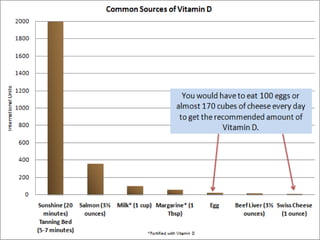

Rickets is defective
mineralization or
calcification of bones
before epiphyseal
closure in immature
mammals due to deficiency
or impaired metabolism
of vitamin D,
phosphorus or calcium
potentially leading to
fractures and deformity.
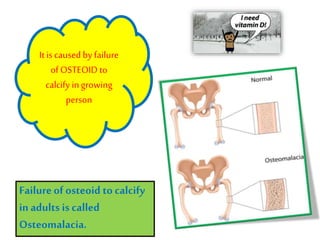
Failureof osteoid to calcify
in adults is called
Osteomalacia.
It is caused by failure
of OSTEOID to
calcify ingrowing
person
 Enamel hypoplasia is a defect of the teeth in which the enamel is
hard but thin and deficient in amount. Harrison's groove, also known as Harrison's sulcus, is a
horizontalgroove along the lower border of the thorax corresponding
to the costal insertion of the diaphragm.
 Craniotabes is the finding of a softening or thinning of the skull.
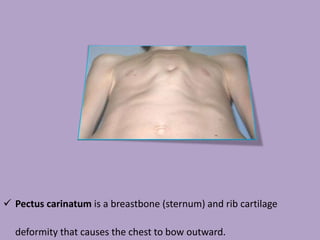
 Pectus carinatum is a breastbone (sternum) and rib cartilage
deformity that causes the chest to bow outward.
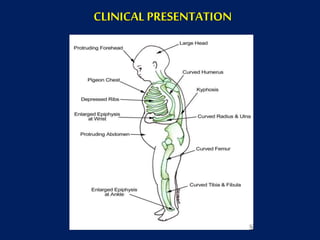
CLINICAL PRESENTATION
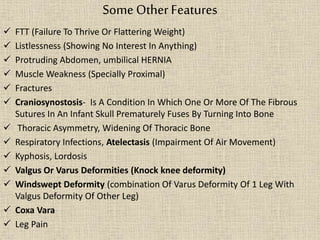
Some Other Features
 FTT (Failure To Thrive Or Flattering Weight)
 Listlessness (Showing No Interest In Anything)
 Protruding Abdomen, umbilical HERNIA
 Muscle Weakness (Specially Proximal)
 Fractures
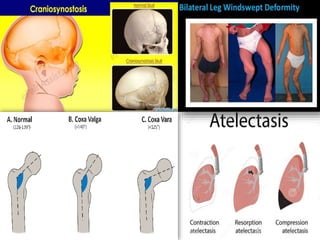
 Craniosynostosis- Is A Condition In Which One Or More Of The Fibrous
Sutures In An Infant Skull Prematurely Fuses By Turning Into Bone
 Thoracic Asymmetry, Widening Of Thoracic Bone
 Respiratory Infections, Atelectasis (Impairment Of Air Movement)
 Kyphosis, Lordosis
 Valgus Or Varus Deformities (Knock knee deformity)
 Windswept Deformity (combination Of Varus Deformity Of 1 Leg With
Valgus Deformity Of Other Leg)
 Coxa Vara
 Leg Pain
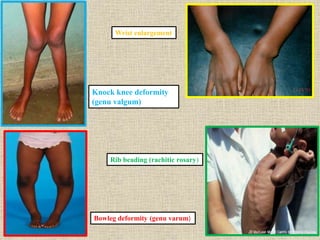
Knock knee deformity
(genu valgum)
Bowleg deformity (genu varum)
Wrist enlargement
Rib beading (rachitic rosary)
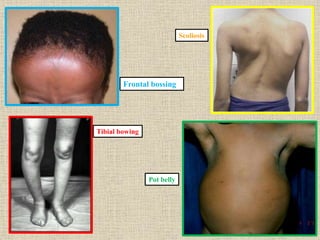
Frontal bossing
Tibial bowing
Scoliosis
Pot belly
HOW
IT IS CAUSED
PATHOPHYSIOLOGY
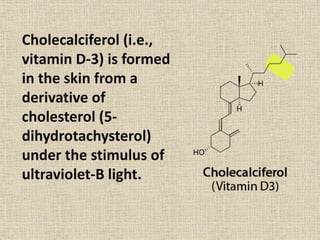
Cholecalciferol (i.e.,
vitamin D-3) is formed
in the skin from a
derivative of
cholesterol (5-
dihydrotachysterol)
under the stimulus of
ultraviolet-B light.
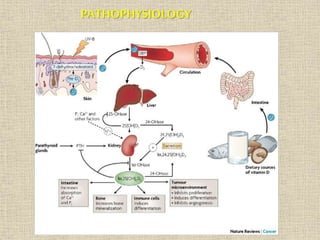
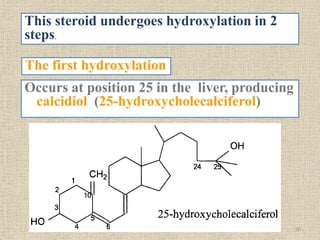
Occurs at position 25 in the liver, producing
calcidiol (25-hydroxycholecalciferol)
The first hydroxylation
This steroid undergoes hydroxylation in 2
steps.
16
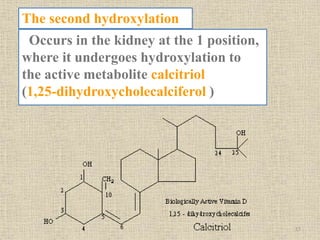
Occurs in the kidney at the 1 position,
where it undergoes hydroxylation to
the active metabolite calcitriol
(1,25-dihydroxycholecalciferol )
The second hydroxylation
17
Calcitriol
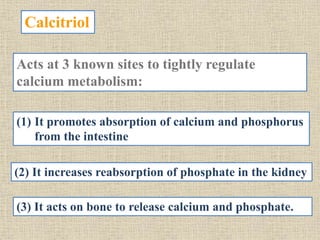
Acts at 3 known sites to tightly regulate
calcium metabolism:
(1) It promotes absorption of calcium and phosphorus
from the intestine
(2) It increases reabsorption of phosphate in the kidney
(3) It acts on bone to release calcium and phosphate.
Serum measurements in the workup for
rickets may include the following:
1. Calcium
2. Phosphorus
3. Alkaline phosphatase
4. Parathyroidhormone
5. 25-hydroxy vitamin D
6. 1,25-dihydroxyvitamin D
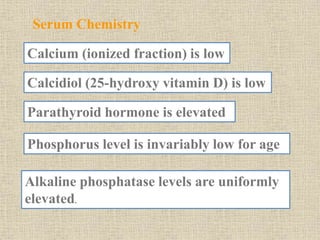
Serum Chemistry
Calcium (ionized fraction) is low
Calcidiol (25-hydroxy vitamin D) is low
Parathyroid hormone is elevated
Phosphorus level is invariably low for age
Alkaline phosphatase levels are uniformly
elevated.
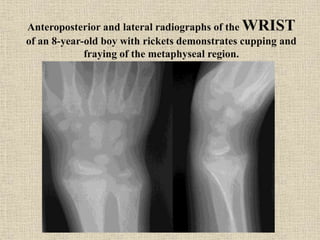
Anteroposterior and lateral radiographs of the WRIST
of an 8-year-old boy with rickets demonstrates cupping and
fraying of the metaphyseal region.
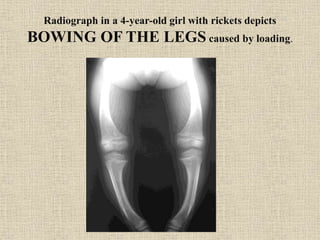
Radiograph in a 4-year-old girl with rickets depicts
BOWING OF THE LEGS caused by loading.
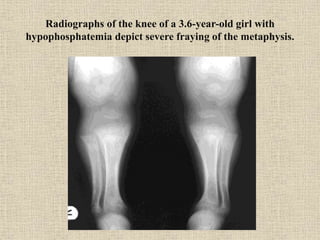
Radiographs of the knee of a 3.6-year-old girl with
hypophosphatemia depict severe fraying of the metaphysis.
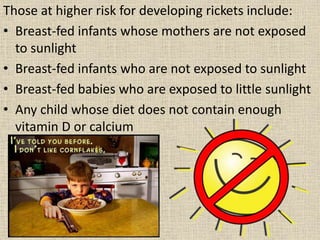
Those at higher risk for developing rickets include:
• Breast-fed infants whose mothers are not exposed
to sunlight
• Breast-fed infants who are not exposed to sunlight
• Breast-fed babies who are exposed to little sunlight
• Any child whose diet does not contain enough
vitamin D or calcium
Rickets
Rickets
Rickets
Rickets
Rickets

Rickets

  • 3.
    Rickets is defective mineralizationor calcification of bones before epiphyseal closure in immature mammals due to deficiency or impaired metabolism of vitamin D, phosphorus or calcium potentially leading to fractures and deformity. Failureof osteoid to calcify in adults is called Osteomalacia. It is caused by failure of OSTEOID to calcify ingrowing person
  • 5.
     Enamel hypoplasiais a defect of the teeth in which the enamel is hard but thin and deficient in amount. Harrison's groove, also known as Harrison's sulcus, is a horizontalgroove along the lower border of the thorax corresponding to the costal insertion of the diaphragm.  Craniotabes is the finding of a softening or thinning of the skull.  Pectus carinatum is a breastbone (sternum) and rib cartilage deformity that causes the chest to bow outward.
  • 6.
  • 7.
    Some Other Features FTT (Failure To Thrive Or Flattering Weight)  Listlessness (Showing No Interest In Anything)  Protruding Abdomen, umbilical HERNIA  Muscle Weakness (Specially Proximal)  Fractures  Craniosynostosis- Is A Condition In Which One Or More Of The Fibrous Sutures In An Infant Skull Prematurely Fuses By Turning Into Bone  Thoracic Asymmetry, Widening Of Thoracic Bone  Respiratory Infections, Atelectasis (Impairment Of Air Movement)  Kyphosis, Lordosis  Valgus Or Varus Deformities (Knock knee deformity)  Windswept Deformity (combination Of Varus Deformity Of 1 Leg With Valgus Deformity Of Other Leg)  Coxa Vara  Leg Pain
  • 9.
    Knock knee deformity (genuvalgum) Bowleg deformity (genu varum) Wrist enlargement Rib beading (rachitic rosary)
  • 10.
  • 11.
  • 14.
  • 15.
    Cholecalciferol (i.e., vitamin D-3)is formed in the skin from a derivative of cholesterol (5- dihydrotachysterol) under the stimulus of ultraviolet-B light.
  • 16.
    Occurs at position25 in the liver, producing calcidiol (25-hydroxycholecalciferol) The first hydroxylation This steroid undergoes hydroxylation in 2 steps. 16
  • 17.
    Occurs in thekidney at the 1 position, where it undergoes hydroxylation to the active metabolite calcitriol (1,25-dihydroxycholecalciferol ) The second hydroxylation 17
  • 18.
    Calcitriol Acts at 3known sites to tightly regulate calcium metabolism: (1) It promotes absorption of calcium and phosphorus from the intestine (2) It increases reabsorption of phosphate in the kidney (3) It acts on bone to release calcium and phosphate.
  • 20.
    Serum measurements inthe workup for rickets may include the following: 1. Calcium 2. Phosphorus 3. Alkaline phosphatase 4. Parathyroidhormone 5. 25-hydroxy vitamin D 6. 1,25-dihydroxyvitamin D
  • 21.
    Serum Chemistry Calcium (ionizedfraction) is low Calcidiol (25-hydroxy vitamin D) is low Parathyroid hormone is elevated Phosphorus level is invariably low for age Alkaline phosphatase levels are uniformly elevated.
  • 23.
    Anteroposterior and lateralradiographs of the WRIST of an 8-year-old boy with rickets demonstrates cupping and fraying of the metaphyseal region.
  • 24.
    Radiograph in a4-year-old girl with rickets depicts BOWING OF THE LEGS caused by loading.
  • 25.
    Radiographs of theknee of a 3.6-year-old girl with hypophosphatemia depict severe fraying of the metaphysis.
  • 27.
    Those at higherrisk for developing rickets include: • Breast-fed infants whose mothers are not exposed to sunlight • Breast-fed infants who are not exposed to sunlight • Breast-fed babies who are exposed to little sunlight • Any child whose diet does not contain enough vitamin D or calcium

Editor's Notes

  • #21 Infants who are breastfed are at risk for rickets, especially those who: a. receive no oral supplementation b. have darkly pigmented skin
  • #33 http://www.slideshare.net/dangthanhtuan/vitamin-d-3591912