1
2
Cryosurgery
3
Introduction
Cryosurgery is a technique for
freezing and killing abnormal cells.
• is used to treat some kinds of cancer and some precancerous
or noncancerous conditions
• can be used both inside the body and on the skin.
4
5
cryosurgery
Cryosurgery (also called cryotherapy or cryoablation ) is the
use of extreme cold produced by liquid nitrogen (or argon
gas) to destroy abnormal tissue.
6
Brief history
The first cryogens were liquid air and compressed carbon
dioxide snow. Liquid nitrogen became available in the
1940s and currently is the most widely used cryogen.
7
Brief history
This method is being supplanted by liquid nitrogen spray
techniques is easy to use, and similar techniques can be
employed to manage benign, premalignant, and
malignant lesions.
8
Mechanism of Action
Liquid nitrogen or argon gas is circulated through a hollow
instrument.
The doctor uses ultrasound or MRI to guide the cryoprobe.
A ball of ice crystals forms around the probe, freezing nearby
cells.
9
Cryosurgery is an alternative to SURGERY for :
• Breast
• Prostate
• Early-stage skin cancers
• Precancerous conditions of the cervix
• Liver cancer
• Colon
• Retinoblastoma
• Tumors of the bone
• Parkinson
10
Cryotherapy can be used to treat men who have early-stage
prostate cancer that is confined to the prostate gland.
Long-term outcomes are not known
is not used to treat prostate cancer that has .spread outside
the gland
prostate cancer
11
prostate cancer
12
side effects
These side effects may occur more often in men who have
had radiation to the prostate :
• lack of control over urine flow
• Many men become important
• In some cases, the surgery has caused injury to the rectum
13
The tumor and a half inch margin of normal liver are frozen
to -190°C for 15 minutes, which is lethal to all tissues.
The area is thawed for 10 minutes and then re-frozen to
-190°C for another 15 minutes.
primary liver cancer
14
Side effect
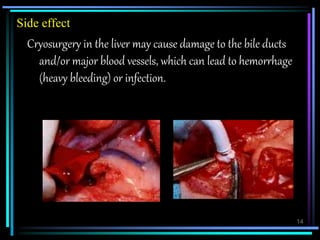
Cryosurgery in the liver may cause damage to the bile ducts
and/or major blood vessels, which can lead to hemorrhage
(heavy bleeding) or infection.
15
skin cancer
Cryosurgery has been used to treat skin lesions for
approximately 100 years.
Benign skin lesions that are suitable for freezing include actinic
keratosis, solar lentigo, seborrheic keratosis, viral wart,
molluscum contagiosum, and Dermatofibroma.
16
Advantages
• Cryosurgery requires little time and fits easily into the physician's
office schedule
• Low risk of infection
• Short recovery times
• Minimal wound care suture removal
• Cryosurgery requires no expensive supplies or
injectable anesthesia.
• Treat AIDS-related Kaposi’s sarcoma when the skin lesions are
small and localized
17
Disadvantage
• Scarring
• Loss of sensation
• Loss of pigmentation
• Loss of hair in the treated area
18
New advantages
• Simple pencil type grip for easy use .
• Very accurate application.
• Freezes to -89ºC and to a depth of 3mm .
• Interchangeable ‘contact’ heads for special applications
including GUM, Podiatry & Dermatology .
• Avoids all of the storage and transport problems associated
with traditional cryotherapy
19
New advantages
• Once a cylinder has been
attached Cryo Alfa can be kept
in a drawer without degradation of the N20 contents for
approximately 3 months .
• Can be easily transported for use in home visits .
• The level of cold generated can be adjusted by the rate at
which the button is depressed.
20
Cervical cryosurgery
• Cervical cryosurgery or cryotherapy is a gynecological
treatment that freezes a section of the cervix.
• Is also used for the treatment of cervicitis or inflammation
of the cervix
21
Cervical cryosurgery
• Cryosurgery is not a treatment for cervical cancer.
22

Cryosurgery & Cryotherapy

  • 1.
  • 2.
  • 3.
    3 Introduction Cryosurgery is atechnique for freezing and killing abnormal cells. • is used to treat some kinds of cancer and some precancerous or noncancerous conditions • can be used both inside the body and on the skin.
  • 4.
  • 5.
    5 cryosurgery Cryosurgery (also calledcryotherapy or cryoablation ) is the use of extreme cold produced by liquid nitrogen (or argon gas) to destroy abnormal tissue.
  • 6.
    6 Brief history The firstcryogens were liquid air and compressed carbon dioxide snow. Liquid nitrogen became available in the 1940s and currently is the most widely used cryogen.
  • 7.
    7 Brief history This methodis being supplanted by liquid nitrogen spray techniques is easy to use, and similar techniques can be employed to manage benign, premalignant, and malignant lesions.
  • 8.
    8 Mechanism of Action Liquidnitrogen or argon gas is circulated through a hollow instrument. The doctor uses ultrasound or MRI to guide the cryoprobe. A ball of ice crystals forms around the probe, freezing nearby cells.
  • 9.
    9 Cryosurgery is analternative to SURGERY for : • Breast • Prostate • Early-stage skin cancers • Precancerous conditions of the cervix • Liver cancer • Colon • Retinoblastoma • Tumors of the bone • Parkinson
  • 10.
    10 Cryotherapy can beused to treat men who have early-stage prostate cancer that is confined to the prostate gland. Long-term outcomes are not known is not used to treat prostate cancer that has .spread outside the gland prostate cancer
  • 11.
  • 12.
    12 side effects These sideeffects may occur more often in men who have had radiation to the prostate : • lack of control over urine flow • Many men become important • In some cases, the surgery has caused injury to the rectum
  • 13.
    13 The tumor anda half inch margin of normal liver are frozen to -190°C for 15 minutes, which is lethal to all tissues. The area is thawed for 10 minutes and then re-frozen to -190°C for another 15 minutes. primary liver cancer
  • 14.
    14 Side effect Cryosurgery inthe liver may cause damage to the bile ducts and/or major blood vessels, which can lead to hemorrhage (heavy bleeding) or infection.
  • 15.
    15 skin cancer Cryosurgery hasbeen used to treat skin lesions for approximately 100 years. Benign skin lesions that are suitable for freezing include actinic keratosis, solar lentigo, seborrheic keratosis, viral wart, molluscum contagiosum, and Dermatofibroma.
  • 16.
    16 Advantages • Cryosurgery requireslittle time and fits easily into the physician's office schedule • Low risk of infection • Short recovery times • Minimal wound care suture removal • Cryosurgery requires no expensive supplies or injectable anesthesia. • Treat AIDS-related Kaposi’s sarcoma when the skin lesions are small and localized
  • 17.
    17 Disadvantage • Scarring • Lossof sensation • Loss of pigmentation • Loss of hair in the treated area
  • 18.
    18 New advantages • Simplepencil type grip for easy use . • Very accurate application. • Freezes to -89ºC and to a depth of 3mm . • Interchangeable ‘contact’ heads for special applications including GUM, Podiatry & Dermatology . • Avoids all of the storage and transport problems associated with traditional cryotherapy
  • 19.
    19 New advantages • Oncea cylinder has been attached Cryo Alfa can be kept in a drawer without degradation of the N20 contents for approximately 3 months . • Can be easily transported for use in home visits . • The level of cold generated can be adjusted by the rate at which the button is depressed.
  • 20.
    20 Cervical cryosurgery • Cervicalcryosurgery or cryotherapy is a gynecological treatment that freezes a section of the cervix. • Is also used for the treatment of cervicitis or inflammation of the cervix
  • 21.
    21 Cervical cryosurgery • Cryosurgeryis not a treatment for cervical cancer.
  • 22.