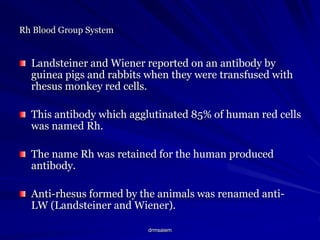
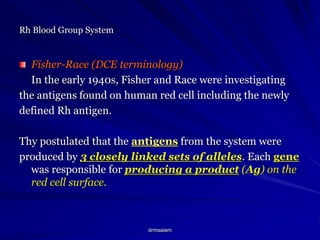
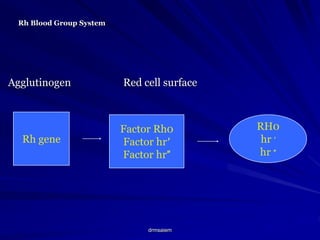
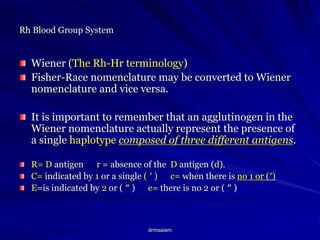
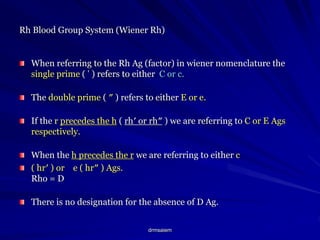
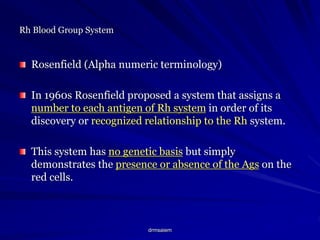
The Rh blood group system is complex, comprising over 50 antigens. It was first described when a woman formed an antibody against her husband's blood after the delivery of their stillborn infant, causing a hemolytic transfusion reaction. The key antigens of the system are D, C, c, E, and e. There are several naming systems for describing Rh phenotypes and genotypes, including those proposed by Fisher-Race, Wiener, Rosenfield, and the ISBT. Rh antigens are proteins embedded in the red blood cell membrane. The D antigen is the most immunogenic. Determining Rh D status is important for blood transfusions and preventing hemolytic disease of the fetus and newborn. Weak D phenotypes exist due to genetic
![drmsaiem
Rh Blood Group System
The term Rh refers not only to a specific red cell antigen
but also to complex blood group system that is currently
comprised on more than 50 different antigenic specificities.
History of the Rh System
Levine and Stetson described a hemolytic transfusion
reaction in an obstetric patient following delivery of
stillborn infant. The women required transfusion. Her
husband, who had the same ABO type, was selected as
her donor, after transfusion the recipient, demonstrated
the classic symptoms of acute hemo]ytic transfusion
reaction.](https://image.slidesharecdn.com/rhbloodgroupsystem6-231110060517-70519748/85/Rh_Blood_Group_System__6-ppt-2-320.jpg)















![Blood group.007[1]](https://cdn.slidesharecdn.com/ss_thumbnails/bloodgroup-140326055444-phpapp01-thumbnail.jpg?width=640&height=640&fit=bounds)


