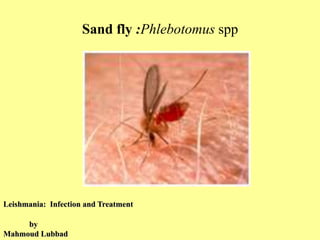
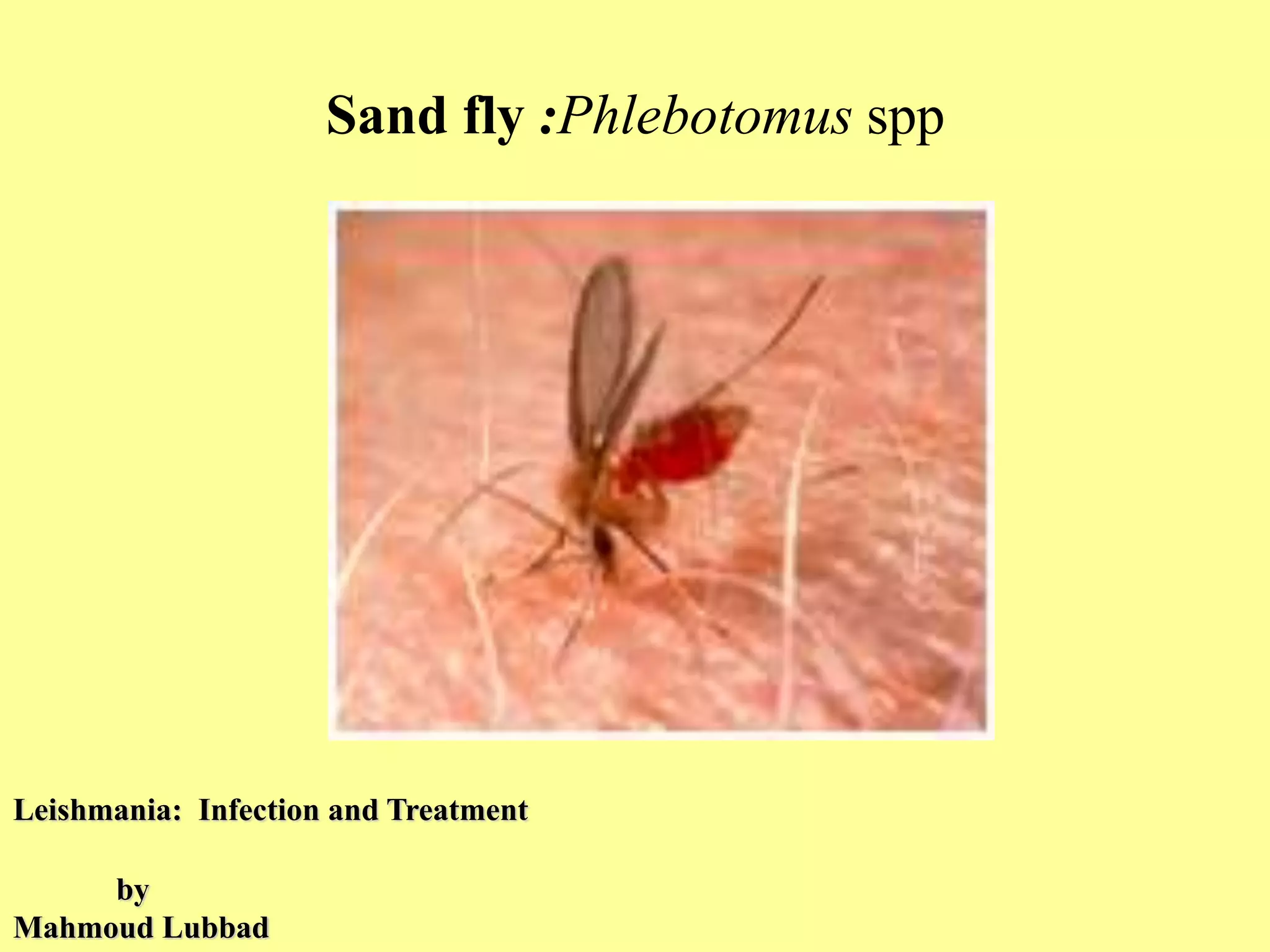
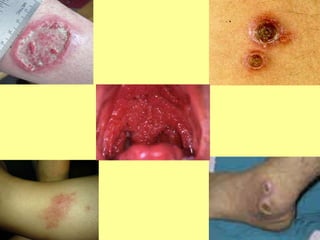
Sand fly :Phlebotomus spp
by
Mahmoud Lubbad
Leishmania: Infection and Treatment
classification of Leishmania
• The leishmaniases include a complex of vector-borne diseases,
caused by more than 20 species of the protozoan genus Leishmania,
and ranging from localized skin ulcers to lethal systemic disease.
Leishmaniasis is classified as one of the "most neglected diseases,"
based on the limited resources invested in diagnosis, treatment and
control, and its strong association with poverty.
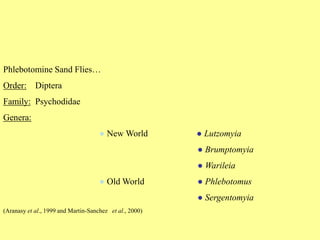
Phlebotomine Sand Flies…
Order: Diptera
Family: Psychodidae
Genera:
● New World ● Lutzomyia
● Brumptomyia
● Warileia
● Old World ● Phlebotomus
● Sergentomyia
(Aranasy et al., 1999 and Martin-Sanchez et al., 2000)
Morphology
• Adults - small (less than 5 mm long) with
conspicuous black eyes, long narrowly obovate
wings that form a V-shaped out line above thorax,
wing veins are parallel to each other ,slender with
piercing mouthparts and long antennae; There are
fine hairs on body, wings and legs.
‫في‬ ‫يتوطن‬ ‫الليشمانيا‬ ‫مرض‬
88
‫وهنالك‬ ‫العالم‬ ‫في‬ ً‫ا‬‫بلد‬
350
‫المصابين‬ ‫عدد‬ ‫ويبلغ‬ ‫لالصابة‬ ‫المعرضين‬ ‫من‬ ‫شخص‬ ‫مليون‬
‫بالمرض‬
14.000.000
‫شخص‬ ‫مليون‬
.
‫الليشمانيا‬ ‫ألمراض‬ ‫الوحيد‬ ‫الناقل‬ ‫هى‬ ‫الرمل‬ ‫ذباب‬ ‫حشرة‬ ‫وتعتبر‬
.
‫حش‬ ‫تنقل‬ ‫كما‬
‫ذبابة‬ ‫رة‬
‫الليشمانيا‬ ‫مرض‬ ‫من‬ ‫أنواع‬ ‫ثالثة‬ ‫الرمل‬
:
•
‫الجلدية‬ ‫الليشمانيا‬
Cutaneous leishmaniasis
•
‫الحشوية‬ ‫الليشمانيا‬
Visceral leishmaniasis
•
‫المخاطية‬ ‫الليشمانيا‬
Mucocutaneous leishmaniasis
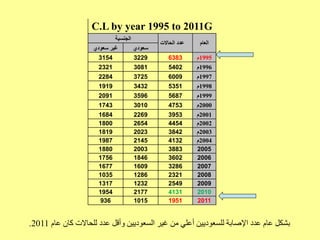
C.L by year 1995 to 2011G
‫العام‬
‫الحاالت‬ ‫عدد‬
‫الجنسية‬
‫سعودي‬
‫سعودي‬ ‫غير‬
1995
‫م‬
6383
3229
3154
1996
‫م‬
5402
3081
2321
1997
‫م‬
6009
3725
2284
1998
‫م‬
5351
3432
1919
1999
‫م‬
5687
3596
2091
2000
‫م‬
4753
3010
1743
2001
‫م‬
3953
2269
1684
2002
‫م‬
4454
2654
1800
2003
‫م‬
3842
2023
1819
2004
‫م‬
4132
2145
1987
2005
3883
2003
1880
2006
3602
1846
1756
2007
3286
1609
1677
2008
2321
1286
1035
2009
2549
1232
1317
2010
4131
2177
1954
2011
1951
1015
936
‫عام‬ ‫كان‬ ‫للحاالت‬ ‫عدد‬ ‫وأقل‬ ‫السعوديين‬ ‫غير‬ ‫من‬ ‫أعلي‬ ‫للسعوديين‬ ‫اإلصابة‬ ‫عدد‬ ‫عام‬ ‫بشكل‬
2011
.
Habits
• Only female sandflies are blood sucker and they are
nocturnal feeders.
• They are poor flier and fly in a characteristic hopping,
30-1000 m, not over 200 m.
• Prevalent from May to September. Larvae survive
through the winter.
Hematophagous diptera(flies) are of two basic types :-
Capillary feeders : mouth parts are inserted into the skin and
blood is withdrawn directly (solenophages) .
Pool feeders : mouthparts short and are used to lacerate the
skin then the blood flow and ingested by the fly (temophages).
Female feed on blood at night.
Sand flies are pool feeder ( telmophages ) which suck blood
from a small wound they make in the skin.
Their bite is therefore relatively painful .
- Sand flies do not produce a buzzing or whining noise before
biting which again reduces the perceived nuisance to man.
-Color of sand flies are brownish in day light , but their
bodies
are densely covered in oily hairs which give them whitish
appearance when illuminated
‫ذكر‬ ‫أنثى‬
Adult male and female sandfly
‫ذكر‬ ‫أنثى‬
Pharynx
Maxillary
palp
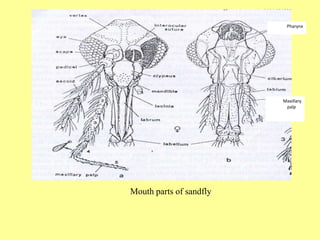
Mouth parts of sandfly
B
A
‫أنثى‬
‫أنثى‬
Phlebotomus
Phlebotomus
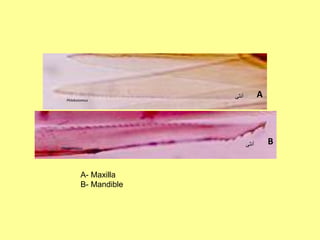
A- Maxilla
B- Mandible
Life cycle (stages)
• Eggs are laid in dark humid animal burrows, cracks
or crevices, or under dead leaves (Egg laid on moist
dark place containing organic debris ( under leaves
on the ground ,in damp mossy place ,in rank
vegetation or on hallow tree trunks ) .
• There are 4 larval instars, the larval stage lasting a
total of 4-6 weeks
• The pupa requires 10 days for development
• LC requires 40-50 days
• Only adult females suck blood
• Adult life span 2-3 weeks, 30-50 eggs/female.
‫ذباب‬
‫الرمل‬
Sand fly
(
Phlebotomas papatasi
)
‫الحياة‬ ‫دورة‬
‫الطبية‬ ‫االهمية‬
:
‫اللشمانيا‬ ‫طفيل‬ ‫منها‬ ‫االمراض‬ ‫لبعض‬ ‫ناقلة‬
‫المختلفة‬ ‫بأنواعها‬
‫الرمل‬ ‫ذباب‬ ‫حمى‬ ‫أو‬ ‫أيام‬ ‫الثالث‬ ‫حمى‬ ‫تنقل‬
‫الهرارا‬ ‫داء‬ ‫حدوث‬ ‫تسبب‬
(
‫حساسية‬ ‫مرض‬
)
- Sand fly bite: The bite in indudurated, inflamed with a
wheal of 1-2 cm. and accompanied by pruritus lasting for
hours or weeks and sometime with systemic allergic reaction
(fever, nausea, malaise swelling of the bitten member).
- Treatment: Topical application of phenolated camphor in
mineral oil or anesthetic ointment.
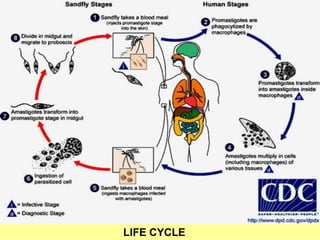
1. Leishmaniasis is transmitted by the bite of female
phlebotomine sandflies. The sandflies inject the infective
stage, promastigotes, during blood meals.
2. Promastigotes that reach the puncture wound are
phagocytized by macrophages.
3.They transform into amastigotes.
4. Amastigotes multiply in infected cells and affect different
tissues.
5. Sandflies become infected during blood meals on an
infected host when they ingest macrophages infected with
amastigotes.
6. In the sandfly's midgut, the parasites differentiate into
promastigotes.
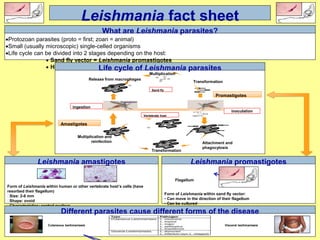
7. They multiply and migrate to the proboscis.
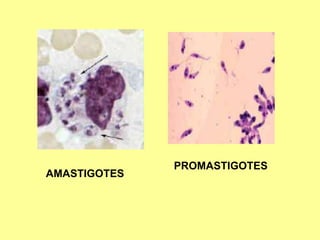
PROMASTIGOTES
AMASTIGOTES
LIFE CYCLE
inoculation
ingestion
Sand fly
Vertebrate host
Transformation
Attachment and
phagocytosis
Multiplication and
reinfection
Release from macrophages
Multiplication
Transformation
Protozoan parasites (proto = first; zoan = animal)
Small (usually microscopic) single-celled organisms
Life cycle can be divided into 2 stages depending on the host:
 Sand fly vector = Leishmania promastigotes
 Human or other vertebrate = Leishmania amastigotes
Leishmania fact sheet
What are Leishmania parasites?
Life cycle of Leishmania parasites
Form of Leishmania within human or other vertebrate host’s cells (have
resorbed their flagellum)
Size: 2-6 mm
Shape: ovoid
Characteristics: central nucleus
Leishmania amastigotes
Different parasites cause different forms of the disease
Flagellum
Form of Leishmania within sand fly vector:
• Can move in the direction of their flagellum
• Can be cultured
Leishmania promastigotes
Amastigotes
Promastigotes
Cutaneous lesihmaniasis Visceral lesihmaniasis
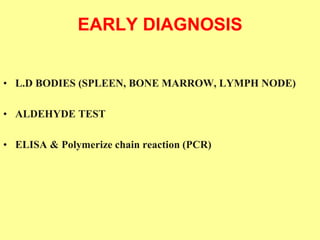
EARLY DIAGNOSIS
• L.D BODIES (SPLEEN, BONE MARROW, LYMPH NODE)
• ALDEHYDE TEST
• ELISA & Polymerize chain reaction (PCR)
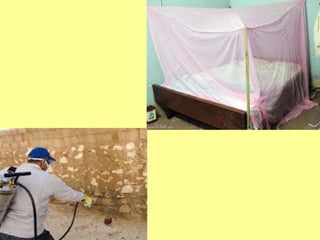
Control
• 1. Elimination of breeding grounds
• 2. Application of insecticides.
• 3. Personal protection. ‫المكافحة‬
:
•
‫الحوائط‬ ‫في‬ ‫والثقوب‬ ‫الشقوق‬ ‫سد‬
•
‫النوافذ‬ ‫على‬ ‫الشبك‬ ‫إستخدام‬
•
‫الذباب‬ ‫طاردات‬ ‫إستخدام‬
•
‫الحشرية‬ ‫المبيدات‬ ‫إستخدام‬
28
Thank you

sandfly_powerpoint_presentation_leishmania_14_oct_2012.ppt

  • 1.
    Sand fly :Phlebotomusspp by Mahmoud Lubbad Leishmania: Infection and Treatment
  • 2.
    classification of Leishmania •The leishmaniases include a complex of vector-borne diseases, caused by more than 20 species of the protozoan genus Leishmania, and ranging from localized skin ulcers to lethal systemic disease. Leishmaniasis is classified as one of the "most neglected diseases," based on the limited resources invested in diagnosis, treatment and control, and its strong association with poverty.
  • 3.
    Phlebotomine Sand Flies… Order:Diptera Family: Psychodidae Genera: ● New World ● Lutzomyia ● Brumptomyia ● Warileia ● Old World ● Phlebotomus ● Sergentomyia (Aranasy et al., 1999 and Martin-Sanchez et al., 2000)
  • 4.
    Morphology • Adults -small (less than 5 mm long) with conspicuous black eyes, long narrowly obovate wings that form a V-shaped out line above thorax, wing veins are parallel to each other ,slender with piercing mouthparts and long antennae; There are fine hairs on body, wings and legs.
  • 5.
    ‫في‬ ‫يتوطن‬ ‫الليشمانيا‬‫مرض‬ 88 ‫وهنالك‬ ‫العالم‬ ‫في‬ ً‫ا‬‫بلد‬ 350 ‫المصابين‬ ‫عدد‬ ‫ويبلغ‬ ‫لالصابة‬ ‫المعرضين‬ ‫من‬ ‫شخص‬ ‫مليون‬ ‫بالمرض‬ 14.000.000 ‫شخص‬ ‫مليون‬ . ‫الليشمانيا‬ ‫ألمراض‬ ‫الوحيد‬ ‫الناقل‬ ‫هى‬ ‫الرمل‬ ‫ذباب‬ ‫حشرة‬ ‫وتعتبر‬ . ‫حش‬ ‫تنقل‬ ‫كما‬ ‫ذبابة‬ ‫رة‬ ‫الليشمانيا‬ ‫مرض‬ ‫من‬ ‫أنواع‬ ‫ثالثة‬ ‫الرمل‬ : • ‫الجلدية‬ ‫الليشمانيا‬ Cutaneous leishmaniasis • ‫الحشوية‬ ‫الليشمانيا‬ Visceral leishmaniasis • ‫المخاطية‬ ‫الليشمانيا‬ Mucocutaneous leishmaniasis
  • 7.
    C.L by year1995 to 2011G ‫العام‬ ‫الحاالت‬ ‫عدد‬ ‫الجنسية‬ ‫سعودي‬ ‫سعودي‬ ‫غير‬ 1995 ‫م‬ 6383 3229 3154 1996 ‫م‬ 5402 3081 2321 1997 ‫م‬ 6009 3725 2284 1998 ‫م‬ 5351 3432 1919 1999 ‫م‬ 5687 3596 2091 2000 ‫م‬ 4753 3010 1743 2001 ‫م‬ 3953 2269 1684 2002 ‫م‬ 4454 2654 1800 2003 ‫م‬ 3842 2023 1819 2004 ‫م‬ 4132 2145 1987 2005 3883 2003 1880 2006 3602 1846 1756 2007 3286 1609 1677 2008 2321 1286 1035 2009 2549 1232 1317 2010 4131 2177 1954 2011 1951 1015 936 ‫عام‬ ‫كان‬ ‫للحاالت‬ ‫عدد‬ ‫وأقل‬ ‫السعوديين‬ ‫غير‬ ‫من‬ ‫أعلي‬ ‫للسعوديين‬ ‫اإلصابة‬ ‫عدد‬ ‫عام‬ ‫بشكل‬ 2011 .
  • 10.
    Habits • Only femalesandflies are blood sucker and they are nocturnal feeders. • They are poor flier and fly in a characteristic hopping, 30-1000 m, not over 200 m. • Prevalent from May to September. Larvae survive through the winter.
  • 11.
    Hematophagous diptera(flies) areof two basic types :- Capillary feeders : mouth parts are inserted into the skin and blood is withdrawn directly (solenophages) . Pool feeders : mouthparts short and are used to lacerate the skin then the blood flow and ingested by the fly (temophages).
  • 12.
    Female feed onblood at night. Sand flies are pool feeder ( telmophages ) which suck blood from a small wound they make in the skin. Their bite is therefore relatively painful .
  • 13.
    - Sand fliesdo not produce a buzzing or whining noise before biting which again reduces the perceived nuisance to man. -Color of sand flies are brownish in day light , but their bodies are densely covered in oily hairs which give them whitish appearance when illuminated
  • 14.
  • 15.
  • 16.
  • 17.
    Life cycle (stages) •Eggs are laid in dark humid animal burrows, cracks or crevices, or under dead leaves (Egg laid on moist dark place containing organic debris ( under leaves on the ground ,in damp mossy place ,in rank vegetation or on hallow tree trunks ) . • There are 4 larval instars, the larval stage lasting a total of 4-6 weeks • The pupa requires 10 days for development • LC requires 40-50 days • Only adult females suck blood • Adult life span 2-3 weeks, 30-50 eggs/female.
  • 18.
    ‫ذباب‬ ‫الرمل‬ Sand fly ( Phlebotomas papatasi ) ‫الحياة‬‫دورة‬ ‫الطبية‬ ‫االهمية‬ : ‫اللشمانيا‬ ‫طفيل‬ ‫منها‬ ‫االمراض‬ ‫لبعض‬ ‫ناقلة‬ ‫المختلفة‬ ‫بأنواعها‬ ‫الرمل‬ ‫ذباب‬ ‫حمى‬ ‫أو‬ ‫أيام‬ ‫الثالث‬ ‫حمى‬ ‫تنقل‬ ‫الهرارا‬ ‫داء‬ ‫حدوث‬ ‫تسبب‬ ( ‫حساسية‬ ‫مرض‬ )
  • 19.
    - Sand flybite: The bite in indudurated, inflamed with a wheal of 1-2 cm. and accompanied by pruritus lasting for hours or weeks and sometime with systemic allergic reaction (fever, nausea, malaise swelling of the bitten member). - Treatment: Topical application of phenolated camphor in mineral oil or anesthetic ointment.
  • 20.
    1. Leishmaniasis istransmitted by the bite of female phlebotomine sandflies. The sandflies inject the infective stage, promastigotes, during blood meals. 2. Promastigotes that reach the puncture wound are phagocytized by macrophages. 3.They transform into amastigotes. 4. Amastigotes multiply in infected cells and affect different tissues. 5. Sandflies become infected during blood meals on an infected host when they ingest macrophages infected with amastigotes. 6. In the sandfly's midgut, the parasites differentiate into promastigotes. 7. They multiply and migrate to the proboscis.
  • 21.
  • 22.
  • 24.
    inoculation ingestion Sand fly Vertebrate host Transformation Attachmentand phagocytosis Multiplication and reinfection Release from macrophages Multiplication Transformation Protozoan parasites (proto = first; zoan = animal) Small (usually microscopic) single-celled organisms Life cycle can be divided into 2 stages depending on the host:  Sand fly vector = Leishmania promastigotes  Human or other vertebrate = Leishmania amastigotes Leishmania fact sheet What are Leishmania parasites? Life cycle of Leishmania parasites Form of Leishmania within human or other vertebrate host’s cells (have resorbed their flagellum) Size: 2-6 mm Shape: ovoid Characteristics: central nucleus Leishmania amastigotes Different parasites cause different forms of the disease Flagellum Form of Leishmania within sand fly vector: • Can move in the direction of their flagellum • Can be cultured Leishmania promastigotes Amastigotes Promastigotes Cutaneous lesihmaniasis Visceral lesihmaniasis
  • 25.
    EARLY DIAGNOSIS • L.DBODIES (SPLEEN, BONE MARROW, LYMPH NODE) • ALDEHYDE TEST • ELISA & Polymerize chain reaction (PCR)
  • 26.
    Control • 1. Eliminationof breeding grounds • 2. Application of insecticides. • 3. Personal protection. ‫المكافحة‬ : • ‫الحوائط‬ ‫في‬ ‫والثقوب‬ ‫الشقوق‬ ‫سد‬ • ‫النوافذ‬ ‫على‬ ‫الشبك‬ ‫إستخدام‬ • ‫الذباب‬ ‫طاردات‬ ‫إستخدام‬ • ‫الحشرية‬ ‫المبيدات‬ ‫إستخدام‬
  • 28.